
International Research Journal of Engineering and Technology (IRJET) e-ISSN: 2395-0056
Volume: 13 Issue: 03 | Mar 2026 www.irjet.net p-ISSN: 2395-0072

International Research Journal of Engineering and Technology (IRJET) e-ISSN: 2395-0056
Volume: 13 Issue: 03 | Mar 2026 www.irjet.net p-ISSN: 2395-0072
Satyam
Kishor Gawali1, Aditya Motiram Pagare1 , Sakshi Ganesh Chaudhari1, Snehal Mohan Patel2
1Department of Computer Engineering, Shatabdi Institute of Engineering and Research, Nashik, Maharashtra, India
2Head of Department, Computer Engineering, Shatabdi Institute of Engineering and Research, Nashik, Maharashtra, India ***
Abstract – Communication between people speaking different languages remains a significant challenge, particularly in environments where reliable internet connectivity is limited. Most existing speech translation systems rely on cloud-based services for speech recognition and machine translation, which introduces network dependency,increasedlatency,andpotentialprivacyconcerns. This paper presents CLVCA (Cross Language Voice Chat Application), an offline real-time speech translation system designed to enable multilingual communication directly on mobile devices. The proposed system integrates speech recognition,on-devicemachinetranslation,andtext-to-speech synthesis to perform end-to-end speech translation without requiring internet connectivity. The system is implemented usingtheFlutterframeworkandutilizeson-devicetranslation models provided by Google ML Kit. A modular architecture consisting of speech processing, translation engine, and conversation management modules enables efficient processingofspokenlanguagewhilemaintaininglowlatency suitableforreal-timeconversations.Experimentalevaluation showsthatthesystemachievesanaveragetranslationlatency of approximately 1–3 seconds for short conversational sentences with an estimated translation accuracy of nearly 95%. The results demonstrate that offline speech translation canbeeffectivelyimplementedonmobiledevices,providinga practical solution for multilingual communication in lowconnectivity environments.
Key Words: Offline Speech Translation, Multilingual Communication, On-Device Machine Learning, Speech Recognition, Text-to-Speech, Flutter, Google ML Kit, Real-Time Communication
Language barriers continue to be a major obstacle to effective communication in multilingual environments. In many real-world situations such as international travel, healthcare services, disaster response, and cross-cultural interactions, people often encounter difficulties communicatingduetodifferencesinlanguage.
Recent advancements in speech recognition and machine translation technologieshave enabledthedevelopment of speechtranslationsystemsthatcanconvertspokenlanguage
from one language to another [1], [2]. However, most existing solutions rely heavily on cloud-based services for speechprocessingandtranslation.Thesesystemsrequirea stable internet connection and may suffer from increased latency,privacyconcerns,andlimitedaccessibilityinregions withpoornetworkconnectivity.
Offline speech translation has emerged as a promising alternative to overcome these limitations. By performing speech recognition and machine translation directly on mobiledevices,offlinesystemscanreducedependencyon cloudinfrastructurewhileimprovingresponsetimeanddata privacy. With the growing computational capabilities of modernsmartphones,ithasbecomefeasibletoimplement real-time speech translation using on-device machine learningmodels[3],[4].
This paper presents CLVCA (Cross Language Voice Chat Application),anofflinereal-timespeechtranslationsystem designedformultilingualcommunicationonmobiledevices. The proposed system integrates speech recognition, ondevicemachinetranslation,andtext-to-speechsynthesisto enable end-to-end speech translation without requiring internetconnectivity.Theapplicationisimplementedusing the Flutter framework and utilizes on-device translation modelsprovidedbyGoogleMLKit[5].
The proposed system follows a modular architecture consisting of speech processing, translation engine, and conversationmanagementcomponents.Thisdesignallows efficient handling of speech input, translation processing, andaudiooutputwhilemaintaininglowlatencysuitablefor conversationalinteractions[6].
Theremainderofthispaperisorganizedasfollows.Section IIpresentstheproblemstatement.SectionIIIdescribesthe system architecture. Section IV explains the proposed methodology. Section V discusses the system implementation.SectionVIevaluatestheperformanceofthe system,andSectionVIIconcludesthepaper.
Communication between individuals speaking different languagesremainsasignificantchallengeinmanyreal-world
International Research Journal of Engineering and Technology (IRJET) e-ISSN: 2395-0056
Volume: 13 Issue: 03 | Mar 2026 www.irjet.net p-ISSN: 2395-0072
situations.Althoughseveralspeechtranslationapplications existtoday,mostsystemsrelyoncloud-basedservicesfor speechrecognitionandmachinetranslation[1],[3],which introduces limitations affecting usability, reliability, and performance.
One of the major limitations of cloud-based speech translationsystemsistheirdependencyonstableinternet connectivity.Inenvironmentssuchasruralareas,disaster zones, remote locations,or duringtravel, reliableinternet accessmaynotalwaysbeavailable.Asaresult,usersmaybe unable to access translation services when they are most needed.
Another challenge is the increased latency introduced by networkcommunication.Speechdatamustbetransmittedto remote servers for processing, and the translated result mustbereturnedtothedevice.Thisprocesscansignificantly delayreal-timeconversation,makingnaturalcommunication difficult[6].
Privacy is also a critical concern. Cloud-based speech translationservicestypicallytransmitaudiodatatoexternal serversforprocessing,whichmayraiseconcernsregarding user data security and confidentiality. In sensitive environmentssuchashealthcare,businesscommunication, orgovernmentoperations,transmittingspeechdataoverthe internetmaynotbedesirable.
Furthermore, many translation systems are designed primarily for text-based input rather than conversational speech. This limitation reduces their effectiveness in realtimeverbalcommunicationscenarios[7].
To address these challenges, there is a need for an offline speech translation system capable of performing speech recognition, machine translation, and speech synthesis directlyonmobiledevices.Suchasystemshouldminimize latency,eliminatedependencyoninternetconnectivity,and preserveuserprivacywhileenablingefficientmultilingual communication.
TheCLVCAsystemisdesignedtoaddressthesechallenges by implementing an offline real-time speech translation frameworkthatoperatesentirelyon-deviceusingmachine learningmodelsoptimizedformobileplatforms.
The CLVCA system is designed using a modular layered architecturetosupportefficientofflinespeechtranslationon mobiledevices.Thearchitectureseparatestheapplication into multiple functional layers, allowing clear interaction between user interface components, processing modules, anddevice-levelservices.
As illustrated in Figure 1, the proposed architecture is composedofmultiplelayersthatcooperatetoperformrealtime speech translation. Such layered architectures are
commonly used in modern speech processing and translation systems to improve modularity and scalability [8].
Thepresentationlayerrepresentsthemobileuserinterface developed using the Flutter framework. This layer allows userstoinitiateconversations,providespeechinput,select source and target languages, and view translated results duringcommunication.
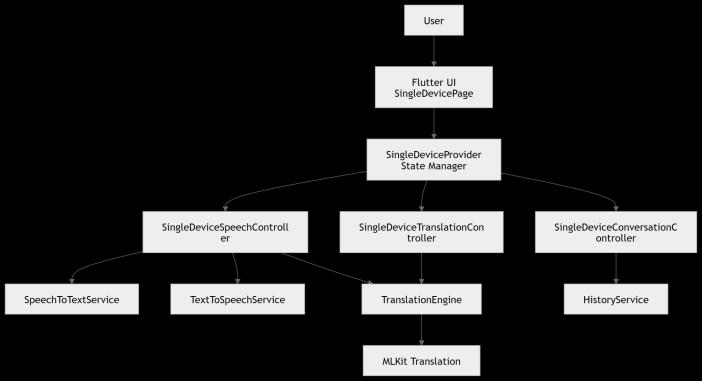
Fig -1:LayeredarchitectureoftheproposedCLVCA offlinespeechtranslationsystem
Thestatemanagementlayermanagesapplicationstateand coordinatescommunicationbetweentheuserinterfaceand internal processing modules. In the proposed system, the Providerstatemanagementapproachisusedtoefficiently manageconversationstatesandtranslationworkflows.
The controller layer acts as the coordination unit of the system. It handles speech input processing, translation requests,andconversationmanagement.Thislayerincludes components such as the speech controller, translation controller,andconversationcontroller.
The service layer contains the core processing modules responsibleforspeechrecognition,machinetranslation,and speechsynthesis.Theseservicesutilizeon-devicemachine learning models provided by Google ML Kit to perform translationwithoutrequiringinternetconnectivity[3],[4].
Finally, the platform layer interacts directly with device hardwareandoperatingsystemservices.Itprovidesaccess tosystemresourcessuchasthemicrophoneforcapturing speechinput,thespeakerforgeneratingaudiooutput,and on-device machine learning libraries used for translation processing.
This modular architecture enables efficient coordination between speech recognition, translation, and speech synthesismodules,allowingthesystemtosupportreal-time multilingualcommunicationwhilemaintaininglowlatency andimprovedperformance.
International Research Journal of Engineering and Technology (IRJET) e-ISSN: 2395-0056
Volume: 13 Issue: 03 | Mar 2026 www.irjet.net p-ISSN: 2395-0072
TheCLVCAsystemperformsofflinespeechtranslationusing amulti-stageprocessingpipelinedesignedtosupportrealtime multilingual communication on mobile devices. The proposed methodology integrates speech recognition, machine translation, and speech synthesis modules operating entirely on-device, thereby eliminating dependency on internet connectivity and reducing translationlatency.
TheoverallspeechtranslationpipelineoftheCLVCAsystem is illustrated in Figure 2. The translation process begins when a user provides speech input through the device microphone.Thecapturedaudiosignalisprocessedbythe speech recognition module, which converts the spoken languageintotextualform[1],[2].
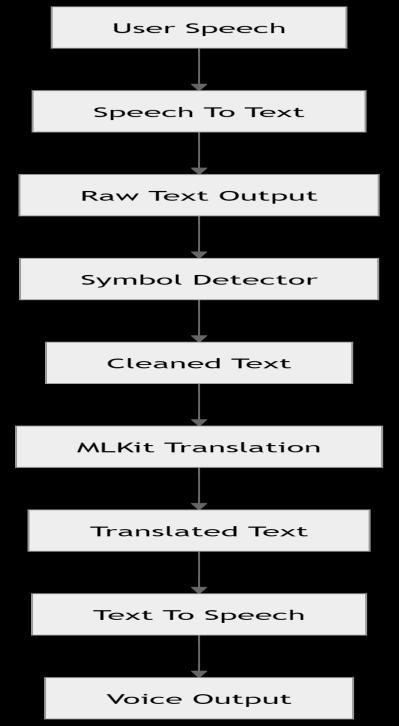
Oncethespeechisconvertedintotext,thegeneratedtextis passed through a preprocessing stage that removes unnecessary symbols and noise. The cleaned text is then forwardedtothetranslationengine.ThesystemutilizesondeviceneuraltranslationmodelsprovidedbyGoogleMLKit to translate the recognized text into the selected target language[3],[9].
After the translation process is completed, the translated textisforwardedtothetext-to-speechmodule.Thismodule generates synthesized speech corresponding to the translatedoutputusingmoderntext-to-speechtechniques [10].Thegeneratedspeechisthenplayedthroughthedevice
speaker,enablingseamlesscommunicationbetweenusers speakingdifferentlanguages.
The internal processing workflow of the CLVCA system is showninFigure3.Thesystemfirstinitializesaconversation session between users. When a user speaks, the speech recognitionmodulecapturestheaudiosignalandconvertsit intotext.
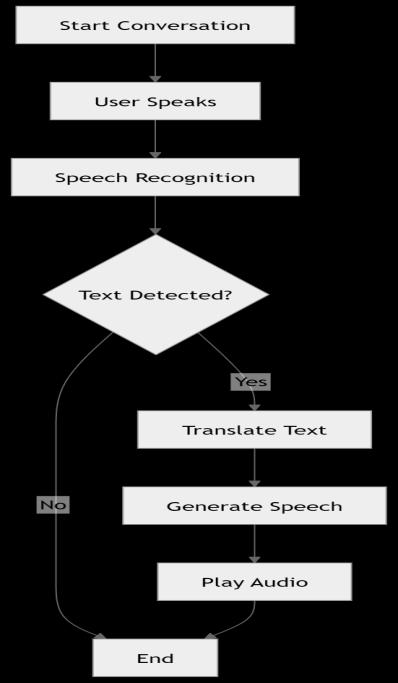
Fig -3:Processingflowofspeechrecognition, translation,andspeechsynthesis
Ifvalidtextisdetected,therecognizedtextisforwardedto the translation engine for language conversion. The translated text is subsequently processed by the text-tospeech module to generate speech output. The generated audioisthenplayedbacktotheuser,completingonecycleof thespeechtranslationprocess.
Thisworkflowiscontinuouslyrepeatedtoenablereal-time multilingual conversations between users.
International Research Journal of Engineering and Technology (IRJET) e-ISSN: 2395-0056
Volume: 13 Issue: 03 | Mar 2026 www.irjet.net p-ISSN: 2395-0072
To further improve translation efficiency and reduce processing latency, the system incorporates a translation cachingmechanism.Thecachingworkflowisillustratedin Figure4.
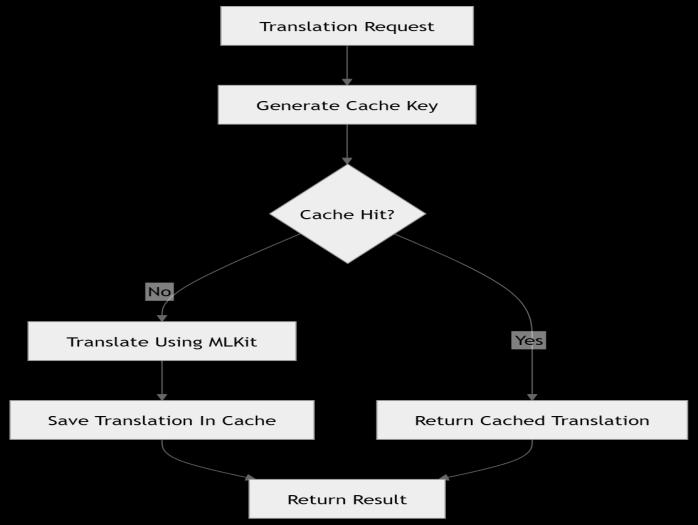
Fig -4:Translationcachingmechanismusedtoreduce repeatedtranslationprocessing
When a translation request is generated, the system first createsauniquecachekeybasedontheinputtextandthe selectedlanguagepair.Thecachestorageisthencheckedto determinewhetherthetranslatedresultalreadyexists. Ifacachehitoccurs,thestoredtranslationisimmediately returnedwithoutinvokingthetranslationengine.Otherwise, the translation is performed using the ML Kit translation model, and the resulting output is stored in the cache for futurerequests.
This caching mechanism significantly reduces repeated translation computations and improves overall system responsiveness during continuous multilingual conversations.
TheCLVCAsystemisimplementedasamobileapplication usingtheFlutterframework.Theimplementationfocuseson enablingofflinereal-timespeechtranslationbyintegrating speech recognition, machine translation, and speech synthesis modules directly on the device. Modern mobile speech processing systems commonly integrate these components to support real-time multilingual interaction [8].
The internal software architecture of the CLVCA system follows a modular design pattern that separates state management, controllers, and service layers. The class structureofthesystemisillustratedinFigure5.
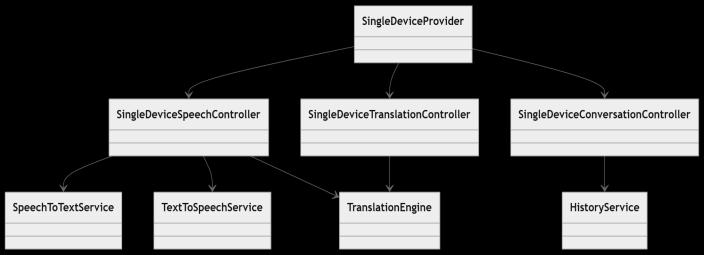
:Classdiagramrepresentingthecorecomponentsof theCLVCAsystem
The central component of the system is the SingleDeviceProvider, which acts as the primary state manager responsible for coordinating communication betweentheuserinterfaceandbackendprocessingmodules. Theproviderinteractswithmultiplecontrollersthathandle specificfunctionalitieswithinthesystem.
The SingleDeviceSpeechController manages speech input and audio output operations. It interacts with the SpeechToTextServicetoconvertspokenlanguageintotext and the TextToSpeechService to generate synthesized speechfromtranslatedtext.
TheSingleDeviceTranslationControllerhandlestranslation requests and communicates with the TranslationEngine module.Thisengineutilizeson-devicemachinetranslation models provided by Google ML Kit to perform translation withoutrequiringinternetconnectivity[3],[4].
The SingleDeviceConversationController manages conversationsessionsandstoresinteractionhistoryusing theHistoryServicecomponent.
Theinteractionbetweensystemcomponentsduringspeech translationisillustratedinFigure6.Thissequencediagram representstheflowofoperationsfromuserspeechinputto translatedaudiooutput.
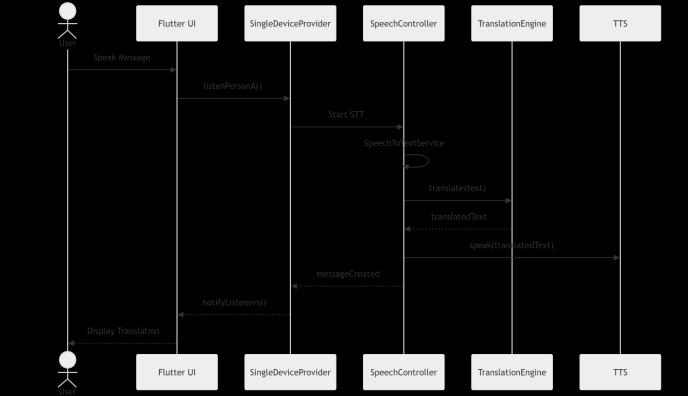
Fig -6:Sequencediagramillustratinginteractionbetween systemcomponentsduringspeechtranslation
International Research Journal of Engineering and Technology (IRJET) e-ISSN: 2395-0056
Volume: 13 Issue: 03 | Mar 2026 www.irjet.net p-ISSN: 2395-0072
Whenauserspeaks,theFlutteruserinterfaceforwardsthe speech input to the SingleDeviceProvider. The provider activatesthespeechcontrollertostartspeechrecognition. Therecognizedtextisthensenttothetranslationenginefor languagetranslation.
Once translation is completed, the translated text is forwarded to the text-to-speech module, which generates audiooutput.Thesynthesizedspeechisthenplayedthrough the device speaker while the translated text is simultaneouslydisplayedontheuserinterface.
This modular implementation approach ensures efficient coordination between system components while maintaining scalability and maintainability of the application.
TheCLVCAapplicationprovidesasimpleandintuitiveuser interfacethatenablesuserstocommunicateusingdifferent languages in real time. The conversation mode interface allows two speakers to interact using speech input and translatedaudiooutput.
The interfaceincludeslanguageselection controls,speech input buttons, and audio playback functionality, allowing userstointeractnaturallyinmultilingualconversations.
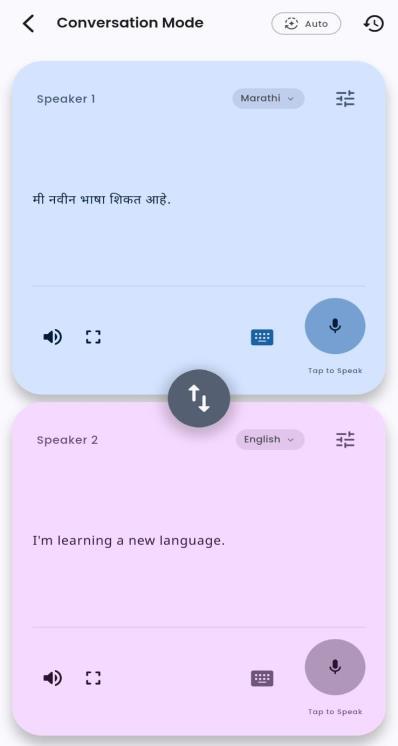
Fig -7:UserinterfaceoftheCLVCAconversationmode demonstratingreal-timeMarathi-to-Englishspeech translation
The performance of the CLVCA system was evaluated to analyzetranslationlatency,systemresponsiveness,andthe effectiveness of the caching mechanism during real-time speech translation. The evaluation was conducted on Android mobile devices with different hardware configurations.
Translationlatencyrepresentsthetimerequiredtoconvert speech input into translated audio output. The CLVCA system performs all processing steps on-device, including speech recognition, machine translation, and speech synthesis.
Experimental observations indicate that the average translationlatencyforshortconversationalsentencesranges between 1 to 3 seconds. This delay includes speech recognitionprocessing,translationexecutionusingMLKit, and speech generation using the text-to-speech engine. Similarlatencycharacteristicshavebeenreportedinrecent speech translation systems based on neural sequence models[6],[9].
To improve performance, the system implements a translation caching mechanism that stores previously translatedsentences.Whenthesamesentenceisrequested again,thesystemretrievesthetranslationdirectlyfromthe cacheinsteadofinvokingthetranslationengine.
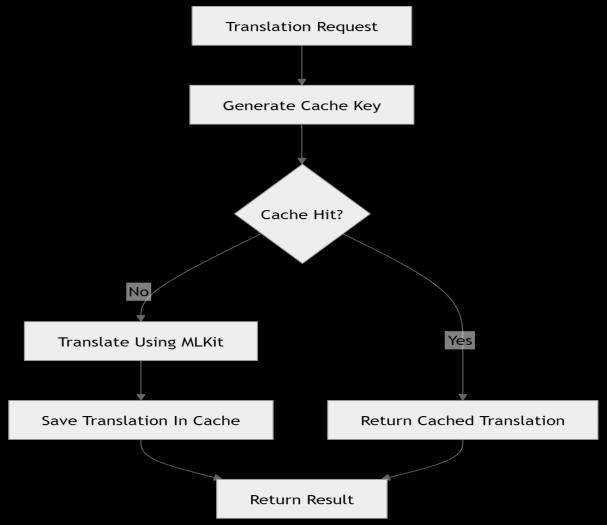
Fig -8:Translationcachingworkflowusedtoreduce repeatedtranslationprocessing
As shown in Figure 8, when a translation request is generated, the system first checks whether the translated result exists in the cache. If a cache hit occurs, the stored translation is immediately returned, reducing translation latencytonearlyzero.Similarcachingstrategieshavebeen
Volume: 13 Issue: 03 | Mar 2026 www.irjet.net
shown to improve performance in multilingual speech processingsystems[7].
The performance of the CLVCA system was tested on multiple device categories to evaluate translation responsivenessacrossdifferenthardwareconfigurations.
Table -1: Translationlatencyacrossdifferentdevice categories
Devices
ms–1.2s
The results indicate that the proposed system performs efficientlyevenonmid-rangeandbudgetmobiledevices.The use of on-device machine learning models combined with cachingoptimizationsignificantlyreducestranslationlatency and improves the overall responsiveness of the system duringmultilingualconversations.
This paper presented CLVCA (Cross Language Voice Chat Application),anofflinereal-timespeechtranslationsystem designedtoenablemultilingualcommunicationdirectlyon mobile devices. The proposed system integrates speech recognition, machine translation, and text-to-speech synthesistoperformend-to-endspeechtranslationwithout relyingoncloud-basedservices.
ThesystemisimplementedusingtheFlutterframeworkand utilizes on-device machine learning models provided by Google ML Kit for translation processing. By performing speechrecognitionandtranslationdirectlyonthedevice,the proposed approach eliminates dependency on internet connectivity while improving data privacy and reducing communicationlatency.
Experimentalevaluationshowsthatthesystemachievesan averagetranslationlatencyofapproximately1–3secondsfor short conversational sentences. The integration of a translation caching mechanism further improves system efficiency by reducing repeated translation computations and minimizing processing delays during continuous conversations.
The modular architecture of the CLVCA system enables efficient coordination between speech recognition, translation, and speech synthesis modules. The results demonstratethatofflinespeechtranslationcanbeeffectively implemented on modern mobile devices, providing a
2395-0072
practicalsolutionforreal-timemultilingualcommunication in environments with limited or unreliable internet connectivity.
Futureworkwillfocusonimprovingtranslationaccuracyfor complex sentences, expanding language support, and integrating peer-to-peer device communication to enable cross-device multilingual conversations without requiring internetconnectivity.
[1] G.Hinton,L.Deng,andD.Yu,“Deepneuralnetworksfor acoustic modeling in speech recognition,” IEEE Signal ProcessingMagazine,2012.
[2] A. Graves, A.-r. Mohamed, and G. Hinton, “Speech recognitionwithdeeprecurrentneuralnetworks,”IEEE International Conference on Acoustics, Speech and SignalProcessing,2013.
[3] D. Bahdanau, K. Cho, and Y. Bengio, “Neural machine translation by jointly learning to align and translate,” InternationalConferenceonLearningRepresentations (ICLR),2015.
[4] I. Sutskever, O. Vinyals, and Q. V. Le, “Sequence to sequencelearningwithneuralnetworks,”Advancesin NeuralInformationProcessingSystems,2014.
[5] K. Cho, B. Merrienboer, and C. Gulcehre, “Learning phraserepresentationsusingrnnencoder–decoderfor statisticalmachinetranslation,”EMNLP,2014.
[6] R. Weiss, J. Chorowski, and N. Jaitly, “Sequence-tosequencemodelscandirectlytranslateforeignspeech,” INTERSPEECH,2017.
[7] S.BansalandH.Kamper,“Lowresourcespeech-to-text translation,” IEEE Spoken Language Technology Workshop,2018.
[8] W.Chan,N.Jaitly,andQ.Le,“Listen,attendandspell:A neural network for large vocabulary conversational speechrecognition,”IEEEInternationalConferenceon Acoustics,SpeechandSignalProcessing,2016.
[9] C. Wang et al., “Speech-to-text translation without speech recognition,” ACL Conference on Empirical MethodsinNaturalLanguageProcessing,2020.
[10] P. Taylor, “Text-to-speech synthesis,” Cambridge UniversityPress,2009.