
International Research Journal of Engineering and Technology (IRJET) e-ISSN: 2395-0056
Volume: 13 Issue: 02 | Feb 2026 www.irjet.net p-ISSN: 2395-0072
International Research Journal of Engineering and Technology (IRJET) e-ISSN: 2395-0056
Volume: 13 Issue: 02 | Feb 2026 www.irjet.net p-ISSN: 2395-0072
Shishir A. Bagal1 , Ajay Shahare2, Sakshi Shinde3, Shubham Borikar4, Harshal Ghatbandhe5
1Assistant Professor, Department of Electronics & Tele. Engineering, KDK College of Engineering, Nagpur (Maharashtra), India
2Final Year Student, Department of Electronics & Tele. Engineering, KDK College of Engineering, Nagpur (Maharashtra), India
3Final Year Student, Department of Electronics & Tele. Engineering, KDK College of Engineering, Nagpur (Maharashtra), India
4Final Year Student, Department of Electronics & Tele. Engineering, KDK College of Engineering, Nagpur (Maharashtra), India
5Final Year Student, Department of Electronics & Tele. Engineering, KDK College of Engineering, Nagpur (Maharashtra), India ***
Abstract - Modern farming is becoming smarter, and the core goal of this project is to give farmers a powerful, cloud-based tool to make that shift easy and effective. Think of this system as a dedicated, digital assistant for the soil itself.
Farmers today need precise, minute-by-minute insights, not guesswork. That's why we're planting smart sensors directly in the fields. These sensors are constantly checking the soil's vital signs: its moisture level, temperature, pH balance, and key nutrients.
This real-time data is instantly beamed up to the cloud. Once there, clever software analyzes everything, transforming raw numbers into clear, actionable advice. Suddenly, farmers have the power to make perfectly informed decisions: they know exactly what crop to plant, the precise moment to turn on the irrigation, how much water is truly needed, and the minimum amount of fertilizer required for a healthy yield.
The system is also proactive. If a condition suddenly goes wrong say, the soil dries out too quickly or the pH balance swings wildly the farmer gets an instant alert right on their phone or tablet. This guarantees they can fix a problem before it hurts the crop.
Ultimately, this isn't just about high-tech gadgets; it's about sustainability and efficiency. By using water and fertilizer only when and where it's
absolutely necessary, the system saves the farmer money, cuts down on tedious manual testing, and protects the environment from unnecessary waste. By collecting and storing years of soil history, it also helps farmers learn and improve their methods season after season.
Keywords: Crop prediction, Wi-Fi Module (ESP32), NPK Sensor, Moisture Sensor, DHT-11 Sensor.
The future of agriculture demands a decisive shift away from traditional, intuition-based farming practices toward data-driven and technology-enabled solutions [1]. Global challenges such as increasing food demand, shrinking cultivable land, climate change, soil erosion, andnutrientdepletionareplacingimmense pressureon existing agricultural systems. Conventional farming methods, which often rely on experience, manual observation, and periodic soil testing, are no longer sufficient to handle modern challenges such as unpredictable rainfall, prolonged droughts, pest infestations, uneven crop yields, and inefficient use of water and fertilizers [2] . These issues not only reduce productivity but also threaten long-term soil health and environmentalsustainability[3].
To address these challenges, this project proposes a cloud-based, real-time soil monitoring and crop management platform that functions as a digital assistant for farmers. The system is designed to provide continuous, accurate, and actionable insights into soil and environmental conditions, enabling informed decision-makingateverystageofcropcultivation[4].By integrating Internet of Things (IoT) technologies, cloud computing, and machine learning, the platform transforms raw field data into meaningful recommendationsthatsupportprecisionagriculture[5].
At the core of the system is a network of IoT-based sensors deployed directly in agricultural fields. These sensors continuously measure critical soil and environmental parameters, including soil moisture, temperature, electrical conductivity, and essential macronutrients such as nitrogen (N), phosphorus (P), and potassium (K) [6]. Additional parameters such as humidity and weather-related data are incorporated through external weather APIs. Together, these measurements provide a high-resolution, real-time view
International Research Journal of Engineering and Technology (IRJET) e-ISSN: 2395-0056
Volume: 13 Issue: 02 | Feb 2026 www.irjet.net p-ISSN: 2395-0072
of soil health and growing conditions that far surpasses thecapabilitiesoftraditionaltestingmethods[7].
The sensor data collected in the field is processed by a microcontroller, which performs initial validation and formatting before transmitting the information wirelessly to the cloud using Wi-Fi or similar communication modules. This ensures minimal delay between data collection and analysis. Once transmitted, the data is securely stored on a cloud platform, where it becomes available for real-time monitoring, visualization,andadvancedanalysis[8].
Within the cloud environment, sophisticated machine learning algorithms analyze the incoming data to assess soil health and crop suitability [9]. These algorithms compare real-time sensor readings against scientific benchmarks, historical datasets, and crop-specific requirements [10]. By identifying patterns and deviations,thesystemcandetectearlysignsofproblems such as moisture stress, nutrient deficiencies, soil salinity issues, or temperature extremes. When critical thresholds are crossed, the platform automatically triggersreal-timealertsthataredelivereddirectlytothe farmer’s mobile device through SMS or application notifications.Thisimmediatefeedbackallowsfarmersto takeswiftcorrectiveaction suchasinitiatingirrigation, adjusting fertilizer application, or modifying crop management strategies before significant damage occurs[11].
Beyond real-time monitoring and alerts, the system provides advanced predictive analytics capabilities. By combining historical soil data, current sensor readings, seasonal trends, and real-time weather forecasts, the platform generates personalized recommendations tailoredtospecificcropsandfieldconditions[12].These recommendations include optimal irrigation schedules, precise fertilizer dosages, suitable sowing times, and crop selection guidance. Unlike one-size-fits-all advisory systems, this platform adapts its suggestions to local conditions, soil characteristics, and cropping patterns, making it suitable for both single-crop and multi-crop farmingscenarios.
A key advantage of the proposed system is its ability to archiveallcollecteddatasecurelyinthecloud.Thislongterm data storage enables farmers and agricultural experts to analyze seasonal variations, monitor soil health over multiple years, evaluate the impact of farming decisions, and plan future cultivation strategies more effectively . The availability of historical data also supports continuous improvement of machine learning models, allowing the system to become more accurate andreliableovertime.
From a scalability perspective, the cloud-based architecture ensures that the system can be easily expanded to accommodate additional sensors, larger
farmareas,ormultipleuserswithoutsignificantchanges totheunderlyinginfrastructure.Thismakesthesolution suitable for individual farmers, large farms, and agricultural cooperatives alike. The modular design also allows future integration of advanced features such as automated irrigation control, pest prediction models, andsatelliteimageryanalysis.
Ultimately, this project represents a significant step towardsmart,sustainable,andprofitableagriculture.By replacing guesswork with precise, data-driven insights, the system helps farmers optimize resource usage, reduce water and fertilizer wastage, lower operational costs, and improve crop yields. At the same time, it promotes environmental conservation by encouraging responsible use of natural resources and maintaining long-term soil health. As global agricultural challenges continue to intensify, such intelligent, cloud-based solutionswillplayacrucialroleinensuringfoodsecurity and supporting the transition to sustainable farming practices.
Recent innovations in smart agriculture focus on creating powerful, cloud-based systems that provide precision crop management and real-time alerts to farmers,helpingtoincrease yieldswhilereducingwaste through sustainable practices [1]. Researchers are developing sophisticated IoT-based soil monitoring systems that use sensors to measure critical field conditions such as moisture, pH, temperature, and nutrient levels [7]. Typically, a microcontroller (such as an Arduino or NodeMCU) collects this sensor data and transmits it wirelessly oftenvia Wi-Fi,GSM,orLoRa to a cloud platform (for example, AWS IoT, Firebase, or ThingSpeak),whichservesasthecentralhubforstoring, analysing, and visualizing the information [8]. This arrangement enables farmers to continuously monitor thehealthoftheirfieldsfromremotelocations[9].
A key feature highlighted in many studies is the automated alert system. In this approach, the cloud platform is configured with ideal threshold values for soil parameters; if any reading moves outside the defined limits, the system immediately sends an SMS notificationtothefarmer’sphone[11].
As a result, farmers can take quick corrective actions such as starting irrigation or adjusting fertilizer application even when they are far from the field. Our proposed project builds on these proven approaches by delivering a fully integrated and scalable platform that combinescontinuoussensormonitoring,advancedcloud analytics, and instant SMS alerts. This ensures that farmers have effective tools for timely decision-making, optimal resource utilization, and maximized crop yield [12].
International Research Journal of Engineering and Technology (IRJET) e-ISSN: 2395-0056
Volume: 13 Issue: 02 | Feb 2026 www.irjet.net p-ISSN: 2395-0072
The system is designed to act as a bridge between the physical environment of the farm and the digital intelligence of modern computing [1],[2]. This process begins with "listening to the land" through a network of strategically placed sensors that monitor real-time soil chemistry and environmental fluctuations . Rather than relying on static or historical data, we capture the living soil of the farm measuring variables such as moisture levels, pH balance, and local weather patterns to ensure the foundation of our analysis is as accurate as possible[3].
3.1Components Used:
1. Arduino UNO:
Acts as the main microcontroller that collects data from all sensors, processes it, and sends it to the cloudforanalysis.
2. Soil Moisture Sensor:
Measures the moisture level in the soil, helping to determine whether irrigation is required and how muchwaterthesoilneeds.
3. pH Sensor:
Detects the acidity or alkalinity of the soil, which is crucial for identifying soil health and selecting suitablecropsforcultivation.
4. Temperature & Humidity Sensor (DHT11/DHT22):
Monitors ambient temperature and humidity, providing environmental data that influences soil moistureandplantgrowth.
5. Wi-Fi Module (ESP8266):
Enables wireless communication between the Arduino and the cloud platform, allowing real-time data transmissionandremotemonitoring.
6. Power Supply (5V/9V):
Providestherequiredelectricalpowertoallsensorsand the microcontroller, ensuring stable and continuous systemoperation.
7. Cloud Platform (ThingSpeak / Blynk / AWS IoT):
Stores and visualizes the collected sensor data, enabling real-time monitoring, data analytics, and decision-making for better crop and irrigation management.
3.2Data Collection & Signal Processing:
ThesystemusesArduinoUNOasthemaincontrolunit.
ASoilMoistureSensorisplacedinthefieldtomeasure thewatercontentinthesoil.
ApHSensorisusedtomeasuretheacidityoralkalinity ofthesoil.
A Temperature & Humidity Sensor (DHT11/DHT22) monitorsenvironmentalconditionsaroundthecrops.
Allsensorscontinuouslycollectreal-timedatafromthe field.
The collected sensor signals are sent to the Arduino UNO.
Analog signals from the soil moisture and pH sensors areconvertedintodigitalformusingtheArduino’sbuiltinADC.
TheDHT11/DHT22providesdigitaldatadirectlytothe Arduino.
The Arduino filters noise and removes incorrect or unstablereadings.
The processed data is formatted in a simple structure. Data is transmitted wirelessly using the Wi-Fi Module (ESP8266).
Throughtheinternet,data issenttothecloudplatform (ThingSpeak / Blynk / AWS IoT).Based on the cloud analysis,alertsandupdatesaredeliveredtothefarmer
3.3Block Diagram:
Sensorinfield soilmoisture, pH, Temperaturesensor
Fig -1: BlockDiagramofSystem
International Research Journal of Engineering and Technology (IRJET) e-ISSN: 2395-0056
Volume: 13 Issue: 02 | Feb 2026 www.irjet.net p-ISSN: 2395-0072
3.4Algorithm Development:
It checks whether the sensor readings are correct and comparesthemwithpredefinedlimits.Basedonthis,the system will identify normal and abnormal soil conditions. Machine learning models are being added to supportcroppredictionandrecommendations.
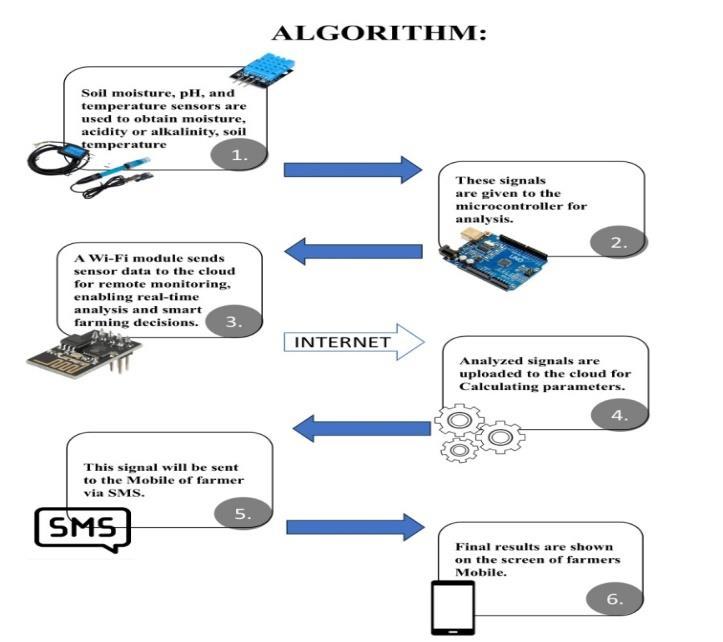
Fig -2:AlgorithmofSystem
3.5System Integration:
The system is designed for efficient real-time data processinganddisplay.UsingtheESP8266Wi-Fimodule, sensordataissentinstantlytothecloudforlivetracking. This information is then presented through a mobile dashboard, allowing farmers to check their soil and environmentalconditionsataglance.
3.6Testing & Validation:
The soil moisture sensor is checked and adjusted by comparing its readings with a trusted moisture measuringdevicetomakesureitgivescorrectvalues.
ThepHsensoristestedusingstandardsolutionssoitcan accuratelydetectwhetherthesoilisacidicoralkaline.
Thesystemistriedondifferenttypesofsoil,suchas sandy,clay,andloamysoil,toconfirmthatitworks reliablyinallconditions.
Tests are carried out under different moisture and pH levels to ensure the system provides consistent and dependableresults.
The project aims to develop a cloud-based system that cancontinuouslymonitorsoilandfieldconditionsinreal
time. Once implemented, the system is expected to accurately collect important soil and environmental information such as moisture level, pH value, temperature,andhumidityusingIoTsensorsinstalledin the agricultural field. These readings will be processed by the Arduino UNO and sent wirelessly to the cloud using the ESP8266 Wi-Fi module. The cloud platform will securelystore the data andpresentitthrough easyto-understand graphical dashboards, helping farmers clearlyviewandunderstandfieldconditions.
The backend system is expected to handle data storage and retrieval while allowing farmers and analysts to review past records for improved decision-making. Machinelearningmodelsintegratedintothesystemwill analyze both real-time and historical data to provide basiccroprecommendationsandirrigationsuggestions.
An alert system will also be included to inform farmers via SMS or mobile notifications whenever critical conditions such as low soil moisture, unusual pH levels, or extreme temperatures occur. Overall, the system is expected to reduce manual soil testing efforts, improve theefficientuseofresources,increasecropproductivity, and support farmers in moving toward smart and sustainable farming practices once the project is fully completed.
This project is designed to understand soil health and helpfarmerschoosetherightcropsfortheirland.Todo this, soil samples were collected from different farms and tested for important nutrients such as pH, soil EC, phosphorus, potassium, urea, TSP, and MOP, along with moisture and temperature. Sensors and simple soil testing methods were used to get real-time and manual readings. These values were then compared with recommendedlimitstocheckwhetherthesoilishealthy orneedsimprovement.Farmersandagriculturalexperts were also consulted to understand crop needs and confirm the results. Using this information, the system analyses soil nutrients and uses machine learning to suggest the most suitable crops for better and more efficientfarming.
Volume: 13 Issue: 02 | Feb 2026 www.irjet.net p-ISSN: 2395-0072
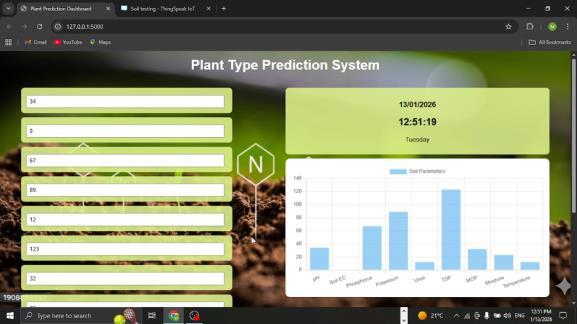
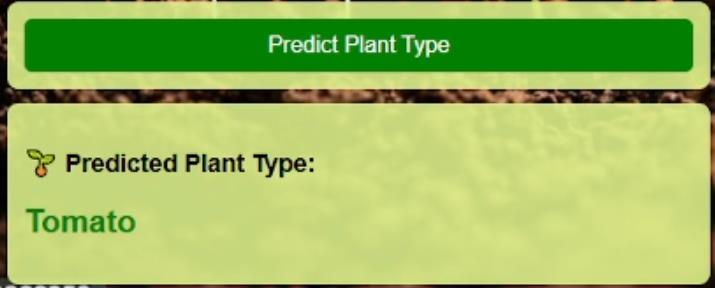
We studied the soil needs of different crops and set suitable value ranges for each one. These values were decided by understanding farming practices, expert suggestions, and real soil conditions. For every crop, specific limits were set for pH, moisture, temperature, andnutrientslikephosphorusandpotassium.Thishelps thesystemcomparethesoildatawithcroprequirements andsuggestthebestcropsforplanting.
Once the software was fully ready, initial testing was done to check how well the system works in real situations. The software was tested using real and sample soil data to see if it correctly measures soil nutrients like pH, EC, moisture, temperature, phosphorus, potassium, urea,TSP, andMOP. The results shownbythesystemwerecomparedwithbasicsoiltest valuestomakesuretheywereaccurate.Thistestingalso helpedconfirmthatthesystemcancorrectlyunderstand soilconditionsandsuggestsuitablecropsforfarming.
Now that the software testing is complete, the next step is hardware development and primary testing. During this phase, all required sensors and hardware components will be assembled and integrated with the system.Eachsensorwillbetestedindividuallytoensure itisworkingproperlyandgivingcorrectreadingsforsoil parameters such as pH, EC, moisture, temperature, and nutrientlevels.Thehardwaresetupwillalsobetestedas a whole to confirm smooth communication between sensors and the software. This primary testing helps identifyanyhardwareissuesearlyandensuresaccurate andreliabledatacollectionforfurtheranalysis.
Building this platform has been about more than just hardware and code; it is about giving the land a voice. By creating a digital bridge between the soil and the cloud,wehavemovedfromaworldoffarmingbasedon “gut feeling” to one guided by clear, real-time intelligence. At a time when climate change and soil fatigue are making every season more unpredictable, this technology provides a much-needed layer of securityforthepeoplewhofeedus.
So far, we have turned this vision into reality. We have successfully deployed sensors that act as a constant “pulse” for the farm, monitoring moisture, pH, and temperature with a level of detail that traditional soil tests simply cannot match. Because this data flows instantlytothecloud,farmerscannowdetectaproblem the moment it begins rather than waiting weeks for a lab report. Our early work with machine learning has also shown that we can do more than just observe the soil wecanpredictitspotential,helpingfarmersselect the crops most likely to thrive in their specific conditions.
Aswemoveoutofthelabandintorealfields, ourfocus is on making this system as robust and reliable as the farmerswhowilldependonit.Thismeansensuringthat the hardware can withstand harsh environmental conditions and that our SMS alerts never miss a beat, even in remote areas. We are not simply trying to add more technology to the farm; we aim to remove the stress of uncertainty. By reducing wasted water and fertilizer,wesupportenvironmentalsustainabilitywhile alsoimprovingfarmprofitability.
Ultimately, this project is our contribution to a more sustainable future. By replacing guesswork with datadriven confidence, we are empowering farmers to produce more with fewer resources. As we continue refiningourAIandexpandingourreach,webelievethis platformwillbecomeanessentialtoolforprotectingsoil health and ensuring food security for generations to come.
[1]. IoT-Enabled Real-Time Crop Prediction System usingSoilFertilityAnalysis
Published in MDPI journals Integrates IoT sensor data with cloud and machine learning for crop suitabilityandsoilanalysisinrealtimeIoT-EnabledSoil andCropMonitoring.
[2]. Smart farming for a sustainable future: implementing IoT-based systems in precision agriculture
International Research Journal of Engineering and Technology (IRJET) e-ISSN: 2395-0056
Volume: 13 Issue: 02 | Feb 2026 www.irjet.net p-ISSN: 2395-0072
Bulletin of the National Research Centre (2025) Covers real-time soil and weather monitoring with mobileaccessandcloudintegration.
[3]. Dhananjay Kumar, and Sakshi Balyan, “Soil Health and Nutrient Management” October 2025, at: https://www.researchgate.net/publication/396228868
[4].IoTBasedSmartAgricultureMonitoringSystem
Prof. M. D. Chavan et al. IoT sensors monitor soil parameters and send real-time data to a cloud platform forirrigationanddecision-making.
[5]. System Using Low-Cost Smart Sensors for Precision Agriculture
MDPI Real-time monitoring of soil moisture, temperature,humidity,anduploadtocloudwithalerts.
[6]. Smart Sensing Technologies for Real-Time Monitoring of Soil Health in Precision Agriculture JournalofAppliedOptics(2024)
[7].Reviewofsmartsensingtechnologiesforsoilhealth andreal-timedatasystems.
An IoT-based soil analysis system using optical sensors andmultivariateregression
International Journal of Experimental Research and Review Real-time soil parameter sensing with cloud uploadandvisualization.
[8]. A Study of Cloud-Enabled Deep Learning for MonitoringandPredictingSoilHealthinAgriculture
Journal of Remote Sensing & GIS (2025) Combines cloud computing and AI for real-time soil health analysis.
[9].PrecisionAgricultureRevolution:IntegratingDigital TwinsandCropRecommendationforOptimalYield
ArXiv preprint (2025) Uses real-time soil data and digitalsimulationtomanagecropgrowth.
[10]. Smart Soil Fertilizer Monitoring and Crop RecommendationSystem
M.Sunandinietal.,IJERT(2023) Soilnutrientsensors withIoTandcloud databasetorecommendcropsusing machinelearning.
[11]. Yuliyanto, Supriadi Sahib, Taufik Imran, Andriansyah OktafiandiArisha and Munawirah, “Crop Recommendation Based on Soil and WeatherConditions Using the K-Nearest Neighbors Algorithm ” July 2025, DOI:https://doi.org/10.61628/jsce.v6i3.1955
[12]. Dattarao Bhise, manish Kharat, Rushikesh Bhusari and Ashutosh Kumar, “Soil Management and nutrient Requirement for Horticultural Crops”, June 2025 at: https://www.researchgate.net/publication/392708103
[13]. Vishal Singh1, Yogesh Kumar2*, Pravind Yadav1 and Nitima Singh1 “The dynamic relationship between soil testing and crop response”, December 2024, at: https://www.researchgate.net/publication/386329915
[14].Thilakarathne,B.,Bakar,M.F.,Abas,Z.,&Yassin,M. “Towardsmakingthefieldstalk:Areal-timecloud enabledIoTcropmanagementplatformforsmart agriculture”<JournalDetails>