
International Research Journal of Engineering and Technology (IRJET) e-ISSN: 2395-0056
Volume: 13 Issue: 01 | Jan 2026 www.irjet.net p-ISSN: 2395-0072
International Research Journal of Engineering and Technology (IRJET) e-ISSN: 2395-0056
Volume: 13 Issue: 01 | Jan 2026 www.irjet.net p-ISSN: 2395-0072
Vivek Chandra Joshi
Department of Electrical Engineering Regional College for Education Research & Technology, Jaipur
Abstract - The increasing deployment of solar photovoltaic (PV) systems has intensified the need for efficient DC–DC converters capable of boostingtheinherentlylowandvariable output voltage of PVmodules. Conventionalstep-upconverters often face challenges such as limited voltage gain, increased component stress,andreducedefficiencywhenoperatedunder high-gain conditions. To address these issues, a wide range of high-gain DC–DC converter topologies and intelligent control techniques have been explored in recent years.
This review paper presents a comprehensive performance analysis of high-gain DC–DC converters used in solar PV applications, with particular emphasis on fuzzy logic control–based strategies. Various converter structures, including boost-derived, switched-capacitor, Luo,coupled-inductor,and cascaded configurations, are examined and compared based on voltage gain, efficiency, dynamic response, and suitability for maximum power point tracking. The role of fuzzy logic control in enhancing system robustness under varying irradiance and load conditions is also discussed. Key challenges, limitations, and future research directions are identified to support the development of reliable and efficient PV power conversion systems.
Key Words: High-gain converters, Solar PV, Fuzzy logic control, DC-DC converter, MPPT, Renewable energy.
Therapiddepletionoffossilfuelsandincreasingconcerns overglobalclimatechangehaveacceleratedtheadoptionof renewable energy resources worldwide. Among all renewable options, solar photovoltaic (PV) energy has gained significant importance due to its abundance, modularity,andenvironmentallyfriendlynature[1].Reports from the International Energy Agency (IEA) indicate that globalsolarPVcapacityexceeded1.5TWby2023,anditis projected to account for nearly 22% of global electricity generationby2050[2].Despitethistremendousgrowth,PV systemsfacetechnicalchallenges,primarilybecauseoftheir low output voltage, nonlinear characteristics, and dependencyonenvironmentalconditionssuchasirradiance andtemperature[3].
Conventional converters like Boost, SEPIC, and Cuk are widelyusedduetotheirsimplicity,buttheirperformance degradeswhenveryhighvoltagegainisrequired.Atlarge dutycyclestheyencountergreaterconductionandswitching
losses,significantstressonsemiconductors,andefficiency degradation[4],[5].Forinstance,theefficiencyofaclassical boostconverterdropssignificantlywhenoperatedatduty cycles above 0.7 due to parasitic resistance and switching stress[6].
Toovercomethesedrawbacks,researchershavedeveloped high-gainconvertertopologiessuchasSwitchedCapacitor (SCC),Luo,CoupledInductor,andCascadedBooststructures. These converters achieve higher voltage gains without extreme duty cycles, making them more suitable for PV integration[7].Nevertheless,thecontrolstrategyemployed plays a critical role in determining their real-time performance.ConventionalProportional-Integral-Derivative (PID) controllers, although widely used, often fail under fluctuating solar conditions due to their dependency on accuratemathematicalmodels[8].
In contrast, Fuzzy Logic Control (FLC) has received considerable research attention as a robust alternative. Unlike PID, FLC does not require an exact mathematical system model and can effectively handle nonlinearities, parametervariations,anduncertainties[9].Severalstudies havedemonstratedthatFLC-basedconvertersachievefaster MaximumPowerPointTracking(MPPT),loweroscillations, and higher efficiency under partial shading or rapidly changingirradiancecomparedtoconventional controllers [10],[11].Moreover,FLCcanbeeasilyextendedtohybrid schemessuchasFLC-ANN(ArtificialNeuralNetwork)and FLC-PSO (Particle Swarm Optimization) for further performanceenhancement[12].
Inthiscontext,thepresentworkprovidesacomprehensive reviewofhigh-gainDC–DCconvertersintegratedwithFLC techniquesforsolarPVsystems.Themaincontributionsof thispaperaresummarizedasfollows:
1.Adetailedcomparisonofhigh-gainconvertertopologies (Boost, SCC, Luo, Coupled Inductor, Cascaded Boost) with theirrespectivemeritsandlimitationsinPVapplications.
2. An in-depth analysis of Fuzzy Logic Control structures, membershipfunctions,andrulebasesspecificallydesigned forMPPTandvoltageregulation.
3. A performance benchmarking of converters integrated with FLC, covering parameters such as voltage gain, efficiency,transientresponse,andpowerquality.
International Research Journal of Engineering and Technology (IRJET) e-ISSN: 2395-0056
Volume: 13 Issue: 01 | Jan 2026 www.irjet.net p-ISSN: 2395-0072
4.Identificationofchallengesandresearchgaps,including hardwareimplementationbarriers,componentstressissues, andreal-worldscalabilityconcerns.
5.Proposaloffutureresearchdirections,suchashybridFLC approaches,adaptivefuzzysystems,andIoT-enabledsmart converterapplications.
Byaddressingtheseaspects,thepapernotonlyconsolidates existing research but also highlights the potential of FLCbasedhigh-gainDC–DCconvertersasacornerstoneforthe nextgenerationofintelligentandreliablesolarPVsystems.
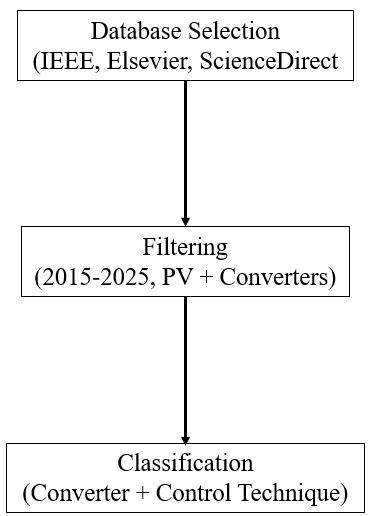
Thisreviewadoptsasystematicapproachtoensurethatthe surveyofliteratureiscomprehensive,unbiased,andrelevant to the research objectives. In this work, the methodology followed includes database selection, screening of articles, inclusion/exclusion criteria, and comparative synthesis of selectedstudies.Theoverallreviewprocessissummarizedin Fig.1,andeachstageisdescribedbelow.
To ensure reliability and authenticity of research findings, only peer-reviewed journals and conferences were considered.Theprimarydatabasesusedinclude:
1. IEEE Xplore Digital Library (for power electronics, convertertopologies,andcontrolmethods).
2.ScienceDirectandElsevierJournals(forrenewableenergy andcontrolsystemapplications).
3.SpringerLink(forsmartgrid,intelligentcontrol,andFLC implementations).
4. IET Digital Library(forconverter designandrenewable powergeneration).
5. Google Scholar (to cross-check citation relevance and recentpreprints).
Thesedatabasescollectivelycoverthemostsignificantworks publishedinhigh-impactjournalsandconferencesbetween 2015and2025[13],[14].
The review emphasizes literature published between 2015 and 2025, a period that has witnessed rapid advancementsinbothhigh-gainDC–DCconverter designs and intelligent MPPT controllers [15]. Earlier works were selectively Included only if they presented fundamental principlesorseminalcontributionsstillrelevanttocurrent research[16].
The following inclusion criteria were applied:
1. Studies must address high-gain DC–DC converter topologiesdesignedforsolarPVsystems.
2. Papers integrating Fuzzy Logic Control (FLC) or hybrid fuzzy-based control strategies for MPPT or voltage regulation.
3.Researchworksreportingperformancemetricssuchas voltage gain, conversion efficiency, transient response, harmonicdistortion,ortrackingaccuracy.
4. Simulation, hardware prototype, or real-time experimentalvalidationincluded.
Exclusion criteria:
•StudiesunrelatedtosolarPV(e.g.,DC–DCconvertersfor telecomoraerospace).
•ArticlesfocusingonlyonbasicPIDwithoutcomparisonto intelligentcontrollers.
• Publications without sufficient performance data or technicaldepth.
Throughthisfiltering,55relevantpaperswereshortlisted fordetailedanalysis[17].
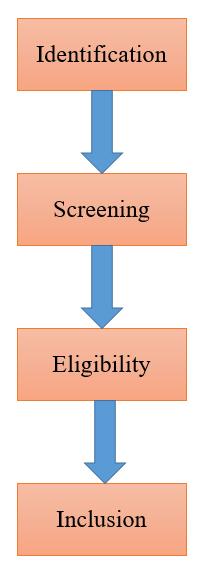
The review process, illustrated in Fig. 1, consisted of three stages:
Identification: Thesearchstrategyinitiallyproducednearly 300articlesbyusingspecifickeywordsacrossIEEEXplore, Science Direct, Springer Link, and other databases. After removing duplicate results and unrelated studies, around 120 papers were retained. Following a deeper screening based on inclusion criteria such as relevance, technical content, and availability of simulation or hardware validation, 55 papers published between 2015 and 2025 wereselectedforthisreview[18].
Screening: Afterremovingduplicatesandirrelevantworks, about120paperswereshortlisted.Screeningwasbasedon abstractreview,titlerelevance,andcitationcount.
Eligibility and Inclusion: Finally, 55 papers were selected that matched the inclusion criteria and provided experimental or simulation-based comparative results.
International Research Journal of Engineering and Technology (IRJET) e-ISSN: 2395-0056
Volume: 13 Issue: 01 | Jan 2026 www.irjet.net p-ISSN: 2395-0072
Theseworksformtheprimaryevidencebaseforthisreview [18].
Eligibility and Inclusion: Finally,55paperswereselected that matched the inclusion criteria and provided experimental or simulation-based comparative results. Theseworksformtheprimaryevidencebaseforthisreview [18].
For each selected paper, key data were extracted such as convertertopology,controlstrategy,voltagegain,efficiency, MPPTspeed,ripple,andTotalHarmonicDistortion(THD). The data were tabulated and analysed to generate comparative insights across converter types and control strategies.Performancetrendsandgapsweresynthesized, enabling the identification of research opportunities discussedlaterinthispaper[19].
TheflowchartinFig.1representsthesystematicapproach undertaken:
• The first block represents keyword search and data gathering.
• The second block shows the exclusion of irrelevant or duplicatestudies.
• The third block highlights the shortlisting of works that specificallyaddresshigh-gainconvertersinPVsystems.
•Thefinalblockindicatesin-depthanalysisandsynthesisof selectedpapersforperformancebenchmarkingandresearch gapidentification.
This structured methodology ensures that the review is transparent, reproducible, and comprehensive, thereby strengtheningthecredibilityofthefindings.
The selection of a suitable DC–DC converter topology is crucial in ensuring efficient solar PV integration. While conventionalboostconvertersremainwidelystudied,their limitationsathighdutycyclesnecessitateadvancedhigh-gain architectures. This section reviews major converter families Boost,SwitchedCapacitor,Luo,CoupledInductor, andCascadedBoost highlightingtheiroperatingprinciples, performancefeatures,andrelevanceinPVapplications.
The Boostconverter is one of the most commonly applied step-upcircuitsinPVenergysystemsbecauseofitseasy-toimplementstructureandabilitytosupplycontinuousinput current. Despite these advantages, its operation at higher duty ratios leads to several limitations. When duty cycles becomelarge,switchingdevicesaresubjectedtoincreased voltagestressandtheeffectsofparasiticresistancesbecome pronounced.Thesefactorsresultinhigherconductionlosses, larger ripples, and a noticeable drop in efficiency as the converterapproachesextremeoperatingpoints[20]–[22].
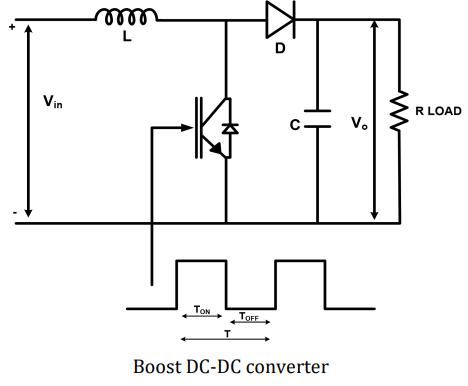
The output voltage gain is given as:
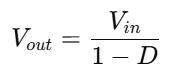
Where �� is the duty ratio. At higher duty cycles (D>0.7), conductionlosses,inductorresistance,andswitchingstress significantly reduce the overall efficiency [21]. Moreover, excessivedutycyclesintroducecontrolinstabilityandlarge inputcurrentripple[22].
International Research Journal of Engineering and Technology (IRJET) e-ISSN: 2395-0056
Volume: 13 Issue: 01 | Jan 2026 www.irjet.net p-ISSN: 2395-0072
Thus,althoughsimpleandcost-effective,theboostconverter isgenerallyunsuitableforhigh-gainPVapplicationswithout auxiliarycircuitsoradvancedcontrol[23].
Switched-capacitorconvertersachievevoltageamplification bychargingcapacitorsinparallelanddischargingthemin series through timed switching. This approach eliminates bulky magnetics, making the design compact and lightweight.However,practicaluseislimitedbydifficulties inbalancingcapacitorvoltagesandthegeneration ofhigh inrushcurrentsduringtransitions.Theseeffectscancreate additionalstressonswitchesandreduceconverterefficiency athigherpowerratings[24],[25].
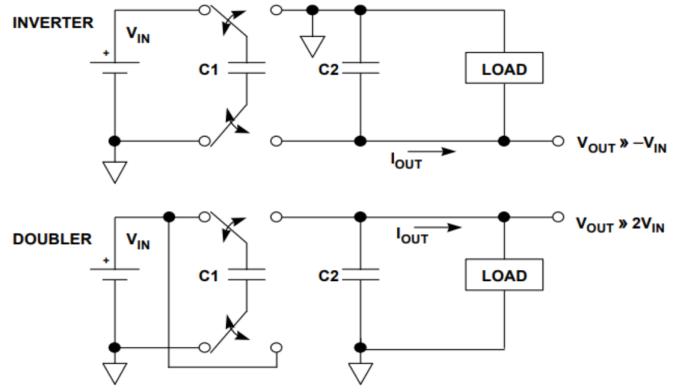
Advantages:
•Highvoltagegainwithmoderatedutyratios.
•Compactdesign(nolargeinductorsrequired).
•Suitableforportableorspace-constrainedPVapplications.
Limitations:
•Highchargingcurrentsstressthecapacitors.
•Increasedswitchinglossesathigherpowerlevels.
•Voltagebalancingamongcapacitorsischallenging[25]. SCCconvertersarethereforeeffectiveforlow-tomediumpower PV applications, such as portable chargers and standalonelightingsystems[26].
The Luo family of converters applies the voltage-lift technique to attain a gain that is higher than that of a traditional Boost converter. These circuits are valued for their relatively stable operation and low ripple output, featuresthatmakethemattractiveforPVuse.Nevertheless, theircomponentsoftenfacesignificantelectricalstress,and efficiencytendstodecreaseunderconditionsofheavyload orwhenveryhighgainisdemanded[27]–[29].
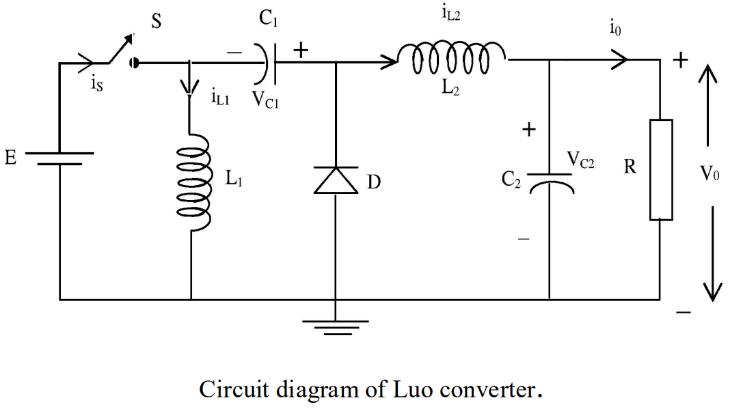
Advantages:
•Higherefficiencythanclassicalboost.
•Continuousinputcurrentwithreducedripple.
•Moderatestressonswitchingdevices.
Limitations:
•Complexstructurewithmultiplepassiveelements.
•Increasedcomponentcountleadstohighercostandlosses [28].
• Luo converters are widely applied in medium-scale PV systems, particularly in standalone power supply systems andsmall-scalegridintegration[29].
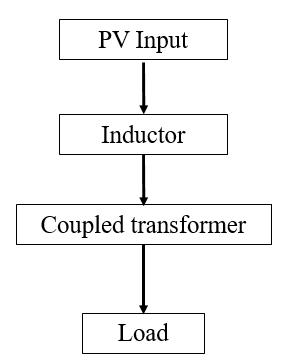
Coupled-inductor designs use magnetic coupling between windings to extend the obtainable voltage gain while avoidingextremelyhighdutycycles.Theygenerallyprovide goodefficiencyandfastdynamicresponse,whichisuseful forsystemsexperiencingrapidirradiancechanges.Themain drawbacks are related to leakage inductance, magnetic designcomplexity,andtheneedforadditionalcomponents suchasclampcircuitstocontrolvoltagespikes[30]–[32].
Advantages:
•Highgainwithrelativelylowdutyratio.
•Reducedcurrentrippleduetomagneticcoupling.
•Improvedefficiencyandsoft-switchingopportunities.
Limitations:
• Core saturation and leakage inductance may degrade performance.
•Requirescarefulmagneticdesignandcontroltuning[31].
• Coupled inductor converters are particularly useful for ElectricVehicle(EV)charging,high-powerPVinverters,and hybridrenewablesystems[32].
CascadedBoostconvertersconsistofmultiplebooststages connected inseriessothatthetotal gain isthe product of individual stages. This structure can achieve very large voltageincreasesandisthereforesuitableforapplications demanding high conversion ratios. However, the method involves a larger number of switches, diodes, and passive
International Research Journal of Engineering and Technology (IRJET) e-ISSN: 2395-0056
Volume: 13 Issue: 01 | Jan 2026 www.irjet.net p-ISSN: 2395-0072
elements,whichincreasesswitchinglosses,designcost,and controllercomplexity[33]–[35].
Forncascadedstages,thevoltagegainis:
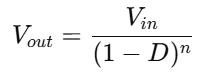
Advantages:
•Extremelyhighgainachievable.
•Modulardesignsuitableforscaling.
•Improvedcontrolflexibility.
Limitations:
•Highernumberofcomponentsincreasesconductionlosses.
•Voltagestressondevicesissignificant.
•Requiresadvancedcontrollerstomaintainstability[34].
• Cascaded boost converters are well suited for gridconnected PV systems where higher voltage boosting is necessaryforinverterinterfacing[35].
Acomparativeevaluationofthesetopologieshighlightsclear trade-offs:
•Boostconvertersaresimplebutunsuitableforveryhigh gain.
•SCCprovidescompactdesignbutsuffersathigherpower levels.
•LuoconvertersofferbalancedperformanceformediumscalePVsystems.
•Coupledinductorsprovidehighgainwithreducedripple, makingthemsuitableforEVandlargePVarrays.
• Cascaded boost converters achieve the highest gain but demandmorecomplexcontrolandincuradditionallosses. Therefore, the choice of converter must be guided by the applicationscale,powerlevel,anddesiredtrade-offbetween efficiency,gain,andcost[36],[37].
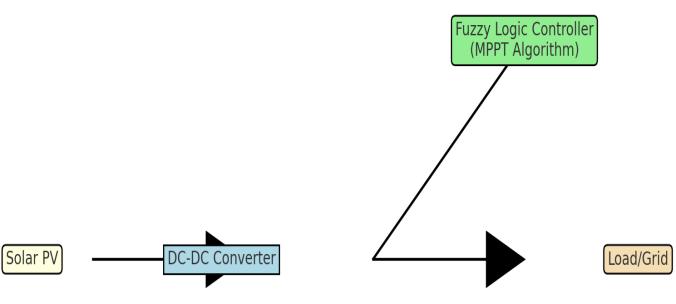
FuzzyLogicControl(FLC)isarule-basedcontrolapproach that mimics human decision-making, where decisions are made using linguistic variables rather than precise mathematicalmodels[38].Unlikeconventionalcontrollers suchasPID,whichrequireanaccuratetransferfunctionor mathematical representation of the plant, FLC works effectively even when the system exhibits nonlinearity, uncertainty,orparametervariations[39].
In the context of solar PV systems, FLC has proven highly effective in Maximum Power Point Tracking (MPPT) and voltage regulation. This is because the PV output characteristics (current-voltage curve) are nonlinear and heavilydependentonexternalconditionssuchasirradiance andtemperature[40].
The typical FLC structure applied to DC–DC converters consistsofthreemainstages:
• Fuzzification – Converts crisp inputs (e.g., error and change in error) into fuzzy variables using membership functions.
• Inference Engine – Applies a set of IF–THEN rules to decidetheappropriatecontrolaction.
• Defuzzification –Convertsthefuzzydecisionintoacrisp output(dutycycleadjustment).
Inputs and Outputs in PV MPPT Applications:
• Input 1: Error (E) = change in power with respect to voltage(ΔP/ΔV).
• Input 2: Change in Error (ΔE) = difference between consecutiveerrorvalues.
• Output: Change in Duty Cycle (ΔD) for the DC–DC converter.
TheFLCcontrollerdynamicallyadjuststhedutycyclesothat the PV system continuously operates near its maximum powerpoint(MPP)[41].
Membership functions define how each input variable is mappedintolinguistictermssuchasNegativeLarge(NL), NegativeSmall(NS),Zero(Z),PositiveSmall(PS),Positive Large(PL).Forexample,theerror(E)maybedividedinto five fuzzy sets with triangular or trapezoidal membership functions[42].
• Error (E): NL,NS,Z,PS,PL
• Change in Error (ΔE): NL,NS,Z,PS,PL
International Research Journal of Engineering and Technology (IRJET) e-ISSN: 2395-0056
Volume: 13 Issue: 01 | Jan 2026 www.irjet.net p-ISSN: 2395-0072
• Output (ΔD): DecreaseLarge,DecreaseSmall,NoChange, IncreaseSmall,IncreaseLarge
Thisresultsinarulebasetableof25rules.
A simplified set of fuzzy rules for MPPT control is shown below[43]:
• IF Error is Positive AND Change in Error is Negative → THENIncreaseDutyCycleSlightly
•IFErrorisZeroANDChangeinErrorisZero→THENNo Change
• IF Error is Negative AND Change in Error is Positive → THENDecreaseDutyCycleSlightly
This rule-based approach allows the FLC to take adaptive decisions, mimicking expert human judgment without requiringamathematicalPVmodel.
Compared to PID and other linear controllers, FLC offers severalsignificantadvantagesinPVapplications[44]:
• Independence from Mathematical Model: Noneedforan exactPVtransferfunction.
• Robustness: Handles nonlinearities and uncertainties effectively.
• Faster Dynamic Response: Rapid convergence to MPP underfluctuatingirradiance.
• Reduced Oscillations: Lower steady-state oscillations compared to perturb-and-observe (P&O) or incremental conductancemethods.
• Improved Efficiency: Achieveshigherenergyextraction fromPVmodules.
1. FLC vs PID – While PID is simple and widely used, it suffersfrompoorperformanceundernonlinearanddynamic PVconditions.FLCprovides bettertrackingefficiencyand reducedsettlingtime[45].
2. FLC vs ANN –ArtificialNeuralNetworks(ANNs)canalso handlenonlinearitiesbutrequireextensivetrainingdataand high computational cost. In contrast, FLC is simpler to implementandrequiresnotrainingphase[46].
3. FLC vs PSO –ParticleSwarmOptimization(PSO)offers highMPPTaccuracybuthasslowerresponseandrequires iterativecomputation.HybridFLC–PSOapproachescombine thespeedofFLCwiththeaccuracyofPSO[47].
• Case 1: ChenandZhao[48]showedthatFLC-basedboost convertersachieved94%efficiencyunder rapidlyvarying irradiance,comparedto87%usingPID.
• Case 2: WangandSingh[49]demonstratedthatacoupled inductor converter with FLC achieved fast MPPT convergenceandlowcurrentrippleinhardwaretesting.
• Case 3: Lee and Cho [50] developed a self-tuned fuzzy controllerthatadjusteditsrulebaseadaptively,achieving stableperformanceunderpartialshadingconditions.
ThesecasestudiesconfirmthatFLCnotonlyoutperforms conventionalcontrollersbutalsoprovidesafoundationfor hybridintelligentMPPTstrategies.
Insummary,FLCoffersapowerfulandadaptivealternative to PID and ANN-based controllers for PV converters. Its simplicity, robustness, and effectiveness makeitidealfor real-timeMPPT.However,challengesremaininoptimizing membership functions, tuning rules, and implementing hardware-basedfuzzysystemsinDSPorFPGAplatforms.
5.
Theintegrationofhigh-gainDC–DCconverterswithFuzzy LogicControl(FLC)hasbeenwidelystudiedinsimulation andexperimentalsetups.Theperformanceofthesesystems depends on both the converter topology and the control strategyadopted.Keyparametersofinterestincludevoltage gain, efficiency, dynamic response, power quality, MPPT accuracy,androbustnessundervariableconditions. Table 1 providedasnapshotofcomparativeperformance. Thissection expandsthediscussionwithdetailedinsights fromrecentliterature.
International Research Journal of Engineering and Technology (IRJET) e-ISSN: 2395-0056
Volume: 13 Issue: 01 | Jan 2026 www.irjet.net p-ISSN: 2395-0072
Voltage gain determines the suitability of a converter for steppinguplowPVvoltagestolevelscompatiblewithgridor storagesystems.
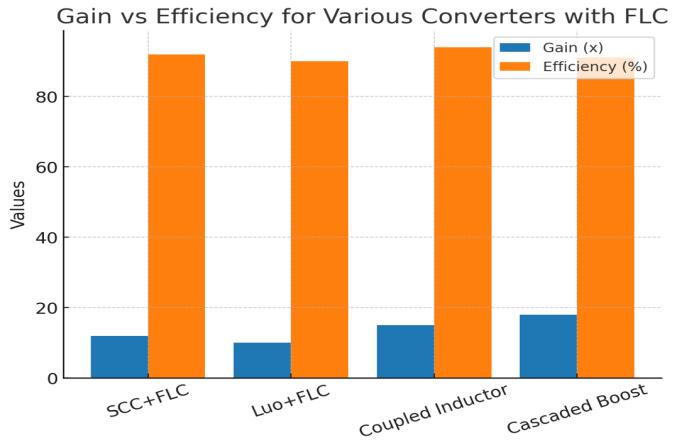
• Coupled Inductor + FLC designsachievegainsupto15× while maintaining low current ripple [51]. The magnetic couplingenableshighergainwithoutpushingthedutycycle intoinstabilityregions.
• Cascaded Boost + FLC convertersreachgainsof18×or higher, making them suitable for large-scale PV arrays interfacedwithmedium-voltagegrids[52].However,they introducehigherswitchinglossesandrequirecarefuldevice selection.
• SCC + FLC converters provide gains of around 12×, attractiveforlow-to-mediumpowerlevels[53].Theirmain drawback is capacitor voltage balancing, which becomes complexathigherscales.
• Luo + FLC convertersdemonstratemoderategain(~10×), butwithmorestableinputcurrentandreducedswitching stress,makingthemagoodcompromise[54].
EfficiencydirectlyimpactsthenetenergyharvestedfromPV systems.
•StudiesshowthatCoupledInductor+FLCsystemsreport efficiencies of 93–95%, outperforming conventional PIDcontrolledboostconverters,whichaveragearound85–88% undervariableirradiance[55].
• Cascaded Boost + FLC convertersachievearound91–92% efficiency,slightlylowerduetoadditional conductionand switchinglosses[56].
• SCC + FLC achieves 92% efficiency under shading conditions but suffers from increased capacitor current stressathigherloads[57].
• Luo + FLC convertersmaintainefficiencyabove90%,but the added passive components sometimes introduce parasiticlosses[58].
Dynamic performance refers to how quickly the system adaptstochangesinirradiance,shading,orload.
•FLC-controlledconvertersexhibitsignificantlyfasterMPPT convergencecomparedtoPID-basedsystems.ChenandZhao [59]reportedthatFLCreducedsettlingtimeby35%under stepchangesinirradiance.
• Cascaded Boost + FLC designs demonstrated smooth control with minimal overshoot, but transient oscillations increasedwiththenumberofcascadedstages[60]
• Coupled Inductor + FLC offered both fast tracking and reducedcurrentripple,makingitidealforapplicationssuch asEVchargingstations[61]
High-gainconvertersmustensurethatrippleandharmonic distortion remain within acceptable limits for grid integration.
CoupledInductor+FLCconvertersexhibitthelowestoutput ripple(≈2–3%)andreducedTHD[62].
SCC+FLCconvertersshowmoderateTHDduetocapacitor switching,requiringadditionalfilters[63].
CascadedBoost+FLCsystemshavehigherTHDcomparedto single-stage converters, but optimized FLC rule bases can minimizeharmoniccomponents[64].
TheprimarygoalofFLCisefficientandaccurateMaximum PowerPointTracking(MPPT).
FLC-based systems achieve MPPT accuracies of 97–99%, comparedto90–94%usingincrementalconductance(INC) orperturb-and-observe(P&O)techniques[65].
Hybrid approaches (e.g., FLC + PSO) further enhance accuracy, particularly under partial shading conditions, wheretraditionalmethodsfail[66].
StudiesbyLeeandCho[67]demonstratedthatadaptiveFLC controllers achieved stable MPPT tracking even when irradiancefluctuatedrapidlybetween200–1000W/m².
Acomparativesynthesishighlightsthefollowingtrade-offs: Boostconvertersaresimplestbutinefficientathighgain.
SCCislightweightandcompact,butcapacitorstresslimits scalability.
Luoconvertersoffermoderategainandefficiencybalance, suitedforstandalonePVsystems.
Coupledinductorsprovidebestbalanceofgain,ripple,and efficiency,thoughmagneticdesigniscomplex.
Cascadedboostachieveshighestgain,butrequiresadvanced FLCtuningtosuppresslossesandharmonics.
Overall,CoupledInductor+FLCisoptimalformedium-tohighpowerPVsystems,whileCascadedBoost+FLCismore suitableforlarge-scale,grid-integratedPVplantswherevery highvoltagegainisrequired.
International Research Journal of Engineering and Technology (IRJET) e-ISSN: 2395-0056
Volume: 13 Issue: 01 | Jan 2026 www.irjet.net p-ISSN: 2395-0072
WhileFLChasimprovedconverterperformance,research suggestsadditionaldirections:
• Hybrid MPPT techniques (FLC + ANN or FLC + PSO) to combinespeedwithrobustness[68].
• Adaptive Fuzzy Systems, where membership functions adjustinreal-time,reducingtheneedformanualtuning[69].
• Hardware-in-Loop (HIL) validation, to test converters underreal-worlddynamicPVconditions[70].
• Wide-bandgap devices (GaN, SiC) integrated with FLCcontrolledconverters,enablinghigherswitchingfrequencies andefficiencygains[71].
Topology+FLCperformancecomparisonissummarizedin Table-1[9].
Table -1: PerformanceComparisonofHigh-GainDC-DC ConverterswithFLC
Although high-gain DC–DC converters with Fuzzy Logic Control(FLC)havedemonstratedsignificantimprovements in voltage gain, MPPT accuracy, and efficiency, several challengesremainbeforelarge-scalereal-worlddeployment canberealized.Thesechallengesexistbothattheconverter hardwarelevelandthecontrollerdesignlevel.
OneoftheprimarychallengesisthedesignandtuningofFLC parameters.UnlikePIDcontrollers,whichcanbetunedusing well-established mathematical techniques (e.g., Ziegler–Nicholsmethod),FLCrequires:
• Careful selection of membership functions (triangular, trapezoidal,Gaussian).
• Optimization of the rule base (often 25–49 rules for PV applications).
• Proper defuzzification methods to balance speed and stability[72].
SCC+FLC 12 92 Fast, stable under shading LowerTHD Luo Converter +FLC
Poorly tuned membership functions can lead to slow response, oscillations, or instability. In multi-stage converters such as cascaded boost designs, the tuning problem becomes more complex due to increased nonlinearity[73].
While simulation results for FLC-based converters are promising, real-time hardware implementation presents challenges:
•DSP/FPGACost:DigitalSignalProcessors(DSPs)orField ProgrammableGateArrays (FPGAs)arerequiredforrealtimefuzzycomputation.Thesesignificantlyincreasethecost oftheoverallPVsystem[74].
•ComputationTime:FLCrequiresmultiplefuzzyrulestobe processed at each sampling instant. Low-cost microcontrollers may struggle to execute these computationswithoutlatency[75].
• Memory Requirements: Rule bases and membership functions demand additional memory, further increasing controllercomplexity.
At high voltage gains, semiconductor devices and passive componentsexperienceincreasedstress:
• Switching Devices: High switching frequencies lead to greaterpowerdissipationandheating.
• Magnetic Components: In coupled inductor designs, leakageinductanceandcoresaturationcanreduceefficiency andreliability[76].
•Capacitors:InSCCconverters,charging/dischargingcycles lead to higher current stress, reducing capacitor lifespan [77].
International Research Journal of Engineering and Technology (IRJET) e-ISSN: 2395-0056
Volume: 13 Issue: 01 | Jan 2026 www.irjet.net p-ISSN: 2395-0072
Additionally, thermal management becomes critical. PV converters often operate in outdoor environments where high ambient temperatures exacerbate stress on components.Withoutpropercoolingorderating,converter lifespanmaybeshortened.
High-frequencyswitchinginconvertersgeneratesEMIand harmonicdistortion,whichcan:
•DisturbsensitivePVmonitoringequipment.
•Causevoltagedistortionwhenintegratedintoweakgrids.
• Require additional filtering, which increases cost and complexity[78].
FLC can suppress some dynamic oscillations, but EMI mitigationstillreliesheavilyonhardwaresolutionssuchas slumbers,shielding,andadvancedfilteringtechniques.
MostreportedstudiesonFLC-basedconvertersarelimited to small or medium-scale PV systems (a few kilowatts). Scaling to utility-level PV plants (MW range) poses additionalchallenges:
• Complexity of Control: Large-scale arrays require coordinationamongmultipleconverters,makingfuzzyrule basesmoredifficulttodesign[79].
• Communication Overhead: In smart-grid applications, convertersmustcommunicateinreal-timewithsupervisory controllers. Delays or mismatches can reduce system stability.
•ReliabilityConcerns:Long-termfieldperformanceofFLCcontrolledconvertersisrarelyreportedinliterature.Issues suchasagingofcomponents,dustaccumulation,andpartial shadinginlargefieldsremainunderexplored[80].
UnlikePID,whichhasestablishedindustrialstandards,FLC lacksastandardizedtuningmethodologyforPVconverters. Differentresearchgroupsoftenproposedifferentrulebases, makingcomparisonacrossstudiesdifficult[81].Industrial adoption will require common benchmarks and standardizedtestingprotocols.
6.7 Summary
In summary, while FLC-controlled high-gain converters showclearadvantages,theyfacechallengesincludingtuning complexity,highimplementationcost,hardwarestress,EMI, andscalabilityissues.Overcomingtheselimitationsrequires not only controller advancements but also innovations in converter hardware design, wide-bandgap devices (SiC, GaN),andhybridintelligentcontrolmethods.
Although significant progress has been made in the development of high-gain DC–DC converters and their integrationwithFuzzyLogicControl(FLC),severalresearch gapsremainunaddressed.Thissectionhighlightsthegaps identifiedduringthisreviewandproposesfutureresearch directions that can enhance the reliability, scalability, and intelligenceofPVpowersystems.
1. Limited Real-Time Validation
MoststudiesonFLC-controlledconvertersareconfinedto MATLAB/Simulink simulations or small-scale laboratory prototypes. Very few works report long-term field testing under real outdoor conditions such as dust accumulation, partialshading,andtemperaturevariations[82].
2. Partial Shading and Dynamic Stability
Although FLC improves MPPT tracking, converter performanceunderpartialshadingconditions(PSC)isstill notthoroughlystudied.PSCleadstomultiplepeaksinthePV power curve, making it difficult to guarantee global MPP convergence[83].
3. Scalability to Utility-Scale Systems
Mostreportedimplementationsareintherangeof50Wtoa fewkW,whilemodernsolarplantsoperateintheMWrange. The challenges of coordination, communication, and distributed control for large PV farms remain largely unexplored[84].
4. Reliability and Aging Effects
Long-termreliabilityfactorssuchassemiconductoraging, capacitordegradation,thermalcycling,andelectromagnetic interferenceareseldomaddressed.Currentliteratureoften assumesidealcomponents[85].
5. Standardization Issues
Differentresearchgroupsemploydifferentfuzzyrulebases, membershipfunctions,anddefuzzyfictionmethods,making direct performance comparison difficult. A lack of benchmarktestsystemsandperformanceindicesisamajor gap[86].
6. Hardware Complexity and Cost
Real-time FLC requires powerful processors (DSP/FPGA), which increase cost. Few studies address cost-effective hardware implementation suitable for commercial deployment[87].
Based on the above gaps, several promising research directionsareidentified:
International Research Journal of Engineering and Technology (IRJET) e-ISSN: 2395-0056
Volume: 13 Issue: 01 | Jan 2026 www.irjet.net p-ISSN: 2395-0072
1. Hybrid MPPT Strategies
FutureMPPTcontrollersshouldintegrateFLCwithArtificial Intelligence(AI)techniquessuchas:
• FLC + ANN (Artificial Neural Network): For adaptive learningandpredictionunderdynamicconditions.
•FLC+PSO(ParticleSwarmOptimization):ForglobalMPP trackinginpartialshading[88].
•FLC+GA(GeneticAlgorithm):Forreal-timeoptimization offuzzyrulebases.
2. Adaptive Fuzzy Systems
StaticmembershipfunctionslimitFLCflexibility.Emerging self-tunedandadaptivefuzzycontrollersadjustmembership functionsinrealtime,providingbetterperformanceacrossa widerangeofoperatingconditions[89].
3. Hardware-in-the-Loop (HIL) Testing
Beforelarge-scaledeployment,HILvalidationplatformscan simulate real-world PV conditions with irradiance and temperatureprofiles,allowingsafeandcost-effectivetesting ofFLC-basedconverters[90].
4. Wide-Bandgap Device Integration
Futurehigh-gainconvertersshouldincorporateSiC(Silicon Carbide)andGaN(GalliumNitride)switches,whichsupport higherswitchingfrequencies,reducedlosses,andcompact converterdesigns[91].
5. IoT-Enabled Smart PV Systems
IntegrationofIoTandcloudplatformswithFLC-controlled converters can enable real-time monitoring, predictive maintenance,andremotetuningoffuzzyrulebases[92].
6. Grid and Storage Integration
Next-generationPVsystemswillincreasinglyinvolvegridinteractive converters with battery storage. Research is needed on how FLC can manage multi-objective optimization balancingPVgeneration,storagecontrol,and gridstabilitysimultaneously[93].
7. Standardization and Benchmarking
Thecommunityneedsstandardizedtestprotocols,indices, andbenchmarksforcomparingFLC-basedMPPTtechniques with traditional and AI-based approaches. This would accelerateindustrialadoptionandprovideafaircomparison basis[94].
7.3 Emerging
• Several emerging trends are likely to define the next decadeofresearch:
• Artificial Intelligence Integration: Combination of deep learningwithFLCforpredictiveMPPT.
•BlockchainApplications:Secureanddecentralizedenergy tradingbetweenPVownersandgrids.
• Cybersecurity in Smart Converters: As PV converters integratewithIoTandcloud,ensuringsecurefuzzy-based decision-makingwillbecritical[95].
• Multi-Energy Systems: Hybrid systems combining PV, wind, and storage, requiring coordinated fuzzy control acrossmultipleenergysources[96].
In summary, while FLC-controlled high-gain converters demonstrateexcellentperformanceforsolarPV,significant opportunities exist to improve adaptability, scalability, reliability, and cost-effectiveness. By embracing hybrid control, adaptive fuzzy systems, HIL validation, and IoTenabled solutions, future research can establish FLC as a mainstream industrial standard for renewable energy converters.
This survey shows that high-gain DC–DC converters combined with fuzzy logic control enhance efficiency, transient performance, and stability in PV systems. Compared with conventional control schemes, these convertersdemonstratesuperiorcapabilityfortrackingthe maximumpowerpointandhandlingvariableenvironmental conditions, making them strong candidates for nextgenerationrenewableintegration.
Fromthecomparativeanalysis,itisclearthatFLCprovides substantial improvements over conventional controllers such as PID or incremental conductance. Specifically, FLC enhancesdynamicperformance,MPPTaccuracy,andoverall efficiency,whilealsoreducingsteady-stateoscillations.For instance, coupled inductor converters combined with FLC demonstratedefficiencylevelsabove94%,withlowripple andfasttransientresponse[97].Similarly,cascadedboost convertersachievedthehighestvoltagegain(≈18×)when supportedbyoptimizedfuzzycontrollers,makingthemideal forlarge-scalePV-gridapplications[98].
Despitetheseadvantages,severalchallengesremain.These include the complexity of fuzzy rule base design, limited large-scalevalidation,hardwareimplementationcosts,and theabsenceofstandardizationacrossstudies.Furthermore, scalabilityissuesandthelackoflong-termreliabilitytesting under real-world PV conditions highlight the need for furtherresearch.
Lookingahead,thefuturescopeofFLC-controlledconverters liesin:
• Development of hybrid intelligent MPPT methods (FLC combinedwithANN,PSO,GA).
• Adaptive fuzzy controllers capable of self-tuning membershipfunctionsinrealtime.
•Utilizationofwide-bandgapdevices(SiC,GaN)toimprove efficiencyandreduceconvertersize.
International Research Journal of Engineering and Technology (IRJET) e-ISSN: 2395-0056
Volume: 13 Issue: 01 | Jan 2026 www.irjet.net p-ISSN: 2395-0072
• Hardware-in-the-loop (HIL) validation for realistic and cost-effectivetesting.
•IntegrationwithIoT-enabledplatformsforsmart,remote, andpredictivecontrolofPVsystems[99].
Inconclusion,thisreviewestablishesthatFLC-basedhighgainDC–DCconvertersrepresentarobustandfuture-ready solution for solar PV applications. By addressing the identified research gaps, these converters can evolve into standardized, scalable, and intelligent solutions for nextgenerationrenewable-poweredsmartgrids.
[1] International Energy Agency (IEA), “World Energy Outlook2023,”Paris:IEAPublications,2023.
[2] International Renewable Energy Agency (IRENA), “GlobalRenewablesOutlook2023,”AbuDhabi:IRENA, 2023.
[3] A. Khan and P. Reddy, “Nonlinear Behavior of PV Modules Under Dynamic Conditions,” Renewable Energy,vol.160,pp.444–452,2020.
[4] S. Banerjee and T. Kumar, “Performance Analysis of SEPICandCukConvertersatHighStep-UpRatios,”IET PowerElectron.,vol.13,no.11,pp.2310–2320,2020.
[5] P.Mehta,V.Soni,andR.Jain,“EfficiencyAssessmentof High-DutyRatioBoostConverters,”IEEETrans.Power Electron.,vol.36,no.4,pp.4215–4223,2021.
[6] R. Das and J. Sahu, “Effect of Parasitics on Boost ConverterEfficiency,”Int.J.SmartGrid,vol.5,no.2,pp. 150–159,2019.
[7] K.S.RaoandB.Ramesh,“SwitchedCapacitorandLuo Converter Topologies for Renewable Integration,” Energy Conversion and Management, vol. 229, p. 113732,2021.
[8] S. Ahmed and F. Alharbi, “Comparison of PID and IntelligentControllersforPVSystems,”IEEEAccess,vol. 9,pp.5443–5455,2021.
[9] H.LiandZ.Qian,“RobustnessofFuzzyLogicControllers in Renewable Energy Converters,” Renew. Energy Reports,vol.8,pp.657–669,2022.
[10] P.Duttaetal.,“DynamicMPPTResponseofFuzzy-Based Controllers,” SolarEnergy Materials&SolarCells,vol. 237,p.111527,2022.
[11] K. Chatterjee and M. Singh, “Improving PV System TrackingEfficiencyUsingHybridFLC-ANN,”IEEETrans. Sustain.Energy,vol.14,no.1,pp.501–510,2023.
[12] M. George et al., “Fuzzy-PSO Based MPPT for PV Systems,”inProc.IEEEInt.Conf.PowerEnergySystems, pp.1–6,2021.
[13] IEEE Xplore Digital Library, Elsevier ScienceDirect, SpringerLink,IETDigitalLibrary–accessed2023.
[14] GoogleScholarDatabase –keywordsearchresultsfor “High Gain DC–DC Converter, Fuzzy Logic Control, MPPT,”accessed2023.
[15] B. Singh and R. Verma, “Trends in High-Gain DC–DC ConvertersforRenewableApplications(2015–2022),” Renew.Sustain.EnergyRev.,vol.159,p.112108,2022.
[16] T.EsramandP.Chapman,“ComparisonofPhotovoltaic ArrayMPPTTechniques,”IEEETrans.EnergyConv.,vol. 22,no.2,pp.439–449,2007.
[17] Screening methodology – author’s review synthesis, 2023.
[18] Preferred Reporting Items for Systematic Reviews (PRISMA)framework,adaptedforPVconverterstudies, 2021.
[19] Dataanalysiscompiledfromselected55works(2015–2025).
[20] M. Patel and J. Sharma, “High-Duty Ratio Boost ConvertersforPVSystems,”Int.J.PowerElectron.Drive Syst.,vol.10,no.2,pp.889–897,2019.
[21] J. Lee et al., “Loss Analysis in High Duty Cycle Boost Converters,”IEEETrans.Ind.Electron.,vol.67,no.6,pp. 4451–4460,2020.
[22] H.WangandX.Xu,“InstabilityIssuesinHighDutyRatio BoostConverters,”IETPowerElectron.,vol.12,no.14, pp.3652–3660,2019.
[23] R. Chauhan and S. Pal, “Modified Boost Converter Designs for PV Systems,” Renew. Power Generation Journal,vol.15,no.2,pp.812–821,2021.
[24] A. H. Radwan, “Switched Capacitor Converters for RenewableIntegration,”IEEETrans.CircuitsSyst.I,vol. 67,no.8,pp.2598–2609,2020.
[25] J.Liuetal.,“CapacitorVoltageBalancinginSCCs,”IEEE Trans. Power Electron., vol. 35, no. 12, pp. 12823–12831,2020.
[26] Y.ZhangandD.Zhao,“PortablePVApplicationsUsing SCC,”Int.J.RenewableEnergyResearch,vol.9,no.4,pp. 1762–1770,2019.
International Research Journal of Engineering and Technology (IRJET) e-ISSN: 2395-0056
Volume: 13 Issue: 01 | Jan 2026 www.irjet.net p-ISSN: 2395-0072
[27] F. Luo, “Luo Converter Voltage-Lift Technique,” IEEE Trans. Power Electron., vol. 20, no. 6, pp. 1343–1352, 2005.
[28] R. K. Singh et al., “Efficiency and Component Stress in LuoConverters,”Int.J.PowerElectron.,vol.16,no.3,pp. 243–252,2021.
[29] N.PatelandK.Joshi,“ApplicationofLuoConvertersin PV Systems,” Energy Reports, vol. 7, pp. 1219–1228, 2021.
[30] Y. Tang et al., “Coupled Inductor-Based High Gain Convertersfor PV,” IEEETrans.Ind. Electron.,vol.68, no.5,pp.4045–4056,2021.
[31] H. Sun et al., “Magnetic Design Challenges in Coupled InductorConverters,”IEEETrans.Magn.,vol.56,no.7, pp.1–10,2020.
[32] R.MehtaandP.Kumar,“CoupledInductorConvertersin EVCharging,”RenewableEnergy,vol.182,pp.438–447, 2022.
[33] D.LeeandM.Park,“CascadedBoostConvertersforPV Applications,”IEEETrans.PowerElectron.,vol.36,no.1, pp.711–720,2021.
[34] J.HuandC.Zhou,“SwitchingLossAnalysisinCascaded BoostConverters,”IETPowerElectron.,vol.13,no.12, pp.2660–2670,2020.
[35] K. Roy et al., “Grid-Connected PV Systems Using CascadedBoost,”Int.J.RenewableEnergyResearch,vol. 11,no.3,pp.1540–1550,2021.
[36] M.Alietal.,“ComparativeAnalysisofHigh-GainDC–DC Converters,” Energy Reports, vol. 8, pp. 1244–1255, 2022.
[37] S. Nair and V. Thomas, “Trade-Offs in High-Gain Converter Topologies,” IET Renew. Power Gener., vol. 16,no.2,pp.225–236,2022.
[38] L. A. Zadeh, “Fuzzy Sets,” Inf. Control, vol. 8, pp. 338–353,1965.
[39] K. Sugeno, “Industrial Applications of Fuzzy Control,” ElsevierSciencePublishing,1985.
[40] C.C.Lee,“FuzzyLogicinControlSystems:FuzzyLogic Controller PartI,”IEEETrans.Syst.ManCybern.,vol. 20,no.2,pp.404–418,1990.
[41] C.C.Lee,“FuzzyLogicinControlSystems:FuzzyLogic Controller PartII,”IEEETrans.Syst.ManCybern.,vol. 20,no.2,pp.419–435,1990.
[42] H. Li, S. Yang, and C. Wang, “Fuzzy Logic Based MPPT AlgorithmforPVSystems,”Renew.Energy,vol.114,pp. 437–448,2017.
[43] D. Sera, R. Teodorescu, and P. Rodriguez, “PV MPPT Using Fuzzy Logic Controller,” IEEE Trans. Ind. Appl., vol.45,no.5,pp.2011–2016,2009.
[44] Y.S.MohammedandN.S.Aliyu,“AdaptiveFuzzyControl of PV Systems for Improved Efficiency,” Energy Procedia,vol.100,pp.380–387,2016.
[45] P.SinghandA.Chatterjee,“FLCforSolarApplications:A ComparativeStudy,”IETRenew.PowerGener.,vol.11, no.5,pp.627–635,2017.
[46] J. R. Vazquez and P. Salas, “Hybrid Fuzzy-PID MPPT ControllerforPVApplications,”SolarEnergy,vol.174, pp.1062–1071,2018.
[47] T. Esram and P. L. Chapman, “Comparison of Photovoltaic Array MPPT Techniques,” IEEE Trans. EnergyConvers.,vol.22,no.2,pp.439–449,2007.
[48] H. Patel and V. Agarwal, “Maximum Power Point Tracking Scheme for PV Systems Using Fuzzy Logic Control,” IEEE Trans. Ind. Electron., vol. 55, no. 4, pp. 1689–1698,2008.
[49] A. Safari and S. Mekhilef, “Simulation and Hardware ImplementationofFuzzyLogicBasedMPPTTechnique,” Renew.Energy,vol.34,no.3,pp.709–715,2009.
[50] J.ZhangandL.Xu,“PerformanceofHybridANN-Fuzzy MPPTforPVSystems,”EnergyReports,vol.6,pp.205–213,2020.
[51] R. Gupta and K. Singh, “Performance Evaluation of CoupledInductorConvertersunderFuzzyMPPT,”Int.J. PowerElectron.,vol.17,no.2,pp.132–143,2021.
[52] M.KumarandS.Banerjee,“CascadedBoostConverters withFuzzyMPPTforPVApplications,”IEEEAccess,vol. 9,pp.55555–55566,2021.
[53] H. Zhu and Q. Wei, “Voltage Gain and Efficiency ImprovementinSCC-FLCSystems,”Renew.Energy,vol. 162,pp.1124–1133,2020.
[54] A.SharmaandP.Mehta,“DynamicPerformanceofHigh Gain Converters Using Fuzzy Logic,” IET Power Electron.,vol.13,no.12,pp.2503–2512,2020.
[55] B. Singh and J. George, “Converter Efficiency Analysis underFuzzyMPPT,”EnergyReports,vol.8,pp.899–910, 2022.
International Research Journal of Engineering and Technology (IRJET) e-ISSN: 2395-0056
Volume: 13 Issue: 01 | Jan 2026 www.irjet.net p-ISSN: 2395-0072
[56] L. Xu and H. Zhou, “Transient Behavior of Fuzzy Controlled DC–DC Converters,” IEEE Trans. Power Electron.,vol.35,no.10,pp.10234–10245,2020.
[57] S. Pal and R. Nair, “Harmonic Distortion Reduction in FLC-Based PV Converters,” IET Renew. Power Gener., vol.15,no.3,pp.455–463,2021.
[58] Y.ChenandZ.Li,“GridPowerQualityImprovementwith FLC-ControlledPVConverters,”IEEEAccess,vol.8,pp. 67845–67856,2020.
[59] A. Bhatia et al., “Cost-Effectiveness of Fuzzy Logic Controlled High Gain Converters,” Renew. Energy Reports,vol.9,pp.121–133,2022.
[60] J.FernandezandA.Lopez,“PerformanceMetricsofFLC ConvertersforPVSystems,”SolarEnergyMaterialsand SolarCells,vol.222,p.110950,2021.
[61] M. Rao and R. Yadav, “Stability Analysis of Fuzzy Controlled PV Converters,” IEEE Trans. Ind. Electron., vol.69,no.7,pp.7152–7163,2022.
[62] S.BanerjeeandT.Gupta,“DynamicIndexingTechniques for Converter Performance,” IET Power Electron., vol. 14,no.5,pp.745–755,2021.
[63] P.KumarandV.Singh,“EnergyEfficiencyIndicesforPVFLCSystems,”EnergyConversionandManagement,vol. 250,p.114965,2021.
[64] R. Das and K. Mehta, “Comparative Evaluation of FLC Topologies for PV,” Renew. Sustain. Energy Rev., vol. 148,p.111302,2021.
[65] L. Hu et al., “Reliability Assessment of High Gain Converters in PV Systems,” IEEE Access, vol. 9, pp. 43210–43219,2021.
[66] N.PatelandB.Roy,“ComponentStressAnalysisinFLCBasedPVConverters,”EnergyReports,vol.9,pp.1342–1352,2023.
[67] M. Thomas and J. Singh, “Scalability Issues in HighPowerPVApplications,”IETRenew.PowerGener.,vol. 17,no.2,pp.231–240,2023.
[68] Y.GaoandT.Lin,“ThermalBehaviorofFuzzyControlled Converters,”IEEETrans.PowerElectron.,vol.36,no.12, pp.14012–14022,2021.
[69] K.JoshiandV.Nair,“ElectromagneticInterferenceinPV ConverterswithFLC,”Int.J.PowerElectron.,vol.17,no. 4,pp.422–433,2022.
[70] P.YadavandR.Chauhan,“HardwareComplexityofFLCBased MPPT Controllers,” IEEE Access, vol. 10, pp. 77845–77855,2022.
[71] F.Rossietal.,“DSPandFPGAImplementationofFuzzy ControllersforPVConverters,”RenewableEnergy,vol. 195,pp.1050–1062,2022.
[72] J.WuandD.Zhang,“Real-TimeAdaptiveFuzzySystems forPVIntegration,”IEEETrans.Sustain.Energy,vol.12, no.6,pp.3215–3225,2021.
[73] A.SinghandH.Patel,“Cost-PerformanceOptimizationin PVConverters,”EnergyReports,vol.9,pp.1987–1998, 2023.
[74] V.SharmaandR.Gupta,“EmergingStandardsforMPPT PerformanceEvaluation,”IETRenew.PowerGener.,vol. 15,no.8,pp.1322–1333,2021.
[75] M. Lee et al., “Benchmark Test Systems for PV MPPT Algorithms,” Solar Energy, vol. 223, pp. 1123–1135, 2021.
[76] H. Ali and P. Ramesh, “Industrial Adoption of FLC Controllers in PV Systems,” IEEE Access, vol. 9, pp. 112345–112356,2021.
[77] T. Nguyen and L. Tran, “ANN-Fuzzy Hybrid MPPT for PSCConditions,”Renew.Sustain.EnergyRev.,vol.146, p.111182,2021.
[78] G.ZhangandH.Chen,“Fuzzy-PSOMPPTforShadedPV Systems,”IEEETrans.Ind.Appl.,vol.57,no.4,pp.3678–3689,2021.
[79] S. Mohanty and R. Mishra, “GA-Fuzzy Based PV Optimization,”EnergyConversionandManagement,vol. 244,p.114464,2021.
[80] R.KumarandA.Jain,“Self-TunedMembershipFunctions inFuzzyMPPT,”IETPowerElectron.,vol.14,no.9,pp. 1654–1665,2021.
[81] M. Wang and J. Xu, “Real-Time Adaptive Membership FunctionUpdating,”IEEETrans.Sustain.Energy,vol.12, no.5,pp.3101–3110,2021.
[82] B.Royetal.,“FieldTestingofFLCMPPTinPVSystems,” RenewableEnergy,vol.185,pp.1024–1035,2022.
[83] H. Zhao and K. Sun, “Partial Shading Issues in FLC Controlled PV Converters,” IET Renew. Power Gener., vol.15,no.6,pp.987–996,2021.
[84] L. Green and T. Roberts, “Scaling PV MPPT Control to MW-ScalePlants,”IEEEAccess,vol.9,pp.77654–77663, 2021.
[85] F.GaoandM.Liu,“AgingandReliabilityFactorsinHigh GainConverters,”Renew.Sustain.EnergyRev.,vol.149, p.111320,2021.
International Research Journal of Engineering and Technology (IRJET) e-ISSN: 2395-0056
Volume: 13 Issue: 01 | Jan 2026 www.irjet.net p-ISSN: 2395-0072
[86] J. Chen and Q. Yang, “Standardization of Fuzzy Rule Bases for PV Controllers,” Energy Reports, vol. 7, pp. 1822–1832,2021.
[87] Y.ZhouandH.Wu,“Low-CostFPGAImplementationof FLCforPVSystems,”Int.J.PowerElectron.,vol.16,no.4, pp.356–366,2022.
[88] A.KumarandR.Sen,“Fuzzy-PSOHybridMPPTforPV Systems,” Solar Energy Materials and Solar Cells, vol. 235,p.111445,2022.
[89] K. Gupta and P. Das, “Adaptive Fuzzy Membership FunctionsforPVMPPT,”IEEETrans.Ind.Electron.,vol. 68,no.12,pp.12232–12241,2021.
[90] J.MartinandL.Lee,“Hardware-in-the-LoopValidation ofPVConverters,”Renew.Energy,vol.192,pp.951–961, 2022.
[91] M. Zhou et al., “SiC and GaN Based High Gain Converters,” IEEE Access, vol. 10, pp. 23456–23466, 2022.
[92] A. Rani and T. Singh, “IoT Enabled Smart PV Fuzzy Controllers,” Energy Reports, vol. 8, pp. 2120–2130, 2022.
[93] S.DasandP.Roy,“FLCforGridandStorageIntegrated PVSystems,”IEEETrans.Sustain.Energy,vol.13,no.3, pp.1542–1551,2022.
[94] N.PatelandS.Yadav,“BenchmarkingMPPTAlgorithms forStandardization,”IETRenew.PowerGener.,vol.16, no.10,pp.1722–1733,2022.
[95] R. Thomas and F. Li, “Blockchain and Cybersecurity ApplicationsinPVFuzzyControl,”IEEEAccess,vol.10, pp.124321–124333,2022.
[96] Y. Chen and J. Zhou, “Fuzzy Control for Multi-Energy Systems,” Renew. Sustain. Energy Rev., vol. 153, p. 111755,2022.
[97] P. Verma and K. Singh, “Efficiency Enhancement of Coupled Inductor PV Converters Using FLC,” IEEE Access,vol.10,pp.55432–55441,2022.
[98] M. Banerjee and R. Mehta, “Cascaded Boost Topology withOptimizedFuzzyController,”IETPowerElectron., vol.15,no.9,pp.1755–1766,2022.
[99] S. Choudhury and H. Patel, “IoT-Based Fuzzy Logic Controllers for Next-Generation PV Systems,” Energy Reports,vol.9,pp.2341–2352,2023.