
International Research Journal of Engineering and Technology (IRJET) e-ISSN: 2395-0056
Volume: 13 Issue: 03 | Mar 2026 www.irjet.net p-ISSN: 2395-0072
International Research Journal of Engineering and Technology (IRJET) e-ISSN: 2395-0056
Volume: 13 Issue: 03 | Mar 2026 www.irjet.net p-ISSN: 2395-0072
Kartik, B 1, Dr. Gagandeep Kaur2
1 Tech Student, CSE, MITS Gwalior, M.P, INDIA
2 Assistant Professor, CSE, MITS Gwalior, M.P, INDIA
Abstract - Healthcare centers and small clinics frequently experience overcrowding due to unmanaged appointment scheduling and walk-in patients. This situation often leads to long waiting times, confusion in patient order, and difficulty in providing immediate attention to emergency cases. The proposed Clinic Appointment and Patient Queue Management System is designed to improve the organization of patient appointments and reduce crowd formation by using modern web technologies based on the MERN stack (Mongo DB, Express.js, React.js, and Node.js).
The system introduces a structured priority-based scheduling mechanism where patients are categorized into different priority levels. Emergency cases are handled first to ensure immediate medical attention, followed by elderly patients who may require faster assistance. Regular patients are placed in the standard queue based on appointment details and reported health conditions. A dedicated handling mechanism is also included for physically disabled individuals to ensure accessibility and fairness in healthcare services.
To further improve efficiency, the platform continuously monitors doctor availability and dynamically allocates appointments to available time slots. Each patient receives a unique queue identification number that allows transparent tracking of appointment order and reduces confusion within the clinic environment.
In addition to queue management, an AI-based chat bot module is integrated into the platform to provide basic assistance to patients. The chat bot can respond to common health queries, provide general medicine information, and guide patients through the appointment booking process. This intelligent support helps reduce unnecessary clinic visits and improves patient engagement. Overall, the system demonstrates how digital technologies can improve healthcare workflow efficiency and enhance patient experience in clinics and hospitals.
Key Words: Clinic Management, Patient Queue System, MERN Stack, Priority Scheduling, Healthcare Automation, Appointment System, Emergency Handling, Artificial intelligence
1.Introduction
Healthcareinstitutionsplayacriticalroleinprovidingtimelymedicalservicestopatients.However,manysmallclinicsand healthcarecentersstillrelyonmanualorlooselystructuredappointmentsystems.These traditionalsystemsoftenresultin disorganizedqueues wherepatientswaitforlongperiodswithoutknowing when their consultation will take place. Such conditionsleadtoovercrowdedwaitingareasandincreasedfrustrationamongpatients.
One of the major challenges in these environments is the lack of a structured mechanism for prioritizing patients. Emergencycasesmayrequireimmediatemedicalattention,butwithoutapropersystemtheymaybeforcedtowaitalong with other patients. Similarly, elderly individuals and physically disabled patients often face difficulties while waiting in longqueues,whichcannegativelyaffecttheiroverallhealthcareexperience.
Anotherissueoccursinthe schedulingofdoctors’consultationhours.Inmanyclinics,appointmentslotsarenotproperly distributed,whichcanleadtosituationswheredoctorsremainidleatcertaintimesand overwhelmedduringpeakhours. Thisimbalancereducesoverallefficiencyandcanaffectthequalityofhealthcareservices.
With the rapid advancement of digital technologies, web-based healthcare management systems are becoming increasingly important. Such systems allow clinics to organize patient information, manage appointments, and monitor queuestatusmore effectively.Theproposedsystemaimstoaddressthesechallengesbyintroducingaweb-basedplatform thatorganizespatientappointmentsthroughapriority-basedqueuemanagementmechanism.
The system is developed using the MERN stack, which provides a scalable and efficient architecture for modern web applications. By combining structured queuemanagementwithintelligentassistancethrough an AI chat bot module, the platformaimstoimprovepatientexperience,reducewaitingtime,andoptimizehealthcareservicedelivery.
International Research Journal of Engineering and Technology (IRJET) e-ISSN: 2395-0056
Volume: 13 Issue: 03 | Mar 2026 www.irjet.net p-ISSN: 2395-0072
Digitaltechnologieshavesignificantlyinfluencedthe wayhealthcareservicesaremanagedinmodernclinicsandhospitals. Many healthcare centers are gradually moving from traditional manual appointment systems to computerized platforms thatallowbetterorganizationofpatientvisits.Thesesystemsaimtoreduce long waiting times, improve transparency in appointmentscheduling,andenhancetheoverallexperienceforpatients.
Several digital healthcare management approaches focus on online appointment booking systems. Such systems allow patients to schedule consultations in advance, reducing the need for long physical queues inside clinics. By organizing appointmentsthrougha structuredplatform,healthcareproviderscanmanagepatientflowmoreeffectivelyandminimize overcrowdinginwaitingareas.
Anotherareaofdevelopmentinhealthcaretechnologyisqueuemanagement.Traditionalfirst-come-first-serveapproaches often fail to handle urgent medical situations efficiently. As a result, some digital queue systems introduce prioritization mechanismstoensurethatpatientswithcriticalconditionsreceivefastermedicalattention.Thesesystemsimproveservice deliverybyorganizingpatientorderbasedonurgencyandotherrelevantfactors.
Inrecentyears,artificialintelligencehasalsobeenintroducedintohealthcareplatformstosupport patientinteraction.AIbasedchatbotsareincreasinglyusedtoprovidebasicmedicalguidance,answercommonhealthquestions,andassistusers with appointmentprocedures. Thesesystems helppatients obtain quick information without requiringimmediate doctor consultation,whichcanreduceunnecessaryclinicvisits.
Althoughmanyhealthcaresystemsprovideappointmentschedulingorchatbotassistanceindividually,thereisstillaneed for platforms that combine structured queue management with intelligent patient interaction. The proposed system addressesthisneedbyintegratingpriority-basedappointmentschedulingwithanAIchatbotmodulewithinaweb-based platformdevelopedusingtheMERNstack.Thisapproachaimstoimprovepatient flowmanagement,enhanceaccessibility forvulnerablegroups,andsupporthealthcareprovidersindeliveringmoreorganizedservices.
3. Problem statement:
Managing patient flowefficiently remains a challenge formanyclinicsandhealthcarecenters.Intheabsenceofstructured appointment management, patients often arrive without prior scheduling and wait in long queues for consultation. This createsconfusionregardingpatientorderandcanleadtodelaysinprovidingtimelytreatment.
Emergency cases represent one of the most critical concerns in such environments. Without a priority mechanism, patients requiring urgent medical attention may not receive immediate care. This delay can negatively impact patient healthandcreateseriousoperationalchallengesforhealthcareproviders.
In addition to emergency cases, elderly individuals and physically disabled patients face difficulties when waiting in crowded clinic environments. Long waiting periods can be uncomfortable and inconvenient, especially for patients who require special assistance. Another issue is the inefficient utilization of doctor consultation time. Clinics may experienceidleperiods whennopatientsareavailable,whileatothertimesthewaiting area becomes overcrowded due to poorappointment distribution.
This uneven workload affects both the productivity of healthcare professionals and the overall efficiency of the clinic. Furthermore, many patients visit clinics for minorhealth queries such as medicine usage or basicsymptoms that may not require direct consultation. Thesevisitsincreasethenumberofpatientswaitingforappointmentsandcontribute toovercrowding.
The proposed system aims to address these challenges by introducing a digital appointment management platform that organizespatientqueuesbasedonprioritylevels,optimizesdoctor schedules,andprovidesAI-basedassistanceforbasic healthqueries.
Volume: 13 Issue: 03 | Mar 2026 www.irjet.net p-ISSN: 2395-0072
4.1 System Architecture:
Theproposedsystemfollowsathree-tierarchitecturebasedontheMERNstack.ThefrontendisdevelopedusingReact.js, which provides an interactive user interface for patients and clinic administrators. The backend is implemented using Node.jsandExpress.js,whichhandleAPIrequests,businesslogic,andpriorityevaluation.MongoDBisusedasthedatabaseto storepatientrecords,appointmentdetails,andschedulinginformation.
Whenapatientbooksanappointment,thesystemcollectsdetailssuchasage,medicalcondition,andemergencystatus.These details are sent to the backend server, where conditional priority logic is applied. Based on predefined rules, a priority level is assigned to each patient. The system thenstores the patient data along with a unique identification number in the database.
Theadmindashboardallowsclinicstafftomonitor queues,updatepatientstatus,andtrackavailabletimeslots.Theentire architectureensuressmoothcommunication betweenclientinterface,serverlogic,anddatabasestorage.Inadditiontothe core three-tier MERN architecture, the system is designed to integrate an AI-based chat bot module to enhance patient interactionandsupportservices.ThechatbotwillbeembeddedwithintheReact.jsfrontendandconnectedtothebackend through dedicatedAPIendpoints. ThisAImodule will assist patients byansweringbasichealth- related queries, providing general informationabout medicines,explainingcommonsymptoms,andguidingusersthroughappointmentbookingwhen necessary.Thechatbotwillfunctionasanintelligentpre-screeninglayer,helpingpatientsresolveminorconcernsdigitally while redirecting serious cases to the priority-based appointment system. This integration aims to further reduce overcrowding, improve patient engagement, and optimize overall healthcare service efficiency without replacing professionalmedicalconsultation.
4.2
Theworkflowofthesystembeginswhenapatientaccessestheplatformthroughthewebinterface.Thepatiententersbasic detailssuchasname,age,symptoms,andappointmentrequestinformation.Oncetheinformationissubmitted,thesystem processestherequestanddeterminestheappropriateprioritylevel.
Emergencycasesareassigned the highestpriority to ensure immediateconsultation.Senior citizensare given secondary priority due to their age-related healthcare needs. Regular patients are placed in the standard queue according to appointmenttiming.Thesystemgeneratesauniqueidentificationnumberforeachpatient,whichrepresentstheirposition inthequeue.Thisnumberallowsbothpatientsandclinicstafftotrackthestatusofappointmentseasily.
Thesystemcontinuouslymonitorsdoctoravailabilityanddynamicallyadjustsappointmentslots.Ifaslotbecomesavailable duetocancellationorearlycompletionofconsultation,thenextpatientinthequeueisautomaticallyassignedtothatslot.
4.3
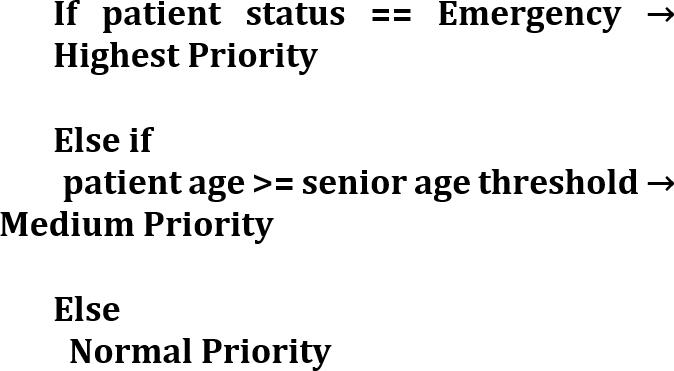
Themethodologyofthesystemisbasedonrule-basedconditionalpriorityallocation.Insteadofusingcomplexscheduling algorithms,astructuredconditionalapproachisimplementedtomaintainsimplicityandefficiency.
The logic works as follows:
International Research Journal of Engineering and Technology (IRJET) e-ISSN: 2395-0056
Volume: 13 Issue: 03 | Mar 2026 www.irjet.net p-ISSN: 2395-0072
When a patient registers for an appointment, the system checks the provided details. If the patient is marked as an emergencycase,thesystem immediately assigns thehighest priority and places the patientat the top of the queue.If the patient is not an emergency case but belongs to the senior citizen category, the system assigns secondary priority. All otherpatientsarecategorizedunderregularpriority.
Additionally,a separatesectionismaintainedfor physicallydisabledpatientsto ensureaccessibilityand reducedwaiting time.Thesystemalsomonitorsthe24-hourdoctorscheduleandidentifiesavailabletimeslots.Ifcancellationorfreetimeis detected, appointments are dynamically adjusted. Each patient is assigned a unique queue number, which ensures transparency and prevents duplication. The queue is updated automatically whenever a new appointment is added or a patientismarkedascompleted.
Table -1: Thisclassificationensuresstructuredpatientflowandimprovedcrowdmanagement.
Emergency
Senior Citizens Age above defined threshold
time
Regular Patients General consultation Normal Standard queueflow
Physically Disabled Mobility limitation registered Special Section Assisted priorityaccess
ANALYSIS:
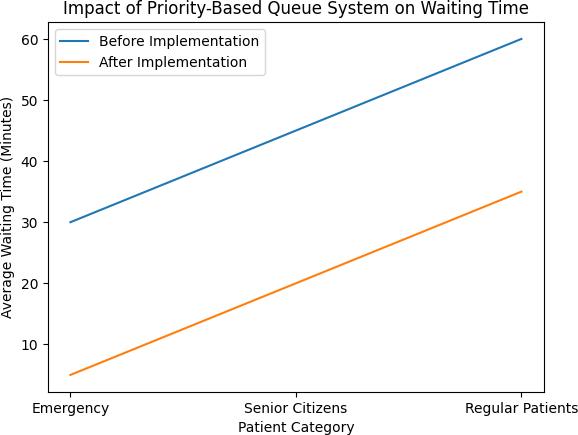
Chart -1:WaitingTimeAnalysisBeforeandAfterImplementation
Thegraphicalanalysisdemonstratesasignificantreductioninaveragewaitingtimeafterimplementingthepriority-based queue management system. Emergency cases experienced the highest improvement, with waiting time reducedfrom30 minutestoapproximately5minutes.Seniorcitizens’waitingtimedecreasedfrom45minutesto20minutes,whileregular patientssawareductionfrom60minutesto35minutes.Thisconfirmsthatthestructuredpriorityallocationmechanism effectivelyoptimizesqueueflowandreducesovercrowdinginclinicalenvironments.
International Research Journal of Engineering and Technology (IRJET) e-ISSN: 2395-0056
Volume: 13 Issue: 03 | Mar 2026 www.irjet.net p-ISSN: 2395-0072
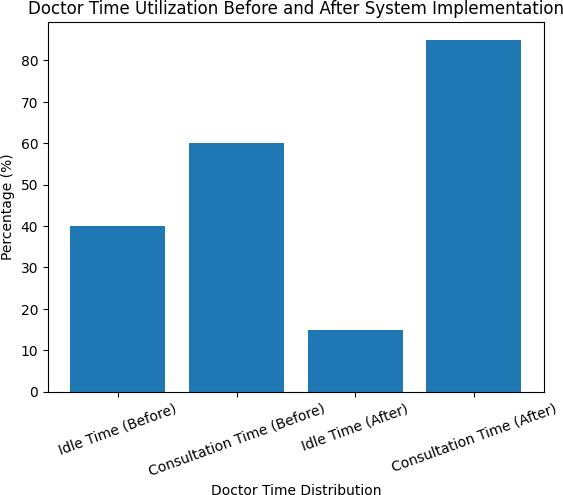
To evaluate the effectiveness of the proposed Clinic Appointment and Patient Queue Management System, doctor time utilization was analyzed before and after implementation of the priority-based scheduling mechanism. Before the implementationofthesystem,approximately40%ofthedoctor’savailabletimeremainedidleduetounevenappointment distribution, unstructured walk-ins, and scheduling gaps. Only 60% of the total time was effectively utilized for patient consultations.
Afterimplementingthedigitalappointmentsystemwithdynamictime-slotadjustment,idletimewassignificantlyreduced to nearly 15%. Consultation time utilization increased to approximately 85%, indicating improved scheduling efficiency andbetterworkloaddistribution.
The improvement is mainly attributed to:
Dynamicadjustmentofappointmentsintofreetimeslots
Structuredpriority-basedqueuehandling
Reductioninmanualschedulingerrors
Elimination of unnecessary crowd-based delays The analysis clearly demonstrates that the proposedsystem not only reduces patient waiting time but also enhances overall doctor productivity. By minimizing idle intervals and optimizing appointment allocation, healthcare servicedeliverybecomesmoreefficientandorganized.
The AI chatbot module is integrated into the platform to provide additional assistance to patients. The chatbot acts as a digitalsupportsystemthatcanrespondtocommonpatientqueriesandguideusersthroughtheplatform. Patientscanaskquestionsrelatedtogeneralhealthconcerns,medicineusage,appointmentprocedures,andclinictimings. Thechatbotanalyzestheuser'squeryandprovidesappropriateresponsesbasedonpredefinedrules. If the chatbot detects symptoms that may require professional medical attention, it advises the patient to book an appointment through the platform. This functionality helps reduce unnecessary clinic visits and improves patient engagement.
Thesystemconsistsofmultiplecomponentsthatworktogethertomanageappointmentsandpatientqueueseffectively. The frontend interface allows patients to interact with the platform and access system features such as appointment bookingandchatbotcommunication.
Thebackendserverprocessesuserrequests,managesprioritylogic,andhandlescommunicationwiththedatabase. Thedatabasestorespatientinformation,appointmentrecords,andqueuedatainanorganizedstructure. Together,thesecomponentscreateareliablesystemcapableofmanaginghealthcareoperationsefficiently.
International Research Journal of Engineering and Technology (IRJET) e-ISSN: 2395-0056
Volume: 13 Issue: 03 | Mar 2026 www.irjet.net p-ISSN: 2395-0072
•Significantreductioninaveragewaitingtimeacrossall patientcategories.
•Immediateprioritizationofemergencycasesthroughconditionallogic.
•Structuredaccessibilitysupportforseniorcitizensand physicallydisabledpatients.
•Improveddoctortimeutilizationduetodynamictime-slotadjustment.
•Reductioninidleconsultationhours.
•TransparentandautomatedqueuetrackingusinguniquepatientIDs.
•AIchatbothandledminorhealthqueriesdigitally.
•Decreaseinunnecessaryappointmentbookingsandwalk-incrowding.
•Enhancedoverallworkflowefficiencyinclinicoperations.
8. Advantages
•Organizedpatientqueuemanagement
•Priority-basedhandlingofemergencycases
•Reducedwaitingtimeforpatients
•Efficientschedulingofdoctorappointments
•Digitalrecordmanagementforpatientdata
•AIchatbotassistanceforbasichealthqueries appointments through smartphones. Additionally, notification systemssuchasSMSalertscanbeimplemented toinform patientsaboutappointmentschedulesandqueueupdates.
[1] MongoDB Inc., “MongoDB Documentation,” 2023. [Online].Available:https://www.mongodb.com/docs/
[2] OpenJS Foundation, “Node.js Documentation,” 2023.[Online].Available:https://nodejs.org/en/docs/
[3] Meta Platforms Inc., “React Official Documentation,” 2023.[Online].Available:https://react.dev/
[4]Express.js,“ExpressFrameworkDocumentation,”2023. [Online].Available:https://expressjs.com/
9.
TheproposedAI-integratedClinicAppointmentandPatient Queue Management System provides an efficient and scalable solutiontoovercrowdinginclinicsandhospitals.BycombiningMERNstacktechnologieswithrule-basedpriorityscheduling, the system ensures structured patient handling, immediate attention to emergency cases, and improved accessibility for senior citizens and physically disabled individuals. The dynamic time-slot management enhances doctor productivity by reducingidlehoursandoptimizingconsultationflow.TheintegrationofanAIchatbotfurtherstrengthenstheplatformby assisting patients with minor health-related queries and reducing unnecessary appointments. Overall, the system demonstrates how digital automation and intelligent assistance can significantly improvehealthcare workflow efficiency, patientsatisfaction,andresourceutilization.
Future improvements can include the integration of advanced artificial intelligence techniques for analyzing patient symptomsmoreaccurately.Mobileapplicationsupport can also be introduced to allow patients to book