
International Research Journal of Engineering and Technology (IRJET) e-ISSN: 2395-0056
Volume: 13 Issue: 05 | May 2026 www.irjet.net p-ISSN: 2395-0072
International Research Journal of Engineering and Technology (IRJET) e-ISSN: 2395-0056
Volume: 13 Issue: 05 | May 2026 www.irjet.net p-ISSN: 2395-0072
1Vijayalekshmi G, 2Gokul M S, 3Harikrishnan B, 4Jewel Joy, 5Joyal Saji
12345,Dept.ofElectronicsand Communication Engineering St. Joseph’s College of Engineering and Technology Palai, India
Abstract-In dangerous and disaster-prone areas, realtime monitoring and exploration play a vital role in mitigating risks and improving rescue efforts' effectiveness. This topic is based on a microcontroller-based Disaster Surveillance Rover paired with a Remote Monitoring Unit. The system focuses on efficient environmental monitoring through a combination of sensors including ultrasonic sensors for detecting obstacles, PIR sensors for motion detection, MQ5 sensors for detecting gas leaks, MLX90614 infrared sensors for measuring temperatures, KY037 sensors for measuring noise levels, and SW-420 vibration sensors for measuring vibrations. Communication relies on NRF24L01 modules facilitating efficient and reliable longdistance data transfer, while the remote unit utilizes a 16x2 I2C LCD to show real-time sensor data. Motivation involves four DC motors with L298Nmotor driversdrivenbyan11.1 volts lithiumion battery pack. The power management system uses buck converters to generate 5 volts and 3.3 volts voltage supply lines to operate the sensors and communication modules. The entire system uses the standalone ATmega328P chipset, which costs about 4000 Rs.
Disasters result in situations where humans find it difficult to enter the environment, making real-time monitoring and analysis crucial for the management of disasters.
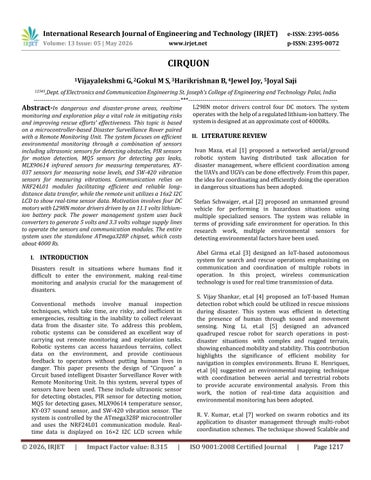
Conventional methods involve manual inspection techniques, which take time, are risky, and inefficient in emergencies, resulting in the inability to collect relevant data from the disaster site. To address this problem, robotic systems can be considered an excellent way of carrying out remote monitoring and exploration tasks. Robotic systems can access hazardous terrains, collect data on the environment, and provide continuous feedback to operators without putting human lives in danger. This paper presents the design of “Cirquon” a Circuit based intelligent Disaster Surveillance Rover with Remote Monitoring Unit. In this system, several types of sensors have been used. These include ultrasonic sensor for detecting obstacles, PIR sensor for detecting motion, MQ5 for detecting gases, MLX90614 temperature sensor, KY-037 sound sensor, and SW-420 vibration sensor. The system is controlled by the ATmega328P microcontroller and uses the NRF24L01 communication module. Realtime data is displayed on 16×2 I2C LCD screen while
L298N motor drivers control four DC motors. The system operateswiththehelpofaregulatedlithium-ionbattery.The systemisdesignedatanapproximatecostof4000Rs.
Ivan Maza, et.al [1] proposed a networked aerial/ground robotic system having distributed task allocation for disaster management, where efficient coordination among theUAVsandUGVscanbedoneeffectively.Fromthispaper, theideaforcoordinatingandefficientlydoingtheoperation indangeroussituationshasbeenadopted.
Stefan Schwaiger, et.al [2] proposed an unmanned ground vehicle for performing in hazardous situations using multiple specialized sensors. The system was reliable in terms of providing safe environment for operation. In this research work, multiple environmental sensors for detectingenvironmentalfactorshavebeenused.
Abel Girma et.al [3] designed an IoT-based autonomous system for search and rescue operations emphasizing on communication and coordination of multiple robots in operation. In this project, wireless communication technologyisusedforrealtimetransmissionofdata
S. VijayShankar, et.al [4] proposed an IoT-based Human detectionrobotwhichcould beutilizedinrescuemissions during disaster. This system was efficient in detecting the presence of human through sound and movement sensing. Ning Li, et.al [5] designed an advanced quadruped rescue robot for search operations in postdisaster situations with complex and rugged terrain, showingenhancedmobilityandstability.Thiscontribution highlights the significance of efficient mobility for navigationincomplexenvironments.Bruno E. Henriques, et.al [6] suggested an environmental mapping technique with coordination between aerial and terrestrial robots to provide accurate environmental analysis. From this work, the notion of real-time data acquisition and environmentalmonitoringhasbeenadopted.
R. V. Kumar, et.al [7] worked on swarm robotics and its application to disaster management through multi-robot coordinationschemes.ThetechniqueshowedScalableand
International Research Journal of Engineering and Technology (IRJET) e-ISSN: 2395-0056
Volume: 13 Issue: 05 | May 2026 www.irjet.net p-ISSN: 2395-0072
flexible response capability. From this work, the approach of efficient coordination in the system has beenused.
Zhi-YongShu, et.al [8]introduced a rescuerobot design with efficient mobility and sensing for disaster management operations. From this contribution, the concept of efficient integration of mobility with sensing for effective environmental monitoring has been adopted.
1. Design and construct an automated rover using the microcontroller ATmega328P for continuous environmentalmonitoring.
2. Incorporate multiple sensor components to sense obstacles, monitor movement, gas leakage, temperature, sound,andvibrations.
3. Establish wireless communication between the sensor module and the receiving module using the NRF24L01component.
4. Construct a motor-driven rover using the L298N motor driver IC that can be used in dangerous environments.
5. Design a small and economical setup costing less than4000Rs.
There are some situations where it is necessary to perform an immediate, safe evauations of potentially hazardousareas,withoutendangeringhumanlivesinany way. The example of the Sangareddy building falling down in Telangana, India, duringthemonthofJune2025 proves the importance of gaining immediate access to potentially hazardous areas along with gathering data instantly.
1. Real-timemonitoringusingmultiplesensors.
2. Reliablewirelesscommunication(150–200m).
3. Fastoperationandresponse.
4. Compactandlightweightdesign(1.5kg).
5. Durablebatterysystem.
6. Efficientpowermanagement.
7. Easyremotecontrol.
8. Obstacledetectioncapability(upto50cm).
9. Stableandaccuratesensorreading.
10. Continuousdatatransmissiontoremoteunit.
A. Sequence Diagram
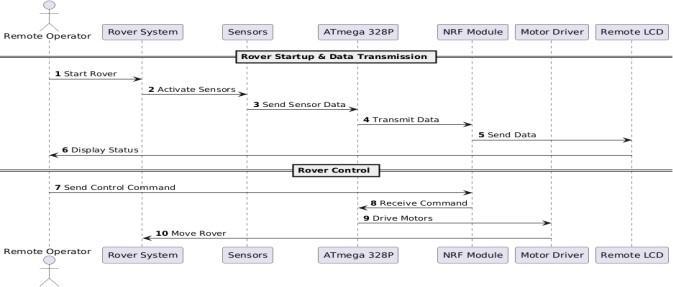
Fig. 1 SequenceDiagram
B. Use Case Diagram
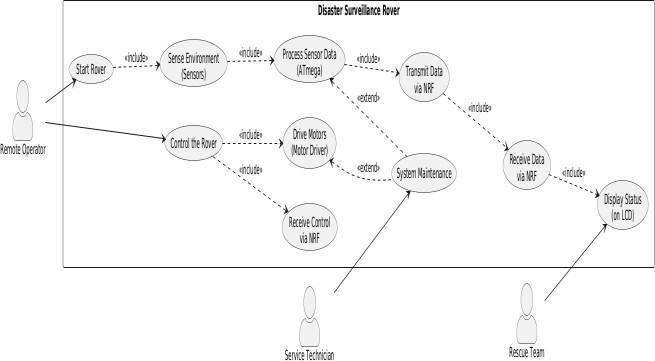
Fig. 2 Use-CaseDiagram
As illustrated in Figure 4.3, the block diagram shows the integration of sensors, motors, and wireless communication technologies in the disaster surveillance robot by the ATmega328P microcontroller. The HC-SR04 sensor detects obstacles in the path of the robot while the HC-SR501 PIR sensor detects movements around the vehicle. The hazardous gases in the environment are detectedthroughtheMQ5sensorwhilethetemperatureis sensedbytheMLX90614sensor.Vibrationsandsoundsare detected bythe SW-420andKY-037 sensors, respectively. The ATmega328P is the controlling element that gets the datafromeachandeverysensorinstalledintherobotand controls the system's operation. The real-time data collected by the sensors is transmitted to the remote unit throughtheNRF24L01wirelessmodule.Thewheelsofthe
International Research Journal of Engineering and Technology (IRJET) e-ISSN: 2395-0056
Volume: 13 Issue: 05 | May 2026 www.irjet.net p-ISSN: 2395-0072
robot are controlled by the L298N motor driver while the LM2596 step-down module is used to regulate the voltagelevelsto5Vand3.3V.
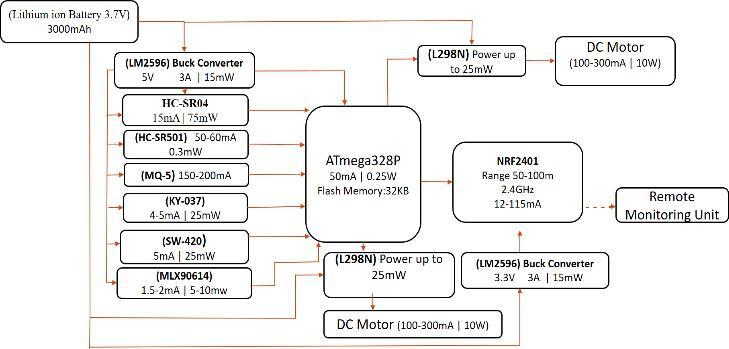
Fig. 3 BlockDiagram
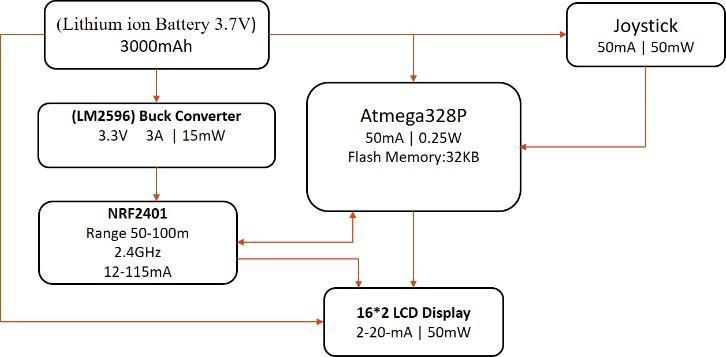
Fig. 4. BlockDiagram(RemoteMonitoringUnit)
VIII. CIRCUIT DIAGRAM
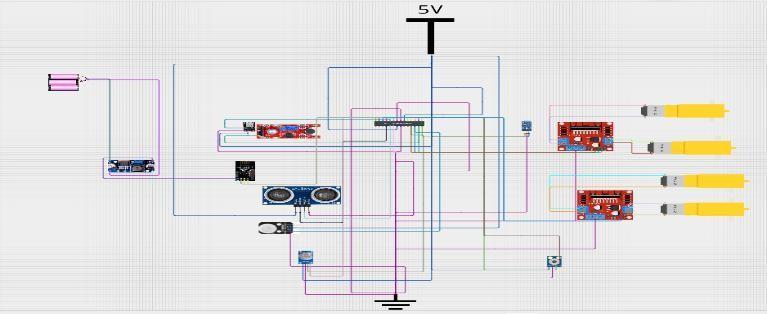
Fig. 5. CircuitDiagram
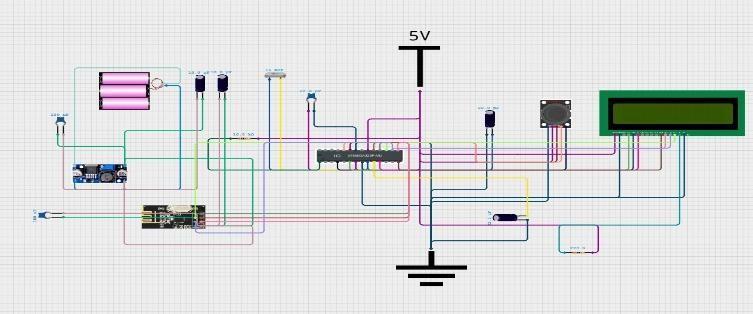
Fig. 6. CircuitDiagram(RemoteMonitoringUnit)
The remote monitoring device is centered on the ATmega328P microcontroller that connects the functionalities of wireless communication, display, and control.Datareceivedinrealtimefromtheroverintheform of signals is transferred wirelessly using the NRF24L01 module and reaches the ATmega328P microcontroller. The microcontroller processes the data and displays it live through the LCD 16x2 display via an I2C connection. The microcontroller not only processes and displays data, but also controls the rover through the transmissionofcommand signalsusingthejoystick module. Wireless transmission of the commands is also carried out via the NRF24L01 module. For power supply, an LM2596 voltage regulator is used to convert the input voltage to a stableoutputof3.3VfortheNRFmodule
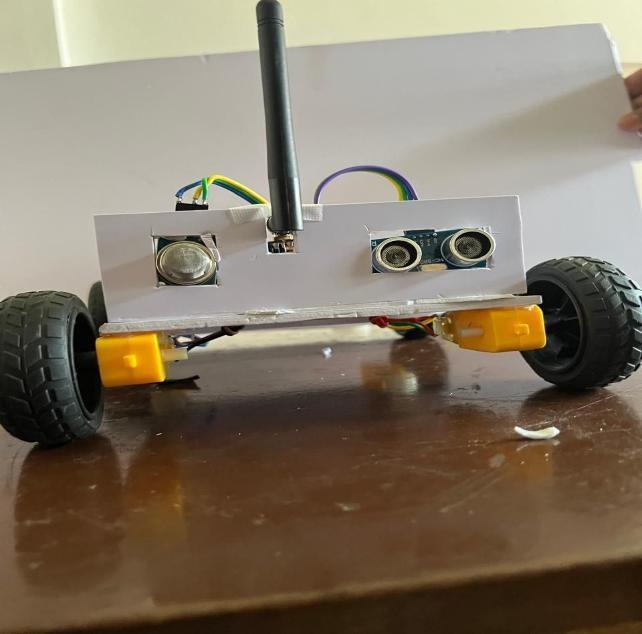
Finally, the Disaster Surveillance Rover with Remote Monitoring Unit has been effectively designed and implemented as a useful application for hazardous environmentmonitoring.Initially,thesystemwasassembled using a breadboard design and later organized within a compact PCB design utilizing the EasyEDA platform. Integration of the ATmega328P microcontroller and such sensors as the HC-SR04 ultrasonic, HC-SR501 PIR, MQ5 gas, MLX90614 temperature, KY-037 sound, and SW-420 vibration sensors allows efficient and accurate environment monitoring through detection of obstacles, presence of
International Research Journal of Engineering and Technology (IRJET) e-ISSN: 2395-0056
Volume: 13 Issue: 05 | May 2026 www.irjet.net p-ISSN: 2395-0072
people, gas leaks, temperature fluctuations, sound, and vibrations. Collected data is transmitted via the wireless communication system using the NRF24L01 transceiver moduletoaremotemonitoringunit,whereitispresented by means of the OLED screen. Besides, the joystick interface allows effective control of the rover movements. All in all, the system can function efficiently under challenging conditions. In conclusion, it is necessary to emphasize that the created Disaster Surveillance Rover withRemote Monitoring Unit has proven itself to be an effective tool for monitoring hazardous environment conditions remotely and safely. It significantly limits the participation of people in disaster environments. Moreover, the system shows the efficient work of the wireless communication system and embedded devices andcanserveasagoodbasisforfuturedevelopments.
1. Ivan. Maza, A. Viguria, and A. Ollero, “Networked aerial-ground robot system with distributed task allocation for disaster management,” in IEEE Int. Workshop on Safety, Security and Rescue Robotics (SSRR),2006.doi:10.1109/10544923
2. S. Schwaiger, L. Muster, G. Novotny et al., “UGVCBRN: An Unmanned Ground Vehicle for Chemical, Biological, Radiological, and Nuclear Disaster Response,”
3. A. Girma et al., “IoT-Enabled Autonomous System Collaboration for Search and Rescue Operations,” IEEEJ.AutomaticaSinica,2025.DOI: 10.1109/JAS.2020.1003291
4. S. Vijay Shankar, S. Bharathi, S. Krishnakumari, M. S. Kavitha, “Design and Development of Human Detection Robot to Rescue People from Disaster Environment by Using Internet of Things,” in Proc. IEEE Int. Conf. on Innovative Computing, Intelligent Communication and Smart Electrical Systems (ICSES),2023,DOI:10.1109/ICSES60034.10465483
5. Li, N., Cao, J., and Huang, Y., “Fabrication and testing of the rescue quadruped robot for post-disaster search and rescue operations,” in 2023 IEEE 3rd International Conference on Electronic Technology, Communication and Information (ICETCI), Changchun,China,26–28May2023,pp.723–729.DOI: 10.1109/ICETCI57876.2023.10176723
6. E. Henriques, M. Baglioni “Camera-based mapping in search-and-rescue via flying and ground robot teams,”MachineVisionandApplications,vol.35, art. 117,2024.DOI: 10.1007/s00138-024-01594-4
2026, IRJET | Impact Factor value: 8.315 |
7. R. V. Kumar, M. V. D. P. Kumar, M. B. and A. V. Hanuman,“SwarmRobotics forDisasterManagement,” International Journal of Intelligent Systems and Applications in Engineering, vol. 12, no. 4, pp. doi:10.5584–5595,2024.
8. Z. Y.Shu,K.Meng,andP.An,“Thedesignofrescuerobot based on disaster rescue,” in Proc. 2020 International Conference on Innovation Design and Digital Technology (ICIDDT), 2020, pp. 257–261,doi: 10.1109/ICIDDT52279.2020.00054