
International Research Journal of Engineering and Technology (IRJET) e-ISSN: 2395-0056
Volume: 13 Issue: 05 | May 2026 www.irjet.net p-ISSN: 2395-0072
International Research Journal of Engineering and Technology (IRJET) e-ISSN: 2395-0056
Volume: 13 Issue: 05 | May 2026 www.irjet.net p-ISSN: 2395-0072
Prof.Dhopre.N.P1 , Mr.MohammadSiyam2 ,Mr. Sumit Kaware3 , Mr. Faizan Khan4
1Asst. Professor, Department of CSE, Gramin Technical & Management, Campus, Vishnupuri, Nanded. (MH) India
2UG Student Department of CSE Gramin Technical & Management Campus, Vishnupuri, Nanded. (MH) India
3UG Student Department of CSE Gramin Technical & Management Campus, Vishnupuri, Nanded. (MH) India
4UG Student Department of CSE Gramin Technical & Management Campus, Vishnupuri, Nanded. (MH) India
Abstract: Selecting a suitable college during the admission process is a major challenge for students due to complex eligibility criteria, reservation policies, and continuously changing cut-off trends. Many students rely on manual comparison of admission information collected from multiple sources, which often leads to confusion and inefficient decision-making. This paper presents the design and implementation of a Check College Admission Advisor System that provides structured admission guidance using rule-based data analysis. The proposed system extracts previous year’s admission cut-off data from official PDF documents using the Python PDFPlumber library. The extracted data is processed and analyzed using Pandas and NumPy libraries to determine eligibility conditions based on student percentage, category, and preferred academic branch. A user-friendly web interface is developed using Streamlit to allow students to input their academic details and receive suitable college recommendations instantly. The system improves transparency, reduces manual effort, and supports data-driven admission planning. Unlike AI-based predictive systems, the proposed platform focuses on practical analysis of real admission datasets, making it reliable and easy to maintain. Future enhancements may include real-time admission updates and integration with centralized educational portals.
Keywords: Admission Guidance, Data Analysis, PDF Extraction, Streamlit, Rule-Based System, Educational Technology
Highereducationadmissionisanimportantstageinastudent’sacademicjourney,asitdirectlyinfluencesfuturecareer opportunities and professional growth. After completing higher secondary education or diploma studies, students are requiredtoselectsuitablecollegesandacademicprogramsbasedontheiracademicperformance,entranceexamination results,reservationcategory,and personal interests.However,the admission processhasbecomeincreasingly complex due to the rapid growth of educational institutions, availability of multiple course options, and continuously changing admissioncut-offtrends.Asaresult,studentsoftenfinditdifficulttoidentifycollegeswheretheyhaverealisticchancesof admission.
Inmanycases,studentsdependoninformalsourcessuchasfriends,relatives,socialmediadiscussions,orlocalcounseling centerstogatheradmission-relatedinformation.Althoughofficialwebsitesandadmissionbrochuresprovideusefuldata, theinformationisusuallypresentedinanunstructuredmanner.Studentsarerequiredtomanuallycomparepreviousyear cut-off marks, eligibility criteria, and seat availabilityacross multiple institutions. Thisprocessrequires significant time andeffortandmaystillleadtoconfusionorincorrectadmissiondecisions.Therefore,thereisastrongneedforastructured digitalplatformthatcansimplifytheanalysisofadmissiondataandprovideclearguidancetostudents.
The CheckCollege AdmissionAdvisor System is developedto addressthese challengesbyusing a data-driven and rulebasedapproach.Insteadofrelyingonpredictivemodelsorcomplexartificialintelligencetechniques,thesystemfocuses on analyzing real admission cut-off data collected from official PDF documents released byeducational authorities. By extracting and organizing this data into a structured format, the system enables accurate eligibility filtering based on studentpercentage,category,and preferredbranchofadmission.Thisapproachensurespracticalandreliableguidance alignedwithactualadmissiontrends.
Thesystemalsoprovidesaninteractive web-basedinterfacedevelopedusingStreamlit,whichallowsstudentstoeasily entertheiracademicdetailsandreceiveinstantcollegesuggestions.TheuseofPython-baseddataprocessinglibrariessuch
International Research Journal of Engineering and Technology (IRJET) e-ISSN: 2395-0056
Volume: 13 Issue: 05 | May 2026 www.irjet.net p-ISSN: 2395-0072
as PDFPlumber, Pandas, and NumPy ensures efficient extraction, cleaning, and analysis of admission datasets. By presentingadmissionrecommendationsinaclearanduser-friendlymanner,theplatformreducesdependencyonmanual counselingandhelpsstudentsmakeinformedacademicdecisions.
Furthermore, the proposed system contributes to improving transparency and accessibility in the admission process. Studentsfromdifferentgeographicalregionscanaccesstheplatformandobtainstructuredadmissionguidancewithout requiringextensivetechnicalknowledge.Themodulardesignofthesystemalsoallowsfutureenhancementssuchasrealtime admission updates, integration with centralized admission portals, and development of mobile-based advisory applications. Overall, the Check College Admission Advisor System represents a practical step toward the digital transformation ofadmissionguidancebyprovidingasimple,reliable,anddata-orienteddecisionsupportsolution.
The use of digital platforms in higher education admission processes has increased significantly in recent years. Many educationalinstitutionsandgovernmentauthoritiesprovideonlineadmissionportalstosimplifyapplicationsubmission and information dissemination. These systems allow students to access details such as course availability, eligibility criteria,admissionschedules,andinstitutionalguidelines.However,mostoftheseplatformsprimarilyfocusonapplication managementratherthanassistingstudentsinanalyzingtheirchancesofadmission.Asaresult,studentsarestillrequired tomanuallyinterpretpreviouscut-offtrendsandcomparemultiplecollegesbeforemakingdecisions.
Several studies have explored the development of intelligent academic advisory systems that use data processing techniquestosupportstudentdecision-making.Thesesystemsaimtoimprovetransparencyandaccessibilityinadmission guidance by organizing large volumes of educational data into structured formats. Web-based counseling tools and centralizedinformationsystemshavebeenproposedtoreducethedependencyontraditionalcounselingmethods.Such platforms enable studentsto obtain admission-related information froma single source, thereby reducing the time and effortrequiredtosearchacrossmultiplewebsites.
In recent research, artificial intelligence and machine learning techniques have also been applied in educational recommendation systems to predict student performance or suggest academic pathways. While these approaches offer advancedpredictivecapabilities,theyoftenrequireextensivedatasets,modeltraining,andcontinuousupdates.Inpractical admission scenarios, especially at regional or institutional levels, rule-based data analysis using actual previous year admission cut-off records can provide more realistic and understandable guidance to students. Systems based on real admissiondataensurethatrecommendationsarealignedwithofficialeligibilityconditionsandhistoricaltrends.
Despitetheavailabilityofdigitaladmissionplatforms,thereisstillalackofstructureddecision-supportsystemsthatcan automatically analyze previous admission cut-off data and generate suitable college suggestions. Students often face confusion due to unorganized information, manual comparison processes, and uncertainty regarding admission possibilities.Therefore,theproposedresearchfocuses ondevelopinga Check College Admission Advisor System that extractsadmissiondatafromofficialPDFdocumentsandprocessesitusingPython-baseddataanalysistools.Bypresenting filteredandrelevantcollegeoptionsthroughaninteractivewebinterface,thesystemaimstoimproveadmissionplanning efficiencyandsupportdata-drivenacademicdecision-making.
Anotherimportantaspecthighlightedinrecentstudiesistheuseofdataextractionanddataprocessingtoolsforanalyzing educationalinformationavailableinunstructuredformatssuchasPDFdocuments,reports,andadmissionnotices.Many admissionauthoritiespublishcut-offlistsandeligibilitydetailsindocumentform,whichmakesitdifficultforstudentsto directlyanalyzeorcomparethedata.Researchershavesuggestedthatconvertingsuchunstructureddataintostructured datasets using programming tools can significantly improve accessibility and usability. Python libraries for document parsinganddataanalysisenableefficientextraction,cleaning,andfilteringofadmissioninformation.Whencombinedwith simpleweb-basedinterfaces,suchsystemscanprovide practicaldecisionsupportwithoutrequiringcomplexpredictive models. This approach emphasizes transparency, real-world data usage, and ease of system implementation, making it suitable for developing admission advisory platforms that focus on accurate eligibility analysis rather than theoretical prediction.
International Research Journal of Engineering and Technology (IRJET) e-ISSN: 2395-0056
Volume: 13 Issue: 05 | May 2026 www.irjet.net p-ISSN: 2395-0072
Basedonsurveys,studentinteractions,andanalysisofexistingadmissionguidancesystems,thefollowing majorproblemswereidentified:
1. Lack of Personalized Admission Guidance:
Many students do not receive proper and customized guidance during the college selection process. Most admission decisions are taken based on assumptions, limited information, or informal advice, which may not reflectactualeligibilityconditions.
2. Scattered Admission Information Sources:
Important admission data such as previous year cut-off marks, eligibility criteria, course availability, and institutionalrequirementsaredistributedacrossmultipleplatformslikecollegewebsites,PDFs,brochures,and admissionportals.Thismakessystematiccomparisondifficultforstudents.
3. Dependence on Informal Counseling Methods:
Students often rely on suggestions from friends, relatives, coaching centers, or social media discussions. Such sourcesmayprovideoutdatedorinaccurateinformation,leadingtoconfusionandinappropriatecollegechoices.
4. Absence of Centralized Structured Admission Platform:
There is no single digital platform that collects, organizes, and presents verified admission cut-off data in a structuredandeasy-to-understandformat.Thiscreatesdifficultiesinanalyzingrealisticadmissionpossibilities.
5. Difficulty in Understanding Admission Eligibility:
Students find it challenging to interpret admission criteria such as percentage requirements, reservation categoryconditions,andbranch-wisecut-offtrendswithoutexpertassistance.
6. Time-Consuming Manual Comparison Process:
Analyzingmultiplecollegecut-offPDFsandcomparingeligibilityconditionsmanuallyrequiressignificanttime andeffort,especiallyduringthelimitedadmissionperiod.
7. Limited Decision-Support Features in Existing Systems:
Mostcurrentadmissionportalsfocusonlyonapplicationsubmissionorgeneralinstitutionalinformationanddo notproviderule-basedeligibilityfilteringorstructuredrecommendationsupport.
8. Lack of Awareness About Suitable Colleges:
Due tounorganizedadmissioninformationandabsence ofanalytical tools,manystudentsremainunaware of collegeswheretheyhaverealisticchancesofadmissionbasedontheiracademic performanceandpreferences.
Toaddresstheaboveproblems,an Intelligent College Admission Advisor System isbeingdeveloped.
1. Allow students to enter academic details such as marks, entrance exam scores, category, preferred course,andlocationpreferences.
2. Analyzestudentdatausingpredefinedadmissionrulesandeligibilitycriteria.
3. Predictsuitablecollegesandacademicprogramsbasedonstudentperformance.
4. Displayrecommendedcollegessortedaccordingtoeligibility,cut-offtrends,andrelevance.
5. Provide detailed information about each college, including course availability, fee structure, placementrecords,andadmissionrequirements.
With this solution, students will no longer need to manually search different websites or depend completely on counselingcentersforadmissionguidance.
Allrelevantcollegeinformationandadmissionsuggestionswillbeavailableinstantlyonasingleplatformbasedon thestudent’sacademicprofile.
International Research Journal of Engineering and Technology (IRJET) e-ISSN: 2395-0056
Volume: 13 Issue: 05 | May 2026 www.irjet.net p-ISSN: 2395-0072
The processof selectinga suitable college andcourse aftercompletinghighersecondaryeducationorentrance examinationsisoftencomplexandtime-consumingforstudents.Inmanycases,studentsdependonscatteredinformation availableonmultiplewebsites,counselingcenters,orinformalguidancefromfriendsandrelatives.Thislackofstructured and reliable information makes it difficult for them to understand eligibility criteria, compare institutions, and make informed academicdecisions.To overcome these challenges,the concept of a rule-based college admission guidance system has emerged as an effective digital solution that simplifies the admission process through logical filtering and organizeddatamanagement.
Arule-basedadmissionguidancesystemworksonpredefinedconditionsandinstitutionaladmissionrulesstored in a centralized database. Instead of using Artificial Intelligence or predictive learning techniques, the system follows a structured approach where students provide inputs such as academic marks, entrance examination scores, preferred stream or course, category, and location preferences. The system then compares these inputs with the eligibility requirements of various colleges and generates a list of institutions where the student is eligible to apply. This logical comparisonmechanismhelpsstudentsquicklyidentifysuitablecollegeswithoutmanuallycheckingcut-offsandadmission criteriafromdifferentsources.
Oneofthemajoradvantagesofsuchsystemsistheirabilitytoprovideaccurateandtransparentinformationina user-friendly digital format. Students can access college details, admission procedures, course availability, and basic eligibility requirements in a single platform. This reduces confusion, saves time, and minimizes the risk of missing importantopportunitiesduetolackofawareness.Additionally,thecentralizedstructureofthesystemallowseducational authorities or administrators to update admission rules, course information, and institutional data efficiently, ensuring thatstudentsalwaysreceiveup-to-dateguidance.
Furthermore,rule-basedadmissionguidanceplatformscontributetobetteracademicplanningbyhelpingstudents understandtheirrealisticadmissionoptionsbasedontheirperformanceandpreferences.Thesesystemsareparticularly beneficialforstudentsfromruralorremoteareaswhomaynothaveeasyaccesstoprofessionalcounselingservices.By digitizing the admission guidance process and presenting information in a structured manner, the system promotes fairness,accessibility,andinformeddecision-makinginhighereducationadmissions.
Overall, the rule-based college admission guidance system represents a practical and technology-supported approachtoimprovingthecollegeselectionprocess.AlthoughitdoesnotuseadvancedArtificialIntelligencetechniques, it effectively streamlines admission guidance through logical rules, organized databases, and automated eligibility checking.Suchsystemsplayasignificantroleinenhancingtransparency,reducinguncertainty,andsupportingstudentsin makingconfidentacademic andcareerchoices
Inrecentyears,digitaltransformationhassignificantlyinfluencedtheeducationsector,particularlyinthe areaofadmissionguidanceandstudentsupportservices.Theincreasingnumberofhighereducationinstitutions, courses, and admission procedures has made it difficult for students to gather accurate information and make suitable academic choices. This study focuses on the role of digital technologies in improving admission support systemsandsimplifyingthecollegeselectionprocessthroughstructuredonlineplatforms.
The research highlights how web-based admission guidance systems help students access centralized information related to college eligibility criteria, course availability, admission schedules, and institutional requirements.Unliketraditionalcounselingmethodsthatrelyheavilyonmanualguidanceandfragmentedsources ofinformation,digitalplatformsprovideanintegratedenvironmentwherestudentscanentertheiracademicdetails andreceivefilteredresultsbasedonpredefinedrulesandlogicalcomparisonmechanisms.Thedataforthisstudy wascollectedthroughanalysisofexisting onlineadmissionportals,studentfeedbacksurveys,andreviewofcurrent digitaleducationsupporttools.
International Research Journal of Engineering and Technology (IRJET) e-ISSN: 2395-0056
Volume: 13 Issue: 05 | May 2026 www.irjet.net p-ISSN: 2395-0072
Theresultsindicatethatdigitaladmissionsupportsystemsimprovetransparency,accessibility,andefficiency intheadmissionprocess.Studentsareabletocomparemultiplecollegesinashortperiod,understandtheireligibility status, and plan their academic journey more effectively. The structured presentation of admission-related data reduces confusion and helps students avoid incorrect decisions caused by misinformation or lack of guidance. Furthermore, the study shows that centralized digital systems assist educational institutions in managing large volumesofadmissionqueriesandapplicationsmoresystematically.
The findings of this research contribute to the development of technology-driven educational services by emphasizingtheimportanceofuser-friendlydigitalplatformsinacademicdecision-making.Suchsystemsprovidevaluable supportnotonlytostudentsbutalsotoinstitutionsandcounselingorganizationsbystreamliningtheadmissionworkflow andenhancingcommunicationbetweenstakeholders.Overall,digitaltransformationinadmissionguidanceplaysacrucial roleinpromotingefficient,transparent,andaccessiblehighereducationopportunitiesforstudents.
Withtheincreasinguseofdigitaltechnologiesintheeducationsector,onlineadmission guidanceplatformshave become essential tools for helping students select suitable colleges and courses. Many students face difficulties in understanding eligibility criteria, comparing institutions, and accessing reliable admission information due to the availabilityofscattereddataacrossmultiplesources.Toaddressthisissue,arule-basedonlineadmissionguidanceplatform canbedevelopedtoprovidestructuredandcentralizedinformationtostudents.Suchasystemallowsuserstoentertheir academic details, entrance examination scores, and course preferences, and then processes this information using predefinedinstitutionaladmissionrulestogeneratealistofeligiblecolleges.Thisapproachimprovestransparency,reduces the time required for manual comparison, and supports better academic decision-making. Furthermore, the platform enhances accessibility for students from different regions by providing a simple, user-friendly interface and organized admission data. Overall, the development of an online admission guidance system contributes to efficient admission management,minimizesconfusionduringcollegeselection,andpromotestechnology-supportededucationalplanning.
From the review of existing studies and digital admission guidance platforms, it is observed that many systems focusmainly on providing general admission informationor relyonadvanced technologiessuchasArtificial Intelligence andpredictiveanalytics.However,theseapproachesoftenincreasesystemcomplexity,requirelargedatasets,andmaynot alwaysbepracticaloraccessibleforalleducationalinstitutionsandstudents.Additionally,severalexistingplatformspresent admissiondatainascatteredorlessstructuredformat,whichstillcreatesconfusionduringcollegeselection.Thereisalack ofsimple,rule-basedadmissionguidancesystemsthatcanefficientlycheckstudenteligibilityusingpredefinedinstitutional criteriaandprovideclear,filteredcollegerecommendationsonasingleplatform.Moreover,limitedattentionhasbeengiven todesigninguser-friendlydigitalsolutionsthatcanbeeasilyimplementedwithouthightechnicalrequirementswhilestill improvingtransparencyanddecision-makingintheadmissionprocess.Therefore,thereisaneedtodevelopastructured, database-driven admission guidance system that simplifies college selection, reduces dependency on manual counseling, andsupportsstudentsinmakinginformedacademicchoices.
Theproposedsystemisdesignedasarule-basedonline collegeadmissionguidance platformthathelpsstudents identifysuitablecollegesbasedontheiracademiceligibility.Themethodologyfocusesoncollectingstudentinputdatasuch as marks obtained in qualifying examinations, entrance examination scores, preferred courses, and location preferences. Thisinformationisprocessedusingpredefinedadmissionrulesstoredinacentralizeddatabasecontainingdetailsofvarious colleges,courses,andeligibilitycriteria.Thesystemperformslogicalfilteringandcomparisontogeneratealistofcolleges wherethestudentiseligibletoapply.Theplatform alsoprovidesadditionalfeaturessuchascollegeinformationdisplay, course details, and basic admission guidelines to support student decision-making. The development process includes databasedesign,userinterfaceimplementation,rule-basedlogicintegration,andtestingtoensureaccurateresultsanduserfriendlyoperation.Thisstructuredmethodologyaimstosimplifytheadmissionprocess,reducemanualeffort,andimprove transparencyincollegeselectionthroughanefficientdigitalsolution.
Volume: 13 Issue: 05 | May 2026 www.irjet.net p-ISSN: 2395-0072
Thesystemarchitectureoftheproposedrule-basedcollegeadmissionguidanceplatformisdesignedtoprovidea structuredandefficientmechanismforcheckingstudenteligibilityanddisplayingsuitablecollegeoptions.Thearchitecture mainlyconsistsofthreemajorcomponents:theuserinterfacelayer,theapplicationprocessinglayer,andthedatabaselayer Theuserinterfaceallowsstudentstoregister,login,andentertheiracademicdetailssuchasmarks,entranceexamination scores,preferredcourses,andlocationpreferences.Thisinformationisthentransferredtotheapplicationlayer,whererulebasedlogicalprocessingisperformed.Thesystemcomparesthestudent’sinputdatawithpredefinedadmissionrulesand eligibilitycriteria storedin the centralizeddatabase.Basedonthiscomparison, the systemgeneratesfilteredresultsand displaysalistofeligiblecollegesalongwithrelevantinformationsuchascourseavailabilityandadmissionrequirements. The database layer plays an important role in storing institutional details, eligibility conditions, and user records in an organized manner. This layered architecture ensures smooth data flow, easy system maintenance, and improved performance. It also enhances system reliability and transparency by providing accurate admission guidance through structureddigitalprocessing.
Inadditiontothelayeredstructure,thesystemarchitecturealsoemphasizesefficientdatamanagementandsmooth interactionbetweendifferentmodulesoftheplatform.Theuserinterfacemoduleisresponsibleforcollectingaccurateinput fromstudentsandpresentingtheeligibilityresultsin aclearandunderstandableformat.Theprocessingmodulehandles ruleexecution,datavalidation,andresultgenerationbyapplyingpredefinedlogicalconditionsonthestoredadmissiondata Properconnectivitybetweentheapplicationlayerandthedatabaseensuresthatupdatedcollegeinformationandeligibility criteriaareretrievedquickly,whichimprovestheoverallperformanceofthesystem.Moreover,thearchitectureisdesigned inamodularmannersothatnewcolleges,courses,oradmissionrulescanbeaddedeasilywithoutaffectingexistingsystem functionality. This flexibility enhancessystemscalabilityand maintainability, makingthe platformsuitable for handlinga large number of users during peak admission periods. Overall, the structured system architecture supports reliable operation,fasterresponsetime,andeffectivedigitalguidanceforstudentsduringthecollegeselectionprocess.
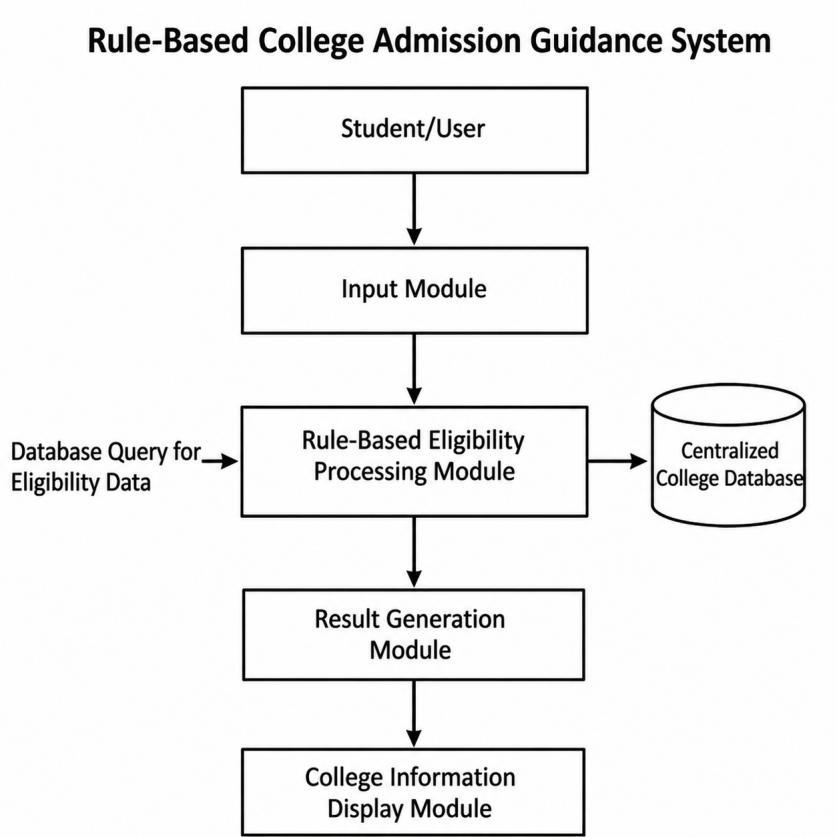
4.1: System Architecture of Rule-Based College Admission Guidance System
International Research Journal of Engineering and Technology (IRJET) e-ISSN: 2395-0056
Volume: 13 Issue: 05 | May 2026 www.irjet.net p-ISSN: 2395-0072
4.2 : Level-0 Data Flow Diagram of Rule-Based College Admission Guidance System
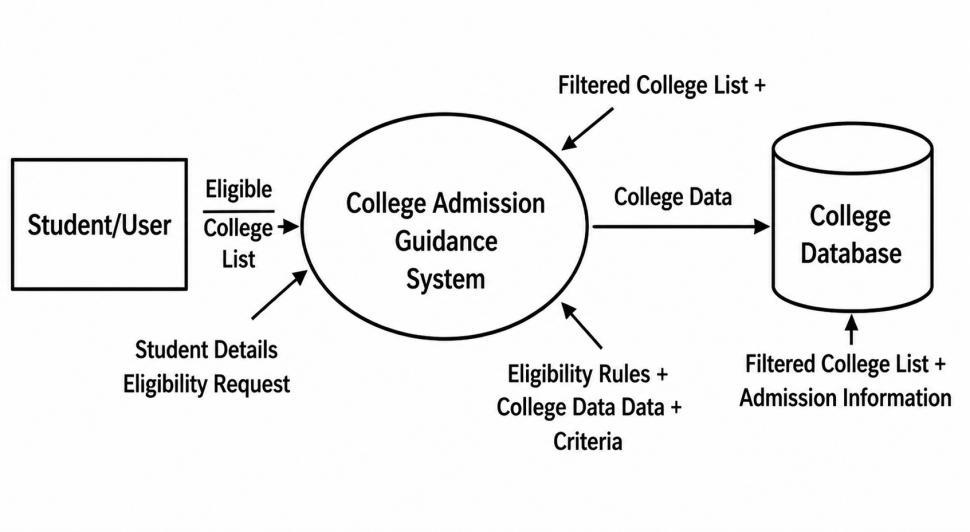
Figure 4.2: Level-0 Data Flow Diagram of Rule-Based College Admission Guidance System
4.3 : Level-1 Data Flow Diagram of Rule-Based College Admission Guidance System
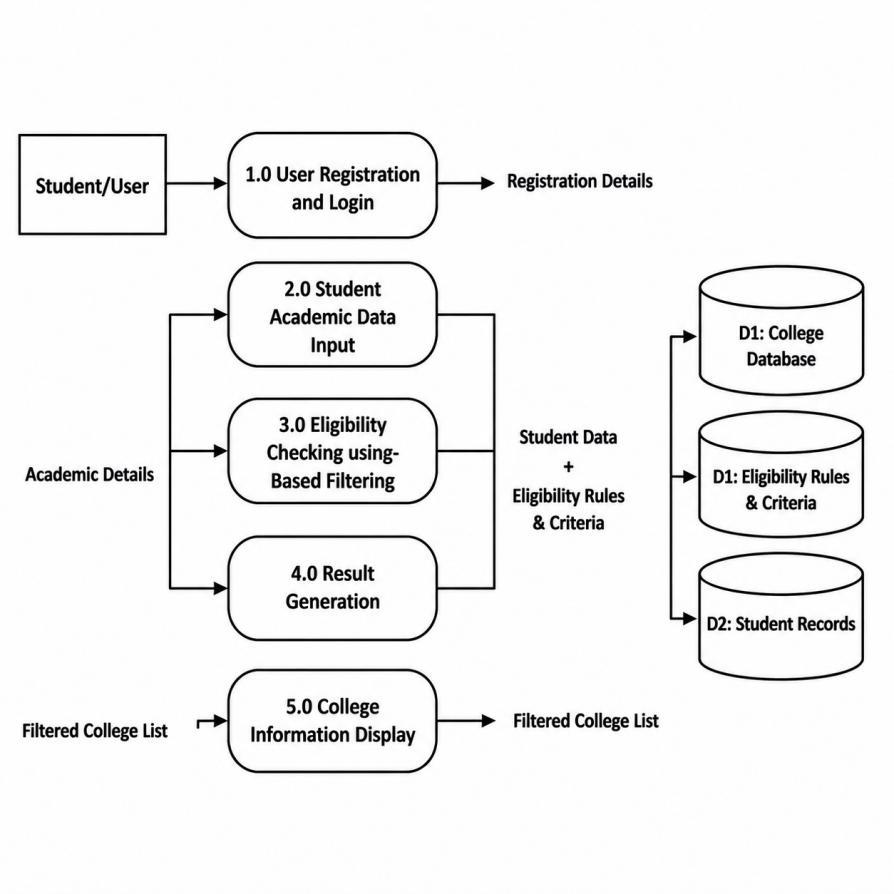
Figure 4.3: Level-1 Data Flow Diagram of Rule-Based College Admission Guidance System
Volume: 13 Issue: 05 | May 2026 www.irjet.net p-ISSN: 2395-0072
Theimplementationoftheproposedrule-basedcollegeadmissionguidancesystemfocusesondevelopingauserfriendlyandefficientdigitalplatformthatassistsstudentsincheckingtheircollegeeligibility.Thesystemisimplemented using web-based technologies that support data collection, processing, and result generation in a structured manner. Initially,acentralizeddatabaseiscreatedtostoreinformationaboutcolleges,courses,admissioneligibilitycriteria,and user details. The front-end interface is designed to allow students to easily register, log in, and enter their academic informationsuchasmarks,entranceexaminationscores,preferredstream,andlocationpreferences.
Thecorefunctionalityofthesystemisdevelopedusingrule-basedlogicalconditionsthatcomparethestudent’s inputdatawiththestoredeligibilityrulesofdifferentinstitutions.Basedonthiscomparison,thesystemgeneratesalistof colleges where the student meets the admission requirements. Additional features such as college information display, coursedetails,andbasicadmissionguidelinesarealsoimplementedtosupportstudentdecision-making.Propertestingis carried out to ensure system accuracy, usability, and reliability. Overall, the implementation phase ensures that the proposed platform operates smoothly and provides effective digital admission guidance to students in a simple and transparentmanner.
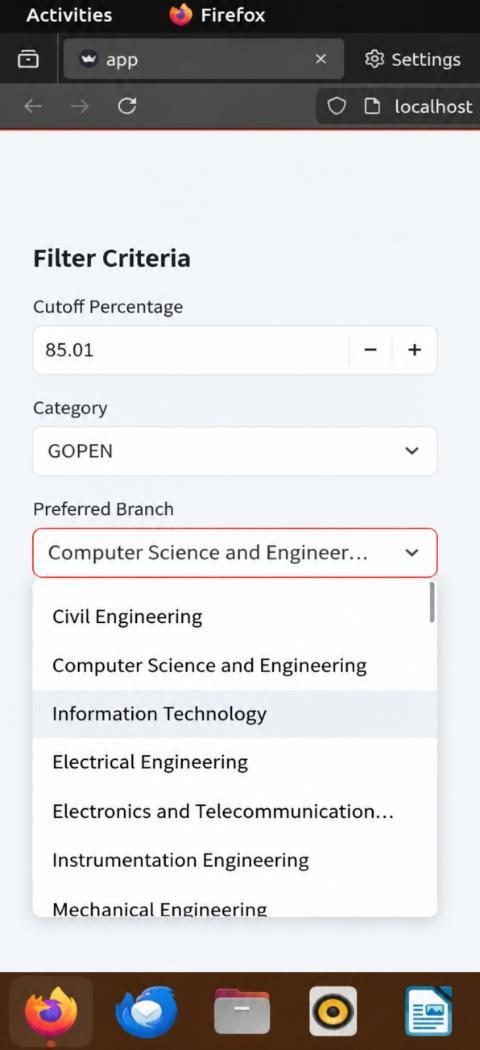
The system provides a filter criteria panel where the user enters admission-related details such as cutoff percentage, category, and preferred engineering branch. This interface is designed to collect accurate academic and preference data from the student. The cutoff percentage field allows users to specify their obtained score, while the categoryselectionhelpsinapplyingcategory-wiseadmissionrules.Thepreferredbranchdropdownenablesstudentsto choosetheirdesiredcourseforeligibilitychecking.
International Research Journal of Engineering and Technology (IRJET) e-ISSN: 2395-0056
Volume: 13 Issue: 05 | May 2026 www.irjet.net p-ISSN: 2395-0072
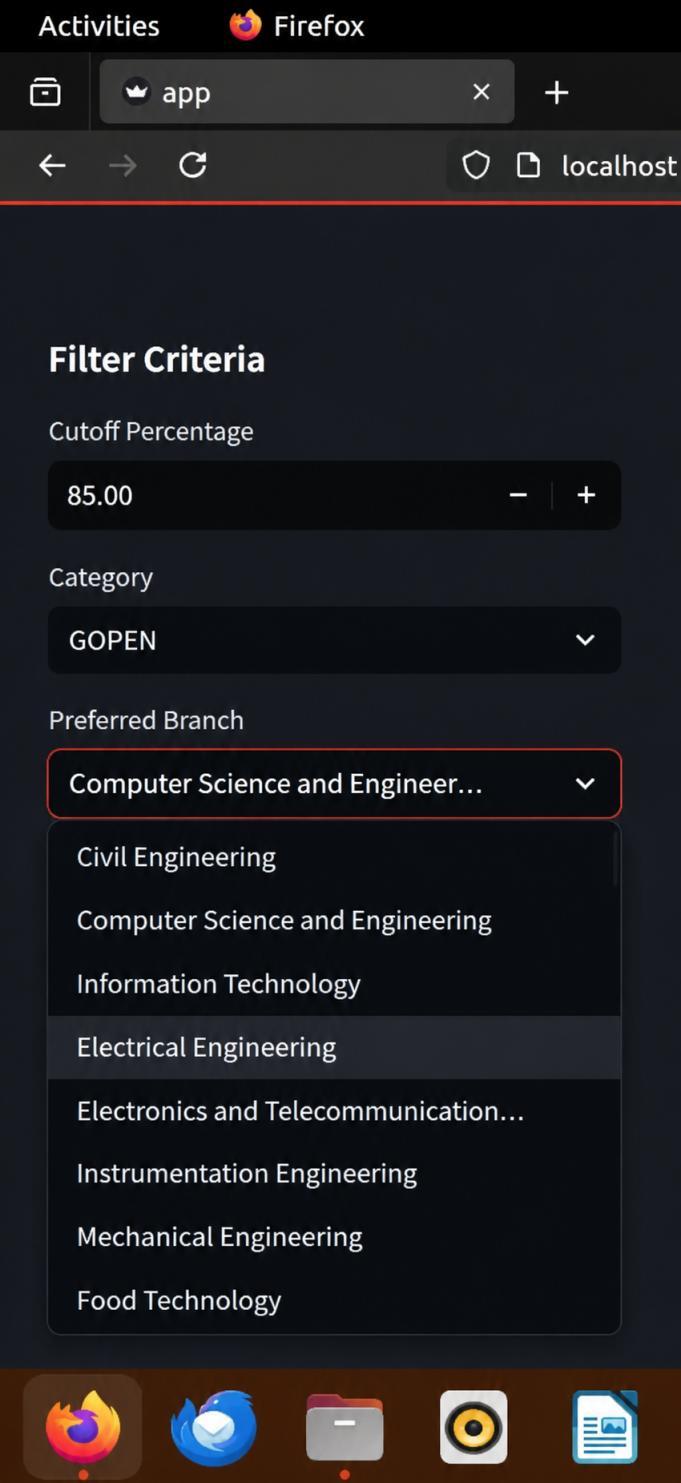
After entering the cutoff percentage and category, the user selects the preferred engineering branch from the dropdownlist. The system dynamicallyupdatesthe filteringconditions basedonthe selectedcourse.Thisstepensures thatonlyrelevantcollegesofferingthechosenbranchareconsideredduringeligibilitychecking.
International Research Journal of Engineering and Technology (IRJET) e-ISSN: 2395-0056
Volume: 13 Issue: 05 | May 2026 www.irjet.net p-ISSN: 2395-0072
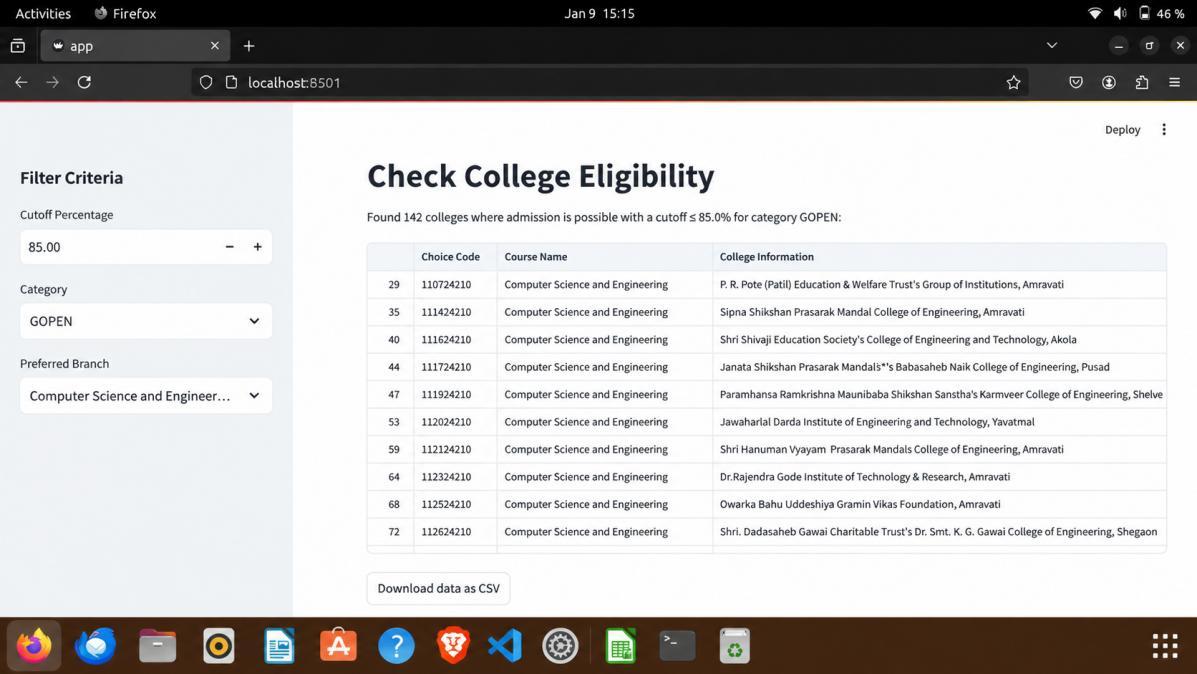
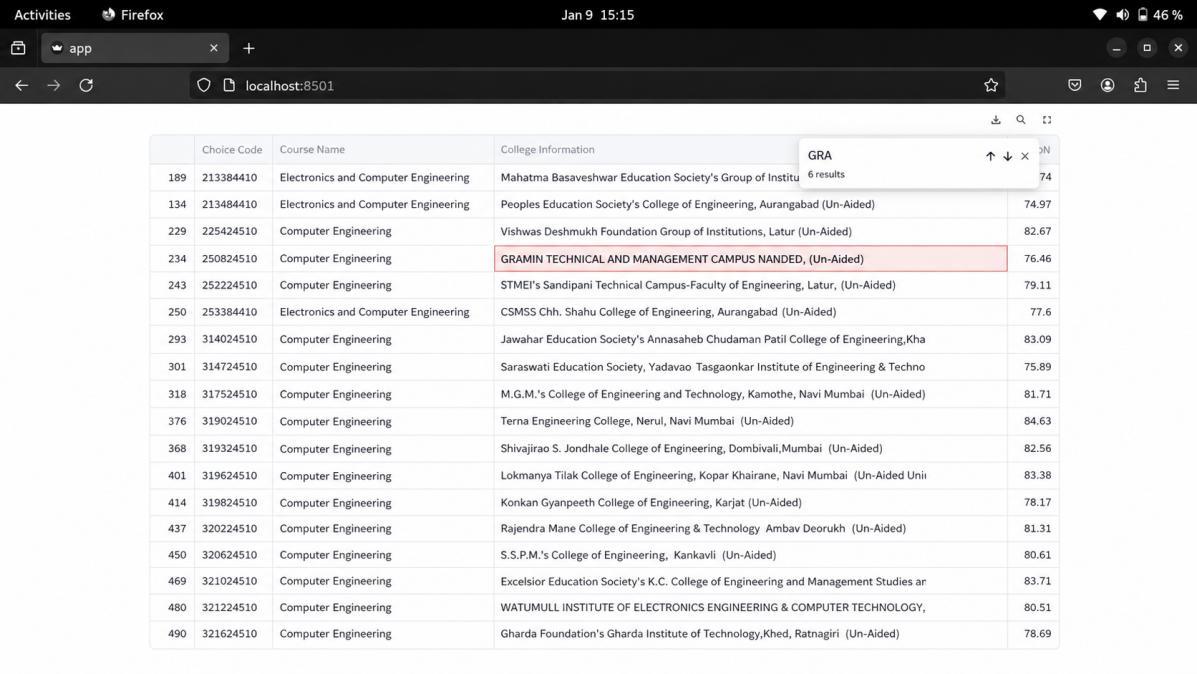
Afterprocessingtheinputdata,thesystemgeneratesafilteredlistofeligiblecolleges.Inthetestedscenario,the systemidentified 142 colleges whereadmissionispossiblefortheselectedcutoffpercentageandcategory.Theresults aredisplayedinatabularformatcontainingdetailssuchaschoicecode,coursename,collegeinformation,andcutoff values.Thisstructuredresultpresentationsupportsstudentsincomparinginstitutionsandmakinginformedadmission decisions.
International Research Journal of Engineering and Technology (IRJET) e-ISSN: 2395-0056
Volume: 13 Issue: 05 | May 2026 www.irjet.net p-ISSN: 2395-0072
The system can be enhanced by integrating real-time admission data and cutoff updates from official counseling authorities to improve accuracy.
1. A mobile application version of the platform can be developed to increase accessibility for students using smartphones.
2. Theplatformcanbeexpandedtoinclude more colleges, courses, and universities from different regions toprovidewideradmissionguidance.
3. Advanced features such as college comparison tools, admission notifications, and counseling schedule updates canbeadded.
4. Thesystemcanbeimprovedbyintegrating Artificial Intelligence or machine learning techniques inthefuture toprovidepersonalizedcollegerecommendations.
5. A student profile tracking and history module can be implemented to help users monitor their admission possibilitiesovertime.
6. Integration with online application portals and document verification systems can make the admission processmoreautomatedandefficient.
7. The platform can also include career guidance, course reviews, and placement statistics to support better academicdecision-making.
[1] R. B. Khedkar and S. R. Patil, “Web-Based Decision Support System for College Admission Guidance,” International Journal of Computer Applications,vol.180,no.32,pp.15–19,2018.
[2] P. Sharma and M. Singh, “Digital Admission Management System for Higher Education Institutions,” International Journal of Advanced Research in Computer Science,vol.9,no.2,pp.210–214,2018.
[3] A.KumarandR.Gupta,“OnlineCollegeSelectionSystemUsingRule-BasedFilteringTechniques,” International Journal of Engineering Research and Technology (IJERT),vol.7,no.5,pp.345–349,2019.
[4] S.MehtaandK.Shah,“StudentDecisionSupportSystemsinEducation:ASurvey,” International Journal of Innovative Technology and Exploring Engineering,vol.8,no.6,pp.1200–1204,2019.
[5] T. Jain and V. Sharma, “Design and Implementation of Web-Based Information Systems for Academic Guidance,” International Journal of Scientific Research in Computer Science, vol. 6, no. 3, pp.25–30,2018.