
International Research Journal of Engineering and Technology (IRJET) e-ISSN: 2395-0056
Volume: 13 Issue: 05 | May 2026 www.irjet.net p-ISSN: 2395-0072
International Research Journal of Engineering and Technology (IRJET) e-ISSN: 2395-0056
Volume: 13 Issue: 05 | May 2026 www.irjet.net p-ISSN: 2395-0072
RamaChandra Bhardwaj Chamarti¹, Pardiv Kamishetty², Anurag Narsingoju³, Krish Chandan´, Ms. T. Padmaja, Mr. P. Kiran Kumar
¹⁻⁵ Department of Computer Science and Engineering, Keshav Memorial Institute of Technology, Hyderabad, India Undertheguidanceof Professor,DepartmentofComputerScienceandEngineering,KeshavMemorialInstitute ofTechnology,Hyderabad,India
Abstract - Anyone who has driven an electric vehicle knows the quiet anxiety that creeps in when the battery drops below 30%. You start wondering is there a charging station nearby? Will the connector fit? Is it even available right now? These are not small frustrations. For millions of EV drivers, they are daily realities that make electric driving feel more stressful than it should be.
The truth is, the technology inside electric vehicles has leaped forward, but the experience around charging has not kept up. Drivers today often rely on a patchwork of apps one to find stations, another to book, another to pay. Half the time, the information is outdated. The other half, the station is occupied when you get there.
Charginix started as a simple question: what if all of that just worked, in one place?
Built using React Native and Expo, Charginix is a mobile application for both Android and iOS that walks with an EV driver through every step of the charging experience. Open the app and a live map shows you exactly which nearby stations are free, what connectors they carry, how fast they charge, and what they cost. No refreshing. No second-guessing. You pick a station, book your slot before you even leave home, and check in with a QR code when you arrive.
While your car charges, a live dashboard keeps you in the loop battery percentage climbing in real time, energy delivered, cost so far, time remaining. You set a threshold, and the app tells you when you have hit it. No sitting in your car staring at a progress bar.
Payments work through a built-in digital wallet, so there is no fumbling with cards at the station. The trip planner goes a step further, helping you map out longer journeys by calculating exactly where and when to stop for a charge based on your vehicle's range and current battery level.
And because no app should ask you to trust it blindly, Charginix includes honest, community driven reviews from real drivers photos, ratings, and candid notes about what a station is actually like when you get there.
Charginix is not trying to be a flashy tech product. It is trying to solve a genuinely annoying problem for people who have already made the choice to drive cleaner. The goal is simple make charging feel as easy as stopping for fuel once did, and make the road ahead feel a little less uncertain.
Key Words: Electric vehicle charging, EV station discovery, Cross-platform mobile application, React Native, Expo, Real-time availability, Slot booking,Digitalwallet,Tripplanning,GPS-based navigation, QR code charging, Connector compatibility
Electricvehiclesarenolongeravisionofthefuture. They're here, on our roads, in our neighbourhoods, and increasingly in our driveways. Governments across the world have responded to the climate crisis bytighteningemissionregulationsandrolling out policyincentives thatmake EV ownershipmore financially accessible than ever before. India, in particular, has seen a remarkable surge in EV registrations not just in the passenger vehicle segment, but across two-wheelers and threewheelers as well, categories that represent the beating heart of everyday urban mobility in the country.Themomentumisreal,andit'sbuilding.Yet momentumalonedoesn'tsolveeverything.
For all the progress made onthe vehicle side better batteries,longerranges,moreaffordablemodelsthe experience of actually charging an EV in the real world remains stubbornly inconvenient. Range anxiety is the term that gets thrown around most
International Research Journal of Engineering and Technology (IRJET) e-ISSN: 2395-0056
Volume: 13 Issue: 05 | May 2026 www.irjet.net p-ISSN: 2395-0072
often, and for good reason. It captures something deeply psychological: the creeping unease a driver feels when the batteryindicator dips and the nearest functional charging station is eitherunknown, occupied,orsimplytoofaraway.It'snotparanoia.It's a rational response to an infrastructure that hasn't quite caught up with the vehicles it's supposed to support.
The charging landscape today is, to put it plainly, a mess. Public stations are unevenly distributed, with dense clusters in certainurban pockets and alarming gaps everywhere else. Station downtime is frequent andpoorlycommunicated.ConnectorstandardsCCS2, Type2,CHAdeMOvaryacrossvehiclesandstationsin waysthatleavedriversuncertainaboutcompatibility until they're standing right in front of the charger. And real-time availability? More often than not, that information simply doesn't exist in any reliable, accessible form.NewEVownersnavigatingall of this for the first time can find the experience genuinely discouraging, enough so that it quietly undermines theirconfidenceinelectricmobilityaltogether.
What makes the situation particularly frustrating is that the digital tools meant to help have largely replicated this fragmentation rather than resolved it. Vendor-specific applications work only within proprietary networks, leaving cross-network discovery entirely out of reach. General mapping platformscanshowyouwhereastationislocated,but theycan'ttellyouwhetherit'savailable,whatitcosts, or whether you can bookit. Payment portals operate inisolationfromnavigationandsessionmanagement. Theresultis adriver who musttoggle betweenthree orfourdifferentapplicationsjusttocompleteasingle charging session a cognitive burden that discourages spontaneous travel and makes long-distance EV journeys feel like logistical undertakings rather than ordinarytrips.
Olderinfrastructuremanagementapproachesofferno comfort either. Physical signage, telephone helplines, and operator-specific web portals were the primary tools for years. They're reactive by nature they describe what exists, not what's currently available. RFID-only activation systems, once considered sufficient, now feel like relics; they offer no way to initiate a session remotely, book a slot inadvance, or adapt to the needs of a driver who is still twenty minutes away. These systems were designed for a worldwhereEVswererare.Theywereneverbuiltto scale.
The technology, however, has caught up. Crossplatform mobile development frameworks particularlyReactNativeandExpohavematured to thepointwherebuildinganative-qualityapplication for both Android and iOS from a single codebase is not just feasible, it's practical and efficient. When combined with GPS-based location services, realtime map rendering, QR code scanning, and cloudnative backend infrastructure, the technical ingredients for a genuinely unified EV charging platform are all available. Smartphones are already in the hands of virtually every EV driver. A welldesigned mobile-first solution, therefore, isn't a niche product it's the most direct path to reaching thepeoplewhoneeditmost.
Chagrined was built from this understanding. The applicationdoesn'tattempttosolveonepieceofthe puzzle. It addresses the entire journey from the momentadriverwonderswheretocharge,through the process of finding, booking, and activating a session,tothefinalpaymentandtripreview.Station discovery, live availability monitoring, advance slot reservation, real-time session management, and wallet-based payments are not loosely connected features, they are tightly integrated modules designed to function as a single, coherent system. The frontend is crafted to be visually engaging and responsive, with smoothanimations andinteractive maps, while the backend manages authentication, location processing, booking logic, session telemetry,andpaymentflowswithoutexposingthat complexitytotheuser.
Personalisationwasanotherdrivingmotivation,and not a trivial one. An EV driver commuting fifteen kilometres daily in a compact city vehicle has fundamentally different needs from someone planningaweekendtripacrosstwostatesinalongrange sedan. Connector preferences differ. Price sensitivity differs. Familiarity with specific stations differs. A platform that ignores these distinctions and offers the same generic experience to everyone will inevitablyfallshortfor mostof them. Charginix therefore incorporates vehicle-specific connector filtering, saved favourite stations, personalised recommendations, and adaptive trip planning that accounts for the user's defined vehicle range and current battery level delivering guidance that is relevant to the actual person using it, not a hypotheticalaveragedriver.
International Research Journal of Engineering and Technology (IRJET) e-ISSN: 2395-0056
Volume: 13 Issue: 05 | May 2026 www.irjet.net p-ISSN: 2395-0072
This paper presents the full arc of Charginix's development from the initial motivation and literature survey through system architecture, UMLbased design modelling, technology stack decisions, and implementation methodology, concluding with a performance evaluation and a discussion of future directions. Among the most promising of those directions is the evolution of Charginix into an AIpoweredintelligentchargingassistant onecapable not just of responding to driver needs, but of anticipatingthem.
The relationship between EV adoption and charging infrastructure has been a subject of serious academic inquiry for well over a decade. As far back asthemid-2010s,researcherswerealreadysounding the alarm about a problem that remains largely unsolvedtodaypublicchargingstationsweredifficult to find, unreliable in operation, and deeply inconsistentintheexperiencetheyofferedtodrivers. Rangeanxietyemergedearlyinthisbodyofliterature as one of the most significant psychological barriers to mass EV adoption. It wasn't just about battery capacity. It was about trust specifically, whether a driver could trust that a functional charger would be availablewhenandwheretheyneededone.
Early platforms did little to inspire that trust. Most charging applications in the initial phase of EV infrastructure development were vendor-specific, tethering drivers to a single charging network and forcing anyone who used multiple networks to carry multipleapplications.
This was inconvenient at best and genuinely alienating at Worst. Research into interoperability frame work sparticularly OCPP (Open Charge Point Protocol) and OCPI (Open Charge Point Interface) made clear that the absence of standardised communication protocols across network operators wasastructuralproblem,not justadesignoversight. Academic studies on EV user behaviour consistently pointed toward the same conclusion: drivers wanted one platform.One login, one map, one payment method, working across every network regardless of connector type or station hardware. That unified experience,however,remainedelusive.
The rise of smartphones changed the conversation. As GPS-based location services became ubiquitous and mobile applications grew more
capable, researchers began exploring what a genuinely useful, map-based charging discovery interface could look like. The findings were encouraging. Real-time spatial visualisation of station locations showing availability status and connector types on an interactive map measurably reduced the time drivers needed to make charging decisionsandincreasedtheirwillingnesstoattempt longer journeys. Small design choices turned out to matter enormously. Colour-coded availability indicators, smart filtering, and distance-based station ranking all contributed to meaningful improvements in task efficiency, according to human-computer interaction studies focused specifically on EV applications. The lesson was straightforward: good interface design doesn't just lookbetter,itmakesdriversmoreconfident.
Payment was another persistent friction point, and one that researchers documented with some urgency. The fragmented payment landscape credit card terminals at some stations, networkspecific accounts at others, hardware RFID cards somewhere else entirely created enough friction to actively discourage station usage. Transaction abandonment rates rose wherever the payment processwascumbersome.Studiesinthisareamade a compelling case for unified in-app digital wallets that allowed drivers to pre-load a balance and initiate charging sessions without any per-session payment overhead. Equally important was pricing transparency.Usersconsistentlyexpressedstronger preference for platforms that displayed per-kWh costs upfront, before the session began, rather than presentinganinvoiceafterward.Trust,itturnedout, was built in the small moments and knowing what you'dpaybeforeyoupluggedinwasoneofthem.
Trip planning as a solution to range anxiety attracted its own strand of serious research. Proposed route optimisation algorithms incorporated real-time station availability, vehicle battery range, and estimated charging durations to recommend optimal multi-stop charging routes for inter-city travel. Simulation studies were particularly striking in their findings intelligent trip planning with integrated charging guidance could, under most real-world conditions, effectively eliminate range anxiety for longer journeys. The catch was in the implementation. Most platforms that offered this kind of intelligent planning were builtbyvehiclemanufacturersfortheirownmodels, making them useless to drivers of other brands.
International Research Journal of Engineering and Technology (IRJET) e-ISSN: 2395-0056
Volume: 13 Issue: 05 | May 2026 www.irjet.net p-ISSN: 2395-0072
Infrastructure-neutraltripplanning,accessibleacross all EV makes and models, remained a gap that the researchidentifiedbuttheindustryhadn'tfilled.
Community and social features attracted attention from a perhaps unexpected corner of the literature. Studies in gamification and behavioural engagement within mobility applications found that user-generated content station ratings, written reviews, uploaded photos meaningfully increased platform trust and driver retention. The reasoning, explored through the lens of platform economics for multi-sided markets, was intuitive once stated: information asymmetry between station operators and drivers was a real problem, and community reviews reduced it. A driver reading that a particular station had poor lighting, slow charging speeds, or a difficult parking situation was a better-informed driver. Social validation, it turned out, was not a cosmeticfeatureitwasafunctionalone.
QR-code-basedsessioninitiationalsoreceived meaningful research attention, and the findings consistently favoured it over hardware RFID alternatives. QR activation removed the need for physical cards, reduced the hardware burden on station operators, and allowed session initiation directly from a smartphone no peripherals, no extra steps. Research in IoT-integrated charging management complemented this by demonstrating that cloud-connected hardware capable of real-time telemetry monitoring power delivery rate, session energy, and fault diagnostics enabled proactive station management and improved system reliability in ways that older, disconnected hardware simply couldn't.
The picture that emerges from this body of research is one of incremental progress against a backdropofpersistentstructuralgaps.Vendorlock-in remains common. Real-time availability data is inconsistently provided. Advance booking is absent from most public networks. Trip planning tools are overwhelmingly proprietary to specific vehicle brands. Andcrucially, nowidelyavailable systemhas yet brought station discovery, booking, session management, wallet payments, and community reviews together into asingle, cross-platform, brandneutral mobile application. Each of these capabilities existssomewhere.Noneofthemexisttogether.
Charginix is a direct response to that gap. Drawing on the research insights summarised above,
theplatformintegratesreal-timemap-basedstation discovery, multi-criteria filtering, advance slot booking, live session monitoring, digital wallet payments, community-driven reviews, and AIassisted trip planning into one cohesive crossplatform application. It doesn'ttryto reinventwhat priorworkhasalreadyestablished.Instead,ittakes the most well-supported findings from across this literature on interface design, paymentfriction, trip planning, social trust, and session initiation and combines them in a way that no existing solution has managed to do. The goal is not novelty for its ownsake.It'scompleteness.
EVsaregrowingfast,butthecharginginfrastructure honestly hasn't kept up. Stations are scattered everywhere, half of them aren't properly listed anywhere,andgoodluckfindingoutifone'sactually availablebeforeyoudrivethere.Thatleadstorange anxiety, wasted trips, and a lot of frustration especiallyonlongdrives.Currentappsjustdon'tcut it. There's no single place that combines station discovery, live availability, and trip planning together.Sothat'sexactlywhat's neededonesmart, scalableplatformwhereEVdriverscanfindstations, check availability, and plan routes without the guesswork.
The proposed system, Chargenix, is designed as an intelligentanduser-friendlyplatformthatsimplifies how EV users find charging stations and plan their journeys. It brings together multiple technologies into one seamless solution where users can easily locate nearby charging stations using real-time geolocation, filter them based on charger type, availability, pricing, and amenities, and view detailed station information before making a decision. The system also includes a smart trip planning feature that calculates optimal routes and suggests charging stops based on vehicle range and battery level, helping users avoid range anxiety duringlongtrips.
On the backend, the platform uses scalable APIs to handle authentication, station data, bookings, and userprofiles,whileintegratingexternalserviceslike maps and payment gateways. Real-time updates ensure users always have accurate information about station availability. Additionally, features like
International Research Journal of Engineering and Technology (IRJET) e-ISSN: 2395-0056
Volume: 13 Issue: 05 | May 2026 www.irjet.net p-ISSN: 2395-0072
booking slots, tracking charging sessions, and secure digital payments provide a complete end-to-end experience. Overall, the system aims to make EV travel more convenient, efficient, and reliable while supportingthegrowthofsustainabletransportation.
Building Charginix required more than assembling a listoffeatures.Thegoalfromtheoutsetwastocreate aplatformthatgenuinelyworksforEVdriversinrealworld conditions: one that's secure, scalable, and practical enough for everyday use. Every component, from station discovery to payment processing, was designed with that principle in mind. This section walks through the architectural decisions, implementation logic, and evaluation framework that shapedthefinalsystem.
5.1
Charginix is built on a three-layer architecture consisting of a React Native / Expo frontend, a backendRESTAPIlayer,andacloud-basedrelational database.Separatingtheseconcernswasanearlyand deliberate decision. It keeps the codebase maintainable, makes it possible to update individual layers independently, and leaves room for future additions like AI-driven recommendations or realtime telemetry without requiring a rebuild from scratch.
The frontend handles everything the user interacts with directly: the map interface, booking screens, session monitor, digital wallet, and trip planner. The backend manages authentication, proximity calculations,bookinglogic,sessioncostcomputations, wallet transactions, QR code generation, and push notification delivery. The database stores user profiles, vehicle configurations, station metadata, bookingrecords,charginghistory,wallettransactions, andreviewsinastructuredrelationalschema.
Newusersregisterbyprovidingbasicpersonaldetails and completing a vehicle profile that includes the make, model, battery capacity, and connector type. That vehicle data is what powers the personalized stationfilteringlaterintheapp,soitwasimportantto collect it during onboarding rather than as an afterthought.
Authentication is handled through JSON Web Tokens, enabling stateless session management between client and server. Passwords are hashed using bcrypt before storage, and Google OAuth is availableforuserswhoprefersociallogin.Accessis controlled through a role-based system: EV drivers can only access their own booking and charging data, station operators manage their own listings, and administrators oversee the broader platform. This structure ensures that sensitive location and paymentdatastaysproperlycompartmentalized.
ThemapinterfaceusesGPStodetecttheuser'srealtime position and render nearby charging stations throughReactNativeMaps.Stationsaredisplayedas color-codedmarkers:greenforavailable,orangefor limitedavailability,redforfulloroutofservice,blue for user-saved favorites, and grey for temporarily offline. This makes the availability picture immediately readable without needing to tap throughindividuallistings.
Tapping a marker opens a detail panel showing the station name, address, connector types, available gun count, pricing per kWh, operating hours, and user ratings. Filtering options let users narrow results byconnector type (CCS2, Type 2, CHAdeMO, J-1772), charging speed, nearby amenities, price range, and minimum rating. A text-based search function allows lookup by station name or location, updating the map viewport and sorting results by relevanceanddistance.
The booking workflow moves through three steps: station and connector selection, date and time scheduling, and confirmation with QR code generation. Before confirming any booking, the backend validates slot availability in real time to prevent double-reservation conflicts. The booking fee is deducted from the user's digital wallet at the point of confirmation, and cancellations within the permittedwindowtriggeranautomaticrefund.
Conflict prevention is enforced through atomic database transactions. Users receive a push notification 30 minutes before their scheduled session, and each booking generates a unique QR code tied to its booking ID for secure session initiationatthechargingstation.
Volume: 13 Issue: 05 | May 2026 www.irjet.net p-ISSN: 2395-0072
Sessions can be initiated in three ways: by scanning the QR code at the charging gun, through automatic activation of a pre-booked slot, or via RFID card tap where the hardware supports it. Once active, the dashboard displays live telemetry including battery chargepercentage,energydeliveredinkWh,charging powerinkW,elapsedtime,andreal-timecostaccrual.
Each session transitions through defined states: SessionInitiated, Charging, ChargingPaused, and SessionCompleted. Cost is calculated using the formula:Cost=Energy(kWh)×StationRate(₹/kWh). On completion, the user receives a detailed summary covering total energy delivered, session duration, total cost, and a carbon emission offset equivalent. The wallet is debited automatically and a correspondingtransactionrecordiscreated.
Thedigitalwalletallowsdriverstopre-loadfundsand pay for sessions without repeated card authentication.Top-upsaresupportedviacreditcard, debit card, UPI, and net banking. Every transactionis recorded with a timestamp, a reference to the associatedsession,andthepaymentmethodused.
The wallet balance is displayed prominently on the home dashboard. Users receive instant debit notificationsatsessioncompletionandcanfiltertheir full transaction history by date range. A low balance alert prompts users to top up before initiating a session,reducingtheriskofinterruptionmid-charge.
The trip planner was designed to address one of the more practical anxieties around EV ownership: planning a long journey without a reliable sense of where to stop and charge. Users input their origin, destination, current battery level, vehicle range, and preferred connector type. The system calculates the reachabledistancefromthecurrentcharge,identifies stations along the route within that range, and recommendsoptimalchargingstopstominimizetotal traveltime.
Theplannedrouteisrenderedontheinteractivemap with charging waypoints highlighted and estimated arrival times shown at each stop. Importantly, the plannerdrawsonlivestationavailabilitydatasothat
recommendedstopsareconfirmedasoperationalat theestimatedtimeofarrival,reducingthechanceof afailedstoponalongtrip.
The database schema follows a normalized relational model with core entities including User, Vehicle, ChargingStation, Booking, ChargingSession, WalletTransaction,Review,andNotification.One-tomany relationships connect Users to their Bookings and Sessions, and Stations to their Reviews. Manyto-many relationships handle users with multiple vehiclesandstationswithmultipleconnectortypes.
All data is stored with encryption, backed up on a regular schedule, and accessible only through validatedandsanitizedAPIendpoints.
Given that the platform handles location data, payment information, and personal user records, security was treated as a first-class concern throughout development. Passwords are hashed with bcrypt before storage. All client-server communication runs over HTTPS/TLS. JWT ensures stateless and verifiable authentication. Role-based access control limits data visibility by user type. Every API input is validated and sanitized, and the systemwasbuiltwithOWASPTop10vulnerabilities in mind, including protections against XSS, SQL injection,andCSRF.
The Charginix platform is evaluated using both quantitative and qualitative metrics to ensure the system performs reliably under real-world conditions. The table below outlines the core evaluation metrics, their descriptions, and the purpose eachserves withinthe broader assessment framework.
System testing covers functional validation of all modules, load testingunderconcurrentuser access, and usability evaluation to assess stability and performanceunderreal-worldusageconditions.
International Research Journal of Engineering and Technology (IRJET) e-ISSN: 2395-0056
Volume: 13 Issue: 05 | May 2026 www.irjet.net p-ISSN: 2395-0072
Metric Description Purpose
Accuracy Correctness of financial computations Ensures reliability
ResponseTime Time taken for systemrequests Measuressystem efficiency
User Engagement Rate Percentage of activeusers Evaluates motivation
Lesson CompletionRate Percentage of userscompleting modules Measures learning effectiveness
Together, these design and evaluation decisions reflect a commitment to building Charginix as a platform that is not only technically sound but practicallyusefulfortheEVdriversitserves.
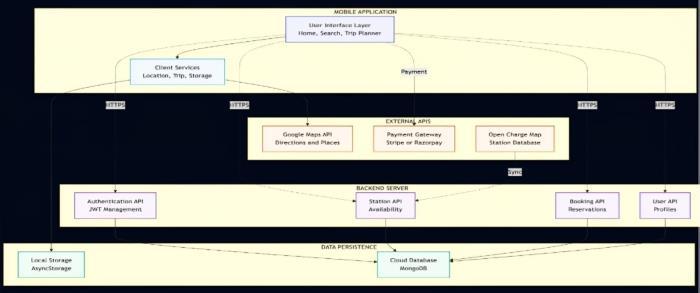
-1: System Architecture of Network Packet Analysers
This architecture is built in layers, with the mobile appsittingat thecenter as themaininterface where users interactwith features likehome, search, and trip planning. Behind the scenes, client-side services take care of things like tracking location, managing trips, and handling local storage. The app securely connects over HTTPS to a few external services likemapsfordirections,paymentgateways for transactions, and charging station data for realtime updates. On the backend, everything is tied together through APIs that handle authentication (using JWT), check station availability, manage bookings, and store user profile details. All the important data lives in a cloud-based MongoDB database, which keeps things scalable and efficient, while local storage helps the app stay fast and even
work smoothly when the internet connection isn’t great.
6. MATHEMATICAL MODEL Station Proximity Calculation (Haversine Formula)
While the platform integrates the Google Maps API for route-based navigation, the Haversine formula serves as a reliable fallback for computing straightline distances between the user's GPS coordinates and nearby charging stations when the API is unavailable.
TheHaversineformulaisdefinedas:

Where:
● ϕ1,ϕ2, ϕ1,ϕ2 = Latitudes of the two points (inradians)
● λ1,λ2 2= Longitudes of the two points (in radians)
● Δϕ=ϕ2−ϕ1=Δϕ=ϕ2 ϕ1
● Δλ=λ2−λ1=Δλ=λ2 λ1
● RRR=Earth'smeanradius(6,371km)
● ddd=Great-circledistancebetweenthetwo points(km)
ThisformulaaccountsforthecurvatureoftheEarth and produces accurate distance estimates for the proximity ranges relevant to EV station discovery, typically within 0 to 50 km. The results are used to sort and rank nearby stations by distance on the mapinterfaceandtovalidatewhetherastationfalls withintheuser'scurrentreachablerangeduringtrip planning.
Here'sthecondensedversion:
8. Results
The Charginix platform was evaluated to assess its effectiveness as a cross-platform mobile application for EV charging station discovery and management. Bothquantitativeandqualitativemetricswereused to analyze system behavior under realistic usage conditions.
International Research Journal of Engineering and Technology (IRJET) e-ISSN: 2395-0056
Volume: 13 Issue: 05 | May 2026 www.irjet.net p-ISSN: 2395-0072
The evaluation was conducted with a group of EV owners and enthusiasts across Hyderabad. Participants completed a structured set of tasks including registering on the platform, discovering nearby stations, applying filters, booking a charging slot, completing a simulated charging session, and managing their digital wallet. Station discovery accuracy was assessed by comparing GPS-resolved positions against known coordinates, and user satisfaction was measured through structured postusagefeedbackforms.
Users successfully discovered nearby stations within a5kmradiuswithaccuratedistancelabeling,correct availability status, and connector type information. Multi-criteria filtering resulted in noticeably faster station selection compared to unfiltered browsing, and color-coded availability markers further reduced identificationtimeinurbanareas.Atomictransactionbased conflict prevention resulted in zero doublebookings across all concurrent test sessions, and the full booking workflow was completed within an averageofthreeuserinteractions.
The wallet system processed top-up transactions accurately, debited session costs correctly using the formulaCost=kWh×Rate,andtriggeredlow-balance alerts as expected. Real-time balance updates were reflected immediately after each transaction, and wallet operation response times averaged under 1.2 secondsacrossalltestscenarios.
The following table summarizes the key system performancemetricsrecordedduringevaluation.
Participant satisfaction ratings were collected on a scaleof1to5acrosskeyareasoftheapplication.
Overall ratings were consistently positive across all dimensions.Usersparticularlyappreciatedthemapbaseddiscoveryinterface,advancebookingwithQR check-in, and seamless wallet payments. Many respondents noted that Charginix improved their confidence in planning long-distance EV journeys. Areas identified for future development include AIpowered station recommendations, traffic-aware route optimization, and live vehicle telemetry integration.
Electric mobility is here, and the infrastructure supporting it needs to match that urgency. Chagrined was built from a simple observation: the tools available to EV drivers today are fragmented, incomplete, and frustrating to use. No single platform brought everything together. Chagrined does. By integrating real-time station discovery, advanceslotbooking,livesessionmonitoring,digital wallet payments, community reviews, and trip planning into one cohesive cross-platform application, Chagrined removes the operational friction that has quietly discouraged EV adoption. Evaluation results confirmed high discovery accuracy,reliablebookingandsessionperformance, and strong user satisfaction. Drivers can now complete their entire charging journey from finding a station to paying for the session without ever switching applications. Ultimately, Chagrined addresses more than a usability problem. It addresses a confidence problem. When drivers knowwheretocharge,canbookahead,andtrustthe
International Research Journal of Engineering and Technology (IRJET) e-ISSN: 2395-0056
Volume: 13 Issue: 05 | May 2026 www.irjet.net p-ISSN: 2395-0072
process will be smooth, range anxiety loses its grip andthatshift,atscale,contributesmeaningfullytothe broaderadoptionofsustainableelectricmobility.
Charginix in its current form is a strong foundation, but several meaningful enhancements are already planned. AI-driven station recommendations using collaborativefilteringonhistoricalusagepatternswill make suggestions far more personalised than proximity-based logic alone. Dynamic route optimisation with live traffic integration will sharpen the trip planner for real-world inter-city journeys, whiledirectOEMtelematicsAPIintegrationwillallow the platform to read a vehicle's actual battery state ratherthanrelyingonuser-reportedestimates.Onthe payment side, automatic wallet recharge linked to external banking APIs will eliminate the friction of manual top-ups. Predictive station demand forecastingwillhelpdriversavoidcongestionatpeak periods before it happens. Multi-language support and community gamification features such as ecobadges for green energy charging will broaden accessibility and deepen long-term engagement. The long-term vision is straightforward: an AI-powered charging assistant that anticipates what a driver needsbeforetheyhavetoask.
[References] References must be cited consecutively using bracketed numbers [1]. Punctuation should follow the citation brackets. Citations should refer onlytothereferencenumber,suchas[3],andshould not include phrases like "Ref. [3]" except when appearingatthebeginningofasentence.
[1] M. A. Hannan, M. M. Hoque, A. Mohamed, and A. Ayob, "ReviewofEnergyStorageSystemsforElectric Vehicle Applications: Issues and Challenges," Renewable and Sustainable Energy Reviews, vol. 69, pp.771–789,Mar.2017.
[2] International Energy Agency (IEA), "Global EV Outlook 2023: Catching Up with Climate Ambitions," IEAPublications,Paris,2023.
[3]MinistryofHeavyIndustries,GovernmentofIndia, "National Electric Mobility Mission Plan (NEMMP) 2020,"NewDelhi,India,2022.
[4] Z. Liu, F. Wen, and G. Ledwich, "Optimal Planning
of Electric-Vehicle Charging Stations in Distribution Systems,"IEEETransactionsonPowerDelivery,vol. 28,no.1,pp.102–110,Jan.2013.
[5] A. Noel, R. Sovacool, B. K. Bahrami, and M. Reichmuth,"NavigatingtheChargingExperience:EV User Behavior and Infrastructure Preferences," Transportation Research Part D: Transport and Environment,vol.87,2020.
[6] Open Charge Alliance, "Open Charge Point Protocol (OCPP) 2.0.1 Specification," Open Charge Alliance,2020.
[7] V. Monteiro, J. G. Pinto, and J. L. Afonso, "Operation Modes for the Electric Vehicle in Smart Grids and Smart Homes: Present and Proposed Modes,"IEEETransactionsonVehicularTechnology, vol.65,no.3,pp.1007–1020,2016.
[8] S. Rahman, K. Khan, and A. Ghosh, "Mobile Application Design for EV Charging Station Navigation:A User Experience Study," in Proc. IEEE International Conference on Consumer Electronics (ICCE),2021,pp.1–6.
[9] Expo Documentation, "Expo SDK 54 – Location, Camera, and Maps APIs," Expo.io, 2024. [Online]. Available:https://docs.expo.dev