International Research Journal of Engineering and Technology (IRJET)
e-ISSN: 2395-0056
Volume: 13 Issue: 05 | May 2026
p-ISSN: 2395-0072
www.irjet.net
CFD-Based Design Optimization of Axial Flow Fans: A Review Omkar Jadhav1, Sujal Shelke2, Sampada Dravid3 1,2Bachelor of Technology, 3Professor, Mechanical Engineering, BRACT’s Vishwakarma Institute of Information
Technology, Maharashtra, India ---------------------------------------------------------------------***---------------------------------------------------------------------
Abstract – Axial flow fans one most used fans compared to
optimized model. The base for these studies appears to be the gas turbine theory book by Cohen et al [4].
the other Radial Fans in various fields such as domestic appliances, commercial and Industrial use-cases. Mostly found in Digital equipment, Air ventilation systems , The parameters for simulations are blade geometry, rotational speed, hub-tip ratio, Temperature, guide vane arrangement .CFD analysis’s rise has led to significant optimizations in almost every field due to the MVP of product or Prototyping phase is sped up ,reducing significant time in iterations by bypassing physical testing. This is the review for the advancements in the field of Axial Flow Fans design and innovations by enhancing significant enhance air flow and efficiency also reducing noise levels
Conventional methods used previously are outdated and time consuming compared to today’s CFD, Algorithms, Numerical calculations predictors based on the older data collected from Empirical charts, Laboratory testing and Trial and Errors present already. While conventional methods allowed to build good machines but were limited to constraints such as long research and development time and expensive prototype testing. Available tools today helps engineers evaluate several designs and make a decision help saving a lot of resources. This paper is the combined study of recent technological developments in the field of design, development of Axial Flow Fans with focus on tools like CFD analysis, aerodynamic optimization, noise reduction, and future intelligent systems.
Key Words: (Axial Flow Fan, CFD, Optimization, Aerodynamics, Guide Vanes, Noise Reduction, Efficiency
1. INTRODUCTION 1.1 Fan Design Method
This In Axial flow fans the air movement is parallel to the shaft axis and they are designed to generate high volumetric flow rates with relatively rising low pressure. Due to its advantages discussed above the use of the fans is preferred in compact spaces where there is need of external ventilation or Air conditioning sources. The design of Axial flow fans maintains the flow in one and straight direction which results in the best suitable fans to use in products like ducts, Open ventilation applications, cooling systems. Fanbao Chen et al.[1] conduct flow rate optimization based on DOE and CFD of guide vanes in axial flow fans. Mustafa Tutar et al[5] perform CFD study for both individual and combined effects of blade stagger angle and the winglets performance of the fans in controlled and uncontrolled environments. Renhui Liu et al [3] performed Finite element analysis of four structural factors of axial fan blade installation angle, number of blades, deflector plate, rotational speed, drawing fan wind pressure and rotational speed cloud diagram, calculation of axial power, by analyzing the distribution of the cloud diagram to design the shape of the fan blade, and derive the change rule of the wind pressure when changing the structure of the fan[3]. Yaming Fan et al.[6] did study that integrates aerodynamic and acoustic experiments with computational fluid dynamics (CFD) simulations to establish predictive models for flow field characteristics and aerodynamic noise in DEC systems. C.Lee et al.[2] did the study to obtain the optimal spanwise distribution of blade angles and chord length through CBD model and created a optimization algorithm which compares the initial model with the optimal conditions and predicts a
© 2026, IRJET
|
Impact Factor value: 8.315
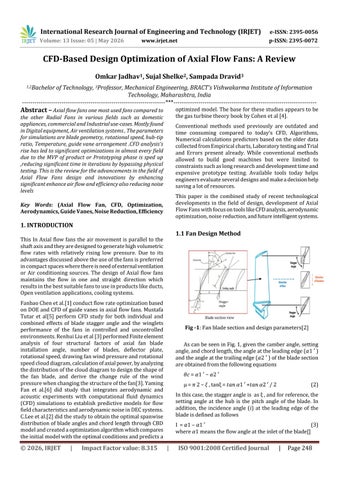
Fig -1: Fan blade section and design parameters[2] As can be seen in Fig. 1, given the camber angle, setting angle, and chord length, the angle at the leading edge (𝛼1 ′ ) and the angle at the trailing edge (𝛼2 ′ ) of the blade section are obtained from the following equations 𝜃𝑐 = 𝛼1 ′ − 𝛼2 ′ μ = 𝜋 2 − 𝜉 , tanξ = 𝑡𝑎𝑛 𝛼1 ′ +𝑡𝑎𝑛 𝛼2 ′ / 2
(2)
In this case, the stagger angle is as ξ , and for reference, the setting angle at the hub is the pitch angle of the blade. In addition, the incidence angle (𝑖) at the leading edge of the blade is defined as follows I = 𝛼1 − 𝛼1 ′ (3) where 𝛼1 means the flow angle at the inlet of the blade[]
|
ISO 9001:2008 Certified Journal
|
Page 248