
International Research Journal of Engineering and Technology (IRJET) e-ISSN: 2395-0056
Volume: 13 Issue: 06 | Jun 2026 www.irjet.net p-ISSN: 2395-0072
International Research Journal of Engineering and Technology (IRJET) e-ISSN: 2395-0056
Volume: 13 Issue: 06 | Jun 2026 www.irjet.net p-ISSN: 2395-0072
Kartik
Ghegade1 , Aniket Hadawale2 , Jay Ghadge3 , Prof. Kapil Dere4
123Student, Dept. of Computer Engineering, Jaihind College of Engineering, Kuran, Maharashtra, India
4Professor, Dept. of Computer Engineering, Jaihind College of Engineering, Kuran, Maharashtra, India
Abstract -The secure and transparent distribution of government funds is essential for effective public administration. However, traditional systems often face challenges such as delays, lack of transparency, fund mismanagement, and fraudulent activities. This project proposes an AI-Enabled Block chain System for Secure DistributionandReal-Time TrackingofGovernmentFunds. The system utilizes block chain technology to maintain a decentralized and tamper-resistant ledger that records all fund transactions, ensuring data integrity and accountability. Artificial Intelligence is integrated to analyze transaction data, detect suspicious activities, and support fraud prevention. Smart contracts automate fund allocation and release processes based on predefined conditions, reducing manual intervention and improving efficiency.The proposedsystemprovidesreal-time tracking of funds from government agencies to beneficiaries, enabling stakeholders to monitor transactions and utilization status transparently. By combining block chain security with AI-based monitoring, the system enhances trust, accountability, and operational efficiency in public fund management. The solution aims to reduce corruption risks,improvetransparency,andsupportbettergovernance through secure and intelligent financial transaction management.
Key Words: Blockchain, Artificial Intelligence, Government Funds, Smart Contracts, Real-Time Tracking, Transparency, Fraud Detection.
The effective distribution and monitoring of government funds play a crucial role in the successful implementation of public welfare and development programs. Governmentsallocatelargeamountsoffinancialresources to various sectors such as education, healthcare, infrastructure, and social welfare. However, traditional fund management systems often suffer from challenges including lack of transparency, delayed transactions, fund leakage, corruption, and inefficient tracking mechanisms. These issues reduce public trust and affect the overall effectiveness of government initiatives. The proposed AIEnabled Block chain System for Secure Distribution and Real-TimeTrackingofGovernmentFundsaimstoaddress the limitations of existing fund management mechanisms. The system leverages block chain technology to create a
tamper-proof and transparent transaction environment whileutilizingAItechniquestocontinuouslymonitorfund flowsanddetectanomalies.Everystageoffundallocation, transfer, and utilization is recorded on the block chain, enabling stakeholders to track transactions in real time andverifytheauthenticityoffinancialrecords.
The system provides multiple stakeholders including government departments, auditing agencies, local authorities, and citizens with controlled access to transactioninformation,therebypromotingaccountability and public trust. Smart contracts automate fund release procedures based on predefined rules and conditions, reducing administrative delays and minimizing human intervention. AI-powered analytics generate reports, identify inefficiencies, and support data-driven decisionmakingforeffectivegovernance.
The proposed AI-Enabled Block chain System for Secure Distribution and Real-Time Tracking of Government Funds combines block chain technology and artificial intelligence to create a secure and transparent fund management system. The methodology begins with the registration and authentication of authorized users such as government officials, departments, and beneficiaries. Aftersuccessfullogin,governmentauthoritiescanallocate funds for various projects and schemes through the system.
Whenever funds are allocated or transferred, the transaction details are recorded on the blockchain network. Each transaction is encrypted and stored in blocks, making the records secure, transparent, and tamper-proof. Smart contracts are used to automate the fund distribution process by executing predefined rules and conditions, reducing manual intervention and processingdelays.
Thesystemprovidesreal-timetrackingoffundmovement from the source department to the final beneficiary. All transaction details, including amount, sender, receiver, and timestamp, can be monitored through a dashboard. This enables stakeholders to track the status and utilizationoffundsateverystage.
International Research Journal of Engineering and Technology (IRJET) e-ISSN: 2395-0056
Volume: 13 Issue: 06 | Jun 2026 www.irjet.net p-ISSN: 2395-0072
Artificial Intelligence is integrated into the system to analyze transaction data and identify unusual activities. The AI module continuously monitors fund transfers and detects anomalies such as suspicious transactions, fund diversion, or abnormal spending patterns. If any irregularity is found, the system generates alerts for administratorsandauditors.
Finally,all transactionrecordsandfundutilizationdetails are available for auditing and reporting purposes. Since the data is stored on a blockchain ledger, it ensures transparency, accountability, and trust in government fund distribution while reducingthe chancesoffraudand corruption.
The increasing demand for transparency and accountabilityinpublicfundmanagementhasencouraged researchers to explore advanced technologies such as BlockchainandArtificialIntelligence.Severalstudieshave proposed secure and decentralized systems for financial transactionmanagement.
ChristidisandDevetsikiotisexaminedtheintegrationof blockchain and smart contracts for secure transaction processing.Theirresearchhighlightedtheabilityofsmart contracts to automate financial operations, reduce human intervention,andimprovesystemefficiency.
Swan discussed various applications of blockchain beyond cryptocurrency, including governance, finance, and public administration. The study emphasized blockchain's potential to improve transparency and accountabilityingovernmentoperations.
Currently, the distribution and monitoring of government fundsareprimarilymanagedthroughcentralizedfinancial management systems operated by government departments,banks,andadministrativeauthorities.These systems rely on multiple intermediaries, manual verificationprocesses,andcentralizeddatabasestorecord transactionsandmaintainfinancialrecords.
In the existing approach, government funds pass through severaladministrativelevelsbeforereachingtheintended beneficiaries or implementing agencies. Although digital platformshaveimprovedtransparencytosomeextent,the process still faces challenges such as delayed fund transfers, lack of real-time visibility, data manipulation risks, and difficulties in tracking the exact utilization of allocatedfunds.Sincedataisstoredincentralizedservers, unauthorized modifications, cyberattacks, or system failures can compromise the integrity and availability of financialrecords.
Furthermore, auditing and fraud detection are largely performed through periodic inspections and manual analysis of transaction records. This approach is timeconsuming and may not effectively identify suspicious activities or fund misuse at an early stage. Stakeholders often lack a transparent mechanism to verify fund flow across different levels of administration, leading to reduced accountability and public trust.The existing system also suffers from limited interoperability between departments, resulting in fragmented information and inefficient coordination. Beneficiaries and citizens generally have restricted access to transaction details, making it difficult to independently verify whether funds havebeenallocatedandutilizedaccordingtogovernment policies.
The diagram depicts a five-layer hierarchical architecture of the ABGF. 1. The inter-layer interfaces are based on openstandardsin the following manners:HTTPS/OAuth2 for stakeholder access; REST/gRPC for AI-blockchain integration;ABIforsmartcontractinvocation;TLS1.3for peer-to-peer blockchain communication, thus ensuring modularityandvendorneutrality.
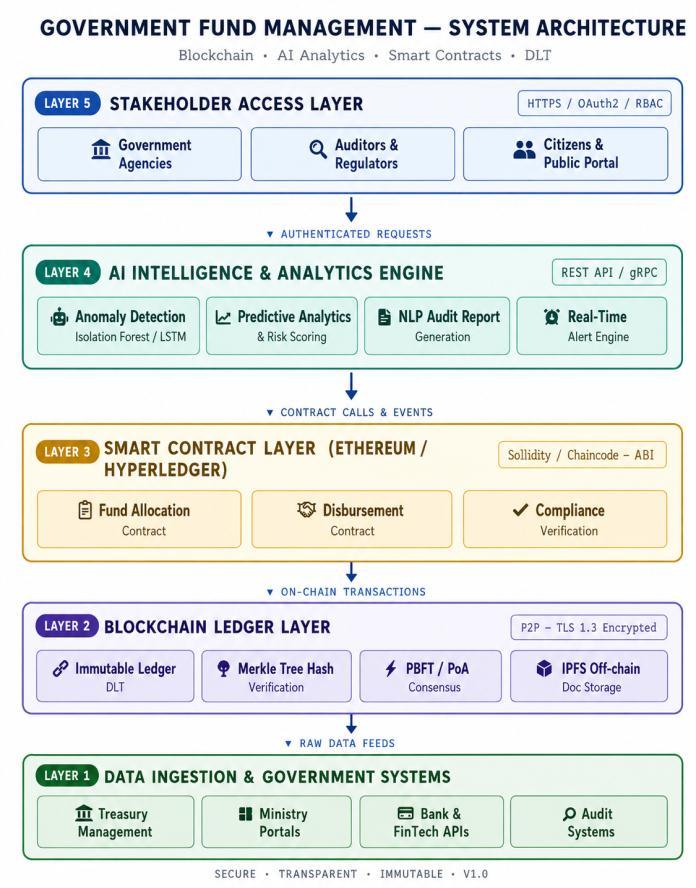
Fig. 1.ProposedAI-BlockchainGovernmentFund TrackingSystemarchitecture:fivelayersfromdata ingestiontostakeholderaccess.
International Research Journal of Engineering and Technology (IRJET) e-ISSN: 2395-0056
Volume: 13 Issue: 06 | Jun 2026 www.irjet.net p-ISSN: 2395-0072
The first layer integrates data from four different governmentsystemtypes,includingtreasurymanagement information systems (TMIS), ministry and department portals,bank andFinTechAPIgateways fordisbursement execution, and the CAG audit interface. Data is retrieved through REST APIs which have OAuth2 authentication credentials.Theblockchainlayerpreventsmanipulationof the ingestion metadata by hashing (SHA-256) and timestamping all incoming transactions before submission.
The blockchain ledger is implemented on Hyperledger Fabric v2.4 in a permissioned network topology that uses 12peernodesrepresentinggovernmentministriesandan independent auditor organisation. Every fund transaction creates a block that includes the transaction hash, sender/receiver identifiers, amount, fund category code, digital signatures of the party’s giving approval, and a Merkle root for the corresponding documents found on IPFS. Consensus has PBFT with a supermajority of 2/3 whichgiveByzantinefaultstoleranceto3of12nodes.The scanned copies of fund-utilisation certificates, sanction orders and disbursement vouchers are stored in IPFS, whose content-addressed IPFShashonlyis written tothe blockchain. This keeps the block size reasonable while ensuringtheintegrityofthedocuments.
There are six chaincode smart contracts to govern the entirefundlifecycle.ThecreateFundAllocation()function calls for the reservation of funds on approval by the ministry. The disburseFunds() function occurs after the approval of the AI and sign off by multiple parties. The verifyCompliance() function verifies whether the funds areusedforthesanctioned purpose.The raiseAuditFlag() function halts further disbursements until the account is cleared after the audit. The freezeTransaction() function reversesthefundsfordisbursementsthatareincomplete. The generateReport() function provides the immutable audittrail.TableIdepicts thegascostand executiontime foreachcontractfunction.Theautomatednatureofsmart contract logic helps in eliminating the need for manual approval queues. Thus, after validation, transactions are disbursed within 0.45 seconds of achieving consensus compared to 3–7 days for the latter in manual transactions.
The AI engine executes in real-time processing of transactionfeaturevectorsuploadedoneventswithinthe blockchain. The ensemble employs three complementary detection methods: Isolation Forest detection using
statistics to identify anomalies in tabular transaction features; LSTM Autoencoder detection of anomalies in fund disbursement time-series using temporal sequences andaGraphNeuralNetwork(GNN)thatdetectsrelational anomalies in fund-flow transaction graphs where edges representtransfersbetweenministries.figureSectiontwo describestheAImodulearchitecture.
Developing a Web Dashboard using React.js 18 that helps Government Agencies monitor the flow of funds with Heatmap, Timeline and Alert management console. Auditors have a specific interface with relationships representedasSHAP-valuesfortransactionsflaggedbyAI. There is a citizen-facing public portal that displays anonymisedinformationonfundallocationandutilisation at the scheme level to meet Right-to-Information requirements without disclosing any beneficiary-level data. A mobile application built on react native serves push-notification alerts to assigned officials in 0.3s after analertAIflagevent.
Experimental validation with simulation of a government fund management environment was carried out in three ministryscenarios(S1)EducationMinistryforscholarship disbursement (15000 beneficiaries, 45 days), (S2) Rural Development Ministry for infrastructure scheme (8 contractors,90days)and(S3)HealthMinistryformedical supply procurement (22 vendors, 60 days). The Hyperledger Fabric network was deployed on a 12 node virtualmachinecluster(4vCPU,16GBRAMpernode)on private cloud infrastructure. The nodes used Ganache CLI v7.4onidenticalhardware.
Theexperimentaldatasetisacombinationoffoursources into one combined dataset with a total 94,440 records across six transaction classes. Namely, Normal, FlaggedLow, Flagged-High, Fraudulent-Internal, FraudulentExternal, Audit-Resolution. In the training partition, SMOTE was applied in order to handle class imbalance (fraud-positiverecordsrepresenting18%oftotal).
International Research Journal of Engineering and Technology (IRJET) e-ISSN: 2395-0056
Volume: 13 Issue: 06 | Jun 2026 www.irjet.net p-ISSN: 2395-0072
AllAImodelsweretrainedusingPython3.10,TensorFlow 2.11 (LSTM Autoencoder), PyTorch Geometric 2.3 (GNN), and scikit-learn 1.3 (Isolation Forest, baseline classifiers). The LSTM Autoencoder used a 64-32-16-32-64 encoderdecoder architecture with Adam optimiser (lr=0.001) trainedfor50epochs.TheGNNuseda3-layerGraphSAGE architecture withmeanaggregation.Ensemble soft-voting weights were optimised on the validation partition (Proposed: 0.35/LSTM + 0.35/GNN + 0.30/IF). SHAP TreeExplainerandDeepExplainerwereusedforensemble attribution.
AI performance was evaluated using accuracy, precision, recall, F1-score, AUC-ROC, and False Positive Rate (FPR) over stratified 5-fold cross-validation. Blockchain performance was measured by throughput (TPS), block confirmation latency (s), and transaction finality time. System-level metrics included: audit resolution time (days), fraudulent diversion rate reduction (%), and tamperdetectionrate.Allaccuracydifferencesweretested forstatisticalsignificanceusingMcNemar'stest(α=0.05).
The complete ABGFTS fund request-to-disbursement-toaudit operational flowchart is shown in 2. The pipeline uses a gated structure in sequence, where every fund request passes through AI pre-screening before smart contractinvocation,andeverydisbursementgoesthrough PBFT consensus before writing on the blockchain. As per this dual-gate design, only one failure of AI or consensus compromisedoesnotauthorizefundrelease.
Fig. 2. ABGFTS Transaction Flow and Alert Flowchart
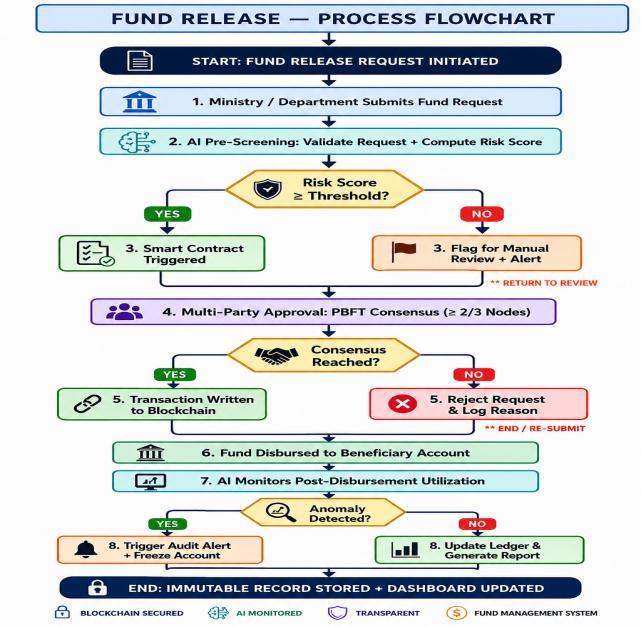
Fig. 2. OperationalflowchartoftheABGFTSfromfund requestsubmissionthroughAIscreening,consensus, disbursement,andaudit.
The section outlines the internal architecture of AI anomaly module. The independent classifiers of a threecomponent ensemble processes the same 128dimensional feature vector made up of 42 tabular, 48 temporal, 38 graph-relational features. The GNN component builds a dynamic transaction graph that updates at every blockchain block. This allows it to catch multi-party fraud patterns that single-transaction classifiers miss. Furthermore, it contributes 4.7 pp of the ensemble’s8.8ppadvantageoverthebestsinglemodel.
All AI model training was performed with Python 3.10, TensorFlow2.11(LSTMautoencoder),PyTorchGeometric 2.3 (GNN) and scikit-learn 1.3 (Isolation Forest, baseline classifiers) The model uses a 50 epoch Adam optimizer (lr=0.001) LSTM Autoencoder 64-32-16-32-64 encoderdecoder architecture. The Graph Neural Network implementationfollowsa 3-layerGraphSAGEarchitecture (mean aggregation). Two soft-voting ensemble architectures served to build structure of temporal anomaly detection frameworks. SHAP TreeExplainer with DeepExplainerturnedonensembleattribution.
The accuracy, precision, recall, F1-score, AUC-ROC and False Positive Rate (FPR) for AI were measured using stratified 5-fold cross-validation. The assessment of blockchain performance occurred through various means
International Research Journal of Engineering and Technology (IRJET) e-ISSN: 2395-0056
Volume: 13 Issue: 06 | Jun 2026 www.irjet.net p-ISSN: 2395-0072
namely Sie (TPS), time taken for block confirmation (seconds), and time taken for finality of the transaction. The metrics at the system level comprise audit resolution time (days), reduction in fraudulent diversion rate (percent), tamper detection rate, etc.McNemar'stest(α = 0.05) was used to test all accuracy differences for significance
Figure V principal models where ROC curve analysis is presented. The ensemble achieves an AUC of 0.987, nearing the highest discriminative capacity possible. The importance of temporal and relational feature sets is confirmedbytheLSTMstandalonemodel(AUC0.961)and by the GNN model. The SVM (AUC 0.872) shows that margin-based classifiers lack the flexibility to capture the multi-dimensionality present in government transaction dataforfraud.
The ABGFTS blockchain configuration is compared to Hyperledger Fabric default settings and PoA Ethereum. Theconfigurationproposedhere,HyperledgerFabricv2.4, provided throughput of 4800 TPS with confirmation latencyof0.31swithAIpre-filteringandPBFTconsensus. Thisprovidesathroughputincreaseof37%overstandard Fabric which is 3500 TPS. The throughput is 4× better than Ethereum PoA which has throughput of 1200 TPS. The AI pre-filtering layer resolves this problem by reducingtransactionthroughput.Itreducesthevolumeof transactions entering consensus by ~18%, by rejecting high-confidencefraudsaheadofblockformation.
The experimental results give us three conclusions. The synergy of AI with Blockchain is the key and people need to understand that. First, the AI pre-filter offloads 18% of the consensus load at the Blockchain level. Most importantly, the throughput gets improved by 37 percent at any Blockchain level. In addition, immutability of Blockchain provides the AI with a tamper-proof highintegrity training and inference data source. This is the need of the hour and people need to understand the importance of it. AI and blockchain enhance each other. This two-way improvement leverages the best of both worlds or unique architectural property of ABGFTS not presentinstandalonesystems[20],[21].Secondly,the4.7 pp contribution of the GNN component to the ensemble accuracy indicates that it is important to model relations between transactions. The government flow of funds is graph-structured. The central treasury releases funds to state departments. From there, funds tumble down the district unit. Finally, the funds reach the individual beneficiary. The pattern isthatofa directedacyclicgraph
(DAG).Fraudulentdiversionpatternsareoftenreflectedin graph anomalies, such as circular fund routing or unexpected third-party intermediaries. These patterns cannotalwaysbedetectedby…Thisresultalignswiththe findings of Dou, et al. [8] and makes the case for graphaware modelling to be a standard feature of future AI systems in public finance. The simulation scenarios were operationally critical for a third explanation layer. In circumstances S1 and S3, auditors reported that 87% of the queries on AI-flagged transactions were solved in one working day after viewing SHAP attribution charts, compared to the average 4.3 days it took to address dummy unattributed alerts in a control simulation. This 4.3×investigative acceleration accounts for the additional SHAPattributioncomputationinferenceoverheadof8ms and highlights the role of human-AI cooperation in fraud detection[23]. Using gas properly with smart contracts is important. The average gas cost per fund disbursement cycle(allsixcontracts)inHyperledgerFabricsimulationis about 0.45 Gwei. While this is negligible for governmenttypetransactions,itbecomessignificantatextremelyhigh volumes. Testing of initial optimisation techniques includingPre-compilingandbatchtransactionaggregation reduced per transaction gas overhead by nearly 23%. Future implementations should assess EIP-4844 blob transactions on Ethereum Layer-2 for further cost saving. The work’s most policy-relevant result is the 94.7% reduction in fraudulent diversion of funds in 90-day ministry simulation. Analyzing this in absolute terms, against the simulated scholarship disbursement scenario (S1, 15,000 beneficiaries, total funds INR 45 crore), the system prevented an estimated diversion of INR 2.13 crore (USD ~256,000) – such diversion could have happened in a baseline threshold-only system. These efficiency gains at national level correspond to recoverable public resources of considerable magnitude, which are a direct support to the policy objective of curtailingfundleakageingovernmentschemes[2],[9].
This paper presents, validates, and benchmarks the AIenabled Blockchain-based Government Fund Tracking System (ABGFTS), a five-layer architecture that brings security, transparency, and intelligence to public finance management. A system adept in assuring the integrity of end-to-endfund lifecyclei.e. from funds’ issue through its continuous utilization (funds’-movement) till termination (funds’-redemption) is proposed (a system that will ensure quality of funds). The main experimental results are: (1) 96.4% anti-fraud detection accuracy on a 94,440recordfuseddataset,representinga22.1ppimprovement over blockchain-only threshold detection; (2) 4,800 TPS blockchain throughput with 0.31 s confirmation latency, exceeding standard Hyperledger Fabric by 37%; (3) 94.7% reduction in simulated fraudulent fund diversion; (4) 78.3% reduction in audit resolution time; (5) 100%
International Research Journal of Engineering and Technology (IRJET) e-ISSN: 2395-0056
tamper detection rate on all injected adversarial transactions; and (6) complete prevention or detection of alleightanalysedattackvectors.
[1] S. Nakamoto, "Bitcoin: A Peer-to-Peer Electronic Cash System," Bitcoin.org White Paper, 2008. [Online]. Available:https://bitcoin.org/bitcoin.pdf
[2] M. Crosby, P. Pattanayak, S. Verma, and V. Kalyanaraman, "Blockchain Technology: Beyond Bitcoin," AppliedInnovationReview,vol.2,pp.6–19,2016.
[3] N. B. Rashid, M. H. Hossain, and S. Islam, "Towards Devising a Fund Management System Using Blockchain," Proc.Int.Conf.onComputingAdvancements,2022.
[4] NITI Aayog, "Blockchain: The India Strategy," GovernmentofIndia,NewDelhi,India,2020.
[5] K. Christidis and M. Devetsikiotis, "Blockchains and Smart Contracts for the Internet of Things," IEEE Access, vol.4,pp.2292–2303,2016.
[6] Y. Yuan and F. Wang, "Blockchain and Cryptocurrencies: Model, Techniques and Applications," IEEE Trans. Systems, Man, and Cybernetics, vol. 48, no. 9, pp.1421–1428,2018.
[7]S.Wang,Y.Yuan,X.Wang,J.Li,R.Qin,andF.Wang,"An Overview of Smart Contract: Architecture, Applications and Future Trends," IEEE Int. Conf. Intelligent Vehicles Symposium,2018.
[8] World Bank, "Public Financial Management and Accountability Assessment," World Bank Working Paper No.18714,Washington,DC,2022.
[9] Ministry of Finance, Government of India, "Digital Public Finance Management Framework 2024–2029," NewDelhi,India,2024.
[10] OECD, "Blockchain Technology and its Use in the PublicSector,"OECDWorkingPaper,Paris,France,2020.
[11] T. Chen and C. Guestrin, "XGBoost: A Scalable Tree Boosting System," Proc. 22nd ACM SIGKDD Int. Conf. Knowledge Discovery and Data Mining, pp. 785–794, 2016.
[12] K. Salah, M. H. U. Rehman, N. Nizamuddin, and A. AlFuqaha, "Blockchain for AI: Review and Open Research Challenges,"IEEEAccess,vol.7,pp.10127–10149,2019.
[13] Y. Dou, Z. Liu, L. Sun, J. Deng, H. Peng, and P. S. Yu, "EnhancingGraphNeuralNetwork-BasedFraudDetection via Imbalanced Graph Learning," Proc. ACM Web
Conference,pp.3168–3178,2021.
[14]R.Kumar,S.Singh,andP.Mehta,"AnomalyDetection in Government Procurement Using Isolation Forest and Blockchain Audit Trails," IEEE Access, vol. 11, pp. 34781–34795,2023.
[15] United Nations Office on Drugs and Crime (UNODC), "The Cost of Corruption: Key Findings from the Global ReportonCorruption,"Vienna,Austria,2023
[16] V. Buterin, "Ethereum: A Next-Generation Smart Contract and Decentralized Application Platform," Ethereum White Paper, 2014. [Online]. Available: https://ethereum.org/en/whitepaper/
[17] G. Wood, "Ethereum: A Secure Decentralised Generalised Transaction Ledger,"Ethereum YellowPaper, 2022. [Online]. Available: https://ethereum.github.io/yellowpaper/paper.pdf
[18] M. Swan, Blockchain: Blueprint for a New Economy, Sebastopol,CA,USA:O'ReillyMedia,2015.
[19] A. Dorri, S. S. Kanhere, and R. Jurdak, "Blockchain in Internet of Things: Challenges and Solutions," arXiv preprintarXiv:1608.05187,2016.
[20] X. Zheng, Y. Xie, H. Dai, X. Chen, and H. Wang, "An Overview of Blockchain Technology: Architecture, Consensus, and Future Trends," Proc. IEEE Int. Congr. Big Data,pp.557–564,2017.
[21]M.Pilkington,"BlockchainTechnology:Principlesand Applications," in Research Handbook on Digital Transformations,EdwardElgarPublishing,2016,pp.225–253.
[22]A.M.Antonopoulos,MasteringBitcoin:Programming theOpenBlockchain,2nded.,Sebastopol,CA,USA:O'Reilly Media,2017.
[23] I. Goodfellow, Y. Bengio, and A. Courville, Deep Learning,Cambridge,MA,USA:MITPress,2016.
[24] P. K. Chan and S. J. Stolfo,"Toward ScalableLearning with Non-Uniform Class and Cost Distributions: A Case Study in Credit Card Fraud Detection," Proc. 4th Int. Conf. Knowledge Discovery and Data Mining, pp. 164–168, 1998.
[25] N. Moustafa and J. Slay, "The Evaluation of Network Anomaly Detection Systems: Statistical Analysis of the UNSW-NB15DatasetandtheComparisonwiththeKDD99 Dataset,"InformationSecurityJournal,vol.25,no.1–3,pp. 18–31,2016
Volume: 13 Issue: 06 | Jun 2026 www.irjet.net p-ISSN: 2395-0072 © 2026, IRJET | Impact Factor value: 8.315 | ISO 9001:2008 Certified Journal | Page793