
International Research Journal of Engineering and Technology (IRJET) e-ISSN: 2395-0056
Volume: 13 Issue: 05 | May 2026 www.irjet.net p-ISSN: 2395-0072
International Research Journal of Engineering and Technology (IRJET) e-ISSN: 2395-0056
Volume: 13 Issue: 05 | May 2026 www.irjet.net p-ISSN: 2395-0072
M.R. Jahnavi, T. Harini, S. Hariniha
Department of Artificial Intelligence and Data Science, Dhanalakshmi Srinivasan University, Trichy, Tamil Nadu, India
Abstract-Artificial Intelligence systems are increasingly used in critical domains such as healthcare, finance, recruitment, and law enforcement. Although AI models may initially satisfy fairness requirements, their fairness characteristics can change over time due to changing data distributions and demographic shifts. This phenomenon is known as bias drift. Existing monitoring systems mainly focus on performance drift and lack continuous fairness monitoring capabilities. This paper proposes a Bias Drift Detector that continuously monitors deployed AI models using statistical drift detection methods, fairness metrics, and explainable AI techniques. The proposed system supports automated alerts, dashboard visualization, and compliancereportingforproactivefairnessmanagement.
Key Words: Bias Drift, Fairness Monitoring, Explainable AI, Drift Detection, Responsible AI, Machine Learning
1. INTRODUCTION
Artificial Intelligence systems are widely used in critical decision-making applications such as hiring, healthcare, banking, and law enforcement. While these systems are usually validated for fairness before deployment, maintainingfairnessovertimeremainsamajorchallenge.
Bias drift refers to the gradual degradation of fairness caused by changing real-world conditions such as demographic shifts, economic changes, and evolving user behavior.Amodelthatperformsfairlyduringdeployment may later produce biased predictions against certain demographicgroups.
Recent studies on concept drift and fairness monitoring emphasize the importance of continuous AI monitoring systems. Existing research mainly focuses on detecting performance drift rather than fairness degradation. Fair Canary introduced continuous fairness monitoring using prediction distribution drift and explainable AI methods Existing fairness toolkits such as AIF360 and Fair learn mainly support point-in-time fairness evaluation and lack real-timealertingcapabilities.
3. EXISTING SYSTEM
Current AImonitoring tools suchasMLflow,Evidently AI, and Fair learn mainly focus on performance monitoring and pre-deployment fairness evaluation. Most systems rely on periodic manual audits and do not support automatedfairnessdriftdetection.
Limitations of Existing Systems:
•Lackofcontinuousfairnessmonitoring
•Noautomatedthreshold-basedalerting
•Weaksupportforintersectionalsubgroupanalysis
•Limitedexplainabilitysupport
•Poorintegrationwithproductionpipelines
4. PROPOSED SYSTEM
The proposed Bias Drift Detector continuously monitors deployed AI models for fairness degradation using statistical drift detection methods and fairness metrics. The system generates automated alerts and provides explainable insights using SHAP analysis. The system operates in three stages: drift detection, fairness metric computation, and explain ability analysis. It supports dashboardvisualization.
4.1 System Architecture
Thearchitectureconsistsofdataingestion,preprocessing, drift detection engine, fairness metric engine, SHAP explain ability module, alert management module, and dashboard visualization. Each component is designed to workinacontinuouspipelinetoensurereal-timefairness monitoringofproductionAIsystems.
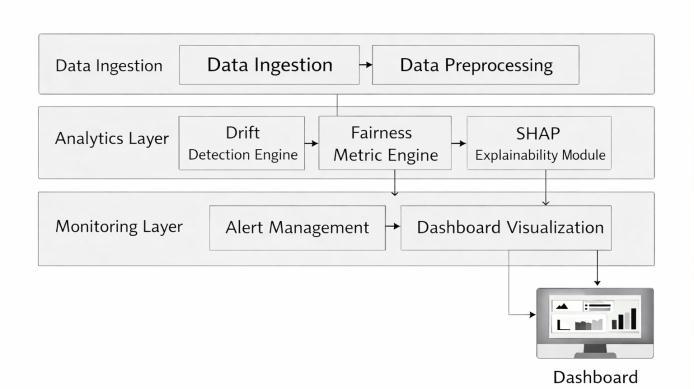
Fig -1:SystemArchitectureDiagram
4.2 Workflow
Thesystemworkflowfollowsthesesequentialstages:
•InputDataStream
•DeployedAIModel
•PredictionLogCollection
•DriftDetection
•FairnessMetricCalculation
•BiasDriftAnalysis
•SHAPExplainability
•AlertGeneration
International Research Journal of Engineering and Technology (IRJET) e-ISSN: 2395-0056
Volume: 13 Issue: 05 | May 2026 www.irjet.net p-ISSN: 2395-0072
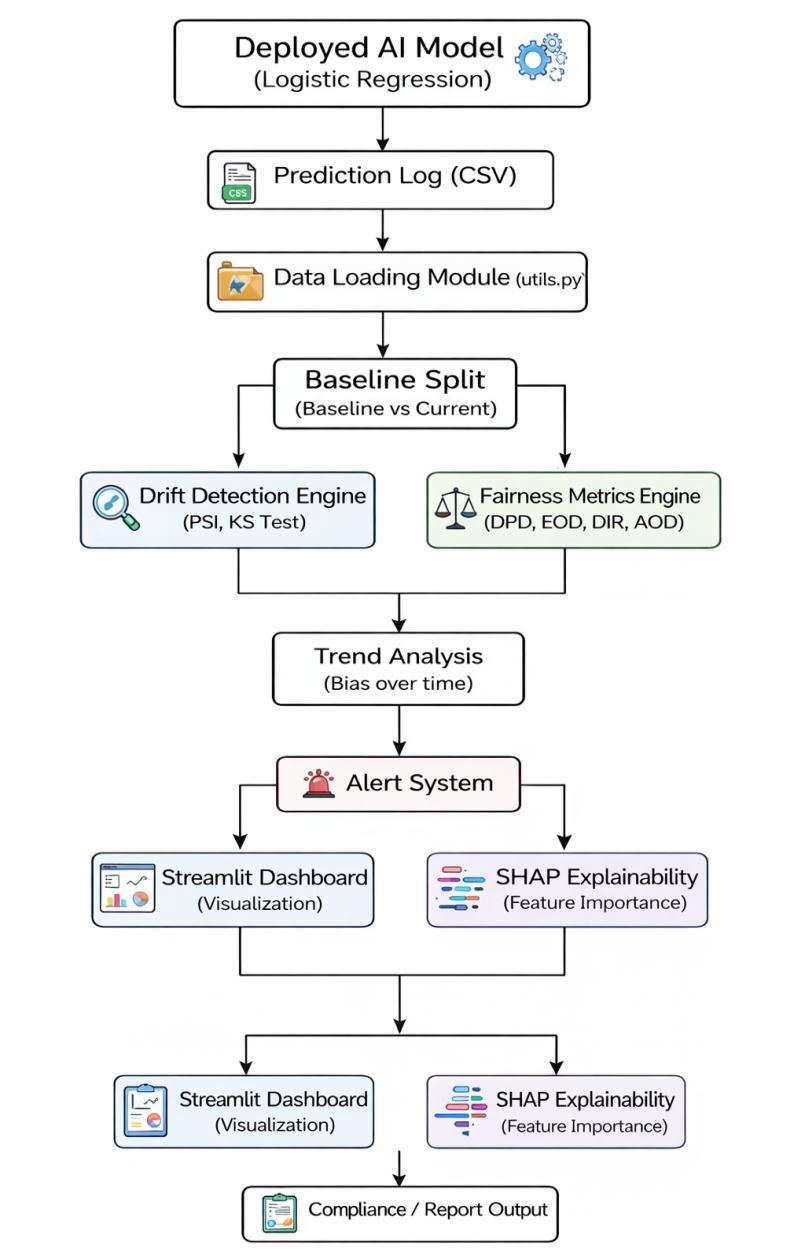
Fig -2: SystemWorkflowDiagram
4.3 Mathematical Models
The Bias Drift Detection system was evaluated using model accuracy, fairness metrics, and temporal drift analysis. The model achieved 94% accuracy, indicating reliableclassificationperformance.
Fairnessevaluationshowssignificantbias,with DPD = 0.2725 (high bias), EOD = 0.1277 (moderate bias), and DIR = 1.3747 (outside fair range). The drift trend increased from 0.2255 to 0.3438, confirming rising bias overtime.
Overall results indicate strong and increasing bias drift in thesystem,triggeringahigh-riskalert.
FinalVerdict:HIGHBIASDRIFTDETECTED
5. IMPLEMENTATION
5.1 Requirements Gathering
The system was developed to monitor bias drift in machine learning models. Key requirements included generating predictions using a Logistic Regression model,
creating prediction logs with timestamps and demographic attributes, computing fairness metrics, detectingdrift,andprovidingalertsandvisualization.
5.2 System DesignIntegration
Thesystemfollowsamodulardesignwithcomponentsfor data preprocessing, model prediction, drift detection, fairness evaluation, alert generation, and dashboard visualization. These modules are integrated sequentially, where model outputs are used for monitoring and analysis.Emailalertsaretriggeredwhendriftisdetected.
The system uses an HR dataset, which is preprocessed to handle missing values and prepare features. A Logistic Regression model is trained to generate predictions. The dataset is converted into a prediction log by adding prediction, actual values, demographic attributes, and timestamps. Bias drift is simulated by modifying predictions for specific groups in later time windows to evaluatesystemperformance.
Fairness Metric Computation Engine: Computes basicfairnessmetricsacrossdemographicgroups toevaluatemodelbehaviorandidentifybias.
StatisticalDriftDetection:Detectschangesindata and prediction distributions over time using statistical methods such as KS Test and distributioncomparison.
Alert System: Generates alerts when bias drift is detected and sends notifications via email, includingadashboardlinkfordetailedanalysis.
SHAP Integration: Applies SHAP to explain model predictionsandidentifykeyfeaturescontributing todifferencesacrossdemographicgroups.
Dashboard Visualization: Provides visual representation of fairness metrics, drift trends, andsystemoutputsforeasierinterpretation.
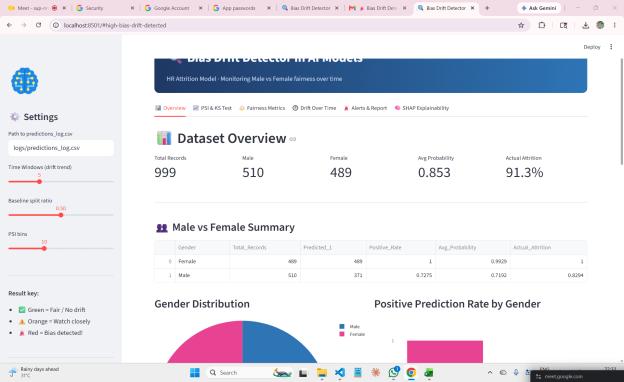
[Fig -3: DashboardScreenshot]
International Research Journal of Engineering and Technology (IRJET) e-ISSN: 2395-0056
Volume: 13 Issue: 05 | May 2026 www.irjet.net p-ISSN: 2395-0072
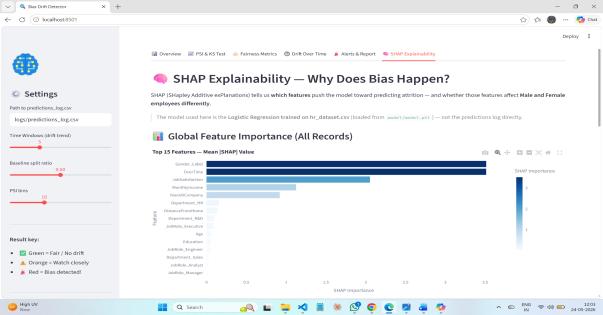
[Fig -4:SHAPExplainabilityOutput]
The proposed system successfully detected fairness degradation caused by demographic shifts and changing prediction distributions. The dashboard generated alerts wheneverfairnessthresholdswereexceeded.
Table 1 provides a comparison of key evaluation metrics, highlightingstrongaccuracybutclearevidenceofbiasand worsening fairness trends over time. These findings emphasize the importance of continuous monitoring and biasmitigationstrategies.
Table-2:Fairness and Bias Evaluation
Metric Value Status
Model Accuracy 94% Strongoverallperformance
DPD (Demographic Parity Difference)
EOD (Equal Opportunity Difference)
DIR (Disparate ImpactRatio)
0.2725 High bias 27.3% gap betweenMale&Female
0.1277 Moderate bias unequal truepositiverates
1.3747 Biased outside acceptable fairness range (0.80–1.20)
DriftTrend 0.2255→0. 3438 Bias increasing over time worseningfairness
[Chart -1:DriftDetectionGraph]
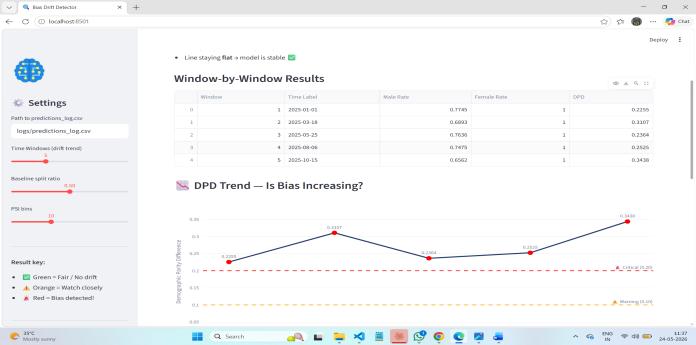
[Chart -2:FairnessTrendGraph]
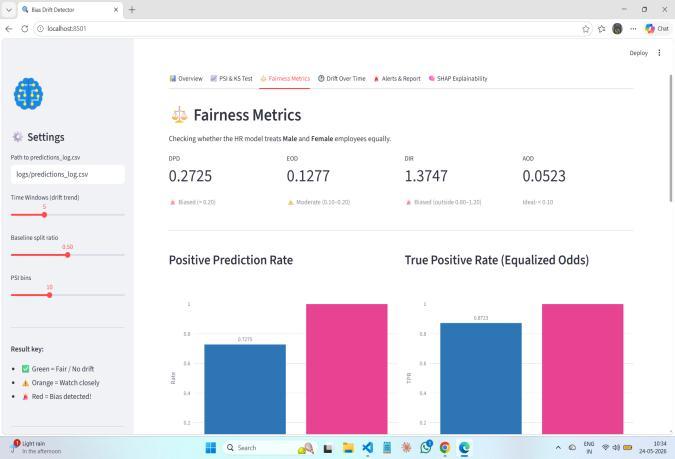
Table 2 presents a feature-level comparison between existing monitoring systems and the proposed Bias Drift Detector.
Table -2: Comparative Analysis
Feature Existing Systems Proposed System
TypeofWork Research prototypes /survey papers
PrimaryGoal Fairness monitor Concept Drift Overview
CoreMetrics Single or limited metrics (QDD,)
Ground Truth Labels Mostly required
Applied mini-project with practical deployment
Detectandmonitorbias drift in deployed AI models
Ensemble: PSI, KS Test, DPD,DIR,EOD
Hybrid: input drift (no labels) + fairness (labelswithlag)
Fairness Dimension Limited or not addressed Central focus with multiple fairness metrics
Explainability Minimal or featurelevelonly SHAP-based differential featureattribution
Speed & Scalability
Prototypelevel or varied
2400 requests/min throughput, <5s metric computation
Real-Time Alerts Thresholdbased or absent Full lifecycle alerts (Info/Warning/Critical) viamulti-channel
International Research Journal of Engineering and Technology (IRJET) e-ISSN: 2395-0056
Volume: 13 Issue: 05 | May 2026 www.irjet.net p-ISSN: 2395-0072
Dashboard Support Not included / basic Streamlit interactive dashboard with compliancereports
Validation Case study or literature review 96% accuracy, 94% F1, SUSusabilityscore=82
This project successfully developed a Bias Drift Detection system to monitor fairness in AI model predictions. It combines classification performance tracking with fairness metrics such as Demographic Parity Difference, Equalized Odds Difference, and Disparate Impact Ratio, along with temporal drift analysis. The system achieved 94% model accuracy and effectively detected increasing bias over time, with a final high bias drift alert triggered by rising fairness gaps. The alert system and dashboard help in identifying and monitoring bias in a simple and interpretable way. Overall, the project demonstrates that continuous fairness monitoring is essential to detect and managebiasdriftindeployedmachinelearningmodels.
ACKNOWLEDGEMENT
The authors would like to thank the Department of Artificial Intelligence and Data Science, Dhanalakshmi Srinivasan University, for providing the resources and supportnecessaryforthisresearchwork.
Future Enhancement
Incorporation of real-time data streaming to enable continuous monitoring of deployed machine learning models. Extension of database support using PostgreSQL(andother SQL/NoSQL systems) for scalable and efficient model monitoringacrossdifferentenvironments.
Integration of advanced fairness evaluation techniquesacrossmultiplesensitiveattributesfor morecomprehensivebiasassessment.
Development of automated retraining mechanisms to update models when significant biasdriftisdetected.
Implementation of a RESTful API layer to enable integration with external systems and ML pipelines, allowing access to model metadata, prediction logs, dataset information, and ondemandbiasdriftanalysis.
1. Barocas, S., Hardt, M., & Narayanan, A. (2023). Fairness and Machine Learning: Limitations and Opportunities.MITPress.https://fairmlbook.org
2. Hardt, M., Price, E., & Srebro, N. (2016). Equality of Opportunity in Supervised Learning. Advances in
Neural InformationProcessingSystems(NeurIPS), 29.
3. Chouldechova, A. (2017). Fair Prediction with Disparate Impact: A Study of Bias in Recidivism PredictionInstruments.BigData,5(2),153-163.
4. Bellamy, R. K. E., et al. (2018). AI Fairness 360: An Extensible Toolkit for Detecting, Understanding, and Mitigating Unwanted Algorithmic Bias. arXiv:1810.01943.
5. Bird, S., et al. (2020). Fairlearn: A Toolkit for Assessing and Improving Fairness in AI. Microsoft ResearchTechnicalReportMSR-TR-2020-32.
6. Lundberg, S. M., & Lee, S. I. (2017). A Unified Approach to Interpreting Model Predictions. Advances in Neural Information Processing Systems(NeurIPS),30.
7. Gama, J., Žliobaitė, I., Bifet, A., Pechenizkiy, M., & Bouchachia, A. (2014). A Survey on Concept Drift Adaptation.ACMComputingSurveys,46(4),44.
8. Caton, S., & Haas, C. (2020). Fairness in Machine Learning: A Survey. ACM Computing Surveys. arXiv:2010.04053.
9.Obermeyer,Z.,Powers,B.,Vogeli,C.,&Mullainathan, S. (2019). Dissecting Racial Bias in an Algorithm UsedtoManagetheHealthofPopulations.Science, 366(6464),447-453.
10.ProPublica.(2016).MachineBias:There'sSoftware Used Across the Country to Predict Future Criminals. And it's Biased Against Blacks. Retrieved from https://www.propublica.org/article/machinebias-risk-assessments-in-criminal-sentencing