
International Research Journal of Engineering and Technology (IRJET) e-ISSN: 2395-0056
Volume: 13 Issue: 03 | Mar 2026 www.irjet.net p-ISSN: 2395-0072
International Research Journal of Engineering and Technology (IRJET) e-ISSN: 2395-0056
Volume: 13 Issue: 03 | Mar 2026 www.irjet.net p-ISSN: 2395-0072
M Sree Ram, P Prathyusha, C Chandradeep, T Saranesh, G Likhith
Abstract - Electric vehicles (EVs) receive more and more popularity, as they are more efficient and less harmful to the environment than regular gasoline cars. As the electric mobility technology is developing very fast, the battery system has demanded a critical factor that directly affects the performance, safety, and reliability of EVs. Electric vehicles rely on Lithium-ion batteries due to their density of energy, lightweight design, extended cycle life, quick charge, and discharge. Nevertheless, efficient functioning and safety of these batteries are not possible without a powerful Battery Management System (BMS).
Important battery parameters like voltage, current, temperature, and environmental conditions are continuously monitored using sensors to a microcontroller-based control unit by the BMS. The gathered data is analyzed and presented on a local display interface, which allows seeing the battery status and load conditions at any point in time when operating and charging. The system also has built in protection mechanisms to curb the abnormal conditions like overvoltage, deep discharge, overheating and excessive current flow.
Proper vehicle control and effective use of energy needs to be properly estimated battery states. The main parameters to be considered to assess the battery performance and predict the state of its functioning include State of Charge (SoC), State of Health (SoH), State of Power (SoP), and Remaining Useful Life (RUL). The suggested BMS will enhance the battery safety, energy management, and battery life through the use of these monitoring and estimation methods, which will guarantee the efficient and safe work of electric vehicles.
Key Words: Battery Management System (BMS),Electric Vehicles (EVs), Lithium-Ion Battery, State of Charge (SoC), State of Health (SoH), State of Power (SoP), Remaining Useful Life (RUL), Thermal Management, Battery Safety, Battery State Estimation
TheproposedsystemisaSmartESP32-basedpower monitoringandcontrolplatformdesignedtofunctionasa compactbatterymanagementandload-controlunitforsmall electric-vehicles and DC power applications. In modern electricvehiclesandportableDCsystems,batteriessupply allthepropulsionandauxiliarypower,soitisessential to supervise their operating conditions and to control connectedloadsintelligentlytoavoidfailures,firehazards, and premature ageing. Conventional setups often rely on manual measurements with multimeters and simple protectiondevicessuchasfuses,whichprovideverylimited
information about battery health and cannot react dynamicallytochangingloadandenvironmentalconditions. By contrast, the ESP32-based architecture integrates sensing,decision-making,actuation,andcommunicationina single controller, creating a smart node that can continuously monitor power-related parameters and take automatic protective actions when abnormal behaviour is detected.
At the heart of the system is the ESP32 microcontroller,whichinterfaceswithaLi-ionbatterypack, aregulatedpowersupply,andasetofsensorsandactuators organised around clearly defined functional blocks. A currentsensorandavoltagesensorfeedreal-timeelectrical data to the ESP32, while a temperature sensor and a humiditysensorcaptureenvironmentalconditionsaround the battery and the connected loads. These values are visualised to the user through an OLED display and two voltmeter-ammeter displays, enabling quick inspection of batterystatus,loadconsumption,andpowerflowwithout external instruments. The controller drives three relay modulesthatselectivelycontrolacoolingfan,aloadmotor representingthetractionloadofanEV,andahalogenbulb representinglightingorresistiveauxiliaryloads,sothatthe system can simulate realistic operating scenarios such as acceleration, lighting, and cooling demand. A buzzer providesaudiblealertswhenparametersexceedpredefined thresholds,improvinguserawarenessandsafety.
In addition to local monitoring, the design incorporatesanIoTcloudinterface,whichallowsmeasured data and system status to be transmitted wirelessly for remote visualisation, logging, and basic analytics. This capabilityhelpsusersandresearchersstudyhowcurrent, voltage, and temperature vary under different loading patterns and charging conditions, and it supports early detection of abnormal trends that may indicate battery degradationorwiringissues.Adedicatedchargingmodule connects the Li-ion battery to an external charger while remaining under observation of the ESP32, enabling supervised charging and controlled connection or disconnectionofthebatteryfromthesystem.Overall,this smartpowermonitoringandcontrolsystemdemonstrates howlow-costmicrocontrollersandIoTtechnologiescanbe combinedtobuildaneducationalandpracticalprototypeof abatterymanagementsystem,suitableforstudent-levelEV projects,laboratorytestbenches,andothersmall-scaleDC energy applications where safety,visibility,and control of powerflowsarecrucial.
International Research Journal of Engineering and Technology (IRJET) e-ISSN: 2395-0056
Volume: 13 Issue: 03 | Mar 2026 www.irjet.net p-ISSN: 2395-0072
The introduction of EVs is changing how transportation is conductedintheworldsinceitisamoreenvironmentaland efficient mode of transport compared to the conventional internalcombustionenginecars.EVsmakeuseoftheconcept ofelectric motors,whicharepoweredbytherechargeable battery packs that reduce the green gas emissions and reliance on fossil fuels to a large extent. EVs are more efficient,smoother,generatelessnoiseandlessexpensiveto maintainasithasfewerpartsofmechanicsascomparedto the traditional vehicles. All these benefits allow EVs to be usedduringthetransportationofcitiesorduringlongroutes.
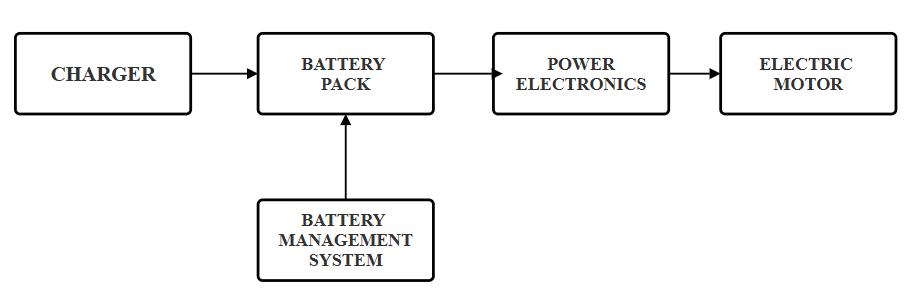
-1:
ThemostimportantfeatureofEVisabatterypackasit hasadirectimpactonthedrivingrange,acceleration,safety, and performance. Lithium-ion batteries are typically used becausetheyarehighinenergydensity,theyarelightweight and service life is very high. Additionally, EVs possess regressivebrakingsystemsthattapintothekineticenergy produced during braking and make it reexperience in the batteryandenhancethetotalenergyefficiency.
This would need a Battery Management System (BMS) that would allow the safe and reliable operation of the battery. The BMS provides continuous searching of the parameter,andtheyarethevoltage,current,temperature, StateofCharge(SoC)andStateofHealth(SoH).Itdefends against excessive power charging, deep discharging, excessive heating and an unbalanced cell consequently increasing battery security and life. Also, the aggressive developmentofthechargingsystem,thesmartenergyuse, and the governmental subsidies are augmenting the EV implementationintotheglobalmarketplace.Consequently, EVsfittedwiththemoderntechnologiesofBMSarebecoming the key toward the attainment of the sustainable and environment-friendlytransportsystems.
Electricvehicles weredesignedandcommercialized in greatnumbersduetohighenergydensity,lowweightand evenlongcyclelifeofthelithium-ionbattery.TheLithiumionbatteriesarehighlymodifiedtotheenergyandpower requirementoftheexistingEVsthatrequiresafast-charging anddischargingbatteryascomparedtothepreviousleadacidandnickelmetallichydridebatteries.
The battery is manufactured using such fundamental elements as the anode, cathode, and electrolyte and separator with the lithium ions flowing between the electrodesduringeitherthechargeordischargecycle.
EVshavecathodematerialthatisusuallylithiumnickel manganesecobaltoxide(NMC)andlithiumironphosphate (LFP), which vary in terms of energy density, thermal stability and cost. Nevertheless, the lithium-ion batteries, like any other type of battery, are also sensitive to the environmentfactors(temperature,voltageandchargerate). Hence, it is required to enhance battery chemistry and thermalcondition,andBatteryManagementSystems(BMS) in order to enhance the safety, reliability, efficiency, and batterylifeofelectricvehicles.
A high-quality Battery Management System (BMS) architectureisimportanttoensurethethingsundercontrol are safe, efficient and reliable battery packs in an electric vehicle.Theoperationofthelithium-ionbatterieswouldbe under high voltage, current and temperature conditions, therefore,toprovidethesafetyofthebatteryandthelong serviceofthebattery,strongBMSwouldberequired.
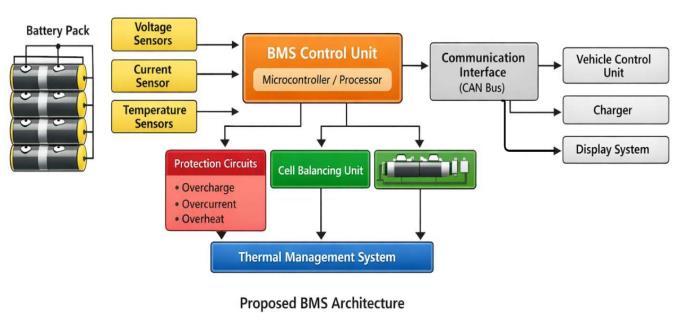
The general BMS is made up of sensing, control, protection, balancing and communication unit. An appropriatesensesinthesensingunitdetectcellvoltages, packcurrent,andpacktemperature.
The control unit processes this data and estimates the battery states including the State of Charge (SoC) and the State of Health (SoH) and provides safe control of the charging and discharging. Protection circuits avoid overcharging,deepdischarge,shortcircuitandoverheating.
Cell balancing enhances the efficiency of energy and the battery life and the communication interfaces offer the opportunity to communicate with vehicle control and diagnostics systems which guarantee safe and reliable performanceofEVs.
International Research Journal of Engineering and Technology (IRJET) e-ISSN: 2395-0056
Volume: 13 Issue: 03 | Mar 2026 www.irjet.net p-ISSN: 2395-0072
This work is a project where a Battery Management System (BMS) to be applied to an electric vehicle is developedanddeliveredwiththehelpofamicrocontrollerbasedarchitecture.Thesystemincorporatesacombination of voltage, current, temperature and safety sensors and modules of control and communication to gauge and safeguard a lithium-ion battery pack. The adopted BMS fulfills the following key functions: State of Charge estimation, State of Health estimation, State of Power estimation, thermal management and safety protection, whichmakebatterybehaviorsafeandreliable.
The estimation of the State of Charge (SoC) is done throughthecontinuousmeasuringofthevoltageandcurrent ofthebattery,whicharemeasuredwiththehelpofanalog sensing circuits connected to the microcontroller ADC channels.Avoltagedividernetworkisalsousedtoreduce thebatteryvoltagetoamountsthatarecompatiblewiththe controller.Thereal-timeprocessingoftheacquiredsignalsis to calculate the remaining capacity of the battery. The estimated SoC is built on an OLED module and wirelessly with the ability to monitor battery status in real-time and managetheenergyefficiently.
Theestimationofstateofhealth(SoH)inthisprojectis done through the analysis of long-term behavior of the battery,likethe behaviorof voltagestability,temperature variations, and charging/discharging performance. These parameterschange,whichistheindicatorofbatteryageing and degradation. The system logs deviant trends and informs the user using buzzer signaled and wireless messages.Inthisway,faultscanbedetectedearlyenough, andbatteryreliabilityandlifecanbeassessed.
TheStateofpower(SoP)estimationisamethodusedto establishthemaximumamountofpowerthatcouldbesafely providedbythebatterytotheload.SoPisconsideredinthis projectthroughobservingthecurrentflow,voltagelimitand temperatureconditions.Accordingtotheseparameters,the controller will adjust the load relay to avoid unnecessary power consumption when it is in unsafe conditions. This feature will provide regulated power supply when under heavy load as well as insulate the battery against any electricaloverload.
Thermal management is also put in place with temperaturesensorsthatareattachedtothebatterypackto
monitortheoperatingtemperature.Themicrocontrollerwill interpretthetemperaturereadingsandtakeprecautionary measuresincasethebatterytemperaturepassesanyofthe pre-establishedlimits.The displayandaudiblealarmsare activated by high temperature, and the charging or load operation will be stopped when it is required. This plan eliminatesthermalstrainandthechancesofoverheatingand thermalrunaway.
The implemented BMS has safety and protection as its characteristics. The system has safeguarding against over voltages,undervoltages,overcurrents,over-heatingandfire issuesthroughspecialsensorsandisolationthroughrelays. When faults are detected, the controller will separate the batteryofthechargingsourceorloadandprovidereal-time notifications via a wireless notification system. Such mechanisms contributegreatlytothe safety ofoperations andprovideagoodamountofreliabilityinthebatteryuseof electricvehicles.
BatteryManagementSystemwhichseekstoidentifythe real-time and future behaviour of the lithium-ion battery adopts the state estimation and prediction methods. All important battery states are those with State of Charge (SoC),StateofHealth(SoH)andStateofPower(SoP)which are sensor-based measurements of voltage, current and temperatureusingtheADCofthemicrocontroller.Longterm variations in the battery voltage constancy and thermal responseareemployedtoestimateSoH,voltage-basedand current-tracking to estimate SoC. The supply of power is predictedinbothcurrentworkinglimitsandintemperature conditions.Thebenefitsofthesepredictionandestimation methodsarethattheyprovidecontrolmeasuresbeforehand, enhance safety, and augment reliability of batteries to the overalluseofelectricvehicles.
RemainingUsefulLife(RUL)estimationisanestimation ofthetimealithium-ionbatterywillbesafelyabletobeused until the point of diminishing performance levels. In the proposed Battery Management System, RUL can be calculated, relying on the more long-term changes of electricalandthermalparametersthataremeasuredwith theassistanceofsensorsandconvertedbyamicrocontroller. The system helps predictive maintenance by tracking the degradationtrends,andimprovingbatteryperformancein theelectriccars.
Thesignificantparametersconsideredintheestimation ofRULare:
International Research Journal of Engineering and Technology (IRJET) e-ISSN: 2395-0056
Volume: 13 Issue: 03 | Mar 2026 www.irjet.net p-ISSN: 2395-0072
Workingabilityofbatterylostwithtime.
Increaseinoperationalinternalresistance.
Carryingoutbehaviorincharginganddischarging.
Increase in temperature on load and rapid charging basis.
Safety accidents and natural operation occurring conditions.
Proper estimation of RUL can help to prevent unexpected failures, enhanced security of the system, and successful batteryreplacementplanning.
1. Battery Pack
The battery pack isthe main energy storageunit of an electric vehicle. It consists of multiple lithium-ion cells connected in series and parallel to provide the required voltage and capacity. The BMS monitors the condition of thesecellstoensuresafeandefficientoperation.
2. Sensors
Sensors are used to measure important battery parameters such as voltage, current, and temperature. Voltagesensorsmonitorthebatteryvoltage,currentsensors measure the charging and discharging current, and temperature sensors detect the battery temperature to preventoverheating.
3. Microcontroller / Control Unit
The microcontroller acts as the brain of the BMS. It collectsdatafromsensors,processestheinformation,and makes decisions based on programmed algorithms. It is responsible for estimating battery states such as State of Charge (SoC), State of Health (SoH), and State of Power (SoP).
4. Protection Circuit and Relays
Protectioncircuitsandrelaysareusedtodisconnectthe battery from the load or charging source when unsafe conditionsoccur.Theyprotectthebatteryfromovervoltage, undervoltage,overcurrent,andoverheating.
5. Communication and Display Module
ThecommunicationmoduleallowstheBMStotransmit battery data to external devices or monitoring systems. Display modules such as OLED screens show real-time batteryinformationlikevoltage,temperature,andbattery percentagetotheuser.
The ESP32 has a built-in Wi-Fi module that enables internetconnectivity.Thisallowsthesystemtoconnecttoa wirelessnetworkandsenddataoralertstotheuserthrough theTelegramapplication.
4. Telegram Bot
ATelegramBotisusedtosendnotificationsandalertsto the user. When the system detects conditions such aslow batteryvoltage,hightemperature,orfiredetection,thebot automatically sends warning messages to the user's Telegramaccount.
5. Cloud / IoT Communication
The IoT communication system allows data transfer between the microcontroller and the Telegram server throughtheinternet.Thisenablesremotemonitoringand instantalertnotifications.
6. User Device (Smartphone)
Theuserreceivesalertsandsystemstatusmessagesona smartphonethroughtheTelegramapplication.Thishelpsin monitoring the battery system remotely and taking necessaryactionwhenrequired.
International Research Journal of Engineering and Technology (IRJET) e-ISSN: 2395-0056
Volume: 13 Issue: 03 | Mar 2026 www.irjet.net p-ISSN: 2395-0072
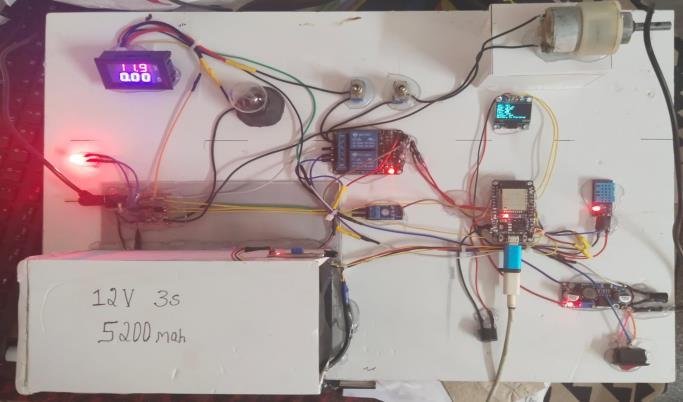
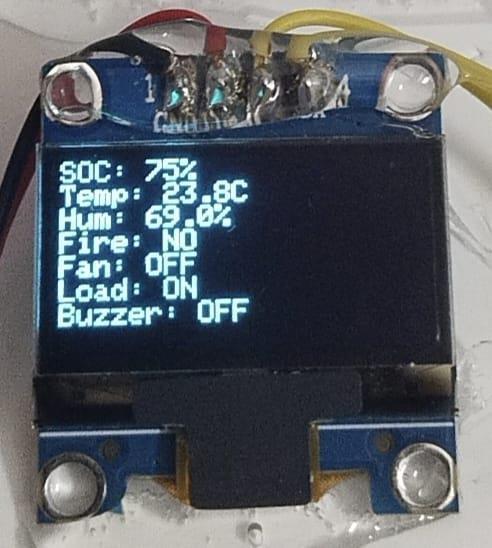
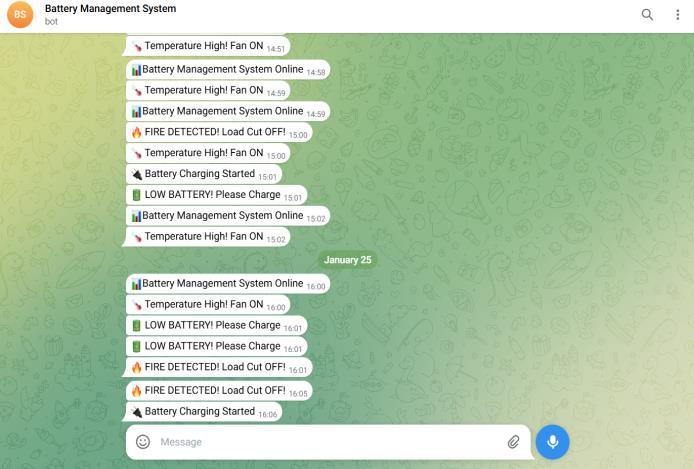
1.TheESP32-basedBMSsuccessfullymonitoredLi-ion batteryvoltage,current,temperature,andhumidityinreal time.
2. SOC estimation and basic SOH indication were achieved using voltage and current data with suitable algorithms.
3. Protection functions worked correctly: relays disconnectedloads,thefanturnedon,andthebuzzeralerted during overcurrent, overtemperature, and low-voltage events.
4. The OLED display and panel voltmeter/ammeter showedconsistent,calibratedreadings,matchingeachother duringtests.
5.IoT/Telegraminterfacesreliablysentstatusupdates and fault alerts, enabling remote monitoring and basic control.
6.UnderdynamicloadingwiththeDCmotorandhalogen bulb, the system correctly handled voltage sag, current spikes,andtemperaturerise,keepingthebatterywithinsafe operatinglimits.
Thispaperdescribesthedesignandimplementationof BatteryManagementSysteminthecaseofelectricvehicles withfocusonStateofCharge(SoC),StateofHealth(SoH), StateofPower(SoP),aswellasRemainingUsefulLife(RUL) estimation. The designed system will guarantee the safe operationofbatteriesduetothewell-developedprotection andthermalmanagementsystems.Ingeneral,thedesigned BMSwillimprovebatteryreliability,operationalsafety,and energy efficiency, which will help in achieving better performanceandlongerbatterylifeinelectricvehicles.
[1]S.Mishra,S.C.Swain,andR.K.Samantaray,“AReviewon BatteryManagementSystemandItsApplicationinElectric Vehicle,”Proceedingsofthe10thInternationalConference on Advances in Computing and Communications (ICACC), IEEE, 2021, pp. 202152719.2021.9708114. 1–6, doi: 10.1109/ICACC
[2] R. Pakdel, M. Yavarinasab, M. Rezania Zibad, and M. R. Almohaddesn, “Design and Implementation of Lithium Battery Management System for Electric Vehicles,” in Proceedings of the 9th Iranian Conference on Renewable Energy&DistributedGeneration(ICREDG),IEEE,2022,pp. 1–6,doi:10.1109/ICREDG54199.2022.9804549.
[3] S. Shete, P. Jog, D. K. Palwalia, and R. K. Kumawat, “BatteryManagementSystemforSOCEstimationofLithiumIonBatteryinElectricVehicle:AReview,”inProceedingsof
International Research Journal of Engineering and Technology (IRJET) e-ISSN: 2395-0056
Volume: 13 Issue: 03 | Mar 2026 www.irjet.net p-ISSN: 2395-0072
the6thIEEEInternationalConferenceonRecentAdvances and Innovations in Engineering (ICRAIE), IEEE, 2021, pp. 10.1109/ICRAIE52900.2021.9703752.1–6,doi:
[4] Y. Xing, E. W. M. Ma, K. L. Tsui, and M. Pecht, “Battery managementsystemsinelectricandhybridvehicles,”IEEE Transactions on Industrial Electronics, vol. 58, no. 9, pp. 4150–4162,Sept.2011.
[5]R.Xiong,J.Cao,Q.Yu,H.He,andF.Sun,“Criticalreview onthebatterystateofchargeestimationmethodsforelectric vehicles,”IEEEAccess,vol.6,pp.1832–1843,2018.
[6]R.Xiong,Y.Zhang,J.Wang,H.He,andM.Pecht,“Lithiumion battery health prognosis based on a real battery management system,” IEEE Transactions on Vehicular Technology,vol.68,no.5,pp.4110–4121,May2019.
[7] H. He, R. Xiong, and J. Fan, “Evaluation of lithium-ion battery equivalent circuit models for state of charge estimation,”IEEETransactionsonIndustrialElectronics,vol. 58,no.11,pp.5124–5132,Nov.2011.
[8] J. Kim, J. Shin, C. Chun, and B. H. Cho, “Stable configurationofalithium-ionseriesbatterypackbasedona screening process for improved voltage/SOC balancing,” IEEETransactionsonPowerElectronics,vol.27,no.1,pp. 411–424,Jan.2012.
© 2026, IRJET | Impact Factor value: 8.315 | ISO 9001:2008 Certified Journal | Page781