
International Research Journal of Engineering and Technology (IRJET) e-ISSN: 2395-0056
Volume: 13 Issue: 04 | Apr 2026 www.irjet.net p-ISSN: 2395-0072

International Research Journal of Engineering and Technology (IRJET) e-ISSN: 2395-0056
Volume: 13 Issue: 04 | Apr 2026 www.irjet.net p-ISSN: 2395-0072
Saripalli Sravani 1,K. Mani Shankar 2,G. Naveen Kumar 3,I. Roopa Devi 4 , K. Giridhar 5
1 Assistant Professor, Department of ECE, Dr. Lankapalli Bullayya College of Engineering, Visakhapatnam, Andhra Pradesh, India.
2,3,4,5 Department of ECE, Dr. Lankapalli Bullayya College of Engineering, Visakhapatnam, Andhra Pradesh, India.
ABSTRACT: Traditional library management systems rely on manual or barcode-based methods, which are timeconsuming and prone to human errors. This paper presents a low-cost automated library management system using Radio Frequency Identification (RFID) technology integrated with a GSM-based alert mechanism. The system utilizes RFID tags for user and book identification, while an Arduino Uno microcontroller controls the overall operation. A 16×2 LCD is used to display real-time system status, and PLX-DAQ is employed to log transaction data directly into Microsoft Excel for monitoring and record maintenance. Additionally, a SIM900A GSM module is used to send SMS notifications for book issue, return, and overdue alerts. The proposed system reduces manual intervention, improves transaction accuracy, and ensures efficient library operations. The developed prototype demonstrates reliable performance and is suitable for implementation in academic libraries.
Keywords: RFID, Arduino UNO, Library Automation, GSM, SIM900A, PLX-DAQ, MFRC522, LCD 16×2
Radio Frequency Identification (RFID) is an automated technique for identifying, tracking, and managing objects using radiowaves.Inlibraryenvironments,RFIDimprovescirculationoperationssuchasbookissue/return,inventorytracking, and anti-theft measures. RFID-enabled automated libraries can function as self-service stations requiring minimal assistance from librarians. By adopting RFID-based check-in and check-out systems, operational delays reduce significantly,improvingusersatisfactionandoverallefficiency.
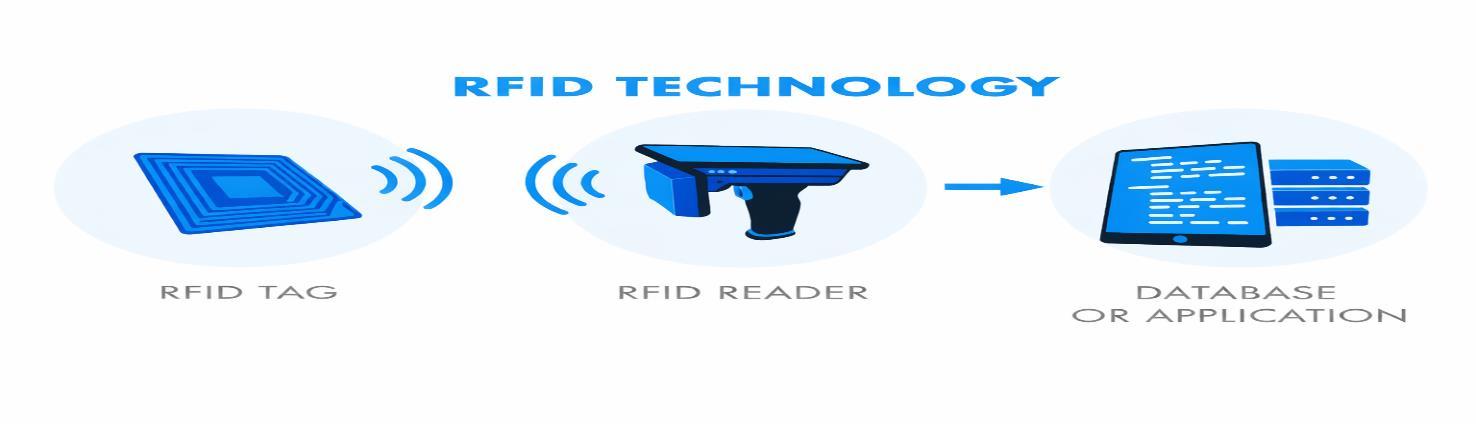
The primary objective of this project is to design and implement a smart library management system using RFID technologyandembeddedcontrollerstostreamlineroutinelibraryprocesses.Thesystemfocuseson(i)automatingbook issue and return operations, (ii) minimizing human errors, (iii) providing real-time user feedback via LCD display, (iv)enabling secure and reliable transactions, and (v) improving overall operational efficiency with alerts and structured recordkeeping.
Volume: 13 Issue: 04 | Apr 2026 www.irjet.net
-0056
-ISSN: 2395-0072
Traditional library management relies on manual registers or barcode-based methods for recording issue/return transactions. Users must depend on staff for availability checks and transaction updates. This approach can lead to misplacedbooks,delaysinprocessing,andhigherprobabilityofhumanerror.Overduetrackingandfinemanagementalso requiremanualeffort,affectingefficiency.
TheproposedautomatedlibrarymanagementsystemintegratesRFID,PLX-DAQ,andaSIM900AGSMmoduleforefficient book transactions. Users borrow or return books by scanning RFID-tagged user cards and book tags. The Arduino UNO verifies the inputs, updates the transaction status, and displays real-time messages on a 16×2 LCD. PLX-DAQ logs the transaction details directly into MS Excel for on-premise record storage. The GSM module sends SMS notifications for successfultransactionsandoverduereminders,therebyenhancingsecurityandcompliance.
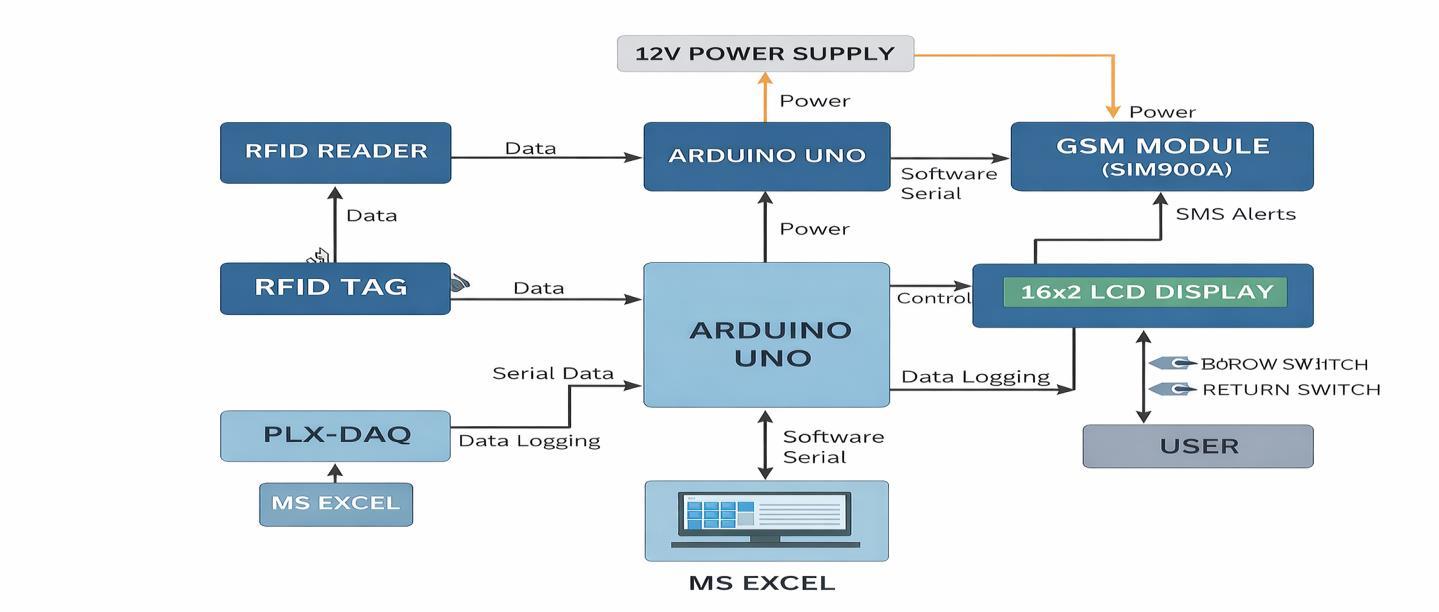
Theblockdiagramillustratestheoverallarchitectureoftheproposedsystem.TheRFIDreaderscansuserandbooktags, and the Arduino Uno processes the data. The GSM module sends SMS alerts, while the LCD displays system status. PLXDAQisusedforreal-timedataloggingintoMicrosoftExcel.
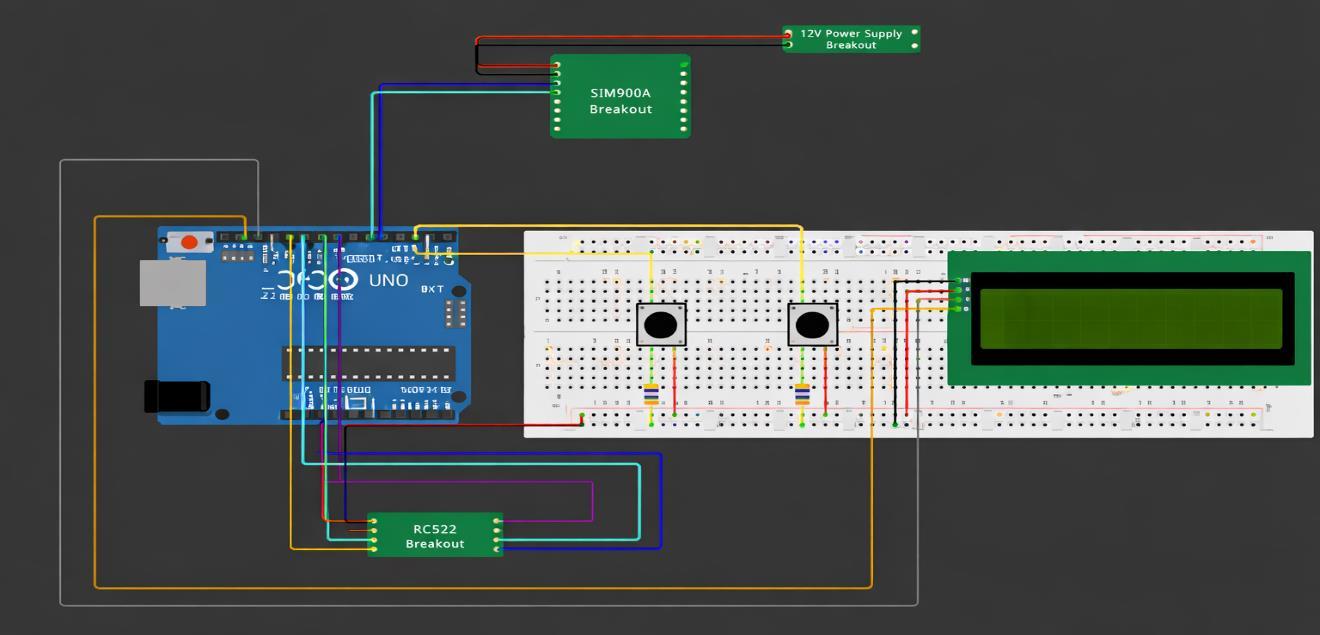
The RC522 RFID module is interfaced with the Arduino Uno through the SPI interface, where the slave select and reset lines are connected to digital pins 10 and 9 respectively. The SIM900A GSM module is connected using software serial communication on digital pins 6 and 7. Two tactile switches used for borrow and return operations are connected to digitalpins2and3.A16×2LCDmoduleisemployedtodisplaytransactionandsystemstatusmessagestotheuser.
1)UserscansRFIDIDcard.
2)Booktagisscanned.
3)Systemvalidatesauthorizationandtransactionrules.
4)Issue/Returnstatusisupdated.
5)RecordsareloggedtoExcelusingPLX-DAQ.
-0056
Volume: 13 Issue: 04 | Apr 2026 www.irjet.net p-ISSN: 2395-0072
6)SMSalertsaresentforsuccessfultransactionsandoverduereminders.
The proposed automated library management system is implemented using an Arduino Uno controller, MFRC522 RFID reader, 16×2 I2C LCD display, SIM900A GSM module and PLX-DAQ based data logging. The system operates by first scanningtheuserRFIDcardfollowedbyscanningthebookRFIDtag.Basedontheselectedoperationusingtheborrow or returnswitch,thecontrollerverifiestheuserauthorizationandthebookstatus.
TheMFRC522RFIDreaderisinterfacedwiththeArduinothroughtheSPIinterface,wheretheslaveselectandresetpins areconnectedtodigitalpins10and9respectively.TheGSMmoduleisinterfacedusingsoftwareserialcommunicationon digital pins 6 and 7 to transmit SMS notifications. The borrow and return switches are connected to digital pins 2 and 3, andtheLCDmoduleisconnectedthroughtheI²Cinterfacefordisplayingsystemmessages.
Aftersuccessfulverification,thetransactiondetailssuchasuserID,bookID,actiontypeandtimearetransmittedthrough the serial interface to the PLX-DAQ tool, which logs the data automatically into a Microsoft Excel sheet. In case of unauthorized access or overdue conditions, the system generates alert messages and sends SMS notifications to the respectiveuserorlibrarian.
This step-by-step procedure ensures reliable identification, automated transaction handling, real-time data logging and securemonitoringoflibraryactivities.
ThehardwareincludesArduinoUNO asthecontrol unit,MFRC522RFIDreaderandtags/cardsfor identification,a 16×2 LCDforstatusdisplay,tactileswitchforoperationcontrol,andSIM900AGSMmoduleforSMScommunication.Thedesign supportslow-costimplementationandisscalableforinstitutionallibraryenvironments.
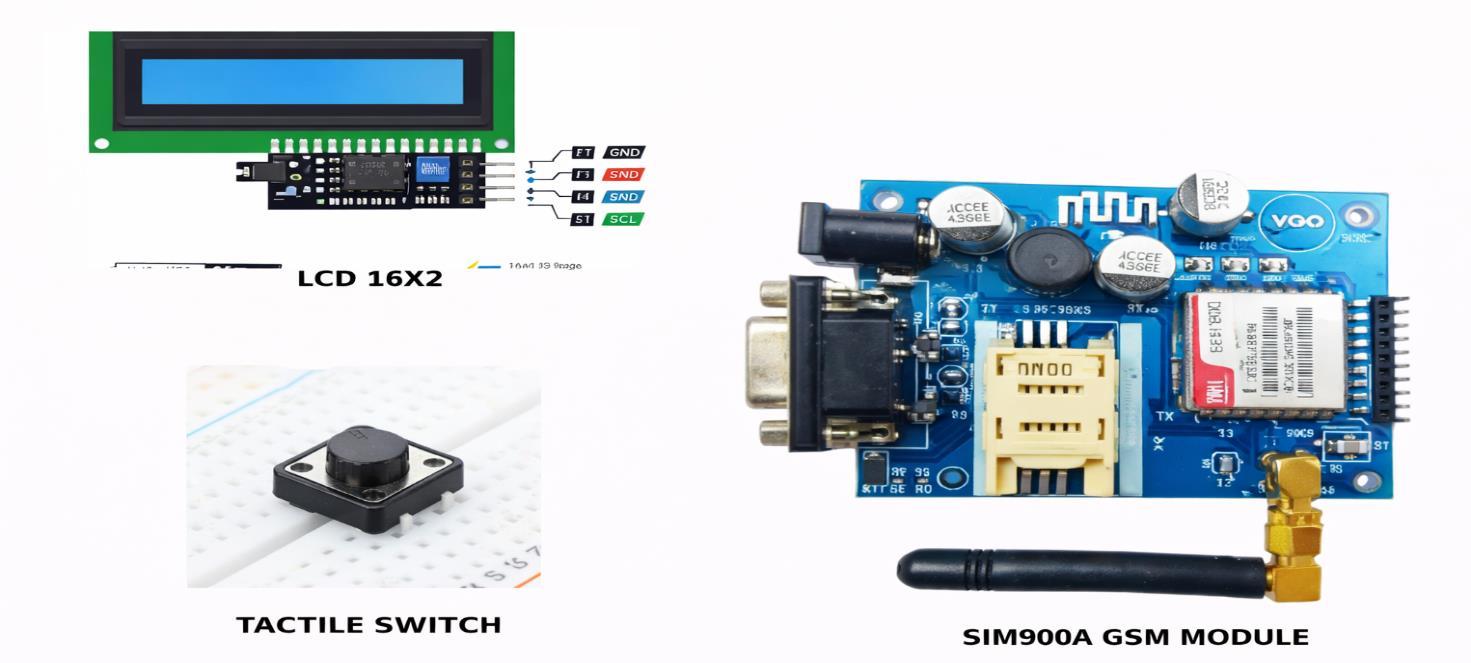
Fig. 3. Components
The prototype was tested using multiple user cards and book tags. The system performed quick RFID identification and transaction logging. Real-time Excel logging was successfully obtained using PLX-DAQ, and SMS notifications were received for transaction confirmation and reminders. The overall system reduces manual workload and improves transactionaccuracy.
International Research Journal of Engineering and Technology (IRJET) e-ISSN: 2395-0056
Volume: 13 Issue: 04 | Apr 2026 www.irjet.net p-ISSN: 2395-0072
During real-time implementation, practical issues such as occasional RFID tag detection failures, LCD communication addressmismatch,GSMnetworkavailabilityproblemsandPLX-DAQdataloggingerrorswere observed.Theseissueswereresolvedbyverifyingwiringconnections,confirmingcorrectI²Caddressing,matchingserial baudratesettingsandvalidatingGSMATcommandresponses.Afterthesecorrections,thesystemoperatedreliablyunder repeatedtestingconditions.
13 Issue: 04 | Apr 2026 www.irjet.net
International Research Journal of Engineering and Technology (IRJET) e-ISSN: 2395-0056
Volume: 13 Issue: 04 | Apr 2026 www.irjet.net p-ISSN: 2395-0072
Advantages of the proposed system
The proposed RFID-based library management system reduces manual intervention, improves transaction accuracy and enables faster book issue and return operations. Automatic record logging using PLX-DAQ simplifies data management, whileGSM-basedalertsenhancesecurityandhelpinmonitoringoverdueandunauthorizedactivities.
VIII. CONCLUSION
Thispaper presentedan RFID-basedlibrary managementautomation system integrating GSMalertsand PLX-DAQbased datalogging.Theprototypedemonstratesfasterprocessing,reducederrors,andimprovedmonitoringoflibraryactivities. Theapproachenhancesuserexperienceandcanbeextendedfurtherforadvancedsmart-libraryapplications.
Future enhancements include cloud-based database integration, web/mobile interfaces for students to check availability and due dates, improved security using additional authentication, and integration with IoT dashboards for centralized monitoring.
International Research Journal of Engineering and Technology (IRJET) e-ISSN: 2395-0056
Volume: 13 Issue: 04 | Apr 2026 www.irjet.net p-ISSN: 2395-0072
[1]K.Finkenzeller,RFIDHandbook:FundamentalsandApplicationsinContactlessSmartCardsandIdentification,2nded. Wiley,2003.
[2]R.Want,“AnintroductiontoRFIDtechnology,”IEEEPervasiveComputing,vol.5,no.1,pp.25–33,2006.
[3]Arduino,“ArduinoUNORev3,”Datasheet/Documentation,2023.
[4]NXPSemiconductors,“MFRC522RFIDReaderIC,”Datasheet,2022.
[5]SIMCom,“SIM900AGSM/GPRSModule,”Datasheet,2021.
[6]S.A.AhsonandM.Ilyas,RFIDHandbook:Applications,Technology,Security,andPrivacy,CRCPress,2008.
[7]V.K.Garg,WirelessCommunicationsandNetworking,MorganKaufmann,2007.
[8]Arduino,“MFRC522RFIDModuleDocumentation,”OnlineAvailable:https://www.arduino.cc
© 2026, IRJET | Impact Factor value: 8.315 | ISO 9001:2008 Certified Journal | Page97