
International Research Journal of Engineering and Technology (IRJET) e-ISSN: 2395-0056
Volume: 13 Issue: 03 | Mar 2026 www.irjet.net p-ISSN: 2395-0072
International Research Journal of Engineering and Technology (IRJET) e-ISSN: 2395-0056
Volume: 13 Issue: 03 | Mar 2026 www.irjet.net p-ISSN: 2395-0072
Ms.Pratibha Bharat Patil 1 , Mansi Nitin Dhumale, Pooja Sanjay Bashetti, Divya Mohan Dongare, Snehal Mahadev Gaikwad , Adiba Salim Shaikh
1 HOD,Electrical Engg.
Electrical Engineering Dept, Shri Siddheshwar Women‘s Polytechnic Solapur ***
Abstract - In educational institutions, the traditional bell system is mostly operated manually,whichmaylead tohuman errors such as delays, missed periods, or irregular ringing times. To overcome these issues, a Smart Periodic Bell System is designed and implemented to automate the bell ringing process according to a predefined schedule. The proposed system uses a microcontroller-based design along with electronic components such asareal-timeclock(RTC)module, display unit, and buzzer or bell mechanism.
The system allows users to set and manage differentschedules for regular class periods and examination timings. Once the schedule is programmed, the system automatically rings the bell at the specified time without manual intervention. This helps in maintaining discipline, accuracy, and time management within educational institutions.
The Smart Periodic Bell System is reliable, cost-effective, and easy to operate. It reduces the need for human involvement and ensures that the bell rings at the correct timeconsistently. This project demonstrates how automation and embedded systems can improve the efficiency of routine operations in schools and colleges.
Time management plays a very important role in schools, colleges, and other educational institutions. Traditionally, the bell used to indicate the start and end of periods is operatedmanuallybyastaffmember.Thismanualsystem maysometimesleadtoproblemssuchasdelays,incorrect ringingtime,ormissedperiodsduetohumanerror.These issuescandisturbtheregularscheduleofclassesandaffect disciplineintheinstitution.
Toovercometheseproblems,anautomatedsystemknown asa SmartPeriodicBell Systemcanbe implemented. This systemautomaticallyringsthebellat time withthestoredscheduleandactivatesthe bell when thesettimeisreached.Thesystemcanalsobeprogrammed for different schedules, such as regular class timings and examination timings. This makes the system flexible and easytouseineducationalenvironments.
The Smart Periodic Bell System reduces human effort, improvesaccuracy,andensuresthatthebellringsexactlyat thescheduledtime.Itisacost-effectiveandreliablesolution
thathelpsmaintainpropertimemanagementanddiscipline inschoolsandcolleges.

Automation has become an important part of modern educationalinstitutions.Manyresearcherspredefinedtimes accordingtothedailyschedule.Thesystemuseselectronic componentssuchasamicrocontroller,real-timeclock(RTC) module,displayunit,andbuzzerorbelltocontrolthetiming operationaccurately.
Thereal-timeclockhelpsmaintainthecorrecttime,while the microcontroller compares the current and developers haveproposedautomatedbellsystemstoreplacetraditional manualbellringingmethods.Thesesystemsaimtoimprove accuracy,reliability,and timemanagementinschoolsand colleges.
Earlier bell systems were mostly based on simple timer circuitsormechanicaltimers.Althoughthesesystemscould ringthebellautomatically,theyhadlimitationssuchaslack of flexibility, difficulty in changing schedules, and lower accuracy. With the development of microcontrollers and
International Research Journal of Engineering and Technology (IRJET) e-ISSN: 2395-0056
Volume: 13 Issue: 03 | Mar 2026 www.irjet.net p-ISSN: 2395-0072
embedded systems, more advanced solutions have been introduced.
Severalstudieshaveproposedautomatedbellsystemsusing microcontrollers and real-time clock (RTC) modules. The RTC module helps maintain accurate time, while the microcontrollercontrolstheringingofthebellaccordingto thestoredschedule.Somesystemsalsoincludedisplaysand userinterfacesthatallowuserstoeasilysetormodifythe belltimings.
Recent developments have also integrated wireless technologies such as Bluetooth or GSM to control the bell system remotely. These advanced systems provide better controlandmonitoring,buttheymayincreasethecostand complexityofthesystem.
The Smart Periodic Bell System proposed in this project focuses on providing a simple, reliable, and cost-effective solutionforeducationalinstitutions.Itallowsautomaticbell ringing based on predefined schedules and can support different modes such as regular class schedules and examinationtimings.Thisimprovestimemanagementand reduces human errors associated with manual bell operation.
Automation has become an important part of modern educationalinstitutions.Manyresearchersanddevelopers haveproposedautomatedbellsystemstoreplacetraditional manualbellringingmethods.Thesesystemsaimtoimprove accuracy,reliability,and timemanagementinschoolsand colleges.
Earlier bell systems were mostly based on simple timer circuitsormechanicaltimers.Althoughthesesystemscould ringthebellautomatically,theyhadlimitationssuchaslack of flexibility, difficulty in changing schedules, and lower accuracy. With the development of microcontrollers and embedded systems, more advanced solutions have been introduced.
Severalstudieshaveproposedautomatedbellsystemsusing microcontrollersandreal-timeclock(RTLiteraturereview)
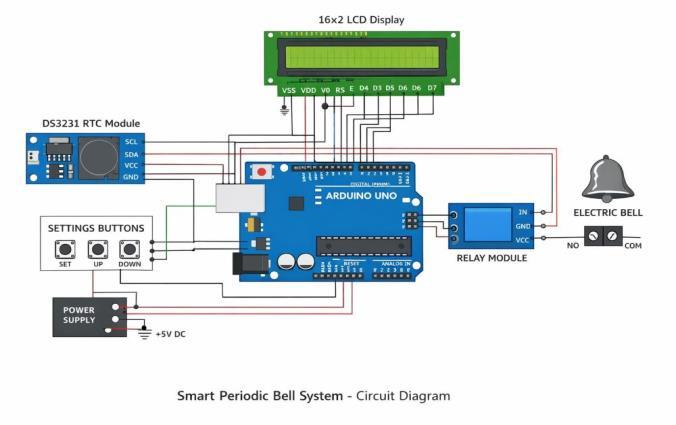
TheSmartPeriodicBellSystemisdesignedtoautomatethe ringing of the bell in schools and colleges according to a predefined schedule. The system architecture consists of severalhardwarecomponentsthatworktogethertoensure accuratetimemanagementandreliableoperation.
The main components of the system include a microcontroller,real-timeclock(RTC)module,displayunit, control buttons, relay module, and a bell or buzzer. The microcontrolleractsasthecentralcontrollerofthesystem andcoordinatestheoperationofallcomponents.
Thereal-timeclock(RTC)modulecontinuouslykeepstrack of the current time and sends the time data to the microcontroller. The microcontroller compares this time with the stored bell schedule. When the current time matchesthescheduledbelltime,themicrocontrollersendsa signaltotherelaymodule.
Therelaymoduleactsasaswitchingdevicethatcontrolsthe powersupplytothebell.Whenactivated,therelayturnson thebellorbuzzer,causingittoring.Afterafewseconds,the microcontrollerturnstherelayoff,stoppingthebell.
Thedisplayunitisusedtoshowthecurrenttimeandsystem status, while the control buttons allow the user to set or modifythebellschedule.Thesystemcansupportdifferent timing modes such as regular class schedules and examinationschedules.
Overall, the system architecture ensures accurate timing, automatic operation, and easy control of the bell system, makingitsuitableforuseineducationalinstitutions.
TheSmartPeriodicBellSystemisdesignedtoautomatethe ringing of the bell in schools and colleges according to a predefined schedule. The system architecture consists of severalhardwarecomponentsthatworktogethertoensure accuratetimemanagementandreliableoperation.
The main components of the system include a microcontroller,real-timeclock(RTC)module,displayunit, control buttons, relay module, and a bell or buzzer. The microcontrolleractsasthecentralcontrollerofthesystem andcoordinatestheoperationofallcomponents.
Thereal-timeclock(RTC)modulecontinuouslykeepstrack of the current time and sends the time data to the microcontroller. The microcontroller compares this time withthestoredbellschedule.
The Smart Periodic Bell System uses several electronic componentstoperformautomaticbellringingaccordingto thesetschedule.Themainhardwarecomponentsusedinthe systemaredescribedbelow.
Themicrocontrolleristhemaincontrolunitofthesystem.It processesalltheinstructionsandcontrolstheoperationof the bell system. It receives the time data from the RTC module and compares it with the programmed schedule. When the time matches the preset bell time, the microcontrolleractivatestherelaytoringthebell.
2395-0056
Volume: 13 Issue: 03 | Mar 2026 www.irjet.net p-ISSN: 2395-0072
TheRTCmoduleisusedtomaintainaccuratecurrenttime anddate.Itcontinuestokeeptrackoftimeevenwhenthe systempoweristurnedoffbecausei…
Hardware Components
The Smart Periodic Bell System uses several electronic componentstoperformautomaticbellringingaccordingto thesetschedule.Themainhardwarecomponentsusedinthe systemaredescribedbelow.
Themicrocontrolleristhemaincontrolunitofthesystem.It processesalltheinstructionsandcontrolstheoperationof the bell system. It receives the time data from the RTC module and compares it with the programmed schedule. When the time matches the preset bell time, the microcontrolleractivatestherelaytoringthebell.
TheRTCmoduleisusedtomaintainaccuratecurrenttime anddate.Itcontinuestokeeptrackoftimeevenwhenthe systempoweristurnedoff
TheSmartPeriodicBellSystemusessoftwaretocontroland manage the operation of the hardware components. The softwareisresponsibleforsettingthebellschedule,reading thecurrenttime,andactivatingthebellatthecorrecttime. The main software components used in this system are describedbelow.
ArduinoIDE(IntegratedDevelopmentEnvironment)isused to write, compile, and upload the program to the microcontroller.Itprovidesasimpleplatformfordeveloping andtestingthecoderequiredforthesystemoperation.
The program for the microcontroller is written using Embedded C language. This program contains the instructions that control the operation of the system. It includesthelogicf…
TheSmartPeriodicBellSystemusessoftwaretocontroland manage the operation of the hardware components. The softwareisresponsibleforsettingthebellschedule,reading thecurrenttime,andactivatingthebellatthecorrecttime. The main software components used in this system are describedbelow.
ArduinoIDE(IntegratedDevelopmentEnvironment)isused to write, compile, and upload the program to the microcontroller.Itprovidesasimpleplatformfordeveloping andtestingthecoderequiredforthesystemoperation.
The program for the microcontroller is written using Embedded C language. This program contains the instructionsthatcontroltheoperationofthesystem.
The Smart Periodic Bell System works on the principle of time-basedautomationusingamicrocontrollerandarealtime clock (RTC) module. The RTC module continuously keepstrackofthecurrenttimeandsendsthisinformationto themicrocontroller.
Themicrocontrollerstoresthepredefinedbellschedulein its program. It continuously compares the current time receivedfromtheRTCmodulewiththestoredbelltimings. Whenthecurrenttimematchestheprogrammedbelltime, themicrocontrollersendsasignaltotherelaymodule.
Therelaymoduleactsasaswitchandactivatestheelectric bellorbuzzer.Thebellringsforafewsecondstoindicate thestartorendofaclassperiod.Afterthespecifiedtime,the microcontrollerautomatically
The Smart Periodic Bell System works on the principle of time-basedautomationusingamicrocontrollerandarealtime clock (RTC) module. The RTC module continuously keepstrackofthecurrenttimeandsendsthisinformationto themicrocontroller.
Themicrocontrollerstoresthepredefinedbellschedulein its program. It continuously compares the current time receivedfromtheRTCmodulewiththestoredbelltimings. Whenthecurrenttimematchestheprogrammedbelltime, themicrocontrollersendsasignaltotherelaymodule.
International Research Journal of Engineering and Technology (IRJET) e-ISSN: 2395-0056
Volume: 13 Issue: 03 | Mar 2026 www.irjet.net p-ISSN: 2395-0072
Therelaymoduleactsasaswitchandactivatestheelectric bellorbuzzer.Thebellringsforafewsecondstoindicate thestartorendofaclassperiod.Afterthespecifiedtime,the microcontroller automatically Working of the System (RelatedtoBlockDiagram)
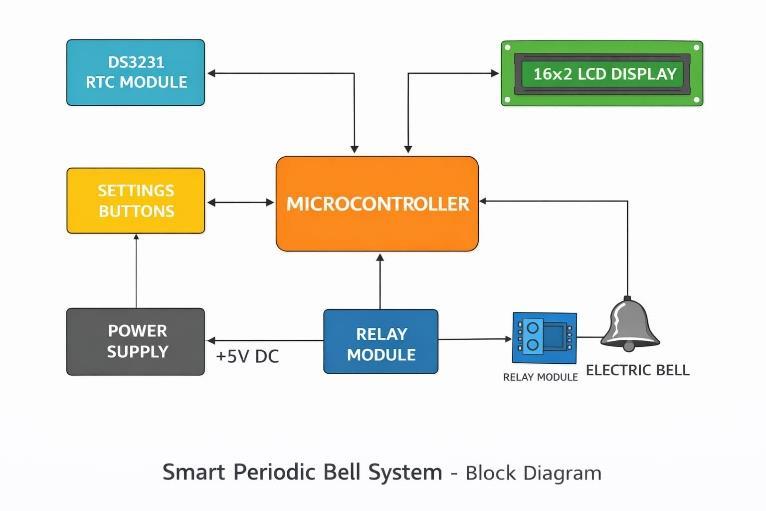
TheblockdiagramoftheSmartPeriodicBellSystemshows howdifferentcomponentsofthesystemareconnectedand worktogethertoautomatethebellringingprocess.
ThepowersupplyprovidestherequiredDCvoltage(usually +5V) to all the components of the system such as the microcontroller,RTCmodule,LCDdisplay,andrelaymodule.
TheRTC(RealTimeClock)modulecontinuouslykeepstrack of the current time and sends this time data to the microcontroller. The microcontroller acts as the main controlunitofthesystemandprocessesalltheoperations.
Thesettingsbuttonsareconnectedtothemicrocontroller andallowtheusertosetormodifythebelltimings.Using thesebuttons,thescheduleforregular
Working of the System (Related to Block Diagram)
TheblockdiagramoftheSmartPeriodicBellSystemshows howdifferentcomponentsofthesystemareconnectedand worktogethertoautomatethebellringingprocess.
ThepowersupplyprovidestherequiredDCvoltage(usually +5V) to all the components of the system such as the microcontroller,RTCmodule,LCDdisplay,andrelaymodule.
TheRTC(RealTimeClock)modulecontinuouslykeepstrack of the current time and sends this time data to the microcontroller. The microcontroller acts as the main controlunitofthesystemandprocessesalltheoperations.
Thesettingsbuttonsareconnectedtothemicrocontroller andallowtheusertosetormodifythebelltimings.Using thesebuttons,theschedule
Automaticbellringingwithoutmanualoperation.
Accuratetimingusingthereal-timeclock(RTC).
Reduceshumaneffortandchancesofmistakes.
Easytosetandmodifythebellschedule.
Reliableandconsistentoperation.
Low-costandenergy-efficientsystem.
Suitableforschools,colleges,andotherinstitutions.
SchoolsandColleges –Toautomaticallyringbells forclassperiods,breaks,andendofclasses.
ExaminationCenters–Toindicateexamstarttime, warningtime,andexamendtime.
Offices andFactories – Tosignal shiftstart, break time,andshiftend.
Hospitals–Forscheduledannouncementsorshift timingalerts.
PublicInstitutions–Usefulinplaceswhereregular time-basedalertsarerequired.
Training Centers and Coaching Institutes – To managelecturetimingsandbreaksefficiently.
ApplicationsSchoolsandColleges–Toautomatically ring bells for class periods, breaks, and end of classes.
ExaminationCenters–Toindicateexamstarttime, warningtime,andexamendtime.
Offices andFactories – Tosignal shiftstart, break time,andshiftend.
Hospitals–Forscheduledannouncementsorshift timingalerts.
PublicInstitutions–Usefulinplaceswhereregular time-basedalertsarerequired.
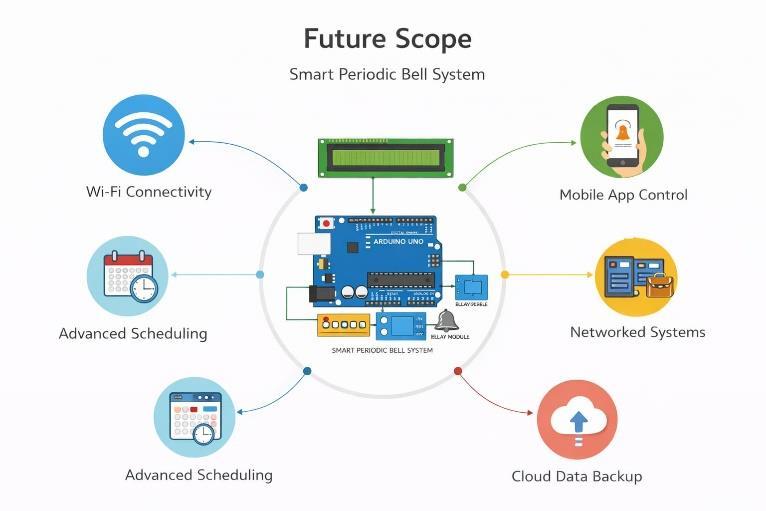
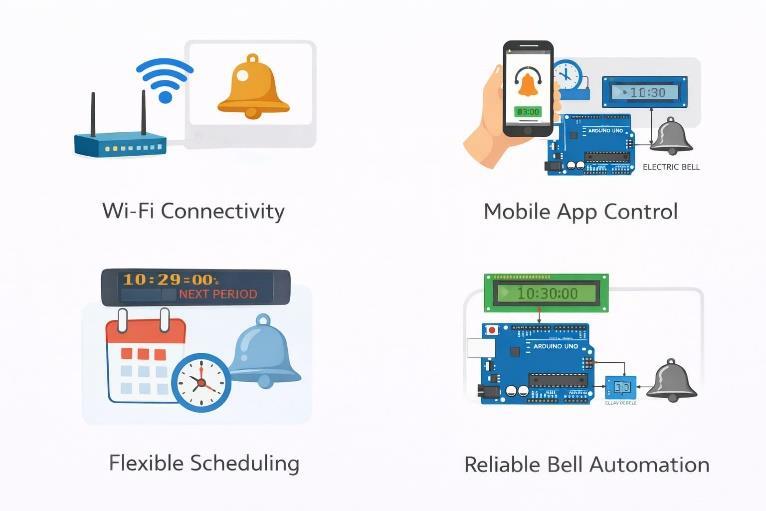
Future Scope of Smart Periodic Bell SystemThe Smart Periodic Bell System can be further improved by adding advancedtechnologiesandfeatures.Inthefuture,thesystem can be connected to Wi-Fi or Internet, allowing administrators to control and monitor the bell schedule remotely.
International Research Journal of Engineering and Technology (IRJET) e-ISSN: 2395-0056
Volume: 13 Issue: 03 | Mar 2026 www.irjet.net p-ISSN: 2395-0072
Amobileapplicationcanalsobedevelopedsothatteachers or staff can easily change the bell timings using their smartphones.Thiswillmakethesystemmoreflexibleand user-friendly.
Thesystemcanalsobeintegratedwithacentralizedschool management system, where bell timings automatically adjustaccordingtothetimetableorspecialevents.
Anotherimprovementisaddingvoiceannouncementsalong withthebell soundtoprovideinformationsuchasperiod numbersorimportantannouncements.
Additionally, cloud data storage can be used to save schedules and system settings, making it easier to update andmanagethesystemfromanywhere.
Withthese improvements, theSmartPeriodicBell System can become a more intelligent, efficient, and widely used automation system in schools, colleges, offices, and other institutions.
ThedemandfortheSmartPeriodicBellSystemisincreasing inschools,colleges,coachingcenters,andotherinstitutions wheretimemanagementisveryimportant.Traditionalbell systems require manual operation, which can lead to mistakes or delays. Therefore, many institutions prefer automated systems that can ring the bell accurately and automatically.
The Smart Periodic Bell System provides a reliable and efficientsolutionbyautomatingthebellringingprocess.It helpsmaintaindisciplineandproperschedulingofclasses, breaks,andexaminations.Duetoitslowcost,simpledesign, andeasyoperation,thesystemissuitableforbothsmalland largeeducationalinstitutions.
Theresponsetothissystemisgenerallypositivebecauseit reduces human effort and ensures accurate timing. Institutionsthatimplementautomatedbellsystemsbenefit
from better time management and improved daily operations.Asautomationtechnologycontinuestogrow,the demand for smart systems like the Smart Periodic Bell Systemisexpectedtoincreaseinthefuture.
ThedemandfortheSmartPeriodicBellSystemisincreasing inschools,colleges,coachingcenters,andotherinstitutions wheretimemanagementisveryimportant.Traditionalbell systems require manual operation, which can lead to mistakes or delays. Therefore, many institutions prefer automated systems that can ring the bell accurately and automatically.
The Smart Periodic Bell System provides a reliable and efficientsolutionbyautomatingthebellringingprocess.It helpsmaintaindisciplineandproperschedulingofclasses, breaks,andexaminations.Duetoitslowcost,simpledesign, andeasyoperation,thesystemissuitableforbothsmalland largeeducationalinstitutions.
PowerSupplyIssues–Ifthereisapowerfailure,thesystem maystopworkingunlessabackuppowersourceisprovided.
InitialSetupandProgramming–Settingthecorrectschedule andprogrammingthemicrocontrollermayrequiretechnical knowledge.
HardwareFailure–Componentssuchastherelaymodule, microcontroller, or RTC module may fail if not properly maintained.
Maintenance Requirement – The system needs occasional checkingandmaintenancetoensureproperfunctioning.
CostofInstallation–Althoughthesystemiscost-effective, the initial setup cost may still be a concern for very small institutions. System Dependency – If the system stops
International Research Journal of Engineering and Technology (IRJET) e-ISSN: 2395-0056
Volume: 13 Issue: 03 | Mar 2026 www.irjet.net p-ISSN: 2395-0072
workingduetotechnicalfaults,thebellwillnotringuntilthe issueisresolved.
Conclusion
TheSmartPeriodicBellSystemisanefficientandreliable solution for automating the bell ringing process in educationalinstitutions.Byusingamicrocontrollerandrealtimeclockmodule,thesystemensuresaccuratetimingand automatic operation without the need for manual intervention. It helps maintain discipline and proper time managementinschoolsandcolleges.
Thesystemissimple,cost-effective,andeasytooperate.It reduceshumaneffortandminimizeserrorsthatmayoccur inmanualbellsystems.Therefore,theSmartPeriodicBell System isa practical anduseful applicationof automation technologyineducationalenvironments.
References
[1]M.BanziandM.Shiloh,GettingStartedwithArduino,3rd ed.,MakerMedia,2015.
[2] Arduino, “Arduino Uno Rev3,” Available: https://www.arduino.cc
[3]DS3231RealTimeClock(RTC)ModuleDatasheet,Maxim Integrated.
[4] J. Monk, Programming Arduino: Getting Started with Sketches,McGraw-HillEducation,2016.
[5]A.S.Tanenbaum,ComputerOrganizationandEmbedded Systems,PearsonEducation.