
International Research Journal of Engineering and Technology (IRJET) e-ISSN: 2395-0056
Volume: 13 Issue: 02 | Feb 2026 www.irjet.net p-ISSN: 2395-0072
International Research Journal of Engineering and Technology (IRJET) e-ISSN: 2395-0056
Volume: 13 Issue: 02 | Feb 2026 www.irjet.net p-ISSN: 2395-0072
Jiger P. Acharya1 , Dr. Milind S. Shah2
1Research Scholar, Gujarat Technological University –Ahmadabad, Gujarat, India
2Professor, Electronics & Communication Dept., S.S.E.C-Bhavnagar, Gujarat, India
Abstract – Depression is a mood disorder in whichnegative mood of a person prolonged more than 2 weeks The World Health Organization list depression as major cause of disability. More than 370 million people suffer from it. Proper concern is not given to such burning issue globally. Psychological and clinicaltreatmentsareavailablebutquality and availability of clinical professional associated to domain are limited to resolve this issue an automated ML based approach is suggested formooddetection.Personcancheckits present mood automatically by its own at no cost. The accuracy of approach is above 90%. Personcanrepeatthetest and if negative mood result continues then person can say to converge toward depressed mood.
Key Words: Depression, Positive mood, Negative mood, Psychology, PHQ-9, BDI, CES-D, MOS, SDDS-PC, QIDS, DMI-10, Mild Negative, Depressive disorder
1.
Depressionisleadingcauseofdisabilitygloballyinallage groupswhichseverelyaffectstheglobalhealthindex.Itis complexand anongoingproblem whichmayresolvewith proper care but may reoccur via various risk factors. The medicalcommunitydoesnotfullyunderstandthecausesof depression but mostly known various risk factors like environmentalfactors,psychological,socialfactors,financial factors,drugaddictionschangeingeneticfeatures,brain's neurotransmitterlevels,accidentaleventslikeheadmajor headinjuryandmanymore.Earlydetectionplaysacrucial roleasbypositivecounseling,variousphysicalandmental exercises like meditation and proper medication may resolved depression else situations become worst up to suicidal tendency. Depression can be detected through variousbehavioralsymptomsandduringclinicalinterview bymedicalexpertbuttherateoftheaffectedpersonreachat right time with right medical professional is very low so many researchers from physiological, pattern matching, computer vision have tried to detect depression features frombehaviorverbalandnonverbalchannelswithhelpof various of machine learning algorithms under Artificial Intelligencedomain.NeuralNetworkhasshownshowsgreat potentialtoresolvethisburningissueofhumanhealthcare domaintoservemankind.
Psychological and clinical based interview to evaluate depression symptoms are carried out since last 60 years. Initially interviews were taken place in person or on
telephonelineswherequestionisassessedontimescaleof months. After decades scenario was changed with modifications of question and examination period was in weeks. In present situations where technology had made great impact on our life style the risk of depressed mood increase[6],[13],[14],[15],[16],[17],[28].
1.2
Personhavingdepressedmoodspeechcanbeidentified sospeechprocessingdomaindealwithsuchtaskandclassify normal,milddepressedandmajordepressedpersonfrom vocalfeatures[5],[11],[18],[19].
Personhavingdepressedmoodcanbeidentifiedfromits visual features since long time person’s expressions are recognizedintosevenprototypicclassandtheycanfurther classify as positive and negative expression. Happy is positive emotion or expression where sad, disgust, angry, contempt are negative expressions. Surprise may lead to positiveornegativeexpressionaccordingtotheassociation ofitwithevent[4],[7],[8],[9],[20],[21].
1.4
Ineraofsocialnetworkingtechnologypersonsparetime moreonscreensosocialmedialikeFacebook,twitter,snap are identified person’s mood and emotions so based on status,textmessageandupdateslikepicture,snapperson’s datainwhichTextdatainvariouslevelsandcategorizewith positiveornegativebroadlyandmuchspecificlikeemphatic, gladetc.databasesfortextual emotionanalysis[18].From uploadedpictures,emojisupdatedonvarioussocialmedia platformsperson’smoodbehaviourcanbeexamined.
1.5
Therearevariousbiosensorsareavailabletocheckthe person’smentalactivityandassociatedparameterslikeEEG basedapproachphysiologicalsignalsreceivefrombrainare measuredwhicharerealtimeinnatureandcannotsuppress orhidelikefacialexpressions,audioandtextualemotionsso itismoreauthenticandpreciseonlydrawback isthecost andcomplexityassociatewiththisapproach[18].Theresult of such sensors is efficient only drawback is the cost and complexityofsetup,evaluationandexaminationcriteriain suchmodalities[19].
International Research Journal of Engineering and Technology (IRJET) e-ISSN: 2395-0056
Volume: 13 Issue: 02 | Feb 2026 www.irjet.net p-ISSN: 2395-0072
Manycontributorsusedfusionofaboveapproachescalled multi-modal data in which persons reflect their feelings throughmultiplechannels[19],[20],[21].Whicharemore accurateandreliablethanfocusingonlyonasinglemodal likeaudio,video,text,orEEGetc.[18],[22].
Inclinicalapproachpersonisassessedcriticallyby medical mental health expert of psychology based on responseofone-to-oneinteractionandrealtimeobservation by medical expert decision is made and psychological treatmentand/ormedicationisapplied[6].Majorproblem withthisapproachisquantityofsuchassessmentasperson doesn’t accept such mental health issues and because of socialstigmatheyhavetendencytoconcealsuchissuesso approximately 10% actually affected get benefits of this approach.
Hamilton Rating Scale for Depression (HRSD): popular as HAM-D which is MCQ type questionnaires which medical professionalusefordepressionseverityassessment[13].
Beck DepressionInventory(BDI): The BDI is 21 questions whicharemultipleoptiontypesself-reportwhichcalculate theseverityofdepressionsymptomsandfeelingsbasedon theresponsegiven[14].
PatientHealthQuestionnaires(PHQs):ThePHQ-9hasnine questions about person’s mood and daily activities like appetite,watchingTelevisionwhichhelpsDoctorcometoa depression diagnosis [15]. The PHQ-2 asks the first two questions of the PHQ-9. Which is a screening test guide doctorforfurtherprocessing.
ZungSelf–RatingDepressionScale:Itisagainshortsurveys whichidentifydepressionlevels[16].
CentreforEpidemiologicStudies-DepressionScale(CES-D): is a self-reported scale with 20 questions designed for caregivers to measure how often they have depression symptoms. A higher score can help doctor to identify risk levelofdepression[17].
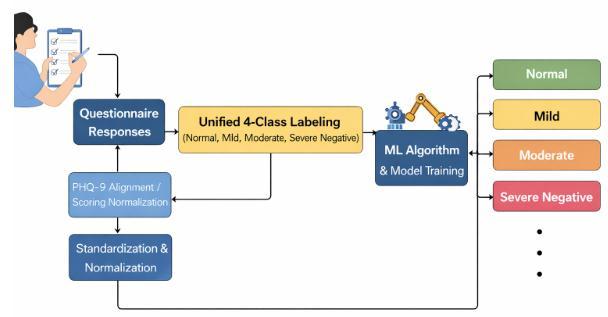
By Analyzing all above approaches proposed System questionaries are design in such a way that it fuse the physical,mentalandcognitivehealthemotionwithblendof colour psychology also to generate positive and negative moodclassificationtaskeasierlaternegativemoodfurther classified as mild, moderate and severe negative mood respectively.
Table -1: ComparativestudyofexistingApproach
Comparison of existing Approach ToolwithYear Type Que stio ns ScoringLevels/ Severity
BeckDepression Inventory (BDI)1961
Report
BeckDepression Inventory–Short Form(BDI-Short) 1978 SelfReport
Centerfor Epidemiologic StudiesDepression Scale(CES-D)1977
Centerfor Epidemiologic StudiesDepression Scale–ShortForm (CES-D-Short)1997
MedicalOutcomes Study–Depression Scale(MOS)1992
Self-Diagnostic DepressionScale–PrimaryCare (SDDS-PC)1994
PatientHealth Questionnaire–9
(PHQ-9)2001
QuickInventoryof Depressive Symptomatology (QIDS)2003
DepressionMeasure Inventory–10
(DMI-10)2004
Proposed
0–13:Min,14–19: Mild,20–28: Moderate,29–63: Severe
Mild,8–15: Moderate,≥16: Severe
<16:Normal,16–26:Mild–Moderate,≥27: Severe
<10:Normal10–14:Mild≥15: Severe
Report 8 Lowscore: Normal,High score:Higher depression
Report
self
Report
–2:Normal3–4: Mild5–7:Severe
–4:Minimal,5–9: Mild10–14: Moderate,15–19: Mod-Severe20–27:Severe
0–5:None6–10: Mild,11–15: Moderate16–20: Severe
0–7:Normal,8–14:Mild15–20: Moderate>20: Severe
0–4:Normal,5-9: Mild,10–14: Moderate,>15: Severe
International Research Journal of Engineering and Technology (IRJET) e-ISSN: 2395-0056
Volume: 13 Issue: 02 | Feb 2026 www.irjet.net
Self –Response Inventory (S.R.I): Quiz based questionaries approachinwhichpersonisrequiredtorespondquiz-based questions mainly deal with habit of food, sleep, rest concentration,decisionmakingrelatedtohealthylifestyleon the best knowledge of truthfully based on response each question generate number and based on additive score mental health is decided. As mental health is depended primarilyonourphysicalhealthwhichagainrelyonpattern offood,rest,exerciseetc.andvariouspsychologicalaffective domainrelatedaspectslikecommunication,positiveattitude towardslife,concentration,decisionmaking,colourselection dependingoncolourpsychologywherecolourisusedastool foremotionidentificationnotonlyasselectiondependingon psychologyofcolour[12]aretrulyrespondedrepresenttrue picture of our mental health in normal, mild negative, moderatenegativeandhighlynegativeclasses.Thequestions whicharemostimportantgiventwiceweightagecompareto others.
Data Analysis:
Total 150person’sresponse recorded onthreeoptions as Yes,Noandnotdecidedbasis.Where0-identifiesnotsure (neutral), Yes reflect the affirmation to question response while no reflect negative confirmation to the question. Questions are mixed with positive and negative form and mixed with generalized simple questions where person simplyresponditandmoodscoreiscreatedautomatically
Table -2: ConfusionMatrixofProposedSystem
2395-0072
Table -3: Class-wisePerformanceofProposedSystem
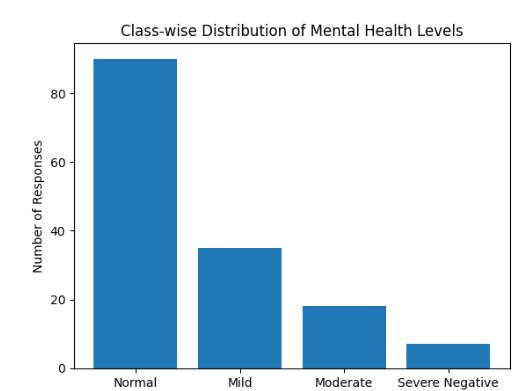
Chart -1: BargraphofProposedSystemclassification
Volume: 13 Issue: 02 | Feb 2026 www.irjet.net
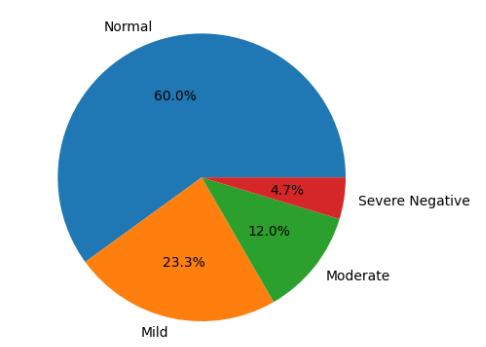
Chart -2:PiechartofProposedSystemClassification
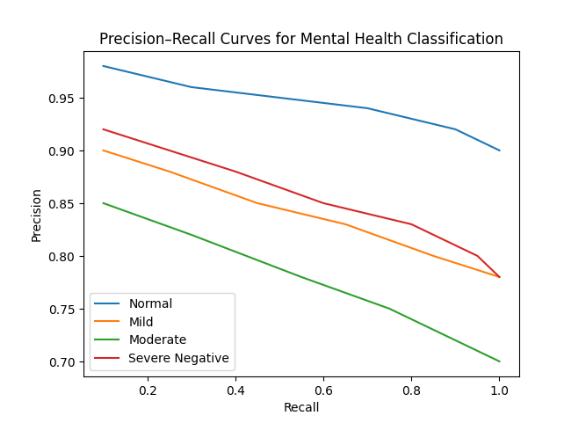
Chart -3:Precision-RecallGraphofProposedSystem
Table -4: Mapping of Proposed System with PHQ-9
Above mapping represent alignment of Proposed System with PHQ-9 which is clinically proven standard for depression which clearly reflect the clinical validity and acceptabilityofProposedSystemasdiagnosistoolinmental healthcaredomain.
Number of researchers has contributed their work to identifydepressionwhichcloselyrelatedwithpsychology, affective,computerandclinicaldomainssoinrealtimeit’sa multi-challenging task. As domain start with Psychology, ComputerScienceandClinicaldomainandlastlongtosocial domainthemajorkeychallengesarementionedasunderto mappsychologicaldomaintocomputerandvalidateitwith behavioral/clinicalpredictions[22]. Humanareexpressive throughverbalandnonverbalcommunicationchannelsboth channelsareimportanttoexpressfeelings[3],[4].Person canremainsilenttosuppressverbalcommunicationandby fakeexpressionorconcealexpressioncanhiderealscenario, biological sensor-based assessment of various biological parameters are complex to setup, execute and evaluation point of view and not user friendly. The person who is already in negative mind set not ready for any complex examination.Inthisapproachnothirdpersonintervention orparticipationrequiredpersonbyowncancheckthemood automatically.Allthemodalitieshaveitsownprosandcons butclassicalapproachofQuestionariesinautomatedversion remainultimatechoicetovalidatementalhealthstatus.This automatedmooddetectiontoolwhicheffectivelyidentified moodviaasetofquizrelatedtopsychological,physicaland general routine questionnaires person’s mental health is estimated Iftestcontinuouslygivenegativemindstatemood result the quiz can be repeated after 2 or 3 days as fresh version and evaluation of mood should carry out up to 2 weeksatvarioustimelikemorning,afternoon,evening,night butifnegativemoodisreflectedasoutcomeinalltestresults, thensuchpersonisadvicetotakecareofmentalhealthvisit forclinicaladviceforfurthertreatment.
Toallwhohavedirectlyorindirectlymotivatedustodolittle contribution to society by developing automated mood detectiontoolespeciallymyGuideDr.MilindShahsirforhis continuous positive support during my journey, respected DPC members for their continuation feedback for improvement, my family members for their unconditional loveandsupportandco-operativecolleaguesandstudents fortheiractiveparticipationtovalidatemyproposedmethod forautomaticmooddetectiontool:SelfResponseInventory andlastbutnotleastAlmightyforblessings.
[1] World Health Organization. The world health report (2003).shapingthefuture.
International Research Journal of Engineering and Technology (IRJET) e-ISSN: 2395-0056
Volume: 13 Issue: 02 | Feb 2026 www.irjet.net p-ISSN: 2395-0072
[2]MathersC.,BoermaJ,FatD.(2008).TheGlobalBurdenof Disease.UpdateGeneva,Switzerland:WHO.
[3] P. Ekman, Handbook of Cognition and Emotion, John Wiley&SonsLtd,2005,pp.45-60.
[4] H.Ellgring, R. J. Eiser, K. R. Scherer,"Non-verbal CommunicationinDepression,"CambridgeUniversityPress, 2007.
[5]YangY,FairbairnCE,CohnJF(2013).Detectingdepression severityfromvocalprosody.IEEETransactionsonAffective Computing,4:142–150.
[6] MH, Ibrahim HM, Carmody TJ, Arnow B, Klein DN, Markowitz JC, Ninan PT, K ornstein S, Manber R, et al. (2003). The 16-item quick inventory of depressive symptomatology (qids), clinician rating (qids-c), and selfreport(qids-sr).apsychometricevaluationinpatientswith chronicmajordepression.Biologicalpsychiatry,54(5):573–583.
[7] Alghowinem S, Goecke R, Wagner M, Parker G, BreakspearM(2013).Headposeandmovementanalysisas an indicator of depression. In Humaine Association Conference on Affective Computing and Intelligent Interaction,283–288.
[8] Alghowinem S, Goecke R, Wagner M, Parker G, BreakspearM(2013).Eyemovementanalysisfordepression detection. In IEEE International Conference on Image Processing,4220–4224.
[9]GirardJM,CohnJF,MahoorMH,MavadatiSM,HammalZ, Rosenwald DP (2014). Nonverbal social withdrawal in depression:Evidencefrommanualandautomaticanalyses. ImageandVisionComputing,32:641–647.
[10] Ooi KEB, Lech M, Allen NB (2013). Multichannel weighted speech classification system for prediction of major depression in adolescents. IEEE Transactions on BiomedicalEngineering,60:497–506.
[11] Cummins N, Sethu V, Epps J, Krajewski J (2014). Probabilisticacousticvolumeanalysisforspeechaffectedby depression. In Annual Conference of the International SpeechCommunicationAssociation,1238–1242.
[12] Internet resource: https:// www.verywellmind. com/colour-psychology-2795824
[13] Hamilton M. A rating scale for depression (1960). Journalofneurology,neurosurgery,andpsychiatry,23(1): 56.
[14] Beck AT, Steer RA, Ball R, Ranieri WF. (1996). Comparison of beck depression inventories-ia and-ii in psychiatricoutpatients.Journalofpersonalityassessment, 67(3):588–597.
[15]PatientHealthQuestionnaire-9,Kroenke,K.,Spitzer,R. L.,&Williams,J.B.W.(1999).PatientHealthQuestionnaire-9 (PHQ-9)[Databaserecord].APAPsycTests.
[16]Zung,WW(1965)Aself-ratingdepressionscale.Arch GenPsychiatry12,63-70
[17] Radloff, L.S. (1977). The CES-D Scale: a self-report depression scale for research in the general population. AppliedPsychologicalMeasurement,1:385-401.
[18] Komal D. Anadkat & Dr. Hiteishi M. Diwanji “Effectof ActivationFunctioninSpeechEmotionRecognitionOnThe RavdessDataset”Reliability:TheoryandApplication“ISSN 1932-2321, Volume 16 Issue 3 PP-63 September 2021 (SCOPUSIndexed).
[19] N.Cummins, J.Joshi, A.Dhall, V.Sethu, R.Goecke,J .Epps (2013, October). Diagnosis of depression by behavioural signals:amultimodalapproach.AVEC’13:Proceedingofthe 3rdACMinternationalworkshoponAudio/VisualEmotion Challenges.
[20]JeffreyMGirard,JeffreyFCohn,MohammadHMahoor, S Mohammad Mavadati, ZakiaHammal, and Dean P Rosenwald, "Nonverbal social withdrawal in depression: Evidencefrommanualandautomaticanalyses,"Imageand visioncomputing,pp.641-647,2014.
[21]Pampouchidou, Anastasia, Kostas Marias, ManolisTsiknakis, P.Simos, Fan Yang, and Fabrice Meriaudeau (2015). Designing a framework for assisting depressionseverityassessmentfromfacialimageanalysis. In Signal and Image Processing Applications (ICSIPA), InternationalConferenceon,pp.578-583,IEEE.
[22] Morales, M., Scherer, S., & Levitan, R, "A Cross-modal Review of Indicators for Depression Detection Systems," Proceedings of the Fourth Workshop on Computational LinguisticsandClinicalPsychology–-FromLinguisticSignal toClinicalReality,2017.
[23]KayaH,SalahAA(2013).Eyeswhisperdepression.In ACM International Workshop on Audio/Visual Emotion Challenge,1–4.
[24]Y.Zhou,S.Scherer,D.Devault,J.Gratch,G.Stratou,L.-P. Morency, and J. Cassell, "Multimodal Prediction of Psychological Disorders: Learning Verbal and Nonverbal Commonalities in Adjacency Pairs," 17thWorkshop on the SemanticsandPragmaticsofDialogue.SEMDIAL,pp.160169,2013.
[25] SchererS, StratouG, LucasG, MahmoudM, BobergJ, GratchJ,RizzoAS,MorencyLP(2014).Automaticaudiovisual behavior descriptors for psychological disorder analysis. ImageandVisionComputing,32:648–658.
2026, IRJET | Impact Factor value: 8.315 | ISO 9001:2008 Certified Journal | Page825
International Research Journal of Engineering and Technology (IRJET) e-ISSN: 2395-0056
Volume: 13 Issue: 02 | Feb 2026 www.irjet.net p-ISSN: 2395-0072
[26]AmericanPsychiatricAssociation(5thedition,2013). Diagnostic and statistical manual of mental disorders. Washington:DC.
[27]Spitzer,R.L.,Williams,J.B.W.,Kroenke,K.,Linzer,M., deGruy,F.V.,Hahn,S.R.,Brody,D.,&Johnson,J.G.(1997). Utilityofanewprocedurefordiagnosingmentaldisordersin primary care: The PRIME-MD 1000 study Journal of GeneralInternalMedicine,12(7),439–445. https://doi.org/10.1046/j.1525-1497.1997.00076.x
[28]Rush,A.J.,Trivedi,M.H.,Ibrahim,H.M.,Carmody,T.J., Arnow, B., Klein, D. N., Markowitz, J. C., Ninan, P. T., Kornstein,S.,Manber,R.,Thase,M.E.,Kocsis,J.H.,&Keller, M. B. (2003). The 16-Item Quick Inventory of Depressive Symptomatology(QIDS),clinicianrating(QIDS-C),andselfreport (QIDS-SR): A psychometric evaluation in patients with chronic major depression Biological Psychiatry, 54(5),573–583.https://doi.org/10.1016/S00063223(02)01866-8
[29] JigerP.Acharya,Dr.MilindS.Shah,(2025)Depression DetectionSystem:ASystematicReview.JournalofNeonatal Surgery,14(32s),1486-1492.
[30] Jiger P. Acharya, Dr. Milind S. Shah, (2025) User Responsive AutomaticMethod forReal TimeDepression DetectionUsingDeepNeuralNetwork.JournalofNeonatal Surgery,14(32s),4286-4297.
BIOGRAPHIES


First Author: Ph.D Research Scholar, Gujarat Technological University, Ahmedabad, Gujarat, India
Second (Corresponding) Author: Ph.D Supervisor at Gujarat Technological University, Ahmedabad,Gujarat,India. Author Photo