International Research Journal of Engineering and Technology (IRJET)
e-ISSN: 2395-0056
Volume: 13 Issue: 05 | May 2026
p-ISSN: 2395-0072
www.irjet.net
AUTOMATED 3D PRINTING FILAMENT MAKER USING SOLID WASTE Rakesh B G1, Brundhan B A2, Ismail Zabi Ulla3, Sivaneshwaran G4 Mr. Rakesh B G, Assistant Professor, Department of Mechanical Engineering Brundhan B A, Ismail Zabi Ulla, Sivaneshwaran G Department of Mechanical Engineering, Vemana Institute of Technology, Bengaluru ---------------------------------------------------------------------***---------------------------------------------------------------------
Abstract - This paper describes the design and fabrication
of an automated system that converts post-consumer PET plastic waste into usable 3D printing filament. The proposed setup integrates controlled heating, extrusion, cooling, and synchronized spooling using an Arduino-based controller to maintain dimensional stability of the filament. The process flow minimizes manual intervention while improving repeatability and safety. Experimental evaluation indicates that the produced filament achieves near-uniform diameter suitable for low-cost prototyping and academic use, thereby supporting sustainable manufacturing and effective solid waste utilization. Keywords: 3D Printing Recycled PET, Filament Extrusion, Automation, Solid Waste Management.
1.INTRODUCTION The increasing adoption of additive manufacturing has resulted in a growing dependence on thermoplastic filaments, which contributes to higher material costs and environmental burden. Among plastic wastes, PET bottles represent a significant fraction due to their widespread use. Transforming PET waste into 3D printing filament presents an economical and environmentally responsible solution. This work aims to develop an automated filament production system capable of delivering consistent output quality from discarded PET materials.
top of that, it holds up well when turned into 3D printed stuff such as, food packaging boxes used to deliver food in online platform.
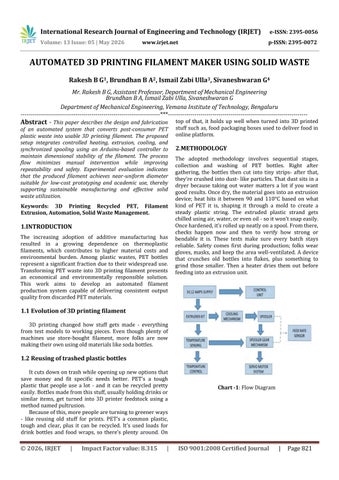
2. METHODOLOGY The adopted methodology involves sequential stages, collection and washing of PET bottles. Right after gathering, the bottles then cut into tiny strips- after that, they’re crushed into dust- like particles. That dust sits in a dryer because taking out water matters a lot if you want good results. Once dry, the material goes into an extrusion device; heat hits it between 90 and 110°C based on what kind of PET it is, shaping it through a mold to create a steady plastic string. The extruded plastic strand gets chilled using air, water, or even oil - so it won’t snap easily. Once hardened, it’s rolled up neatly on a spool. From there, checks happen now and then to verify how strong or bendable it is. These tests make sure every batch stays reliable. Safety comes first during production; folks wear gloves, masks, and keep the area well-ventilated. A device that crunches old bottles into flakes, plus something to grind those smaller. Then a heater dries them out before feeding into an extrusion unit.
1.1 Evolution of 3D printing filament 3D printing changed how stuff gets made - everything from test models to working pieces. Even though plenty of machines use store-bought filament, more folks are now making their own using old materials like soda bottles.
1.2 Reusing of trashed plastic bottles It cuts down on trash while opening up new options that save money and fit specific needs better. PET’s a tough plastic that people use a lot - and it can be recycled pretty easily. Bottles made from this stuff, usually holding drinks or similar items, get turned into 3D printer feedstock using a method named pultrusion. Because of this, more people are turning to greener ways - like reusing old stuff for prints. PET’s a common plastic, tough and clear, plus it can be recycled. It’s used loads for drink bottles and food wraps, so there’s plenty around. On
© 2026, IRJET
|
Impact Factor value: 8.315
|
Chart -1: Flow Diagram
ISO 9001:2008 Certified Journal
|
Page 821