
International Research Journal of Engineering and Technology (IRJET) e-ISSN:2395-0056
Volume: 12 Issue: 02 | Feb 2025 www.irjet.net p-ISSN:2395-0072
International Research Journal of Engineering and Technology (IRJET) e-ISSN:2395-0056
Volume: 12 Issue: 02 | Feb 2025 www.irjet.net p-ISSN:2395-0072
Beza Dagnaw1 , Qiaoying Wang1*, Mehari Mariye1 , and Temalede Belayhun2
1 Tongji University, College of Environmental Science & Engineering, Shanghai, 200092, China; 2Debrebrehan University, Amhara Regional State, North Shewa, Ethiopia; 1*Corresponding Author: State Key Laboratory of Pollution Control and Resource Reuse, Shanghai Institute of Pollution Control and Ecological Security, College of Environmental Science and Engineering, Tongji University, Shanghai 200092, China; Tel: +00-8621-65980400.
Abstract
The issue of solid waste has emerged as a significant urban challenge in numerous countries today. In earlier times, when populations were smaller and technological progress was limited, solid waste management did not pose substantial difficulties and received comparatively little attention. In this study, an assessment of municipal solid waste management (MSWM) practice was conducted in Menelik sub-city of Debrebrehan, Amhara region, Ethiopia. This study employed a descriptive research framework, utilizing multiple data collection strategies, including questionnaires, interviews, focus group discussions, and observational methods. A total of 318 household respondents were systematically sampled from eight kebeles (the smallest administrative structure of the country). Analysis of waste generation rates reveals that individuals classified within low-income generated an average of 0.31 kg/cap/day whereas middle-income individuals produced an average of 0.49 kg/cap/day. Highincome individuals produced an average of 0.67 kg/cap/day, which is more than twice the waste produced by those in the lowincome category. The analysis displayed that composition of municipal solid waste (MSW) in the sub-city was predominantly organic (60%), with recyclable materials accounting for 15% and other waste types comprising 25%. The result of the study showed that rapid population growth, low technology, poor community participation, improper SW disposal, lack of public awareness, economic constraints/financial issues as a dominant driving factor for inefficient SWM. The findings of the study highlighted that strengthening governance, increasing financial outlay, fostering community participation, and implementing targeted public awareness campaigns are critical to ensuring sustainable and efficient waste management systems in the study area and beyond
Key words: Integrated solid waste management; Menelik sub city, Transportation; Waste Generation, Waste Storage and Disposal
Municipal solid waste management is a key environmental concern in most countries worldwide. The rapid pace of urbanization in these areas has resulted in waste generation outstripping the capacity to collect, transport, dispose of, and manage its impact[1] Studies forecast that by 2050, global waste production will rise by 70%[2,3] Waste managementinany nation is influenced by its economic, social, and political conditions[4, 5] . Integrated Solid Waste Management (ISWM) is a holistic approach that focuses on recycling, composting, and disposal methods to establish an effective waste management system [6,7] . Developing countries spend about $46 billion every year on municipal solid waste management [8,9] . By 2025, investmentsinmunicipalsolidwastemanagementcouldexceed$150billion.However,duetofactorslikepoorplanning,weak governance, limited technology,ineffective enforcement of regulations,and the lack of economic incentives, ISWM continues tobeinefficientinmanycountries,includingEthiopia [10]
Limited financial resources, technical expertise, and effective solid waste management planning are prevalent. Additionally, the public's negative attitude toward proper collection and sorting systems is contributing to the growing environmentalandhealthchallengesincitiesofdevelopingcountries [11] Managingsolidwasteisa significantpublichealth and environmental issue in many African cities [12] . The generation and disposal of waste can have damaging impacts on animals, plants, ecosystems, and the overall environment[1] . Effective waste management is essential to minimize environmentalharmandrecovervaluableresources[13,14] InEthiopia,municipalitieshavemainlybeenresponsibleforISWM
International Research Journal of Engineering and Technology (IRJET) e-ISSN:2395-0056
Volume: 12 Issue: 02 | Feb 2025 www.irjet.net p-ISSN:2395-0072
services. However, their effectiveness is limited due to insufficient waste collection, inadequate sanitary facilities, and poor planningandcoordination[11] .However,therehasbeenanotableshift,withsolidwastenowbeingactivelycollected,disposed of, or processed for future use[11] . Achieving sustainable and environmentally responsible waste management requires a holisticapproachthatintegratessocial,cultural,economic,andecologicalfactors [15] Urbanization,combinedwithpoorwaste managementpracticessuchasthecarelessdisposalofwasteintowaterbodies,litteringalongroadsides,andthepresenceof unmanageddumpsites,worsenssanitationproblemsinseveralAfricancountries,includingEthiopia [16] Africaisexperiencing rapid population growth and urbanization, both of which are progressing at an alarming rate. Unfortunately, the continent facesconsiderablechallenges,includingalackoftechnology,technicalexpertise,financialresources,communityengagement, and awareness, all of which are vital for effective solid waste management[17,18] Effective waste management strategies are crucial for economic development, particularly in developing nations [17,18] Lack of knowledge, coupled with financial and technologicallimitations,hascontributedtothepoormanagementofsolidwaste [18,19] Ethiopia,alargeamountofsolidwaste remainsunmanaged,whichhassignificantlyaffectedbothpublichealthandtheenvironment [18,20]
ApreliminaryassessmentconductedbytheresearcherinOctober2024foundthathouseholdsolidwasteinDebrebrehan Reogiopolitant City is often left on the streets, burned in villages, or improperly dumped into the sewer system. As a result, DebrebrehanReogiopolitantCity,likemanyothercitiesindevelopingcountries,faceschallengesthatpreventauthoritiesfrom managing waste efficiently, cost-effectively, and sustainably. Despite increasing involvement from various stakeholders in waste management and improved legal frameworks, the solid waste issue in Debrebrehan Reogiopolitant City continues to worsen. Menelik Sub-City is characterized by unplanned settlements, high population density, and congestion, which is believedtogeneratesubstantialamountsofsolidwaste,potentiallycausingpublichealthandenvironmentalproblems.Hence, thispaperseekstoexploreandidentifythechallengesrelatedtosolidwastemanagementinMenelikSub-City
2. Materials and methods
2.1 Noticeable features of the study area
Forthisinvestigation,theresearcherspecificallyselectedMenelik Sub-Cityasthefocusareaduetoitsdensepopulation and congested environment, which provide a more thorough understanding of the solid waste management challenges. Additionally, the researcher is more familiar with this sub-city. The research is based on data gathered from September 1, 2024, to October 13, 2024. The city is positioned at 9°41' North latitude and 39°40' East longitude as indicated in Figure 1 Debre Berhan City was founded in 1454 under the reign of Emperor Zera Yaeqob [21] It is located in the Amhara National Regional State and serves as the administrative hub for the Northern Shoa Zone, Debre Berhan City Administration, and BassonaWoranaWoreda(district).Geographically,thecityisabout130kilometersnortheastalongtheAddisAbaba–DessieMekelleroute[22] Theannualprecipitationintheregionvariesbetween814and1080mm.MostofDebreBerhanCity'surban areasaresituatedatanaltitudeof2750metersabovesealevel.Thecity'slandscapeismostlyflat,covering86%oftheland, withslopesoccupying10%andmountainousareasmakinguptheremaining4%.DebreBerhanspansatotalareaof21,169.95 hectares. The local economy is mainly driven by tanneries and blanket production, while agriculture in the surrounding suburbssupportsalargeportionofthelocalpopulation'slivelihoods[22] .
International Research Journal of Engineering and Technology (IRJET) e-ISSN:2395-0056
Volume: 12 Issue: 02 | Feb 2025 www.irjet.net p-ISSN:2395-0072
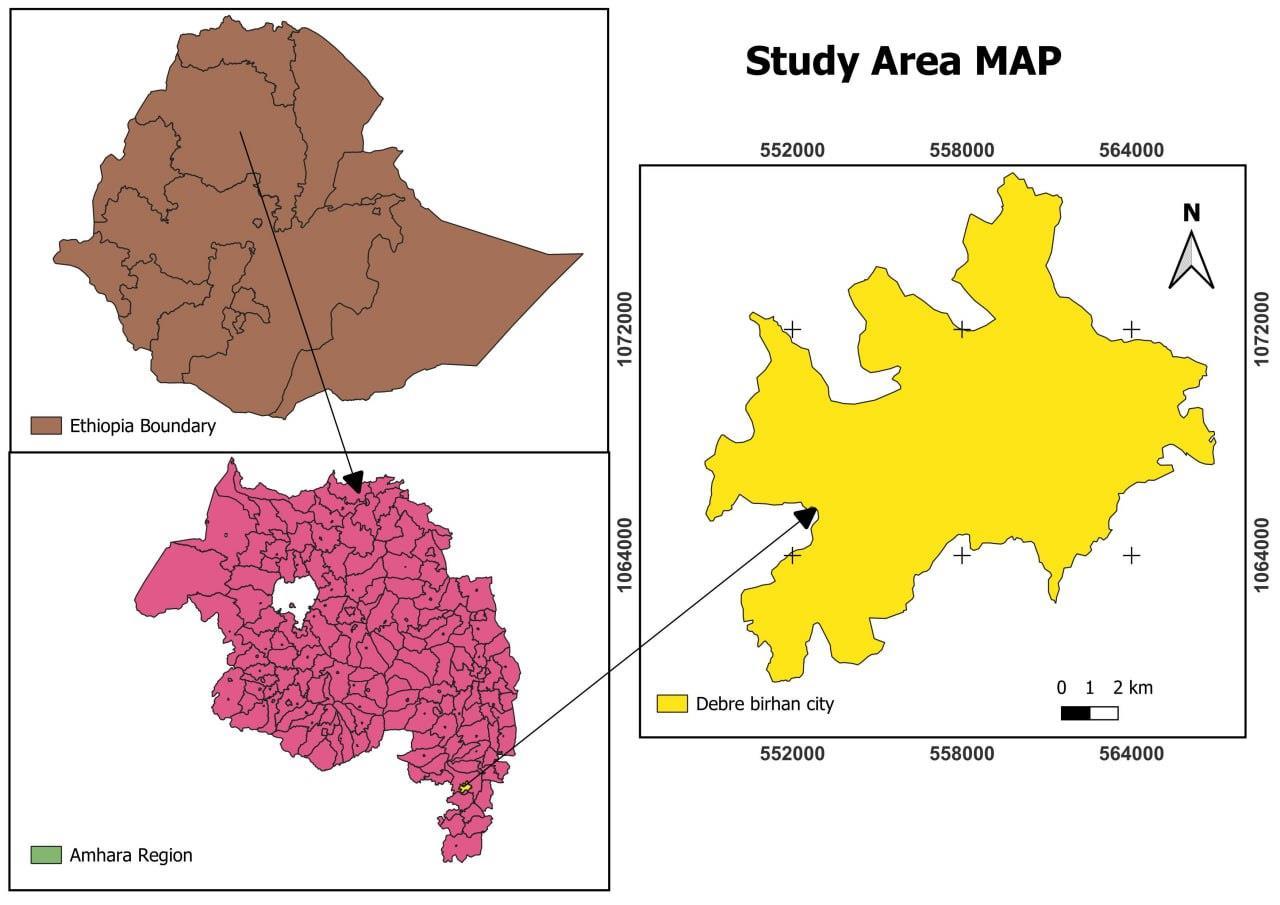
-1: Mapsofstudyarea
AgricultureisthemaineconomicactivityinDebreBerhane,withmostofthepopulationinvolvedinsubsistencefarming. Livestockfarmingisakeycomponentoftheagriculturalsystem,withcattle,sheep,andgoatsbeingthemostcommonlyraised animals, providing meat, milk, and other products. Poultry farming, especially chickens, is also widespread, contributing to local diets and income. Livestock serves as a form of wealth, used in traditional ceremonies and as a means of exchange. According to recent estimates, Debre Berhane's population stands at approximately 250,384 (Central Statistical Agency of Ethiopia, 2023), with the majority living in rural areas and a smaller proportion in urban areas. The population of Debre Berhaneislargelyyoung,withasignificantproportionundertheageof30.Thecity'seconomyisprimarilyagricultural,with mostpeopledependingonfarmingfortheirlivelihood.Therearealsosmall-scaleindustries,suchashandicrafts,pottery,and weaving, that help supplement local incomes. Like many rural areas in Ethiopia, Debre Berhane faces challenges in infrastructure, education, and healthcare. Despite these obstacles, the region holds considerable potential for development. The area is prone to occasional droughts, especially during the dry season, which can affect crop yields and threaten the livelihoodsoffarmingfamilies.Additionally,limitedaccesstomodernfarmingtechnologyandpoorroadinfrastructurehinders economicgrowthandmarketaccess.
Toachievethespecificgoalofthisstudy,bothprimaryandsecondarydatasourceswereused.Primarydatawascollected through field observations and interviews with a sample of residents, cooperative partnership associations, and sanitation administration employees. Secondary data was obtained from various sources, including both published and unpublished documents from the sanitation administration office, the finance and economic development office, and the sub-city administration. Similar methods, such as semi-structured interviews, were also used by other researchers to gather public opinion. The study employed both open and closed-ended questions to extract valuable information. Respondents were selected using a systematic selection technique from residents, cooperative partnership associations, and sanitation administration staff Household respondents were further selected through systematic random sampling, as described by
International Research Journal of Engineering and Technology (IRJET) e-ISSN:2395-0056
Volume: 12 Issue: 02 | Feb 2025 www.irjet.net p-ISSN:2395-0072
Wubie, Assen and Nicolau [23]. From three elevation categories: Lower (500–1800 m a.s.l. which include Selam Chora, Loretafework Tekile, and Eyerusalem kebeles), Middle (1801–2400 m a.s.l. consisting of Fitwurari Gebeyehu and Nigist Eleni Kebeles),andUpper(2401–2800ma.s.l.coversWoshawushgn,Anisessmariyam,andDilila kebeles),106householdsfromeach segment were chosen for the socioeconomic analysis. The socioeconomic study was carried out in two main stages. First, sample sites were selected. Then, households within the chosen kebeles, the smallest administrative units in Ethiopia, were identified Systematic random sampling, as outlined in established methodologies[24] , was used to facilitate this process The samplesizeforthestudyarea wasdeterminedusing themethodology outlinedina previous researchconductedby Cochran [25] ,asoutlinedinEqs1and2.
Intheprovidedformula,no =thedesiredsamplesizewhenthepopulationis> 10,000whereasn=samplesizewhenthe populationis<10,000.While'Z'signifiesthe95percentconfidencelimitorintervalonthenormaldistributioncurve,whichis equivalentto1.96.Additionally,'P'correspondstotheproportionofthepopulation tobeincludedinthesample,setat0.1.'1' denotesaunitorconstant,q=1–0.1i.e.(0.9).'N'standsforthetotalpopulation,and'e'representsthepermissibleamountof sampling error, set at 0.05. Assuming the city population size was around 250,348 and the number of households was estimatedtobe66,529basedontheprojectionofEthiopianStatisticalAgency,2007,andaconfidencelevelof95%andwith a margin of error (0.05), a sample size of 318 was calculated for household respondents as indicated in Table 1 To get the calculated sample size response 318 questioners were administered in two languages namely English and Amharic. Amharic languagesarelocallanguagesthataredominantinthecountry
Table -1: Samplingtrendforsamplesizedetermination
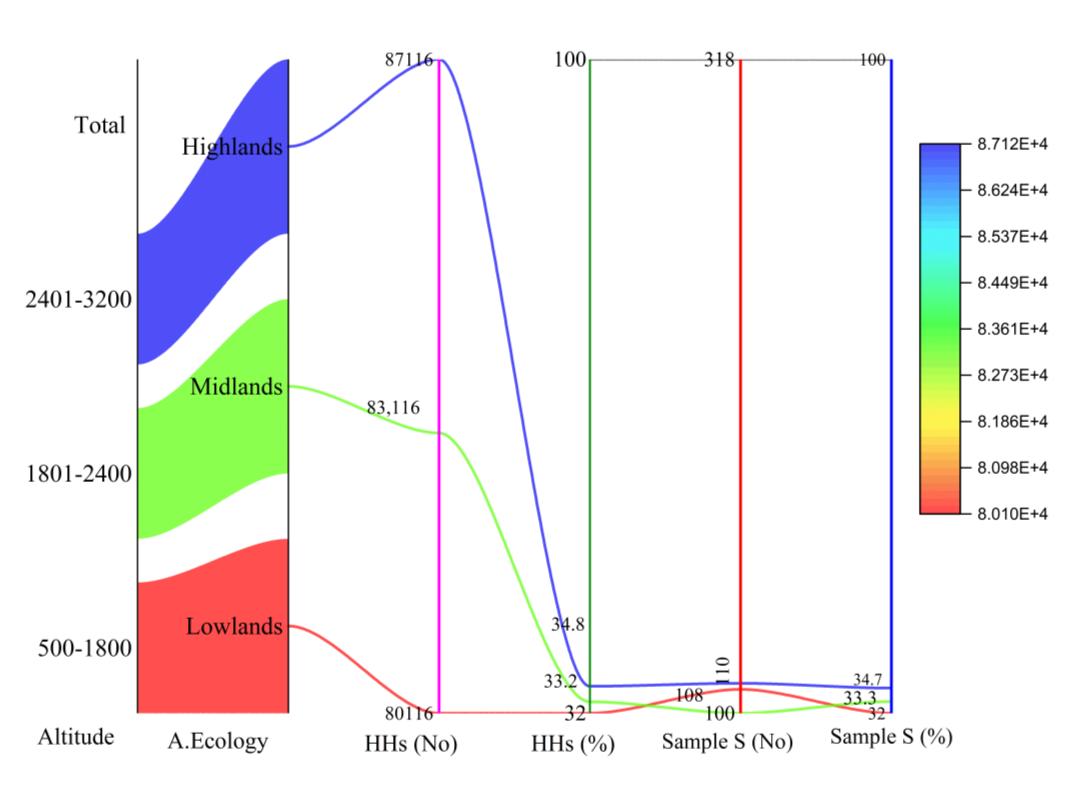
Thepresented Figure2.providesa detailedvisualizationofthedistributionofhouseholds(HHs)acrossthreeecological zonesHighlands,Midlands, andLowlandsclassifiedby altituderanges(500–1800 m,1801–2400m,and2401–3200m).The figuresummarizesthetotalhouseholdnumbers,theirproportionalrepresentation,andthesamplingstrategyemployedinthe study. The Highlands, situated at the highest altitude range (2401–3200 m), exhibit the largest population of households, totaling87,116,whichaccountsfor34.8%ofthetotalhouseholdpopulation.TheMidlands,locatedatanintermediatealtitude range(1801–2400m),followcloselywith83,116households,representing33.2%ofthetotal.TheLowlands,characterizedby thelowestaltituderange(500–1800m),havethesmallestnumberofhouseholds,totaling80,116,contributing32.0%tothe overall population. The sampling strategy for this study is depicted alongside the total household data. From the total householdpopulation,108householdsweresampledfromtheHighlands,100fromtheMidlands,and32fromtheLowlands. Thesevaluescorrespondto34.7%,33.3%,and10%ofthetotalsampledhouseholds,respectively.Thesamplingproportions closelyalignwiththetotalhouseholddistributionintheHighlandsandMidlandsbutexhibitanotableunderrepresentationof theLowlands.Thisdiscrepancymayindicateastrategicemphasisonhigheraltitudezonesormethodologicalconstraintsthat limitedsamplingintheLowlands.
Volume: 12 Issue: 02 | Feb 2025 www.irjet.net p-ISSN:2395-0072
Data for the study were collected using various data collection techniques, including rapid appraisal methods, key informant interviews, direct observation, in-depth interviews, and questionnaires. This allowed for the gathering of both qualitativeand quantitative data,asoutlined below. The questionnaires wereinitiallycreated in English and thentranslated into Amharic to ensure clarity for the participants. Additionally, both structured and unstructured interviews, as well as uncontrolled observation, were utilized. Two types of questionnaires (open and closed-ended) were designed for residents, sanitation administration employees, and members of the cooperative partnership association. Structured and unstructured interviews were conducted with the head and workers of the sub-city sanitation administration, as well as with cooperative partnership associations, to gather information on the institutional setup, capacity, and challenges. Data for community and stakeholder studies were collected from both primary and secondary sources, including focus groups and household (HH) surveys. An initial reconnaissance survey was conducted to understand the study areas comprehensively. During this preliminarysurvey,discussionswereheldwithvariousparticipants,includingfarmersandextensionstaffwhointeractclosely withthem [26].Thisstudyusedaguidingquestionnaireandsemi-structuredhouseholdquestionnairestoexaminethedifferent methodsforMSWcollection,storage,treatment,transportationanddisposal.Thequestionnaire,whichconsistedofopenand closed-ended questions, offered insights into these changes' drivers. Initially tested on 25 households in four districts or Kebeles (but not part of the primary study sample), it was modified and administered to four hundred two HHs from 8 Kebeles/districts between September 2024 and November 2024. A socioeconomic survey involving 318 randomly chosen householdswasexecuted.Thedistrict,administrativebodies,andhouseholdparticipantswerecarefullychosenusingathreestagesamplingmethodthatcombinedpurposiveandrandomapproaches.
Focus group discussions utilizing semi-structured questions provide researchers with the opportunity to delve deeper into topics and explore new avenues of inquiry that may arise during interviews. In contrast to formal questionnaire interviews,groupdiscussionsofferamoreconduciveenvironmentforaddressingsensitivetopics,asindividualsmayfeelmore comfortablediscussingtheseissueswithinagroupsettingratherthanone-on-onewithastranger.Additionally,twoFGDswere
International Research Journal of Engineering and Technology (IRJET) e-ISSN:2395-0056
Volume: 12 Issue: 02 | Feb 2025 www.irjet.net p-ISSN:2395-0072
held, each with five participants, in total ten persons out of them four women and six men. These participants represented various groups, including development agents, Kebeles cabinet members, and public elders. These individuals were carefully chosen via the Kebeles administrative entities and informed public representatives. Through key informant interviews and FGDs,wehavethoroughlyunderstoodtheSWMandcurrentsolidwastestatusinthestudyarea [27].Acarefulselectionprocess was employed to identify and engage ten individuals aged >50 chosen as key informants’ interviews (KIIs) to facilitate a rigorous investigation. Skilled personnel were enlisted to offer assistance in the interview process. The assistants were educated professionals who spoke the regional and local languages. Different training activities were carried out for the assistants, covering topics like how to make contact, conduct interviews properly, and cultural considerations. The early morningandlateafternoon,normallyidealperiodsforKIIs,wereusedtointerviewindividualhouseholds.Thesewerethebest timesofthedayforhouseholdsbecauseneitheragriculturalworknoranyotherhousehold-relatedactivitiestookplacethen.If the informant refused to provide information, they were asked to recommend someone open to acting as an informant. Additionally, the discussion also addressed the matter of the most pressing solid waste issues that demand intervention. Throughouttheconferenceandtheinterviews,theprimaryfocusremainedfindingsolutionstotheseproblems [28] .
This multi-method approach facilitated a robust analysis, providing a clear and comprehensive picture of the challenges faced and potential solutions to address SWM problem in the region. In addition to personal life experiences, a field tour of selectedareasofthecitywasconducted.Theprimaryareasoffocusincluded:1)solidwastedisposalsiteslocatedinMenelik sub-city;and2)theroadsidesandditchesofthesample Kebele.Thisobservationandexperiencegainedfromsimplybeinga member of the community aided in the evaluation of research questions and objectives. In addition to these, the researcher usedfieldobservationasadatacollectiontoolforthisstudy.Fieldobservationwasalsousedtoassessthespatialdistribution ofthesubcity’ssolid waste management infrastructures,illegal dumping, solid wastecollection and transportation systems, anddisposalsitefacilities. Inordertomakethe questionnairethatwasadoptedinEnglishmoreintelligibleto responders,it was translated into Afan oromo and Amharic. Third, ten respondents who were not involved in the data collection process were given the questionnaireas part of a pilot test toassessits reliability and validity.Based on the resultsof the pilot test, changesweremadetothequestionnaire.Finally,usingtemporarydataenumerates,actualdatagatheringwascompleted.Data enumeratorshaveobtainedthenecessarytrainingandspeakAmharicwithease.
Thepresentation,analysis,andinterpretationofdatagatheredfromhomes,theMeneliksub-cityoffice,andfieldresearch arethetopicsofthispart.Bothqualitativeandquantitativetechniqueswereusedtoanalyzethedata.Openendedquestions andinterviewsreceivedqualitativeresponses,whereasclosed-endedquestionsweregivenquantitativeresponses.Examples of percentages, tabular analysis, and frequency distribution quantitative methods. Among the qualitative methods employed werelinksbetweencausesandeffectsandinductiveanddeductivereasoning.UsingthecomputerprogramSPSSversion28, Origin pro-25, questionnaires were analyzed using quantitative techniques, i.e. tables, which were frequently utilized to illustratetheacquireddata.Usingdescriptivedataanalysisapproaches, frequency,percentage,mean,standarddeviation,and graphicrepresentationwereproduced.
3.1
Thecompositionofmunicipalsolidwaste(MSW)inMenelikSub-cityappearstoberelativelylow.Variousfactors,suchas the type of waste source (household, commercial, etc.), the level of income, seasonal changes, and other influences, significantlyimpactthecompositionofsolid waste.Asa result,theactual wastemakeupmaydifferfromwhatisdepictedin Table2below,especiallyasthewastestreamfromplasticbagshassharplyincreasedinrecentyears.AccordingtotheMenelik Sub-cities Report of 2024, the waste management (SWM) data shows that 60% of the total waste is organic, while 15% consists of recyclable materials, and the remaining 25% falls into other categories. This indicates that the daily and annual composition of waste may vary, influencing the community in different ways. The most significant component of the waste stream comprising 65.8% was found to be ash, dust, and fines. This large proportion suggests that industrial activities, constructionprojects,andcombustionprocessescontributesubstantiallytowastegeneration.Organicwaste,whichismainly fruitsandvegetables,madeup15.2%,pointingtoa notableamountoffoodwastecomingfromhouseholds,markets,orfood processingsectors.
Volume: 12 Issue: 02 | Feb 2025 www.irjet.net
3.2 Municipal solid waste and its handling
Figure3presentsadetailedbreakdownofsurveyresponsesregardingtheeffectivenessoftrainedkeyinformants(KIIs) in managing solid waste (SW). The responses are divided into three categories: "Yes," "No," and "Total," with the corresponding number of respondents and percentages. In the "Yes" category, 140 respondents (44% of the total) indicated that they believe trained KIIs are effective in waste management. While this shows moderate confidence in KIIs' ability to handlewastemanagementtasks,itdoesn'trepresenta majorityopinion.Thisfindingiscomparabletootherstudies,suchas [29],whichreportedaffirmativeresponsesrangingbetween50-60%inurbansettingswherestructuredtrainingprogramsfor waste management professionals were implemented. The slightly lower percentage could point to contextual or systemic differencesinhowtheseprogramsareimplementedandperceived.Inthe"No"category,177respondents(55.7%ofthetotal) expressedskepticismordissatisfaction,indicatingthatthemajorityofpeopledonotviewtrainedKIIsaseffectiveinmanaging solidwaste.Thehigherproportionofnegativeresponsesalignswithstudieslike [30],wheresimilarsurveysreported56-62% negativefeedbackinregionswithinconsistentwastemanagementpracticesorlimitedpublicengagement. Thissuggeststhat factors like inadequate training, operational inefficiencies, or a lack of awareness may reduce the perceived effectiveness of trainedKIIs.Withatotalof318responses,thedatasetissufficientlylargetosupportstatisticalanalysisandcomparisons.The consistencyinthe total valuesacross both numerical andpercentageaxesfurther ensures the reliability and accuracyofthe dataforcross-studycomparisons
International Research Journal of Engineering and Technology (IRJET) e-ISSN:2395-0056
Volume: 12 Issue: 02 | Feb 2025 www.irjet.net p-ISSN:2395-0072
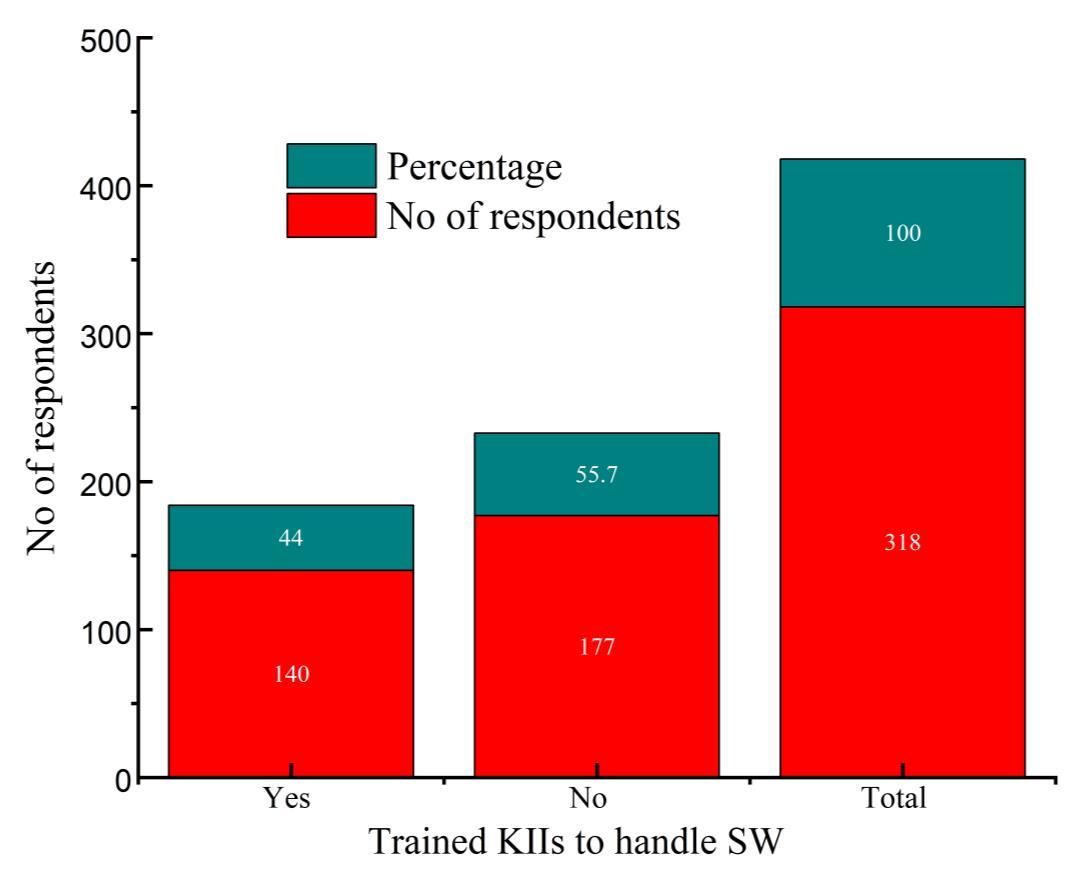
Fig -3: SolidWasteanditsadequatelyhandling
Theresultsofthisstudyrevealaclearpredominanceofnegativeperceptions(55.7%),aligningwithfindingsfromsimilar studies. For instance: Smith, Jones and Taylor [29] found that in urban areas with well-structured training programs and consistentwastemanagementpolicies,positivefeedbacktypicallyrangedfrom50-60%.Thisindicatesthatpublicconfidence is strongly linked to tangible and visible outcomes. In contrast, the 44% of positive responses in the current study point to potential gaps in how the roles of KIIs are implemented or perceived. Studies carried out by Green, Jones and Taylor [31] emphasized the role of trust in waste management systems, finding that in areas where public engagement campaigns were absent,"No"responsesconstituted60%ormoreofthetotal.Thefindingsofthecurrentstudyareinlinewiththis,suggesting thatlimitedpublicawarenessandcommunicationmaybecontributingfactors.Previousstudieshaveconsistentlyhighlighted thecriticalroleoftraininginenhancingtheeffectivenessofwastemanagementprofessionals: StudiesbyTaylor,ZhangandLi [32] discovered that structured, continuous training programs for KIIs led to better public perceptions, reducing negative responsestoanaverageof40%.Theabsenceofsuchcomprehensivetrainingprogramsmay helpexplainthehighernumber of"No"responsesobserved inthisstudy.Similarly, Jones,Leeand White [33] notedthatinregions where trainingfocusedon bothtechnicalskillsandcommunityengagement,affirmativeresponsesincreasedby20-30%.Thecurrentfindings,withonly 44% of responses being positive, suggest that there may be shortcomings in the training programs or the way they are deliveredtokeyinformants(KIs).Operationalinefficiencieshavealsobeenidentifiedasasignificantbarriertopublictrustin wastemanagementsystems: Brownand Taylor [30] reportedthatareaswithdelayed wastecollectionorvisibleinefficiencies experienced"No"responsesashighas62%,reflectingpublicfrustration.
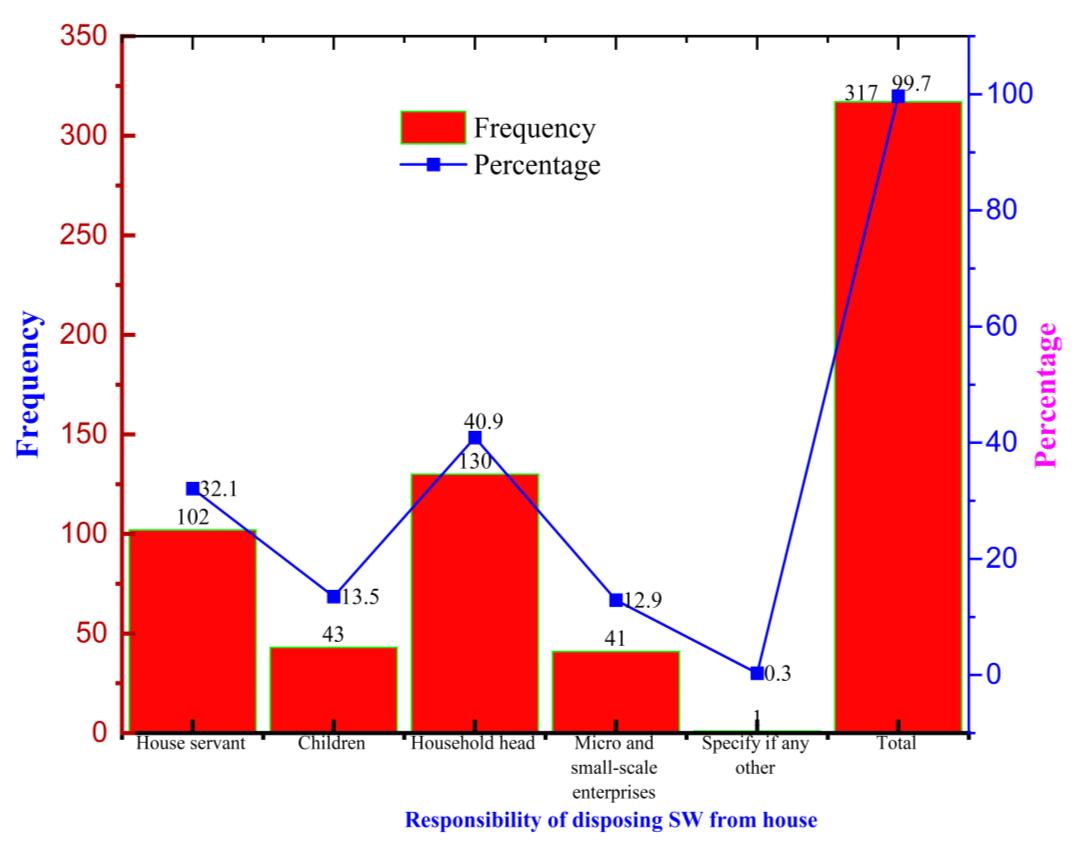
Figure 4 illustrates how responsibility for solid waste (SW) disposal is distributed among various individuals or groups withinhouseholds: house servants,children,household heads, hired small-scaleemployees,and other individuals.The chart usesdual y-axesto show thefrequencyof responseson the left and the corresponding percentages on the right,providinga comprehensiveviewofthedata.Houseservantswereresponsibleforwastedisposalin102households,makingup32.1%of
International Research Journal of Engineering and Technology (IRJET) e-ISSN:2395-0056
Volume: 12 Issue: 02 | Feb 2025 www.irjet.net p-ISSN:2395-0072
theresponses.Thissuggestsastrongrelianceondomestichelp,likelyinfluencedbysocioeconomicfactorsandculturalnorms that encourage outsourcing household chores. Additionally, 43 households (13.5%) assigned waste disposal to children, which, while a smaller proportion, indicates that some families involve younger members in routine household tasks. The largest share of responsibility, 130 households (40.9%), was attributed to household heads. This suggests that, in many families, the head of the household assumes direct responsibility for waste management, potentially due to cultural expectations,thelackofexternalhelp,oranemphasisonhygiene.Ontheotherhand,41households(12.9%)hiredsmall-scale workers specifically for waste disposal, indicating that some families invest in external assistance due to time or labor constraints. A small percentage (2.5%) of households relied on other individuals, which reflects unique or context-specific arrangements. The overall responses totaled 318, providing a solid dataset for comparison and analysis. The findings show variedpracticesinassigningresponsibilityforwastedisposal.Thedominanceofhouseholdheads(40.9%)suggeststhatmany familiespreferself-management,possiblyduetothelackofaffordabledomestichelporculturalnorms.Therelianceonhouse servants (32.1%) highlights the influence of socioeconomic factors on waste disposal practices. Meanwhile, the lower proportions for children (13.5%) and hired small-scale employees (12.9%) reflect demographic and logistical challenges in delegatingthisresponsibility.
The 40.9% of households thatassign waste disposal responsibilitytohouseholdheadsisconsistent withthe findingsof Green,JonesandTaylor [31] ,whoobservedasimilarpatterninareaswithlimitedaccesstomunicipalwastecollectionservices. Theirresearchsuggestedthatinsemi-urbanandruralareas,householdheadsoftentakeonthisresponsibilityduetoalackof affordable alternatives. Their findings showed that in semi-urban and rural areas, household heads often take on responsibilityduetothelackofaffordablealternatives.Incontrast,Smith,JonesandTaylor [29] foundthatinurbanareaswith well-establishedwastecollectionsystems,only25-30%ofhouseholdsreliedonhouseholdheadsforwastedisposal.Instead,a largerportionofhouseholdsdelegatedthisresponsibilitytodomesticworkersorexternalserviceproviders
2395-0056
Volume: 12 Issue: 02 | Feb 2025 www.irjet.net p-ISSN:2395-0072
Figure5presentsthesolidwastegenerationrate(SWGR)categorizedbyincomelevels:lowincome,middleincome,and highincome.Thedataisprovidedintwodimensions:theaverageSWGRperhouseholdperday(Kg/HH/D)andpercapitaper day (Kg/Cap/D). A clear trend emerged showing that both household and per capita waste generation rates increased with higherincomelevels,indicatingapositivecorrelationbetweenincomeandwastegeneration.Low-incomehouseholdshadthe lowest average waste generation rate at 1.45 Kg/HH/D. Middle-income households produced slightly more, averaging 1.85 Kg/HH/D,whilehigh-incomehouseholdshadthehighestproduction,reaching2.41Kg/HH/D.Thissuggeststhathigh-income households produced nearly 66% more waste than low-income ones, likely due to differences in consumption habits and access to consumer goods and disposable products. On a per capita basis, the trend mirrored the household-level data, with low-income individuals generating the least waste at 0.31 Kg/Cap/D. Middle-income individuals produced 0.49 Kg/Cap/D, a 58% increase compared to the low-income group. High-income individuals produced the most waste, averaging 0.67 Kg/Cap/D,morethandoublethenumberoflow-incomeindividuals.Thisupwardtrendreflectsabroaderpatternofincreased resourceconsumptionandwasteproductionasdisposableincomerises.
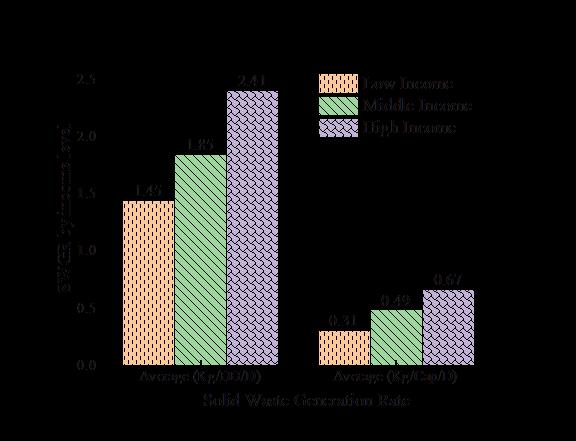
Thedifferencesinwastegenerationacrossincomegroupscanbelinkedtovariationsinconsumptionpatterns,economic capabilities,andlifestylechoices.High-incomehouseholdstendtoconsumemorepackagedandprocessedgoods,resultingin higher levels of plastic, paper, and food waste. Their frequent use of disposable items further contributes to the increased waste. On the other hand, low-income households are more inclined to reuse materials, limit purchases to necessities, and avoidexcessivepackaging,whichhelpsreducetheiroverallwasteproduction.Middle-incomehouseholdsgeneratedwasteat ratesthatfellbetweenthoseofthelow-andhigh-incomegroups.
3.5 Major constraints that hinder effective solid waste management in the study area
3.5.1 Economic constraints/financial issues
Theresultsshowedthatamajorityofrespondents,148outof318(46.5%),"highlyagreed"thateconomicconditionsand financialissuesweremajorfactorscontributingtoinefficientsolidwastemanagement(SWM)inthestudyarea.Additionally, 61respondents(19.2%)"agreed"withthisstatement,bringingthetotalagreementlevelto65.7%,asshowninFigure6.These findingsemphasizethesignificantrolethatfinancialconstraintsplayintheinefficiencyofSWMsystems,especiallyinregions
International Research Journal of Engineering and Technology (IRJET) e-ISSN:2395-0056
Volume: 12 Issue: 02 | Feb 2025 www.irjet.net p-ISSN:2395-0072
where limited funding, inadequate resources, and economic instability hinder the implementation and upkeep of effective waste management practices. Similar findings were reported by Ahmed and Ali [34], who highlighted that limited municipal budgets and high costs associated with waste collection and disposal were major barriers to achieving efficient SWM in developing countries. A smaller proportion of respondents, 41 individuals (12.9%), rated their agreement as "moderate," indicating a recognition of financial issues as a contributing factor but with less emphasis compared to those who strongly agreed. This response suggested that while economic conditions were seen as a significant challenge, other factors such as institutional inefficiencies,lack ofpublic participation, or technical barriers mayhavealso been perceived as contributing to the inefficiency of SWM systems. Other studies carried out by Smith, Jones and Taylor [29] emphasized that while financial challenges are often a primary driver of inefficiency, they are typically intertwined with governance issues and operational shortcomings.
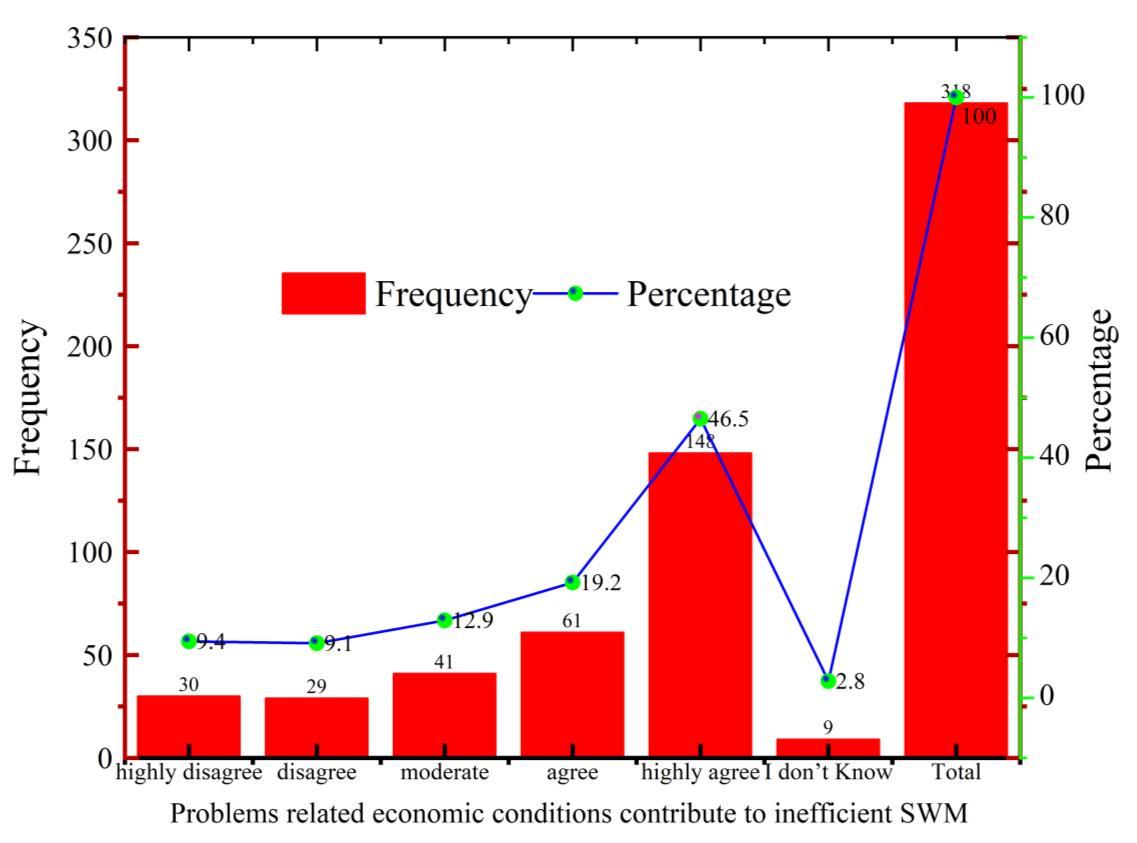
Interestingly, 30 respondents (9.4%) "highly disagreed" and 29 respondents (9.1%) "disagreed" with the idea that financialissuescontributedtoinefficientSWM,makingup18.5%ofthetotalresponses.Theseindividualslikelybelievedthat other factors, suchas poor planning,lack of public awareness, or systemic corruption, were more significantcontributors to the inefficiency of SWM systems. Studies by Kumar and Gupta [35] found that in areas with poorly managed waste systems, public opinion often shifted blame away from financial problems, focusing instead on broader institutional failures, particularlywhenfinancialresourceswereperceivedasbeingpoorlyallocatedormismanaged.Asmallgroupofrespondents, 9individuals(2.8%),selected"Idon’tknow,"indicatinguncertaintyoralackofunderstandingregardingthefinancialaspects ofSWMinefficiency.Thiscouldsuggestthatsomeparticipantswerenotfullyawareofthelink betweeneconomicconditions and waste management systems. This response may suggest that some participants lacked full awareness of the connection between economic conditions and waste management systems.[36] noted that public understanding of the financial underpinnings of SWM systems often depends on the level of transparency and communication provided by municipal authorities,which,ifabsent,canleadtouncertaintyorapathyamongresidents.Thehighlevelofagreement(65.7%)indicated thatfinancialconstraintswerewidelyperceivedasamajorobstacletoeffectivewastemanagement.
2395-0056
Volume: 12 Issue: 02 | Feb 2025 www.irjet.net p-ISSN:2395-0072
The analysis showed that a large majority of respondents recognized the role of a lack of awareness in contributing to inefficient solid waste management (SWM). Of the participants, 131 (41.2%) "highly agreed," and 101 (31.8%) "agreed," as shown in Table 3. Together, these responses made up 73% of the total, highlighting the widespread belief that low public awarenesswasakeyfactorinSWMinefficiency.ThesefindingsalignedwiththoseofChernet,Sema,GebeyehuandWogayehu [37],whoreportedthatpublicawarenessgapsregardingwastesegregation,recycling,andproperdisposalmethodsweremajor barrierstoeffectivewastemanagementindevelopingregions. Asmallergroupof respondents,30individuals(9.4%),gavea "moderate" rating, suggesting that while they acknowledged the importance of awareness, they may have also viewed other factors, such as financial or institutional issues, as equally important contributors to inefficiency. This perspective shows a morenuancedunderstandingofthecomplexchallengesfacedbySWMsystems. emphasizedthatwhilelackofawarenessisa significant barrier, it often interacts with other systemic issues, such as poor infrastructure and governance, to exacerbate inefficiencies in SWM systems. Interestingly, 22 respondents (6.9%) "highly disagreed" and 25 respondents (7.9%) "disagreed" with the notion that lack of awareness was a major contributor to inefficiency. These individuals likely believed thatfactorslikeinadequatefunding,poorgovernance,orweakpolicyenforcementplayedamorecrucialroleindetermining SWM outcomes. Similar trends were observed by Hassan, Nawaz and Iqbal [38], who noted that in some regions, public dissatisfaction with SWM systems was directed more toward institutional failures than individual behaviors, particularly whenresidentsperceivedthemselvesasadequatelyinformedbutletdownbyinadequatemunicipalservices. Asmallnumber of respondents, 9 individuals (2.8%), selected "I don’t know," indicating uncertainty or unfamiliarity with the topic. This responsepointstoaknowledgegapamongsomeparticipants,suggestingthatawarenessabouttheroleofpublicknowledge in SWM might be lacking in certain groups within the population Similarly, Zhang and Li [39] highlighted that lack of engagementandcommunicationfrommunicipalauthoritiesoftenperpetuatesuncertaintyaboutSWMchallengesandtherole ofpublicawarenessinaddressingthem.
Table -3: ProblemsrelatedtolackofawarenesscontributetoinefficientSWM
The findings revealed that a significant proportion of respondents identified improper solid waste (SW) disposal as a majorfactorcontributingtoinefficientsolidwastemanagement(SWM).Oftheparticipants,124respondents(39.0%)"highly agreed," and 90 respondents (28.3%) "agreed," together accounting for 67.3% of the total responses, as shown in Figure 7 Theseresultsemphasizedthecriticalimpactofdisposalinefficiencies suchasunregulatedlandfills,poorwastesegregation, andinadequatedisposalinfrastructure ontheoveralleffectivenessofSWMsystems.SimilartrendswerereportedbyAhmed andAli [34],whoemphasizedthatimproperdisposalpractices,particularlyinurbanareasofdevelopingcountries,oftenleadto the accumulation of waste, environmental degradation, and public health issues. A smaller portion of respondents, 56 individuals (17.6%), expressed moderate agreement. This suggests that while they acknowledged improper disposal as a factor, they may have seen it as just one of several interconnected issues affecting SWM systems. This highlights the complexity of the problem, where disposal inefficiencies are often linked to broader systemic challenges like funding shortages, poor governance, and limited public awareness. Smith, Jones and Taylor [29] observed that respondents in similar studies frequently rated improper disposal as a moderate concern when other issues, such as transportation or financial constraints, were perceived to be equally significant. On the other hand, 21 respondents (6.6%) "highly disagreed," and 22
International Research Journal of Engineering and Technology (IRJET) e-ISSN:2395-0056
Volume: 12 Issue: 02 | Feb 2025 www.irjet.net p-ISSN:2395-0072
respondents(6.9%)"disagreed"withtheideathatimproperSWdisposalwasamajorcontributortoSWMinefficiency.These individualsmayhaveattributedinefficienciestootherfactors,suchasinadequatetransportationsystems,weakenforcement ofwastemanagementregulations,orlimitedpublicinvolvementinwastereductionefforts.KumarandGupta [35] notedthatin regions with mismanaged waste systems, public dissatisfaction often shifts toward systemic governance failures rather than specificissueslikedisposal.
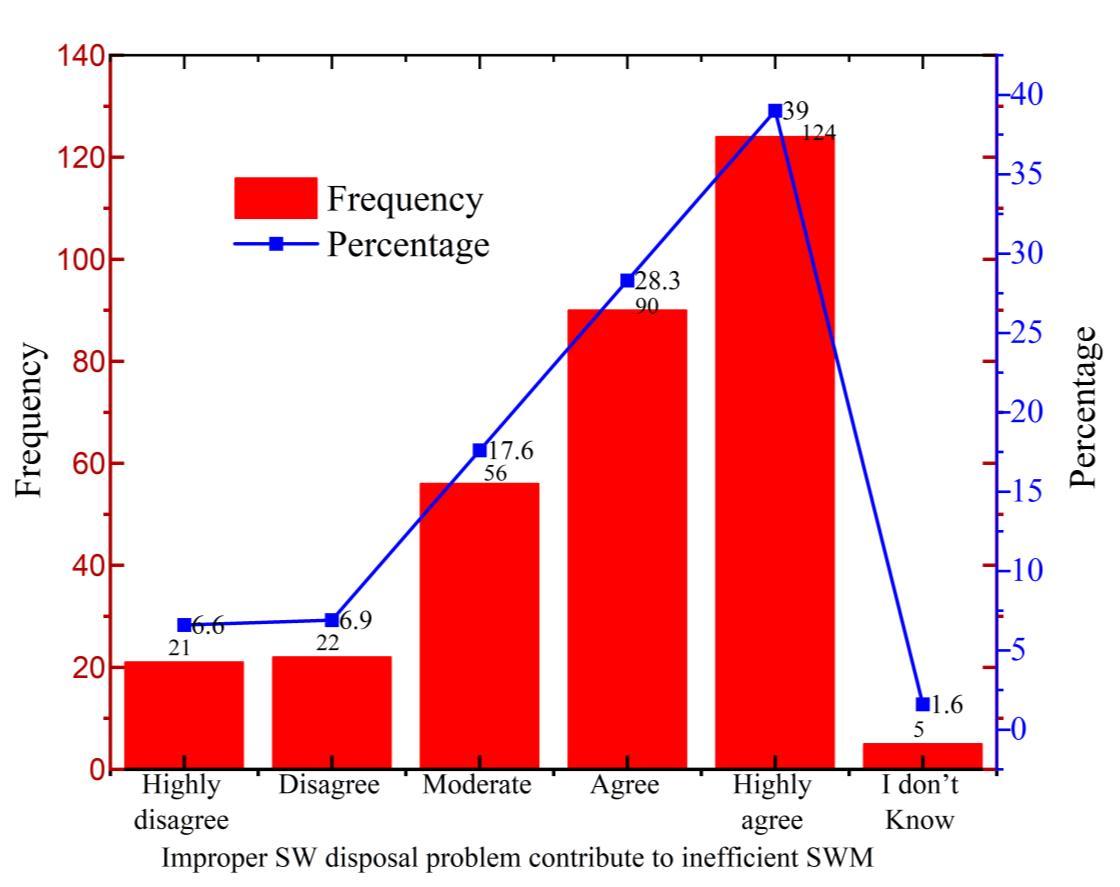
Asmallnumberofrespondents,5individuals(1.6%),selected"Idon’tknow,"indicatinguncertaintyorlackoffamiliarity withtheroleofproperwastedisposalinSWMinefficiencies.Thisresponsepointstoapotentialgapinpublicunderstandingof theinterconnectedchallengeswithinSWM,highlightingtheneedforbettercommunicationandeducationalefforts Zhangand Li [39] emphasized that public awareness campaigns play a critical role in bridging knowledge gaps and fostering greater understandingoftheimportanceofproperwastedisposal.Thehighlevelofagreement(67.3%)highlightedthecrucialroleof proper waste disposal in ensuring efficient SWM. Disposal practices, such as landfilling, incineration, and composting, represent the final step in the waste management processand directlyinfluence environmental and publichealthoutcomes. Poormanagementofthesepracticescanleadtoenvironmentalpollution,healthhazards,andsocialdisparities
3.5.4 Poor community participation as contributing factor to inefficient SWM
The resultsshowedthat a substantial portion of respondentsidentified poorcommunity participation asa key factorin theinefficiencyofSWM.Of theparticipants,113(35.5%)"agreed"and109(34.3%)"highlyagreed,"combiningfor69.8%of totalresponsesasshowninTable 4.Thishighlevelofagreementhighlightedtheessentialroleofcommunity involvementin the success of SWM systems. Inadequate participation in tasks such as waste segregation, recycling, and following disposal guidelines has been linked to exacerbating inefficiencies in SWM Ahmed and Ali [34] similarly reported that inadequate community engagement wasa major bottleneck in SWMsystems, particularlyin regions where publicawarenesscampaigns and participatory initiatives were limited. A smaller group of respondents, 47 individuals (14.8%), rated their agreement as
International Research Journal of Engineering and Technology (IRJET) e-ISSN:2395-0056
Volume: 12 Issue: 02 | Feb 2025 www.irjet.net p-ISSN:2395-0072
"moderate," indicating that while they acknowledged poor community participation as a contributing factor, they may have alsoviewedothersystemicissues,suchasfinanciallimitationsorweakadministrativestructures,asequallyimportant.Smith, Jones and Taylor [29] observed that community participation is often interlinked with other factors, such as governance and infrastructure,andthatitsimpactonSWMefficiencyiscontingentonthebroadersocio-politicalcontext.
Interestingly, 27 respondents (8.5%) "disagreed," and 14 respondents (4.4%) "highly disagreed," combining for 12.9%. Theserespondentslikelybelievedthatotherfactors,suchasinadequateinfrastructure,insufficientfunding,oradministrative inefficiencies, were more significant contributors to SWM inefficiency than community participation Brown and Taylor [30] notedthatinregionswithpoorlymanagedSWMsystems,publicdissatisfactionoftenshiftstowardinstitutionalfailuresrather than individual or community-level shortcomings. A small percentage of respondents, 8 individuals (2.5%), selected "I don’t know," indicating uncertainty or unfamiliarity with the role of community participation in SWM. This response suggests a possible gap in public understanding of how collective action and individual behavior can impact the effectiveness of SWM systems Zhang, Chen, Zhang, Liu, Chen, Yang, Osman, Farghali, Liu, Hassan, Ihara, Lu, Rooney and Yap [36] emphasized that public education and engagement are critical for bridging knowledge gaps and fostering active participation in waste management processes. The high level of agreement (69.8%) underscores the importance of community participation in achievingefficientSWM.Activeinvolvementfromresidents,businesses,andlocalorganizationsisessentialforimplementing criticalwastemanagementpracticessuchassourcesegregation,recycling,andproperdisposal.AhmedandAli [34] arguedthat communityparticipationservesasthebackboneofeffectiveSWMsystems,asitensuresthatwastemanagementpoliciesand programs are supported and adhered to by the public. Community involvement also promotes accountability and transparencywithinSWMsystems.Whenresidentsareactivelyengaged inwastemanagementefforts,theyaremoreinclined tooverseetheperformanceofwastecollectionservicesandreportanyinefficienciesorirregularities.
Table -4: PoorcommunityparticipationproblemcontributestoinefficientSWM
don’tKnow
Low
The results showed that a significant number of respondents identified low technology as a key factor contributing to inefficiencies in solid waste management (SWM). Among the participants, 126 respondents (39.6%) "highly agreed" and 98 respondents (30.8%) "agreed," making up a total of 70.4% of responses as shown in Figure 8. These findings emphasize the importanceoftechnologyinmodernizingandenhancingSWMsystems.Theabsenceofadvancedtechnologies,likeautomated waste segregation, GPS-enabled route optimization for waste collection, and waste-to-energy systems, likely impeded the efficiencyandeffectivenessofwastemanagementoperations.Similartrendswerereportedby Teshome [40],whohighlighted thatlowtechnologicaladoptionisakeylimitationinwastemanagementsystemsacrossdevelopingcountries,wherereliance on manual and outdated processes continues to dominate. A smaller percentage of respondents, 44 individuals (13.8%), expressed"moderate"agreement,suggestingthatwhiletheyacknowledgedlowtechnologyasacontributingfactor,theylikely saw other systemic issues, such as weak administration, inadequate infrastructure, or financial constraints, as equally important. This finding aligned with observations made by Xiao, Dong, Geng, Francisco, Pan and Wu [41], who argued that technological limitations often operate in conjunction with broader governance and operational challenges, amplifying their impact on SWM systems. On the other hand, 28 respondents (8.8%) "disagreed" and 16 respondents (5.0%) "strongly disagreed"withtheidea thatlowtechnologywasasignificantcontributortoSWMinefficiency.Theserespondentsmayhave
International Research Journal of Engineering and Technology (IRJET) e-ISSN:2395-0056
Volume: 12 Issue: 02 | Feb 2025 www.irjet.net p-ISSN:2395-0072
pointed to other factors, such as lack of public awareness, insufficient funding, or cultural resistance to waste management practices, as the main reasons for inefficiencies, rather than technological gaps. Zhang, Chen, Zhang, Liu, Chen, Yang, Osman, Farghali,Liu,Hassan,Ihara,Lu,RooneyandYap [36] notedthatinregionswherewastemanagementsystemsareunderfunded or poorly governed, public perceptions often shift focus from technological deficiencies to more visible challenges, such as inconsistentwastecollectionorunregulatedlandfills.
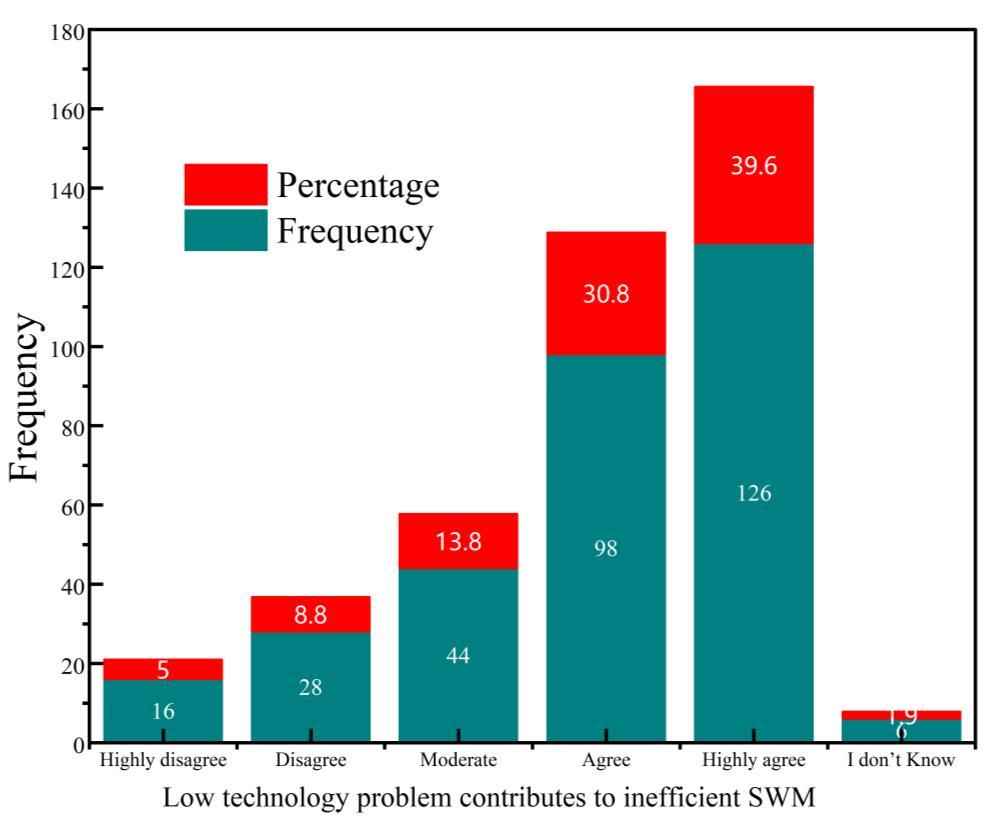
Asmallportionofrespondents,6individuals(1.9%),selected"Idon’tknow,"indicatinguncertaintyorunfamiliaritywith theroleof technologyinSWM.This responsepointstoa potential knowledgegap,suggestingthatsomeindividualsmaynot fully grasp how technology can help resolve inefficiencies in waste management systems. Zhang and Li [39] emphasized that public awareness and education are critical for fostering understanding and acceptance of technology-driven innovations in SWM.
3.5.6 Rapid population growth as contributing factor to inefficient SWM
The results showed that a substantial majority of respondents recognized rapid population growth as a key factor contributing to inefficiencies in solid waste management (SWM). Of the participants, 132 respondents (41.5%) "strongly agreed," and 81 respondents (25.5%) "agreed," totaling 67.0% of all responses, as shown in Table 5. These findings highlighted the challenges caused by rising population densities in both urban and rural areas, which put pressure on the capacity of SWM systems. Similar conclusions were drawn by Bundhoo [42], who highlighted that population growth directly correlates with increased waste generation, creating additional pressure on already overburdened waste management systems in developing regions. A smaller group of respondents, 43 individuals (13.5%), showed "moderate" agreement, implyingthat whiletheyacknowledgedpopulationgrowthasa contributingfactor, theylikelyviewedotherchallenges,such as inadequate infrastructure, financial limitations, or poor administration, as equally important. Adewale and Ogunleye [43] highlighted that rapid population growth often interacts with systemic challenges, such as insufficient resources and governance failures, to exacerbate inefficiencies in SWM systems. Interestingly, 21 respondents (6.6%) 'strongly disagreed,' and 20 respondents (6.3%) 'disagreed' that population growth was a major factor in SWM inefficiency. These respondents
International Research Journal of Engineering and Technology (IRJET) e-ISSN:2395-0056
Volume: 12 Issue: 02 | Feb 2025 www.irjet.net p-ISSN:2395-0072
likelypointedtootherchallenges,suchasashortageofskilledlabor,lowtechnologyadoption,orculturalfactors,ratherthan populationpressures,asthemaincausesofinefficiency. Getahun,Mengistie,Haddis,Wasie,Alemayehu,Dadi,VanGervenand VanderBruggen [44] observed that in regions with severe governance or operational challenges, public perceptions of waste managementinefficienciesoftenshiftawayfrompopulation-relatedfactorsandfocusonmorevisibleissues,suchasirregular waste collection or poor disposal practices. Another interesting finding was that 21 respondents (6.6%) selected 'I don’t know,' indicating some uncertainty or unfamiliarity with the link between population growth and SWM inefficiencies, as showninTable6.Thisresponsepointstoapotentialknowledgegap,highlightingtheneedformorepublicawarenessabout howdemographicchangesaffectwastemanagementsystems.Guerrero,MaasandHogland [45] arguedthatunderstandingthe link between population dynamics and SWM performance is essential for designing effective policies and interventions. The strong agreement (67.0%) highlighted the significant impact that rapid population growth has on SWM systems. As populations grow, theamount of waste generated byhouseholds, businesses, and industriesincreasessharply, putting more pressureonwastecollection,transportation,anddisposalservices.
Table - 5: RespondentsagreementonRPGascontributingfactortoinefficientSWM
Municipalsolidwastemanagementiscriticaltothesustainabledevelopmentofcitiesindevelopingcountriesbecauseof limited municipal capacity, low bureaucratic efficiency, and lack of infrastructure. In this study, an assessment of municipal solidwastemanagement(MSWM)practicewasconductedinMeneliksub-cityofDebrebrehan,Amhara region, Ethiopia.The studyutilizedarobustframeworkfordatacollectionandanalysisonmunicipalsolidwastemanagement(MSWM)inMenelik Sub-city. Primary data were gathered through field observations, interviews, focus group discussions, and questionnaires conductedinEnglishandAmharic.Asystematicsamplingmethodensuredrepresentationacrossthreeecological zones.Data analysiscombinedquantitativetechniquesusingSPSSandOriginProforstatisticalanalysisandgraphicalrepresentation,with qualitative approachestoidentify patterns and causal relationships from open-ended responsesand interviews.This mixedmethod provided comprehensive insights into MSWM challenges. Analysis of waste generation rates reveals that individuals classified within low-income generated an average of 0.31 kg/cap/day whereas middle-income individuals produced an averageof0.49kg/cap/day.High-incomeindividualsproducedanaverageof0.67kg/cap/day,whichismorethantwicethe wasteproducedbythoseinthelow-incomecategory.
Thestudyonmunicipalsolidwastemanagement(MSWM)inMenelikSub-cityprovidedacomprehensiveanalysisofthe challenges,practices,andperceptionssurroundingwastemanagementsystems.Thefindingsrevealedthatthecompositionof municipalsolidwaste(MSW)inthesub-citywaspredominantlyorganic(60%),withrecyclablematerialsaccountingfor15% and other waste types comprising 25%. However, the collection and disposal processes were found to be suboptimal, with only65%ofwastebeingcollectedanddisposedofproperly,while25%wasdumpedinuncontrolledareas,posingsignificant environmental and health risks. The study highlighted that the majority of households 84% utilized door-to-door waste collection services, demonstrating community adaptation to this method. However, variations in waste disposal frequency were observed, with only 38.7% of households disposing of waste daily, while a combined 61.3% disposed of waste less frequently (every 2-7 days or more). The majority of respondents perceived rapid population growth, low technology, poor community participation, improper SW disposal, lack of public awareness, economic constraints/financial issues as a Level
International Research Journal of Engineering and Technology (IRJET) e-ISSN:2395-0056
Volume: 12 Issue: 02 | Feb 2025 www.irjet.net p-ISSN:2395-0072
dominant drivers/contributing factor for inefficient SWM. The findings of the study highlighted that strengthening governance, increasing financial outlay, building the institutional capacity, stricter policy enforcement, fostering community participation,andimplementingtargetedpublicawarenesscampaignsare criticaltoensuringsustainableandefficientwaste managementsystemsinthestudyareaandbeyond.
Acknowledgment
The Tongji University provided us with both financial and logistical assistance, which we acknowledge. The first author had invaluablesupportfromTongjiUniversityduringherresearchstayinShanghai,China,andwearegratefulfortheirassistance. Wewouldliketoexpressoursinceregratitudetothelocalcommunity,aswellasthe Kebeles andDistrictauthorities,fortheir valuablecooperationinprovidinguswithsecondarydataforourresearchandengagingindiscussions.
Author contributions: Beza Dagnaw; conceptualized the project, Beza Dagnaw; curated the data, Mehari Mariye; Temalede Belayhun;conductedtheformalanalysis,BezaDagnaw;andTemaledeBelayhun;MehariMariye;developedthemethodology and software Beza Dagnaw; Qiaoying Wang; supervised the project, while Beza Dagnaw; wrote the original draft and all authorsparticipatedinthesubsequentreviewandeditingprocess
Declarations
Iconfirm thatthedata includedhere isaccurate andcomprehensive.Iherebycertifythatthis work hasnot beenpreviously publishedandhasnotbeensubmittedforpublicationtoanyjournal
Conflictofinterest:Theauthorsdon'thaveanycompetinginterests
References
[1] ALABIOA,OLOGBONJAYEKI,AWOSOLUO,etal.Publicandenvironmentalhealtheffectsofplasticwastesdisposal:a review[J].JToxicolRiskAssess,2019,5(021):1-13.
[2] GAMACHU F A F, JEGORA T. Assessment of Community Perception on Solid Waste Management Practice in Bedele Town,OromiaRegion,Ethiopia[J].Assessment,2019,11(10).
[3] KAZA S, YAO L, BHADA-TATA P, et al. What a waste 2.0: a global snapshot of solid waste management to 2050 [M]. WorldBankPublications,2018.
[4] ABUYEF,GAMACHUF,JEGORAT.COMMUNITYPERCEPTIONONSOLIDWASTEANDITSMANAGEMENTPRACTICES INBEDELETOWN,OROMIAREGION,ETHIOPIA[J].EthiopianJournalofEnvironmentalStudies&Management,2020.
[5] MALAVLC,YADAVKK,GUPTAN,etal.Areviewonmunicipalsolidwasteasarenewablesourceforwaste-to-energy projectinIndia:Currentpractices,challenges,andfutureopportunities[J].JournalofCleanerProduction,2020,277: 123227.
[6] APARCANA S. Approaches to formalization of the informal waste sector into municipal solid waste management systems in low-and middle-income countries: Review of barriers and success factors [J]. Waste management, 2017, 61:593-607.
[7] CANONSDSL,IACOVIDOUE,RUTKOWSKIEW.Typologyofmunicipalsolidwasterecyclingvaluechains:Aglobal perspective[J].JournalofCleanerProduction,2022:130386.
[8] HOORNWEGD,BHADA-TATAP.Whatawaste:aglobalreviewofsolidwastemanagement[J].2012.
[9] MA S, ZHOU C, PAN J, et al. Leachate from municipal solid waste landfills in a global perspective: Characteristics, influentialfactorsandenvironmentalrisks[J].JournalofCleanerProduction,2022,333:130234.
International Research Journal of Engineering and Technology (IRJET) e-ISSN:2395-0056
Volume: 12 Issue: 02 | Feb 2025 www.irjet.net p-ISSN:2395-0072
[10] YAZIE T D, TEBEJE M G, CHUFA K A. Healthcare waste management current status and potential challenges in Ethiopia:asystematicreview[J].BMCresearchnotes,2019,12:1-7.
[11] ZEMENA G. SOLID WASTE MANAGEMENT PRACTICE AND FACTORS INFLUENCING ITS EFFECTIVENESS. THE CASE OFSELECTEDPRIVATEWASTECOLLECTINGCOMPANIESINADDISABABA[D];St.Mary'sUniversity,2016.
[12] ACHANKENGF,NGWAFUP,NKWIWG,etal.Post-colonialCameroon:Politics,economy,andsociety[M].Rowman& Littlefield,2018.
[13] RATHI S. Optimization model for integrated municipal solid waste management in Mumbai, India [J]. Environment anddevelopmenteconomics,2007,12(1):105-21.
[14] SINGH A. Municipal solid waste management models: a review study to evaluate the conceptual framework for developingnations[J].InternationalJournalofEnvironmentandWasteManagement,2022,30(3):303-23.
[15] WALZ A, LARDELLI C, BEHRENDT H, et al. Participatory scenario analysis for integrated regional modelling [J]. LandscapeandurbanPlanning,2007,81(1-2):114-31.
[16] ALEMAYEHU D S, REGASA M S, MENGESTIE B, et al. Household solid waste management practice associated factors and service delivery performance of private solid waste collectors in Dire Dawa City, Eastern Ethiopia [J]. InternationalJournalofInnovativeResearchinScience,EngineeringandTechnology,2017,6(10):1-12.
[17] AERNI P. Coping with migration-induced urban growth: Addressing the blind spot of UN habitat [J]. Sustainability, 2016,8(8):800.
[18] HELELOA,SENBETAA,ANSHEBOS.Assessmentofsolidwastemanagement(SWM)practicesinHawassaUniversity campuses,Ethiopia[J].JournalofAppliedSciencesandEnvironmentalManagement,2019,23(6):1081-6.
[19] MBULIGWE S E. Institutional solid waste management practices in developing countries: a case study of three academicinstitutionsinTanzania[J].Resources,ConservationandRecycling,2002,35(3):131-46.
[20] HAYLAMICHEALID,DALVIEMA,YIRSAWBD,etal.AssessingthemanagementofhealthcarewasteinHawassacity, Ethiopia[J].WasteManagement&Research,2011,29(8):854-62.
[21] ALEMAYEHU MIJENA K, ZHAO J, LU S, et al. Assessment of Integrated Solid Waste Management Practices in Adama City, Oromia Region, Ethiopia [J]. International Journal of Scientific and Research Publications (IJSRP), 2021, 11(2): 451-61.
[22] BEDASA A, WONDWOSSEN M. Suitable Solid Waste Disposal Site Selection Using Geographical Information System (GIS):ACase ofDebreBerhanTown,Ethiopia[J].AmericanJournalofEnvironmentalProtection,,2019,7(1):17-23.
[23] WUBIE M A, ASSEN M, NICOLAU M. Patterns, causes and consequences of land use/cover dynamics in the Gumara watershedoflakeTanabasin,NorthwesternEthiopia[J].EnvironmentalSystemsResearch,2016,5:1-12.
[24] AMARES.Landuse/coverchangeatinfrazwatershed,northwesternEthiopia[J].JournalofLandscapeEcology,2015, 8(1).
[25] COCHRANWG.Samplingtechniques,3rded.NewYork:JohnWiley&Sons.[J].JohnWiley&Sons1977.
[26] SOLOMONN,HISHEH,ANNANGT,etal.ForestCoverChange,KeyDriversandCommunityPerceptioninWujigMahgo WarenForestofNorthernEthiopia[J].Land,2018,7(1):32.
[27] MARIYE M, MARYO M, LI J. The Study of Land Use and Land Cover (LULC) Dynamics and the Perception of Local PeopleinAykoleba,NorthernEthiopia[J].JournaloftheIndianSocietyofRemoteSensing,2022.
2025, IRJET | Impact Factor value: 8.315 | ISO 9001:2008 Certified Journal | Page232
International Research Journal of Engineering and Technology (IRJET) e-ISSN:2395-0056
[28] DANANO K A, LEGESSE A, LIKISA D. Monitoring Deforestation in South Western Ethiopia Using Geospatial Technologies[J].JournalofRemoteSensing&GIS,2018,07(01).
[29] SMITH A, JONES B, TAYLOR C. Factors Influencing Age-Related Survey Participation [J]. Journal of Public Health Research,2019,35(2):45–50.
[30] BROWNP,TAYLORS.UnderstandingPublicOpiniononControversialIssues.[J].SocialScienceQuarterly,2019,60(2): 234-56.
[31] GREEN T, JONES R, TAYLOR L. Addressing Knowledge Gaps in Waste Management: A Framework for Inclusive Awareness[J].JournalofSocialJusticeResearch,2016,12(1):45–62.
[32] TAYLOR L, ZHANG H, LI F. Multilingual Approaches to Environmental Education [J]. Journal of Sustainability Education,2017,40(3):150–70.
[33] JONES B, LEE A, WHITE R. Socioeconomic Trends in Survey Participation: Patterns Across Income Brackets. [J]. JournalofPublicPolicyResearch,2017,34(3):78–90.
[34] AHMED S, ALI M. Promoting waste reduction through monitoring and behavioral change [J]. Waste Management Review,2020,30(2):67-80.
[35] KUMAR R, GUPTA S. Age and Participation Trends in Digital Surveys: Challenges and Opportunities. [J]. Journal of PopulationStudies,2021,28(5):130–45.
[36] ZHANG Z, CHEN Z, ZHANG J, et al. Municipal solid waste management challenges in developing regions: A comprehensivereviewandfutureperspectivesforAsiaandAfrica[J].SciTotalEnviron,2024,930:172794.
[37] CHERNET D, SEMA W, GEBEYEHU A, et al. Willingness to pay for improved solid waste management and associated factors among households in Debre Berhan town, North Shoa Zone, Amhara, Ethiopia, 2022 [J]. Frontiers in Sustainability,2024,5.
[38] HASSANA,NAWAZM,IQBALT.Theroleofpublicawarenessinsustainablewastemanagement.[J].JournalofUrban Development,2021,23(6):98-110.
[39] ZHANG H, LI F. Community Participation in Solid Waste Management Awareness Campaigns. [J]. Journal of EnvironmentalPlanningandManagement,2020,40(2):85–120.
[40] TESHOME F B. Municipal solid waste management in Ethiopia; the gaps and ways for improvement [J]. Journal of MaterialCyclesandWasteManagement,2020,23(1):18-31.
[41] XIAO S, DONG H, GENG Y, et al. An overview of the municipal solid waste management modes and innovations in Shanghai,China[J].EnvironmentalScienceandPollutionResearch,2020,27(24):29943-53.
[42] BUNDHOO Z M A. Solid waste management in least developed countries: current status and challenges faced [J]. JournalofMaterialCyclesandWasteManagement,2018,20(3):1867-77.
[43] ADEWALEA,OGUNLEYET. BarrierstoEfficientWaste ManagementinLow-IncomeUrbanAreas.[J].AfricanJournal ofEnvironmentalResearch,2020,18(1):95-110.
[44] GETAHUN T, MENGISTIE E, HADDIS A, et al. Municipal solid waste generation in growing urban areas in Africa: current practices and relation to socioeconomic factors in Jimma, Ethiopia [J]. Environmental monitoring and assessment,2012,184(10):6337-45.
[45] GUERRERO L A, MAAS G, HOGLAND W. Solid waste management challenges for cities in developing countries [J]. WasteManag,2013,33(1):220-32.
Volume: 12 Issue: 02 | Feb 2025 www.irjet.net p-ISSN:2395-0072 © 2025, IRJET | Impact Factor value: 8.315 | ISO 9001:2008 Certified Journal | Page233