
International Research Journal of Engineering and Technology (IRJET) e-ISSN: 2395-0056
Volume: 13 Issue: 05 | May 2026 www.irjet.net p-ISSN: 2395-0072

International Research Journal of Engineering and Technology (IRJET) e-ISSN: 2395-0056
Volume: 13 Issue: 05 | May 2026 www.irjet.net p-ISSN: 2395-0072
Aishwarya Soni¹, Vikas Vishwakarma², Rajesh Kaushal³
1 Student, Department of Chemical Engineering, IPS Academy, Institute of Engineering and science, Indore, Madhya Pradesh
2 Professor, Department of Chemical Engineering, IPS Academy, Institute of Engineering and science, Indore, Madhya Pradesh
³ Head of Department, Department of Chemical Engineering, IPS Academy, Institute of Engineering and science, Indore, Madhya Pradesh
Abstract - Heavymetal contaminationin industrial soilisa persistent environmental problem, as these metals do not degrade and accumulate in terrestrial ecosystems over the long term. This study investigated the concentrations, distribution, and contamination levels of sixheavy metals(Cu, Ni, Cr, Pb, Mn and Zn) in soil samples collected from fifteen locations in the Pithampur industrialareaofMadhyaPradesh, India. The soil pH ranged from slightly acidic to moderately alkaline, reflecting the diversity of industrial influences. The measured concentrations of Ni, Cr and Pb exceeded natural background levels at most locations, indicating significant anthropogenic enrichment. Descriptive statistics andPearson correlation analysis revealed strong correlations between Ni and Cr, Pb and Cr, and Pb and Ni, suggesting common industrial sources such as metal refining, electroplating, machining, and other manufacturing processes. The overall pollution index (PLI = 0.60) indicated moderate deterioration of soil quality and higher levels of pollution in sulfur-rich areas. These results highlight the necessity for continuous monitoringandimprovementofindustrialwastemanagement to prevent the accumulation of toxic metals and sustainably maintain environmental quality in the region.
Key Words: Heavy metal contamination Industrial soil pollution,TracemetalsContaminationfactor(CF)Pollution loadindex(PLI)Statisticalanalysis
Rapid industrial growth has contributed significantly to economic development, but it has also introduced serious environmental challenges, particularly the heavy metal accumulation in soil systems. Heavy metals are of major concernbecausetheyarenon-biodegradable,persistentin nature, and capable of accumulating in soils over long periods,therebyaffectingsoilqualityandecosystemstability (Alloway,2013).Unlikeorganiccontaminants,thesemetals are not biodegradable and accumulate in the soil and can negatively influence plant productivity, microbial activity, andecologicalbalance(Nagajyotietal.,2010).Itchangesthe chemical composition of the soil, reduces its fertility, and
poseslong-termriskstothehealthofplants,animals,and humans.
Various studies have investigated heavy metal contamination in industrial regions globally and across India. Industrialization, mining, and manufacturing are major contributors to heavy metal enrichment in soils, leadingtoecologicalandhumanhealthrisks.Theseactivities releasemetalslikelead(Pb),nickel(Ni),andchromium(Cr) through emissions, waste disposal, and atmospheric deposition (Nriagu & Pacyna, 1988; Sharma et al., 2007). Improper waste management and continuous industrial discharge further accelerate the enrichment of toxic elementsinsurroundingsoils(Guptaetal.,2008).Globally, metalssuchasCd,Pb,Cr,CuNi,andZnhavebeenfoundat concentrations exceeding natural background levels in industrialandurbansoils(Tayibietal.,2009).
Highconcentrationsofheavymetalsinsediments andsoilshavebeendetectednearmajorindustrialcentersin India, such as Vapi (Gujarat), Tarapur (Maharashtra), Patancheru(Telangana),andPithampur(MadhyaPradesh). Pithampur,alsoknownasthe"DetroitofIndia,"isoneofthe leading industrial growth centers in India, with a strong presence in the engineering, automobile, and pharmaceuticalssectors.ItisintheDhardistrictofMadhya Pradesh, 30 km from Indore, with over 600 functional industrialunitsandprovidesemploymenttoaround32,000 people. The rapid industrialization of the area, with the coexistenceofresidentialandagriculturalland,hasraised seriousconcernsaboutpotentialheavymetalcontamination. Previous environmental monitoring reports and local investigationshavedetectedhighconcentrationsofmetals, suchasnickel(Ni),chromium(Cr),lead(Pb),andzinc(Zn), inthe soilofPithampur,particularlynearindustrial areas and wastewater treatment plants. Various sources of contamination include metal processing units, inadequate waste disposal, wastewater from treatment plants, and hazardous waste landfills. Despite these findings, comprehensive and widespread investigations of heavy metalsoilcontaminationinPithampurarestillscarce.
International Research Journal of Engineering and Technology (IRJET) e-ISSN: 2395-0056
Volume: 13 Issue: 05 | May 2026 www.irjet.net p-ISSN: 2395-0072
Therefore, systematic, and scientifically sound research is required to understand the extent, distribution, and potential risks of heavy metal soil contamination in the Pithampurindustrialarea.Suchinvestigationswillnotonly provide fundamental environmental information but also serveasabasisforremediationplansandthedevelopment of local environmental policies in the future (Hakanson, 1980;Qinetal.,2019).
2.1
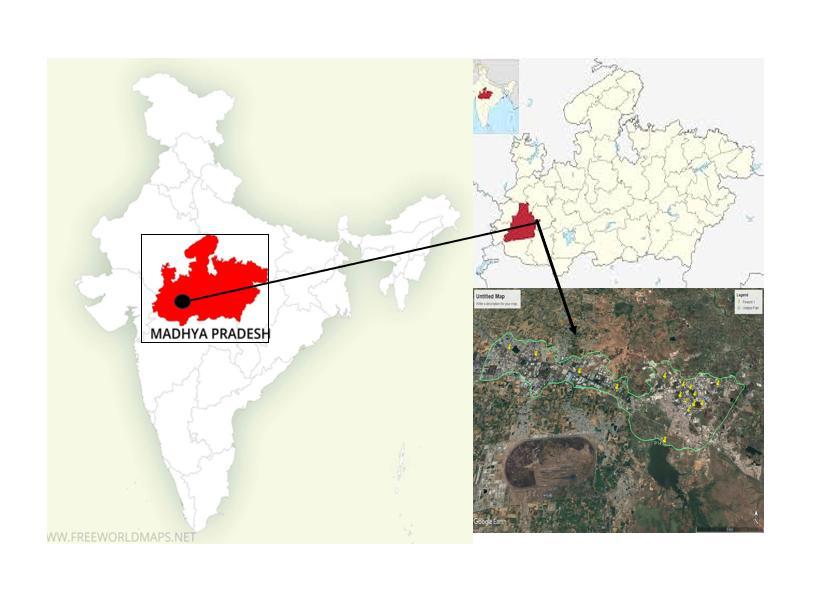
ThestudywasconductedwithinthePithampurIndustrial Area(PIA)intheDhardistrictoftheIndianstateofMadhya Pradesh(latitude22°35′Eto22°41′Eandlongitude75°35′ Eto75°41′E).The regionisconsideredoneofthelargest industrial centres in Central India and is home to many chemicals, pharmaceutical, automobile, galvanizing, and mechanical engineering companies. The region is characterizedbybasalticparentmaterialandalkalineblack soil (Vertisol) with moderate clay content and a rich clay texture. The climate is tropical, with an average annual precipitation of approximately 900–1000 mm. The PIA, divided into three different sectors, I, II, and III, is surroundedbyagriculturallands,residentialareas,andopen waste, which can act as reservoirs for atmospheric depositionandrunofffromindustrialsources.Theproximity of industries, wastewater treatment plants, and landfills makestheregionecologicallysensitiveandpronetoheavy metalaccumulationinthesoil.
2.2
A systematic random sampling method was adopted to ensure representative coverage of several sectors in the industry. A total of 15 sampling locations were selected based on their proximity to possible sources of
contamination,suchaseffluentdischargepoints,hazardous wastestoragefacilities,andareassurroundingwastewater treatmentplants(WWTPs)Thesampleswerecollectedfrom industrial, roadside, and buffer-zone locations of all three sectorsusingastainless-steelaugeratadepthof50-10cm. Allsampleswerekeptincleanpolyethylenebags,labelledas P+Numberforlaboratoryanalysis
The collected soil samples were air-dried at room temperaturefor3-4days,followedbyovendryingat10°C for8htoeliminatemoisture.Thedriedsamplesweregently pulverizedusingamortarandpestleandsievedthrougha2 mmmeshtoobtainauniformgrainsize.Allglasswareand equipmentwerewashedwithacid(10%HNO₃)andrinsed withdeionizedwater.
The pH of soil was measured in a ratio of 1:10 soil-water suspension using a calibrated pH meter. Heavy metal concentrations(Pb,Cr,Ni,Cu,Zn,andMn)weredetermined using the USEPA 3050B acid digestion method. Approximately 1 g of each soil sample was digested in a mixture of concentrated HNO₃ and HCl (3:1) for 4 h. The solutionwasfilteredanddilutedto50mLusingdeionized water.
The descriptive statistics includes: i) minimum and maximum, ii) mean, iii) standard deviation, and iv) coefficient of variation (CV%). These statistics were calculated to examine the spatial variability of soil parameters.Pearsoncorrelationanalysis,amethodwidely usedinsoilpollutionstudies(Zhang,2006;Lietal.,2013) wasappliedtorecognizerelationshipsamongheavymetals to study the possible causes of contamination. Similarly, graphicalrepresentationssuchasboxplots,barcharts,and correlationheatmapsweregeneratedusingOriginsoftware andMSExcel.


Thecontaminationfactor(CF)andpollutionloadindex(PLI)were calculatedtoevaluatethedegreeofheavymetalcontamination.The CFforagivenmetal isdefinedas: where isthemeasuredconcentrationofmetal insoiland is the corresponding background value. The majorly cited global background soil values were adopted in this study:Cu=30mgkg⁻¹,Cr=80mgkg⁻¹Ni=50mgkg⁻¹,Pb=

International Research Journal of Engineering and Technology (IRJET) e-ISSN: 2395-0056
Volume: 13 Issue: 05 | May 2026 www.irjet.net p-ISSN: 2395-0072
50mgkg⁻¹,Mn=500mgkg⁻¹,and Zn=70mgkg⁻¹.TheCF values <1 indicate low contamination, 1–3 indicates moderate, 3–6 indicates considerable and >6 very high contamination.Theoverallsoilqualitywasassessedusing the pollution load index (PLI) which is defined as the nth rootoftheproductofthecontaminationfactorsofnmetals:
PLI<1suggestsnooverallpollution,PLI=1showsbaseline levels, and PLI >1 shows progressive deterioration of site quality.
3.1 Soil pH
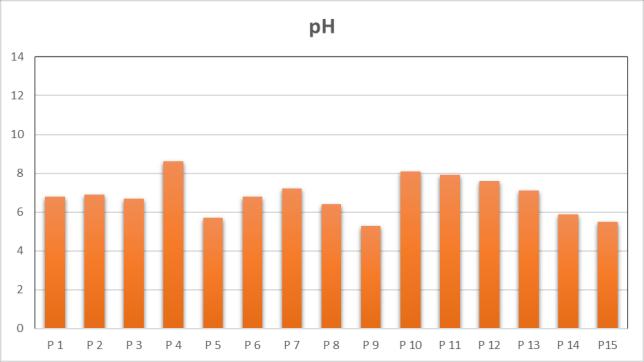
ThepHvaluesofthesoilinthePIAvariedfrom5.3to8.6, indicatingslightlyacidictomoderatelyalkalineconditions acrossthesamplinglocations.SuchelevatedpHvaluesare characteristicofindustrialenvironmentswherecontinued deposition of cement dust, ash residues lime-rich particulates,andalkalineindustrialeffluentsoccurs.Along withindustrialinputs,the basalticparentrockmaterialof theregionalsocontributestodistinctivesoilalkalinity.The observed variability in pH (CV ≈ 25%) suggests heterogeneous influence of industrial activities across different locations. High soil pH plays a crucial part in controlling heavy-metal behaviour by reducing solubility and leaching; however, it also promotes long-term metal holding within the soil matrix due to adsorption and precipitationmechanisms.Therefore,alkalineconditionsin Pithampur soils may act as a sink for heavy metals, facilitatinggradualaccumulationovertime.Thevariationof pHwiththelocationispresentedinthegivenfigure:
TheconcentrationsofCu,Ni,Cr,Pb,Mn,andZnmeasured acrossthe15samplinglocationsdemonstratednoticeable spatial variability, reflecting differences in industrial intensity, traffic density, and waste-handling practices withinthestudyarea.
:Heavymetalsdescriptivestatistics
Table-2:Analysisofheavymetalatdifferentlocations
International Research Journal of Engineering and Technology (IRJET) e-ISSN: 2395-0056
Volume: 13 Issue: 05 | May 2026 www.irjet.net p-ISSN: 2395-0072
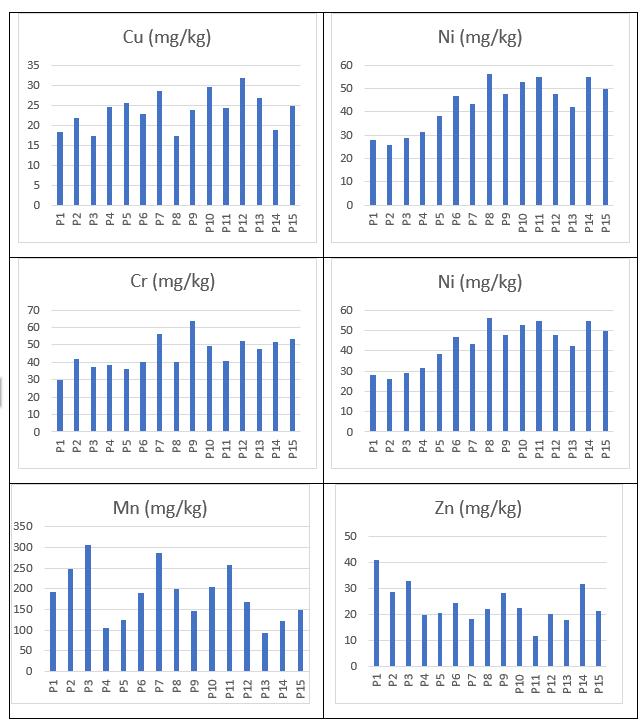
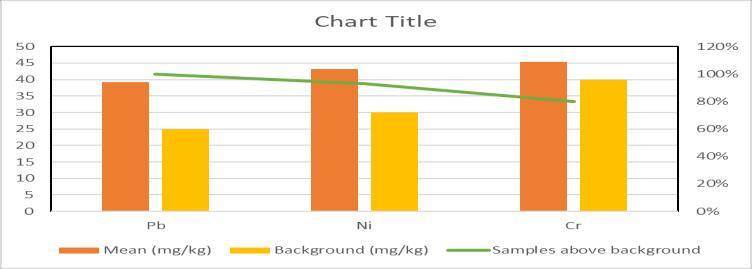
Fig- 2:Comparisonofheavymetalconcentrationinthe soilsamples
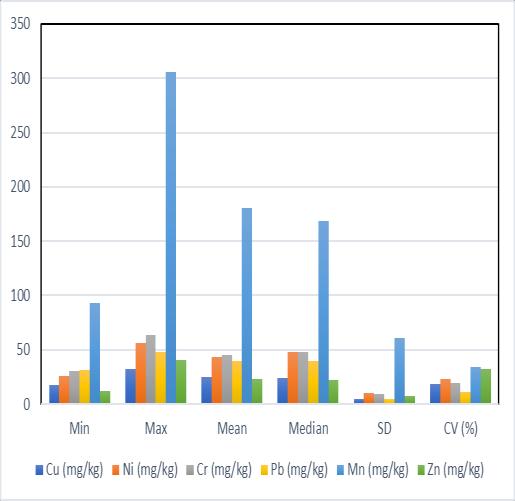
Fig-4:Descriptivestatisticsofheavymetals
Nickel,chromium,andleadshowedrelativelyelevatedmean concentrationscomparedtothetypicalnaturalbackground levels reported for uncontaminated soils. Similar observations have been widely reported in soils from industrialzoneswhereprolongedindustrialactivityleadsto gradualmetalaccumulation(Sharmaetal.,2007;Luoetal., 2012). TherelativelylowcoefficientsofvariationforPb,Ni, and Cr (≈11–23%) suggest widespread and consistent industrial influence, whereas Mn and Zn exhibit higher variability, indicating mixed lithogenic and anthropogenic origins.
Ni, Cr)
Becauseoftheirtoxicityandindustrialrelevance,Pb,Ni,and Cr were evaluated separately to assess anthropogenic enrichmentpatterns.
Table-3:Backgroundlevelsofthreetoxicmetals
All soil samples exhibited Pb concentrations exceeding natural background values, confirming substantial anthropogenicinput.Leadcontaminationinthestudyareais likely associated with vehicular emissions, industrial combustionprocesses,battery-relatedactivities,andpaint orpigmentusage.Nickelenrichmentwasobservedinnearly all samples, reflecting contributions from metal-plating units,alloyfabricationindustries,andmachiningactivities that dominate the Pithampur industrial zone. Chromium concentrations also exceeded background levels at most locations, suggesting inputs from electroplating, metal finishing,andchemicalprocessingindustries.Theconsistent enrichmentofthese toxic metalsconfirmsthatPithampur soilsareaffectedbyongoingindustrialcontaminationrather thanisolatedlocalinputs.
To examine relationships among various metals and recognizepossiblecommonsourcesthePearsoncorrelation analysis was applied . Strong positive correlations were observedbetweenNi–Cr(r=0.85),Pb–Cr(r=0.72),andPb–Ni (r = 0.68). These strong associations indicate a shared origin, most likely related to metallurgical operations, electroplating, engineering workshops, and industrial surfacecoatings.ModeratecorrelationsinvolvingCu,Zn,and Mnsuggestmixedsources,includingindustrial emissions, vehicularwear,lubricants,andnaturalsoilconstituents.The negativecorrelationbetweenpHandmostmetalsindicates that alkaline conditions reduce the immediate metal mobility. However, immobilization increasesthe potential forlong-termaccumulation,ratherthaneliminatingtherisk of contamination. The correlation heatmap visually
International Research Journal of Engineering and Technology (IRJET) e-ISSN: 2395-0056
Volume: 13 Issue: 05 | May 2026 www.irjet.net p-ISSN: 2395-0072
strengthenstheserelationshipsbyevidentlyclusteringNi, Cr,andPb,emphasizingtheircommonanthropogenicorigin.
Thecorrelationmatrixisgivenbelow:
Table-4:Correlationmatrixofheavymetals
CorrelationInterpretation
• ThestrongassociationofPb–Ni(0.68),Pb–Cr(0.72) and Ni–Cr (0.85) indicate a common industrial sourceofcontamination,probablymetal-finishing, electroplating, and engineering industries. The correlationsofCu–Pb,Mn–Cr,Zn–Pbacclaimmultisource contamination including vehicular emissions, and paint industries. The following correlation is represented in the givenfigure.
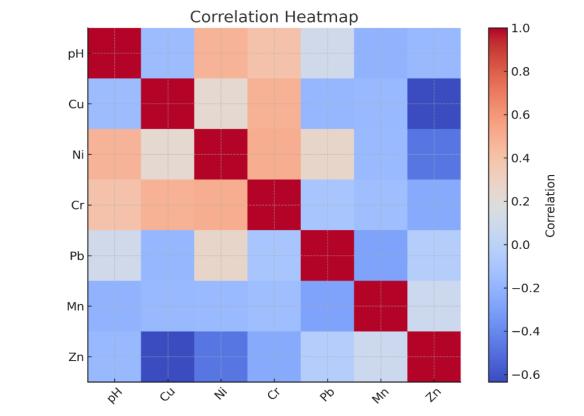
:Correlationheatmaps
3.5 Contamination Factor (CF) and Pollution Load Index (PLI)
ContaminationFactorvaluesprovideinsightintothedegree of anthropogenic enrichment relative to background
concentrations.Nickel,chromium,andleadshowCFvalues greater than 1, confirming moderate contamination of industrialsource.Incontrast,Cu,Mn,andZnshowlowerCF values,indicatingsecondaryormixedsources.Thecalculated Pollution Load Index (PLI = 0.60) indicates overall soil qualitydegradationduetoanthropogenicactivities.
Table-5:Contaminationfactorofheavymetals
Metal CF Contaminationlevel
Cu 0.81 Low Ni 1.44 Moderate Cr 1.13 Moderate Pb 1.57 Moderate–High
Mn 0.36 Low
Zn 0.33 Low
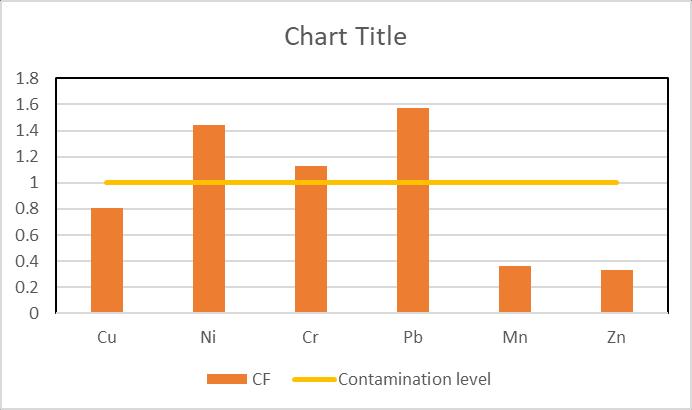
Fig-7:Contaminationfactorandcontaminationlevelof heavymetals
Although the PLI suggests that contamination is not yet severeataregionalscale,theelevatedCFvaluesandmetal enrichmentpatternsindicatesaprogressivecontamination trend,particularlyatspecifichigh-impactlocations.
Thecollectiveanalysisofdescriptivestatistics,toxicmetal enrichment, correlations, and pollution indices states that industrialactivitieshaveasignificantimpactonthesoilsof the PIA. The enrichment of lead (Pb), nickel (Ni), and chromium (Cr) above natural levels observed at most sampling sites indicates continuous industrial emissions rather than irregular pollution events.While the highly alkalinesoilsdecreasemetalmovement,theypromotetheir adsorptionandlong-termaccumulation,thusincreasingthe
International Research Journal of Engineering and Technology (IRJET) e-ISSN: 2395-0056
Volume: 13 Issue: 05 | May 2026 www.irjet.net p-ISSN: 2395-0072
riskofchronicsoildegradation.Overall,theresultsindicate that the soils of Pithampur are moderately contaminated with toxic metals. Therefore, continuous environmental monitoring,improvedemissionsmanagement,andstringent procedures for industrial waste disposal are essential to preventfurtherenvironmentaldegradation(Alloway,2013; Tchounwouetal.,2012).
This study demonstrates a comprehensive assessment of heavy metal contamination in the soils of PIA. The assessment is based on pH analyses, metal concentration measurements,quantitativecorrelations,andcontamination indicators.Thesoilexhibitsaslightlyacidictomoderately alkaline pH, influenced by both natural lithology and industrialemissions.Elevatedconcentrationsoflead,nickel, and chromium, exceeding reference values, confirm the presenceofanthropogenicsourcessuchasgalvanizing,road construction,steelmanufacturing,andchemicalprocesses. The strong correlations between the metals indicate the presence of common industrial sources, particularly for nickel,chromium,andlead.
Thecontaminationfactors(CF)suggestlowcontamination levels for these metals, while the impact of copper, manganese,andzincisminimal.Thisreflectstheinterplay between geogenic and industrial sources. Although the combinedpollutionindex(CPI)(0.60)indicatestheabsence ofseverepollution,environmentaldegradationisincreasing inthemostaffectedareas.Thisupwardtrend,coupledwith ongoingindustrialactivity,suggestsaprobableriskoflongterm accumulation if mitigation measures are not strengthened. Therefore, it is necessary to improve air quality management, implement an effective waste managementsystem,andregularlymonitorsoilqualityto preventfurtherdegradationinthePIA.
[1] Adelekan,B.A.,&Abegunde,K.D.(2011).Heavymetals contamination of soil and groundwater at automobile me chanic villages in Ibadan, Nigeria. International JournalofthePhysicalSciences,6(5),1045–1058.
[2] Alloway,B.J.(2013).Heavymetalsinsoils:Tracemetals andmetalloidsinsoilsandtheirbioavailability(3rded.). Springer.https://doi.org/10.1007/978-94-007-4470-7
[3] BureauofIndianStandards.(2000).Indianstandard Soilqualitystandardsforheavymetals(IS14767:2000). BIS,NewDelhi.
[4] Chen,H.,Lu,X.,Li,L.Y.,&Gao,T.(2014).Heavymetals in dust from urban, suburban and industrial areas of Shanghai,China:Spatialdistribution,sources,andhealth risks. Science of the Total Environment, 480, 12–22. https://doi.org/10.1016/j.scitotenv.2014.01.094
[5] Gupta, S., Nayek, S., Saha, R. N., & Satpati, S. (2008). Assessment of heavy metal accumulation in soil and plantsnearamunicipalsolidwastedumpingsite.Water,
Air, & Soil Pollution, 193, 123–134. https://doi.org/10.1007/s11270-008-9684-2
[6] Hakanson,L.(1980).Anecologicalriskindexforaquatic pollutioncontrol:Asedimentologicalapproach.Water Research, 14(8), 975–1001. https://doi.org/10.1016/0043-1354(80)90143-8
[7] Kabata-Pendias, A., & Mukherjee, A. B. (2007). Trace elements from soil to human. Springer. https://doi.org/10.1007/978-3-540-32714-1
[8] Kisku, G. C., Barman, S. C., & Bhargava, S. K. (2000). Contamination ofsoilandplantsirrigatedwithmixed industrial effluent. Water, Air, & Soil Pollution, 120, 121–137.https://doi.org/10.1023/A:1005292303149
[9] Krishna, A. K., & Govil, P. K. (2004). Heavy metal contamination of soil around Pali industrial area, Rajasthan,India.EnvironmentalGeology,47(1),38-44.
[10] Krishna, A. K., & Govil, P. K. (2004). Heavy metal contamination of soil around Pali industrial area, Rajasthan,India.EnvironmentalGeology,47(1),38-44.
[11] Li,F.,Liu,J.,Zeng,G.,Huang,X.,&Li,X.(2013).Spatial distribution and sources of heavy metals in soils of a typical industrial city, China. Environmental Earth Sciences, 68, 181–189. https://doi.org/10.1007/s12665-012-1727-2
[12] Luo, X. S., Yu, S., & Zhu, Y. G. (2012). Distribution and sourceanalysisoftraceelementsinurbansoilsofChina. Applied Geochemistry, 27(1), 86–94. https://doi.org/10.1016/j.apgeochem.2011.09.020
[13] Nagajyoti,P.C.,Lee,K.D.,&Sreekanth,T.V.M.(2010). Heavy metals, occurrence and toxicity for plants: A review.EnvironmentalChemistryLetters,8,199–216. https://doi.org/10.1007/s10311-010-0297-8
[14] Nriagu, J. O., & Pacyna, J. M. (1988). Quantitative assessment of worldwide contamination of air, water and soils by trace metals. Nature, 333, 134–139. https://doi.org/10.1038/333134a0
[15] Qin, Y., Chen, J., & Li, W. (2019). Evaluation of heavy metal pollution in soils of industrial areas using contaminationindices.EnvironmentalMonitoringand Assessment, 191, 1–14. https://doi.org/10.1007/s10661-019-7346-2
[16] Sahoo,P.K.,Kim,K.,Powell,M.A.,&Equeenuddin,S.M. (2016).Geochemicalassessmentofsoilcontamination duetominingactivities.EnvironmentalEarthSciences, 75,1–15.https://doi.org/10.1007/s12665-016-5494-2
[17] Velea, T., Gherghe, L., Predica, V., & Krebs, R. (2009). Heavy metal contamination in the vicinity of an industrialareanearBucharest.EnvironmentalScience andPollutionResearch,16(Suppl1),27-32.
[18] Sharma, R. K., Agrawal, M., & Marshall, F. M. (2007). Heavy metal contamination of soil and vegetables in urbanareasofIndia.EcotoxicologyandEnvironmental Safety, 66(2), 258–266. https://doi.org/10.1016/j.ecoenv.2005.11.007
[19] Sutherland,R.A.(2000).Bedsediment-associatedtrace metalsinanurbanstream.EnvironmentalGeology,39, 611–627.https://doi.org/10.1007/s002540050473
[20] Tchounwou,P.B.,Yedjou,C.G.,Patlolla,A.K.,&Sutton, D.J.(2012).Heavymetaltoxicityandtheenvironment. EXS, 101, 133–164. https://doi.org/10.1007/978-37643-8340-4_6
International Research Journal of Engineering and Technology (IRJET) e-ISSN: 2395-0056
Volume: 13 Issue: 05 | May 2026 www.irjet.net p-ISSN: 2395-0072
[21] United States Environmental Protection Agency (USEPA). (1996). Method 3050B: Acid digestion of sediments,sludges,andsoils.USEPA.
[22] United States Environmental Protection Agency (USEPA).(2002).Supplementalguidancefordeveloping soilscreeninglevels.USEPA.
[23] Wei, B., & Yang, L. (2010). A review of heavy metal contaminations in urban soils, road dusts and agricultural soils from China. Microchemical Journal, 94(2), 99–107. https://doi.org/10.1016/j.microc.2009.09.014
[24] Wu,S.,Xia,X.,Lin,C.,Chen,X.,Zhou,C.,&Liu,H.(2014). Distributionandaccumulationofheavymetalsinsoils. Environmental Earth Sciences, 72, 1–12. https://doi.org/10.1007/s12665-013-2848-3
[25] Zhang,C.(2006).Usingmultivariatestatisticalanalysis to identify pollution sources of heavy metals. Environmental Geology, 51, 443–450. https://doi.org/10.1007/s00254-006-0341-4
[26] Zhao, K., Fu, W., Ye, Z., & Zhang, C. (2015). Contaminationandspatialvariationofheavymetalsin agriculturalsoils.ScienceoftheTotalEnvironment,505, 728–734. https://doi.org/10.1016/j.scitotenv.2014.10.058
[27] Luo,W.,Lu,Y.,Giesy,J.P.,Wang,T.,Shi,Y.,Wang,G.,& Xing,Y.(2011).Effectsoflanduseonconcentrationsof metals in surface soils. Environmental capturing facilities: processes, challenges, and mitigations a review.Process Integration and Optimization for Sustainability,9(1),3-30.