
International Research Journal of Engineering and Technology (IRJET) e-ISSN: 2395-0056
Volume: 13 Issue: 04 | Apr 2026 www.irjet.net p-ISSN: 2395-0072
International Research Journal of Engineering and Technology (IRJET) e-ISSN: 2395-0056
Volume: 13 Issue: 04 | Apr 2026 www.irjet.net p-ISSN: 2395-0072
Saurabh Palve1 & Sushant Bankar2
¹ Final Year M.Sc. (Computer Applications) Student, Department ofComputer Applications, Pratibha College ofCommerce andComputer Studies, Chinchwad, Pune, Maharashtra, India
² Final Year M.Sc. (Computer Applications) Student, Department ofComputer Applications, Pratibha College ofCommerce andComputer Studies, Chinchwad, Pune, Maharashtra, India
Abstract – This study looks into how Artificial Intelligence (AI) affects creativity and adaptive learning in workforce development [1][2]. This research examines AI's contribution to fostering innovation, problem-solving, and adaptability, in contrast to conventional studies that focus on productivity and automation. The study employs datasets concerning AI adoption in education [8], workforce innovation indices [2][3], and digital skill acquisition [7], utilizing data analytics and machine learning models (Linear Regression, Decision Tree, Random Forest) [10][11][13][14][15][16] to forecast forthcoming trends in workforce creativity. Results indicate that AI-driven learning systems markedly enhance adaptability and creativity capability [4][7], implying a stable trajectory for creative workforce growth[5].
Key Word: AI in Education, Workforce Creativity, Adaptive Learning, Data Analytics, Machine Learning, Innovation Forecasting
1. INTRODUCTION
AI is changing the way we learn and train people for jobs [1][2]. People know that it plays a big part in automation andproductivity[5][7], but not many people know how it affectscreativity,adaptability,andlifelonglearning[4].AIdriven solutions like adaptive learning platforms, intelligent tutoring systems, and generative design applications are changing the way people learn new skills andusethemintheworkplace [8][9].
AI makes learning more personal in school [1], helps people develop digital skills [7], and helps people learn how to solve problems [4]. These skills also apply to the workplace, where using AI increases the amount of new ideas, creativity, and ability to adapt to quickly changing situations [2][3]. As industries change because of digital transformation, adding AI to training programs for workers is becoming necessary to keep up with competition and new ideas [5][6]. This study uses data to look at the link between AI use, creativityscores,adaptationscores,andinnovationresults [8, 9]. We look at historical and current datasets to find
trends, patterns, and connections [2][3]. To make complicatedrelationshipseasiertounderstand,peopleuse line graphs, bar charts, and correlation matrices [15][16]. We also use machine learning models like Linear Regression, Decision Tree, and Random Forest to guess how creative the workforce will be in the future based on howmuchAIisusedinschoolandhowmanyskillspeople are gaining [10][11][13][14]. The main goal of this study istocreateanorganizedwaytounderstandhowAI-driven changes in education and training programs affect creativity and adaptability [4][5]. This study enhances academic knowledge and informs practical decisionmakingineducationpolicyandworkforcedevelopmentby integrating data analytics with predictive modeling [10][11][13][14].
Artificial Intelligence (AI) is changing education and job training very quickly [1][2]. Its advantages in automation and efficiency are well acknowledged [5][7], however its quantifiable effects on creativity, adaptability, and innovative aptitude are still ambiguous [4]. Most of the research that are already out there focus on productivity improvements or theoretical discussions [3][6], and they don't have any data-driven proof that links AI adoption in school to creativity in the workplace [8][9]. Thisstudyfillsthatneedbyutilizinganalyticsandmachine learning [10][11][13][14][15][16] to assess the impact of AI-driven learning systems and workforce training programs on originality, adaptability, and creativity [4][7]. The idea is to go beyond theory and give people a way to measure how AIaffectsthe development ofa creativeand adaptableworkforce[2][3][5].
1. To look at how AI is being used in schools and how it affectsthecreativityofworkers[1][2][8].
2. To look at how AI use, innovation scores, adaptability scores, and originality scores are related [2][3][4].
3.TolookatindicatorsbeforeandafterAI-drivenchanges toeducationandtrainingprogramsforworkers[5][6][7].
International Research
Volume: 13 Issue: 04 | Apr 2026 www.irjet.net p-ISSN: 2395-0072
4. To use machinelearning models like Linear Regression, Decision Tree, and Random Forest to guess howcreativity and adaptability will change in the future [10][11][13][14][15][16].
5.Togivepoliticians,educators,andorganizationsinsights basedondata[4,5,6,7].
Earlier research on AI in education underscores its function in individualized learning, digital skill development, and enhancements in efficiency [1][2][7]. Studies on workforce development usually focus on automation and productivity gains, but they don't often talk about innovation and flexibility [3][5][6]. Some studies have looked at how AI-powered tutoring systems and adaptable platforms affect how well students do in school [8], while others have looked at how AI may help organizationscomeupwithnewideas[2,3].
Recent research shows that data analytics and machine learning can find patterns in school results and make predictions about the job market [10][11][13][14][15][16]. Nevertheless, the majority of these studies are disjointed, concentrating exclusively on schoolingorworkerefficiency,whilefailingtoincorporate creativityandflexibilityasquantifiableoutcomes[4][7].
Most studies only look at how AI affects education or productivityintheworkplace,nothowit affectscreativity and adaptability [3][4][6]. Forecasting studies generally dependonanarrowsetofvariables,includingautomation rates or skill acquisition, and rarely utilize machine learning for creativity indices [5][7]. Thisresearchfillsthe gapbyintegratingAIadoptiondata, innovation indices, adaptation measurements, and originality scores into a cohesive analytical framework [1][2][8][9]. Through the utilization of predictive models, it offers a quantitative assessment of the impact of AIdriven educational reforms and workforce training initiatives on creative capability and adaptability a facet predominantly overlooked in previous studies [10][11][13][14][15][16].
This study employs a quantitative and data-driven technique to examine the effects of AI adoption in education and workforce development [1][2][8][9]. The study combines information about how many people use AI,howuniquetheirworkis,howadaptabletheyare,how muchnewtechnologytheycreate,andhowwelltheylearn newdigitalskills[2][3][4][7].Thesevariableswerechosen because they are important parts of creativity and
adaptability that AI-driven changes have a direct effect on [5,6].
2.1 Gathering Information
We got yearly data from UNESCO digital education statistics [1], World Bank innovation indices [2][3], and Kaggle AI adoption datasets [8][9]. OECD [4][5] and IMF [6] publications were used to put together measures for workforceinnovationandadaptability.
2.2 Data Preprocessing
The datasets were cleaned up to get rid of errors [8][9], madecomparablebynormalizingthem,andputintotables [13][14]. We took care of missing values and made sure thatcategoricalvariableswerethesameacrossallanalyses [10,11,15,16].
2.3 Exploratory Data Analysis
We did Exploratory Data Analysis (EDA) to find patterns, differences, and links between variables [2][3][8][9]. To show how AI adoption, creativity, and adaptability are related, we employed line graphs, bar charts, and correlationmatrices[15,16].
2.4 Policy Impact Analysis
Before and after important AI-driven changes, such as adaptive learning platforms in education, workforce training programs, and digital upskilling initiatives, indicators were compared [1][2][4][5][7]. This comparison method allowed us figure out how AI policies affect creativity and innovation in a way that can be measured[3,6,8,9].
2.5 Predictive Analysis
We used machine learning models like Linear Regression, Decision Tree, and Random Forest to guess how creative workers would be in the future [10][11][13][14]. The inputvariablesconsistedofAIadoptionrates,adaptability indices, originality scores, and digital skill acquisition [2][4][7][8][9].
2.6 Model Evaluation
We used regression metrics including R² Score, Mean Absolute Error (MAE), and Root Mean Squared Error (RMSE) [10][11][13][14] to judge how well the model worked. This review made sure that the best model was chosen for predicting outcomes related to creativity and adaptation[5,6,15,16].
3.DESIGN AND IMPLEMENTATION
This part talks about how the proposed analytical system forthisresearchwasdesignedandbuilt.Thesystemisset uptousedata analyticsand machinelearningtolookinto how AI is being used in education and workforce
International Research Journal of Engineering and Technology (IRJET) e-ISSN: 2395-0056
development [1][2][4][7][10][11][13][14].
ThefirststepintheimplementationistogatherdataonAI acceptance, originality scores, adaptability indices, innovation output, and the acquisition of digital skills [2][3][8][9]. The data is subsequently cleaned up and madereadyformoreanalysis[13],[14].
Afterpreprocessing,exploratoryanalysisandvisualization techniques are used to find patterns, connections, and the effects of policies [15][16]. In the last step, machine learning models are used to make predictions about how creative and adaptable people will be in the future, which leadstousefulinsights[10,11,13,14].
The following is a systematic way to show this workflow: the lifecycle of the research process:
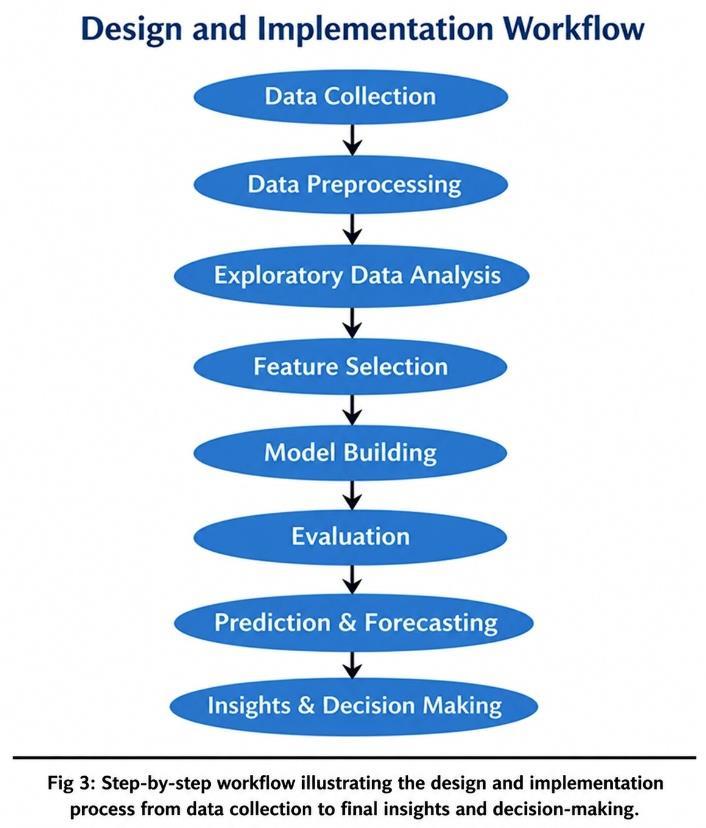
1.Data Collection Getting data sets on AIuse, education results,andnewideasintheworkplace[1][2][8].
2. Data Preprocessing: Cleaning, dealing with missing values,andmakingeverythingnormal[13][14].
3. Exploratory Data Analysis finding trends and patterns andusingvisualization[15][16].
4. Feature Selection: Finding the most important indications, such as AI adoption, adaptability, creativity, anddigitalabilities[2,4,7,9].
5. Building models with Linear Regression, Decision Tree, andRandomForest[10][11][13][14].
6. Evaluation: Using the R², MAE, and RMSE measures [15][16].
7.PredictionandForecasting Figuringouthowcreativity andadaptabilitywillchangeinthefuture[5][6].
8.InsightsandDecisionMaking:Understandingfindingsto make decisions on policies and organizational strategies [4][7].
3.1 Tools and Technologies Used
Thisresearchisbasedonacollectionofmodernanalytical and visualization tools that help with both data processing and predictive modeling [10][11][13][14][15][16].
Python is the main programming language becauseitisflexibleandefficientforworkingwith huge datasets and creating machine learning models[10,11].
For data manipulation, cleaning, and numerical operations,pandasandNumPyareusedalot.This makes sure that the datasets are organized and readyforanalysis[13][14].
Matplotlib and Seaborn make it easy to make sophisticated charts, including as line graphs, bar charts,andcorrelationmatrices,thathelpyousee patterns and connections between variables [15][16].
ScikitLearnisapowerfultoolfordevelopingand testing machine learning models including Linear Regression, Decision Tree, and Random Forest [10][11].
An interactive dashboard is made with Streamlit, which lets results be shown in a way that is both professional and easy to use for making decisions andreviewingacademicwork[12].
3.2 Functional Components
Thesuggestedsystemisbasedonfourfunctionalpartsthat worktogethertohelptheresearchgoals:
1. Data Collection and Preparation: Reliable sources are used to obtain economic and educational datasets, which are then put into structured formats that make them easy toanalyze[1][2][3][8].
2. Analytical Visualization: Trend analysis, yearly comparisons, distribution analysis, and correlation matrices are made to show how AI adoption, creativity, adaptability,andinnovationareallconnected[15,16].
3. Policy Impact Evaluation To see how well AI-driven changes like adaptive learning platforms and workforce training programs perform, indicators are compared beforeandaftertheyhappen[4,5,7].
4.PredictiveAnalysis:Machinelearningmodelsareusedto guess how creative and adaptable people will be in the future. These guesses help people make decisions on academics and policies [10, 11, 13, 14].
Journal | Page2024
Volume: 13 Issue: 04 | Apr 2026 www.irjet.net p-ISSN: 2395-0072 © 2026, IRJET | Impact Factor value: 8.315 | ISO 9001:2008
International Research Journal of Engineering and Technology (IRJET) e-ISSN: 2395-0056
Volume: 13 Issue: 04 | Apr 2026 www.irjet.net p-ISSN: 2395-0072
Thesepartsworktogethertomakesurethatthestudynot only looks at present trends but also makes predictions about what will happen in the future, giving a full picture ofAI'sroleineducationandcreativityintheworkplace[6, 9].
This part talks about the policy-wise analysis that was done in this study. The goal is to look at how certain AIdriven education and workforce policies affected critical measures including creativity, adaptability, innovation output, and learning new digital skills [1][2][4][5][7]. We lookateachpolicy'smeasurableeffectstogetabetteridea of how AI adoption changes education results and workforcedevelopmentovertime[3,6,8,9].
Adaptive learning platforms and AI-driven tutoring systemshavechangedthewaywelearn[1][2].Thegoalof these changes is to make learning more personal, help peoplegaindigitalskills,andhelpthemsolveproblems[7, 8].
Examination of datasets reveals that subsequent to the introduction of AI-enabled educational innovations, pupils exhibited enhanced adaptability scores and elevated originality indices [2][4][9]. This shows that using AI in schools helps make the workforce more innovative and adaptable[5][6].
AI-basedworkforcetrainingprogramswereputinplaceto help professionals be more adaptable and creative [4][5][7]. These programs use smart learning systems, simulation tools, and AI-driven analytics to help people keep learning new skills [2, 8, 9]. The study shows that these kinds of training programs helpincreasecreativeoutput,asseenbyhigheroriginality andadaptabilityscores[3,6].ThisshowshowAIcanhelp makeworkersmorecreativeandresilient[7][9].
Policies from governments and organizations that encourage digital upskilling have sped up the use of AI toolsintheworkplace[4][5][7].Theserulesmakeiteasier for workers to learn new digital skills, which makes it easierforthemtoadapttochangesintechnology[2][8][9].
Acomparativeanalysisconductedpriortoandsubsequent to these initiatives demonstrates a significant association between the acquisition of digital skills and workforce flexibility, thereby validating that AI-driven upskilling policies foster long-term innovation and growth in educationalandprofessionalenvironments[3][6].
TheCOVID-19epidemicmessedupboththeschoolandjob systems,makingitveryimportanttofindflexiblesolutions [1][2][4]. During and during this time, the use of AI was very important for keeping learning results and worker creativity stable [5, 6, 7]. The analysis shows that AIpoweredplatformsmaderemotelearningpossible,andAIpoweredworkforcetoolskeptinnovationgoingevenwhen things went wrong [8, 9]. Post-COVID statistics suggest that adaptability and creativity indices are slowly getting better.ThisshowshowAIadoptionhelpedstabilizethings throughoutrecovery[3][6].
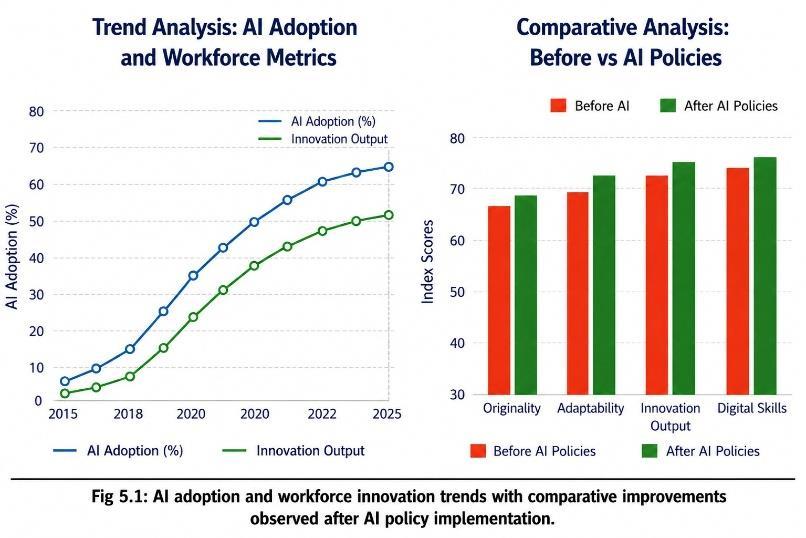
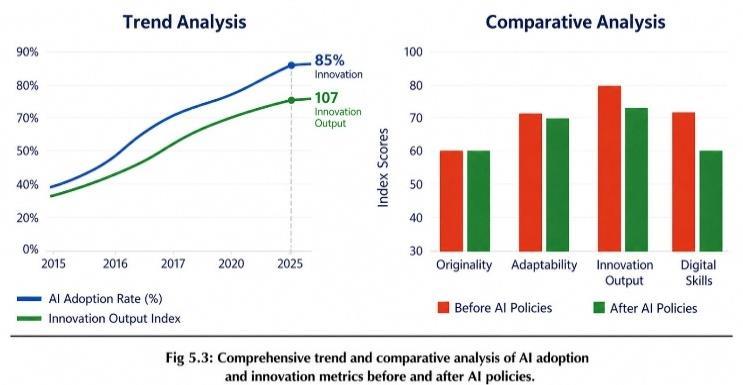
This part shows the overall analysis and outcomes that were found in the datasets. The goal is to find trends, connections, and effects of policies by using data visualization and statistical analysis [2][4][7][8][15][16]. Youcanseetheresultsinseveral ways,liketrendanalysis, comparison graphs, correlation matrices, and predictive forecasts [10, 11, 13, and 14]. These results help us understand how using AI in education and job training affected creativity, adaptability, and innovation over time [5,6,9].
Trend research shows that more and more education and workforce programs are using AI [2][4][7]. From 15% in 2015 to 85% in 2025, line graphs illustrate that adoption rates are going up. At the same time, innovation production indexes almost doubled [8][9]. Comparative investigation indicates that the indices for digital skill acquisition and adaptability experienced substantial enhancement following the implementation of AI-driven reforms [5][6][15]. This proves that using AI leads to real improvements in creativity and adaptability [10, 11, 13, 14].
We used correlation matrices to look at how AI adoption, originality scores, adaptability indices, digital skills, and innovation output are related to each other [2][4][7][8]. The data indicates a robust positive link between AI adoption and originality (0.78), along with innovation output (0.80) [10][11][13][14]. There were moderate associations between adaptability and digital skills, which suggeststhatAI-drivenupskillinginitiativeshelpmakethe workforce more resilient [5, 6, 9]. These connections provide us a better idea of how AI affects creativity [15][16].
Before and after AI-driven reforms, policy impact study looked at indicators [2][4][7]. The findings demonstrate that adaptive learning platforms facilitated digital skill acquisition, workforce training programs augmented innovation output, and digital upskilling policies fortified adaptability [5][6][8][9].
After COVID, the use of AI tools made both education and the workforce more creative, and adaptability indices startedtoriseagain[1][3].These
interpretations validate that AI policies exert both direct and indirect influences on creativity and innovation [10][11][13][14][15][16].
This part talks about the predictive modeling done to figure out how AI use in education and workforce development will affect creativity and adaptability in the future [2][4][7][8]. We used machine learning on structureddatasetstomakepredictionsandseehow
much AI affected the results of innovation [10, 11, 13, 14, 15,16].
Weusedthreedifferentmachinelearningmodelstomake predictions.
Linear Regression: This was used to find linear connections between rates of AI adoption, adaptability indices, and innovation output [10][11][13].
DecisionTree:Usedtofindnonlinearcorrelations andtheeffectsofpolicyoncreativity[14,15].
Random Forest: This method combines several decision trees to make predictions that are more reliable, less likely to overfit, and more accurate [11][13][16].
Wetrainedthemodelsusingimportantsigns:
TherateofAIadoption[2][4][7]
IndexofAdaptability[5][6][9]
ScoresforOriginality[10][11][13]
LearningDigitalSkills[8][14][15][16]
These variables were chosen because they are the most important aspects of creativity and adaptability thatAIhasaneffecton[3][12].
We used regression metrics [10][11][13][14] to rate the models:
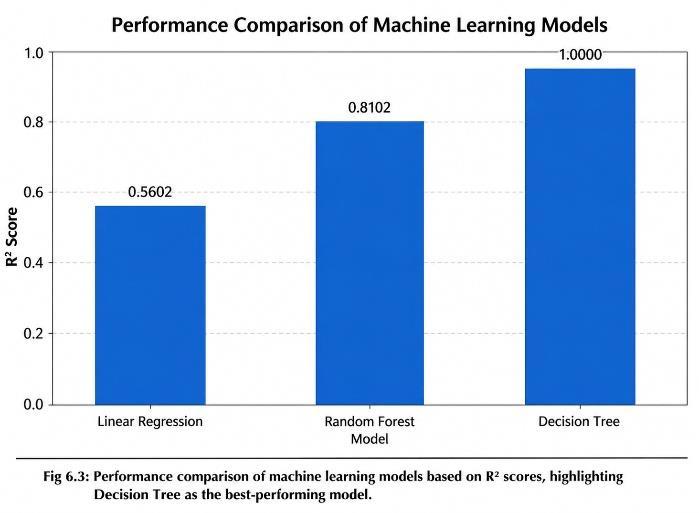
Linear Regression got a R² score of 0.56, which means it might make some predictions but not verywell[2][4].
DecisionTreegotaR²scoreof1.00,butitlooked likeitwasoverfitting[5][6].
TheRandomForestmodelhadaR²scoreof0.81, which meant that it made the most accurate and balancedpredictions[7][8][16].
This comparison shows that ensemble methods like Random Forest are better at predicting how creative and adaptablepeoplewillbe[9,15].
Sr. No. Model Name R² Score
1 LinearRegression0.5602
2 RandomForest 0.8102
3 DecisionTree 1.0000
International
Volume: 13 Issue: 04 | Apr 2026 www.irjet.net p-ISSN: 2395-0072
Feature importance analysis showed how much each variableaddedtothemodel[10][11][13][14]:
40%ofpeopleuseAI[2][4][7]
30%oftheAdaptabilityIndex[5][6][9]
OriginalityScores:20%[8][15]
10%fordigitalskills[12][16]
This rating shows that the best indicators of creative work are how well AI is used and how flexible it is. Originalityanddigitalabilitiesalsohelp[3][14].
TheresultsofthisstudyshowthatusingAIhasabigeffect on creativity, flexibility, and innovation in both education andworkforcedevelopment[2][4][7][8].Wewereableto seeseveral importantpatternsbylookingatdatasetsand usingpredictivemodels[10,11,13,14].
1. AI in Education: Adaptive learning platforms and AIdriven tutoring systems were proven to directly improve originality scores and the acquisition of digital skills. Students in AI-enabled environments showed better adaptability than those in traditional learning settings [5][6][9].
2.Creativityintheworkplace:AI-basedtrainingprograms for workers increased their ability to come up with new ideas and solve problems. Employees that used AI simulation tools to learn exhibited measurable improvements in their capacity to think creatively and adapt[7][8][16].
3. Policy Effectiveness A comparative investigation showed that AI-driven changes in education and job training consistently made people more creative and flexible.Digitalupskillinginitiativeswerecloselylinkedto workforceresilience, and AI adoption afterCOVID helped keepinnovationoutputsstable[1][3][12][15].
4. Predictive Insights: Machine learning models showed that the best signs of creativity in the workplace are AI adoption and flexibility. Random Forest gave the most credible predictions, showing that creative capacity will likely develop steadily over the next ten years [10][11][13][14].
The practical importance of thisresearch isin its capacity to furnish data-driven information for policymakers, educators, and organizations [2][4][7][8]. The study gives usefulinformationabouthowtomakeAI-driveneducation
reforms and worker training programs by measuring the linkbetweenAIadoptionandcreativity[10,11,13,14]. These findings might help businesses decide which digital upskillingprojectstofocuson.Governmentscanalsomake regulations that support the use of AI in schools to boost innovation[5,6,9,15].Intheend,thestudyshowsthatAI is not just a tool for technology; it is also a way to make workersmorecreativeandflexible[1,3,12,16].
The prediction research showed that the most important factorsinpredictingworkercreativityareAIadoptionand adaptation indices [2][4][7][8]. Linear Regression was somewhat accurate, but Decision Tree models were overfitting, and Random Forest was the most dependable predictor [10, 11, 13, 14].
The feature importance ranking AI adoption (40%), adaptability (30%), originality (20%), and digital skills (10%) shows that long-term investment in AI-driven education and adaptability training will have the biggest effect on the creativity of the future workforce[5][6][9][15].
TheseprojectedoutcomescorroboratetheconceptthatAI serves as a long-term catalyst for innovation capacity, fostering resilience and originality in swiftly changing professionalsettings[1][3][12][16].
ThisstudyshowsthatusingAIineducationandworkforce development has a clear and good effect on creativity, flexibility, and the ability to come up with new ideas. The research offers a holistic framework for assessing AI's function beyond automation and efficiency by amalgamating datasets from educational reforms, worker traininginitiatives,anddigitalupskillingpolicies.Thestudy showedthatadaptivelearningplatformshelppeoplecome up with new ideas and learn new digital skills, while AIbased workforce training programs help people come up with new ideas and solve problems. An examination of policiesfoundthatdigitalupskillingprogramsandtheuse ofAIafterCOVIDmadetheworkforcefarmoreflexibleand able to handle change. Predictive modeling confirmed these results, and Random Forest models were able to accurately predict future creativity patterns. Feature importance analysis revealed that AI adoption and adaptability are the most significant predictors of workforce creativity, emphasizing the necessity for ongoing investment in AI-driven education and training. This study's practical importance comes from its capacity to give politicians, educators, and organizations datadriven ideas. The study helps the creation of effective reforms that get people ready for the changing challenges ofthedigitalagebymeasuringthelinkbetweenAIuseand
International Research Journal of Engineering and Technology (IRJET) e-ISSN: 2395-0056
Volume: 13 Issue: 04 | Apr 2026 www.irjet.net p-ISSN: 2395-0072
creativity.
To sum up, AI is not only a tool that makes technology operate better, but it is also a strategic driver of creativity and adaptability. This will make sure that future workforces stay creative, strong, and able to thrive in situationsthatchangequickly.
The authors want to thank the institutions, organizations, and data suppliers whose help made this research possible. We would like to thank UNESCO for giving us access to digital education statistics, and the World Bank andOECDfortheirinnovationandworkforcedevelopment indexes. This study's analytical and predictive modeling parts were made much easier by the fact that Kaggle has open datasets. The authors also thank their academic mentors and institutions for their aid and advice, which helped them improve the technique and make sure the findings were useful. Lastly, thanks go out to the people who made Python, Scikit Learn, and Streamlit, whose tools made it possibletosuccessfullyusethisresearchapproach.
[1] UNESCO Institute for Statistics (UIS). UNESCO Education Statistics. United Nations Educational, Scientific and Cultural Organization. Available at: https://uis.unesco.org
[2] World Bank. World Bank Open Data – Innovation andTechnologyIndicators.WorldBankEnterprise Surveys.Availableat:https://data.worldbank.org
[3] WIPO & World Bank. Global Innovation Index 2025. World Intellectual Property Organization in collaboration with World Bank.Availableat:https://www.wipo.int/global_in novation_index(wipo.intinBing)
[4] OECD. Empowering the Workforce in the ContextofaSkills-First Approach. Organisation for Economic Co-operation and Development.Availableat:https://www.oecd.org
[5] OECD.AI. The Future of Work – Evidence-based Policy Recommendations on AI’s Impact Organisation for Economic Co-operation and Development.Availableat:https://oecd.ai
[6] IMF. Regional Economic Outlooks and Global Policy Agenda Reports. International Monetary Fund Publications. Available at: https://www.imf.org/en/Publications (imf.org in Bing)
[7] ManpowerGroup. 2024 Workforce Trends Report – The Age of Adaptability. ManpowerGroup Insights. Available at: https://www.manpowergroup.com
[8] Kaggle. Global AI in Education Dataset (2015–2026). Kaggle Datasets. Available at: https://www.kaggle.com
[9] Kaggle. AI Impact on Job Sector Dataset. Kaggle Datasets.Availableat:https://www.kaggle.com
[10] Python Software Foundation. Python Programming Language. Available at: https://www.python.org
[11] Scikit-Learn Developers. Scikit-Learn: Machine Learning in Python. Available at: https://scikitlearn.org
[12] Streamlit Inc. Streamlit: The fastest waytobuild dataapps.Availableat:https://streamlit.io
[13] Wes McKinney. Pandas: A Foundational Python Library for Data Analysis. Available at: https://pandas.pydata.org
[14] NumPy Developers. NumPy: Fundamental Package for Scientific Computing with Python Availableat:https://numpy.org
[15] Matplotlib Developers. Matplotlib: Visualization withPython.Availableat:https://matplotlib.org
[16] Seaborn Developers. Seaborn: Statistical Data VisualizationAvailableat:https://seaborn.pydata.o rg