
International Research Journal of Engineering and Technology (IRJET) e-ISSN: 2395-0056
Volume: 13 Issue: 05 | May 2026 www.irjet.net p-ISSN: 2395-0072
ARDUINO BASED FIRE DETECTION WITH GSM ALERT USING ML
P.Sindhu Priya1 , K.Pushpa2 , CH.R.Dhana Sri3 , M.B.M.S Gupta4, P.J Mahesh Babu5
K.Nagaraju6
12345B.Tech Students, 6Assistant Professor, Department of Electronics and Communication Engineering, Sri Vasavi Engineering College, Tadepalligudem, Andhra Pradesh, India
Abstract - Fire accidents can cause damage to life and property, especially in forest areas, homes, industries, and public areas Detecting fire at an early stage is very crucial to reduce risks and take timely action. In this project, a fire detection system is developed using multiple sensors based on ARDUINO UNO. The system continuouslymonitorstemperature,gaslevels,andflame presence to identify fire conditions. To improve the decision-making process, simple logic inspired by decision tree algorithms is used in machine learning, allowing the system to evaluate sensor data and determine the likelihood of a fire based on predefined thresholds. When a fire is detected, the system immediately activates a buzzer and sends an alert message using the GSM module. The proposed system is simple, cost-effective, and suitable for real-time fire safety applications.
Key Words: Fire detection, ARDUINO, sensors, machine learning, decision tree algorithm, and GSM module.
1. INTRODUCTION
Fire accidents are one of the most common hazards thatcanleadtoseveredamageandlossoflife.Inmany cases,thedamagebecomesworsebecausethefireis notdetectedearly.Traditionalfiredetectionsystems usuallydependonfixedlimits,suchastemperatureor smokelevels.Thesesystemsusuallydependonfixed limits, such as temperature and smoke levels. These systems may sometimes give false alarms or fail to detectfireintheearlystages.Withthehelpofmodern embedded systems, it is possible to design more reliablesolutions.Inthisproject,asystemisdeveloped usingamicrocontrollerbasedonARDUINOUNOalong with multiple sensors. By combining data from differentsensorsandapplyingsimplelogicinspiredby machine learning, the system can identify fire conditionsmoreaccuratelyandrespondquickly.
2. LITERATURE REVIEW
Many fire detection systems have been developed using sensors such as smoke detectors and temperaturesensors.Whilethesesystemsareuseful,
theyoftenrelyonasingleparameter,whichcanleadto incorrect results in some situations. Some recent systems use internet-based technologies to monitor fire conditions remotely. However, these systems depend on stable network connections. Machine learning-basedsystemshavealsobeenintroducedto improveaccuracyandreducefalsealarms,buttheycan be complex and expensive. This projectfocuses on a simpleandpracticalapproachbycombiningmultiple sensors with basic intelligent logic to improve reliabilitywithoutincreasingcomplexity
Recentadvancementsinfiredetectionsystemsfocus onimprovingearlydetection,accuracy,andreal-time alertmechanisms.Sharmaetal[1]developedaGSMbased fire alert using ARDUINO to send SMS notificationsduringfireaccidents.CHINCHMALATPURE et al. [2] proposed an IOT-based system integrating multiplesensorsforreal-timemonitoringandcontrol. Additionally, UMOH et al. [3] introduced an ml approach using SVM to reduce false alarms. More recentstudies use IOT and deep learningtechniques for efficient fire detection.AI-based models such as convolutionalneuralnetworks(CNN)andYOLOhave shownhigh accuracy indetectingfire smoke inrealtime environments [4], [5]. Overall, existing systems demonstrateimprovedperformance.
3. PROBLEM STATEMENT
Existing fire detection systems may not always be monitoring accurate values because they depend on fixedthresholdvalues.Thiscanleadtofalsealarmsor todetectingfiretoolate.Inaddition,someadvanced systemsrequireinternetconnectivity,whichmaynot alwaysbeavailableontheinternet.Therefore,thereis aneedforareliable,low-costsystemthatcandetect fireaccuratelyandworkindependently.
4. OBJECTIVES OF THIS PROJECT
*Todetectfireatanearlystage
*Toreducefalsealarms
*Toimproveaccuracy
International Research Journal of Engineering and Technology (IRJET) e-ISSN: 2395-0056
Volume: 13 Issue: 05 | May 2026 www.irjet.net p-ISSN: 2395-0072
5. PROPOSED SYSTEM
Theproposedsystemfocusesondevelopingasimple and efficient fire detection solution using a combinationofsensorsandamicrocontroller.Unlike traditional systems that depend on fixed threshold values, this system uses multiple sensors and intelligent decision logic to improve detection accuracy. In this system, a flame sensor and temperature sensor are connected to the ARDUINO UNO.Thesesensorscontinuouslymonitorenvironment conditions such as heat, smoke, and flame presence. Thecollecteddataisprocessedbythemicrocontroller toidentifyabnormalsituations.Toenhancedecisionmaking, a machine learning model is trained using sensordatacollectedunderdifferentconditions.The model generates decision rules that help in distinguishing between fire and non-fire scenarios. These rules are then implemented in the ARDUINO program.Whenafireconditionisdetected,thesystem activatesabuzzerandLEDforimmediatealert.Atthe sametime,aGSMmodulesendsanSMSnotificationto apredefinedmobilenumber.Thisensuresbothlocal andremotealerting.Thesystemisdesignedtobelowcast, reliable, and suitable for areas where internet connectivityisnotavailable.
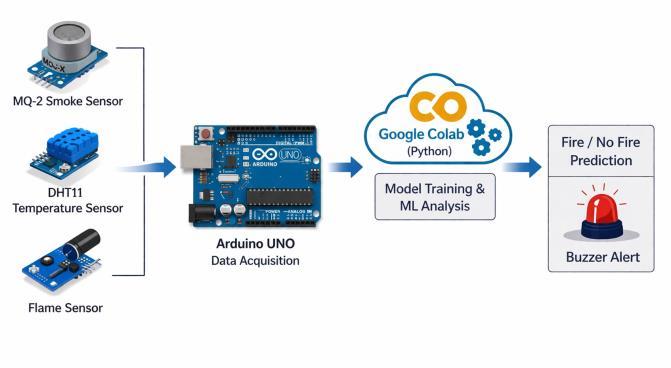
6. SYSTEM ARCHITECTURE
Thesystemconsistsofthreemainparts:sensingunit, processing unit, and alert unit. The sensors collect environmentaldataandsendittothemicrocontroller.
The microcontroller processes the data and decides whetherafireconditionexists.Ifafireisdetected,the alertunitactivatesabuzzerandsendsamessagetothe user.
7.
METHODOLOGY
The system follows a step-by-step approach for fire detection. First, sensors are used to collect environmental data such as temperature, gas levels, and flame presence. This data is continuously
monitoredbytheARDUINO.Next,thecollecteddatais used to train a machine learning model. The model learns patterns that represent fire and normal conditions. After training, the decision rules are extracted and implemented in the ARDUINO code. During real-time operation, the ARDUINO compares sensor values with these rules. If the conditions indicatefire,thesystemactivatesalertsusingabuzzer andGSMmodule.Otherwise,itcontinuesmonitoring. This approach improved accuracy and reduced false alarmswhilekeepingthesystemsimpleandefficient.
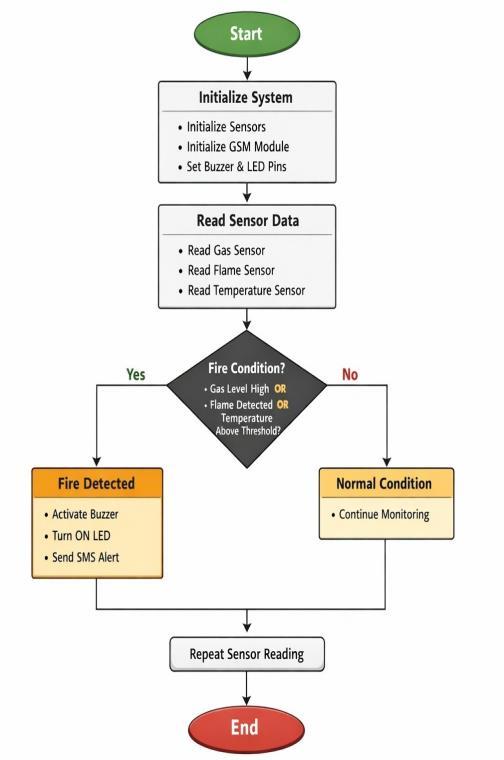
8. FLOWCHART
The flowchart explains the working process of the system. It starts with initializing the system and sensors. Then, thesystemcontinuouslyreadssensor valuesandchecksthemagainstpredefinedconditions. Ifafireconditionisdetected,thesystemactivatesthe buzzerandLEDandsendsanalertmessagetomobile through the GSM module. Otherwise, it continues monitoring.
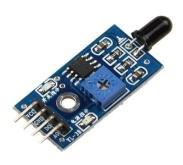
9. HARDWARE REQUIREMENTS




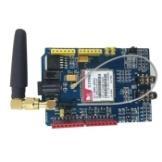





10. SOFTWARE REQUIREMENTS
1.ArduinoIDE
-Used to program Arduino NANO -Readssensordataandcontrolsbuzzer,LED,andGSM
2.Google ColabusingPython
-Used to train decision tree ML model -Processes collected sensor data -Usedfordataprocessing&MLimplementation
11. IMPLEMENTATION
Thefire detection systemis implemented using an Arduino Nano and multiple sensors to detect fire conditions effectively.Inthis project, a flamesensor, gassensor(MQ-2),andtemperaturesensor(DHT11) areusedtomonitortheenvironment.
First,allthecomponentsareconnectedproperly.The sensorsareconnectedtotheinputpinsoftheArduino, whilethebuzzerandLEDareconnectedtotheoutput pins. The GSM module is connected using serial communicationtosendalertmessages.
After completing the hardware connections, the Arduino is programmed using the Arduino IDE. The program is written to read data from all sensors continuously. The sensor values are checked using certainconditionstoidentifyfiresituations. Asimplelogicbasedonmachinelearningisusedinthis project.Thedecisiontreemodelistrainedseparately, and its rules are converted into conditions in the Arduinoprogram.Forexample,ifthetemperatureis high and gas is detected or if a flame is present, the systemidentifiesitasafirecondition.
Whenafireisdetected,thebuzzerstartsringingand theLEDturnsontogiveanalert.Atthesametime,the GSMmodulesendsawarningmessagetoapredefined mobilenumber.
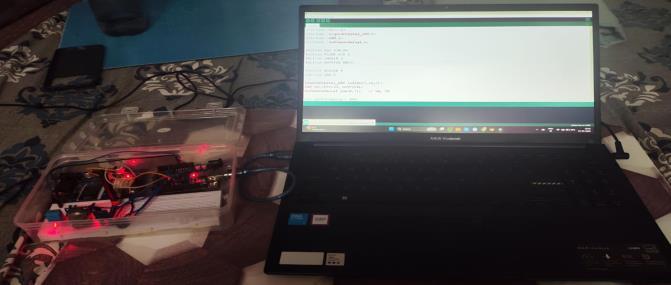
The system continuously monitors the environment andresponds quicklywhenabnormalconditionsare detected.The project is tested under different conditions,anditworksproperlybydetectingfireand sendingalertswithoutdelay.
12. RESULTS AND DISCUSSION
Theproposedfiredetectionsystemwassuccessfully implemented using both hardware components and software techniques. The system was tested under differentconditionstoverifyitsperformance.During testing,undernormalconditions,thesystemdisplayed asafestatus,andnoalertwasgenerated.
International Research Journal of Engineering and Technology (IRJET) e-ISSN: 2395-0056
Volume: 13 Issue: 05 | May 2026 www.irjet.net p-ISSN: 2395-0072
Data Set:
When fire conditions were simulated by increasing temperature,introducinggas,ordetectingflame,the system responded immediately. The LED indicator turnedon,andthebuzzerproducedanalarmsound.At thesametime,theGSMmodulesentanalertmessage to the registered mobile number. The LCD also displayedafirewarningmessage.Thesoftwaremodel wastestedusingadatasetof15samples.Thedecision treealgorithmcorrectlyclassifiedallsamplesintofire and non-fire conditions. The system achieved an accuracyof100%,indicatingcorrectpredictionforall testinputs.Forexample,whentheinputvalueswere gas=800,temperature=54centigrade,andflame=0,the systemsuccessfullypredictedFIREDETECTED.
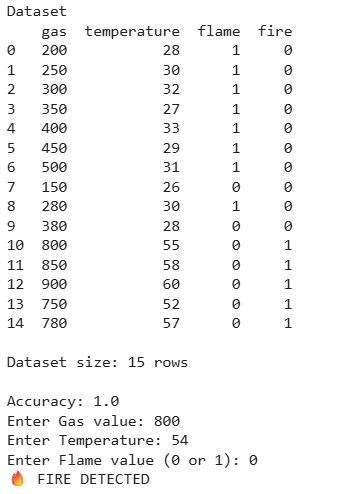
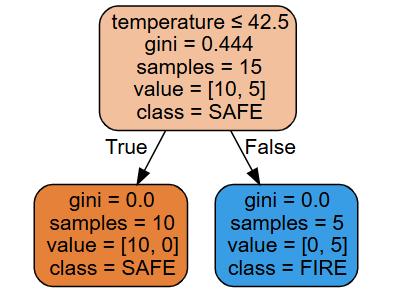
Accuracy Calculation:
Accuracy=(TP+TN)/(TP+TN+FP+FN)
Fire(1) -Positiveclass
Non-fire(0)-Negativeclass
FromDatasethave15samples:
Non-fire(0)samples=10
Fire(1)samples=5
*TP(TruePositive)=5
-firecorrectlydetected
*TN(TrueNegative)=10
-safeconditioncorrectlydetected
*FP(FalsePositive)=0
-Nofalsealarms
*FN(FalseNegative)=0
-Nofiremissed
CONFUSION MATRIX TABLE:
Accuracy=(TP+TN)/(TP+TN+FP+FN)
Accuracy=(5=10)/(5+10+0+0)
Accuracy=15/15=1.0
International Research Journal of Engineering and Technology (IRJET) e-ISSN: 2395-0056
Volume: 13 Issue: 05 | May 2026 www.irjet.net p-ISSN: 2395-0072
DISCUSSION:
Theresultsshowthatthesystemperformsefficiently indetectingfireconditions.Theuseofmultiplesensors improves reliability compared to single-sensor systems.
The decision tree model helps in making better decisionsaboutsensorvalues.Itissimpleandsuitable for implementation in Arduino, as it uses rule-based logicinsteadofcomplexcomputations.
The system provides fast responses and real-time alertsthroughabuzzer,LED,andGSMcommunication. However, the accuracy is calculated using a small dataset, so performance may vary in real-world conditions.
Overall,thesystemiseffective,low-cost,andsuitable forpracticalfiredetectionapplications.
13. CONCLUSION
Inthisproject,afiredetectionsystemwasdeveloped usingARDUINOUNOalongwithgas,temperature,and flamesensors.Thesystemisdesignedtocontinuously observe environmental conditions and identify possiblefiresituationsatanearlystage.
To improve the decision-making process, a simple machinelearningtechnique(decisiontree)wasused. Therulesobtainedfromthemodelwereappliedinthe ARDUINOprogram,whichhelpedthesystemtomake more accurate decisions based on multiple sensor inputs.Duringtesting,thesystemrespondedquickly whenever abnormal conditions were created. The buzzerandLEDprovidedimmediatelocalalerts,and theGSMmodulesuccessfullysentwarningmessagesto theuser.Thesystemwasabletodetectfireconditions correctly without unnecessary alerts in normal situations. Overall, this project demonstrates a practical, cost-effective approach to fire detection. It can be used in different environments to improve safetyandreducetheriskoffire-relateddamage.
REFERENCE
1. IJARIIE-ISSN(0)-2395-4396
2. A.Sharma,R.Gupta,andS.Verma,”GSMBased Fire Alert System Using ARDUINO , ” International journalofEngineeringResearch andTechnology(IJERT),vol.10,no.5,pp.123126,2022.
3. S.CHINCHMALATPURE,A.SAGAR,andR.LOHE “ IoT-based smart fire detection and control system using GSM module”, International
Journal for Research in Applied Science and EngineeringTechnology(IJRASCT),vol.11,no. 3,pp.456-460,2023.
4. U.UMOH,E.UDO,andN.EMMANUEL,”support vectormachine-basedfireoutbreaksystem,”in proc.int.conf.Computingandcommunication systems,2019,pp.1-5
5. K.Sathish Kumar, R. Priya and M. Karthik, “Wireless Sensor Network Based Fire Monitoring System,” International Journal of Advanced Research in Electrical and ElectronicsandInstrumentationEngineering(IJA REE),vol.5,no.4,pp.3021-3026,2016