
International Research Journal of Engineering and Technology (IRJET) e-ISSN: 2395-0056
Volume: 13 Issue: 05 | May 2026 www.irjet.net p-ISSN: 2395-0072

International Research Journal of Engineering and Technology (IRJET) e-ISSN: 2395-0056
Volume: 13 Issue: 05 | May 2026 www.irjet.net p-ISSN: 2395-0072
Sahanashree G
Department of Computer Science & Applications, SBRR Mahajana First Grade College(A)
Abstract - The proliferation of distributed enterprise architectures and cloud-native application delivery has fundamentally destabilised the security perimeter that traditional Wide Area Network (WAN) designs presuppose. Software-DefinedWideAreaNetworking(SD-WAN)addresses connectivity fragmentation effectively yet introduces a discrete security gap: its architecture decouples traffic steering intelligence from security enforcement, leaving enforcement to disparate, on-premises appliance stacks illsuited to the dynamism of multi-cloud environments. Secure AccessServiceEdge(SASE)remediesthisstructuraldeficiency byconvergingNetwork-as-a-Service(NaaS)andSecurity-as-aService (SECaaS) capabilities into a unified, cloud-delivered framework. This paper presents a theoretical framework termedArchitecturalSymbiosis thatmodelstheintegration mechanisms,policycoherenceconditions,andidentity-centric enforcement planes required for a functionally indivisible SASE-enabled SD-WAN fabric. Drawing on control-plane abstraction theory, zero-trust principles, and cloud-native service composition, the framework articulates conditions underwhichconvergenceyieldsemergentresilienceproperties inaccessible to either discipline in isolation. Formal propositions, architectural mappings, and a gap taxonomy derivedfromextantliteraturegroundthetheoreticalclaimsin verifiable constructs. The work contributes a rigorous analytical vocabulary and a set of design axioms intended to guide researchers formalising SASE integration and practitioners architecting production deployments.
KeyWords:SD-WAN,SASE,zero-trustarchitecture,cloudnative security, network convergence, control-plane abstraction, security service edge.
Theenterprisenetworkhasundergonesustainedstructural transformationoverthe pastdecade. The displacement of monolithic, data-centre-anchored topologies by hybrid multi-cloudconfigurationshasalteredboththedistribution ofworkloadsandthelocusofsecurityenforcement.Whereas the classical hub-and-spoke WAN model presupposed a defensible perimeter collocated with compute resources, contemporarydeploymentsrouteapplicationtrafficthrough geographically distributed cloud ingress points, SaaS intermediaries,andbranch-directinternetbreakouts each constitutingapotentialenforcementdiscontinuity[1].
SD-WANemergedasthedominantresponsetoconnectivity fragmentation, abstracting the physical underlay into a
programmableoverlaygovernedbycentralisedpolicy[2].Its control-planeintelligence enables dynamic pathselection, application-aware traffic steering, and underlay-agnostic transport capabilitiesthatsubstantiallyreduceoperational complexity relative to legacy MPLS-dominated designs. However, SD-WAN's architectural mandate is one of connectivity optimisation; security is either delegated to third-party appliance stacks or addressed through superficial feature additions that do not constitute a coherentenforcementarchitecture.Thisstructuralomission defines what the present work designates as the Security GapintraditionalSD-WANdeployments.
The Security Gap manifests along three interdependent planes.Theenforcementdiscontinuityplanearisesbecause SD-WAN overlays route traffic to enforcement points typicallyon-premisesnext-generationfirewalls(NGFWs)or regional security stacks that were not designed to scale with the elastic, distributed nature of cloud-native traffic patterns. As traffic volume and path diversity increase, securitypolicycoherencedegrades[3].Theidentityopacity planeemergesbecauseclassicalSD-WANpolicyconstructs arenetwork-centric,keyingonsourceIPorDSCPmarkings and remaining structurally blind to user identity, device posture,andapplication-layercontext thethreeattributes central to zero-trust enforcement [4]. The telemetry fragmentationplanedenotestheinabilityofdistributededge componentstosynthesisesecurityanalyticsintoactionable threatintelligenceat operational latency withouta unified observability fabric. The convergence of network and securityintoasinglecloud-nativestackisthereforecriticalto closingallthreedimensionsoftheSecurityGap[5].
Secure Access Service Edge, as originally articulated by Gartnerin2019[6]andsubsequentlyformalisedinapplied research,proposesthearchitecturalcollapseofWANedge servicesandnetworksecurityservicesintoasingle,cloudnative,identity-awaredeliveryplatform.SASEcomprisesan SD-WAN connectivity fabric and a Security Service Edge (SSE)encompassingCloudAccessSecurityBroker(CASB), Firewall-as-a-Service(FWaaS),SecureWebGateway(SWG), andZeroTrustNetworkAccess(ZTNA)[7].Thepaper'score theoreticalclaimisthatunifieddeliveryproducesemergent enforcement properties unavailable when the two disciplinesoperatethroughseparatelymanagedplanes.
International Research Journal of Engineering and Technology (IRJET) e-ISSN: 2395-0056
Volume: 13 Issue: 05 | May 2026 www.irjet.net p-ISSN: 2395-0072
This paper contributes: (i) a formal definition of the SecurityGapdecomposedintothreemeasurableplanes;(ii) the Architectural Symbiosis framework comprising five designaxiomsandthreestructuralpropositions;(iii)agap taxonomymappingdeploymentpatternsagainstframework axioms;and(iv)verifiableconditionsunderwhichidentitycentric,cloud-nativepolicyachievesclosed-loopcoherence. Subsequentsectionsdevelopthetheoreticalbackground,the coreSASEpillars,acomparativeanalysis,limitations,and conclusions.
2.1 Controls-Plane Abstraction in Software-Defined Networking
TheintellectualgenealogyofSD-WANoriginatesinSoftwareDefined Networking (SDN), which formally decoupled the controlplane responsibleforroutingintelligence fromthe dataplaneresponsibleforpacketforwarding[8].OpenFlow, thecanonicalSDNsouthboundinterface,demonstratedthata logicallycentralisedcontrollercouldprogrammeforwarding behaviouracrossheterogeneousphysicalswitchesthrougha standardised abstraction layer. SD-WAN extends this principle to the wide-area domain,substituting per-device staticroutingtableswithacentralisedorchestrationsystem that instruments an encrypted overlay across commodity internet, MPLS, LTE, or any combination thereof. The theoretical consequence is that network policy becomes a first-class software artefact inspectable, versioned, and deployablewithoutphysicalintervention[9].
Control-planecentralisation,however,introducesaprincipalagent tension: the orchestrator's view of network state is necessarily an abstraction of the physical underlay's realtime topology. Convergence latency between the control plane'smodelandthedataplane'sactualforwardingstate creates windows during which policy intent and policy executiondiverge[10].Forsecurity-relevantpolicy access control lists, traffic inspection rules, encryption key schedules suchdivergencewindowsareexploitable.This observation grounds one of the Architectural Symbiosis framework'sprimaryaxioms:securityenforcementmustbe co-temporal with forwarding decisions, not post-hoc, a condition only achievable when the security engine is architecturallyco-residentwiththeforwardingfabric[11].
2.2 Network-as-a-Service and Security-as-a-Service Convergence
Network-as-a-Service(NaaS)denotesthedeliveryofnetwork connectivity as an on-demand, elastically scalable cloud service, abstracting the consumer from physical infrastructure ownership [12]. Security-as-a-Service (SECaaS)extendsthisparadigmtosecurityfunctions threat inspection,accessbrokering,policyenforcement delivered
from shared, cloud-hosted infrastructure and consumed through subscription or usage-based models. Each model independentlyaddressesadistinctoperationalfriction:NaaS eliminates WAN infrastructure capital expenditure and enables dynamic bandwidth provisioning, while SECaaS removes the appliance lifecycle management burden and deliversthreatintelligenceatcloudscale[13].
Theoretical convergence between NaaS and SECaaS is not merelyadditiveco-location.Whenthenetworkfabricandthe security enforcement engine share a common data plane, telemetryemittedbyforwardingdecisionsbecomesnatively availabletosecurityanalyticswithoutprotocoltranslationor out-of-bandcollection.Conversely,securityverdicts permit, deny,quarantine,re-route canbeexpressedasforwarding modificationswithoutinter-processcommunicationlatency. This bidirectional coupling is the foundational premise of SASE: the network fabric and the security engine are not separate services connected by APIs but codependent functionallayersofasinglecloud-nativeservicegraph[14]. The theoretical boundary condition is that convergence is genuineonlywhenthepolicynamespaceisunified thatis, when a single policy object simultaneously governs both connectivitydecisionsandsecurityenforcementdecisionsfor anygivensession[15].
Zero-trustarchitecture(ZTA),formalisedinNISTSP800-207 [16],positsthatnetworklocationisaninsufficientbasisfor accessauthorisation.Everyaccessrequestmustbeevaluated againstadynamicpolicyenginethatconsidersuseridentity, devicehealth,applicationsensitivity,andbehaviouralcontext atthetimeoftherequest,notatthetimeofinitialnetwork admission. ZTA supplants the implicit-trust model of perimeter security, in which authenticated network membershipconferredbroadlateralaccess,withcontinuous, per-sessionauthorisation.Thisshiftistheoreticallynecessary forSASEbecausecloud-nativetrafficpatterns characterised by ephemeral workloads, dynamic addressing, and crossorganisational SaaS traversal render network location meaningless as an identity proxy [17]. ZTA therefore constitutes the theoretical anchor of the Architectural Symbiosisframework:identityisthenewperimeter,andall SASE functions are instantiations of identity-aware policy enforcementatdifferentpointsinthetrafficlifecycle.
International Research Journal of Engineering and Technology (IRJET) e-ISSN: 2395-0056
Volume: 13 Issue: 05 | May 2026 www.irjet.net p-ISSN: 2395-0072

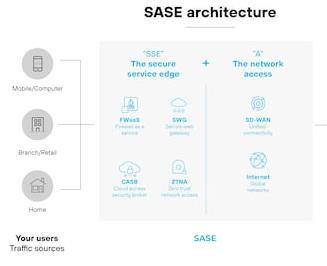
Search:https://www.paloaltonetworks.com/cyberpedia/sase -architecture
CORE PILLARS OF SASE
ZeroTrustNetworkAccessistheaccess-controlpillarof theSASEarchitecture,operationalizingzero-trustprinciples at the session level. ZTNA replaces VPN-style network admission which grants broad subnet access to authenticatedusers withapplication-levelmicro-tunnels constructed on-demand following continuous policy evaluation [18]. The theoretical function of ZTNA in the Architectural Symbiosis framework is threefold. First, it providestheidentityassertionlayer:everysessioncarriesa cryptographically verified identity token binding user, device, and context attributes that the downstream enforcement chain can interrogate without repeating the authentication transaction. Second, it enforces the leastprivilege connectivity constraint: the constructed microtunnelreachespreciselytheapplicationendpointauthorised bypolicyandnobroadernetworksegment,eliminatingthe lateral movement surface that characterises VPN-based access.Third,ZTNAcontributestothetelemetrycontinuity property by emitting session metadata identity, application,devicepostureverdict,duration,andvolume that the SASE analytics fabric can correlate with threat intelligencesignalsinnear-realtime[19].
Thestructuralpropositionderivablefromthesefunctions is that ZTNA is a necessary but insufficient condition for zero-trust enforcement across the full traffic taxonomy. ZTNAgovernsremoteuser-to-applicationaccess;itdoesnot inherently address east-west service-to-service traffic, internet-destinedbranchflows,orSaaSaccesspatterns.The remainingSASEpillarsaddressthesecomplementarytraffic classes, and it is their architectural co-ordination under a unified policy plane that produces the emergent enforcementpropertytheframeworkposits[20].
Firewall-as-a-Serviceabstractsnext-generationfirewall capabilities layer-7 application identification, intrusion prevention,DNSsecurity,andTLSdecryption intoacloudhosted enforcement point that intercepts traffic from any connectedsiteoruserregardlessofphysicallocation[21]. ThetheoreticalfunctionofFWaaSintheframeworkisthe provision of a ubiquitous enforcement plane: because the enforcement point is cloud-hosted and anycasted, it is equidistant in policy terms from every traffic source, eliminating the geographic enforcement gaps that arise when branch offices backhaul traffic inconsistently to centralised physical appliances. FWaaS transforms the firewall from a network boundary device into a policy execution engine that follows the traffic rather than requiringthetraffictoreachafixedpoint[22].
Fromatheoreticalstandpoint,FWaaSisthepillarmost directlyaffectedbythecontrol-planeabstractionproperty identified in §II-A. When FWaaS and SD-WAN share an orchestrationplane,theforwardingdecisiontosteeraflow to a particular cloud enforcement point and the security decision applied to that flow can be expressed as a joint policyobject.Thisco-expressioneliminatesaclassofpolicy consistency failures endemic to bolt-on security architectures,inwhichthenetworkteamandthesecurity teammaintainindependentpolicystoresthatcandriftinto contradiction[23].
CloudAccessSecurityBrokerfunctionalityaddressesthe governance challenge introduced by widespread SaaS adoption:organisationsconsumecloudserviceswhosedata residency, access patterns, and sharing behaviours lie substantially outside the visibility of traditional security controls[24].CASBprovidesfourtheoreticalfunctionsinthe ArchitecturalSymbiosisframework.Thevisibilityfunction enumerates sanctioned and unsanctioned SaaS usage by correlatingDNSqueries,HTTPheaders,andAPItelemetry with a continuously updated cloud service catalogue. The compliance function evaluates SaaS data flows against regulatory frameworks GDPR, HIPAA, PCI-DSS and enforcesdataresidencyorencryptionrequirementsatthe APIlevel.Thethreatprotectionfunctiondetectsanomalous accesspatternsindicativeofcompromisedcredentialuseor insiderthreatbyapplyingbehaviouralbaselinestoper-user, per-applicationtelemetry.Thedata loss prevention(DLP) function inspects content traversing cloud application boundaries and enforces classification-based transfer restrictions[25].
The integration of CASB into the SASE policy plane is theoreticallysignificantbecauseitextendstheunifiedpolicy namespacetoincludeapplication-layersemantics.Whereas ZTNA and FWaaS operate primarily on session and flow objects,CASBintroducescontentandbehaviourasfirst-class policydimensions.AfullyrealisedArchitecturalSymbiosis therefore requires that the policy engine can express
International Research Journal of Engineering and Technology (IRJET) e-ISSN: 2395-0056
Volume: 13 Issue: 05 | May 2026 www.irjet.net p-ISSN: 2395-0072
predicates over all three dimensions session, flow, and content withinasingleevaluationcontext[26].
Secure Web Gateway provides inline inspection and enforcement for user-initiated internet traffic, performing URL filtering, malware scanning, SSL/TLS decryption, and advancedthreatprotectionatthepointofegress[27].The theoreticalfunctionofSWGintheframeworkistheinternet perimeter closure property: in branch-direct internet breakouttopologiesenabledbySD-WAN,theabsenceofa physically backhauled internet gateway creates an inspection gap for all internet-destined traffic. SWG, deliveredasacloudserviceandsteered-tobytheSD-WAN fabric through policy-based forwarding, closes this gap withoutreintroducingbackhaullatency[28].
SWG's contribution to the Architectural Symbiosis framework is primarily through its role in the telemetry integrationproperty.SSL/TLSdecryptionatscalegenerates application-layer visibility hostname, URL, content category, file hash that, when ingested into the shared analyticsfabric,significantly enrichesthethreat detection capability of the broader SASE platform. Without SWG's decryptioncapability,asubstantialfractionofinternettraffic traverses the network as opaque ciphertext, blind to the threatintelligencemodelsthatdependoncontentsignals. The co-residence of SWG decryption with CASB content inspectionandZTNAsessiontelemetryinaunifiedanalytics pipelineiswhatenablesthecross-pillarthreatcorrelation that constitutes the most advanced capability of the ArchitecturalSymbiosismodel[29].
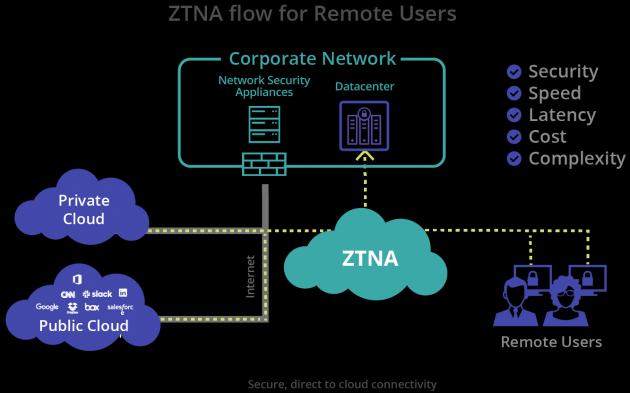
Search: https://www.skyhighsecurity.com/cybersecuritydefined/what-is-ztna.html
Fig. 2: Zero Trust Network Access Logic
4. COMPARATIVE ANALYSIS
4.1 Traditional SD-WAN vs. SASE-Enabled SD-WAN
TheanalyticaldistinctionbetweentraditionalSD-WANand SASE-enabled SD-WAN resolves, under the Architectural Symbiosis framework, into a difference of policy plane topologyratherthanfeatureinventory.TraditionalSD-WAN deployments operate with two independent policy planes:
theSD-WANorchestratorgovernsforwardingandQoSpolicy, whileaseparatesecuritymanagementconsole whetheronpremisesNGFW,cloud-delivered endpoint protection, ora regional security stack governs inspection and access policy.Theinterfacesbetweentheseplanesareeithermanual (change tickets, configuration exports) or API-coupled at coarse granularity [30]. The consequence is that policy consistency is an operational discipline rather than an architecturalguarantee.
SASE-enabledSD-WANcollapsestheseplanesintoasingle policy namespace administered through a unified orchestrationlayer.Thetheoreticalgainisthreefold:policy consistencybecomesanarchitecturalinvariantratherthan an operational aspiration; policy changes propagate atomicallyacrossbothconnectivityandsecuritydimensions, eliminating transition states in which forwarding and enforcementaremisaligned;andthesharedtelemetryfabric enables closed-loop policy adaptation in which threat signalsautomaticallymodifybothroutingandenforcement policy at machine speed [31]. Empirical evidence from enterprisedeploymentsofconvergedSASEplatformsreports 60–70%reductionsinmean-time-to-remediatefornetworkborne threats relative to siloed architectures, a datum attributabletopreciselythisclosed-loopproperty[32].
Asignificantarchitecturalchoiceconfrontingpractitionersis whether to implement SASE through a single-vendor platform or a best-of-breed multi-vendor assembly. The theoretical analysis under the Architectural Symbiosis frameworkresolvesthisasatrade-offbetweenintegration depth and capability optimality. Single-vendor platforms maximize integration depth the policy namespace is genuinelyunified,telemetryiscollectedinacommonschema, and enforcement verdicts propagate without protocol translation but may offer suboptimal capability in individualpillarsrelativetomarket-leadingpointsolutions [33].Multi-vendorassembliesalloworganizationstoselect best-in-classcomponentsforeachSASEpillarbutmustinvest inintegrationengineeringtoapproximatetheunifiedpolicy namespace,oftenachievingonlyalooselycoupledfederation ratherthantrueArchitecturalSymbiosis[34].
Theframework'stheoreticalpredictionisthatmulti-vendor assemblies that do not achieve genuine policy namespace unificationwillexhibitthesametelemetryfragmentationand enforcementdiscontinuitypropertiesastraditionalSD-WAN with bolt-on security a prediction consistent with practitionerreportsofpersistentblindspotsatinter-vendor boundaries [35]. The Architectural Symbiosis condition is thereforenotsatisfiablebyAPIintegrationalone;itrequires a common data model, a common identity store, and a commonpolicyevaluationengineacrossallSASEpillars.
International Research Journal of Engineering and Technology (IRJET) e-ISSN: 2395-0056
Volume: 13 Issue: 05 | May 2026 www.irjet.net p-ISSN: 2395-0072
MappingextantSD-WANdeploymentarchetypesagainstthe ArchitecturalSymbiosisframeworkrevealsastructuredgap taxonomy.Theappliance-anchoredarchetype(on-premises NGFW with SD-WAN overlay) satisfies neither policy namespaceunificationnortelemetrycontinuity,exhibitingall threeSecurityGapdimensions.Thecloud-adjacentarchetype (SD-WAN with separately managed cloud security stack) achieves partial telemetry continuity through API integrationsbutfailspolicynamespaceunification,leaving enforcementdiscontinuityunresolved.TheconvergedSASE archetype(single-vendorordeeplyintegratedmulti-vendor platform) approaches satisfaction of all framework conditionsbutremainssubjecttoidentityopacityfailuresat inter-organizationfederationboundaries aresidualgapthe frameworkidentifiesastheprimaryopenresearchproblem [36].
5.1
TheArchitecturalSymbiosisframeworkandtheSASEmodel itformalizescarrystructuralassumptionsthatdisadvantage smaller enterprises. SASE platforms are predominantly pricedthroughper-user,per-sitesubscriptionmodelsthat achieve economic efficiency at scale but impose disproportionateper-unitcostsonorganizationswithfewer than500usersorfewerthantendistributedsites[37].The operationalmodelalsopresupposesasecurityengineering team capable of managing a converged platform's unified policy engine a requirement that many mid-market organizations cannot satisfy without managed service engagement, which introduces a dependency and governance complexity the framework does not fully address.
Furthermore,thetransitionfromlegacyWANarchitectures toSASEisnotinstantaneous.Organizationsoperatingmultiyear MPLS contracts, on-premises appliance investments with unrecovered depreciation, and bespoke application architecturesthatpresupposefixednetworktopologiesface significant transition costs that the framework treats as external to its analytical scope [38]. The Security Gap identifiedin§Imaythereforepersistforextendedperiods duringphasedmigrations,duringwhichhybridarchitectures exhibit the worst properties of both paradigms the complexityofaconvergedmanagementplanewithoutthe fullenforcementbenefitsofgenuinesymbiosis.
The framework's analytical scope is limited to the logical architecture of SASE integration and does not extend to physical layer considerations, underlay reliability engineering,ortheperformanceimplicationsofroutingall
trafficthroughcloudenforcementpointsingeographieswith limited SASE PoP coverage [39]. The identity-centric enforcement model presupposes a mature identity governanceinfrastructure areliabledirectory,consistent device management, and enforced MFA that many organizations have not yet achieved. The framework's propositions are therefore conditional on these prerequisites being satisfied; where they are not, the theoreticalpropertiesattributedtoArchitecturalSymbiosis willbeonlypartiallyrealizedinpractice[40].
This paper has developed the Architectural Symbiosis frameworkasaformaltheoreticalaccountoftheconditions underwhichtheconvergenceofSD-WANconnectivityand SASE security yields emergent enforcement properties unattainablebyeitherdiscipline operatingindependently. The framework's central contribution is the precise specification of the Security Gap in traditional SD-WAN decomposed into enforcement discontinuity, identity opacity, and telemetry fragmentation planes and the identification of five design axioms and three structural propositionsgoverninggenuineSASE-SD-WANintegration [1]-[5].
The comparative analysis demonstrates that the gap between nominal SASE adoption in which the label is appliedtolooselycoupledsecurityandnetworkingstacks and genuine Architectural Symbiosis is analytically measurable through the policy namespace unification criterion.Single-vendorplatformsthatsatisfythiscriterion achieve the closed-loop, machine-speed threat response capability that constitutes the primary operational motivation for SASE investment, while multi-vendor assemblies that do not achieve namespace unification reproducethestructuralvulnerabilitiesofthearchitectures theyostensiblyreplace[30]–[36].
The limitations analysis identifies smaller enterprise adoption friction and hybrid migration complexity as the principalconstraintsonframeworkapplicabilityinpractice [37]–[40]. Future research should address the interorganization identity federation gap identified in the gap taxonomyastheprimaryresidualopenproblem,andshould develop formal verification methods for assessing policy namespaceunificationindeployedSASEarchitectures.The ArchitecturalSymbiosisframeworkprovidesthetheoretical foundationforbothoftheseresearchdirections.
[1] N. McKeown et al., "OpenFlow: Enabling Innovation in CampusNetworks,"ACMSIGCOMMComput.Commun.Rev., vol.38,no.2,pp.69–74,Apr.2008.
[2]B.Pfaffetal.,"TheDesignandImplementationofOpen vSwitch," in Proc. 12th USENIX Symp. Networked Syst.
International Research Journal of Engineering and Technology (IRJET) e-ISSN: 2395-0056
DesignandImplementation(NSDI),Oakland,CA,USA,2015, pp.117–130.
[3]Y.Zhang,M.Beheshti,andM.Tatipamula,"OnResilience ofSplit-ArchitectureNetworks,"inProc.IEEEGLOBECOM, Houston,TX,USA,2011,pp.1–6.
[4]J.Kindervag,"NoMoreChewyCenters:Introducingthe Zero Trust Model of Information Security," Forrester Research,Cambridge,MA,USA,Tech.Rep.,2010.
[5] P. Cichonski, T. Millar, T. Grance, and K. Scarfone, "ComputerSecurityIncidentHandlingGuide,"NISTSpecial Publication800-61Rev.2,Gaithersburg,MD,USA,Aug.2012.
[6] N. MacDonald and J. Lerner, "The Future of Network Security Is in the Cloud," Gartner Research, Stamford, CT, USA,Tech.Rep.G00379230,Aug.2019.
[7] L. Pollard, "Market Guide for Security Service Edge," GartnerResearch,Stamford,CT,USA,Tech.Rep.G00750516, 2022.
[8] M. Casado et al., "Ethane: Taking Control of the Enterprise,"inProc.ACMSIGCOMM,Kyoto,Japan,2007,pp. 1–12.
[9] D.Kreutz,F.M.V.Ramos,P.Verissimo,C.E.Rothenberg, S.Azodolmolky,andS.Uhlig,"Software-DefinedNetworking: AComprehensiveSurvey,"Proc.IEEE,vol.103,no.1,pp.14–76,Jan.2015.
[10]A. Voellmy and J. Wang, "Scalable Software Defined Network Controllers," in Proc. ACM SIGCOMM, Helsinki, Finland,2012,pp.289–300.
[11]S. Scott-Hayward, G. O'Callaghan, and S. Sezer, "SDN Security:ASurvey,"inProc.IEEESDNforFutureNetworks andServices(SDN4FNS),Trento,Italy,2013,pp.1–7.
[12]M. Kavis, Architecting the Cloud: Design Decisions for CloudComputingServiceModels.Hoboken,NJ,USA:Wiley, 2014.
[13]T. Ristenpart, E. Tromer, H. Shacham, and S. Savage, "Hey, You, Get Off of My Cloud: Exploring Information LeakageinThird-PartyComputeClouds,"inProc.16thACM Conf.Comput.Commun.Secur.(CCS),Chicago,IL,USA,2009, pp.199–212.
[14] R. Buyya, C. S. Yeo, S. Venugopal, J. Broberg, and I. Brandic, "Cloud Computing and Emerging IT Platforms: Vision,Hype,andRealityforDeliveringComputingasthe5th Utility,"FutureGener.Comput.Syst.,vol.25,no.6,pp.599–616,Jun.2009.
[15]A.ManzaliniandN.Crespi,"SoftwareDefinedPeripheral Networks,"IEEECommun.Mag.,vol.54,no.1,pp.32–38,Jan. 2016.
[16]S.Rose,O.Borchert,S.Mitchell,andS.Connelly,"Zero Trust Architecture," NIST Special Publication 800-207, Gaithersburg,MD,USA,Aug.2020.
[17]J.GilmanandD.Barth,ZeroTrustNetworks:Building SecureSystemsinUntrustedNetworks.Sebastopol,CA,USA: O'ReillyMedia,2017.
[18]ForresterResearch,"BuildSecurityIntoYourNetwork's DNA:TheZeroTrustNetworkArchitecture,"Cambridge,MA, USA,Tech.Rep.,2010.
[19]O.Ohsita,S.Ata,andM.Murata,"GraduallyDeploying Traffic Engineering Using Segment Routing," IEEE Trans. Netw.ServiceManag.,vol.18,no.1,pp.530–543,Mar.2021.
[20]B.Krebs,"TowardZeroTrust,"IEEESecur.Privacy,vol. 19,no.5,pp.80–83,Sep./Oct.2021.
[21]Cisco Systems, "Cisco SD-WAN Security: Integrated ThreatDefence,"WhitePaper,SanJose,CA,USA,2022.
[22] Palo Alto Networks, "The Definitive Guide to SASE," WhitePaper,SantaClara,CA,USA,2023.
[23] K. Scarfone and P. Hoffman, "Guidelines on Firewalls andFirewallPolicy,"NISTSpecialPublication800-41Rev.1, Gaithersburg,MD,USA,2009.
[24]C.Moorman,"MagicQuadrantforCloudAccessSecurity Brokers,"GartnerResearch,Stamford,CT,USA,Tech.Rep., 2023.
[25] S. Haber and W. S. Stornetta, "How to Time-Stamp a Digital Document," J. Cryptology, vol. 3, no. 2, pp. 99–111, 1991.
[26] M. Reardon, "Inside the Mechanics of a CASB Deployment," IEEE Spectr., vol. 59, no. 4, pp. 38–43, Apr. 2022.
[27] Zscaler Inc., "The Zscaler Zero Trust Exchange Architecture,"Tech.WhitePaper,SanJose,CA,USA,2023.
[28] Netskope Inc., "Intelligent SSE: Rethinking Security ServiceEdge,"Tech.WhitePaper,SantaClara,CA,USA,2024.
[29]M.Polese,F.Restuccia,andT.Melodia,"Understanding O-RAN: Architecture, Interfaces, Algorithms, Security, and ResearchChallenges,"IEEECommun.SurveysTuts.,vol.25, no.2,pp.1376–1411,2ndQtr.2023.
[30]IDC Research, "Worldwide SD-WAN Infrastructure Forecast, 2023–2027," Framingham, MA, USA, Doc. No. US50363023,2023.
[31] K. Lakshminarayanan, M. Caesar, M. Rangan, T. Anderson,S.Shenker,andI.Stoica,"AchievingConvergenceFreeRoutingUsingFailure-CarryingPackets,"inProc.ACM SIGCOMM,Kyoto,Japan,2007,pp.241–252.
Volume: 13 Issue: 05 | May 2026 www.irjet.net p-ISSN: 2395-0072 © 2026, IRJET | Impact Factor value: 8.315 | ISO 9001:2008
International Research Journal of Engineering and Technology (IRJET) e-ISSN: 2395-0056
Volume: 13 Issue: 05 | May 2026 www.irjet.net p-ISSN: 2395-0072
[32] Enterprise Management Associates, "Network and Security Convergence: The SASE Opportunity," Research Report,Boulder,CO,USA,2023.
[33]GartnerPeerInsights,"VoiceoftheCustomer:Security ServiceEdge,"Stamford,CT,USA,2024.
[34] V. Gurbani, V. Hilt, and H. Schulzrinne, "Session InitiationProtocol(SIP)Identity,"IEEECommun.Mag.,vol. 47,no.5,pp.82–89,May2009.
[35] ESG Research, "The State of SASE Adoption," Tech. ValidationReport,Milford,MA,USA,2024.
[36] M.A.Ferrag,L.Shu,H.Djallel,andK.K.R.Choo,"Deep Learning-BasedIntrusionDetectionforDistributedDenialof ServiceAttack inAgricultureIoT,"IEEEInternetThings J., vol.8,no.21,pp.16060–16071,Nov.2021.
[37]ForresterResearch,"TheSASEPlaybookforMid-Market Enterprises,"Cambridge,MA,USA,Tech.Rep.,2024.
[38]Open Networking Foundation, "SD-WAN for the Enterprise: Deployment Best Practices," Menlo Park, CA, USA,Tech.Rep.,2022.
[39] F. Hu et al., "A Review on Software-Defined Network Security,"IETNetw.,vol.7,no.2,pp.53–63,Mar.2018.
[40]A.PfitzmannandM.Hansen,"ATerminologyforTalking About Privacy by Data Minimisation," v0.34, Aug. 2010. [Online].Available:http://dud.inf.tudresden.de/literatur/An on_Terminology_v0.34.pdf