
International Research Journal of Engineering and Technology (IRJET) e-ISSN:2395-0056 p-ISSN:2395-0072

Volume: 12 Issue: 04 | Apr 2025 www.irjet.net
International Research Journal of Engineering and Technology (IRJET) e-ISSN:2395-0056 p-ISSN:2395-0072
Volume: 12 Issue: 04 | Apr 2025 www.irjet.net
Prof. Priyanka Sananse Department of Information Technology
K.C. College of Engineering
priyanka.sonawane@kccemsr.edu.in

Durvesh Naik
Department of Information Technology
K.C. College Of Engineering durveshnaik@kccemsr.edu.in
Rutika Pingale
Department of Information Technology
K.C. College Of Engineering rutikapingale@kccemsr.edu.in
Abstract - Inrecentyears,theintegrationoftechnology into education has become a focal point for both researchers and educators. Among the emerging technologies,AugmentedReality(AR)standsoutduetoits potential to transform traditional learning methods. AR enhances the learning experience by creating immersive environments that engage students more deeply.For students, Augmented Reality offers an engaging and immersivelearningenvironmentthatenhancesenjoyment and curiosity in the classroom. By bringing abstract or complextopics likethestructureofthesolarsystem to life, AR-based educational tools can also support teachers indeliveringclearer,moreinteractivelessonsthatcapture students'attentionandimprovecomprehensionThus,this report proposes to develop a mobile application to help students in learning process with the help of AR. In conclusion,thisprojectoffersaimmersiveandinteractive experience and improves the teaching learning process and benefits teachers as well as students to explore and learnmoreeffectivelyutilizing3Dvisuals.Whetheryou're an educator, student, or space enthusiast, AR offers an unparalleled gateway to the stars. The future of space exploration is not just something we read about it's somethingwecannowexperiencefirsthand,righthereon Earth.
Key Words: AR, 3D Model, Solar System, Planets, Unity andSceneformFramework,AndroidStudio.
“AR Solarscape” aims at combining the new information technologies (Augmented Reality) available to take advantage of recent gadgets, hence giving access to

Nidhi Parab
Department of Information Technology
K.C. College Of Engineering nidhiparab@kccemsr.edu.in
Manish Pirdankar
Department of Information Technology
K.C. College Of Engineering manishpirdankar@kccemsr.edu.in
knowledgeinasimplifiedandfunmanner.TheARSolarscape, asmallcomponentofthevastuniverse,encompassescelestial bodies including the Sun, its planets-Mercury, Venus, Earth, Mars, Jupiter, Saturn, Uranus, Neptune. The traditional learningprocesstypicallyinvolvesexplanationsandexercises provided by educators, requiring students to be diligent in reading and attentive during lessons to master the content effectively. However, this approach can sometimes lead to monotony and student disengagement. Augmented Reality represents a fusion of real-world objects with virtual elements, operating interactively to bring virtual technology into the real world. Utilizing advancements in 3D visuals, AR is used in education to revolutionize the learning process of the solar system, which traditionally relied on textbooks, by introducing an interactive, smartphone-based learning experience. Augmented Reality allows users to interact with digital content overlaid on the real world through the use of smartphones, tablets, or AR glasses. Unlike traditional 2D representationsofthesolarsystem,ARcreatesanimmersive, interactiveexperience.Userscanvisualizetheplanets,moons, and even spacecraft in their real-world environment, observing these celestial objects in 3D as if they were physically present. This interactive exploration offers an engaging and educational experience for both casual space enthusiasts and dedicated learners alike. One of the most exciting aspects of AR is its ability to make the vastness of space accessible to people of all ages and backgrounds. From studentsinclassroomstofamiliesathome,ARoffersahandson, visual way to learn about the solar system, making abstract concepts more tangible and easier to understand. TeacherscanuseARapplicationstobringthesolarsystemto life for students, sparking curiosity and inspiring the next generationofastronomers,scientists,andexplorers.

International Research Journal of Engineering and Technology (IRJET) e-ISSN:2395-0056 p-ISSN:2395-0072
Volume: 12 Issue: 04 | Apr 2025 www.irjet.net
Muhammad Nasiruddin Bin Mohd Kamal, The simulation of solar system using augmented reality technology cab helps the students of science subject to understand the topic much more effective. The simulations conveyed the information inaninteractive and entertaining way which will trigger the interest of the students to learn. The students will be able to understandandmemorizetheinformationthroughthe simulationastheyenjoyedthelearningprocess.[1]
ResearchandApplicationsOverview,Thefocuswason the various applications of AR in tourism, including wayfinding and navigation. The study also emphasized thedependenceonspecificdevicesandconnectivity,as wellasthechallengesassociatedwithmaintenanceand updatesinthecontextofARintourism.[2]
Paulo Siqueria, a web-based platform that enables users to explore the Solar System using Augmented Reality. By scanning printed markers, students can viewtheplanetsinAR throughanyinternet-connected device equipped with a webcam. The system also provides access to Virtual Reality (VR) visualizations foranenhancedlearningexperience..[3]
PJanardhanaReddy,AugmentedRealityisaneffectivetool forthisemerginglearningparadigm,makingthelearnerin active role of self-directed learning, providing flexibility and interactivity in the teaching and learning process. We needtohaveinteractiveteachinglearningprocessandthis changing role of education is inevitable with the introductionofAugmentedRealityineducation.[4]
IJSECS, This research has resulted in the creation of a cutting-edgeAugmentedReality(AR)applicationdesigned to enhance education about the Milky Way galaxy's solar system.Thisapplicationaddressesthechallengeoflimited understanding among elementary school students regarding the solar system, which was previously taught usingtraditionalglobesandpictures.[5]
Muhammad Andika Putra, This technology not only stimulates students' curiosity, strengthening critical thinking skills, but also enhances creativity, observation skills, analysis, communication, self-confidence, and responsibility individually and in group work. Furthermore, the use of AR also strengthens the collaborative relationship between teachers and students, creating a closer and more interactive learning environment.[6]
Georgios Lampropoulos, Students, teachers, and parentsAccording to Georgios Lampropoulos, the integrationofaugmentedreality(AR)intoNaturalSciences education has been met with favorable responses from
students, teachers, and parents alike. Research consistently shows that students who engaged with AR-based learning tools demonstrated improved academic outcomes compared to their peers who were taught using conventional instructional methods. In most cases, the performance of students using AR was either comparable to or significantly betterthanthoserelyingontraditionalapproaches.[7]
This methodology outlines a structured approach to developing an Augmented Reality (AR) Solarscape application, emphasizing user engagement, technical implementation,andevaluation.
1. Research and Analysis: Identify target audience (eg. students). Analyze existing AR applications related to space and planets. Research solar system models (eg.. planets, moons,orbits).EvaluatethebestARplatforms(eg.Unity,etc.) for the project. Understand hardware limitations (smartphones, tablets) and user requirements. Set project goals.
2. Design and Prototyping: Design user interface (UI) and userexperience(UX)forsmoothARinteraction.Createinitial wireframes and sketches of AR components (planetary models, control panel, etc.) Prototype interactions (e.g., scalingplanets,rotatingorbits,zoomingin/out).
3. Technical Development: Develop 3D models of the solar system components (planets, sun, moons). Implement orbital mechanicstosimulateaccuratemovementofcelestialbodies. Develop AR code for device camera integration, allowing users to view models in real-world space. Optimize performance for mobile devices, balancing graphics quality andefficiency.
4. Implementation of AR Features: Use AR development frameworks like ARCore/ARKit or Unity. Implement plane detection for realistic placement of solar system models in physical spaces.Add features like real-time scaling and planetaryrotations..
5.TestingandValidation:Performinternaltestingonmultiple devices to ensure compatibility. Test the features in different environments (indoors, outdoors, dark-light). Validate accuracyofthesolarsystemmodelandARpositioning.Gather user feedback to refine interaction design, UI/UX, and educational content. Debug performance issues such as lag, crashes. Ensure that content is accurate and scientifically sound.
6. Deployment and Marketing: Publish the app on relevant platforms(GooglePlay,AppleAppStore). Createpromotional content (videos, demo reels) showcasing the AR experience. Implementsocialmediacampaignstoreachtargetaudiences.
International Research Journal of Engineering and Technology (IRJET) e-ISSN:2395-0056 p-ISSN:2395-0072
Volume: 12 Issue: 04 | Apr 2025 www.irjet.net
Collaborate with educational institutions or space enthusiasts for endorsements. Utilize user testimonials andreviewstobuildcredibility.
7. Post-Launch Evaluation: Collect user feedback and reviews from app stores and surveys. Monitor app performance (downloads, crashes, engagement metrics). Fix post-launch bugs and release updates for improving userexperience.Analyzedatatounderstanduserbehavior and feature usage. Plan additional features or future updates based on feedback (e.g., adding new celestial bodies,educationalmodules).
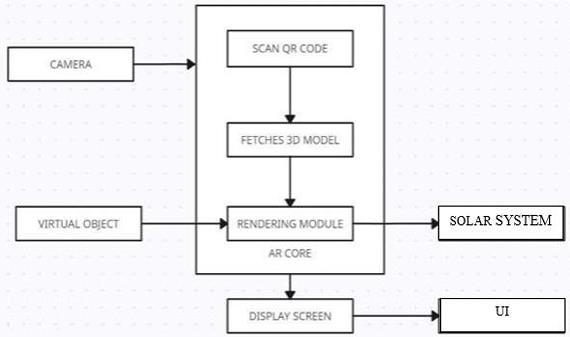
2 Flow chart for System
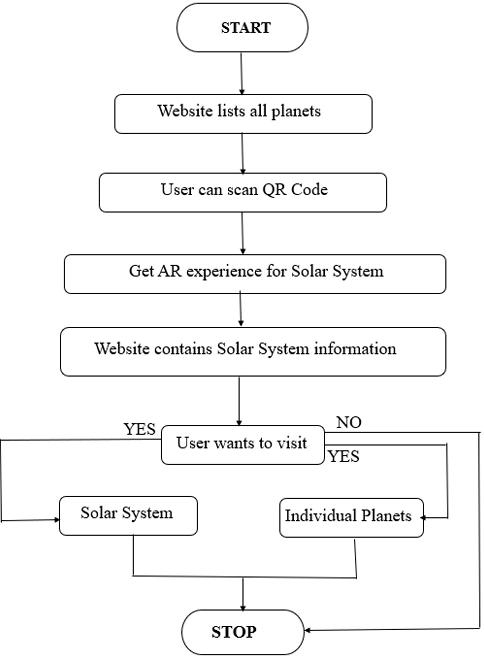
Fig.SystemFlowChart
Severalinnovativeprojectshaveexploredtheintegration of augmented reality (AR) technology into solar system education and exploration. These initiatives aim to enhance the learning experience by allowing users to visualize and interact with celestial bodies in their realworld environment. By overlaying virtual planets, moons, and spacecraft onto physical surroundings through smartphone or tablet screens, AR enables users to explore the solar system up close, examine planetary orbits, and understand astronomical concepts in an immersive way. Such applications not only make space education more engaging but also help learners grasp complex spatial relationships and planetary movements. Additionally, AR-based solar system models have the potential to revolutionize astronomy education by offering interactive simulations, real-time celestial tracking, and personalized learning experiences, ultimately empowering users to explore the wonders of spacelikeneverbefore.
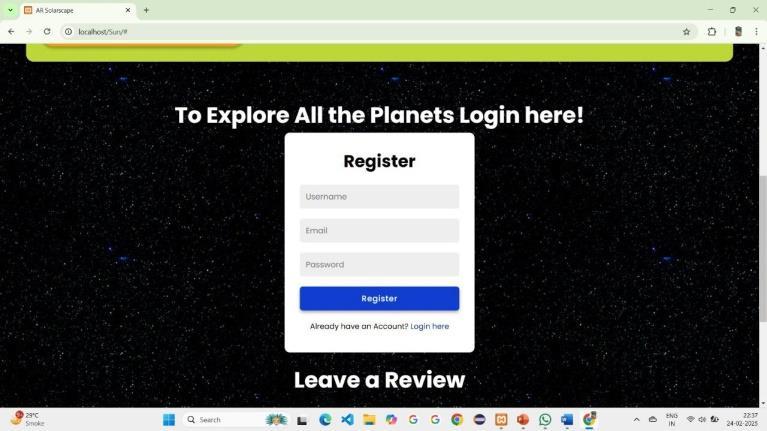
Fig:Registerpage
Registering on the SolarSystem website is a simple process that allows users to access a wide range of interactive features and educational resources. To sign up,usersneedtovisittheofficialwebsiteandclickonthe "Register"or"SignUp"button.Theywillbepromptedto enter basic information such as their name, email address, and a secure password. Some platforms may require email verification to activate the account. Once registered, users can explore augmented reality (AR) solar system models, participate in virtual space tours, andaccessexclusiveastronomycontent.
With a registered account, users can fully immerse themselves in the wonders of the solar system through aninteractiveandengagingdigitalexperience.
International Research Journal of Engineering and Technology (IRJET) e-ISSN:2395-0056 p-ISSN:2395-0072
Volume: 12 Issue: 04 | Apr 2025 www.irjet.net
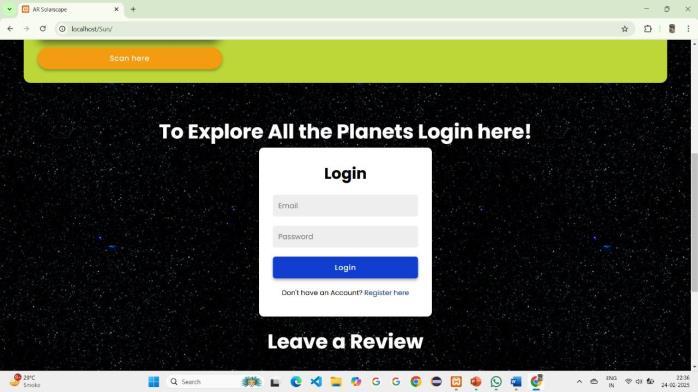
Accessing the Solar System website is a simple and straightforwardprocessthatallowsuserstoengagewitha variety of interactive tools and educational materials. To begin, users should navigate to the official site and select the"Login" or"SignIn"option.Theywillthenbeaskedto provide their registered email address and password. For added security, some websites may include features like two-factor authentication. After successfully logging in, users can explore immersive AR models of the solar system.
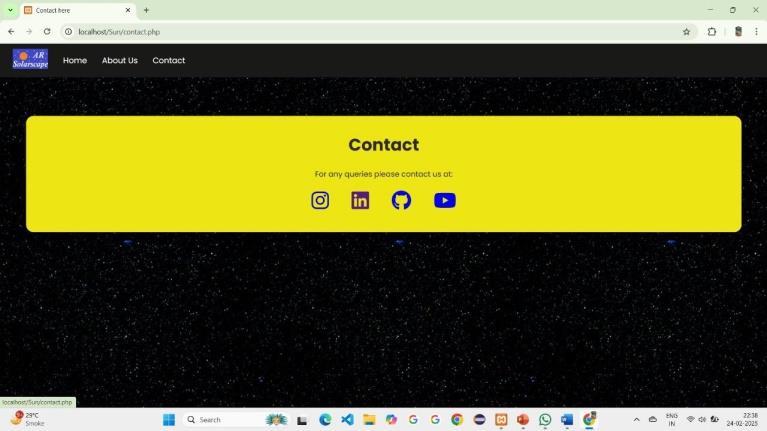
The Contact page of the AR Solarscape website provides users with multiple ways to reach out for inquiries. It features a bright yellow contact section against a starry space-themed background, reinforcing its astronomy focus. The page includes links to Instagram, LinkedIn, GitHub, and YouTube, encouraging engagement through social media and developer platforms. The navigation bar allowsuserstoaccessothersectionslikeHomeandAbout Us. The presence of a localhost URL suggests that the website is still in the development phase, likely being testedbeforeitsofficiallaunch.
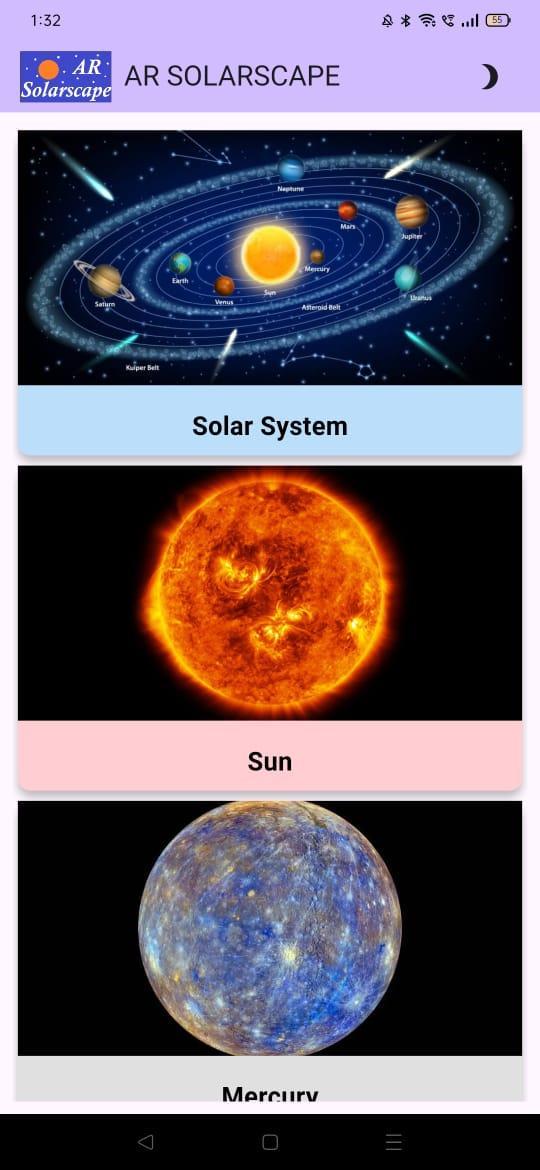
TheAppsectionpresentsastructuredlayoutwithimagesand labels for different celestial objects. The Solar System section displays a complete diagram of planetary orbits around the Sun. Below that, individual celestial bodies such as the Sun , Mercury, Venus, etc. have dedicated sections, each accompaniedbyhigh-qualityimagesandlabeledbuttons.This designsuggeststhattappingonthesesectionsprovidesusers with detailed information, AR interactions, or educational contentabouteachplanetorstar.
International Research Journal of Engineering and Technology (IRJET) e-ISSN:2395-0056 p-ISSN:2395-0072
Volume: 12 Issue: 04 | Apr 2025 www.irjet.net
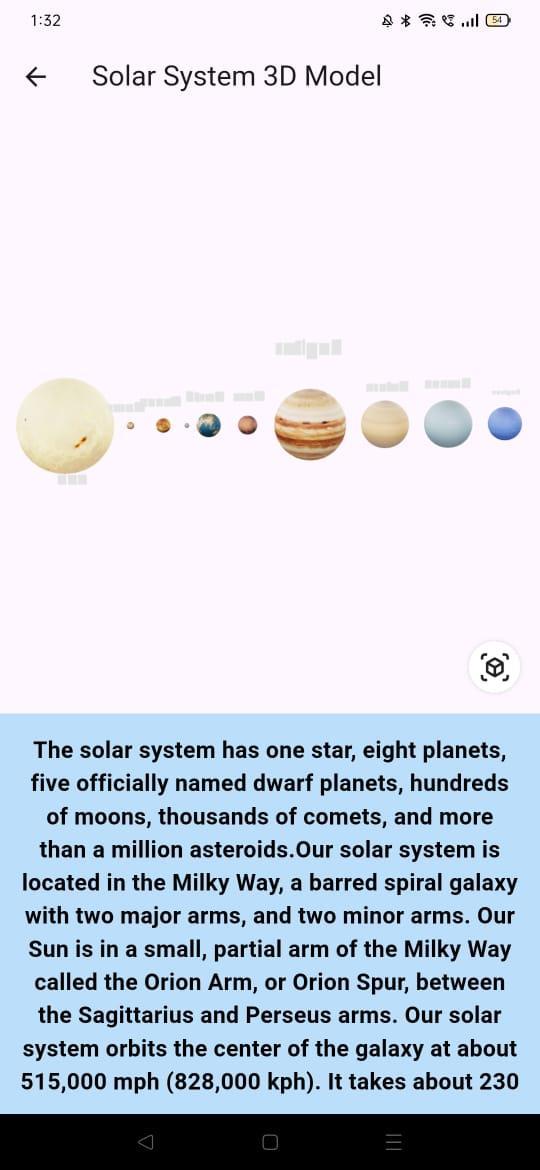
Fig.ARAppModel
This page from the AR Solarscape app provides an interactive3Dmodelofthesolarsystem,allowingusersto explore celestial bodies in detail. At the top, a scrollable planetarylineupvisuallyrepresentstheSun,eightplanets, and other celestial objects, making it easy for users to navigate through different elements of the solar system. The presence of an AR interaction button suggests that usersmayhavetheoptiontoviewthesecelestialbodiesin augmentedreality,enhancingthelearningexperience.
Below the 3D model, a detailed informational section explainskeyfactsaboutthesolarsystem.
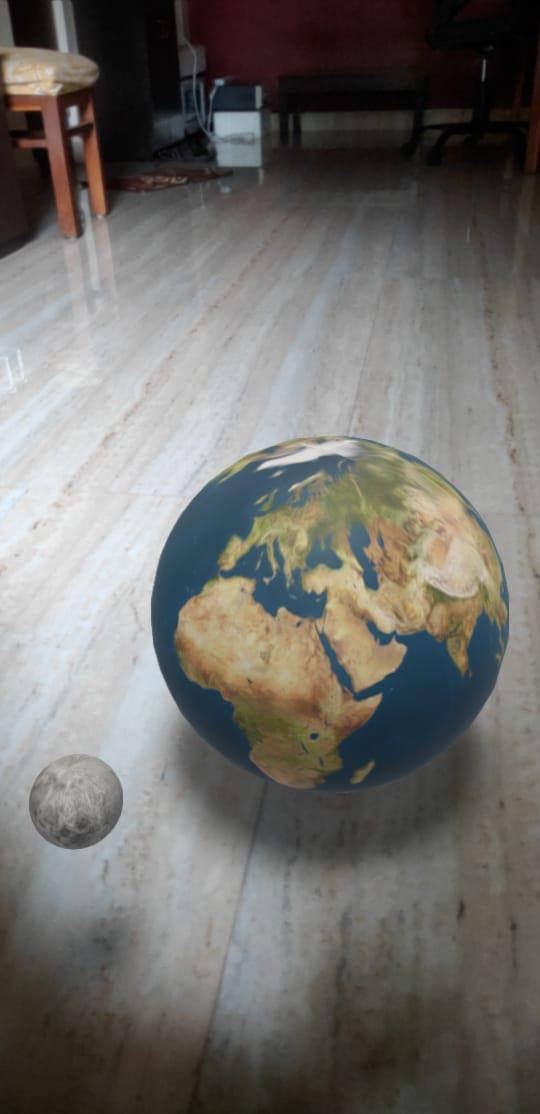
This AR rendering page from the AR Solarscape app showcases an interactive Augmented Reality (AR) model of Earth and its Moon, projected into the real-world environment.TheEarthisdepictedwithdetailedgeographical textures,whiletheMoonappearsrealisticallypositionednear it,maintainingaccuratescaleandsurfacedetail.
By integrating AR technology, the app bridges the gap between traditional learning and interactive exploration, makingitaneffectivetoolforstudents,educators,andanyone interestedinunderstandingoursolarsysteminaninnovative andvisuallyappealingmanner.
International Research Journal of Engineering and Technology (IRJET) e-ISSN:2395-0056 p-ISSN:2395-0072
Volume: 12 Issue: 04 | Apr 2025 www.irjet.net
Augmented Reality (AR) is utilized across numerous industries, enriching user interactions by integrating digital elements into the real world. Below are some key areaswhereARiscommonlyapplied:
1.Gaming: AR has made a significant impact in the gaming industry by blending virtual elements with realworld surroundings. Popular titles like Pokémon GO and Harry Potter: Wizards Unite allow players to interact with digital charactersand objectsintheiractual environment, creatingahighlyimmersiveexperience.
2.Education: In the field of education, AR transforms traditional learning by offering dynamic and engaging visualizations. Through AR apps, students can explore complex subjects such as human anatomy, space science, or historical reenactments in a more interactive and meaningfulway.
3.Retail: AR is revolutionizing the shopping experience by enabling customers to preview products in real-world settings before committing to a purchase. With ARpowered apps, users can virtually try on clothes, see how furniture fits in their living spaces, or test cosmetic productsontheirfaces.
4.Navigation: Augmented reality enhances navigation by overlaying directions and landmarks directly onto the user'sviewofthereal world.Theseapplicationsofferlive guidance, display tourist attractions, and highlight key locations, making it easier to find one's way in new or unfamiliarplaces
5.Industrial Training: In sectors like manufacturing, maintenance, and technical repair, AR is used to support hands-on training. By projecting visual instructions directly onto machinery or equipment, AR helps workers follow procedures more accurately and efficiently, reducingthelikelihoodofmistakes.
Integrating Augmented Reality (AR) in the study of the Solar System provides an immersive and interactive learning experience that enhances both engagement and comprehension. By visualizing planets, moons, and other celestialbodiesin3Dspace,ARallowsstudentstoexplore the Solar System in a more dynamic and interactive way compared to traditional methods. It brings abstract conceptstolife,helpingusersunderstandcomplexspatial relationships, planetary movements, and sizes on a much deeper level. This project demonstrates how technology like AR can revolutionize education by making learning both fun and informative, and for more innovative approaches in science education. This immersive method
of learning enhances engagement, allowing students and users to explore planetary details that are otherwise difficult to grasp through textbooks or static images. By bringing the Solar System into our immediate environment, AR provides an intuitive way to bridges the gap between the theory knowledgeandreal-worldexperience
[1]ScienceTextbooksofstandard1stto10th
[2]https://www.researchgate.net/publication/377488055_Ex ploring_Augmented_RealityBased_Learning _Media_Implementation_in_Solar_System_Materials.
[3]https://youtu.be/cqVzL1McrN0?si=a4PFeeD58Nt2yB3Y
[4]https://www.purkh.com/articles/augmented-reality-andvirtual-reality-web-environment-to-visualizing the-planetsof-the-solar-system.pdf