
International Research Journal of Engineering and Technology (IRJET) e-ISSN: 2395-0056
Volume: 13 Issue: 05 | May 2026 www.irjet.net p-ISSN: 2395-0072

International Research Journal of Engineering and Technology (IRJET) e-ISSN: 2395-0056
Volume: 13 Issue: 05 | May 2026 www.irjet.net p-ISSN: 2395-0072
Prof. S. R. Kshirsagar1 ,Trupti Tatar2, Sagar Gaikawad3, Abhisekh Bhadange4
Student's, Dept. of Civil Engineering, Sanghavi college of Engineering, Maharashtra , India
Abstract - Cement is one of the most essential materials in the construction industry. However, continuous efforts are being made to enhance its performance and sustainability to fulfill the increasing demands. Cement is becoming a scarce commodity globally due to its rapid consumption and also contributes significantly to CO₂ emissions. To reduce environmental impact and improve concrete properties, supplementary cementitious materials such as silica fume are used. This study investigates the utilization of silica fume as a partial replacement of cement in M30 grade concrete using OPC 53 grade cement. The replacement levels considered are 0%, 5%, 10%, and 15% by weight of cement. Artificial sand is used as a complete replacement for natural river sand to promote eco-friendly construction practices. The experimental work includes mix design, casting of concrete cubes, and testing at curing periods of 7, 14, and 28 days. The study focuses on evaluating compressive strength, workability,andoverallperformanceofconcrete.Silicafume, being an ultrafine material rich in silicon dioxide (SiO₂), reacts pozzolanically with calcium hydroxide to form additional calcium silicate hydrate (C–S–H), resulting in improved strength and dense microstructure. The results aim to determine the optimum percentage of silica fume that provides maximum strength without compromising workability. This study contributes to the development of high-performance, durable, and sustainable concrete for modern civil engineering applications.
Key Words: Silica Fume, High Performance Concrete, Artificial Sand, Pozzolanic Reaction, Durability, Workability, Strength performance, Modern civil engineering applications
Concrete is one of the most widely used construction materialsdue toitshigh compressive strength,durability, and versatility. However, the increasing demand for construction has led to excessive use of natural resources such as cement and river sand, causing environmental concernsandresource depletion.Toaddressthese issues, theuseofalternativeandsustainablematerialshasbecome essential.
Silica fume, a by-product of silicon and ferrosilicon industries,isahighlyreactivepozzolanicmaterialusedas apartialreplacementforcement.Itimprovesthestrength, durability, and impermeability of concrete. At the same time,manufacturedsand(M-sand)isemergingasasuitable
alternativetoriversandduetoitsconsistentquality,better bondingproperties,andeco-friendlynature.
The combined use of silica fume and manufactured sand helps in producing high-performance and sustainable concrete.Thisstudyfocusesonevaluatingtheireffectson thestrengthanddurabilitycharacteristicsofconcrete.
Concrete is composed of several essential materials including cement, fine aggregate, coarse aggregate, water, and mineral admixtures like silica fume. Each material plays a crucial role in determining the strength and durabilityofconcrete.
Cement is a fine grey powder made from limestone and clay. When mixed with water, it undergoes hydration and forms a strong binding material. It contains compounds suchaslime(CaO),silica(SiO₂),alumina(Al₂O₃),andiron oxide (Fe₂O₃), which contribute to strength and durability.Ordinary Portland Cement (OPC) 53 grade was selected for this study due to its superior strength characteristics and widespread application in highperformance concrete. A comprehensive evaluation of cement quality was carried out through both field and laboratorytestingmethods.Preliminaryidentificationtests such as colour, lump, float, and temperature assessment confirmed that the cement was fresh, free from moisture contamination, and in satisfactory condition for construction use. Advanced laboratory tests including fineness, specific gravity, standard consistency, and soundness were performed in accordance with IS 4031 specifications to ensure compliance with standard requirements. The fineness of cement was determined as 3%, indicating adequate particle size for effective hydration.Thespecificgravityvalueof3.12fallswithinthe acceptable range for OPC, confirming its density characteristics.The standardconsistencywas found to be 32%,ensuringproperwaterdemandforachievingdesired workability. Furthermore, the soundness test showed an average expansionof2.0 mm,which issignificantlylower thanthepermissiblelimit,indicatingvolumetricstabilityof the cement. Overall, the test results demonstrate that the OPC53gradecementusedinthisinvestigationsatisfiesall relevant IS code provisions and is highly suitable for producingdurableandhigh-strengthconcrete.
International Research Journal of Engineering and Technology (IRJET) e-ISSN: 2395-0056
Volume: 13 Issue: 05 | May 2026 www.irjet.net p-ISSN: 2395-0072
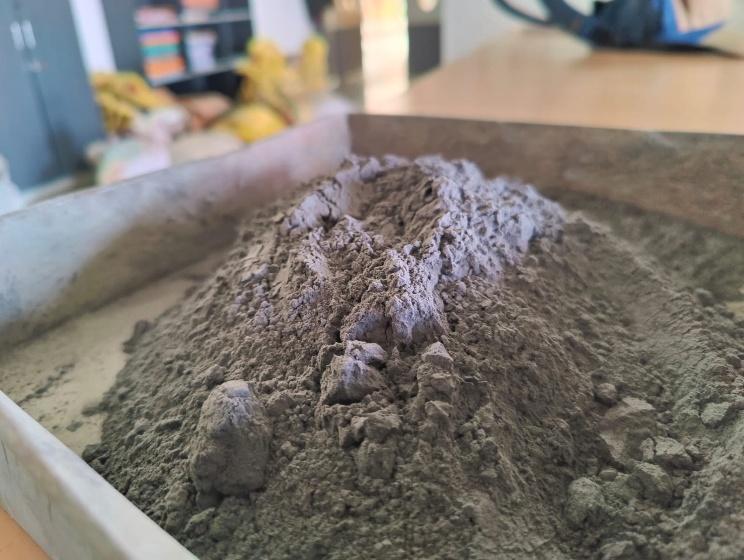
Silicafumeisanultra-fineby-productobtainedduringthe productionofsiliconmetal.Itconsistsmainlyofamorphous silicondioxide(SiO₂).Duetoitsveryfineparticles,itreacts withcalciumhydroxidetoformadditionalcalciumsilicate hydrate (C-S-H), which enhances concrete strength and durability. Silica fume is an ultrafine by-product obtained from the production of siliconandferrosilicon alloys.It is mainlycomposedofamorphoussilicondioxide(SiO₂)and iswidelyusedasapozzolanicmaterialinconcrete.Inthis study, silica fume was tested for its suitability through laboratory tests such as specific gravity, fineness, and chemicalcomposition.Thespecificgravitywasfoundtobe within the standard range, while the fineness test confirmed its extremely fine particle size. The high silica content ensures strong pozzolanic activity, which reacts withcalciumhydroxidetoformadditionalcalciumsilicate hydrate (C–S–H). This improves the strength, durability, anddensityofconcrete.Duetoitsmicro-fillingabilityand high reactivity, silica fume enhances particle packing, reduces porosity, and increases bonding in the cement matrix, making it highly useful in high-performance and sustainableconcrete.
1.1.2.1
Appearance:Veryfinepowderedform
● Colour:Darkgrey
● Texture:Extremelyfineandsmooth
● SiliconDioxide(SiO₂):Minimum89%
● SpecificGravity:2.20
● Particle Size: ~0.1 micron (100 times finer than cement)
● SurfaceArea:15,000–30,000m²/kg
● Nature:Highlypozzolanic
● ParticleShape:Spherical
● Reactivity:Veryhigh
Fine aggregate used in this study was manufactured sand (M-Sand), obtained by crushing hard granite stones and usedasacompletereplacementfornaturalriversand.The materialwaslightbrownishgreyincolour,clean,andfree from organic impurities, making it suitable for concrete production. The silt content test showed a value of 1.2%, whichiswithinthepermissiblelimitof3%,indicatingthat the sand is clean. The float test confirmed the absence of clayandorganicimpurities,ensuringgoodqualitymaterial. Sieveanalysiswasconductedtodeterminegrading,andthe sandwasfoundtofallunderZoneII,indicatingwell-graded sand suitable for concrete. The fineness modulus was calculated as 2.13, confirming appropriate particle size distribution. The specific gravity test yielded an average value of 2.46, which lies within the permissible IS range, indicating good density characteristics. The water absorption test showed a value of 3.54%, which is within acceptablelimitsforfineaggregate.Overall,alltestresults satisfyIS383:2016andIS2386standards,confirmingthat theM-Sandisclean,well-graded,andsuitableforuseasfine aggregateinconcrete
River sand is naturally obtained from riverbeds. It has smoothand roundedparticlesbutmaycontain impurities likesiltandclay.
Manufactured sand is produced by crushing hard stones like granite. It has angular particles, better bonding properties, and consistent quality. It is more economical andenvironmentallyfriendlycomparedtoriversand.
Coarseaggregatesarelarge-sizedmaterialssuchasgravel or crushed stones retained on a 4.75 mm sieve. They provide strength and stability to concrete. The coarse aggregate used in this study was 20 mm size crushed angularstoneobtainedfromalocalquarry.Theaggregates were hard, clean, and free from dust, clay, and organic impurities,ensuringgoodquality.Sieveanalysisconfirmed thattheaggregateiswellgradedandsuitableforconcrete work.Thespecificgravitywasfoundtobe2.68,whichlies within the permissible range, indicating good density characteristics. The water absorption was observed as 3.86%, which is slightly higher than the recommended limit,indicatingporousnaturebutacceptablewithproper mixdesignadjustments.Theaggregatecrushingvaluewas 27%, which is within the permissible limit, confirming adequate strength. Overall, all test results satisfy IS 383:2016andIS2386standards,indicatingthatthecoarse aggregateissuitableforconcreteproduction.
1.1.7
Wateravailableonthecollegecampuswasusedformixing and curing concrete. The water was clear, colourless, and
International Research Journal of Engineering and Technology (IRJET) e-ISSN: 2395-0056
free from visible impurities and odour, indicating good quality. Various tests were conducted to assess its suitabilityasperIS456:2000standards.Visualinspection and odour tests confirmed that the water was clean and freefromharmfulsubstances.Thetastetestindicatedslight hardness due to dissolved salts; however, it was within acceptablelimits.ThepHvaluewasfoundtobe7.2,which lies within the permissible range for concrete use. No floating impurities were observed during the standing water test, confirming its cleanliness. Although the water was slightly hard in nature, all test results satisfy IS code requirements, indicating that it is suitable for use in concrete.
● Highcompressivestrength
● Lowpermeability
● Improveddurability
● Betterbondingwithreinforcement
● Highresistancetochemicalattack
● Reducedwaterpermeability
● Increasedabrasionresistance
● 1.3ADVANTAGESOFMANUFACTUREDSAND
● Eco-friendlyalternativetoriversand
● Betterstrengthduetoangularparticles
● Consistentqualityandgrading
● Cost-effective
● Reducedenvironmentalimpact
● Improveddurabilityofconcretepaper.
●Toanalyzetheworkabilityofsilicafumeconcretemixes.
● To determine the optimum replacement percentage of silicafume.
● To study the effect of silica fume on the strength of concrete.
●Tocompletelyreplaceriversandwithartificialsand(MSand)andevaluateits effectonworkabilityandstrength.
● To understand the role of silica fume in improving durability.
Kaci Chalah, Aghiles Hammas, and Abdelbaki Benmounah [2024]they have studied Improvement of Physical and MechanicalPropertiesofHigh-PerformanceSandConcrete with Different Silica Fume Content. Advances in Civil and Architectural Engineering, 15(29), 19–32. The study examined high-performance sand concrete with 0%, 4%, 6%, and 8% silica fume replacement at a water–cement ratioof0.35.Resultsindicatedthat6%silicafumecontent was optimal, improving compressive strength by 6.19% and flexural strength by 10.03%, while reducing water
absorption by 8.8% and capillary absorption by 8.57%. Beyondthislevel,further improvement wasminimal. The authors concluded that moderate silica fume (≈6%) effectively enhances the strength and durability of highperformancesandconcrete.
Judita Gražulytė, Audrius Vaitkus, Ovidijus Šernas, and DonatasČygas[2020].
In this paper they have studied Effect of Silica Fume on High-StrengthConcretePerformance.InProceedingsofthe International Conference on Sustainable Engineering and Concrete Technology (ICSECT). The research analyzed silicafumeasapartialreplacementforcementat0%,7%, and 10% levels with a constant w/c ratio of 0.4. Results revealed that 7% silica fume gave the best performance, improving compressive strength by 12–15%, tensile strengthby10%,andflexuralstrengthby9%.Theauthors concludedthatsilicafumeenhancescompactness,reduces microcracks, and refines the concrete matrix due to its pozzolanicandmicro-fillingproperties.
Kumar, R., & Dhaka, J. [2016]. Review Paper on Partial ReplacementofCementwithSilicaFumeandItsEffectson Concrete Properties. International Journal for Technological Research in Engineering, 4(1), 83–85. They investigated M35 grade concrete with 0%, 5%, 10%, and 15% silica fume replacement. They observed that partial cement replacement enhanced compressive strength significantly at 7, 14, and 28 days, with optimum results around10%replacement.
Mehta, P. K., & Monteiro, P. J. M. [2014]. Concrete: Microstructure, Properties and Materials (3rd ed.). McGraw-Hill Education. They discussed that silica fume particles, being extremely fine (about 100 times smaller thancement),fillvoidsandrefineporestructure,resulting in increased strength and lower permeability. They highlighted improved resistance against chloride and sulfateattacks.
Neville, A. M. [2011]. Properties of Concrete (5th ed.). Pearson Education. Silica fume enhances the interfacial transition zone (ITZ), the weakest region in normal concrete, leading to improved bond and strength properties.
Pradhan, D., & Dutta, D. [2013]. Effects of Silica Fume in Conventional Concrete. International Journal of Engineering Research and Applications, 3(5), 24–30.Replacing 20% of cement with silica fume yielded the highestcompressivestrengthatallcuringages(24hours, 7,14,and28days).
Ajileye, F. V. [2012]. Investigations on Microsilica (Silica Fume) as Partial Cement Replacement in Concrete. Global Journal of Research in Engineering: Civil and Structural Engineering, 12(1), 17–23. Studied M35 grade concrete with silica fume replacement up to 15%. The results showedthatupto10%replacementincreasedcompressive strengthby16.15–29.24%,whileat15%replacement,the strengthdecreased,suggestinganoptimallimitat10%.
Volume: 13 Issue: 05 | May 2026 www.irjet.net p-ISSN: 2395-0072 © 2026, IRJET | Impact Factor value: 8.315 | ISO 9001:2008 Certified Journal | Page 1813
International Research Journal of Engineering and Technology (IRJET) e-ISSN: 2395-0056
Volume: 13 Issue: 05 | May 2026 www.irjet.net p-ISSN: 2395-0072
Amudhavalli, N. K., & Mathew, J. [2012]. Effect of Silica Fume on Strength and Durability Parameters of Concrete. International Journal of Engineering Sciences & Emerging Technologies, 3(1), 28–35. Investigated M40–M50 grade concrete with silica fume at 0%, 5%, 10%, and 15%. The results showed that silica fume improved compressive strength and durability parameters at all levels, with the bestresultsaround10%.
Roy, D., & Sil, S. [2012]. Effect of Partial Replacement of Cement by Silica Fume on Hardened Concrete. International Journal of Emerging Technology and AdvancedEngineering,2(8),472–475.Observedthat10% silica fume replacement achieved maximum compressive strength, about 19.65% and 16.82% higher than that of normalconcrete.
Siddique,R.[2011].UtilizationofIndustrialBy-productsin Concrete. Resources, Conservation and Recycling, 55(4), 459–467.Reviewedtheuseofsilicafume,flyash,andGGBS as supplementary cementitious materials. Silica fume enhancedcompressivestrength,reducedpermeability,and improved chemical resistance, supporting sustainable concreteproduction.
Tahir Gonen, & S. Yazıcıoğlu [2007]. The Influence of Mineral Admixtures on the Short and Long-Term PerformanceofConcrete.BuildingandEnvironment,42(8), 2980–2985. Investigated silica fume, fly ash, and GGBS. Silicafumesshowedthehighestearlycompressivestrength and lowest permeability, though it reduced workability, makingitsuitableforhigh-performanceconcrete.
4.METHODOLGY
Step-1:CollectionandTestingofMaterials
Step-2:PrimaryTestonMaterials
Step-3:PreparationofMixDesign
Step-4:Batching&MixingofConcrete:
Step-5:TestonFreshConcrete
Step-6:Casting&curingofSpecimens
Step-7:TestingofSpecimens
Step-8:AnalysisofResults
Step-9:Conclusion&ReportPreparation
1.CollectionandTestingofMaterials:Thematerialsusedin thisstudywerecarefullyselectedandtestedtoensuretheir suitability for preparing concrete with silica fume and artificial sand. Each material was examined through basic field tests and laboratory tests according to the Indian Standardcodes.
2.PrimaryTestonMaterials:Primarytestswereconducted on all construction materials to evaluate their basic propertiesandsuitabilityforconcreteproduction.Cement was tested for fineness, specific gravity, standard consistency, and soundness, and the results were found within permissible IS limits. Fine aggregate (M-sand) was tested for silt content, grading, specific gravity, and water
absorption, confirming that it is clean and well graded. Coarseaggregatewasexaminedforshape,grading,specific gravity,andcrushingstrength,indicatinggoodqualityand adequate strength. Silica fume was tested for fineness, specific gravity, and chemical composition, confirming its high pozzolanic reactivity. Water was tested for pH, impurities,andhardness,andwasfoundsuitableformixing andcuring.Overall,allmaterialssatisfiedrelevantIScode requirements, confirming their suitability for use in concrete.
3.PreparationofMixDesign:ThemixdesignforM30grade concretewascarriedoutinaccordancewithIS10262:2009 andIS456:2000guidelines.Thedesignwasdonetoachieve the required strength and workability with proper proportioning of materials. Based on the calculations, the finalmixproportionsfor1m³ofconcretewereobtainedas follows:
Table:1-MixProportionfor1m³Concrete
Table:2-MaterialRequirementfor36Cubes(M30Mix)
5.Test on Fresh Concrete: The slump cone test was performed to evaluate the workability and consistency of freshconcrete.Theconcreteshowedauniformsubsidence without segregation, indicating good cohesiveness. The slumpvalueobtainedforthecontrolmixwas70mm,which represents medium workability suitable for normal RCC construction.
International
Volume: 13 Issue: 05 | May 2026 www.irjet.net p-ISSN: 2395-0072
Table:3-Slumpvalues
It was observed that as the percentage of silica fume increased from 0% to 15%, the slump value gradually decreased from 70 mm to 55 mm. This reduction in workabilityisduetotheextremelyfineparticlesandhigh surface area of silica fume, which increases the water demandofthemix.
4.Batching & Mixing of Concrete: Batching and mixing of concrete were carried out to achieve a uniform and workable mix. The required quantities of cement, silica fume,fineaggregate,andcoarseaggregateweremeasured accurately using the weighing method to maintain proper proportions. All dry materials were mixed thoroughly to ensure uniform distribution of silica fume and artificial sand throughout the mix. Potable clean water was then added gradually while mixing to achieve the desired consistencyandworkability.Asuitablewater-cementratio was maintained throughout the process to ensure proper hydration and uniformity. Proper mixing was continued until a homogeneous and cohesive concrete mix was obtained.
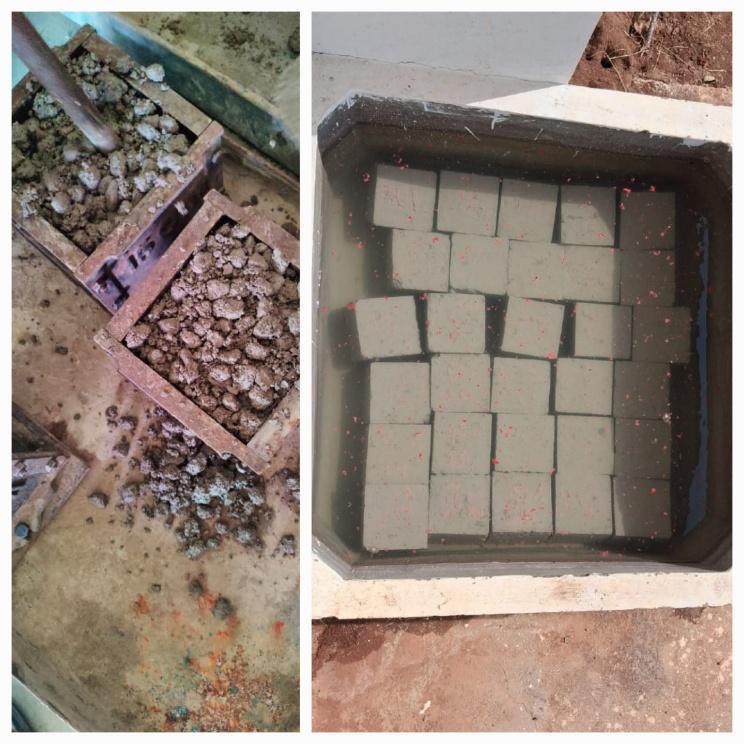
5.Casting and curing Specimens: Fresh concrete was poured into standard cube moulds of size 150 mm × 150 mm × 150 mm to prepare test specimens. Proper compactionwascarriedouttoremoveairvoidsandensure a dense and uniform structure. The moulds were kept undisturbed at room temperature for 24 hours. After demoulding,thespecimenswereplacedinawatertankfor curing to allow proper hydration and strength development. The curing periods were maintained for 7, 14, and 28 days to study the variation in compressive strengthwithtime.
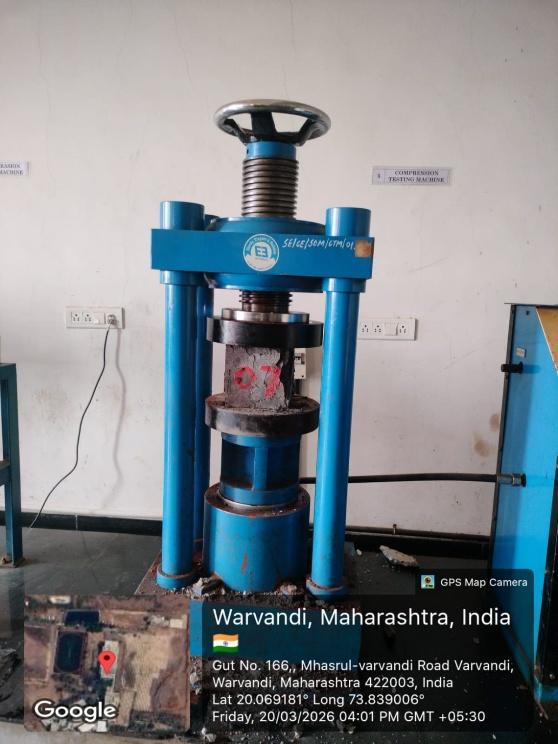
6.TestingofSpecimens:Aftercuringfor7,14,and28days, the concrete cube specimens were tested using a Compression Testing Machine (Accro-Tech, Delhi; Ram diameter: 234 mm) to determine their compressive strength.Theloadwasappliedgraduallyataconstantrate of approximately 2–5 kN/sec as per IS: 516-1959 until failureofthespecimen.Themaximumloadindicatedonthe dial gauge was recorded for each specimen. The compressive strength was calculated and compared for different silica fume replacement mixes with the control concrete. The variation in strength with respect to curing period and percentage replacement was observed and recorded.
International Research Journal of Engineering and Technology (IRJET) e-ISSN: 2395-0056
Volume: 13 Issue: 05 | May 2026 www.irjet.net p-ISSN: 2395-0072
Table:4-CompressivestrengthofSamples
[1] IS456:2000–PlainandReinforcedConcrete–Codeof Practice,BureauofIndianStandards(BIS),NewDelhi.
[2] IS 10262:2019 – Concrete Mix Proportioning –Guidelines, Bureau of Indian Standards (BIS), New Delhi.
[3] Chalah, K., Hammas, A., & Benmounah, A. (2024). ImprovementofPhysicalandMechanicalPropertiesof High-Performance Sand Concrete with Different Silica Fume Content. Advances in Civil and Architectural Engineering,15(29),19–32.
5. Graph and Observation
The graph shows that compressive strength varies with silica fume percentage. The 28-day strength increases significantly at 5% replacement and then decreases graduallyathigherpercentages.The7-daystrengthshows a decreasing trend, while the 14-day strength initially increases and then reduces. This indicates that optimum strengthisachievedaround5%silicafumereplacement.
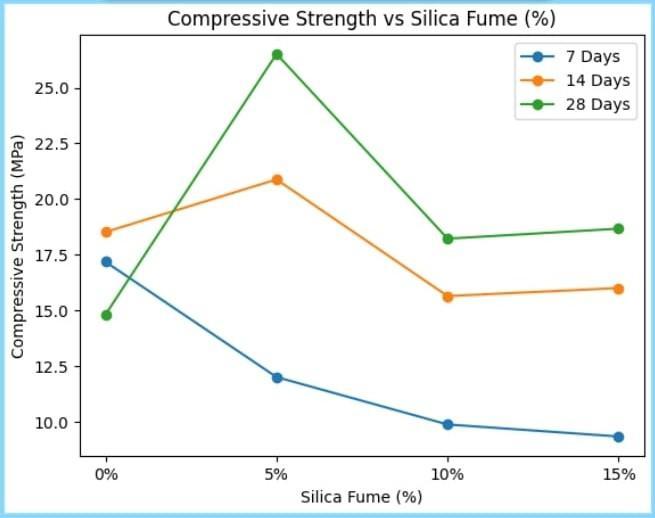
Chart -1:VariationofCompressiveStrengthwithSilica FumeReplacementatDifferentCuringAges
6. CONCLUSIONS
Thisstudysuccessfullyevaluatedtheeffectofsilicafumeas apartialreplacementofcementandM-Sandasacomplete replacementofriversandinM30gradeconcrete. The results show that silica fumes improve compressive strength and durability due to its pozzolanic reaction and micro-filling effect. The optimum replacement level is around5%,whichgivesthebestbalancebetweenstrength and workability. M-Sand proved to be an effective alternativetoriversand.Nochemicaladmixturewasused inthisproject,yettheslumpvalueof70mmconfirmsthat theconcreteremainsworkableandsuitableforRCCwork. Silica fume concrete can be used in both high-rise structuresaswellassmallresidentialbuildings.
[4] Gražulytė,J.,Vaitkus,A.,Šernas,O.,&Čygas,D.(2020). Effect of Silica Fume on High-Strength Concrete Performance. Proceedings of the International Conference on Sustainable Engineering and Concrete Technology(ICSECT).
[5] Kumar,R.,&Dhaka,J.(2016).ReviewPaperonPartial ReplacementofCementwithSilicaFumeandItsEffects on Concrete Properties. International Journal for TechnologicalResearchinEngineering,4(1),83–85.
[6] Mehta, P. K., & Monteiro, P. J. M. (2014). Concrete: Microstructure, Properties and Materials (3rd ed.). McGraw-HillEducation.
[7] Mehta, P. K., & Monteiro, P. J. M. (2014). Concrete: Microstructure, Properties and Materials (3rd ed.). McGraw-HillEducation
[8] Neville,A.M.(2011).PropertiesofConcrete(5thed.). PearsonEducation.
[9] Pradhan,D.,&Dutta,D.(2013).EffectsofSilicaFumein Conventional Concrete. International Journal of EngineeringResearchandApplications,3(5),24–30.
[10] Ajileye, F. V. (2012). Investigations on Microsilica (Silica Fume) as Partial Cement Replacement in Concrete. Global Journal of Research in Engineering, 12(1),17–23
[11] Amudhavalli,N.K.,&Mathew,J.(2012).EffectofSilica Fume on Strength and Durability Parameters of Concrete.InternationalJournalofEngineeringSciences &EmergingTechnologies,3(1),28–35.
[12] Roy,D.,&Sil,S.(2012).EffectofPartialReplacementof Cement by Silica Fume on Hardened Concrete. International Journal of Emerging Technology and AdvancedEngineering,2(8),472–475.
[13] Siddique, R. (2011). Utilization of Industrial Byproducts in Concrete. Resources, Conservation and Recycling,55(4),459–467.
[14] Gonen, T., & Yazıcıoğlu, S. (2007). The Influence of Mineral Admixtures on the Short and Long-Term Performance of Concrete. Building and Environment, 42(8),2980–2985.
International Research Journal of Engineering and Technology (IRJET) e-ISSN: 2395-0056
Volume: 13 Issue: 05 | May 2026 www.irjet.net p-ISSN: 2395-0072
[15] IS 269:2015 – Ordinary Portland Cement –Specification, Bureau of Indian Standards (BIS), New Delhi.
[16] IS4031(VariousParts)–MethodsofPhysicalTestsfor Hydraulic Cement, Bureau of Indian Standards (BIS), NewDelhi.
[17] IS 383:2016 – Specification for Coarse and Fine AggregatesfromNaturalSourcesforConcrete,Bureau ofIndianStandards(BIS),NewDelhi.
[18] IS 2386 (Parts 1–8):1963 – Methods of Test for Aggregates for Concrete, Bureau of Indian Standards (BIS),NewDelhi.
[19] IS 1199:1959 – Methods of Sampling and Analysis of Concrete,BureauofIndianStandards(BIS),NewDelhi
[20] IS 7320:1974 – Specification for Concrete Slump Test Apparatus, Bureau of Indian Standards (BIS), New Delhi.