

International Research Journal of Engineering and Technology (IRJET) e-ISSN: 2395-056
Volume: 13 Issue: 05 | May 2026 www.irjet.net p-ISSN: 2395-072
APPLICATION OF ELECTROCHROMIC GLASS IN MODERN BUILDINGS: A CASE STUDY-BASED EVALUATION OF PERFORMANCE AND PROJECT MANAGEMENT IMPLICATIONS
Ar. S. Hariesh1 , Ar.V.Vidya2 , Ar. Z. Fathima Taskeen3
1Post Graduate Student, M.Arch - Construction project management student, Faculty of Architecture, Dr .M.G.R Educational and Research Institution, Chennai, India.
2Associate Professor, Faculty of Architecture, Dr .M.G.R Educational and Research Institution, Chennai, India.
3Additional HOD, Faculty of Architecture, Dr .M.G.R Educational and Research Institution, Chennai, India. ***
Abstract - Electrochromic (EC) glass is an advanced smart glazing technology that enables dynamic control of solar radiation, daylight, and thermal performance in modern buildings. Conventional glazed façades often increase indoor heat gain, glare, and cooling loads, leading to higher energy consumption and reduced occupant comfort. Electrochromic glass addresses these issues by changing its tint level in response to electrical signals, allowing buildings to regulate light and heat transmission without external shading devices. This paper evaluates the real-world application of electrochromic glass through case study analysis of Google Ananta Office and Monte Carlo Building in Ahmedabad. The study examines the impact of electrochromic glazing on energy performance, thermal comfort, daylight optimization, HVAC load reduction, project cost, and implementation challenges. A comparative assessment is carriedout to understandhowthe technology performs under different climatic and operational conditions. The results indicate that electrochromic glass can reduce cooling loads and overall building energy consumption by approximately 15–30%, while improving occupant comfort and reducing dependence on artificial lighting. However, high capital cost, vendor dependency, specialized installation, and integration with Building Management Systems remain major challenges. The study concludes that electrochromic glass is an effective strategy for sustainable and high-performance buildings when incorporated during the early stages of project planning anddesign.
Key Words: Electrochromic Glass, Smart Façade, Sustainable Building, Smart Glazing, HVAC Reduction, Net-Zero Energy Building, Project Management, Energy Efficiency.
1. INTRODUCTION
Buildings account for nearly 40% of global energy consumption, with a large proportion of this energy used for heating, ventilation, and air-conditioning systems. In contemporary commercial architecture, extensive glass façades are increasingly used to create transparency, visual connectivity, and modern aesthetics. However, conventionalglassfaçadescontributesignificantlytosolar heat gain, glare, and increased cooling loads. Traditional
methods of controlling heat gain include blinds, curtains, and external shading devices. Although these systems reduceheatandglare,theyalsoblocknaturaldaylightand external views. This creates a conflict between daylight utilizationandthermalcomfort.Electrochromicglass,also known as smart glass or dynamic glazing, provides a solutiontothisissue.Electrochromicglasscanvaryitstint levelbyapplyingasmallelectricalvoltage.Whentinted,it reduces glare and solar heat gain; when clear, it allows maximum daylight and visibility. This ability to dynamically respond to changing environmental conditions makes electrochromic glass highly suitable for modern sustainable buildings. Although several studies have demonstrated the theoretical advantages of electrochromic glass, there is limited research on its practical implementation, especially in the Indian construction industry. Most available studies are simulation-based and do not sufficiently address project management implications such as cost, procurement, coordination, scheduling, and integration. This paper therefore investigates the practical use of electrochromic glass through detailed case study analysis. The research seeks to establish a comprehensive understanding of the working principle and control mechanisms of electrochromicglasswhileanalyzingthespecificinfluence ofelectrochromicglazingonbuildingenergyperformance. Furthermore, the study aims to investigate the impact of electrochromic glass on project management parameters such as cost, coordination, scheduling, and procurement. By comparing real-world case studies where electrochromic glass has been implemented, the research identifies the unique opportunities and limitations associatedwiththetechnologyinthecurrentmarket.
2. METHODOLOGY
Chart -1:Methodology
International Research Journal of Engineering and Technology (IRJET) e-ISSN: 2395-056
Volume: 13 Issue: 05 | May 2026 www.irjet.net p-ISSN: 2395-072
3. ELECTROCHROMIC GLASS WORKING PRINCIPLE
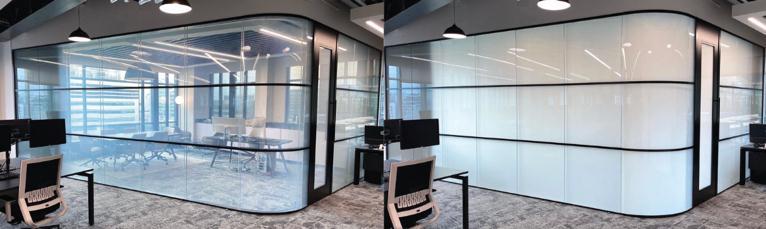
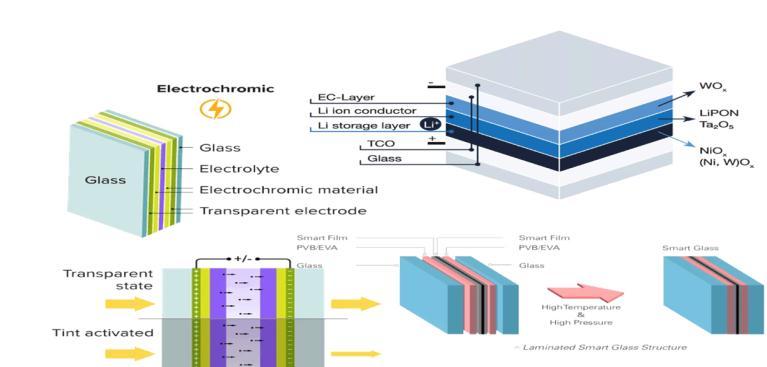
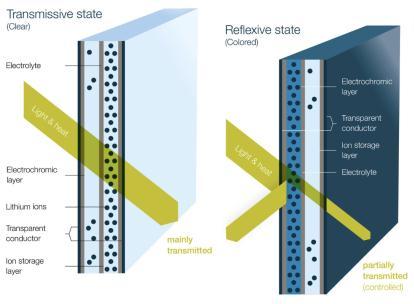
Electrochromic glass is a sophisticated multi-layered system deposited onto a glass substrate, functioning as a solid-state battery. The structure includes a Transparent Conductive Layer, an Electrochromic Layer typically composed of Tungsten Oxide (), an Ion Conductor Layer, and a Counter Electrode Layer, all protected by an outer glass pane. The transformation is triggered when a lowvoltage electrical current usually less than 5V is applied, causing ions to migrate from the counter-electrode through the ion conductor into the electrochromic layer. This ion migration alters the optical properties of the material,shiftingitfromatransparentstatetoadarktint.
Thesystemoperatesintwoprimarymodes.InClearMode, the glass allows for maximum daylight penetration and maintains high visual clarity. In Tinted Mode, the glass selectively filters the solar spectrum to reduce glare and solar heat gain while maintaining a view of the outdoors. This dynamic versatility provides several advantages, including the substantial reduction of cooling loads, the elimination of mechanical blinds, and the enhancement of overall thermal comfort for occupants. Furthermore, the technologyprovidessignificantsupportforachieving high ratings in sustainable building certifications like LEED or GRIHA.
4. CASE STUDY ANALYSIS
4.1 Case study 1 – Google Ananta office, Banglore
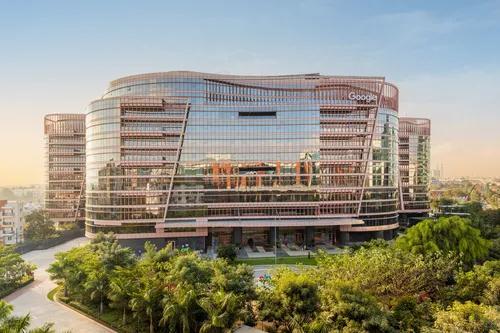
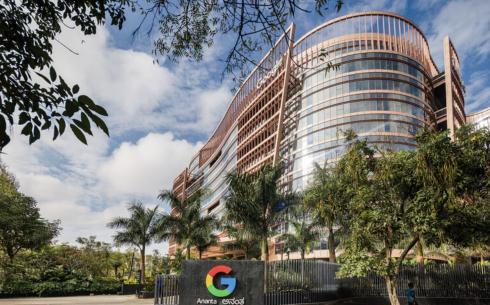
TheGoogle Anantacampus in Bengaluru, Karnataka, stands as a testament to the future of the modern workplace,blendingcutting-edgetechnologywithhumancentric design.Located in the bustlingMahadevapuradistrict, often referred to as India’s Silicon Valley,this projectservesastheanchor for the Rio Business Park Developed by the Bagmane Group, the campus spans approximately1.6 million sq. ft.and is designed to house over5,000 employeesfrom across Google’s diverse divisions, including Android, Cloud, Search, and DeepMind The name "Ananta," derived from Sanskrit for "infinite," reflects a core philosophy of limitlessinnovation
Architectural Vision and Master Concept
Led byBroadway Malyanin collaboration withGoogle Design Studio, the architectural strategy adopts a "citygrid" spatial organization Rather than traditional office layouts, each floor is conceptualized as a mini-city featuringanetworkof"streets"and"neighborhoods".This structure is designed to balance focused work with collaborative team zones.At the heart of the campus lies theSabha, a central amphitheater and town-hall auditorium intended for communal gatherings and the exchange of ideas The exterior is defined by afluid, sculptedfaçadeacurveddesignthatnotonlyenhancesthe building's urban presence but also serves the functional purpose of improving natural daylighting and reducing glare
The Innovation of Electrochromic Glass
A defining feature of Google Ananta is its integration ofSageGlass Harmonyelectrochromic technology In a cooling-dominatedclimatelikeBengaluru,managingsolar heat gain is a significant challenge This "smart" glass solution responds dynamically to the sun, tinting on a gradient to regulate temperature and eliminate glare without the need for traditional blinds or shades This ensures that employees maintain a constant visual connection to the outdoors, including views of the nearby Mahadevapura Lake, which supports the project's biophilicdesigngoals
Performance and Sustainability Metrics
The technical impact of the electro chromic façade is substantial:
Thermal Control:The glass can reject up to96% of solar heat, leading to a direct reduction in the radiant temperature felt by occupants a decrease of approximately6.0°Cnear the façade Energy Efficiency:The system contributes to an estimated20% reductionin overall building energy consumption HVAC Optimization:By reducing peak cooling loads by up
International Research Journal of Engineering and Technology (IRJET) e-ISSN: 2395-056
Volume: 13 Issue: 05 | May 2026 www.irjet.net p-ISSN: 2395-072
to25%, the building was able to downsize its mechanical systems, saving on construction materials and plant spaceVisual Comfort:While static glass often results in severe glare (up to 3,500 lux), the SageGlass system maintainsinteriorilluminanceatcomfortablelevels(600–800lux)evenduringpeaksolarintensity
Inclusive Design and Future Outlook
Completed inNovember 2024, Google Ananta prioritizes inclusivity and well-being The interior strategy includes tactile flooring and Braille signage for visually impaired users, alongside organic landscaping and theAranya Forestnoise buffer, which creates a "living-laboratory" environment.The project’s success relied on a complex technical integration involving over12,000 glass panelsand seamless collaboration between global tech providers and local installation teams.Ultimately, the campus serves as a micro-urban world where technology and green infrastructure meet to foster a creative, inclusivecommunity
4.2 Case Study 2 – Monte Carlo Office, Ahmedabad
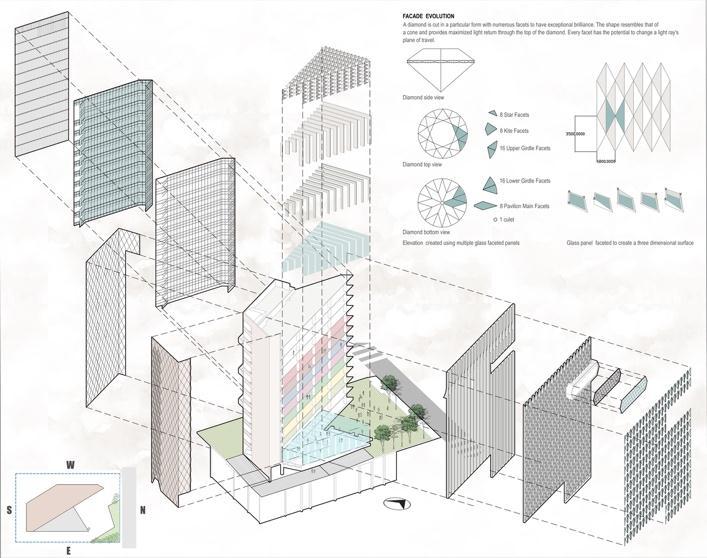
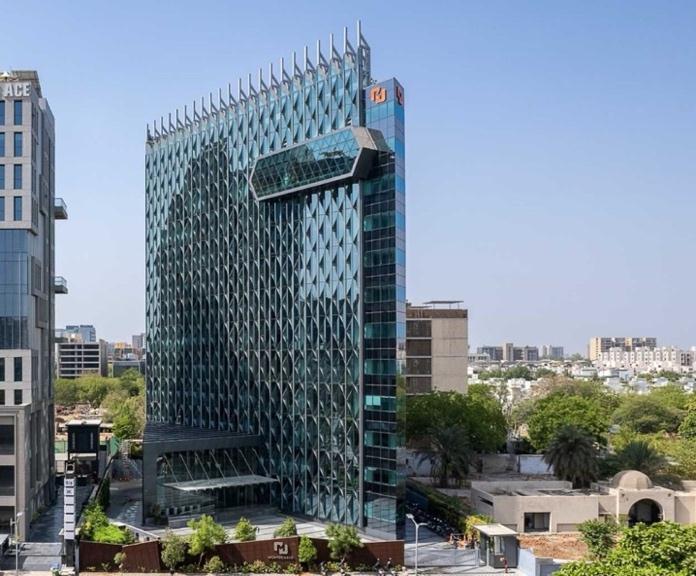
TheMonte Carlo Building in Ahmedabad, Gujarat, serves as a critical case study for the practical application of electrochromic glass within a corporate office setting, specifically tailored to the challenges of ahot-dry climate. Theprimaryarchitectural intentbehindthefaçadedesign was to address the region's intense solar radiation. By integrating electrochromic glazing, the building manages todrasticallyreduceindoorheatgainwhilemaintaininga highdegreeoftransparencyanddaylightautonomy,which isoftenlostwithtraditionalshadingmethods.
From a technical performance standpoint, the smart glass serves as a dynamic thermal barrier. During the harsh summermonthsinAhmedabad,thetechnologyeffectively stabilizes indoor temperatures by modulating its tint based on solar intensity. This process significantly lowers theSolar Heat Gain Coefficient (SHGC)of the building envelope, leading to a measurable reduction in cooling loads. For the occupants, this results in a superior indoor environment where thermal fluctuations are minimized and visual comfort is enhanced through the mitigation of direct glare, which is a common issue in large-scale office glazing.
In terms of project management and financial implications, the integration of this technology necessitated a moderate increase in the initial capital expenditure.However,thisbudgetallocationwaspartially offset by theelimination of external shading devicesand heavy mechanical louvers, which simplified the exterior architectural profile and reduced material waste. The long-term project management strategy focused on a reduced dependence on mechanical cooling systems, which translates to lower operational costs over the building's lifecycle. Ultimately, the Monte Carlo Building demonstratesthatelectrochromicglassisaviablesolution for high-performance buildings in India, achieving a balance between aggressive energy saving and highqualitydaylighting.
International Research Journal of Engineering and Technology (IRJET) e-ISSN: 2395-056
Volume: 13 Issue: 05 | May 2026 www.irjet.net p-ISSN: 2395-072
5. RESULTS AND DISCUSSION
The study shows that electrochromic glass can reduce building energy consumption by approximately 15–30%, depending on climate, building orientation, and integration strategy. Buildings located in hot and composite climates experience the greatest benefit due to thereductionincoolingdemand.
Electrochromic glass also improves occupant comfort by controlling glare and maintaining stable indoor temperatures. Unlike conventional shading systems, it preservesoutdoorviewsanddaylightquality.
From a project management perspective, electrochromic glass affects several aspects of project execution:
Highercapitalexpenditureduringconstruction.
Increased coordination between consultants and vendors.
Need for early-stage integration in design and procurement.
PotentialreductioninHVACsystemsize.
Long-term reduction in operating and maintenancecosts.
The case studies further demonstrate that electrochromic glassismostsuitablefor:
Commercial office buildings. Institutional and educational buildings.Net-zero energy buildings. High-performancefaçadesystems However,thetechnologystillfacesseverallimitations:
High installation cost. Limited local availability. Dependenceonimportedsystems.
Requirement of skilled installation teams. Maintenanceandcontrolsystemcomplexity
6. RECOMMENDATION
Electrochromic glass is an effective smart façade technology that significantly improves building performance,occupantcomfort,andenergyefficiency.The casestudiesdemonstratethatthetechnologyiscapableof reducingcoolingloads,improvingdaylightutilization,and supportingnet-zeroenergygoals.
Although the technology requires higher initial investment and more complex project coordination, the long-term operational and environmental benefits justify its adoption in modern construction projects. Successful implementation depends on early-stage planning, integration with Building Management Systems, and coordination between façade, electrical, and HVAC consultants.
Futureresearchmayfocusonreducingcost,improving local manufacturing, and integrating electrochromic systems with artificial intelligence and predictive building controls.
7. REFERENCE
[1] S. M. Granqvist, “Electrochromics for Smart Windows: Oxide-Based Thin Films and Devices,” Thin Solid Films, vol.564,pp.1–38,2014.
[2] C. G. Granqvist, “Electrochromic Materials: Out of a Niche,”NatureMaterials,vol.5,no.2,pp.89–90,2006.
[3] A. Tällberg et al., “Electrochromic Windows and Their ImpactonEnergyUseinBuildings,”Energy andBuildings, vol.84,pp.1–8,2014.
[4] www.archdaily.com/991712/monte-carlo-officesedifice-consultants/6364efd784929e325e4b6c02-montecarlo-offices-edifice-consultants-diagram01?next_project=no
[5]https://blog.google/intl/en-in/companynews/welcome-to-ananta-google-indias-new-campus-inbengaluru/
[6]https://in.saint-gobainglass.com/blog/electrochromic-glass-commercial-spacesadvantages-implementation-tips