
International Research Journal of Engineering and Technology (IRJET) e-ISSN: 2395-0056
Volume: 13 Issue: 06 | Jun 2026 www.irjet.net p-ISSN: 2395-0072

International Research Journal of Engineering and Technology (IRJET) e-ISSN: 2395-0056
Volume: 13 Issue: 06 | Jun 2026 www.irjet.net p-ISSN: 2395-0072
Anita A. J 1 , Nisarga P. P 2 , Vijayalaxmi H 3 , Samrudhi V. K 4 , R Sai Meghana 5
1234 B.Tech 2nd Year, Dept. of Electronics and Communication Engineering, Visvesvaraya Technological University, Belagavi, Karnataka, India.
5 Junior Research Fellow, Dept. of Electronics and Communication Engineering, Visvesvaraya Technological University, Belagavi, Karnataka, India.
***
Abstract - Agriculture plays a vital role in ensuring food security and supporting the economy. One of the major challenges faced by farmers is crop damage caused by wild and domestic animals entering agricultural fields. Traditional methods such as fencing, scarecrows, and manual monitoring often require significant effort and are notalwayseffective. To address this issue, the Animal Intrusion AlertSystemforSmart Farming has been developed as an automated solution for detecting animalmovementandproviding immediatealertsto farmers. The proposed system uses a PIR (Passive Infrared) sensor to detect motion within the monitored area. The detected signal is processed by the STM32 Blue Pill microcontroller, which acts as the central controller of the system. Whenever movement is detected, the system activates an LED indicator and a buzzer to generate visual and audible alerts. An ESP32 module is also incorporatedtosupportfuture wireless communication and IoT-based monitoring applications. The system continuously monitors the agricultural environment and operatesautomaticallywithout requiring constant human supervision. The proposed solution is cost-effective, reliable, and easy to implement. Experimental results demonstrate that the system successfully detects motion and generates timely alerts, helping farmers reduce crop losses and improve farm security. The project highlights the application of embedded systems and sensor technologies in modern smart farming and provides a foundation forfuture enhancements such as mobile notifications, cloud monitoring, and intelligent animal recognition.
Key Words: Animal Intrusion Detection, Embedded Systems, ESP32, PIR Sensor, Smart Farming
1. INTRODUCTION
Agricultureisoneofthemostimportantsectorssupporting the economy and food production worldwide. Farmers investsignificanteffortandresourcesincultivatingcropsto meet the growing demand for food. However, agricultural fieldsarefrequentlythreatenedbytheintrusionofwildand domesticanimalssuchasboars,monkeys,deer,elephants, andstraycattle.Theseanimalsoftenenterfarmsinsearchof food and water, causing severe damage to crops and resulting in considerable financial losses for farmers. Traditionalmethodsusedtoprotectcropsincludefencing, scarecrows, manual patrolling, and guard animals. While these methods provide some level of protection, they are often ineffective, labor-intensive, and costly. Monitoring
largeagriculturalareascontinuouslyisdifficult,especially duringnighttime.
Therefore,thereisagrowingneedforanautomatedand intelligentsystemcapableofdetectinganimalintrusionand alerting farmers immediately. Recent developments in embedded systems, sensors, and wireless communication technologies have enabled the implementation of smart farmingsolutions.Thesetechnologieshelpfarmersautomate monitoringprocessesandimprovefarmsecurity.TheAnimal Intrusion Alert System for Smart Farming is designed to detectanimalmovementnearagriculturalfieldsandgenerate alertsusingembeddedhardwarecomponents.
Animalintrusionintoagriculturalfieldsremainsamajor concerninruralfarmingcommunities.Farmersoftensuffer substantial crop losses due to the inability to detect intrusions at the right time. Existing protection methods require constant human supervision and may fail under adverseweatherconditionsorduringnighttimeoperations. The main problem addressed in this project is the development ofan automated system capable of detecting animal movement and generating immediate alerts. The system should operate continuously with minimal human interventionwhileprovidingreliableandtimelynotifications topreventcropdamage.
ThemainobjectivesoftheAnimalIntrusionAlertSystemfor SmartFarmingare:
1. Todetectanimalmovementnearagriculturalfieldsusing aPIRsensor.
2. To monitor farm boundaries continuously and automatically.
3. To process sensor signals using the STM32 Blue Pill microcontroller.
4. To generate visual alerts using LEDs when intrusion is detected.
5. Togenerateaudiblealertsusingabuzzerforimmediate farmernotification.
6. ToenablefuturewirelesscommunicationthroughESP32 integration.
The scope of this project includes the design and developmentofanembeddedsystemcapableofmonitoring agriculturalareasforanimalintrusion.Thesystemutilizesa PIRmotionsensortodetectmovementandanSTM32Blue
International Research Journal of Engineering and Technology (IRJET) e-ISSN: 2395-0056
Volume: 13 Issue: 06 | Jun 2026 www.irjet.net p-ISSN: 2395-0072
Pillmicrocontrollertoprocessintrusionevents.Whenever movementisdetected,abuzzerandLEDalertmechanismis activated to notify nearby farmers. The project focuses on developingaprototypesuitableforagriculturalapplications. The ESP32 module provides opportunities for future expansionthroughIoTintegration, cloudconnectivity,and mobile notifications. The proposed system is suitable for farms, orchards, plantations,and crop fields where animal intrusionisacommonproblem.
Yang et al. (2021) presented a comprehensive survey on smartagriculturetechnologies,discussingtheintegrationof IoT, wireless sensor networks, cloud computing, artificial intelligence,andembeddedsystemsinmodernfarming.The authors highlighted that sensor-based monitoring and automatedalertsystemssignificantlyimproveagricultural productivity and reduce manual intervention. They concluded that real-time monitoring using embedded devicesformsthefoundationofsmartfarmingapplications, includinganimalintrusiondetectionandcropprotection[1].
Abrahametal.(2023)conductedadetailedreviewofwild animalintrusiondetectionsystemsusedinagriculture.The study analyzed various sensing technologies such as PIR sensors,infraredsensors,cameras,GSMmodules,andIoTbased monitoring systems. The authors observed that embedded sensor networks combined with wireless communicationprovidereliableandcost-effectivesolutions for protecting crops from wild animal attacks. The review also suggested integrating intelligent image processing techniquestoimprovedetectionaccuracy[2]
Miaoetal.(2023)proposedafog-basedsmartagriculture systemcapableofdetectinganimalintrusionbeforeanimals enteredagriculturalfields.ThesystemcombinedPIRsensors, cameras,LoRacommunication,andedgecomputingtodetect, identify,andpredictanimalmovement.Experimentalresults demonstrated low-latency detection and timely alert generationwhilereducingcloudcommunicationoverhead, makingtheproposedarchitecturesuitableforruralfarming environments[3]
Ashok Kumar et al. (2021) reviewed various animal intrusion detection and repellent systems developed for agriculturalapplications.TheauthorscomparedGSM-based alert systems, wireless sensor networks, image processing techniques,andmachinelearningmethodsusedforwildlife monitoring.Thestudyconcludedthatcombiningembedded microcontrollers with motion sensors and communication modulesprovidesaneffectiveandeconomicalsolutionfor minimizingcropdamagecausedbyanimalintrusion[4]
Ajayi and Olaifa (2023) reviewed existing farmland intrusiondetectionsystems,rangingfromtraditionalfencing methods to modern IoT-based monitoring systems. Their
analysisshowedthatwirelesssensornetworks,embedded controllers,andsmartsurveillancetechnologiesofferbetter reliability,reducedhumaneffort,andimprovedfarmsecurity comparedtoconventionalprotectionmethods[5]
Liuetal.(2021)discussedtheevolutionofAgriculture4.0 and emphasized the importance of IoT, sensor networks, automation,andintelligentmonitoringinmodernfarming. Thestudyexplainedthatembeddedsystemsenablereal-time monitoringofenvironmentalparametersandsecurityevents, providingthetechnologicalfoundationforsmartagricultural applicationssuchasautomatedanimal intrusiondetection [6].
Khanna and Kaur (2019) investigated the role of the InternetofThings(IoT)inprecisionagriculture.Theauthors demonstrated that IoT devices equipped with sensorsand wireless communication enable continuous monitoring of agricultural environments while improving resource utilization and crop protection. The study concluded that sensor-based automation can significantly enhance agriculturalproductivityandreducelaborrequirements[7]
Ray (2017) presented a comprehensive review of IoT technologies applied to smart agriculture. The paper discussed sensor networks, embedded controllers, cloud computing, and wireless communication for agricultural automation.Thestudyhighlightedthatlow-costembedded systems provide practical solutions for real-time field monitoring, making them suitable for applications such as animalintrusiondetectionandfarmsecurity[8]
Elijah etal.(2018) reviewedtheapplicationofIoTand dataanalyticsinagriculture.Theauthorsexaminedvarious sensingtechnologies,wirelesscommunicationmethods,and cloud platforms used for intelligent farming. Their work concluded that integrating embedded systems with IoT significantly improves monitoring efficiency and enables rapid response to security threats and environmental changesinagriculturalfields[9]
Rajeshetal.(2024)developedasmartwildlifeintrusion detection and diversion system that combines infrared sensors,cameras,machinelearningalgorithms,LEDlights, and sound-based repellent mechanisms. The proposed systemaccuratelyidentifiedwildanimalsandactivatedvisual and audible deterrents to protect crops. Experimental evaluationdemonstratedimproveddetectionaccuracyand reducedcropdamage,makingthesystemhighlysuitablefor modernsmartfarmingapplications[10].
The Animal Intrusion Alert System for Smart Farming is designed to provide an automated solution for protecting agricultural fields from animal attacks. The system continuously monitors the farm area using a PIR (Passive
International Research Journal of Engineering and Technology (IRJET) e-ISSN: 2395-0056
Volume: 13 Issue: 06 | Jun 2026 www.irjet.net p-ISSN: 2395-0072
Infrared) sensor and detects motion whenever an animal enters the protected region. Upon detection, the system generates immediate alerts through an LED indicator and buzzer, allowing farmers to take preventive action before significantcropdamageoccurs.
Theproposedsystemconsistsoffivemajorcomponents: STM32BluePillmicrocontroller,PIRsensor,ESP32module, LED, and buzzer. The PIR sensor acts as the sensing unit, whiletheSTM32BluePill servesasthecentral processing unitresponsibleforanalyzingsensorsignalsandcontrolling outputdevices.TheLEDprovidesvisualindication,whereas thebuzzergeneratesanaudiblewarningsignal.TheESP32
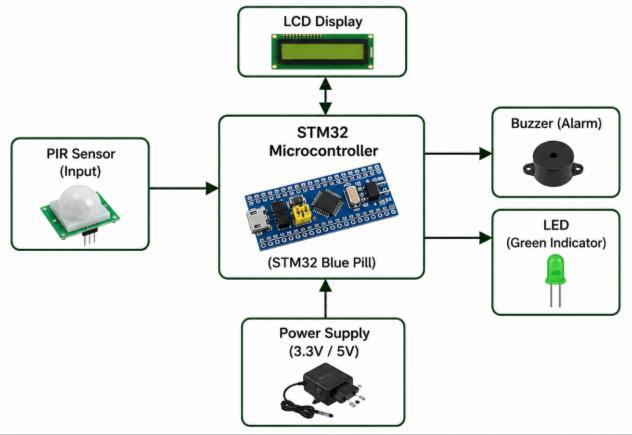
Fig -1:BlockDiagramofAnimalIntrusionAlertSystem modulecanbeusedforfutureIoT-basedcommunicationand remote monitoring applications. The system operates continuously and automatically. When no movement is detected, the PIR sensor remains inactive, and the system stays in monitoring mode. Once an animal enters the detection zone, the PIR sensor detects changes in infrared radiation and sends a signal to the STM32 Blue Pill microcontroller. The controller processes the signal and activatestheLEDandbuzzer.
The block diagram in Fig.1 illustrates the overall operation of the Animal Intrusion Alert System. The PIR sensor continuously monitors the farm environment and detectsanimalmovement.Thedetectedsignalistransmitted totheSTM32BluePill microcontrollerforprocessing.The STM32 Blue Pill acts as the brain of the system and determines whether an intrusion event has occurred. If motionisconfirmed,thecontrollerimmediatelyactivatesthe LEDandbuzzertoalertthefarmer.TheESP32modulecan additionally transmit alert information through wireless communication technologies such as Wi-Fi and cloud platforms.Thisarchitectureensuresreal-timedetectionand rapidalertgeneration,makingitsuitableforagriculturalfield protection.
ThedevelopmentoftheAnimalIntrusionAlertSystemfor Smart Farming was carried out through a systematic approachinvolvinghardwaredesign,softwaredevelopment, integration, and testing. The objective was to create a reliable and cost-effective system capable of detecting animal movement and generating immediate alerts for farmers.
The first stage involved selecting suitable hardware componentsincludingtheSTM32BluePillmicrocontroller, PIR sensor, ESP32 module, LED, and buzzer. These components were chosen because of their low cost, reliability,andeaseofintegration.TheSTM32BluePillwas selected as the main controller due to its processing capabilityandmultipleGPIOinterfaces.
After hardware selection, the circuit connections were designed.ThePIRsensorwasconnectedtotheSTM32Blue Pilltoprovidemotiondetectionsignals.TheLEDandbuzzer were connected as output devices to generate visual and audiblealerts.TheESP32modulewasincludedtosupport futurewirelesscommunicationandIoT-basedmonitoring.
Thesoftwaredevelopmentphaseinvolvedprogramming the STM32 Blue Pill using Embedded C. The program continuouslymonitorsthePIRsensorandchecksformotion detection events. Whenever movement is detected, the controller activates the LED and buzzer. The system then returnstomonitoringmodeoncethemovementdisappears.
Afterintegratingthehardwareandsoftwarecomponents, testing was performed under different conditions. The system was evaluated for motion detection accuracy, response time, and alert generation performance. Experimentalresultsconfirmedthatthesystemsuccessfully detectsanimalmovementandgeneratesalertseffectively.
The working of the Animal Intrusion Alert System begins when power is supplied to the circuit. The PIR sensor continuouslymonitorstheprotectedagriculturalareaand detects changes in infrared radiation caused by animal movement. When an animal enters the sensing range, the PIR sensor generates a signal that is transmitted to the STM32BluePill microcontroller.Thecontrollerprocesses thesignalanddetermineswhethermotionhasoccurred.If motionisdetected,thecontrollerimmediatelyactivatesthe LEDandbuzzer.TheLEDprovidesavisualwarning,while the buzzer generates an audible alert to inform farmers abouttheintrusionevent.Thesystemcontinuesmonitoring untiltheanimalleavesthedetectionarea.Oncenomotionis detected,thecontrollerswitchesofftheLEDandbuzzerand returnstonormalmonitoringmode.TheESP32modulecan
International Research Journal of Engineering and Technology (IRJET) e-ISSN: 2395-0056
Volume: 13 Issue: 06 | Jun 2026 www.irjet.net p-ISSN: 2395-0072
additionallybeusedforfuturewirelesscommunicationand IoT-basedmonitoringapplications.
TheimplementationoftheAnimalIntrusionAlertSystemfor Smart Farming consists of both hardware and software componentsthatworktogethertoprovidereal-timeanimal intrusion detection and alert generation. The hardware is centered around the STM32 Blue Pill (STM32F103C8T6) microcontroller,whichactsasthemainprocessingunit.A
PIR(PassiveInfrared)sensorisusedastheinputdeviceto detect animal movement by sensing changes in infrared radiation. Whenever motion is detected, the PIR sensor sends a digital signal to the STM32 microcontroller for processing.
Basedonthereceivedsignal,themicrocontrolleractivates theoutputdevices,namelytheLEDandthebuzzer.TheLED provides a visual indication of intrusion, while the buzzer generatesanaudiblealarmtoalertnearbyfarmers.AnESP32 module is also interfaced with the STM32 Blue Pill to
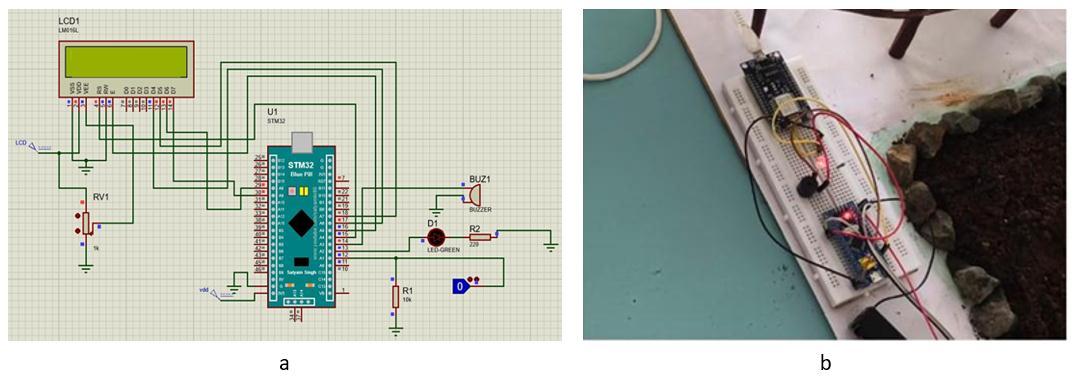
facilitate future IoT-based applications such as wireless monitoring,cloudconnectivity,andmobilenotifications.The entiresystemispoweredusingaregulated3.3V/5Vpower supply to ensure reliable operation of all connected components.
The software was developed using Embedded C and programmed into the STM32 Blue Pill microcontroller. During system initialization, all GPIO pins are configured, withthePIRsensorsetastheinputandtheLED,buzzer,and
2026, IRJET | Impact Factor value: 8.315 |
ESP32 communication pins configured as outputs. The programcontinuouslymonitorsthePIRsensorinaninfinite loop. When the sensor detects motion, the controller immediately switches ON the LED and buzzer to generate alerts.Oncethemotionceases,thecontrollerturnsOFFthe outputdevicesandreturnstomonitoringmode.Thesoftware isdesignedtoprovidequickresponse,reliableperformance, andlowpowerconsumptionwhileallowingfutureexpansion throughESP32-basedwirelesscommunication.
Volume: 13 Issue: 06 | Jun 2026 www.irjet.net p-ISSN: 2395-0072
Fig.2(a)andFig.2(b)illustratestheoverallsoftwareand hardware implementation of the Animal Intrusion Alert Systemrespectively.ThePIRsensorcontinuouslymonitors theprotectedareaandsendsmotiondetectionsignalstothe STM32 Blue Pill microcontroller. The microcontroller processestheinputsignalandcontrolstheLEDandbuzzerto generate visual and audible alerts. The ESP32 module is connected for future IoT-based communication, enabling remote monitoring and notification capabilities, while the regulatedpowersupplyprovidesstableoperatingvoltageto allsystemcomponents.
TheAnimalIntrusionAlertSystemforSmartFarmingwas successfully designed, implemented, and tested. The developedsystemeffectivelydetectedmotionusingthePIR sensor and generated alerts whenever movement was identifiedwithinthemonitoredarea.TheSTM32BluePill microcontroller successfully processed the sensor signals andcontrolledtheoutputdevices.TheHardwareResultof AnimalIntrusionAlertSystemforSmartFarmingisshownin Fig.4.
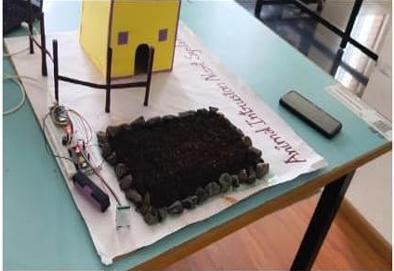
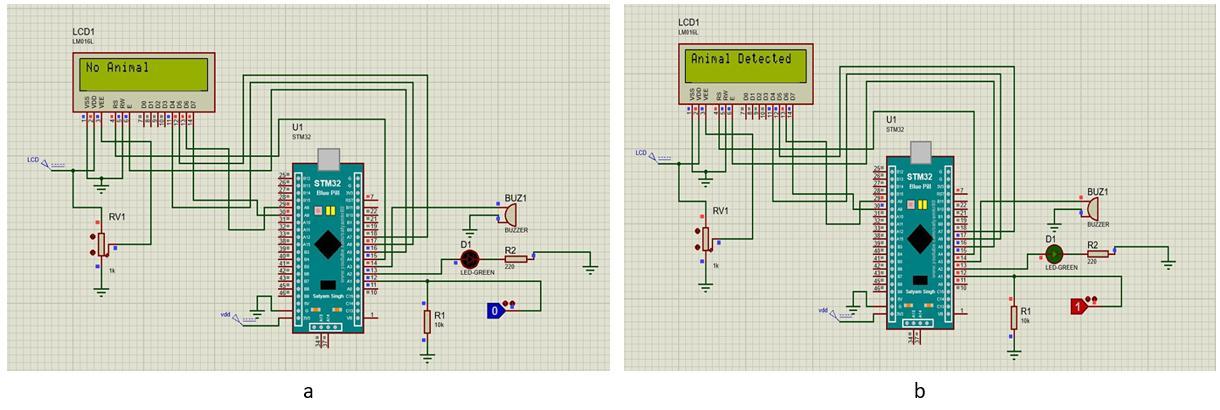
During testing, the system operated continuously and monitored the surroundings without requiring human intervention.WheneverthePIRsensordetectedmotion,the LED indicator and buzzer were activated immediately, providing visual and audible alerts. This allowed rapid identification of intrusion events and demonstrated the effectiveness of the proposed solution. Proteus Result of AnimalIntrusionAlertSystemforSmartFarmingisshownin
Fig.3(a)NoAnimalandFig.3(b)AnimalDetected.
The Proteus simulation results verified the proper functioningofthesystembeforehardwareimplementation. The simulation confirmed that the controller correctly respondedtosensorinputsandactivatedtheoutputdevices asexpected.Thehardwareprototypealsoproducedsimilar results, indicating consistency between simulation and practical implementation. The PIR sensor demonstrated reliablemotiondetectionwithinitsspecifiedoperatingrange. TheSTM32BluePillprocessedsensorsignalsefficientlyand activated alerts with minimal delay. The LED and buzzer responded immediately whenever motion was detected, ensuringtimelynotification.Thesystemmaintainedstable performance during continuous operation and consumed relatively low power, making it suitable for agricultural applications. Table.1 illustrates the observation table of animalintrusionalertsystemforsmartfarming
Table -1: ProjectObservationTable
TheAnimalIntrusionAlertSystemforSmartFarmingwas successfully developed to address the problem of crop damage caused by animal intrusion. The system utilizes a PIRsensortodetectanimalmovementandanSTM32Blue Pill microcontroller to process the detected signals. Whenever motion is identified, the system immediately activates a buzzer and LED, providing both audible and visual alerts to farmers. The project demonstrated that embedded systems can be effectively used in agricultural applicationstoimprovesecurityandreducecroplosses.
International Research Journal of Engineering and Technology (IRJET) e-ISSN: 2395-0056
Volume: 13 Issue: 06 | Jun 2026 www.irjet.net p-ISSN: 2395-0072
The developed system operated reliably during testing andsuccessfullydetectedmovementwithinthemonitored area.Theuseoflow-costcomponentssuchastheSTM32Blue Pill,PIRsensor,LED,buzzer,andESP32modulemakesthe systemaffordableandsuitableforsmallandmedium-scale farmers.
The Proteus simulation and hardware implementation confirmedtheproperfunctioningofthesystem.Theresults showedthatthesystemcancontinuouslymonitorthefarm environment, detect animal intrusion in real time, and generateimmediatealerts.TheESP32modulealsoprovides opportunities for future expansion through wireless communication and IoT-based monitoring. Overall, the project demonstrates a practical, economical, and efficient solution for protecting agricultural fields from animal intrusion and supporting the adoption of smart farming technologies
[1] X. Yang et al., "A Survey on Smart Agriculture: Development Modes, Technologies, and Security and Privacy Challenges," IEEE/CAA Journal of Automatica Sinica,vol.8,no.2,pp.273–302,2021.
[2] A. Abraham et al., "Literature Review on Detection Systems for Wild Animal Intrusions," Journal of Soft ComputingParadigm,vol.5,no.1,pp.50–59,2023.
[3] J.Miaoetal.,"AFog-basedSmartAgricultureSystemto DetectAnimalIntrusion,"arXiv,2023.
[4] L.AshokKumaretal.,"ALiteratureResearchReviewon Animal Intrusion Detection and Repellent Systems," ProceedingsofICCAP2021,EAI,2021.
[5] O.AjayiandO.Olaifa,"AReviewofExistingFarmland Intrusion Detection Systems," International Journal of ComputerApplications,2023.
[6] Y. Liu et al., "From Industry 4.0 to Agriculture 4.0: Current Status, Enabling Technologies, and Research Challenges," IEEE Transactions on Industrial Informatics,vol.17,no.6,pp.4322–4334,2021.
[7] A.KhannaandS.Kaur,"EvolutionofInternetofThings (IoT)anditsSignificantImpactintheFieldofPrecision Agriculture,"ComputersandElectronicsinAgriculture, vol.157,pp.218–231,2019.
[8] P. P. Ray, "Internet of Things for Smart Agriculture: Technologies,PracticesandFutureDirection,"Journalof Ambient Intelligence and Smart Environments, vol. 9, no.4,pp.395–420,2017.
[9] O.Elijahetal.,"AnOverviewofInternetofThings(IoT) and Data Analytics in Agriculture: Benefits and Challenges,"IEEEInternetofThingsJournal,vol.5,no.5, pp.3758–3773,2018.
[10] K.Rajeshetal.,"DesignandDevelopmentofSmart System for the Identification and Diversion of Wild Animal in Agricultural Field," Proceedings of the International Conference on Advances in Computing, CommunicationandSystems(ICACCS),IEEE,2024.