
International Research Journal of Engineering and Technology (IRJET) e-ISSN: 2395-0056
Volume: 12 Issue: 01 | Jan 2025 www.irjet.net p-ISSN: 2395-0072
International Research Journal of Engineering and Technology (IRJET) e-ISSN: 2395-0056
Volume: 12 Issue: 01 | Jan 2025 www.irjet.net p-ISSN: 2395-0072
Tamilselvan C1, Harshal Valvi2, Arun Mohan3, Dr. Sini S Nair4
1Intern,ITG-Dept, National Institute of Electronics & Information Technology,Calicut.
2Intern,ITG-Dept, National Institute of Electronics & Information Technology,Calicut.
3Project Associate,ITG-Dept, National Institute of Electronics & Information Technology,Calicut.
4Scientist,ITG-Dept, National Institute of Electronics & Information Technology,Calicut.
Abstract - Routers play a quintessential role in networkingandcommunicationtotheinternet as theyserve as the gateway between the user devices and the web. Routers are however subject to risks with their firmware as vulnerabilities within it can be exploited by intruders to break into a secure network. An efficient technique for encapsulating such security risks is static analysis which aims to pinpoint security holes within the code without attempting to run it. This research demonstrates the use of Binwalk, Ghidra or any dismantling tool to pin point common router weaknesses such as compromised security through the use of hardcoded passwords, lack of encryption or neglecting to validate inputs. The paper also delves into other mitigation techniques through secure programming, better user identification, and consistent updates to the firmware. The findings counter potential embedded threats toroutersthroughproviding safetyandsecurityprotocols.
Key Words: Static analysis, Router devices, Firmware Analysis, Firmware Vulnerabilities.
A router is a device that enables multiple devices access the internet and also acts as a mediator for data packet transfer between different networks. It also assists in communicationbydeterminingtheoptimaldataroute,which guaranteessafeandquickdeliveryofdata.[1].
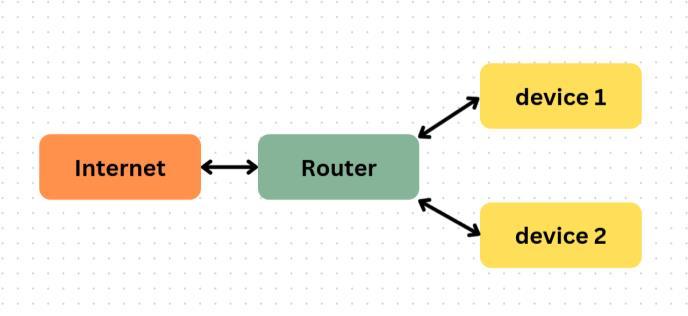
Fig -1: RouterConnectingDevicestotheInternet
Firmwareistheprogramthatiswrittenatthehardware levelofadeviceforperformingbasicoperations.Itservesasa mediator between the hardware and high-level software, ensuring the device is functioning as designed[2].Router firmwareistheprogramthatiswrittenatthecorelevelofthe routerdevicesoastoenableeffectivesendingandreceiving
ofdatabetweenthetwonetworks.Itsupplementstherouter by connecting the device’s hardware to its networking functions, allowing the router to securely and effectively perform its tasks[3].Most people tend to disregard the securityaspectofrouterfirmware;However,weaknessesin this firmware can endanger the whole network. Such vulnerabilities,whenabused, allowanintrudertohijackthe administrationoftherouter,changingthepathsofthedatain thenetwork,retrievingsecretinformationandinsomecases, using other equipment within the network to conduct attacks[4].
Static analysis is an approach that deals with security vulnerabilities and exploits by analyzing the source code or binary files of a program without executing it. Think of it as inspecting the architecture of the software to find potential security risks and embedded flaws. It is very different from dynamic analysis which observes an application in runtime. Staticanalysisdetectsprogrammingerrorssuchaslogicflaws, insecure code errors and buffer overflows which can be misused by the software attackers [5]. In contrast, Static analysis significantly helps in locating software weaknesses before an adversary can leverage them. Usually, router firmware is compiled to binary files and is thus vetting it is somewhatofacomplicatedtask[6].Staticanalysistoolssuch as Ghidra, IDA Pro and Binwalk, however, are capable of identifying hard-coded passwords, insecure communication protocolsandbufferoverflowvulnerabilitiesthatarepresetin afirmwareaswellasreverseengineerit.Securityweaknesses inanapplicationcanbelocatedthroughstaticanalysiswhich then optimally enables tighter security patches and stronger firmwareupdates[7].
Router firmware has been seen to have various vulnerabilitiessuchasbufferoverflowerrorswhichallowan attackertorunarbitrarycodeinthedevice[8].Mostrouters however, contain hard coded username and passwords that can easily be exploited if found, and multiple firmware versionscontainweakandobsoletecommunicationprotocols. These vulnerabilities make routers highly sought targets for thoselookingtodisruptnetworks[9].
Acoupleofsolutionscanbeutilizedforrouterfirmware staticanalysisinordertoexaminevulnerabilitiesinrouter firmwareand they include tools thatassist in decompiling or reverse engineering router firmware[10]. For instance, therearetoolssuchasBinwalkwhichareusefulforbinary
International Research Journal of Engineering and Technology (IRJET) e-ISSN: 2395-0056
Volume: 12 Issue: 01 | Jan 2025 www.irjet.net p-ISSN: 2395-0072
firmware image analysis, while IDA Pro and Ghidra can help in disassembling and compiling code analysis. These tools provide a comprehensive understanding of the firmware's internal structure, enabling researchers to identify vulnerabilities that may have otherwise gone undetected.[14].
This research paper explores the static analysis of securityvulnerabilitiesinrouterfirmware,focusingonthe identification and mitigation of common security issues. The study highlights the significance of router firmware security, as vulnerabilities in this software can lead to serious network breaches, unauthorized access, and attacks.
Visoottivisethetal.[11]arguethatthesecurityofrouter firmware, which is increasingly critical due to its dependency on IoT, can be analyzed effectively using Firmaster:ananalysistoolforhomerouterfirmware..Asof today,manyroutersarestillsusceptibletoseveraltypesof attacks including SQL injection, buffer overflow and poor passwordmanagementwhichcanresultin,datatheft,and unauthorized control and use as a bot to partake in DDoS attacks.Eventhoughcompaniesprovidefirmwareupdates to deal with the issues, a huge number of people do not bother to keep their devices updated which results in exposure to threats. To maintain strong router firmware security, it is essential to have a system of constant maintenance through regular updating, assessments of weaknessesinthefirmware,andconfigurationsthatwould protect the users and their information against cyber threats.
Feng et al. [12] explain how attack vectors can exploit router firmware vulnerabilities, emphasizing the importance of detecting vulnerabilities in IoT device firmware.OneoftheAttackvectorsinvolvedisaweakweb interface that allows manipulation , such as injecting an SQL command or cross-side scripting. Another major source of Attack continues to be altered default logon names and passwords, which attackers can easily circumvent with rudimentary measures. Moreover, inadequatesecurityoftheupdateprocesscanbeexploited to implant malicious code during updates. Open ports and strongencryptionprotocolsarealsomeansforanattacker tocaptureconfidentialinformationortakeovertherouter. They stress the need for constant update of router firmware, effective authentication and secure update mechanismstoavoidexploitingtherouter.
According to Xie et al. [13], modern cybersecurity and privacy are significantly impacted by the integration of various modern devices into the internet, highlighting the importance of vulnerability detection in IoT firmware. Special attention must be delivered towards the detection and alerting against zero day attacks - which in essence,
require the rigorous detection of possible vulnerabilities. Analyzingembeddedfirmwareonspecializedarchitectures is an extremely tedious task one that traditional methods fail to accomplish perfectly. These include static analysis whichiscrucial inthesensethatallowsforvulnerabilities to be found without executing the firmware. symbolic execution on the other hand examines paths in code to detect logical errors while fuzzing provides a more dynamic approach through testing the mechanisms of a firmware. This is however fused with extensive testing which in simple terms means utilizing both dynamic and static means for a better detection rate. A particular example of this is authentication bypass flaws along with other firmware weaknesses, while also combining static analysiswithinfuzzingandthehybridapproach.Butgiven the empirical results showing the reality of both known and unknown firmware vulnerabilities, it still has the potential of shifting the paradigm in terms of device securityasitpertainstonewthreats.
Adithyanetal.[14]emphasizethatsecuritybreachesin router OS were checked using static analysis, which involves examining the router code without executing it, highlighting the techniques used in reverse engineering and backdooring router firmwares. Binwalk is one such tool that is commonly used to extract information from firmware images. This technique possesses the capability of locating embedded files, firmware signatures, and compressed data within a firmware file. Security researchers are then able to review the code for any hardcoded credentials or un-updated libraries. Also, firmware binary binaries can be reverse engineered with tools, such as IDA Pro and Ghidra, and disassembled and decompiled which gives insight into how the code is structured.Thesetoolsmakeitpossibleforresearchersto review the logic and find weaknesses and cases of potentially exploitable malicious code or backdoors. Security experts can then utilize all these static analysis techniques and tools to make sense of how the router firmware operates to detect problems that could go unnoticedtilltheroutergoeslive.
Catuognoetal.[15]reportseveralmitigationstrategies for addressing the risk of vulnerabilities in router firmware, focusing on secure firmware updates and their challenges and solutions. Regularly updating the firmware of a device isamong the most efficient waysto reduce the chances of exploitation, for this practice fixes the known weaknesses and secures the device from newly identified weaknesses as well. Manufacturers should set up secure coding guidelines, for instance, input validation and boundary checking, to minimize the chances of having commonplace vulnerabilities such as command injections and buffer overflows. Another effective method for minimisingtheriskofremoteattacksisthedeactivationof unutilized services and limiting remote access management to trusted networks or VPNs. Deploying
International Research Journal of Engineering and Technology (IRJET) e-ISSN: 2395-0056
Volume: 12 Issue: 01 | Jan 2025 www.irjet.net p-ISSN: 2395-0072
authentication controls such as biometric systems and multi-factor authentication (MFA) would create further barriersforuserswhoattempttogainaccesstoresources that they do not have permission to. Furthermore, the owners of routers ought to change the default security settings and configuration options regularly, for instance, by disabling Universal Plug and Play (UPnP) that can automaticallyopenportswhichincreasethechancesofthe routerbeingattacked.Deployingfirewallsandsegmenting the network can help in preventing critical devices from being connected to potentially attacked routers, thereby reducing the possible harm caused by an intruder after exploitationofanRCEvulnerability.
The objective of this research is tailored on the evaluationof weaknesses inherent in the router firmware. This is achieved through an independent examination of some selected router firmware samples. The methodology isacombinationofthesystematicactuallygatheringofthe firmware from given sources and the setting up of an appropriateanalysisenvironment.Inaddition,astructural method to analyze the firmware is applied to locate any security vulnerabilities. The major activities are selection of the router firmware, preparation of the analysis environment, exploration of security weaknesses, and documentation of the results to ensure a deeper understandingoftheweaknessesdiscovered.Theultimate goal is to find weaknesses and give suggestions on how firmwaresecurityprocedurescanbeimproved.
Firmware samples were collected from official vendor websites and public repositories, prioritizing popular router models and versions with a history of vulnerabilities.
CVEID RouterVersion Description
CVE-202422853 D-LINK Go-RTAC750 GORTAC750_A1_F W_v101b03
Hardcodedpasswordallows remote root access via telnet.
CVE-202437630 D-Link DIR-605L v2.13B01 hardcoded password vulnerabilityin/etc/passwd
CVE-20240769 D-Link DIR-859 1.06B01 Pathtraversalvulnerability.
CVE-202433111
D-Link DIR-845L router <=v1.01KRb03 /htdocs/webinc/js/bs_c_sm s_inbox.php: XSS vulnerability
CVE-202433110 D-Link DIR-845L router v1.01KRb03 /getcfg.php: Vulnerable to permissionbypass.
A secure environment was established for firmware analysis, utilizing tools for extraction and analysis along with emulators for testing. Necessary software, including firmware unpacking utilities and debugging tools, was configured. Binwalk: Used for extracting and unpacking firmwareimagestoanalyzetheircontents.
Ghidra: A reverse engineering tool to decompile and examinebinarycodeforvulnerabilities.
John the Ripper: Apowerfulpasswordcrackingtoolused totest thestrengthoffirmwarecredentials andidentify weakordefaultpasswords.
Vulnerability exploration involved systematically examining the firmware for potential security flaws. This processincludedidentifyingweaknessesintherouter.
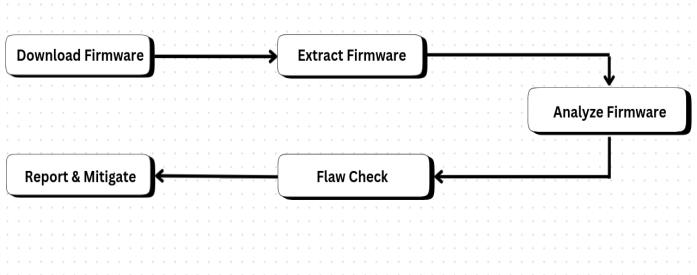
3.2.1
The first step is getting the firmware under scrutiny. Device firmware can be obtained either through a vendor’s website,a deviceupgradepageorthroughactual extraction from the device itself. The source of the firmware must be proper to prevent contamination of the results of the research. This is the very stage from which the further analysis will begin since the quality and version of the firmwareisessentialtotheresearch.
Once the firmware is downloaded, the next step is to extract its contents. This involves unpacking the firmware imagetoaccesstheunderlyingfilesystem,binaries,andother critical components. Specialized tools such as binwalk or manual techniques are employed to extract and reconstruct thefilesystem.Thisstepisessentialtopreparethefirmware forthoroughinspectionandanalysis.
Here, the extracted firmware is thoroughly analyzed. Vulnerabilities of a device through software are identified
International Research Journal of Engineering and Technology (IRJET) e-ISSN: 2395-0056
Volume: 12 Issue: 01 | Jan 2025 www.irjet.net p-ISSN: 2395-0072
usingautomatedtoolsandalsothroughmanualtools.Mostof thetimeshardcodedpasswords,APIkeys,libraries,andother weak configurations are used as the areas of concern. Thus the aim of the analysis is to zero-in on the vulnerabilities surgical devices have which can be easily exploited by attackers,jeopardizingdevicesecurityanduserdata.
At this stage, all flaws that were previously revealed are collected in a continuous fashion and provided in detailed reportsthatincludetypesofdefectsaswellastheirdegreeof seriousnessandlevelofinfluence.Theseflawscanbedetected withthehelpofvarioustools,suchasvulnerabilityscanners, reverseengineeringsystems,andstaticanalysisapplications Thereportisalsoanimportantdocumentforstakeholdersto verifythedangersposedbythefirmware.
Thelaststeprelatestorectifyingtheflawsthatarealready discussed. In some cases, it is suggested that the for what recallofthefirmware,anupdateofthenon-securedlibraries, changing encryption algorithms for more detail, or modification of factory settings should be performed. In this practice, after mitigations are performed, the modified firmwareisretested;theideaistocheckthattheattemptsto fix the earlier problems do not lead to introducing other problems. This step is crucial to mitigating the risk of the device.
The Experimental phase analyzed five different router firmware versions to identify vulnerabilities. The analysis uncovered vulnerabilities in all four firmware, with varying levelsofseverityandimpact.
The firmware file GORTAC750_A1_ FW_v101b03.bin was downloaded from the manufacturer’s website and analyzedusingBinwalk,afirmwareanalysistool.Binwalk enabledtheextractionofembeddedfilesandinspectionof the firmware structure to uncover potential vulnerabilities.
Fig 3 shows the Binwalk analysis results, decomposing thefirmwareintoitscomponents.

The firmware was analyzed using Binwalk, revealing a hardcoded Telnet password in the /squashfsroot/etc/init0.d/ directory.The S80telnetd.sh script contains the command telnetd -l /usr/sbin/login -u Alphanetworks:$image_sign -i br0, which reveals the presence of hardcoded credentials (Alphanetworks) and references $image_sign. This configuration poses significant security risks by enabling unauthorized Telnet access.Fig. 4 illustratesS80telnetd.shscriptcontainingthe vulnerablecommand.

Thehardcodedpassword,asshownin Fig. 5,isstored in squashfs-root/etc/config/image_sign,posingasecurity risk.
Fig -5: hardcodedpasswordoftelnet
The firmware file DIR605LB2_FW213WWB01.bin was analyzedusingBinwalktoextractitscontents,asshownin Fig. 6.
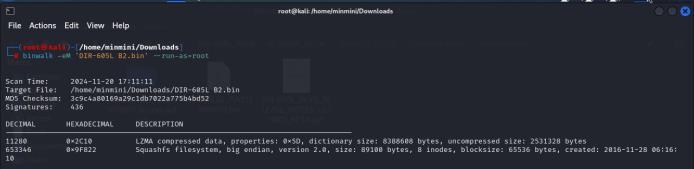
Within the extracted firmware contents, a hardcoded access password was located in the squashfs-root-0/etc/. The hardcoded value root:abSQTPcIskFGc:0:0: root:/:/bin/sh and nobody:x:99:99:Nobody:/: were found. To retrieve the plaintext password, the hashed value was processed using John the Ripper, a robust passwordcracking tool. Fig. 7 illustrates the successful recovery of the plaintext access password, demonstrating the vulnerabilityposedbyhardcodedcredentials.
International Research Journal of Engineering and Technology (IRJET) e-ISSN: 2395-0056
Volume: 12 Issue: 01 | Jan 2025 www.irjet.net p-ISSN: 2395-0072
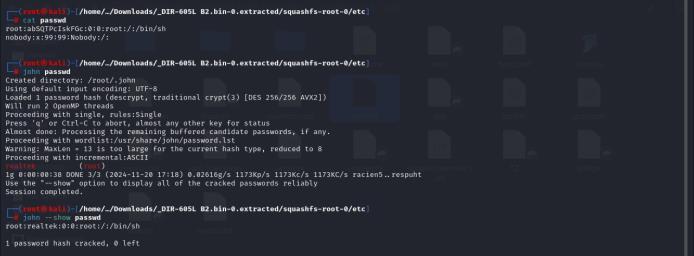
-7: Hardcodedpasswordcredential
4.3
Using Binwalk, the firmware file DIR859Ax_ FW106b01_beta01.bin was analyzed, and various files, including configuration files and executables, were extracted,asshownin Fig. 8.

Fig
Using the Gidhara reverse engineering tool, the Binwalk analysis of the firmware revealed the presence of a vulnerable file located at /htdcos/webinc/fatlady.php/. This file was identified as a potential security risk due to its inclusion in the firmware and the possibility of exploitation. Fig. 9 illustrates the path and highlights the location of the vulnerable fatlady.php file.The vulnerability arises from impropervalidationorinsecurecodingpracticesinthescript, which could be exploited for unauthorized access or other maliciousactivities.
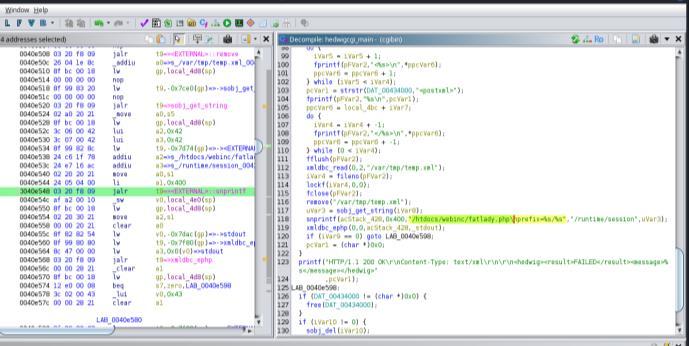
Fig
After analyzing the firmware using the Gidhara reverse engineering tool, the /squashfs-root/ htdocs/webinc/ fatlady.php file was found to contain a path traversal vulnerability. Specifically, the file includes a $target = "/htdocs/phplib/fatlady/".$service.".php" directive, which allows attackers to manipulate file paths and potentially accessrestrictedfilesonthesystem.Thisvulnerabilitycould leadtounauthorizedaccessormodificationofsensitivedata.
Fig. 10 illustratesthefileandhighlightsthevulnerable$target = "/htdocs/phplib/fatlady/".$service.".php" path traversal issue.
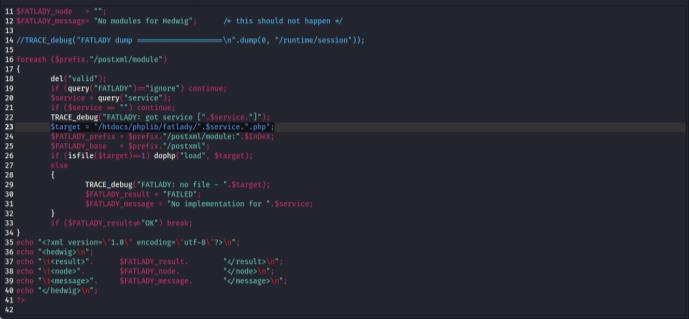
The firmware file DIR845LA1_FW101KRb03.bin was analyzed using Binwalk to extract its contents, as shown in Fig. 11. The tool uncovered several embedded files and configurations, which are essential for identifying vulnerabilitieswithinthefirmware.

After analyzing the file, it was found that the squashfsroot/htdocs/webinc/js/bsc_sms_inbox.php file contains a vulnerability. Specifically, the line var get_Treturn = '<?if($_GET["Treturn"]=="") echo "0"; else echo $_GET["Treturn"];?>';ispronetoaCross-SiteScripting(XSS) attack.Thevulnerabilityarisesfromimpropersanitizationof user input, allowing an attacker to inject malicious scripts into the Treturn parameter. This could lead to session hijackingorunauthorizedactionsperformedonbehalfofthe user. Fig. 12 highlights the vulnerable code in the bsc_sms_inbox.phpfile.
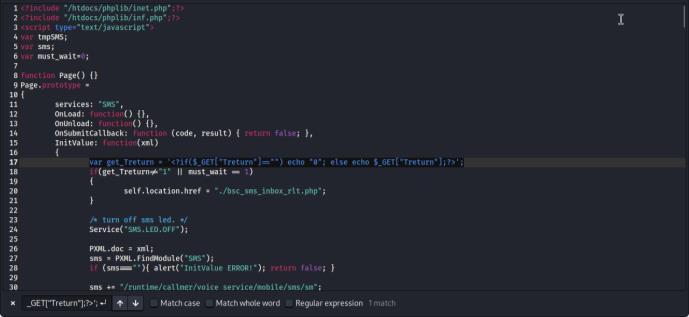
International Research Journal of Engineering and Technology (IRJET) e-ISSN: 2395-0056
Volume: 12 Issue: 01 | Jan 2025 www.irjet.net p-ISSN: 2395-0072
The analysis of the firmware file DIR845LA1_FW101KRb03.bin using Binwalk, as shown in Fig. 13, led to the extraction of key components. These included configuration files and executables, which were thoroughlyexaminedforpotentialvulnerabilities.

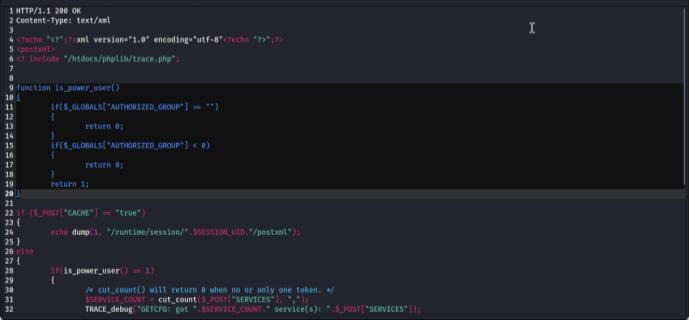
After analyzing the firmware using Binwalk, it was observed that certain files, including /sqush/getcfg.php, contain critical vulnerabilities that can be exploited by attackers. Among these vulnerabilities, a significant permission bypass flaw was identified, which could compromise the overall security of the system by allowing unauthorized access to sensitive areas. The vulnerability arisesfromthecode:
if($_GLOBALS["AUTHORIZED_GROUP"]=="") { return0;}
if ($_GLOBALS["AUTHORIZED_GROUP"] < 0) { return 0;}return1;
Thisvulnerabilityarisesfromtheimproperhandlingand validation of the AUTHORIZED_GROUP variable within the code, which fails to enforce robust access control mechanisms. The flawed logic in the code does not adequatelyverifytheauthorizationstatus,enablingattackers to manipulate system logic and potentially gain access to restrictedfunctionalitiesorsensitiveinformation.Asaresult, this vulnerability poses a serious threat to the integrity and confidentialityofthesystem. Fig. 14 illustratesthevulnerable code in getcfg.php, highlighting the insecure permission validation.
Based on the analysis of five router firmware versions, therearekeyvulnerabilitiesthatappearedindevicesalong with their severity levels. Within the first firmware, there was a risk with hardcoded plaintext telnet credentials which posed a threat for unauthorized access. The
encryptedcredentialswithinthesecondfirmwarecouldbe decrypted due to weak encryption techniques where John the Rip was used. Within the third firmware, there was a PHP script that had not sanitized user inputs and the device users had path traversal vulnerability which allowedthemtoreachfileswhichwerenotauthorized.The fourth firmware surfer from a cross-site scripting vulnerability which was present in a PHP script. This php scriptenableduserstoinjectmaliciousJavaScriptontothe webinterfaceoftherouterandallowedthemtosteal data orhijacktheirsessions.Lastly,thefifthfirmwarecontained scribes of control that had permission circumvention vulnerability enabling users to access features that were supposed to remain restricted. The findings provide important information about the vulnerabilities in authentication, encryption, input validation and access control that may lead to further compromise of system security. In tandem, these concerns bring to light the importance of secure practices during the development of firmware.
The router’s firmware was analyzed, and several security flaws were found including compulsory passwords, cross-site scripting, XSS, and permission bypass.Reverseengineeringandsystematicstaticanalysis ofmanyfirmwaresamplesfoundalargenumberofcoding mistakes, indicating a general trend of negligent coding practices in the firmware industry. The results of their work pointtowardthe necessityofaddressingsecurity in the firmware, particularly during its development phase, to fortify the protection against hardcoded credentials, improper access controls, and faulty inputs. Such tools as GhidraandJohntheRipper,whichareusedascracks,also demonstrated their significance in research activities in cybersecurity.
To reduce the risks and threats, security must be incorporated into the Development Life Cycle, Regular patches for the vulnerabilities found must be performed, andeducatingthedeveloperstocodesecurely.Forfurther work, it might be possible to design automatic usage and systems for vulnerability testing in the firmware and recommendwaystoimproveroutersecurity.
[1] S. Keshav and R. Sharma, "Issues and trends in router design," in IEEE Communications Magazine, vol. 36, no. 5, pp. 144-151,May1998.
[2] Chujay Tan, Junita Mohamad-Saleh, Khairu Anuar Mohamed Zain,Zulfiqar Ali Bin Abd Aziz.Review on Firmware- ICISPC 2017: Proceedings of the International Conference on Imaging, Signal Processing and Communication.
International Research Journal of Engineering and Technology (IRJET) e-ISSN: 2395-0056
Volume: 12 Issue: 01 | Jan 2025 www.irjet.net p-ISSN: 2395-0072
[3] Z. Lu, C. Steinmuller and S. Mukhopadhyay, "Towards Formal Verification of a Commercial Wireless Router Firmware," 2013 IEEE 37th Annual Computer Software and ApplicationsConference,Kyoto,Japan,2013,pp.639-647.
[4] A.Dua,V.Tyagi,N.PatelandB.Mehtre,"IISR:ASecure Router for IoT Networks," 2019 4th International ConferenceonInformationSystemsandComputerNetworks (ISCON),Mathura,India,2019,pp.636-643.
[5] D.N.Kleidermacher,"IntegratingStaticAnalysisintoa Secure Software Development Process," 2008 IEEE Conference on Technologies for Homeland Security, Waltham,MA,USA,2008,pp.367-371.
[6] K. Cheng et al., "DTaint: Detecting the Taint-Style Vulnerability in Embedded Device Firmware," 2018 48th Annual IEEE/IFIP International Conference on Dependable Systems and Networks (DSN), Luxembourg, Luxembourg, 2018,pp.430-441.
[7] B. Beckman and J. Haile, "Binary Analysis with Architecture and Code Section Detection using Supervised Machine Learning," 2020 IEEE Security and Privacy Workshops (SPW), San Francisco, CA, USA, 2020, pp. 152156.
[8] C. Feng, Z. Alomari, Z. Wang, C. Zhang and U. Zakia, "Systemic Implications of CVE-2023-33246 A Closer Look at Remote Code Exploitation Mechanisms," 2024 15th International Conference on Information and Communication Systems (ICICS),Irbid,Jordan,2024, pp. 16.
[9] E. Bertino and N. Islam, "Botnets and Internet of Things Security," in Computer, vol. 50, no. 2, pp. 76-79, Feb.2017.
[10] UlHaq,S.,Singh,Y.,Sharma,A. et al. AsurveyonIoT& embedded device firmware security: architecture, extraction techniques, and vulnerability analysis frameworks. DiscovInternetThings 3,17(2023).
[11] V. Visoottiviseth, P. Jutadhammakorn, N. Pongchanchai and P. Kosolyudhthasarn, "Firmaster: Analysis Tool for Home Router Firmware," 2018 15th International Joint Conference on Computer Science and Software Engineering (JCSSE),Nakhonpathom,Thailand,2018,pp.1-6.
[12] X. Feng, X. Zhu, Q. -L. Han, W. Zhou, S. Wen and Y. Xiang,"DetectingVulnerabilityonIoTDeviceFirmware:A Survey,"in IEEE/CAA Journal of Automatica Sinica,vol.10, no.1,pp.25-41,January2023.
[13] W. Xie, Y. Jiang, Y. Tang, N. Ding and Y. Gao, "Vulnerability Detection in IoT Firmware: A Survey," 2017 IEEE 23rd International Conference on Parallel and Distributed Systems (ICPADS), Shenzhen, China, 2017, pp. 769-772.
[14] A.Adithyan,K.Nagendran,R.Chethana,G.PandyD.and G. Prashanth K., "Reverse Engineering and Backdooring Router Firmwares," 2020 6th International Conference on Advanced Computing and Communication Systems (ICACCS), Coimbatore,India,2020,pp.189-193.
[15] Catuogno, Luigi, and Clemente Galdi. 2023. "Secure Firmware Update: Challenges and Solutions" Cryptography 7,no.2:30.