
International Research Journal of Engineering and Technology (IRJET) e-ISSN: 2395-0056
Volume: 13 Issue: 01 | Jan 2026 www.irjet.net p-ISSN: 2395-0072
International Research Journal of Engineering and Technology (IRJET) e-ISSN: 2395-0056
Volume: 13 Issue: 01 | Jan 2026 www.irjet.net p-ISSN: 2395-0072
Katragadda Harini 1, Tirumalasetty Jahnavi2, Gudeti Sudarshan Aravind Reddy3 , Rudrapankthi Naveen 4 , Reddiboina Leela Krishna5 , Nanduri Tejaswini6
1,2,3,4,5,6BTech in ECE & VVIT,Andhra Pradesh,India`
Abstract - Electricity theft remains one of the most critical challenges faced by modern power distribution systems, particularly in developing regions where monitoring infrastructure is limited. Practices such as illegal tapping, meter bypassing, and physical tampering of energy meters result in significant revenue losses for utility providers and adversely affect grid stability and power quality. Conventional electricity meters are primarily designed for billing purposes and do not possess real-time monitoring, analytical intelligence, or communication capabilities required for effective theft detection.
This paper presents an ESP32-based intelligent power theft detection and load profiling system that continuously monitors voltage and current parameters to compute real-time power and energy consumption. The proposed system introduces load profiling through statistical analysis of historical consumption data, enabling the identification of abnormal usage patterns In addition, tamper detection mechanisms are implemented to monitor electrical irregularities and physical disturbances in the metering system. Time-of-use analysis is incorporated to detect suspicious energy consumption during predefined off-peak or low-activity periods, which is a common indicator of unauthorized usage. Illegal tapping scenarios are experimentally simulated by introducing unregistered loads to evaluate the effectiveness of the detection methodology.
The ESP32 microcontroller performs local data processing and anomaly detection while transmitting energy data and alerts to a cloud-based dashboard using integrated Wi-Fi communication. Experimental results demonstrate that the system can detect abnormal load variations, illegal tapping, and tampering events with low latency and acceptable accuracy. The proposed solution is cost-effective, scalable, and suitable for residential and small commercial applications, contributing to enhanced transparency, improved theft detection, and smarter energy management within modern power distribution networks.
Key Words: Power Theft Detection, Load Profiling, ESP32, Smart Energy Meter, Tamper Detection, Time-of-Use Analysis, IoT, Energy Monitoring
1.INTRODUCTION
Electric power distribution systems form the backbone of modern society, supporting residential, commercial, and industrialactivities.Withrapidurbanizationandincreasingdependenceonelectricalenergy,thedemandplacedonpower gridshasgrownsignificantly.Alongsidethisgrowth,electricitythefthasemergedasamajorconcernforutilityproviders worldwide. Electricity theft not only causes substantial financial losses but also leads to increased transmission losses, voltagefluctuations,transformeroverloading,anddegradationofoverallgridreliability.
Electricity theft can take various forms, including illegal tapping of distribution lines, bypassing of energy meters, manipulation of metering circuitry, and unauthorized extension of loads. These activities often occur intermittently and are difficult to detect using conventional monitoring approaches. In many regions, theft detection relies on manual inspection and post-billing analysis, which are inefficient, time-consuming, and prone to human error. As a result, theft activitiesmaycontinueundetectedforextendedperiods.
Traditional metering infrastructure lacks the capability to analyse consumption patterns or identify abnormal behaviour in real time. The absence of communication and intelligence at the meter level further limits the ability of utilities to respondquicklytosuspiciousactivities.Withtheemergenceofsmartgridconcepts,thereisagrowingneedforintelligent, distributedmonitoringsystemsthatcanoperateattheconsumerendandprovideactionableinsightstoutilityproviders.
Recent advancements in embedded systems and Internet of Things (IoT) technologies have enabled the development of smart energy meters capable of real-time data acquisition, processing, and communication. Embedded controllers with integratedwirelessconnectivityallowcontinuousmonitoringofelectricalparametersandremotevisualizationof energy usage.Loadprofiling,tamperdetection,andtime-of-useanalysisareincreasinglybeingrecognizedaseffectivetechniques foridentifyingabnormalconsumptionbehaviourandpotentialtheftevents.
International Research Journal of Engineering and Technology (IRJET) e-ISSN: 2395-0056
Volume: 13 Issue: 01 | Jan 2026 www.irjet.net p-ISSN: 2395-0072
Traditional energy metering systems are designed primarily to measure cumulative electrical energy consumption over a specifiedbillingperiod.Thesesystemsaretypicallyelectromechanicalorbasicelectronicmetersthatintegratevoltageand currentovertimetocalculateenergyusageinkilowatt-hours.Meterreadingsarecollectedperiodically,eithermanuallyby utilitypersonnelorthroughbasicautomatedmeterreadingmechanisms.
While conventional meters are reliable for basic energy measurement and billing, they lack intelligence and real-time monitoringcapabilities.Theydonotprovideinformationaboutinstantaneouspowerconsumption,loadvariations,ortimebasedusagepatterns..Asa result,utilitiesareunabletodistinguishbetweennormalandabnormalconsumptionbehavior usingtraditionalmetersalone.
Electricitytheftdetectionintraditionalsystemsreliesheavilyonmanualinspectionofdistributionlinesandmeters. Utility personnel may compare billed energy with transformer output or inspect physical connections to identify illegal tapping. These methods are reactive in nature and depend on human judgment, making them inefficient and inconsistent. Shortdurationorintermittenttheftactivitiesareparticularlydifficulttodetectusingsuchapproaches.
Furthermore,traditionalmetersdonotsupportcommunicationwithcentralizedmonitoringsystems.Theabsenceofrealtime data transmission prevents utilities from responding promptly to suspicious activities. In the context of increasing electricitydemandandcomplexdistributionnetworks,thelimitationsoftraditionalenergymeteringsystemshighlightthe needforintelligentalternativescapableofreal-timeanalysisanddecision-making.
Existing electricity theft detection methods suffer from several limitations that restrict their effectiveness in practical scenarios. Manual inspection-based approaches are labour-intensive, time-consuming, and costly. They require frequent field visits and are susceptible to human error, making them unsuitable for large-scale deployment. Post-billing analysis techniquescomparehistoricalconsumptiondatatoidentifydiscrepancies.However, suchmethodsareinherentlydelayed andfailtodetecttheftinrealtime.Theyarealsoineffectiveinidentifyingshort-termorintermittenttheftactivitiesthatdo notsignificantlyaffectmonthlybillingtotals.
Some advanced systems rely on centralized data analytics or complex machine learning models to detect theft patterns. While these approaches can offer improved accuracy, they often require high computational resources and extensive datasets.Thisincreasessystemcomplexityandcost, makingthemunsuitableforlow-costembeddedimplementationsat theconsumerend.
Additionally, many existing solutions focus solely on energy consumption discrepancies and ignore other important indicators such as physical tampering, time-of-use behaviour, and sudden load variations. The lack of integrated tamper detectionandtime-basedanalysisreducesthereliabilityoftheftidentificationandincreasesfalsepositives.
These limitations emphasize the need for a decentralized, intelligent system capable of local data processing, real-time anomalydetection,andremotereporting,whileremainingcost-effectiveandscalable.
The proposed system utilizes an ESP32 microcontroller as the core processing unit due to its high processing capability, lowpowerconsumption,andintegratedWi-Ficonnectivity.VoltageandcurrentsensorsareinterfacedwiththeESP32to continuously measure electrical parameters. Using these measurements, the system calculates instantaneous power and cumulativeenergyconsumptioninrealtime.
Load profiling is performed by analysing historical consumption data collected over extended periods. Statistical parameters such as average load, peak demand, and time-based usage trends are used to establish normal consumption profiles.Deviationsfromtheseprofiles,includingsuddenloadspikesandunusualconsumptionpatterns,areidentifiedas potentialtheftindicators.
International Research Journal of Engineering and Technology (IRJET) e-ISSN: 2395-0056
Volume: 13 Issue: 01 | Jan 2026 www.irjet.net p-ISSN: 2395-0072
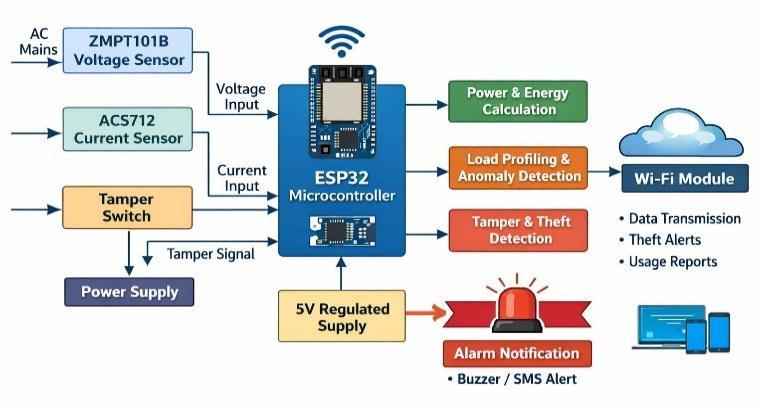
Fig -1: Block Diagram
Tamper detection mechanisms are incorporated to monitor abnormal electrical behaviour and physical disturbances. These include sudden loss of sensor signals, unexpected voltage variations, and abrupt changes in current flow that may indicate meter bypassing or manipulation. Time-of-use analysis further enhances detection by identifying energy usage duringpredefinedoff-peakorrestrictedperiods,whichisacommoncharacteristicofunauthorizedconsumption.
Illegal tapping scenarios are experimentally simulated by connecting unauthorized loads parallel to the monitored line. This allows evaluation of the system’s ability to detect unregistered consumption through abnormal current signatures and load variations. Upon detecting suspicious activity, the ESP32 transmits alerts and energy data to a cloud-based dashboardusingWi-Ficommunication.
The proposed system combines real-time sensing, local intelligence, and IoT-based monitoring into a single platform. It offers a scalable and economical solution for improving theft detection, enhancing energy transparency, and supporting thedevelopmentofsmarterpowerdistributionnetworks.
Table -1: DetectionScenariosandSystemResponse
Scenario Detection Method System Response
NormalLoad ProfileMatching NoAlert
Sudden Load Spike Threshold Deviation TheftAlert
Off-PeakUsage Time-of-use Analysis SuspiciousActivity
MeterBoxOpened ReedSwitch TamperAlert
IllegalTapping CurrentAnomaly TheftAlert
The proposed intelligent power theft detection and load profiling system is developed using low-cost, reliable, and commerciallyavailablehardwarecomponents.Thehardwarearchitectureisdesignedtosupportcontinuousmonitoringof electrical parameters, real-time processing, tamper detection, and wireless data transmission. The system is intended to functionasasmartenergymonitoringunitdeployedattheconsumerend.
Eachhardwarecomponentisselectedtoensuremeasurementaccuracy,operationalreliability,andeaseofintegrationwith the embedded controller. The overall design emphasizes scalability and robustness while maintaining simplicity and cost effectiveness.
The core processing unit of the system is the ESP32 Dev Module (ESP32-WROOM-32). This module is selected due to its integratedWi-Ficapability,highprocessingspeed,andsuitabilityforreal-timeembeddedapplications.TheESP32operates at a clock frequency of up to 240 MHz and includes sufficient SRAM and flash memory for data processing, logging, and communicationtasks.
International Research Journal of Engineering and Technology (IRJET) e-ISSN: 2395-0056
Volume: 13 Issue: 01 | Jan 2026 www.irjet.net p-ISSN: 2395-0072
The ESP32 is responsible for:
Interfacingwithvoltageandcurrentsensors
SamplinganalogsignalsusingtheinternalADC
Computingreal-timepowerandenergyvalues
Executingloadprofilingandanomalydetectionalgorithms
Managingtamperdetectioninputs
TransmittingdataandalertstotheclouddashboardviaWi-Fi LocalprocessingontheESP32minimizes
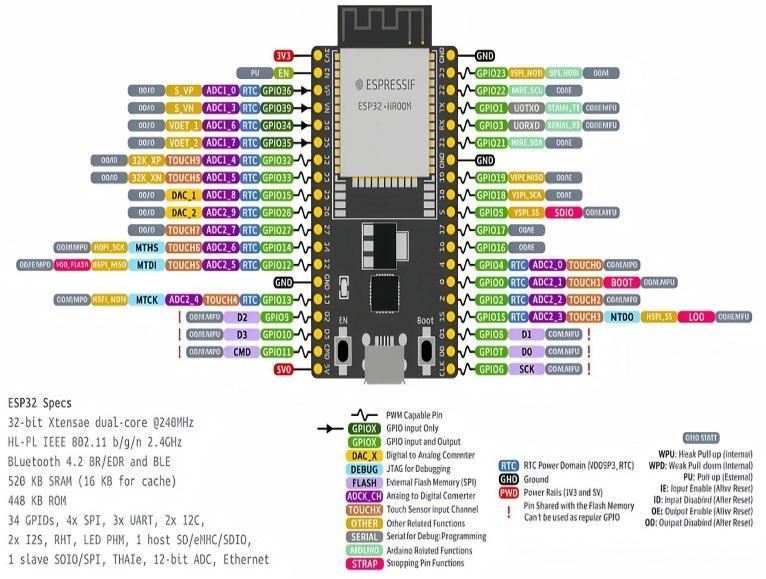
Detectionlatencyandenablesreal-timedecision-makingatthemeterlevel.
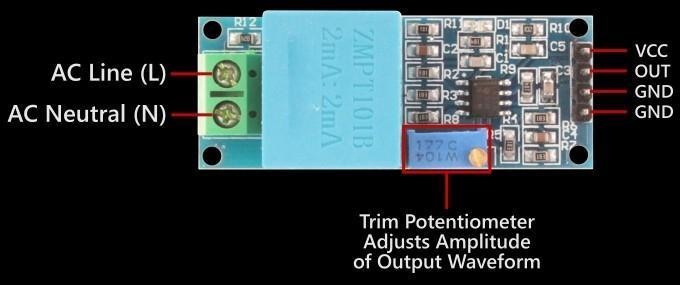
Voltage measurement is implemented using the ZMPT101B AC voltage sensor module. This sensor provides electrical isolation between the high-voltage mains and the low-voltage embedded circuitry, ensuring safe operation. The module outputsananalogsignalproportionaltotheinputACvoltage.
The ESP32continuously samples the voltage sensor output and converts the raw analog values into digital form using its ADC. Software-based calibration is applied to map ADC readings to actual voltage values. This calibration improves measurementaccuracyandcompensatesforsensortolerances.
Real-time voltage monitoring enables the detection of abnormal voltage conditions such as sudden drops or fluctuations. Theseconditionsmayindicatemeterbypassing,supplyirregularities,ortampering,andarethereforetreatedasimportant indicatorsduringanomalydetection.
International Research Journal of Engineering and Technology (IRJET) e-ISSN: 2395-0056
Volume: 13 Issue: 01 | Jan 2026 www.irjet.net p-ISSN: 2395-0072
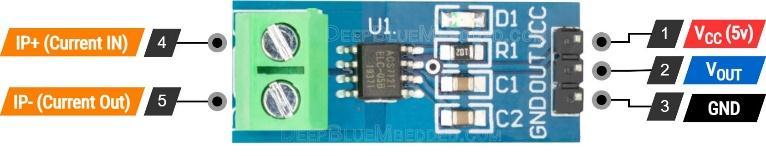
CurrentmeasurementiscarriedoutusingtheACS712-20AHall-effectcurrentsensormodule.Thesensorprovidesgalvanic isolationandoutputsalinearanalogvoltageproportionaltotheloadcurrentflowingthroughthecircuit.Itiswellsuitedfor residentialandsmallcommercialcurrentranges.
The analog output ofthecurrent sensor issampled by the ESP32 at fixedintervals.Offsetcalibrationand noisereduction techniques are applied in software to eliminate zero-drift and improve measurement stability. Accurate current measurementisessentialforreliablepowercalculationandloadprofiling.
Sudden increases in current or unexpected variations in current patterns are closely monitored. Such deviations often indicateillegaltappingorunauthorizedloadconnections,makingcurrentsensingacriticalcomponentoftheftdetection.
Tamperdetectionisimplementedusingbothphysicalandelectricalmonitoringmechanismstoimprovereliability.Areed switch or limit switch is installed inside the meter enclosure to detect unauthorized opening of the meter box. When the enclosure is opened, the switch state changes and is detected by the ESP32 through a digital input pin. In addition to physicalmonitoring,electricaltamperdetectionisimplementedbyobservinginconsistenciesinvoltageandcurrentsensor signals. Sudden loss of sensor output, abnormal signal behavior, or unexpected disconnection of sensing modules are treatedastamperevents.Thisdual-layertamperdetectionapproachensuresthatbothphysicalmanipulationandelectrical bypassingattemptsareidentifiedpromptly,reducingthelikelihoodofundetectedtheft.
Illegal tapping is experimentally simulated by connecting an unauthorized resistive load in parallel with the monitored circuit. This load bypasses the sensing path and introduces additional current consumption that does not match the established load profile. The simulated tapping setup allows controlled testing of the system’s detection capability under realistictheftscenarios.Suddencurrentincreasesandabnormalconsumptionpatternsgeneratedbytheunauthorizedload areusedtoevaluatedetectionaccuracyandresponsetime.
This experimental approach enables validation of the proposed methodology without requiring complex external infrastructureorlarge-scaledeployment.
Thesystemispoweredusingaregulated5Vpowersupplyderivedfromastep-downtransformerorswitched-modepower supplyadapter. AnLM2596DC-DC buck converter module is used to provide stablevoltagelevels required by the ESP32 and sensor modules. Proper voltage regulation ensures reliable operation and prevents malfunction due to voltage fluctuations.Additionalprotectioncomponentssuchascapacitorsandfusesareincludedtoimprovesystemdurabilityand electricalsafety.
International Research Journal of Engineering and Technology (IRJET) e-ISSN: 2395-0056
Volume: 13 Issue: 01 | Jan 2026 www.irjet.net p-ISSN: 2395-0072
The software architecture of the proposed system is designed to support real-time data acquisition, intelligent analysis, anomalydetection,andIoT-basedcommunication.TheembeddedfirmwarerunningontheESP32coordinatesallsystem functionswhilemaintainingreliableanddeterministicoperation
A modular programming approach is adopted to improve readability, maintainability, and future extensibility of the software
The embedded firmware is developed using the Arduino IDE and programmed in Embedded C/C++. The ESP32 Arduino core is used to access hardware peripherals and communication interfaces. This development environment provides extensivelibrarysupportandsimplifiesfirmwaredevelopmentanddebugging.
Structured programming practices are followed to ensure clarity and reliability. Separate software modules are implementedforsensorinterfacing,powercalculation,anomalydetection,andcommunication.
VoltageandcurrentsensorsaresampledatfixedintervalsusingtheESP32’s12-bitanalogy-to-digitalconverter.Multiple samplesareaveragedtoreducenoiseandimprovemeasurementaccuracy.Offsetcalibrationisappliedtocompensatefor sensordriftandenvironmentalvariations.
FilteredsensordataisusedtocomputeRMSvoltageandcurrentvalues.Theseprocessedvaluesformthebasisforpower calculationandsubsequentanalysis.
Instantaneous power is calculated using real-time voltage and current values. Energy consumption is computed by integrating power over time using discrete sampling intervals. These calculations are performed locally on the ESP32, enablingreal-timemonitoringandreducingdependenceoncloud-basedprocessing.
Loadprofilingisimplementedusingastatisticalthreshold-basedapproach.Historicalconsumptiondataisrecordedover timetoestablishnormalusagepatternsforagivenconsumer.Parameterssuchasaverageload,peakdemand,andhourly energyconsumptionarecalculatedandstored.Real-timemeasurementsarecontinuouslycomparedwiththesereference valuestoidentifyabnormalbehaviour.
Time-of-useanalysisdividesthedayintopredefinedintervalssuchaspeakhours,off-peakhours,andlow-activityperiods. Separate consumption profiles are maintained for each interval. Energy usage during off-peak or restricted periods is closely monitored. Unexpected consumption during these intervals is flagged as suspicious and contributes to theft detectiondecisions.
Tamperdetectionlogiccontinuouslymonitorsthestatusofenclosureswitchesandsensorsignals.Achangeinswitchstate or abnormal sensor behaviour triggers a tamper alert. Detected tamper events are logged locally and transmitted to the clouddashboardforimmediatenotificationandfurtherinvestigation.
International Research Journal of Engineering and Technology (IRJET) e-ISSN: 2395-0056
Volume: 13 Issue: 01 | Jan 2026 www.irjet.net p-ISSN: 2395-0072
Illegal tapping is detected using current anomaly detection techniques. Sudden current increases that exceed learned statisticalthresholdswithoutcorrespondingchangesinnormalloadbehaviourareclassifiedasunauthorizedconnections. Thislightweightdetectiontechniqueiswellsuitedforlow-costembeddedsystemsandavoidsthecomplexityofadvanced machinelearningmodels.
TheESP32transmitsreal-timedataandalertstoacloud-baseddashboardusingWi-FicommunicationandHTTPprotocol. The dashboard provides visualization of voltage, current, power, and energy trends. Historical data storage supports performanceevaluation,eventanalysis,andfuturesystemimprovements.
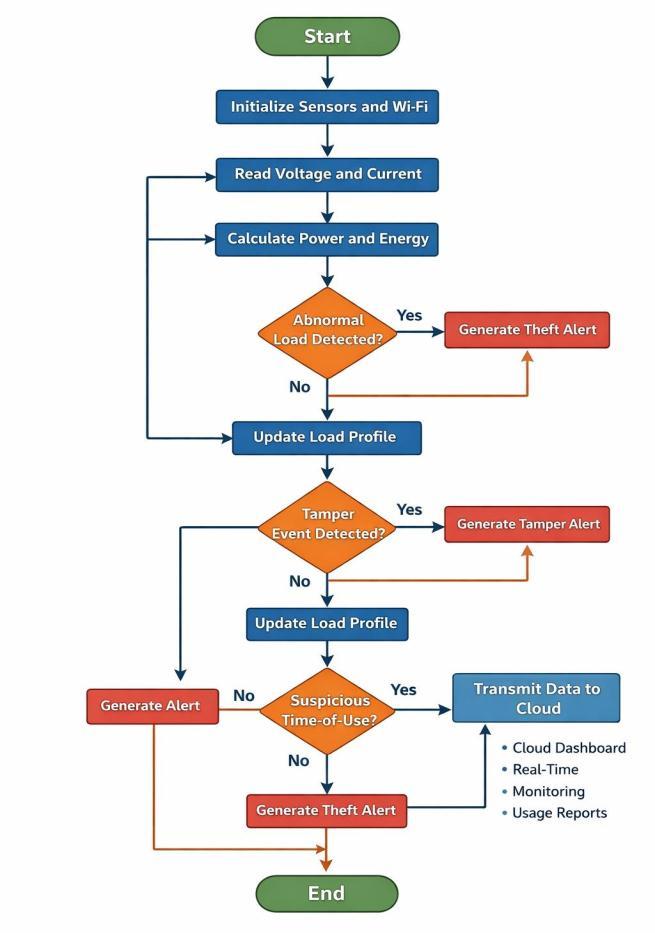
Accurate computation of electrical parameters is fundamental to the proposed intelligent power theft detection system. TheESP32performsreal-timecalculationsusingsampledvoltageandcurrentvaluesobtainedfromthesensingmodules.
Theinstantaneouspowerconsumedbytheloadiscalculatedusingthestandardelectricalrelationship:
P(t)=V(t)×I(t)
WhereV(t)representstheinstantaneousvoltageandI(t)representstheinstantaneouscurrentattimet.
TheRMSvaluesofvoltageandcurrentarecalculatedfromsampleddatausing:
Vrms =sqrt((1/N)×Σ(Vn²)), n=1toN
Irms=sqrt((Δt1/N)×Σ(In²)), n=1toN
Energyconsumptioniscomputedbyintegratingpowerovertimeusingdiscretesamplingintervals:
International Research Journal of Engineering and Technology (IRJET) e-ISSN: 2395-0056
Volume: 13 Issue: 01 | Jan 2026 www.irjet.net p-ISSN: 2395-0072
E=Σ(Pk ×), k=1toM
WhereΔtisthesamplingintervalandPk istheinstantaneouspoweratthekth sample.
These equations are implemented directly in the embedded firmware and executed locally on the ESP32 to enable realtimemonitoringandanalysis.
Algorithm and Pseudo-code
Algorithm 1: Load Profiling and Anomaly Detection
The proposed system uses a statistical threshold-based algorithm to detect abnormal energy consumption patterns. The algorithmcontinuouslycomparesreal-timemeasurementswithlearnedloadprofiles.
Pseudo-code:
Initializesystemparameters
Initializevoltageandcurrentsensors
InitializeWi-Ficommunication
While system is running:
Readvoltagesensor
Readcurrentsensor
CalculateRMSvoltageandRMScurrent
Calculateinstantaneouspower
Updatecumulativeenergy
Updateloadprofilestatistics
Calculatedeviationfromaverageload
Ifdeviation>threshold:
Flagabnormalloadevent
Ifconsumptionduringoff-peakhours:
Flagtime-of-useanomaly
Ifsensorsignalsmissingorenclosureopened:
Flagtamperevent
Transmitdataandalertstoclouddashboard
EndWhile
Thislightweightalgorithmavoidscomplexcomputationwhileprovidingreliabledetectionsuitableforembeddedsystems.
Algorithm 2: Illegal Tapping Detection
Illegaltappingisidentifiedbydetectingsuddencurrentincreaseswithoutcorrespondingvoltagechanges.
Pseudo-code:
Monitorcurrentcontinuously
Storepreviouscurrentvalue
If(current–previouscurrent)>tappingthreshold:
Ifvoltageremainswithinnormalrange:
Declareillegaltappingevent
Generatealert
EndIf
Updatepreviouscurrent
Thisapproacheffectivelydetectsunauthorizedloadconnectionsandminimizesfalsepositives.
International Research Journal of Engineering and Technology (IRJET) e-ISSN: 2395-0056
Volume: 13 Issue: 01 | Jan 2026 www.irjet.net p-ISSN: 2395-0072
This paper presented the design and implementation of an intelligent power theft detection and load profiling system based on the ESP32 microcontroller. The proposed system addresses the limitations of conventional electricity meters by enabling real-time monitoring, local data processing, and remote reporting of electrical parameters. By continuously measuring voltage and current, the system accurately computes power and energy consumption while maintaininglowcostandeaseofdeployment.
The integration of statistical load profiling allows the system to learn normal consumption behaviour over time and distinguish it from abnormal usage patterns. Sudden load variations, unexpected current spikes, and irregular consumption trends are effectively identified using threshold-based analysis. This approach avoids the complexity of computationally intensive machine learning models while remaining well suited for embedded platforms with limited resources.
Tamper detection mechanisms further enhance system reliability by monitoring both physical and electrical disturbances. Unauthorized opening of the meter enclosure and abnormal sensor behaviour are promptly detected and reported. Theinclusion oftime-of-use analysisstrengthens theftdetection byidentifyingsuspicious energy consumption duringoff-peakorlow-activityperiods,whichisacommoncharacteristicofillegalelectricityusage.
Illegal tapping scenarios were experimentally simulated by introducing unauthorized loads parallel to the monitored circuit. The results demonstrate that the proposed system can successfully detect such events through abnormal current signatures and deviations from established load profiles. The ESP32’s integrated Wi-Fi capability enables real-time transmission of energy data and alerts to a cloud-based dashboard, allowing remote monitoring and fasterresponsetotheftincidents.
Overall, the proposed system provides a practical, scalable, and cost-effective solution for enhancing electricity theftdetectionandenergytransparencyinresidentialandsmallcommercialapplications.Bycombiningreal-timesensing, embedded intelligence, and IoT-based communication, the system contributes toward the development of smarter and moresecurepowerdistributionnetworks.
Future work may focus on extending the system to three-phase power systems, integrating advanced data analytics or machine learning techniques for improved detection accuracy, and implementing secure communication protocols for enhanced data protection. The proposed architecture serves as a strong foundation for next-generation smartmeteringandintelligentenergymanagementsystems.
[1] D.P.DivanandH.Johal,“DistributedFACTS Anewconceptforrealizinggridpowerflowcontrol,”IEEETransactions onPowerElectronics,vol.22,no.6,pp.2253–2260,Nov.2007.
[2] S. McLaughlin, D. Podkuiko, and P. McDaniel, “Energy theft in the advanced metering infrastructure,” Critical InformationInfrastructuresSecurity,Springer,pp.176–187,2009.
[3] J. Nagi, K. S. Yap, S. K. Tiong, S. K. Ahmed, and M. Mohamad, “Nontechnical loss detection for metered customers in powerutilityusingsupportvectormachines,”IEEETransactionsonPowerDelivery,vol.25,no.2,pp.1162–1171,Apr. 2010
[4] A.Jokar, N.Arianpoo, and V. C.M.Leung, “Electricity theftdetection in AMIusingcustomers’consumption patterns,” IEEETransactionsonSmartGrid,vol.7,no.1,pp.216–226,Jan.2016
[5] M. F. Shaaban, A. Mohamed, and K. M. Nor, “A load profiling-based electricity theft detection system,” International JournalofElectricalPower&EnergySystems,vol.78,pp.461–472,Jun.2016
[6] S. Depuru, L. Wang, and V. Devabhaktuni, “Electricity theft: Overview, issues, prevention and a smart meter based approachtocontroltheft,”EnergyPolicy,vol.39,no.2,pp.1007–1015,Feb.2011.
[7] H. Patel and R. Sharma, “Design and implementation of IoT based smart energy meter,” International Journal of EngineeringResearch&Technology,vol.9,no.4,pp.112–118,2020
International Research Journal of Engineering and Technology (IRJET) e-ISSN: 2395-0056
Volume: 13 Issue: 01 | Jan 2026 www.irjet.net p-ISSN: 2395-0072
[8] M. R. Alam, M. St-Hilaire, and T. Kunz, “An overview of m. Patel and R. Sharma, “Design and Development of an Autonomous Agricultural Robot for Sowing and Irrigation,” Proceedings of the International Conference on Robotics and Automation in Agriculture, pp. 45–52, 2021.achine learning based methods for electricity theft detection,” IEEE CommunicationsSurveys&Tutorials,vol.21,no.3,pp.2574–2593,2019
[9] A. Jain and S. Patel, “IoT based smart energy meter for efficient energy management,” International Journal of AdvancedResearchinComputerEngineering&Technology,vol.8,no.6,pp.145–151,2019.
[10] EspressifSystems,“ESP32SerieDatasheet,”EspressifSystemsInc.,2023.[Online].Available: https://www.espressif.com
[11]Arduino,“ArduinoIDEDocumentation,”[Online].Available:https://www.arduino.cc/en/software
[12]AllegroMicrosystems,“ACS712Hall-EffectCurrentSensorDatasheet,”[Online].Available: https://www.allegromicro.com
[13]ZemingElectronics,“ZMPT101BACVoltageSensorModuleDatasheet,”[Online].Available: https://www.zeming.com.cn
[14]R.K.SinghandV.Verma,EmbeddedSystemsandIoTinSmartGridApplications,Wiley,2021.
[15] M. Erol-Kantarci and H. T. Mouftah, “Energy-efficient information and communication infrastructures in the smart grid,”IEEECommunicationsMagazine,vol.50,no.5,pp.34–40,May2012.
[16]S.MishraandP.Kumar,IoTBasedSmartMeteringandEnergyManagement,Springer,2020.
[17] P. G. Da Silva, D. Ilić, and S. Karnouskos, “The impact of smart grid prosumer grouping on forecasting accuracy,” IEEETransactionsonIndustrialElectronics,vol.62,no.7,pp.4319–4328,Jul.2015.
[18] G. G. Dranka and A. Ferreira, “Power quality monitoring and analysis in smart grids,” IEEE Transactions on Smart Grid,vol.9,no.4,pp.3512–3520,Jul.2018
[19] R. Jiang, H. Taghizadeh, and S. M. S. Hussain, “Smart meter data analytics for electricity theft detection,” Electric PowerSystemsResearch,vol.189,pp.106687,2020.
[20] N. Lu, Y. Xie, and S. Chen, “Real-time monitoring and anomaly detection in smart grids using IoT,” IEEE Internet of ThingsJournal,vol.7,no.10,pp.9971–9982,Oct.2020.
[21] A. S. Rajput and S. Patil, “Design of low-cost IoT based energy monitoring and theft detection system,” InternationalJournalofElectricalandComputerEngineering,vol.11,no.3,pp.2321–2330,2021.
[22] P. Kumar, R. Singh, and A. Verma, “Time-of-use based load analysis for electricity theft detection,” Journal of ElectricalEngineering&Technology,vol.15,no.5,pp.2191–2200,2020.