
International Research Journal of Engineering and Technology (IRJET) e-ISSN: 2395-0056
International Research Journal of Engineering and Technology (IRJET) e-ISSN: 2395-0056
Rakhi Soni1 , Bhanu Pratap Singh2
1Research scholar, Aditya College of Technology and Science, Satna, Madhya Pradesh, India
2 HOD, CSE, Aditya College of Technology and Science, Satna, Madhya Pradesh, India ***
Abstract - Depression is a critical mental health disorder affecting millions of individuals worldwide, often remaining undiagnosed due to limitations in traditional clinical assessment methods. With the rapid growthofsocialmediaplatforms,largevolumesofusergenerated textual data provide an opportunity for early detectionofdepressivebehavior.Thisstudyproposesan intelligenttransferlearning-basedapproachusingBERT Base Uncased for depression identification from social media text. The model leverages deep contextualized embeddings to capture semantic and linguistic patterns associated with depressive expressions. The proposed systemincludesdatapreprocessing,tokenization,model fine-tuning, and evaluation phases. Experiments were conducted on a benchmark dataset containing 7,731 social media comments, achieving competitive performance in terms of accuracy, precision, recall, and F1-score. Comparative analysis demonstrates that the BERT-based model outperforms traditional and conventional deep learning approaches in handling complex textual patterns. The results highlight the effectiveness of transformer-based models for early and reliable depression detection. Future work aims to incorporate multimodal data such as images and voice to further enhance prediction accuracy and robustness.
Key Words: Depression Detection, BERT Base Uncased, Transfer Learning, Natural Language Processing (NLP), Social Media Analysis, Deep Learning, Sentiment Analysis, Mental Health Prediction
Depressionisasizeablementalcontaminationthatimpacts hundreds of thousands of people around the sector. Depression is characterised through loss of hobby, longer unhappiness,andnumerousemotionalandbodilyproblems thathaveaneffectoneachdayfunctioningandexceptional ofexistenceconsistentwiththeWHO[1],oneofeightpeople intheworldsufferfromalltypesofintellectualdisease,and themostofthepopulaceisunabletoutilizepowerfulcures.
Techniques traditionally used to diagnose despair encompass clinical tests and questionnaires stuffed by meansofpatientswhosepatientsaremet,asquestionsare usually now not looking for help, rather than the entire individualaffectedbydepressivesignsandsymptoms.With thearrivalofnumeroussocialmediawebsites,alongwithX (formerlyTwitter),Instagram,Reddit,fb,andgreater,we've openedthestreetstolocatehumanconductandmoodsin actual time. People often share their ideas, feelings and matterstheydointhissocialmediaplatformeachdayand generate big statistics which could show statistics about their intellectual contamination. As an end result, the conceptofusingsocialmediafactstorecognizemelancholy has come to be famous. The machine learning and Deep Learningtechniqueshaveproventobeextremelypromising in regions along with natural language processing (NLP), predictive analytics, and photo recognition. The advanced technologiescanpredictconsequencesveryappropriately via reading big amounts of unstructured statistics and shootinghiddenpatterns.Whenfiguringoutdepressionthe usage of social media posts, ML and DL models can be educated to perceive verbal data, behavioural styles, and othersignsofmelancholysymptoms.Wald(RF)[7],[8],[9]. These early methods established the capability of MLS on thisarea,howeverhavebeenoftenrestrainedbyusingthe variety and complexity of human language. There are awesomeadvancesinthecreationofdeepmasteringmodels. To extract information from text, researchers used complicated fashions along with the repeating neural network(RNNS),[11],[12]andfoldingcommunity(CNNS) [13] [15] [16]. This discipline included multimodal information [17], [18], [19] to file further enhancements, combiningtext,imagesanduserconducttoprovideamore whole information of the user's intellectual country. Advancesinlearningtransmissionandgrowingoverstated language fashions have enabled a greater green and powerfuldepressiondetectiongadget.Ourpaperrepresent theworkwouldincludehavingperformanceevaluationwith a balanced dataset as well as include more deep learning models and incorporating advanced pre-trained word embedding’susingGloVeandBERTtoextractfeatures
Recentstudieshaveexploredavarietyofmachinelearning anddeeplearningtechniquesfordepressiondetectionusing social media data. In study [20], an innovative BERT-RF
Volume: 13 Issue: 06 | Jun 2026 www.irjet.net p-ISSN: 2395-0072 © 2026, IRJET | Impact Factor
International Research Journal of Engineering and Technology (IRJET) e-ISSN: 2395-0056
Volume: 13 Issue: 06 | Jun 2026 www.irjet.net p-ISSN: 2395-0072
feature engineering approach was introduced, combining contextualized embeddings with probabilistic features to enhance textual representation. Similarly, study [21] proposedahybriddeeplearningmodelintegratingCNNand LSTMarchitectures,furtherimprovedthroughaTwo-State LSTM(TS-LSTM)withanattentionmechanism.Thismodel demonstratedstrongperformance,achievinghighaccuracy, precision, recall, and F1-score. However, its limitations include reduced effectiveness on long text sequences and lackofintegrationwithadvancedpre-trainedmodelssuchas ELMoandBERT.
In study [22], depression intensity classification was performedusingalabeledTwitterdataset,wheremultiple transformer-basedlightweightmodelswereevaluated.The ESG model outperformed others, including DistilBERT, achieving an F1-score of 89% with reduced training time. Nonetheless,themodel’sapplicabilityislimitedtoshort-text datasuchastweets,indicatingtheneedfortrainingonmore diversedatasetslikeReddittoimprovegeneralization.
A hybrid machine learning framework named D2X was proposedinstudy[23],utilizingsentimentanalysisonsocial media platform X (Twitter) data. The model integrates Support Vector Machine (SVM) and Random Forest techniques to process multimodal inputs such as text, emoticons,andimages.Despiteitseffectiveness,challenges remaininhandlingheterogeneousdatatypesandaddressing culturalandlinguisticbiases,asthedatasetislimitedtoThai languagecontent.
Instudy[24],adeeplearningarchitecturecombiningCNN and BiLSTM with an attention mechanism (CBA) was introduced and evaluated on the CLEF2017 dataset. The modelachievedsuperiorperformancecomparedtoexisting approaches. However, the study highlights the need for balanced datasets, inclusion of additional deep learning models,andtheintegrationofadvancedembeddingssuchas GloVeandBERTtofurtherenhanceperformance.
Study[25]proposedanovelframeworkleveragingfastText embeddings, TF-IDF features, and XGBoost classifier to distinguish between depression and suicidal content on Reddit.Whiletheapproachimprovedclassificationaccuracy andcontextualunderstanding,itlackstheincorporationof diverseemotionalfeaturesandmulticlassclassificationfor varyingdepressionintensities.
Finally, study [26] presented an attention-based BiLSTMCNNmodelfordetectingdepressivecontentinBanglasocial media text. The model achieved high accuracy and demonstrated cross-lingual effectiveness when applied to English data. However, limitations include higher falsepositive rates and the need for more diverse datasets, particularlyforlow-resourcelanguages.
Overall, existing research highlights the effectiveness of hybrid and transformer-based models in depression detection. However, challenges such as handling long-text data, dataset diversity, cross-lingual adaptability, and incorporation of advanced contextual embeddings remain openforfurtherinvestigation.
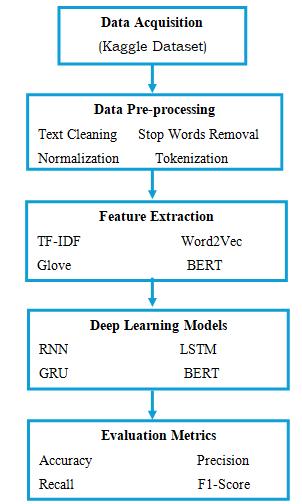
Thissectionoutlinesthegenericarchitectureofadepression detectionsystem,detailingeachcomponentinvolvedinthe process, from data acquisition to evaluation. The architectureoftheproposedmodelisshownbelowinfigure below:
BERTBaseUncasedisatransformer-basedNLPmodelthat understandswordcontextbyanalyzingbothleftandright surroundings(bidirectionallearning).Itisasmaller,efficient version of BERT with 12 layers, 768 hidden units, 12 attention heads, and about 110 million parameters. The “uncased”variantignorescapitalization,treatingwordslike “apple”and“Apple”asthesame,makingitsuitablefortasks wherecasesensitivityisn’timportant.
It is pre-trained on large text datasets (Books Corpus and Wikipedia)usingtwokeyobjectives:
Masked Language Modeling (MLM): Predicts missingwordsinasentence.
Next Sentence Prediction (NSP): Determines if twosentenceslogicallyfolloweachother.
International Research Journal of Engineering and Technology (IRJET) e-ISSN: 2395-0056
Volume: 13 Issue: 06 | Jun 2026 www.irjet.net p-ISSN: 2395-0072
This pre-training allows BERT Base Uncased to perform effectively across various NLP tasks such as text classification,questionanswering,andsentimentanalysis.
BasicstepsforproposedBERTmodelincludesfollowing:
Initialize Model
LoadBERTBaseUncasedmodelandtokenizer.
Preprocess Text
Tokenizeinput,add[CLS]and[SEP],converttotoken IDs,applypadding,andcreateattentionmasks.
Convert to Tensors
PrepareinputIDsandattentionmasksasmodel inputs.
Fine-Tune Model (Optional)
Trainonlabeleddatausingasuitablelossfunction andoptimizer.
Run Inference
Passprocessedinputthroughthemodeltoobtain logits.
Generate Predictions
ApplySoftMax/Sigmoidandselectoutputlabels(or spansforQA,tokenlabelsforNER).
Post-Process Output
Convertpredictionsintoreadableformat(labels, entities,oranswers).
Evaluate
Measureperformanceusingaccuracy,precision, recall,andF1-score.
ThedatasetswereconsideredfromKaggle.Thisdatasethas 7731commentsfromsocialmediaplatformsinwhich3900 comments are not depressed while 3831 comments are depressedrepresentedby0and1respectively.Distribution of classesindatasetisshownbelow:
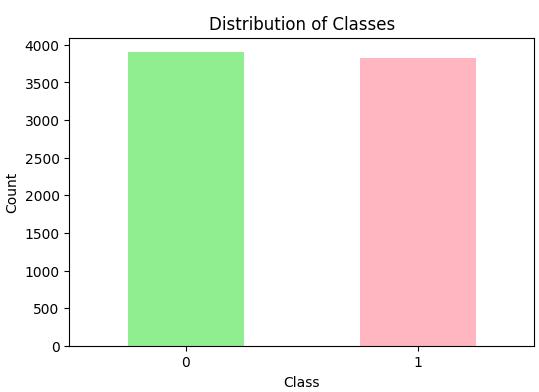
Fig-2: Classdistribution
Confusionmatrixforproposedmodelisshownbelow:
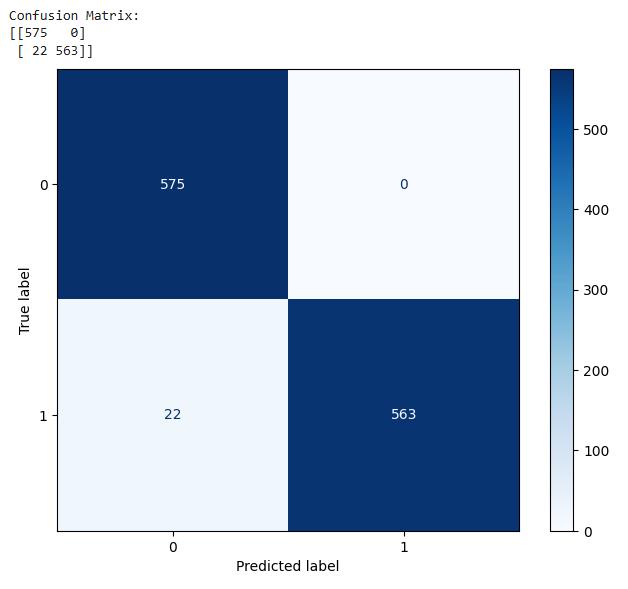
Fig-3:Confusionmatrix
Testingaccuracyisshownbelow:
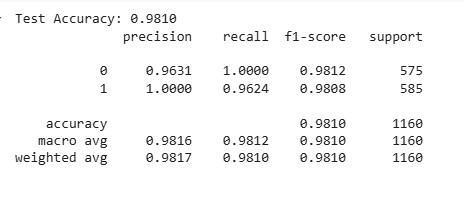
Fig-4:Classificationreport
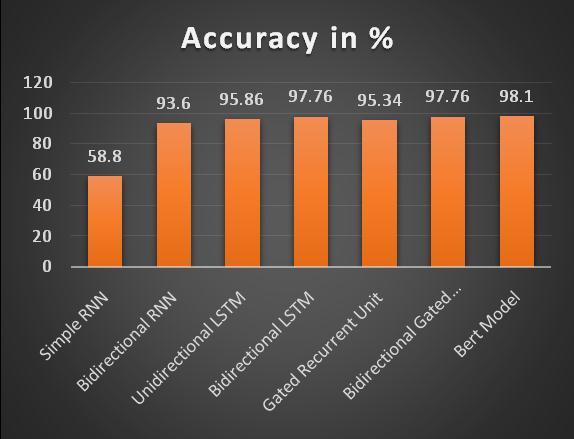
Chartbelowrepresentsevaluationofaccuracyfor proposedmodelwithmanyexistingmodels:
Chart-1:Accuracycomparison
Comparisonchar6tforprecisionisshownbelow:
International Research Journal of Engineering and Technology (IRJET) e-ISSN: 2395-0056
Volume: 13 Issue: 06 | Jun 2026 www.irjet.net p-ISSN: 2395-0072
Chart-2:Precisioncomparison
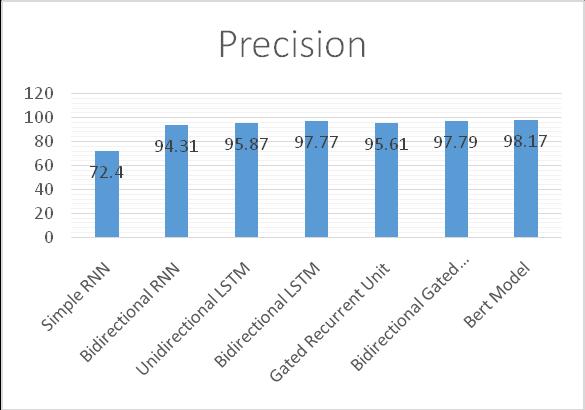
Thisworkfocusesondevelopingaccuratemodelsforearly depressiondetectionusingNLPtechniques.Weconducteda comparative study of various RNNs and Transfer models variants with social media text data, finding that they all performedsimilarlyinaccuracy.However,theBERTmodel variantshowedslightadvantagesinhandlinglargedatasets andcomplexphrases.Notably,BidirectionalLSTMandGRU models slightly outperformed their unidirectional counterparts, indicating that all NLP tasks require bidirectional analysis. From this work, we can safely conclude that this work contributes to more reliable and accurate depression diagnosis models through NLP techniques, with practical applications for mental health support. In future, we plan to integrate multimodal data, suchasimagesandvoice,tocreatemorecomprehensiveand accuratemodelsforearlydepressiondetection
[1]World Health Org. (2022). Mental Disorders. Accessed: Jun. 6, 2022. [Online]. Available: https://www.who.int/newsroom/factsheets/detail/ mental-disorders.
[2]N.A.Asad,Md.A.MahmudPranto,S.Afreen,andMd. M. Islam, ‘‘Depression detection by analysing social media posts of user,’’ in Proc. IEEE Int. Conf. Signal Process.,Inf.,Commun.Syst.(SPICSCON),Nov.2019, pp.13–17.
[3]Fatima, B. U. D. Abbasi, S. Khan, M. Al-Saeed, H. F. Ahmad, and R. Mumtaz, ‘‘Prediction of postpartum depressionusingmachinelearningtechniquesfrom social media text,’’ Expert Syst., vol. 36, no. 4, Aug. 2019,Art.no.e12409,10.1111/exsy.12409.
[4]Y. Ding, X. Chen, Q. Fu, and S. Zhong, ‘‘A depression recognition method for college students using deep
integrated support vector algorithm,’’ IEEE Access, vol.8,pp.75616–75629,2020.
[5]R.Skaik andD.Inkpen,‘‘UsingTwittersocial media fordepressiondetectionintheCanadianpopulation,’’ inProc.3rdArtif.Intell.CloudCompute.Conf., New York, NY, USA, Dec. 2020, pp. 109–114, doi: 10.1145/3442536.3442553.
[6]H.S.AlsagriandM.Ykhlef,‘‘Machinelearning-based approach for depression detection in Twitter using contentandactivityfeatures,’’IEICETrans.Inf.Syst., vol. E103.D, no. 8, pp. 1825–1832, Aug. 2020, doi: 10.1587/TRANSINF.2020EDP7023.
[7]Z.N.Vasha,B.Sharma,I.J.Esha,J.AlNahian,andJ.A. Polin, ‘‘Depression detection in social media commentsdatausingmachinelearningalgorithms,’’ Bull.Electr.Eng.Informat.vol.12,no.2,pp.987–996, Apr.2023.[Online]Available:https://beei.org/index. php/EEI/article/view/4182/3162
[8]K.Sabaneh,M.A.Salameh,F.Khaleel,M.M.Herzallah, J.Y.Natsheh,andM.Maree,‘‘Earlyriskpredictionof depressionbasedonsocialmediapostsinArabic,’’in Proc.IEEE35thInt.Conf.ToolsArtif.Intell.(ICTAI), Nov.2023,pp.595–602.
[9]Helmy, R. Nassar, and N. Ramdan, ‘‘Depression detectionforTwitterusersusingsentimentanalysis inEnglishandArabictweets,’’Artif.Intell.Med.,vol. 147,Jan.2024,Art.no.102716.
[10] H.Uddin,D.Bapery,andA.S.M.Arif,‘‘Depression analysis from social media data in Bangla language using long short term memory (LSTM) recurrent neural network technique,’’ in Proc. Int. Conf. Compute., Commun., Chem., Mater. Electron. Eng. (IC4ME2),Jul.2019,pp.1–4.
[11] H.KourandM.K.Gupta,‘‘Anhybriddeeplearning approachfordepressionpredictionfromusertweets using feature-rich CNN and bi-directional LSTM,’’ Multimedia Tools Appl., vol. 81, no. 17, pp. 23649–23685,Jul.2022,doi:10.1007/s11042-022-12648-y.
[12] S.R.Narayanan,S.Babu,andA.Thandayantavida, ‘‘Detection of depression from social media using deeplearning,’’J.PositiveSchoolPsychol.,vol.6,no.4, pp.4909–4915,2022.
[13] HusseiniOrabi,P.Buddhitha,M.HusseiniOrabi,and D.Inkpen,‘‘Deeplearningfordepressiondetectionof Twitter users,’’ in Proc. 5th Workshop Compute. LinguisticsClin.Psychol.,KeyboardClinic,K.Loveys, K.Niederhoffer,E.Prud’hommeaux,R.Resnik,andP. Resnik,Eds.,Jun.2018,pp.88–97.[Online].Available: https://aclanthology.org/W18-0609
International Research Journal of Engineering and Technology (IRJET) e-ISSN: 2395-0056
Volume: 13 Issue: 06 | Jun 2026 www.irjet.net p-ISSN: 2395-0072
[14] P. K. Gamaarachchige and D. Inkpen, ‘‘Multi-task, multi-channel,multi-inputlearningformentalillness detectionusingsocialmediatext,’’inProc.10thInt. WorkshopHealthTextMiningInf.Anal.(LOUHI),E. Holderness,A.JimenoYepes,A.Lavelli,A.-L.Minard,J. Pustejovsky,andF.Rinaldi,Eds.,Nov.2019,pp.54–64.[Online].Available:https://aclanthology.org/D196208
[15] Lin,P.Hu,H.Su,S.Li,J.Mei,J.Zhou,andH.Leung, ‘‘SenseMood:Depressiondetectiononsocialmedia,’’ in Proc. Int. Conf. Multimedia Retr., New York, NY, USA, Jun. 2020, p. 407, doi: 10.1145/3372278.3391932.
[16] J. Devlin, M.-W. Chang, K. Lee, and K. Toutanova, ‘‘BERT: Pre-training of deep bidirectional transformers for language understanding,’’ in Proc. Conf. North Amer. Chapter Assoc. Compute. Linguistics,Hum.Lang.Technol.,vol.1,J.Burstein,C. Doran,andT.Solorio,Eds.,Jun.2019,pp.4171–4186. [Online]. Available: https://aclanthology.org/N191423
[17] M.An,J.Wang,S.Li,andG.Zhou,‘‘Multimodaltopicenrichedauxiliarylearningfordepressiondetection,’’ in Proc. 28th Int. Conf. Compute. Linguistics, Barcelona, Spain, D. Scott, N. Bel, and C. Zong, Eds., 2020, pp. 1078–1089. [Online]. Available: https://aclanthology.org/2020.coling-main.94
[18] Y. Chiu, H. Y. Lane, J. L. Koh, and A. L. P. Chen, ‘‘Multimodal depression detection on Instagram consideringtimeintervalofposts,’’J.Intell.Inf.Syst., vol. 56, no. 1, pp. 25–47, Feb. 2021, doi: 10.1007/s10844-020-00599-5.
[19] Zafar, D. Aftab, R. Qureshi, Y. Wang, and H. Yan, ‘‘Multi-explainable temporalNet: An interpretable multimodal approach using temporal convolutional networkforuser-leveldepressiondetection,’’inProc. IEEE/CVF Conf. Compute. Vis. Pattern Recognition. Workshops(CVPRW),Jun.2024,pp.2258–2265.
[20] M. A. Abbas, K. Munir, A. Raza, N. A. Samee, M. M. Jamjoom and Z. Ullah, "Novel Transformer Based ContextualizedEmbeddingandProbabilisticFeatures forDepressionDetectionFromSocialMedia,"in IEEE Access, vol. 12, pp. 54087-54100, 2024, doi: 10.1109/ACCESS.2024.3387695.
[21] S. Almutairi, M. Abohashrh, H. H. Razzaq, M. Zulqarnain,A.NamounandF.Khan,"AHybridDeep LearningModelforPredictingDepressionSymptoms FromLarge-ScaleTextualDataset,"in IEEE Access,vol. 12, pp. 168477-168499, 2024, doi: 10.1109/ACCESS.2024.3496741.
[22] M.Rizwan,M.F.Mushtaq,U.Akram,A.Mehmood,I. Ashraf and B. Sahelices, "Depression Classification From Tweets Using Small Deep Transfer Learning LanguageModels,"in IEEE Access,vol.10,pp.129176129189,2022,doi:10.1109/ACCESS.2022.3223049.
[23] T. Angskun, S. Tipprasert, A. Thippongtorn and J. Angskun,"D₂X:DepressionDetectionSystemthrough XUsingHybridMachineLearning,"in IEEE Access,vol. 12, pp. 172820-172831, 2024, doi: 10.1109/ACCESS.2024.3502241.
[24] JoelPhilipThekkekara,SiraYongchareon,Veronica Liesaputra,“Anattention-basedCNN-BiLSTMmodel fordepressiondetectiononsocialmediatext”,Expert SystemswithApplications,Volume249,PartC,2024, 123834, ISSN 0957-4174, https://doi.org/10.1016/j.eswa.2024.123834
[25] SayaniGhosal,AmitaJain,“DepressionandSuicide Risk Detection on Social Media using fastText Embedding and XGBoost Classifier”, Procedia Computer Science, Volume 218, 2023, Pages 16311639, ISSN 1877-0509, https://doi.org/10.1016/j.procs.2023.01.141.
[26] TapotoshGhosh,Md.HasanAlBanna,Md.JaberAl Nahian,MohammedNasirUddin,M.ShamimKaiser, Mufti Mahmud, “An attention-based hybrid architecturewithExplainabilityfordepressivesocial mediatextdetectioninBangla”,ExpertSystemswith Applications,Volume213,PartC,2023,119007,ISSN 0957-4174,https://doi.org/10.1016/j.eswa. 2022. 119007