
International Research Journal of Engineering and Technology (IRJET) e-ISSN: 2395-0056
Volume: 13 Issue: 05 | May 2026 www.irjet.net p-ISSN: 2395-0072

International Research Journal of Engineering and Technology (IRJET) e-ISSN: 2395-0056
Volume: 13 Issue: 05 | May 2026 www.irjet.net p-ISSN: 2395-0072
Dhilip H1 , Irfana Parveen2 , Gokulram H3
1PG student, department of Civil Engineering, CSI College of Engineering, Ketti, The Nilgiris
2 Assistant Professor, department of Civil Engineering, CSI College of Engineering, Ketti, The Nilgiris
3 Assistant Professor, department of Civil Engineering, CSI College of Engineering, Ketti, The Nilgiris
Abstract - Rapid urban development in weak and medium soil conditions requires sustainable and economical foundation systems. This study investigates the behavior of eco-friendly wooden piles under axial loading conditions. Treated timber piles were selected as an alternative to conventional concrete and steel piles due to their low environmental impact and cost effectiveness. A Finite Element Model (FEM) was developed to analyze pile–soil interaction and settlement behavior. Load– settlement analysis was carried out to evaluate the bearing capacity and deformation characteristics of wooden piles. The results indicate that treated wooden piles provide satisfactory performance with controlled settlement in medium soil conditions. The study concludes that wooden piles can be used as sustainable foundation systems for lightandmedium loadstructures.
Keywords:Woodenpiles, Sustainable foundation, FEM, Soil settlement,Eco-friendlypiles, Load–settlementanalysis.
Weakandmediumstrengthsoilsoftencreatechallenges in foundation construction due to excessive settlement andlowbearingcapacity.Pilefoundationsarecommonly adopted in such conditions to transfer structural loads safely to deeper soil layers. Conventional pile materials suchasconcreteandsteelincreaseconstructioncostand environmental impact. Therefore, sustainable and ecofriendly foundation alternatives are becoming increasingly important in modern civil engineering practice.
Wooden piles are one of the oldest deep foundation systems used in construction. Timber is a renewable material with low carbon emission, lightweight characteristics, and economical advantages. Modern
preservative treatment techniques improve the durability and resistance of wooden piles against moisture, fungi, and biological attack, making them suitableforfoundationapplications.
This study focuses on analyzing the behavior of treated wooden piles under axial loading conditions in medium soil environments. Finite Element Modelling (FEM) was used to predict soil settlement and evaluate pile–soil interaction behavior. Load–settlement analysis was performed to assess the suitability of wooden piles as sustainable foundation systems for civil engineering structures.
Weakandmediumsoilconditionsoftencreateproblems such as excessive settlement and reduced bearing capacity in foundation systems. Conventional concrete andsteel pilesincreaseconstructioncostandcontribute to environmental pollution through high carbon emissions. Therefore, sustainable and economical alternatives are required in modern construction practice.
Treated wooden piles can provide an eco-friendly foundation solution with satisfactory structural performance, reduced environmental impact, and economicalconstructionbenefits.
3. Objectives
• Tostudythebehaviorofwoodenpilesunderaxial loadingconditions.
• To evaluatetheloadcarryingcapacityof wooden piles.
• To analyze the settlement behavior of pile foundationsinmediumsoilconditions.
International Research Journal of Engineering and Technology (IRJET) e-ISSN: 2395-0056
Volume: 13 Issue: 05 | May 2026 www.irjet.net p-ISSN: 2395-0072
• To develop a Finite Element Model (FEM) for pile–soilinteractionanalysis.
• To study the suitability of treated wooden piles forsustainablefoundationapplications.
• To evaluate load–settlement characteristics of woodenpiles.
4. NeedforSustainableFoundationSystems
Rapid urbanization and infrastructure development increase the demand for environmentally sustainable construction materials. The construction industry contributes significantly to carbon emissions due to excessive use of concrete and steel. Sustainable foundation systems using renewable materials can reduce environmental impact and support green constructionpractices.
Wooden piles are renewable, biodegradable, and economical foundation elements. Modern preservative treatments improve their durability and make them suitableforfoundationapplicationsinweakandmedium soilconditions.
Several researchers have studied the behavior of pile foundations under different loading conditions. Timber piles were traditionally used in coastal regions, bridge foundations, and low-rise structures due to their economicalandrenewablenature.
Bowles explained the importance of settlement analysis and bearing capacity evaluation in pile foundation design. Tomlinson studied axial load transfer mechanisms inpilefoundationsandhighlighted the role ofskinfrictionandendbearingresistance.
Recent studies showed that Finite Element Modelling (FEM) provides better prediction of soil settlement and pile deformation characteristics compared to conventional analytical methods. Modern preservative treatment methods significantly improve the durability and service life of timber piles by protecting them againstmoistureandbiologicaldeterioration.
Theliteraturereviewindicatesthattreatedwoodenpiles can provide satisfactory performance in weak and medium soil conditions while supporting sustainable constructionpractices.
Thescopeofthisstudyincludes:
• Analysis of wooden piles under axial loading conditions.
• Evaluation of settlement behaviour in medium soil.
• DevelopmentofFiniteElementModel(FEM).
• Load–settlementanalysisofwoodenpiles.
• Studyofsustainablefoundationapplications.
• Assessmentoftreatedtimberpileperformance.
7.1 TimberMaterial
Timber was selected as the pile material due to its renewable nature, low cost, and environmental benefits. Theimportantpropertiesconsideredinclude:
• Density
• Moisturecontent
• Compressivestrength
• Elasticmodulus
• Durability
Modern preservative treatment methods were consideredtoimproveresistanceagainst:
• Fungaldecay
• Moistureattack
• Termiteattack
• Biologicaldeterioration
7.2 SoilProperties
The soil properties considered for analysis are listed below:
Property Value
SoilType MediumClaySoil
UnitWeight 18KN/m³
Cohesion 25kPa
AngleofInternalFriction28°Young’sModulus 20MPa Poisson’sRatio0.3
© 2026, IRJET | Impact Factor value: 8.315 | ISO 9001:2008 Certified Journal | Page1134
International Research Journal of Engineering and Technology (IRJET) e-ISSN: 2395-0056
Volume: 13 Issue: 05 | May 2026 www.irjet.net p-ISSN: 2395-0072
The methodology adopted in this study involves the analysis of wooden piles under axial loading conditions using theoretical and numerical approaches. Suitable timbermaterialandsoilpropertieswereselectedforthe study. Preservative treatments were reviewed to improvethedurabilityofwoodenpiles.
AFiniteElementModel(FEM)wasdevelopedtoanalyze pile–soil interaction and settlement behavior. Axial compressiveloadswereappliedonthewoodenpile,and the corresponding settlement values were obtained through analysis. Load versus settlement curves were generated to evaluate the bearing capacity and deformation characteristics of the pile foundation system.
Themethodologyincludes:
1. Selectionoftimbermaterial
2. Collectionofsoilproperties
3. DevelopmentofFEMmodel
4. Applicationofaxialloads
5. Settlementanalysis
6. Generationofload–settlementcurves
7. Interpretationofresults
A Finite Element Model (FEM) was developed to study the behavior of wooden piles under axial loading conditions.Thepileandsurroundingsoilweremodelled using suitable material properties and boundary conditions.
Themodellingprocessincluded:
• Creationofpilegeometry
• Definitionofsoildomain
• Assignmentofmaterialproperties
• Meshingofelements
• Applicationofaxialloads
• Settlementanalysis
TheFEManalysishelpedinpredicting:
• Stressdistribution
• Soildeformation
• Settlementbehavior
• Pile–soilinteraction
The developed numerical model provided effective prediction of wooden pile performance under different
loadingconditions.
Axial compressive loads were applied gradually on the wooden pile foundation system. The corresponding settlement values were observed and recorded. The relationship between load and settlement was representedusingaload–settlementcurve.
Theanalysisshowedthatsettlementincreasedgradually with increase in applied load. Initially, the pile behaved elastically with small settlement values. At higher loading conditions, settlement increased due to increasedstressconcentrationinthesurroundingsoil. Theload–settlementcurvehelpedinevaluating:
• Ultimatebearingcapacity
• Deformationcharacteristics
• Stabilityoffoundationsystem
• Settlementperformance
The results indicate that treated wooden piles can effectively support light and medium structural loads withcontrolledsettlementbehavior.
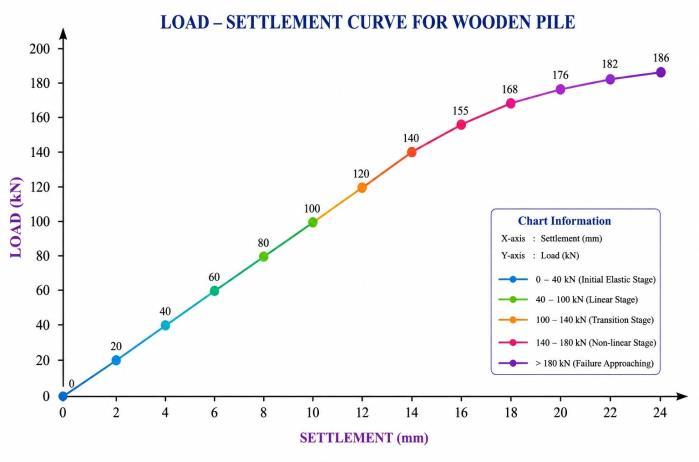
Fig.1Load–settlementcurveforwoodenpile
Fig.1showstheload–settlementbehaviorofthewooden pile under axial loading conditions. Initially, the pile exhibits elastic behavior with low settlement values. As the applied load increases, settlement gradually increasesduetostressconcentrationinthesurrounding soil. The curve indicates that treated wooden piles provide stable performance under moderate loading conditions.
International Research Journal of Engineering and Technology (IRJET) e-ISSN: 2395-0056
Volume: 13 Issue: 05 | May 2026 www.irjet.net p-ISSN: 2395-0072
11. Practical Applications
Treatedwoodenpilescanbeeffectivelyusedin:
• Residentialbuildings.
• Ruralinfrastructureprojects.
• Temporarystructures.
• Coastalfoundationsystems.
• Bridgesubstructures.
• Sustainableconstructionprojects.
12. Results and Discussion
The results obtained from FEM analysis showed that wooden piles provide satisfactory performance under axialloadingconditionsinmediumsoilenvironments. Importantobservationsinclude:
• Settlementincreasedwithincreaseinaxialload.
• Soil stiffness significantly influenced pile behavior.
• Load transfer occurred through skin friction and endbearingresistance.
• Treatedtimberpilesshowedimproveddurability andstability.
• FEM effectively predicted settlement characteristics.
The load–settlement analysis confirmed that wooden piles can be used as sustainable and economical alternatives to conventional pile materials for suitable constructionapplications.
13. Advantages of Wooden Piles
• Eco-friendlyfoundationmaterial
• Renewableconstructionresource
• Economicalcomparedtosteelandconcretepiles
• Easyhandlingandtransportation
• Reducedenvironmentalimpact
• Suitableforweakandmediumsoilconditions
• Lowcarbonfootprint
14. Conclusion
This study investigated the behavior of wooden piles under axial loading conditions using Finite Element
Modelling (FEM). The results showed that treated woodenpilesprovidesatisfactoryloadcarryingcapacity and controlled settlement behavior in medium soil conditions.
The developed FEM model successfully predicted soil settlement and pile–soil interaction characteristics. Load– settlement analysis indicated stable foundation performanceundermoderateloadingconditions. The study concludes that treated wooden piles can be effectively used as sustainable, economical, and ecofriendly foundation systems for light and medium load civilengineeringstructures.
15. Acknowledgement
Theauthorswouldliketoexpresstheirsinceregratitude to the Department of Civil Engineering of CSI College of Engineering, Ketti for providing the necessary facilities to carry out this research work. The authors also thank the project guide Mrs. Irfana Parveen for her valuable guidanceandsupportthroughoutthestudy.
16. References
1. Bowles, J.E., Foundation Analysis and Design, McGrawHillPublication.
2. Das, B.M., Principles of Foundation Engineering, CengageLearning.
3. Tomlinson, M.J., Pile Design and Construction Practice,CRCPress.
4. Poulos, H.G. and Davis, E.H., Pile Foundation AnalysisandDesign.
5. IS2911(Part1):IndianStandardCodeforDesign andConstructionofPileFoundations.
6. ASTM Standards for Timber and Pile Foundation Materials.