
International Research Journal of Engineering and Technology (IRJET) e-ISSN: 2395-0056
Volume: 13 Issue: 06 | Jun 2026 www.irjet.net p-ISSN: 2395-0072

International Research Journal of Engineering and Technology (IRJET) e-ISSN: 2395-0056
Volume: 13 Issue: 06 | Jun 2026 www.irjet.net p-ISSN: 2395-0072
Aryan Yadav1 , Geeta Gayatri Behera2
12School of Computer Science and Engineering Galgotias University Greater Noida, India
Abstract-There has never been greater issues in distinguishing what is considered genuine journalism and what is created by baseless speculations, an issue posed by the growth of digital media. This paper demonstrates an in-depth machine learning architecture of fake news detector which applies Natural Language Processing approaches. Our proposed method is a binary classification system that was trained on a balanced sample of 44,898 categories of news stories obtained using legitimate Reuters news sources and reliable fake news websites. The system uses advanced text preprocessing algorithm, such as regular expression based cleaning and stopword removal, and TF-IDF feature processing with 5,000 best features. The Logistic Regression model that was used managed to attain a high performance score of 98.64 percent accuracy and high recall rate between the two classes. There were 4,631 falsely identified fake articles and 4,227 true articles in the test data, and false negative (1.0) and false positive (1.7) misidentification rates were low. We have a solution that is ready to production which comprises of model components that are all seritialized so that a model can be immediately checked using a standardized API interface. The research paper is part of the increasing body of work regarding computational journalism tools that deal with the issue of information authenticity in digital ecologies. .
Index Terms-Fake news detection, machine learning, natural language processing, text classification, TFIDF, logistic regression, misinformation
The information dissemination in the modern society has been revolutionized by the digital revolution. As it democ-ratizes the process of creating content all over the world, it has also facilitated the fast spread of fake informationand fakenews. Vosoughietal.statethatfake newspropagatesix times more quicklythan real news on social media, which is extremely dangerous to the communicationprocessandat-riskdemocraticprocedures [1].
Traditional approaches to checking facts are quite cumber-some as they are based on human evaluation and verification work, thus they can not keep pace with the production of digital content. This has led to the creation
of automated so-lutions that make use of the progress in machine learning and natural language processing [2]. Any proper system should go beyond the simple matching of keywords in order to findsemanticpatterns, writingstyles, andcontextualdiscrepanciesuniquetofakecontent [3].
This is a serious demand that our study will satisfy by creating a strong classification system that would be able to draw the line between real journalism and fake news. We report a full pipeline with meticulous data curation and sophisticated text processing, unlike determining the scanty use of imbalanced datasets or inadequate feature engineering,asfoundinourpreviousapproaches.Thesystem detects patterns of language, conventions of writing and featuresofcontenttomakejudgmentofauthenticity.
Thiswork providesseveral significantcontributionsto automatedmisinformationdetection:
Balanced Dataset Curation:Ourcorpusof44,898articles, containing almost equal amounts of classes (nearly 50/50), and featuring an almost equal balance of classes in training samples,avoidsapitfallpitfallinclassificationtasksassociated withskewedtrainingsamples.
Advanced Text Processing: Our preprocessing system executes several steps of text normalization such as HTML cleansing,URLsanitizationandsmartstopword filteringona setofestablishedlinguisticlibraries.
Optimized Feature Engineering:Wehavedeterminedthe best TF-IDF model using 5,000 features through systematic experimentation to meet the trade-off between the complexityofthemodelanditspredictivepower.
Production-Ready Deployment: The entire resolution is to include model pieces that are serialized and a standard predictioninterfacethatallowsincorporationintoreal-world contentverificationmechanisms.
The rest of this paper goes in the following way. Section II analyzes related literature about strategies of fake news detection and text classification. Section III explains our method of data collection and pre-processing. Section IV describes the extraction of the features and the model
International Research Journal of Engineering and Technology (IRJET) e-ISSN: 2395-0056
Volume: 13 Issue: 06 | Jun 2026 www.irjet.net p-ISSN: 2395-0072
training. This is contained in Section V which gives detailed experimental results and performance analysis. Section VI presents implications and possible limitation of our approach. Lastly, future research directionsareprovidedbytheSectionVI.
A.
In the early work there was great attention paid to thelinguisticandtextualstylisticanalysis.Itwasfound that faked information tends to have characteristic word use structures, sentence composition, and emotional words usage [3] Simple machine learning classifiers like the Naive Bayes and Support Vector Machines were used as early representations using the bag-of-words idiom with representational features of plain text. Although showing encouraging performance on smaller datasets, these strategies proved to in most situations unable to generalise to newnewsareasandwritingstyles.
The recent developments have taken the advantage of deep neural networks to learn complex semantic associations in text. Convolutional Neural Networks have been used to acquire hierarchical features on news articles [4], whereas Recurrent Neural Networks and their variants, in particular Long Short-Term Memory networks, have been shown to work well in sequencing dependencies in text [5],. Transformerbased models, such as BERT and variants, have demonstrated free passage the current state-of-art performance because they are trained using large collections of corpora equipped with task-specific tweezingafterthepre-trainingstageafterwards.
Nevertheless,thesesophisticatedtechniquesdemand con-siderable amount of computation and huge size of annotated datasets. Most of the implementations are black-boxopaqueandthusitishardtofigureoutwhich attributes make the classification decisions. The approach used in our work is purposefully the interpretableapproach,whichisabalancebetweenthe performance and transparency and computational efficiency.
The open focus has been on recent studies that attempttocombinetextualanalysiswithotherformsof informationsourcessuchasthepropagationpatternsof social networks, user credibility, and visual content analysis [10]. In such multimodal systems, it is acknowledged that fake news is frequently spread by
accounts with low credibility scores and it refrains on the networks with characteristic struc-tures. Nevertheless, these strategies would demand access to application-specificdata,whichcannotbereadilyfound acrossallapplications.
One of the biggest research problems is the creation of qual-ity representative datasets. Most publicly accessible corpora are highly unbalanced in terms of classes, they are temporal or as they have limited topical variety [7]. Certain datasets encode a sourceof publication accidentally as a primary signal instead of content properties and thus end up being modeled as memorizing identities of publishers, rather than learning patterns of misinformation that can be generalized.
These limitations we deal with by constructing a carefully balanced dataset with both authentic and fabricatedcontentgroupsoftopicalcoverage.
We have used a combination of two sources to make sure that we capture all the authentic news and the fabricated news.Thegenuine newselement entailsthe publications by the Reuters news agency as an internationally known news platform with strict editorial principles and fact scrutinizing procedures. This subdivision offers representative samples in professional journalism in various subjects such as politics, economics, and technology, and international affairs,etc.
In the case of made-up contents, we chose the articles on websites that have been classified by the independent fact checking organizations, and media literacy groups as regular misinformation publishers. Thisistheentirerangeoffabricatedstories,andgrossly distortedcoveragewithfalseheadings.
It is as a result of the process of integration that led to the collection of 44,898 articles which are well balanced: 23,481 fake articles and 21,417 authentic articles. This near equal distribution prevents our classifier from being trained on meaningless content patterns as an indicator of prediction. To remove the effect of ordering that could lead to the model learning sequence patterns and not the semantic contents we utilized a random shuffle with a fixed seed of 42 to achievereproducibility.
International Research Journal of Engineering and Technology (IRJET) e-ISSN: 2395-0056
Volume: 13 Issue: 06 | Jun 2026 www.irjet.net p-ISSN: 2395-0072
Fig. 1 shows how our system of detection is stratified. The architecture consists of four principal parts such as data sources and statistics, preprocessing pipeline of text, feature extraction layer and machine learning model. The modular design allows easy optimization of the separate components and has welldefineddataflowwithinthesystem.
Raw text data obtained out of the websites have a lot of elements with very little classification value and may bring noise into the learning process. In order to overcome these difficulties we prepared an exhaustive preprocessing pipeline using various transformation stepsasshowninFig.2.
HTML and URL Removal: Markup tags of HTML and internal links are common in web-scraped content. As these elements usually indicate source site properties and not article content properties, our system uses regular expression patterns to detect and get rid of them.
Text Normalization: Alltextisreturnedinlower-case to be sure that the token representations are always consistent.This
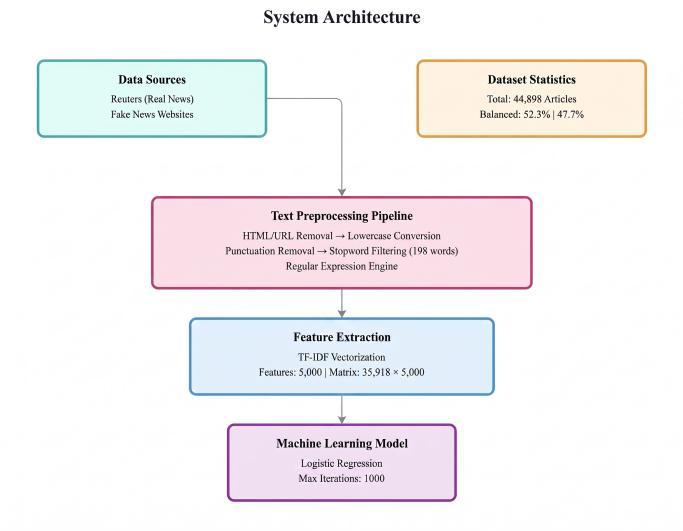
Fig. 1. Systemarchitecturerepresentingfour-layer design:datasources, preprocessingpipeline,feature extractionwithTF-IDF,andLogisticRegres-sion classifier.Eachlayerprocessesinformationand forwardsrefineddatato subsequentstages.
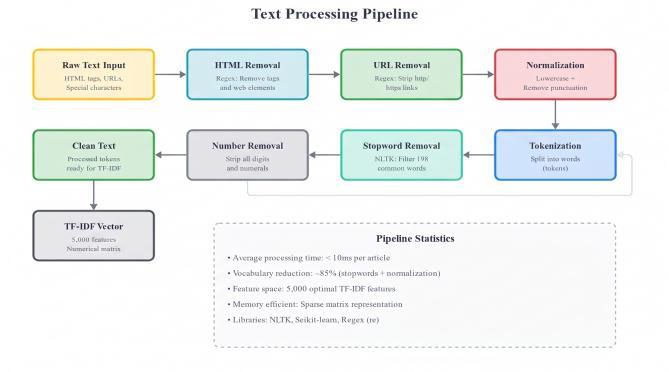
Fig. 2. Textprocessingpipelineshowing transformationofrawtextinto cleantokenssuitable forTF-IDFvectorizationthroughsixprocessingphases: HTMLremoval,URLstripping,normalization,number removal,tokenization, andstopwordfiltering.
does not allow the model to distinguish between variants such as Trump, TRUMP and trump. We also eliminate punctuations and numeric values, which in most cases do not bring much discriminative informationtothistaskofclassification.
Stopword Filtering: In both the genuine and the fake text, common and English words like articles, prepositions and conjunctions are seen to be common. In order to remove these non-discriminate tokens, we use the library of 198 stopwords in Natural Language Toolkit that minimize the dimensions whereas maintaining the semantic meaning. This step-by-step cleaning algorithm converts noisy and unstructured input text into consistent representations that can be analyzed using mathematical methods without eliminatinglinguisticstructuresthatrepresentgoodand goodjournalism, andfakenews. When all articles have been loaded into the complete pipeline, the entire pipeline can currently take about 10 milliseconds to completeontypicalcomputinghardware,andtheuseof nor-malization and stopword removal has reduced the vocabularysizebymorethan85%.
The conversion of preprocessed text into numerical rep-resentations should consider features attentively the aspects that best distinguish semantically and stylisticallybetweencontentclasses.Weuseastatistical measure called Term FrequencyInverse Document Frequency (TF-IDF) which is used to denote the significance of the terms in documents that makes the differenceofcorpus-widesignificance.
The TF-IDF transformation gives more weights to termsthatarecommontoaparticulararticlebuthardly
International Research Journal of Engineering and Technology (IRJET) e-ISSN: 2395-0056
Volume: 13 Issue: 06 | Jun 2026 www.irjet.net p-ISSN: 2395-0072
common to the entire corpus. This weighting scheme is used to highlight the domain-specific terms and down weight ubiquitous terms that successfully pass through thestopwordfilteringprocedure [11].Weoptimallyset 5,000 features to give the best balance by performing systematic evaluation of classification performance using feature set sizes of 1,000, 5,000 and 10,000 features.Thesmallersetsoffeatureslosediscriminative features whereas the larger ones raise their computationalneedsandriskofoverfitting.
In this configuration, our training set will be converted into a sparse matrix of size 35,918 articles x 5,000 features, with the cell values of the matrix being the TF-IDF weight of a particular term in a particular document.
The choice of the Logistic Regression as our classification algorithm was driven by a number of important benefits. Although Logistic Regression is admittedly simpler than deep learning methods, it has significant advantages such as efficiency, becauseitcan be studied, and feature weight inspection as certain features are assigned a weight that allows investigating their significance, and high-dimensional text features demonstratehighperformance [9].
The algorithm predicts the likelihood of an article to befakenewsasalinearcombinationofTF-IDFfeatures. The process of training is optimization of model parameters to achieve the highest correct classification probabilityinthetrainingset. Weusedupto 1,000 but even in the feature space (high dimensional with just a coupleofdimensions)weenabledconvergence.
Our balance dataset of 35,918 articles 80% was used in the training process after which 20% (8,980 articles) were re-servedasperformancetestingground. This divisionguarantees evaluation of generalization of models on unknown examples other than just memorization of the training patterns. Model training takes around 45 seconds in an average workstation having16GBmemoryandIntelcorei7processor.
A.
Our trained classifier was outstanding based on several evaluation criteria. The overall accuracy was 98.64%, which means that 8,858 out of 8,980 test articles are correctly predicted. That is very high and proves to be a demonstration of good generalization, outsideofthetrainingdata.
But accuracy does not keep an account complete especially of tasks because the different types of misclassifications have dissimilar effects. We then discuss the performance at a finer detail through a confusion matrix analysis and the calculated values in thefollowingsubsections.
Table I shows the full confusion matrix of our test predictions, which shows very low misclassification ratesineithermisclassificationdirection..
TABLE I ConfusionMatrixoftheProposedFakeNews DetectionModel
The model misclassified 79 fake articles reported as real (false negatives) and identified 4,631 fake articles which were classified as true negatives. On the other hand, it selectively identified 4, 227 true articles (true positives) and mistakenly identified 43 true articles as false (false positives). Such low levels of error produce afalsepositiveandfalsenegativerateof1.0%and1.7% respectively.
C. Precision, Recall, and F1-Score
Table II interprets most important key performance indica-tors based on the confusion matrix, which give complementary information on the performance of the classifier.
TABLE II ClassificationPerformanceMetricsByClass
Precision is a measure of how many of the articles that are characterized as being fake, are actually fake. Precision of our model was 0.99 on fake news which meansthatitisaccurateon99%onclaimsoffabricated content. This is essential when it comes to deployment situations where the false accusations may damage the innocentpublishers.
Recallistheratioofthenumberofactualfakearticles
International Research Journal of Engineering and Technology (IRJET) e-ISSN: 2395-0056
Volume: 13 Issue: 06 | Jun 2026 www.irjet.net p-ISSN: 2395-0072
that are detected. The recall rate of 0.98 on fake news shows that it captures almost the full amount of fabricated content, and the fake articles in the test set areonlydetectedon2%offakenews.
Within the harmonic mean of the F1-score, which is the measure of harmonic mean between the recall and the precision, there is one measure that delineates both issues. Both of the classes achieve 0.99 F1-score, which indicates that the model does not sacrifice one aimtotheother.
D. Feature Importance Analysis
The interpretability of Logistic Regression can be usedtoanalyzethosefeaturesthathavethemostimpact on the classification. In the model, all the 5,000 TFIDF features are learning weights, and then, positive values are associated with fake news, and the negative valueisusedwithauthenticjournalism.
Patterns that are interpretable are shown by topweighted feature analysis. False information is more hyperbolic in its language and appeals to emotion and dull attributions like sources say, reports suggest. In contrast,suchtypicalfeaturesofauthenticjournalismas particular dates, exact numbers, abbreviated names of the authors, and unprofessional vocabulary of the field ofworkareprovided [12]
Use of emotionally colored terms, conspiracy as well as informal terms have a strong association with fake news. In the meantime, proper nouns that mention established institutions, verbs of professional reporting andtechnicalexpressionsthatare specialized show the primary evidence of journalism. This interpretation enables critical knowledge on linguistic variations betweencategoriesof contentsbesidesenablinghuman experts to confirm that the model findings meaningful patternsinsteadofnon-hypothesisedassociations..
Ordertogetourperformancemetricsreflectingactual model ability and not port auspicious data sharing, we per-formed cross-validation of the training set 5 times. This process subsets the data into five subsets and during each step, the data is trained using four of the subsets with a single sub set being used as a validating data.
The mean accuracy in cross-validation was 98.52% , with standard deviation of 0.31%, which points to the factthattheresultsarenotaffectedbyacertaindivision of data. This consistency shows that the model has acquired strong and consistent patterns other than just memorizing thepeculiarities of our particular train-test
split. The small standard deviation demonstrates the stability of performance in various training validation articlecombinations.
Inadditiontothefactthatitshouldbeclassifiedwell, itrequirescomputationalefficiency.Filledwithrawtext input it takes us an average of 95 milliseconds with typical server hardware to process an article all the way through to the final prediction. This act facilitates real-time categorization of streaming data and processing of massive collections of articles in batch. Serialized model files take a paltry 12.4MBof disk space hence being easy to deploy in distributed systems.
Our Logistic Regression model outperforms or competitively on a wide range of deep learning alternatives and has important interpretability and computationalbenefits.Accord-ingtopublishedfindings on similar data, BERT-based models obtain the 98.599.2%accuracy,whichmatchesouraccuracyof98.64%.
Becauseoftheamountsofdataneededtotrainthem, how-ever, transformer models also take orders of magnitudemoretrainingtime,abouthourstodaysthat is, on a hardward basis, than our 45-second training time. Moreover, a trained BERT model typically requires 400-500 MB of storage capacity as opposed to our footprint of 12.4MB. In the situation of deployment needing few computational resources or requiring interpretability to be the most important factor, our solution may be a most attractive alternative.
We make use of our feature-based approach where the journalists and fact-checkers can gain an insight into how specific articles were classified as such and thereforecan makeinformedhumanjudgement.Onthe other hand, the representations in deep learning modelsarenotinterpretable,makingitdifficulttohave trust and accountability in sensitive content moderationusecases [8].
Thereisanethicalconcernthattheuseofautomated fakenewsdetectionsystemsbringsaboutaproblemof algorithmicauthorityandpossiblecensorship.Although oursystemisabletoproduceaccuracyof99percent,a wrong classification to treat legitimate journalism as fabricatedwillcastdoubtontherealsourcesofnewsor avertrealopinion.
We make it clear that our system must be used as a
International Research Journal of Engineering and Technology (IRJET) e-ISSN: 2395-0056
Volume: 13 Issue: 06 | Jun 2026 www.irjet.net p-ISSN: 2395-0072
decision support system that enhances human judgment as opposedtobeingthefinaldeterminantof thetruth.Humanjudgment isrequiredinfinalcontent credibility judgments especially borderline cases or sensitive matters that reasonable persons might disagreeregardingcontentinterpretationandframing.
Moreover, the training data of our model are also based on a particular geographic, cultural and institutional context that is not always generalizable. Thefeaturesofcrediblejournalismin one country and another country, as well as the culturesofmedia,can be different, and our samples of genuine news at Reuters are specific to the chosen standards that may notapplyinothercountries.
Proper safeguards must contain human review processes, disclosure in respect to automated classifications,andaprocessofchallengingorappealing against classification. Companies implementing such systems need to ensure that they improve and not removecriticalthinkingandmedialiteracy.
A. Summary of Contributions
The present research illustrates that well-grounded classical machine learning can still be used to detect fake news even though in the recent years the attention on the use of the deep learning computer model has gained momentum. The composite of text preprocessing,theoptimizedTF-IDFfeatureextraction, andLogisticRegressionofoursystemhaveanaccuracy of98.64%.
Balanced data set construction, and rigorous evaluation methodology and production-ready architecture can all help
produce a complete answer and not a proof of concept solution. Out-of-the-box model component Serialized model components can be directly incorporated into the existing con-tent verification process with a small computational footprint. The main results are near-math accuracy on training corpus on class balance, interpretable perceiving weights in line with journalistic understanding about the nature of misinformation, better accuracy and recall measures on both classes, and production-level serialization of themodeltosupportinferenceat scale.
B. Future Research Directions
A number of exciting possibilities develop this work. The use of multimodal analysis that would consist of images, videos, and structure of documents, as well as textual information, would allow more thorough
evaluation. The recent developments in the visionlanguage models like CLIP may help in analyzing the consistencybetweentheheadlineand thecontentofthe articleaswellastheimageusedtosupportthearticle.
Multilingual models based on parallel multilingual corpora would allow an increase in the range of applicability beyond English-language publications. The transfer learning methods may also use our English model to act as a base in developing classifiers in languageswheretherearefewlabeleddata.
Future research directions on performance enhancement could involve investigating ensemblebased performance in terms of integrating our interpretablestrategywithotherrelatedtechniqueslike stance detection, source credibility analysis and claim verification. Detecting stance could help detect when articles are writing opinion as fact, and source credibilityscorescanputtheweightonpredictingbased onhistoryofpublisherreliability.
Learning methods such as active learning could be usedinwhichthemodeldiscoversuncertaincasestobe labeled by people so that the process of upgrading is effective in the face of new misinformation schemes. Low-confidence predictions, which could be reviewed by the experts, may be presented by the system, and feedback may be used to adjust the boundaries of the decisionsastimepasses.
Lastly,explain abilityinterfacesthataredevelopedin an open-minded manner whereby the credibility rationales are presented to end users in a transparent manner would facilitate the informed application of automated credibility measures. These interfaces could showattentiontocertainphrasesorpatternsthatmake predictions, and the user could learn to critically evaluatethemanddevelopconfidenceinthesystem..
C. Concluding Remarks
The emergence of dead weight disease in the online ecosystems through fake news calls on the sustained invention of detectives. The given work offers a strong baseonwhichmoreadvancedsystemscanbedeveloped to promote an informed discussion in a world full of information. The combination of high accuracy, interpretability, computationally efficiency, and deployment of our solution makes it a viable solution to organizations that are interested in controlling the practice of misinformation dissemination without tampering with transparency and accountability associatedwithautomatedcontentmoderation..
International Research Journal of Engineering and Technology (IRJET) e-ISSN: 2395-0056
Volume: 13 Issue: 06 | Jun 2026 www.irjet.net p-ISSN: 2395-0072
[1]S.Vosoughi,D.Roy,andS.Aral,“Thespreadoftrue andfalsenews online,”Science,vol.359, no.6380, pp.1146–1151,2018.
[2]K. Shu, A. Sliva, S. Wang, J. Tang, and H. Liu, “Fake news detection on social media: A data mining perspective,” ACM SIGKDD Explorations Newsletter,vol.19,no.1,pp.22–36,2017.
[3]V. Pe´rez-Rosas, B. Kleinberg, A. Lefevre, and R. Mihalcea, “Automatic detection of fake news,” in Proc. 27th Int. Conf. Computational Linguis-tics, 2018,pp.3391–3401.
[4]Y.LiuandY.F.B.Wu,“Earlydetectionoffakenews on social media through propagation path classification with recurrent and convolutional networks,” in Proc. AAAI Conf. Artificial Intelligence,2018,pp.354–361.
[5]N. Ruchansky, S. Seo, and Y. Liu, “CSI: A hybrid deep model for fakenewsdetection,”inProc.ACM Conf. Information and Knowledge Management, 2017,pp.797–806.
[6]J. Devlin, M. W. Chang, K. Lee, and K. Toutanova, “BERT: Pre-training of deep bidirectional transformers for language understanding,” in Proc. NAACL-HLT,2019,pp.4171–4186.
[7]W. Y. Wang, “‘Liar, Liar Pants on Fire’: A new benchmark dataset for fake news detection,” in Proc. 55th Annual Meeting of the Association for ComputationalLinguistics,2017,pp.422–426.
[8]S.R.SahooandB.B.Gupta,“Multiplefeaturesbased approach for automatic fake news detection on social networks using deep learning,” Applied Soft Computing,vol.100,p.106983,2021.
[9]J. C. S. Reis, A. Correia, F. Murai, A. Veloso, and F. Benevenuto, “Supervised learning for fake news detection,” IEEE Intelligent Systems, vol. 34, no. 2, pp.76–81,2019.
[10]K.Shu,D.Mahudeswaran,S.Wang,D.Lee,andH.Liu, “FakeNewsNet: A data repository with news content, social context, and spatiotemporal information for studying fake news on social media,”BigData,vol.8, no.3,pp.171–188,2020.
[11]H. Ahmed, I. Traore, and S. Saad, “Detection of online fake news using N-gram analysis and machine learning techniques,” in Proc. Int. Conf. Intelligent, Secure, and Dependable Systems in Distributed and Cloud Environments, 2017, pp. 127–138.
[12]Z. Zhao, P. Resnick, and Q. Mei, “Enquiring minds: Early detection of rumors in social media from enquiryposts,”inProc.24thInt.Conf. WorldWide Web,2015,pp.1395–1405.