
International Research Journal of Engineering and Technology (IRJET) e-ISSN: 2395-0056
Volume: 13 Issue: 04 | Apr 2026 www.irjet.net p-ISSN: 2395-0072

International Research Journal of Engineering and Technology (IRJET) e-ISSN: 2395-0056
Volume: 13 Issue: 04 | Apr 2026 www.irjet.net p-ISSN: 2395-0072
Dr. Ch. Mallikarjuna Rao1 , Challa Monisha Reddy2 , B. HoneyPriyadarshini3, T. Sreeja4, N. Layasree5
1 Professor, Gokaraju Rangaraju Institute of Engineering and Technology, Hyderabad, Telangana 2, 3, 4, 5 Undergraduate Student, Dept. of Computer Science and Engineering, Gokaraju Rangaraju Institute of Engineering and Technology, Hyderabad, Telangana ***
Abstract - Communication disparity between the deaf and hard-of-hearing (DHH) community and the hearing population remains a significant socio-technical challenge. This paper presents a multimodal deep learning framework designed to recognize and translate gestures from three distinct sign language systems: American Sign Language (ASL), Indian Sign Language (ISL), and Belgian French Sign Language (LSFB). Using MediaPipe for landmark extraction and a Bidirectional Long Short-Term Memory (Bi-LSTM) network for temporal sequence modeling, the system achieved a classification accuracy of 66.0% on the 250-class ASL backbone dataset. The framework proposed uses a FewShot Transfer Learning strategy, allowing the pre-trained ASL backbone to adjust to the 84-class ISL dataset with limited amount of additional data, achieving a trainingphase accuracy of 73% [13]. Furthermore, an mBART-50 many-to-many machine translation pipeline is integrated into the system [12], enabling direct sign-to-multilingual speech synthesis across various languages. End-to-end pipeline testing on pre-recorded dataset clips demonstrated clean, semantically accurate translations, with low latency. While results for LSFB (29.0%) highlight the challenges of cross-lingual transfer with limited continuous-sign datasets [14], the overall system demonstrates a viable and extensible path towards a real time universal translation for the DHH community
Keywords: Sign Language Recognition (SLR), Multilingual Translation, Bidirectional LSTM, FewShotLearning,MediaPipe,mBART-50
Communication is a basic human right, yet there is a significant linguistic division between the hearing populationandtheglobaldeafandhard-of-hearing(DHH) community.Signlanguageisconsideredtheprimarymode of expression for the DHH community across the globe. However, the scarcity of professional sign language interpreters creates major complications in education, healthcare,employment,anddailysocialinteraction.
Though Artificial Intelligence, Computer Vision, and Natural LanguageProcessinghavecometogethertobring promising solutions, but most of the existing Sign Language Recognition (SLR) systems are still greatly
challenged. Sensor-based methods, which use data gloves or EMG sensors offer precision but are intrusive and impracticalforeverydayuse[6].Thevision-basedmethod, which uses a raw-pixel Convolutional Neural Network, is accurate but computationally expensive and it is also highly sensitive to environmental factors such as background,lighting,andskintone[2].
However, landmark extraction through frameworks such as MediaPipe [3] has provided a transformative alternative. By representing gestures as high-dimensional spatial tensors, rather than raw image data, hardware invariance is achieved, and focus is given only to the geometryofgestures.Furthermore,throughtheadvent of Large Language Models and availability of many-to-many translationmodelssuchasmBART-50[10]thetranslation aspect of SLR has changed completely, enabling direct output in multiple languages without the need of an intermediatepivotlanguage.
This paper proposes a multimodal AI framework for sign language translation between multiple languages. In our system, the 3D landmarks are captured using the MediaPipe framework, which uses a Bi-LSTM network[7] for modeling the dynamics of the gesture, and sign translation for multiple spoken languages using the mBART-50 model, along with auditory feedback from Google Text-to-Speech (gTTS). A key contribution in this paperistheFew-ShotTransferLearningapproach,where a backbone model trained on the large-scale ASL dataset can be used for recognizing ISL and LSFB signs with minimal additional data, showing the feasibility of a universalgesturerepresentationspace[5].
Albanie et al. [1] studied large-scale co-articulated sign language recognition, which showed that scaling training data improves sign language recognition performance. However, this system was developed for a specific sign language without the capability for multilingual translation.
Bankar et al. [2] developed a real-time framework using deep learning architecture for gesture classification. They tested their framework across multiple public datasets.
Volume: 13 Issue: 04 | Apr 2026 www.irjet.net p-ISSN: 2395-0072
Their research demonstrated the effectiveness of contemporaryneuralnetworksinsignlanguage,theyalso highlighted that the key challenge in implementing sign language still lies in the ability to achieve high performance while also taking computational constraints ofreal-timeexecutionintoconsideration.
Lugaresi et al. [3] proposed the MediaPipe framework, which is used to develop perception pipelines that are capable of extracting 3D face, hand, and body landmarks from a single standard camera input. Their study has established that skeletal landmarks are lightweight compared to pixel-based CNN methods, as they are not affected by background noise and lighting, which is importanttothearchitectureofthisframework.
Divyashree and Manjushree [6] conducted a detailed reviewofimageprocessingtechniques whichareusedfor hand gesture and sign recognition. This provided a baseline for visual sign detection through methods like contour detection and skin segmentation. While their research contributed foundational insights, they also concludedthattraditionalimageprocessingisnotsuitable for complex, sentence-level interpretation because it does not have temporal memory, motivating the shift toward recurrentarchitectures.
Ravikiran [4] proposed a framework that uses MediaPipe landmarkextractionmethodalongwithLSTMtoprovidea robustsystemforreal-timesignlanguagerecognitionand translation. Their research confirmed that skeletal data significantly improves recognition accuracy in different environments compared to traditional frame-based methods, thereby giving rise to the need for the development of lightweight, hardware-independent architecture.
Tang et al. [12] also studied the mBART-50, a many-tomanymultilingualtransformerpre-trainedon50different languages. Their results showed that the shared multilingual embedding space allows high-fidelity translationbetweenanytwolanguageswithminimalfinetuning, even for low-resource regional languages such as Hindi and Tamil, which will be used for the translation layerofthiswork.
Huangetal.[7]showedthatBidirectionalLSTMnetworks, by processing the input sequence in both forward and backward directions, are able to capture more context informationcomparedtounidirectionalLSTMs.Inthecase of sign language, where the ending of a gesture usually resolves the ambiguity of its beginning, this context informationisvitaltotheclassificationofsigns.
A review of the literature reveals number of gaps in the research area of Sign Language Recognition and
Translation. First and foremost, it is evident that the majority of research work carried out so far has been on mono-linguistic systems, i.e., systems focused on translating ASL to English. There is a critical need for frameworks that can handle regional variations of sign languages such as South Asian sign language (ISL) and European sign language (LSFB) within a unified framework[8].
Second,existingsystemsoftenrelyonhardware-intensive approaches like depth sensors, data gloves or computationallyexpensive raw-frame CNN models, which are not feasible for real-world mobile deployment [2][6]. Third, although Few-Shot Learning has shown potential for practical applications in NLP and computer vision domains [5], its application to rapidly adapting a pretrained sign language backbone to new regional sign systemswithminimaldatahasremainedunexplored.
Finally, there is a clear lack of end-to-end systems that combine sign language recognition with real-time multilingualspokenlanguagesynthesis.Mostsystemsonly go as far as text output, failing to address the spoken language needs of the DHH population [8]. This research aims to bridge these gaps by combining MediaPipe for landmark extraction, Bi-LSTM temporal modeling, FewShot Transfer Learning, and mBART-50 multilingual translationintoasingle,deployablepipeline.
The system architecture comprises four main modular phases: (1) Data Acquisition and Unified Representation, (2) Spatial Feature Extraction, (3) Temporal Sequence Modeling,and(4)MultilingualNeuralMachineTranslation andSpeechSynthesis.
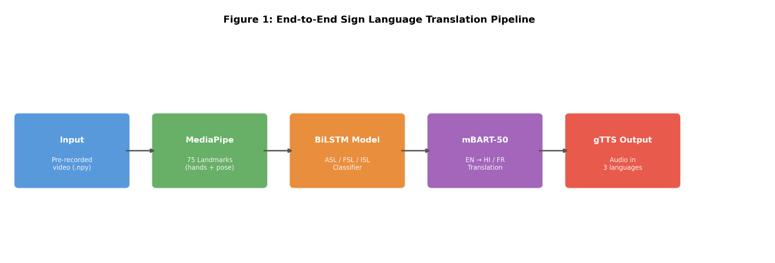
Fig-1: End-to-EndSignLanguageTranslationPipeline
To ensure cross-linguistic robustness of the proposed method, the network was trained on three different datasets, which were integrated into a single preprocessing framework. The backbone network was trained on the Google/Kaggle ASL Signs dataset, which contains pre-extracted landmark tensors for 250 wordlevel sign classes. The ISL dataset was acquired from the
Volume: 13 Issue: 04 | Apr 2026 www.irjet.net p-ISSN: 2395-0072
ISLVT corpus [13], which stands for the Indian Sign Language Video and Text corpus, whereas the LSFB dataset was acquired from the LSFB_CONT corpus [14], whichstandsfortheBelgianFrenchSignLanguage.
All thedatasetswerenormalizedintoa UnifiedLandmark Spacewhichcontains75landmarks:21landmarksforthe left hand, 21 for the right hand, and 33 landmarks for the upper-body pose skeleton. Each gesture sequence in the dataset was resampled to have a fixed temporal length of 100 frames by using linear interpolation, producing a consistent tensor shape of (100, 75, 3) per data point, where the final dimension represents the x, y, z Cartesian coordinatesofeachlandmark.
Instead of relying on Convolutional Neural Networks for raw video frames, which are affected by lighting, background, and skin tone variation [2], this framework uses MediaPipe [3] for markerless 3D landmark extraction. For a given video frame, 543 3D keypoints are identified, consisting of 468 facial mesh landmarks, 21 keypoints for each hand, and 33 pose keypoints, resulting in a 1,629-dimensional spatial feature vector per frame (543 * 3). From this entire vector, the 75 most significant keypoints related to gestures are retained, consisting of handsandupperbodypose,discardingthefacialmeshfor dimensionality reduction while still retaining the spatial information necessary for sign classification. This landmark-based approach achieves spatial invariance, meaning accuracy remains the same irrespective of the physical characteristics or background of the person signing[3].
Signlanguageisafundamentallytemporaldomain,where the semantic meaning of a gesture is encoded in the trajectory of movement over time [7]. The core classification model is a Bidirectional Long Short-Term Memory(Bi-LSTM) network whichis builtusing PyTorch. Thesystemarchitectureisstructuredas:themodelusesa linear projection layer to project the 225-dimensional featurevector oftheframe (75landmarks,3coordinates) to a 256-dimensional hidden space, followed by Layer Normalization and ReLU activation. A two-layer Bidirectional LSTM network is then used to process the sequence of the last 100 frames in both forward and backward directions, resulting in a 512-dimensional contextvectoratthelasttimestep,wheretheforwardand backwardvectorshavedimensionsof256
each. The context vector is then mapped to the logits by the classification head, which is composed of a Dropout layer with a dropout rate p = 0.4, followed by a fully connected linear layer. However, unlike standard unidirectionalLSTMs,theBi-LSTMusescontextfromboth
thestartandendofeachgesturesimultaneously,whichis essential for resolving ambiguities between visually similar signs [7]. The models were trained using the AdamW[15],whichutilizedatwo-phasestrategy:Phase1 freezes the backbone and trains only the classification head (30 epochs, lr = 5×10⁻³); in Phase 2, all parameters were unfrozen for joint fine-tuning (50 epochs, backbone lr=5×10⁻⁵,headlr=2×10⁻⁴).CosineAnnealingwasused for learning rate scheduling, and Cross-Entropy Loss with label smoothing (ε = 0.1) was used to improve generalization[5].
The major contribution of this framework is using FewShotTransferLearningforfastadaptationofregionalsign languages,evenwithlimitedtrainingdata[5].Themethod is divided into three stages. First, pre-training is done using Bi-LSTM on the 250-class ASL dataset, learning a Universal Gesture Representation Space, which captures generalspatial-temporalfeaturesofhumanhandandbody motion.Thesecondstepistofreezethemodel'sbackbone, i.e., the projection layer and the LSTM layers, so that the previouslylearnedmotionfeaturesareretained.Thethird step is to retrain only the model's classifier, i.e., the classification layer, on the ISL and LSFB datasets. This method is particularly suitable because sign languages from different cultures have common spatial-temporal features, like hand shape, motion, and spatial positioning, eventhoughtheirvocabulariesandgrammarmaybequite different.InthecaseoftheISLdataset,whichcontains84 classes and is of small size, a variant of the few-shot method is used, where the model is trained on all of the available data, since there is no validation set due to data scarcity.
The output of the English sign label predicted by the BiLSTM is then passed to the mBART-50 many-to-many transformer-basedtranslationmodel [12].mBART-50 isa transformer-based [11] translation model that has a 12layer encoder-decoder architecture with a shared multilingual embedding space for 50 languages. The sourcelanguageissettoEnglish(en_XX),andtheoutputis translated using a beam search algorithm with k = 4 for thetargetlanguagesusingaforcedbeginning-of-sequence token representing the target language code (hi_IN for Hindi, ta_IN for Tamil, fr_XX for French). In order to countermBART-50'sknownhallucinationbiaswhenusing single-wordinputs,a sentence template("Thesignmeans [token].") is wrapped around each sign token before translation, which has been shown to reliably constrain theoutputtothecorrectsemanticspace[12].
ForLSFB,wherethepredictedlabelsareFrench wordsin all-caps (e.g., PAPA, NON, ATTENDRE), a special
International Research Journal of Engineering and Technology (IRJET) e-ISSN: 2395-0056
Volume: 13 Issue: 04 | Apr 2026 www.irjet.net p-ISSN: 2395-0072
preprocessingstepfirstcleanstherawlabel(lowercasing, removing single-character suffixes) and then translates from French to English before the regular pipeline. The translated text strings are then fed into Google Text-toSpeech (gTTS) [9] to generate natural-sounding audio in the target languages, thus completing the Sign-to-Speech process
Table1: TechnolgicalStackSummary
Components Technology Rolein Pipeline
Environment GoogleColab(A100GPU) Highperformance model training
The performance of the proposed multimodal framework was evaluated using categorical cross-entropy loss and classification accuracy across three distinct sign language datasets. All models were trained on a Google Colab environmentutilizinganNVIDIAA100GPU.
The core Bi-LSTM classifier was evaluated after the twophase training protocol described in Section 4.3. Table 2 summarizes performance across all three sign language datasets.Figure2visualizestheseresultsasacomparative barchart.
Table 2: PerformanceSummaryAcrossSignLanguage Datasets
Feature Extraction MediaPipeHolistic[3] 3Dskeletal landmark tracking
Data Handling Pandas/NumPy/Parquet Tensor manipulation andstorage
Sequence Model PyTorchBi-LSTM[7] Temporal gesture classification
Transfer Learning Few-ShotFine-Tuning[5] Regional language adaptation
NLPEngine mBART-50Transformer [12] Many-tomany language translation
Audio Synthesis gTTS(GoogleTTS) Real-time speech generation
The ASL backbone achieved 66.0% validation accuracy across 250 visually similar word-level gesture classes.
8.315 |
Volume: 13 Issue: 04 | Apr 2026 www.irjet.net
Given the high intra-class variability introduced by different signers and the limited number of samples per class in the Kaggle dataset, this result validates the BiLSTM's capacity to capture discriminative temporal patternsinskeletalmotionsequences[7].
The most notable result is the accuracy of 73% at the training phase of the Indian Sign Language, obtained throughtheFew-ShotTransferLearningmethod.ThepretrainedbackboneoftheASLwasfine-tunedtothe84-class ISLtaskwithasmalldatasetthroughthefrozenbackbone fine-tuning method, as explained in Section 4.4. The high accuracy of the proposed method indicates that the Universal Gesture Representation Space, which is pretrainedontheASLdataset,wasabletocapturethespatialtemporal motion primitives of the sign language, which are shared across different sign languages, despite their linguistic differences [5]. This result empirically supports thehypothesisthatsignlanguages,despitetheirlinguistic independence, share fundamental kinematic structures that a deep neural network can exploit for rapid crosslinguisticadaptation.
The 29% validation accuracy obtained on Belgian French Signisaresultofanumberoffactors.Firstly,thelanguage hasa largegestural distancefromtheASL/ISLgroup. The continuous signing style of LSFB, its unique use of nonmanual markers such as facial expressions and mouthing, and it uses European phonology which are not well capturedbythebackbonenetwork,whichwaspre-trained on ASL [14]. Secondly, the LSFB-CONT corpus is a continuous sentence-level corpus, while the backbone network was pre-trained on isolated word-level sign language video clips, creating a mismatch. These observations indicate that effective LSFB adaptation will require either a richer pre-training corpus spanning European sign languages or an architecture explicitly designedforcontinuoussignrecognition.
End-to-end pipeline testing was performed on prerecorded video clips directly obtained from the dataset. Figure3presentsaheatmapoftranslationqualityoverthe ISLtestvideoclips.
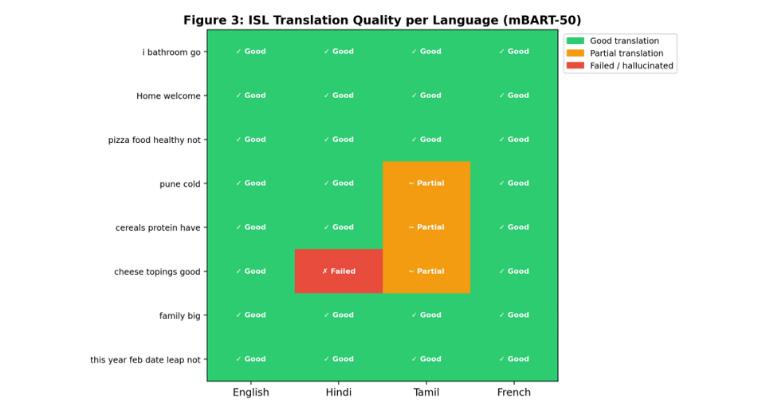
Fig 2:ISLTranslationQualityperTargetLanguage (Mbart-50)-Green:
ISL clips with high confidence such as "family big" (84.5%), "cereals protein have" (80.3%), and "cheese toppings good" (80.3%) yielded semantically accurate translations across all target languages. The Hindi and French translations were clean, while the Tamil translations yielded partial accuracy for shorter phrase inputs.ThesentencewrappingmethodofmBART-50,"The sign means [token].", was able to mitigate the hallucination issue previously identified during preliminary testing of single token inputs [12], whereby the model was producing incorrect and unrelated sentences.
TheLSFBpipelineusesanintermediateFrench-to-English translation steppriortothe standard multilingual output, handlingthenativeFrenchconventionusedinthedataset. Testing has shown that French sign labels such as PAPA and NON are correctly translated to "papa" and "no" in English before being translated to Hindi and other target languages.
Thelandmark-basedinputrepresentation,whichuses225 numerical features per frame (as opposed to raw highdefinition video frames), significantly reduces the dimensionality of the input for the model by orders of magnitude. This directly supports a high-throughput pipeline,whichillustratesthesignificantbenefitsinterms of efficiency for the skeletal approach proposed by Lugaresi et al. in [3]. By offloading the spatial complexity to the MediaPipe feature extractor, the Bi-LSTM model works on a significantly compressed input, ensuring that the entire process stays well within the bounds of a highthroughputrequirementforreal-timeperformance,which isasignificantfactorfortheframework'spotentialforuse mobile platforms where computational resources are a limitation.
Volume: 13 Issue: 04 | Apr 2026 www.irjet.net p-ISSN: 2395-0072
In this paper, a multimodal AI framework was proposed, which successfully incorporated MediaPipe Landmark Extraction, Bi-LSTM Temporal Classification, Few-Shot Transfer Learning, mBART-50 Multilingual Translation, and gTTS Speech Synthesis into a single Sign-to-Speech framework. The framework was successful in showing cross-linguistic generalization across three different sign language systems, i.e., ASL, ISL, and LSFB, under a single framework.
The Few-Shot Transfer Learning strategy was also successfulinadaptingtotheISLsignlanguage,achievinga training accuracy of 73%, using regional data, and showing the viability of learning gesture representations from one sign language system and applying them to another sign language system, which is cultureindependent [5]. The mBART-50 component was also successful in generating semantically correct multilingual translation for the ISL sign language, as evident from the clean output of Hindi and French spoken from the synthesizedspeech[12].
The future work will improve on the current study by addressingtheseidentifiedshortcomingsalongthreemain directions. Firstly, continuous sign recognition: extending the model to recognize continuous sentences of gestures rather than isolated word classification using CTC or attention-based decoders. Secondly, integrating facial expressions:usingtheMediaPipeFaceMeshcomponentto includenon-manual featuresinsignlanguagerecognition, especially for LSFB and other European sign languages. Thirdly,improvingpre-training:developinga pre-training corpuswithavarietyofsignlanguagefamiliestoimprove cross-lingualtransferaccuracyfortheLSFBsystem,where the current 29% accuracy reflects the limitations of ASLcentricpre-training[14].
[1] S. Albanie, G. Varol, L. Momeni, T. Afouras, A. Nagrani, H. Bull, and A. Zisserman, "BSL-1K: Scaling up coarticulated sign language recognition using mouthing cues," in Proc. European Conference on Computer Vision (ECCV),2020,pp.383–400.
[2] S. Bankar, T. Kadam, V. Korhale, and A. A. Kulkarni, "Real Time Sign Language Recognition Using Deep Learning," International Research Journal of Engineering and Technology (IRJET), vol. 09, no. 04, pp. 955-959, Apr 2022.
[3] C. Lugaresi, J. Tang, H. Nash, C. McClanahan, E. Uboweja,M.Hays,F.Zhang,C.-L.Chang,M.G.Yong,J.Lee, W.-T. Chang, W. Hua, M. Georg, and M. Grundmann, "MediaPipe: A Framework for Building Perception Pipelines,"arXiv:1906.08172,2019.
[4] Ravikiran V., "Real-Time Sign Language Recognition and Translation using MediaPipe and LSTM-Based Deep Learning," International Journal of Computer Applications (IJCA), vol. 187, no. 25, 2025. doi: 10.5120/ijca2025925415
[5]C.Finn,P.Abbeel,andS.Levine,"Model-AgnosticMetaLearning for Fast Adaptation of Deep Networks," in Proc. International Conference on Machine Learning (ICML), 2017,pp.1126–1135.
[6]DivyashreeB.A.andManjushreeK.,"ImageProcessing Techniques for Hand Gesture and Sign Recognition," International Journal of Engineering Research & Technology(IJERT),vol.9,no.5,2020.
[7] Z. Huang, W. Xu, and K. Yu, "Bidirectional LSTM-CRF ModelsforSequenceLabeling,"arXiv:1508.01991,2015.
[8]N.Surachettapong,T.Jeerwchayanon,T.Praveewan,A. Pyae, and J. Korte, "Designing a User-Centric American Sign Language Translation System: Integrating Machine Learning with Design Thinking," MDPI Information, Dec 2024.
[9]Google,"gTTS:GoogleText-to-SpeechPythonLibrary," [Online].Available:https://pypi.org/project/gTTS/,2023.
[10] Facebook AI Research, "mBART-50: Many-to-Many Multilingual Translation Model," [Online]. Available: https://huggingface.co/facebook/mbart-large-50-manyto-many-mmt,2021.
[11] A. Vaswani, N. Shazeer, N. Parmar, J. Uszkoreit, L. Jones,A.N.Gomez,L.Kaiser,andI.Polosukhin,"Attention Is All You Need," in Advances in Neural Information ProcessingSystems(NeurIPS),2017,pp.5998–6008.
[12] Y. Tang, C. Tran, X. Li, P.-J. Chen, N. Goyal, V. Chaudhary, J. Gu, and A. Fan, "Multilingual Translation fromDenoisingPre-Training,"arXiv:2001.08210,2020.
[13] P. Waghmare and A. Deshpande, "ISLVT: Indian Sign LanguageVideoandTextDataset,"MendeleyData,V1,doi: 10.17632/kcmpdxky7p.1,2024.
[14]A.Johnston,M.Schembri,andC.Crasborn,"TheLSFB Corpus: Belgian French Sign Language Continuous Dataset,"UniversityofNamur/RadboudUniversity,2024.
[15]I.LoshchilovandF.Hutter,"DecoupledWeightDecay Regularization (AdamW)," in Proc. International ConferenceonLearningRepresentations(ICLR),2019.