International Research Journal of Engineering and Technology (IRJET)
e-ISSN: 2395-0056
Volume: 13 Issue: 05 | May 2026
p-ISSN: 2395-0072
www.irjet.net
An AI-Based Crop Yield Prediction Framework Using Soil, Weather, and Remote-Sensing Features 1Kunal Kumar, 2Manik Agarwal , 3Mr. Satyam Raj 12Department of CSE Galgotias University Greater Noida, India 3School of Computer Science and Engineering Galgotias university Greater Noida, India
-----------------------------------------------------------------------------***------------------------------------------------------------------------biological responses and yield, but is also feature dependent Abstract-We present a machine-learning approach for and prone to transferability issues [4]. This modelling forecasting crop yield using soil, meteorological, crophelps reduce the planning lag. Farmers look to forecasts, practice, previous yield and remotely-sensed yield indices as not retrospectively, before growing season ends. So a crop input data. A controlled data set of 2,400 records from nine yield model needs to be timely, comprehensible and stable. different crops with 80:20 train-test ratio was used. We have It would be true for policy makers interested in the experimented with regression models such as linear relative water, fertilizer and crop suitability across regression, ridge regression, random forest, gradient districts. A model must not confuse these differences by boosting, Extra Trees. Our proposed Extra Trees ensemble amalgamating it into a combined forecast. This aspect was model had the lowest error with RMSE of 1.5149 t/ha, MAE of considered in the proposed design. 0.5815 t/ha, R² of 0.9965 and MAPE of 4.82% on the test set. The predicted vs. actual plot demonstrated a good match in most crop types, while residual analysis shows higher absolute errors for the high tons sugarcane cases. Further feature importance analysis showed that the previous yield, NDVI, EVI, rainfall anomaly, growing-degree days and seasonal rainfall were most important agronomic indices. Our approach allows the prediction of interpretable yields, yet to be field verified. Keywords-Artificial intelligence, crop yield prediction, machine learning, remote sensing, soil features, weather analytics, precision agriculture
I.
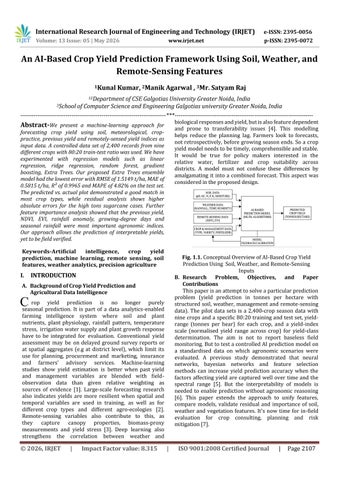
Fig. 1.1. Conceptual Overview of AI-Based Crop Yield Prediction Using Soil, Weather, and Remote-Sensing Inputs B. Research Problem, Objectives, and Paper Contributions This paper is an attempt to solve a particular prediction problem (yield prediction in tonnes per hectare with structured soil, weather, management and remote-sensing data). The pilot data sets is a 2,400-crop season data with nine crops and a specific 80:20 training and test set, yieldrange (tonnes per hear) for each crop, and a yield-index scale (normalised yield range across crop) for yield-class determination. The aim is not to report baseless field monitoring. But to test a controlled AI prediction model on a standardised data on which agronomic scenarios were evaluated. A previous study demonstrated that neural networks, bayesian networks and feature selection methods can increase yield prediction accuracy when the factors affecting yield are captured well over time and the spectral range [5]. But the interpretability of models is needed to enable prediction without agronomic reasoning [6]. This paper extends the approach to unify features, compare models, validate residual and importance of soil, weather and vegetation features. It's now time for in-field evaluation for crop consulting, planning and risk mitigation [7].
INTRODUCTION
A. Background of Crop Yield Prediction and Agricultural Data Intelligence rop yield prediction is no longer purely C seasonal prediction. It is part of a data analytics-enabled farming intelligence system where soil and plant nutrients, plant physiology, rainfall pattern, temperature stress, irrigation water supply and plant growth response have to be integrated for evaluation. Conventional yield assessment may be on delayed ground survey reports or at spatial aggregates (e.g at district level), which limit its use for planning, procurement and marketing, insurance and farmers' advisory services. Machine-learning studies show yield estimation is better when past yield and management variables are blended with fieldobservation data than given relative weighting as sources of evidence [1]. Large-scale forecasting research also indicates yields are more resilient when spatial and temporal variables are used in training, as well as for different crop types and different agro-ecologies [2]. Remote-sensing variables also contribute to this, as they capture canopy properties, biomass-proxy measurements and yield stress [3]. Deep learning also strengthens the correlation between weather and
© 2026, IRJET
|
Impact Factor value: 8.315
|
ISO 9001:2008 Certified Journal
|
Page 2107