International Research Journal of Engineering and Technology (IRJET)
e-ISSN: 2395-0056
Volume: 13 Issue: 05 | May 2026
p-ISSN: 2395-0072
www.irjet.net
ALLUMINIUM AND CAST IRON CASTING DEFECTS COMPARISON ANALYSIS AND REMEDIES Mr. IKBAL PATIL1, Mr. MALAGOUDA PATIL2, Mr. SANGAPPA BANNANNAVAR3, Mr. H.B.GOUDAR4 1234Selection Grade Lecturer, Dept. Mechanical Engg. Government .Polytechnic, Bagalkot ---------------------------------------------------------------------***---------------------------------------------------------------------
Abstract – Nowadays industries plays important role in the national development. So it necessary to produce good quality of products as per acceptable standards. During basic manufacturing process defects free casting production depends upon selection type of material, casting conditions majorly based on the application where the product is used. The design of casting based on strength, damping property and sustainability during prolong period of time. At the same time there is chance that rejections of casting due the hidden defects due variations in composition differ from product to product based on the different design conditions. Therefore it is necessary to have at least few material comparisons to know their manufacturing difficulties for minimize rejections of casting to enhance safe design and development conditions.
manufacturing difficulties based on their applications. And common defects remedies were determined to get sound castings with ease in manufacturing.
Key Words: Design, Development, Manufacturing, Damping, Material.
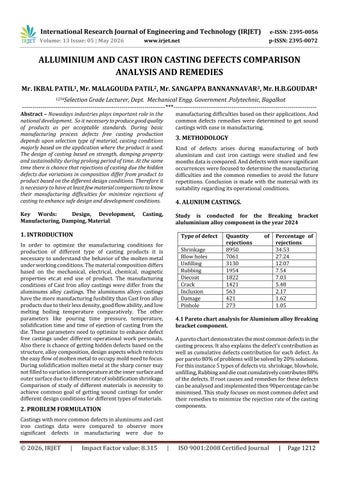
Study is conducted for the Breaking bracket aluluminium alloy component in the year 2024
3. METHODOLOGY Kind of defects arises during manufacturing of both aluminium and cast iron castings were studied and few months data is compared. And defects with more significant occurrences were focused to determine the manufacturing difficulties and the common remedies to avoid the future repetitions. Conclusion is made with the material with its suitability regarding its operational conditions.
4. ALUNIUM CASTINGS.
Casting,
1. INTRODUCTION
Type of defect
In order to optimize the manufacturing conditions for production of different type of casting products it is necessary to understand the behavior of the molten metal under working conditions. The material composition differs based on the mechanical, electrical, chemical, magnetic properties etc.at end use of product. The manufacturing conditions of Cast Iron alloy castings were differ from the aluminums alloy castings. The aluminums alloys castings have the more manufacturing fusibility than Cast Iron alloy products due to their less density, good flow ability, and low melting boiling temperature comparatively. The other parameters like pouring time pressure, temperature, solidification time and time of ejection of casting from the die. These parameters need to optimize to enhance defect free castings under different operational work personals. Also there is chance of getting hidden defects based on the structure, alloy composition, design aspects which restricts the easy flow of molten metal to occupy mold need to focus. During solidification molten metal at the sharp corner may not filled to variation in temperature at the inner surface and outer surface due to different rate of solidification shrinkage. Comparison of study of different materials is necessity to achieve common goal of getting sound castings for under different design conditions for different types of materials.
Shrinkage Blow holes Unfilling Rubbing Diecoat Crack Inclusion Damage Pinhole
Quantity rejections 8950 7061 3130 1954 1822 1421 563 421 273
of
Percentage of rejections 34.53 27.24 12.07 7.54 7.03 5.48 2.17 1.62 1.05
4.1 Pareto chart analysis for Aluminium alloy Breaking bracket component. A pareto chart demonstrates the most common defects in the casting process. It also explains the defect’s contribution as well as cumulative defects contribution for each defect. As per pareto 80% of problems will be solved by 20% solutions. For this instance 5 types of defects viz. shrinkage, blowhole, unfilling, Rubbing and die coat cumulatively contributes 88% of the defects. If root causes and remedies for these defects can be analysed and implemented then 90percentage can be minimised. This study focuses on most common defect and their remedies to minimize the rejection rate of the casting components.
2. PROBLEM FORMULATION Castings with more common defects in aluminums and cast iron castings data were compared to observe more significant defects in manufacturing were due to
© 2026, IRJET
|
Impact Factor value: 8.315
|
ISO 9001:2008 Certified Journal
|
Page 1212