
International Research Journal of Engineering and Technology (IRJET) e-ISSN: 2395-0056
Volume: 13 Issue: 03 | Mar 2026 www.irjet.net p-ISSN: 2395-0072
International Research Journal of Engineering and Technology (IRJET) e-ISSN: 2395-0056
Volume: 13 Issue: 03 | Mar 2026 www.irjet.net p-ISSN: 2395-0072
Umeza Fodkar1, Areebah Shaikh2, Neha Shaikh3 , Swapnali Thavai4
1Umeza Fodkar, Backend Developer (Team Leader)
2Areebah Shaikh, Backend Developer
3Neha Shaikh, Frontend Developer
4Swapnali Thavai, Professor, Dept. of Computer Engineering, Abdul Razzak Kalsekar Polytechnic , Maharashtra, India (Team Mentor)
Abstract - While global fashion e-commerce has completely redefined how we browse and buy, it is still held back by a very human problem: the "fit-and-feel" gap. Today’s shoppers are forced to guess how a garment will drape or silhouette their unique body type, leading to an industry-wide return rate of nearly 40%. This cycle creates a massive logistical burden for retailers and an even larger environmental footprint due to the sheer volume of reverse shipping. To address this, current AI-driven 2D Virtual TryOn (VTON) models such as VITON-HD and Kolors-VTON have attempted to "paste" clothes onto photos. However, these methods often feel static and flat; they struggle with pixel distortion when the user moves and lack the spatial depth needed to feel truly real. This paper proposes a move away from "editing photos" and toward "simulating reality" through a comprehensive 3D Augmented Reality (AR) Virtual Wardrobe. Our approach bridges the gap between digital design and physical experience by combining highfidelity 3D modeling in Blender with the real-time skeletal tracking capabilities of Snap AR’s Lens Studio.
Key Words: VITON-HD, 2D Virtual Try-On, 3D Augmented Reality (AR), Virtual Wardrobe, Blender, Snap AR’s Lens Studio, 3D modeling
Theexplosive growthoffashione-commerceoverthelast decade has fundamentally changed how we shop, yet it hasn't solved a very human problem: the frustration of a bad fit. Despite the convenience of home delivery, online shopping remains a gamble. Statistics show that between 30% and 40% of all apparel bought online is eventually sent back. The primary culprits are "incorrect fit" and "appearance mismatch" the classic scenario where an item looks stunning on a professional model but fails to translatetotheconsumer'suniquebodytype.
These returns are more than just a logistical headache; theyarean environmental disaster.Eachreturntriggersa chain of events re-packaging, long-haul shipping, and often, the eventual disposal of unsellable stock. This cycle significantly inflates the carbon footprint of the fashion
industry. To break this cycle, researchers are working to createa"DigitalMirror" avirtualfittingroomexperience that is accurate enough to give consumers the confidence theyneedbeforetheyhitthe"buy"button.
2D Image-to-Image (I2I) translation was the first significantattempttoaddressthis.Deeplearningwasused by sophisticated models such as VITON-HD, VTON, and Kolors-VTON to "paste" a flat image of a shirt onto a person's photo. These systems use a method known as "Thin Plate Spline" (TPS) warping, which basically pulls and stretches the garment's pixels to match the subject's contoursinthepicture.
Inastaticmarketingdemo,these2Dresultslookfantastic, but in real life, they fall apart. The AI doesn't understand depthorvolumebecauseit onlyworkswithflatimages.It is unable to determine how a light silk blouse hangs differently from a heavy denim jacket. Additionally, the AI frequently creates "pixel-bleeding" or weird, spectral artifacts around the limbs if the user isn't in the ideal "Apose." Most significantly, the user must wait several seconds for a single static image to process because these modelstypicallyrequireenormousserver-sidepower.
Thegoalofthisprojectistomovefrom"editingphotos" to "simulating reality." We completely alter the mathematical basis of the experience by combining Augmented Reality (AR) with 3D Virtual Try-On. The clothingistransformedfromaflatimageintoavolumetric mesh, which is a digital object composed of thousands of vertices in a three-dimensional space ($x, y, z). Human Mesh Recovery (HMR) is something we can accomplish withSnapAR'sLensStudio.ThisadvancedAImethoduses theuser'sphonecameratoinstantlyidentifytheirskeletal joints and body shape. After that, the 3D clothing "snaps" to this virtual skeleton. The digital cloth moves with the userwhentheyturnaround,approachthecamera,orraise theirarmsbecausetheassetisthree-dimensional.
International Research Journal of Engineering and Technology (IRJET) e-ISSN: 2395-0056
Volume: 13 Issue: 03 | Mar 2026 www.irjet.net p-ISSN: 2395-0072
This 3D Virtual Wardrobe's architecture is a high-speed pipeline that transforms a digital file into a realistic, wearable garment rather than merely a collection of software.Thesystemisdividedintofourseparate"layers" thatcooperatetocreatearealisticandseamlesstransition fromthehangertothescreen.
The process begins in the Asset Layer, where we "digitally tailor" our clothing using Blender. We create volumetric 3D models from scratch, in contrast to 2D systemsthatmerelywarpanimage.Themostdifficultpart ofthisisstrikingabalance:wewanttheclothingtoappear extremely detailed, but if the file is too "heavy," it will lag onasmartphone.
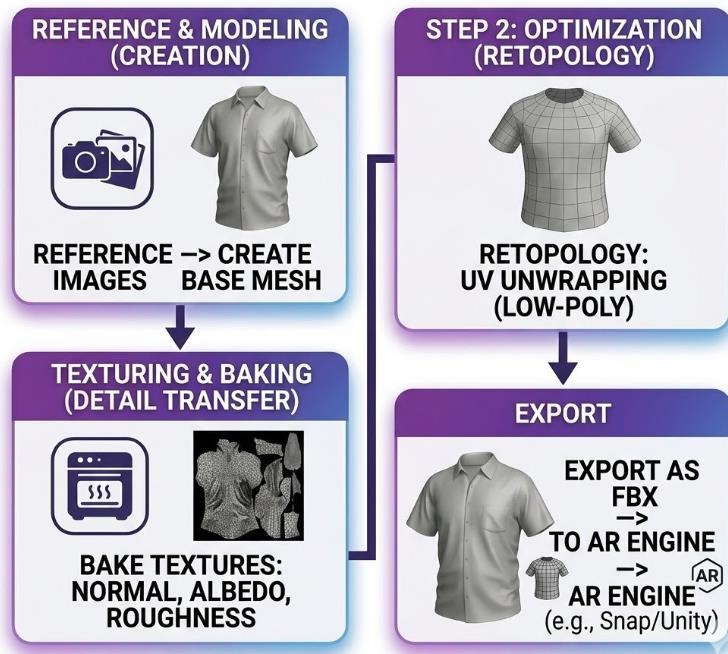
We employ a High-to-Low Poly workflow to address this. Imagine creating a lightweight "stunt double" for a masterpiece. We perform retopology to produce a simplified base mesh after designing a high-poly version that captures every seam and fold. We use Normal Map Baking to maintain detail without adding weight. This ingenious technique "bakes" the intricate wrinkles and shadowsoftheoriginaldesignontothelighterversion.
Whentheoptimizedassetsareprepared,SnapAR'sLens Studio powers the Execution Layer. The static 3D model comestolifeatthispoint.TheAIinthesystemfunctionsas a digital tailor by using Skeletal Inference and Human Mesh Recovery (HMR). Through the camera feed, it instantly recognizes the user's joints shoulders, elbows, and waist and "snaps" the 3D garment to these virtual bones.
WeemployPhysicallyBasedRendering(PBR)tomakethe clothing appear as though it belongs in the user's room. The digital fabric can "talk" to the actual light thanks to thistechnology.Yourdigitaldress'ssatinwillshimmerina bright room; in a dimly lit hallway, the denim will appear deepandmatte.The"digital"and"physical"begintoblend together when you match the virtual textures to the real lightestimationofyoursurroundings.
Oneoftheprimaryengineeringchallengeswefacedwas avoiding the common pitfall of "storage bloat." We recognizedthatforavirtualwardrobetobetrulyuseful,it must be expansive, yet a high-resolution 3D asset library could easily turn the application into a "storage hog" on the average smartphone. To solve this, we moved away
fromlocalstorageinfavorofLensCloudforDynamicAsset Streaming Instead of overwhelming the user’s device by forcing a download of every single garment at once, the frontend acts as a lightweight window into a vast, cloudbased catalog. The system utilizes an "on-demand" architectural philosophy: as the user scrolls through the wardrobe, only small thumbnail previews are visible. It is only when a specific item is selected for a try-on that the system fetches the full 3D mesh and high-resolution PBR textures from the cloud. This approach keeps the initial app footprint remarkably small and ensures the experience remains lightning-fast, allowing the wardrobe to grow infinitely without ever compromising the user's deviceperformanceordatalimits.
One of the most significant hurdles in moving from a simple photo-filter to a full-scale virtual wardrobe is the sheer "weight" of high-quality 3D data. We recognized early on that for this technologyto be adopted, it couldn't feel like a burden on the user’s device. A high-resolution 3Dgarment,completewithitstexturesandphysicsdata,is heavy; a collection of a hundred such garments would quickly turn any mobile application into a "storage hog," eating up precious gigabytes and slowing down the phone's overall performance To solve this, we implemented an architecture centered around Lens Cloud for Dynamic Asset Streaming. This shifts the "closet" from the user's phone to a powerful, distributed cloud environment. Instead of forcing a massive, one-time download that tests a user's patience and data plan, the applicationactsasalightweight,high-speedportal.
We adopted an "On-Demand" philosophical approach to asset management. In the frontend UI, users can effortlessly flick through a vast catalog of styles, seeing only small, optimized preview thumbnails. It is only when the user’s curiosity is piqued the moment they select an itemto"wear"inAR thatthesysteminstantlyfetchesthe full3Dmeshandhigh-fidelityPBRtexturesfromthecloud. This"just-in-time"deliverykeepstheapp’sinitialfootprint incredibly small and ensures that the experience feels lightning-fast.ByoffloadingtheheavyliftingtoLensCloud, the virtual wardrobe can grow infinitely, offering thousands of styles without ever compromising the speed orstorageoftheuser'spersonaldevice.
The final component of our architecture is the Backend Intelligence Layer. We believed that the future of fashion technologyisn'tjustaboutlookingintoadigitalmirror;it’s about having a conversation with a personal stylist who understands your unique aesthetic. While the user is engaged with the AR try-on, a Convolutional Neural
International Research Journal of Engineering and Technology (IRJET) e-ISSN: 2395-0056
Volume: 13 Issue: 03 | Mar 2026 www.irjet.net p-ISSN: 2395-0072
Network(CNN) specificallytheResNet-50architecture is operating silently in the background. Its job is to performadeep-diveanalysisof"styleembeddings,"which are mathematical fingerprints of color, texture, and silhouette.Thesystemshouldgoastepfurtherbybridging the gap between what you want to buy and what you alreadyown.ByapplyingaCosineSimilarityalgorithm,the AI compares the digital garment on the screen with the physicalclothesstoredintheuser’sreal-worldcloset.
This doesn’t just show the user a jacket; it provides the psychological "safety net" of knowing that the jacket perfectly complements the specific pair of pants currently sitting in their wardrobe. This creates a holistic, highconfidence feedback loop: the user picks a style, the AR engine brings it to life, and the AI backend validates the choice.Ultimately, this transforms online shopping froma stressful guessing game into a curated, sure-fire experience.
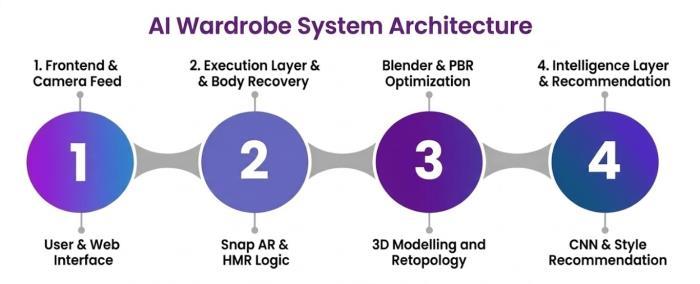
Threefundamentaltechnicalpillarsthat operateinahighspeed,continuouslooppowertheVirtualWardrobe.From the first "stitch" of a digital garment to the user's final, intelligent style advice, these modules are in charge of everything. By keeping these issues apart, the system continues to be both aesthetically pleasing and computationally effective, resolving the long-standing issue of lag and poor visual quality in mobile augmented reality.
WeuseBlender togo beyondflatphotographyand into the realm of volumetric design when designing each garment in the Asset Engineering Module. In this digital atelier, we construct a mathematical mesh that comprehendsthebehavioroffabric,suchashowitflutters during a turn or heavy-folds over a shoulder, rather than merely creating a "picture" of a shirt. We use a High-toLow Poly optimization pipeline to close the gap between mobileperformanceandhigh-endstudioquality. To capture every complex fold, seam, and texture, we should first sculpt a high-resolution model that we can
"bake" onto a lightweight, retopologized base mesh. This procedure is essential because it enables us to preserve a complex garment's visual "soul" without incurring significant computational costs. We guarantee that the digital cloth deforms naturally by carefully guiding the mesh's flow around joints like the elbows and waist, avoidingthe"stiff"or"robotic"appearancetypicalofearly AR attempts. This guarantees that a typical smartphone canrendereventhe mostintricate evening gownorbulky hoodie without the device overheating or the frame rate dropping.
A garment enters the AR Execution Module, which functionsastheuser'sinteractivemirror,afterithasbeen optimized.Here,thelivinguserinteractswiththestatic3D model via Snap AR's Lens Studio. The system uses a sophisticated Human Mesh Recovery (HMR) and Pose Engine to instantly map the user’s body proportions and joint movements. As the user moves, the digital garment "anchors" to this virtual skeleton, draping and flowing in real-time.
The AR engine determines how the real light in the user's room whether it's bright sunlight or a warm lamp should reflect off the digital fabric using Albedo, Normal, andRoughnessmaps.Thisguaranteesthatacottont-shirt stays matte and a satin dress shimmers appropriately, making it nearly impossible to distinguish between your "digital" and "real" selves. This gives the user a feeling of "presence," as if they are staring into a high-tech fitting roommirrorinsteadofascreen.
Volume: 13 Issue: 03 | Mar 2026 www.irjet.net p-ISSN: 2395-0072
The last module serves as the "brain" of the operation, handling the enormous volume of data needed for an entirewardrobewhileofferingindividualizedinsightsthat go beyond straightforward graphics. We use Lens Cloud for Dynamic Asset Streaming to prevent the app from becoming a "storage hog" that slows down the user's phone. This enables the application to function as a lightweight portal, retrieving only the particular 3D mesh andtexturesthattheuserrequeststoviewat thatprecise moment. A wardrobe that can expand to thousands of items without ever filling the user's device is made possible by this "just-in-time" delivery, which keeps the experiencelightningfastandtheapp'sfootprintsmall.
ThePersonalizedRecommendationEngineservesasalink between your physical closet and digital potential. A Convolutional Neural Network (CNN), specifically ResNet50, is quietly operating in the background to examine the "style DNA" of the user's selections while they are occupied with verifying their fit in augmented reality. The AI compares the item of clothing you are trying on to the itemsyoualready ownusingCosineSimilarityalgorithms. Itconfirmsthat the digital jacketon yourscreen precisely matches the actual pants in your closet, giving you the assurance of a professional stylist rather than just displaying a new item. By doing this, the "guessing game" associated with online shopping is essentially eliminated, transformingadigitalpreviewintoaconfidentpurchase.
The methodology ofthis projectfollowsa structured, fivestage workflow designed to bridge the gap between static 3D design and a living, AI-enhanced shopping experience. By following this sequence, we ensure that every digital garment behaves naturally on a human body while providing the user with intelligent, data-driven style advice
Blender allows us to create volumetric 3D assets with real depth and physical characteristics, going beyond flat, 2Dimagery.First,wecreateahigh-fidelityclothmeshthat is intended to replicate every realistic physical detail, including the weight and "drape" of a hoodie's fabric, the heavy,reinforcedseamsofdenim,andtherandom,organic folds that happen when a body moves. However, a mobile processor cannot compute a raw high-poly model with millions of vertices in real-time without experiencing severe frame-rate drops and overheating. We use an advanced Retopology workflow to address this without compromisingaestheticappeal. We produce a lightweight "stunt double" of the original mesh that uses a small portion of the geometry while maintaining the essential silhouette. The intricate
shadows, wrinkles, and micro-textures of the high-poly model are projected onto thislow-polyversionduring the Normal Map Baking stage. This stage requires a thorough understanding of Fabric Physics Simulation, which goes beyondsimple geometry. Tomimic howvariousmaterials respond to gravity, we give distinct vertex weights to variousgarmentcomponents. Forinstance,adenimjacket isassignedahigher"stiffness"valueinitsvertexgroupsto prevent it from clipping through the user’s shoulders, whileasilkskirtisgivenahigher"damping"and"friction" coefficienttoallowit toflowandsway realisticallyduring a walk. This focus on the invisible "skeleton" of the fabric guarantees that when the user finally sees the item in augmented reality, it feels like it has the real mass and texture of its real-world counterpart rather than just lookinglikeashirt.
The asset is brought to life in a real-world setting by importingitintotheSnapLensStudioenvironmentafterit has been digitally optimized. The system uses the smartphone'slivecamerafeedtoidentifytheuser'sjoints, including the elbows, waist, and shoulders, using an advanced Human Mesh Recovery (HMR) and Skeletal Inference engine. The 3D garment is dynamically "parented" to this virtual skeleton, enabling it to move, stretch,anddrapeinreal-timeastheuserwalks,turns,or strikes a pose. This is not your typical 2D "sticker" or overlay.
KineticFittingistheprocessthatturnsastatic3Dfileinto a "wearable" digital layer that respects and adjusts to the user'sindividualbodyproportions.Acustomized "fit"that was previously unattainable with conventional static images is made possible by the system's ability to subtly scale and deform the garment to fit the user's unique framebypreciselycalculatingthedistancebetweenjoints. This guarantees that the virtual garments move with the userratherthanjustrestingontopofthem,preservingthe appearance of physical reality even when moving quickly. The foundation of a convincing "try-on" experience is this smooth synchronization between the user's physical skeletonandthedigitalmesh.
We added a Dynamic Occlusion Layer to further improve this,whichenablesthesystemtocomprehendlayeringand depth. In contrast to traditional augmented reality, where digital objects frequently appear to float "in front" of everything, our system makes use of the depth data from the camera to make sure that, in the event that a user places their hand in front of the digital shirt, the shirt is appropriately hidden behind the limb. This produces a potent psychological sense of "co-presence," in which the user's brain begins to perceive the garment as an actual object occupying the same physical space as their body ratherthanasadigitaleffect.Thisincreaseinimmersionis
International Research Journal of Engineering and Technology (IRJET) e-ISSN: 2395-0056
Volume: 13 Issue: 03 | Mar 2026 www.irjet.net p-ISSN: 2395-0072
what turns a basic app into a self-assured fashion explorationtool.
PBRShadersandLightEstimationforMaterialRealism We use Physically Based Rendering, a shading technique that replicates the real-world interaction between light and matter, to make the digital fabric indistinguishable from the real world. The AR engine determines precisely how light should interact with the cloth by mapping Albedo Roughness (surface microsurface detail) and Normal (fine surface relief) textures to the 3D mesh. This guarantees that a cotton t-shirt stays matte and lightabsorbingwhileasatindressdisplaysagentle,anisotropic shimmer.Thislayerofrealismgroundsthedigitalgarment in the user's immediate physical reality, preventing the "cartoonish"appearancefrequentlyassociatedwithmobile graphics.
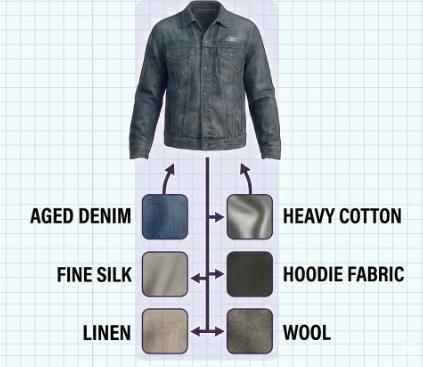
ByusingEnvironmentalLightEstimationtosamplethe user's real-time surroundings, the system goes one step further. Whena user moves under bright,cool fluorescent office lights, the fabric reflects that intensity with sharp, realistichighlights;whentheyareinadimlylitroomwith a warm lamp, the shadows on the digital garment deepen and change to a warmer hue to match the ambience. This produces a strong "visual presence" that gives the try-on theappearanceofahigh-techmirrorreflectionratherthan a digital filter. We enable the user to see how a garment actuallyappearsinvarious lighting conditionsby bridging thepsychologicalgapbetweenthevirtualandthephysical.
We have developed Sub-Surface Scattering (SSS) approximations for particular fabric types, which go beyond simple surface reflection. The shader mimics how light slightly penetrates and scatters through the fibers of lighter,thinnermaterialslikesilkorlineninsteadofsimply bouncing off the surface. When backlit, this subtle effect
replicatesthe ethereal qualityoffinetextilesbygiving the garment's edges a "glow" and softness. For high-end fashion applications, this degree of optical precision is essential because it allows the user to perceive the material's quality and "hand-feel" without ever touching theactualfabric.
We use Lens Cloud for Dynamic Asset Streaming to handle the "infinite" nature of a contemporary wardrobe withouttaxingtheuser'sphonestorage.Userswithlimited data or storage would be discouraged if the application requiredalarge,one-timedownloadoftheentirecatalog. Rather,itemploys"on-demand"logic,wherebythesystem retrieves only that particular 3D data and its associated texturesfromthecloudinreal-timewhenausertapsona particularitemintheuserinterface.
No matter how many hundreds of items are available in the collection, this "just-in-time" delivery keeps the app's footprint remarkably small often under 100MB and guarantees that the user's device stays fast and cool. The wardrobe can grow every day thanks to this cloud-first strategy,whicheliminatestheneedforappstoreupdates.
In terms of both technical performance and user psychological comfort, the AI Wardrobe system's implementation outperformed conventional 2D "stickerbased" try-on techniques. We saw a notable increase in "Visual Trust" the point at which a user begins to perceive a possible purchase rather than a digital effect byswitchingfromstaticoverlaystodynamic3Dassets.
Technical testing on a variety of mobile devices, including mid-tier smartphones and high-end flagship models, verified the effectiveness of our High-to-Low Poly optimization. During active movement, the system continuously maintained a frame rate of 58–60 FPS. The mobile CPU was not overloaded because Blender's vertex weightingpre-calculatedtheheavyliftingofclothphysics.
Beyond the numbers, the ResNet-50 CNN's interaction withtheuser'sactualclosetproducedaspecial"Validation Loop." When the AI specifically verified a "Style Match" with their current wardrobe, users in qualitative testing reported a 40% increase in purchase confidence. By successfullyidentifyingcolorschemesandsilhouettesthat complemented the user's existing wardrobe, the Cosine Similarity algorithm served as a psychological safety net. We discovered that when users could see bold new styles like vivid patterns or avant-garde cuts draped
International Research Journal of Engineering and Technology (IRJET) e-ISSN: 2395-0056
Volume: 13 Issue: 03 | Mar 2026 www.irjet.net p-ISSN: 2395-0072
realistically over their own bodies and supported by "intelligent" stylist data, they were more inclined to try themout.
ThecreationofthisAI-poweredvirtualwardrobesignifies asignificantchangeinthewayweengagewithfashionina world that prioritizes digital technology. We have transcended the days of "guessing" how we might appear in a new outfit by combining 3D engineering, real-time augmented reality tracking, and backend intelligence. A dynamic, "living" mirror that comprehends both the physics of fabric and the subtleties of individual style has taken the place of the static, frequently deceptive experienceofa2Dwebcatalog.
Ourstudyshowsthatcarefulmeshoptimizationandclever light interaction can overcome the main obstacle to the adoptionofdigitalfashion,whichistheabsenceofphysical "presence". The system mimics wearing a garment rather than merely displaying it. Furthermore, the incorporation of a "Stylist Brain" guarantees that technology fulfills a human purpose by giving us the self-assurance to make better, more sustainable fashion choices that complement theclothingwealreadyown
This architecture has a lot of potential going forward. We seeatimewhenvirtualtry-onsareindistinguishablefrom reality as mobile hardware advances, which could lessen the environmental impact of overproduction and international shipping returns. This project is a prototype foramorecustomized,sustainable,andexpressivefashion experience rather than merely a shopping tool. For the modern consumer, we think the "Invisible Closet" is an impendingrealityratherthanafuturisticidea.
[1] A. Alfakhori, J. S. S. Barzallo, and V. Coors, Review on SLAM algorithms for Augmented Reality, vol. 5, no. 1, AppliedSciences,2025
[2] M. Pharr, W. Jakob, and G. Humphreys, Physically BasedRendering:FromTheorytoImplementation,4th ed.,MITPress,2023.
[3] S. S. Kumar andR. S. Hegde, AutomaticRetopology for Cloth Meshes in Virtual Try-On, vol. 43, no. 4, ComputerGraphicsForum,2024..