
International Research Journal of Engineering and Technology (IRJET) e-ISSN: 2395-0056
Volume: 13 Issue: 06 | Jun 2026 www.irjet.net p-ISSN: 2395-0072
International Research Journal of Engineering and Technology (IRJET) e-ISSN: 2395-0056
Volume: 13 Issue: 06 | Jun 2026 www.irjet.net p-ISSN: 2395-0072
1Saurabh D. Pagar, 2Yash M. jagtap, 3Aniket M. Rane, 4Amol p. Pathak
1234Department of Artificial Intelligence and Data Science SNJB’s College of Engineering Chandwad, Nashik, India
Abstract - Interviews play a crucial role in academic and professional development, serving as a primary method for evaluating candidates’ knowledge, communication skills, and suitability for specific roles. However, students often lack access to realistic interview practice and constructive feedback, while organizations face challenges in efficiently screening large numbers of applicants. This paper presents AI Interview Agent, an intelligent and adaptive interview system designed to address these limitations through Artificial Intelligence (AI) and Natural Language Processing (NLP). The proposed system operates in two modes: Student Mode and Business Mode. Student Mode provides realistic mock interviews with personalized feedback to improve interview readiness, communication skills, and confidence. Business Mode automates candidate screening by conducting adaptive interviews, evaluating responses, and generating comprehensive assessment reports to support recruitment decisions. Unlike traditional scripted interview systems, the proposed solution dynamically generates interview questions based on candidate profiles, skills, resumes, and previous responses. Candidate answers are evaluated using multiple parameters, including content relevance, communication clarity, technical knowledge, and confidence. The system generates detailed reports highlighting strengths, weaknesses, and recommendations for improvement or hiring decisions. Experimental evaluation demonstrates that the proposed system provides scalable, objective, and personalized interview experiences, reducing manual effort while improving candidate preparedness and recruitment efficiency.
Key Words: Artificial Intelligence, Interview Agent, Natural Language Processing, Recruitment Automation, Mock Inter-view System, Dynamic Question Generation, Feedback Analysis.
Interviewsplayacrucialroleinbothacademicandprofessionalenvironments,servingasanessentialprocessforevaluatinga candidate’sknowledge,communicationabilities,problem-solvingskills,andoverallsuitabilityforaspecificrole.Successin interviewsrequiresnotonlytechnicalexpertisebutalsoconfidence,effectivecommunication,andtheabilitytorespondto questions in a structured and logical manner. However, many students do not have sufficient opportunities to practice interviewsinrealisticsettingsandoftenlackpersonalizedfeedbacktoidentifyareasforimprovement.Similarly,organizations face challenges in efficiently screening and assessing a large number of applicants, resulting in increased time, cost, and dependencyonhumaninterviewers.
RecentadvancementsinArtificialIntelligence(AI)andNaturalLanguageProcessing(NLP)haveenabledthedevelopmentof intelligentconversationalsystemscapableofunderstandinghumanlanguage,generatingcontext-awareinteractions,and providingautomatedevaluationmechanisms.Thesetechnologieshaveopenednewpossibilitiesforcreatingadaptiveinterview systemsthatcansimulaterealinterviewscenarios,analyzecandidateresponses,anddeliverpersonalizedfeedback.
This paper presents AI Interview Agent, an intelligent and adaptive interview platform designed to address the limitationsoftraditionalinterviewpreparationandrecruitmentprocesses.Theproposedsystemoperatesintwoprimary modes:StudentModeandBusinessMode.InStudentMode,thesystemassistslearnersbyconductingrealisticmockinterviews andprovidingdetailedfeedbackonvariousperformanceparameters,includingcommunicationskills,confidence,content relevance,anddomainknowledge.InBusinessMode,thesystemsupportsorganizationsbyautomatingcandidatescreening, conductingadaptiveinterviews,andgeneratingcomprehensiveassessmentreportstoaidrecruitmentdecisions.
Unlikeconventionalrule-basedinterviewsystemsthatrelyonpredefinedquestionsets,theproposedsystemdynamically generatesinterviewquestionsbasedoncandidateprofiles,resumes,skills,jobdescriptions,andpreviousresponsesduringthe interview.Theadaptivenatureofthesystemenablesittoaskcontext-awarefollow-upquestionsandconductunscripted conversations, thereby creating a more realistic and engaging interview experience. Furthermore, the system evaluates candidateresponsesusingmultipleperformancemetricsandgeneratesactionablerecommendationsforskillimprovement anddecision-making.
By integrating AI-driven conversational capabilities, dynamic question generation, and automated performance evaluation,theproposedAIInterviewAgentbridgesthegapbetweenautomatedassessmentandpersonalizedcoaching.The systemaimstoimproveinterviewreadinessamong students,reduceinterviewanxiety,andprovideorganizationswitha scalable,objective,andefficientcandidateevaluationframework.
International Research Journal of Engineering and Technology (IRJET) e-ISSN: 2395-0056
Volume: 13 Issue: 06 | Jun 2026 www.irjet.net p-ISSN: 2395-0072
TherapidadvancementofArtificialIntelligence(AI),NaturalLanguageProcessing(NLP),andMachineLearning (ML) has significantly transformed the field of intelligent human-computer interaction. Oneof the emerging applications of these technologies is the development of automated interview systemscapable of conducting interviews, evaluating candidate responses, and providing personalized feedback.Researchers from both academia and industry have proposed various approaches to improve interviewpreparation, recruitment automation, andcandidateassessment. This sectionpresents a comprehensivereviewofexistingstudiesandidentifiestheresearchgapsaddressedbytheproposed AIInterviewAgent Traditional interview preparation methods primarily rely on human interviewers, training sessions, and predefined questionnaires. Although these approaches provide valuable insights, they are often time-consuming,expensive,and difficulttoscaleforlargenumbersofcandidates.Furthermore,humanevaluationscanbesubjectiveandinconsistentdueto differencesininterviewerexperience,bias,andevaluationcriteria. These limitations havemotivatedresearchers toexplore intelligent systems that can automateinterviewsandprovideobjectiveassessments.
Earlyautomatedinterviewsystemswereprimarilyrule-basedchatbotsthatreliedonpredefinedquestionsetsand decisiontrees.Thesesystemsfollowedfixedconversationflowsandgeneratedresponsesbased onmanuallydesignedrules. While such systems reduced the dependency on human interviewers andprovidedbasicinteractioncapabilities,they lackedadaptabilityandcontextualunderstanding.Theinabilitytogeneratefollow-upquestionsandevaluateresponsesbeyond keywordmatchingsignificantlylimitedtheireffectivenessinsimulatingrealinterviewenvironments.
The emergence of Natural Language Processing techniques enabled the development of more sophisticated conversationalagentscapableofunderstandingandprocessinghumanlanguage.NLPtechniquessuchastokenization,part-ofspeechtagging,namedentityrecognition,sentimentanalysis,andsemanticsimilaritymeasurementhavebeenwidelyapplied ineducationalandrecruitmentapplications.ResearchershavedemonstratedthatNLP-basedsystemscanextractmeaningful informationfromcandidateresponsesandevaluatecommunicationeffectiveness,contentrelevance,andlinguisticquality. However,manyexistingsystemsstilldependheavilyonpredefinedtemplatesandlackdynamicconversationcapabilities.
SeveralstudieshaveinvestigatedtheuseofMachineLearningalgorithmsforcandidateevaluationandrecruitment automation.Classificationalgorithms,includingSupportVectorMachines(SVM),DecisionTrees,RandomForests,andNeural Networks,havebeenappliedtopredictcandidateperformanceandclassifyresponsesbasedonpredefinedcriteria.These systemsattemptto improve theobjectivityandconsistencyofcandidateassessmentbylearning patternsfrom historical recruitmentdata.Althoughmachinelearningapproacheshaveshownpromisingresultsinautomatingevaluationprocesses, they often require large labeled datasets and may struggle to adapt to diverse interview scenarios and domain-specific requirements.
Recent advancements in deep learning and transformer-based language models have significantly improvedthe capabilitiesofconversationalAIsystems.LargeLanguageModels(LLMs)havedemonstratedremarkableperformancein languageunderstanding,contextretention,andtextgenerationtasks.Thesemodelscangeneratecoherentandcontextually relevantresponses,makingthemsuitablefordevelopingintelligentinterviewsystems.Researchershaveincreasinglyexplored theintegrationoftransformer-basedarchitecturesin educational tutoringsystems,question-answeringapplications,and recruitmentplatforms.Suchsystemsprovidemorenaturalinteractionsandcangenerateadaptivequestionsbasedonuser responses. Nevertheless, many existing implementations focus primarily on question generation and do not provide comprehensiveevaluationframeworksoractionablefeedbackmechanisms.
Intheeducationaldomain,AI-poweredtutoringsystemsandvirtuallearningassistantshavegainedconsiderable attention.Intelligenttutoringsystemsaredesignedtoprovidepersonalizedlearningexperiencesbyadaptinginstructional contentaccordingtolearnerperformanceandprogress.Severalstudieshavereportedthatpersonalizedfeedbackandadaptive interactionsimprovestudentengagement,confidence,andlearningoutcomes.Theprinciplesofadaptivelearningemployedby intelligent tutoring systems can also be applied to interview preparation environments. However, existing educational interviewsimulatorsfrequentlyprovidelimitedfeedbackandfailtocapturemultipledimensionsofinterviewperformance suchascommunicationskills,confidence,andtechnicalknowledge.
Intherecruitmentdomain,organizationsincreasinglyutilizeAI-driventechnologiestostreamlinecandidatescreening andselectionprocesses.Automatedresumescreeningsystems,candidaterankingalgorithms,andinterviewschedulingtools havebeenwidelyadoptedtoreducerecruitmentcostsandimproveefficiency.Someplatformsalsoincorporatechatbots capableofconductingpreliminaryscreeninginterviewsandcollectingcandidateinformation.Despitetheseadvancements, many recruitment systems remain limited in their ability to conduct realistic interviews and provide detailed candidate
International Research Journal of Engineering and Technology (IRJET) e-ISSN: 2395-0056
Volume: 13 Issue: 06 | Jun 2026 www.irjet.net p-ISSN: 2395-0072
assessments. Most systems focus primarily on filtering candidates rather than offering comprehensive evaluations and personalizedrecommendations.
Researchinsentimentanalysisandspeechanalyticshasfurthercontributedtothedevelopmentofintelligentassessment systems. Sentimentanalysis techniqueshave been employed to evaluate emotional tone,confidence,andcommunication effectivenessduringinterviews.Speechprocessingtechnologieshave enabled systems toanalyzevocal characteristics such as speaking rate, pauses, and intonation. These approaches provide valuable insights into candidate behavior and can enhanceinterviewevaluationmechanisms.However,theintegrationofmultimodalanalysistechniquesinpracticalinterview systemsremainsanactiveareaofresearch.
Anotherimportantareaofinvestigationinvolvesadaptivequestiongenerationsystems.Dynamicquestiongeneration aimstocreatecontext-awarequestionsbasedoncandidateprofiles,previousresponses, anddomainknowledgerequirements. Researchershavedemonstratedthatadaptivequestioningstrategiesincreaseuserengagementandproducemorerealistic interactions compared to static questionnaires. Nevertheless, the majority of existing systems generate questions using predefinedtemplatesorrely solelyonkeywordextractiontechniques,limitingtheirabilitytoconducttrulyunscriptedand personalizedinterviews.
The literature indicates that although significant progress has been made in conversational AI, educational tutoring systems, and recruitment automation, several research challenges remain unresolved.Existinginterviewsystems often exhibit one or more limitations, including dependence on fixed question sets, inadequate personalization, limited evaluationcriteria,lackofactionablefeedback,andinsufficient supportformultipleapplicationdomains.Furthermore,few systemssimultaneouslyaddresstherequirementsofbothstudentsseekinginterviewpreparationandorganizationsseeking recruitmentautomation. To address these limitations, the proposed AI Interview Agent introduces an intelligent and adaptiveinterview framework that integrates Artificial Intelligence, Natural Language Processing, and dynamicquestion generationtechniques.Thesystemoperatesintwomodes,namelyStudentModeandBusiness Mode,therebysupportingboth interviewpreparation andrecruitmentautomation.Unliketraditionalsystems,theproposedsolutionconductsunscripted interviewsbygeneratingcontext-awarequestionsbased oncandidateprofiles,resumes,skills,jobdescriptions,andprevious responses.Additionally,thesystem evaluatescandidateperformanceacrossmultipledimensions,includingcontentrelevance, communicationclarity, technical knowledge, and confidence, and generates comprehensive reports containing strengths, weaknesses, and recommendations.
Therefore,theproposedsystemattemptstobridgethegapbetweenautomatedevaluationandpersonalizedcoaching byprovidingascalable,objective,andintelligentinterviewplatformcapableofdeliveringrealisticinterviewexperiencesand data-drivenassessmentmechanismsforeducationalandprofessionalenvironments.
Theproposedsystem,namelyAIInterviewAgent,isdesignedasanintelligentandadaptiveinterviewplatformthatleverages ArtificialIntelligence(AI),NaturalLanguageProcessing(NLP),andMachineLearning(ML)techniquestosimulaterealistic interviewexperiencesandautomatecandidateassessment.Thesystemaimstoaddressthelimitationsoftraditionalinterview preparationandrecruitmentmethods byconductingdynamic,unscriptedinterviewsandprovidingcomprehensivefeedback basedoncandidateperformance.
Theproposed methodology followsa multi-stagepipelineconsistingof profilecollection,informationextraction, dynamicquestiongeneration,interactiveinterviewmanagement,responseevaluation,andreportgeneration.Thearchitecture isdesignedtosupporttwooperationalmodes: Student Mode and Business Mode.InStudentMode,thesystemfocuseson interviewpreparationandskillenhancement,whereasBusinessModeisintendedtoassistorganizationsincandidatescreening andrecruitmentdecision-making.
Theoverall workflow of the proposedmethodology is illustrated inFigure.
Theproposedsystemfollows thefollowingsequence ofoperations:
1) CandidateProfileCollection
2) Resume and Skill Analysis
3) Dynamic QuestionGeneration
International Research Journal of Engineering and Technology (IRJET) e-ISSN: 2395-0056
Volume: 13 Issue: 06 | Jun 2026 www.irjet.net p-ISSN: 2395-0072
4) InterviewInteractionManagement
5) ResponseEvaluationand Scoring
6) PerformanceReportGeneration
Each stage of the methodology is described in detail in the following subsections.
B. Candidate Profile Collection
Thefirststageofthesysteminvolvescollectingcandidateinformation.Theuserisrequiredtoprovidebasicinformation suchaspersonaldetails,educationalqualifications,technicalskills,workexperience,projects,certifications,andthetarget jobrole.
The input to the system may include:
• CandidateName
• EducationalBackground
• TechnicalSkills
• Resume or Curriculum Vitae
• YearsofExperience
• Preferred Job Role
• Domain of Interest
• InterviewType(Technical,HR,Behavioral)
The collected information serves as the knowledge base for generating personalized and context-aware interview questions.Unliketraditionalsystemsthatusegenericquestionnaires,theproposedapproachcreatesaninterviewexperience tailoredtoindividualcandidates.
C. Resume and Skill Analysis
Aftercollectingthecandidateprofile,thesystemperformsresumeanalysisusingNaturalLanguageProcessingtechniques. Theprimaryobjectiveofthisstageistoextractmeaningfulinformationfromunstructuredtextualdata.
Theresumeprocessingmoduleperforms thefollowing operations:
1) Textpreprocessing
2) Tokenization
3) Stop-wordremoval
4) Keywordextraction
5) Skill identification
6) Experience extraction
7) Domain classification
TheNLPengine identifies important entities suchas:
• Programminglanguages
• Frameworksandtechnologies
• Academic projects
• Professional experience
• Certifications
• Areas of specialization
Theextractedinformationisstoredinastructuredformatandusedforgeneratingadaptiveinterviewquestions.Thisstage enablesthesystemtounderstandthecandidate’sbackgroundandpreparerole-specificinterviewsessions.
International Research Journal of Engineering and Technology (IRJET) e-ISSN: 2395-0056
Volume: 13 Issue: 06 | Jun 2026 www.irjet.net p-ISSN: 2395-0072
Questiongenerationisoneofthecorecomponentsoftheproposedsystem.Unlikerule-basedinterviewsystemsthatrely onfixedquestionbanks,theproposedAIInterviewAgentdynamicallygeneratesquestionsbasedoncandidateinformation andpreviousresponses.
Thequestiongenerationprocess considers multiplefactors, including:
• Candidateskills
• Educationalqualifications
• Resume content
• Job requirements
• Previousanswers
• Candidateperformancelevel
Thesysteminitiallygeneratesintroductoryquestionstounderstandthecandidate’sbackground.Basedontheresponses, the system adaptively selects follow-up questions of varying complexity levels.
For example, if a candidate mentions expertise in Machine Learning, the system may ask questionsregarding:
• SupervisedandUnsupervised Learning
• ClassificationAlgorithms
• Deep Learning Models
• ModelEvaluationMetrics
• Real-worldApplications
Similarly,ifthecandidatestruggleswithaparticularconcept,thesystemmaygeneratesimplifiedquestionstoevaluate fundamentalunderstanding.ThisadaptivequestioningstrategycreCXatesarealistic andengaginginterviewexperience.
Theinterviewinteractionmodulemanagestheentireconversationalflowbetweenthesystemandthecandidate.The module functions as an intelligent conversational agent capable of maintaining context and generating meaningful interactions.
Theinteraction process consists of:
1) Presentinginterviewquestions
2) Receivingcandidateresponses
3) Maintainingconversationcontext
4) Generatingfollow-upquestions
5) Controllinginterviewdifficultylevel
6) Managinginterviewprogression
Theconversationalenginecontinuouslymonitorscandidateresponsesanddynamicallyadjuststheinterviewflow.This enablesthesystemtoconductunscriptedinterviewsthatcloselyresembleinteractionswithhumaninterviewers.
Theinterviewprocess may includemultipleinterviewcategories:
• TechnicalInterviews
• HumanResource Interviews
• BehavioralInterviews
• SituationalInterviews
• Project-BasedDiscussions
The adaptive nature of the conversation significantly improves candidate engagement and provides more accurate assessments.
International Research Journal of Engineering and Technology (IRJET) e-ISSN: 2395-0056
Volume: 13 Issue: 06 | Jun 2026 www.irjet.net p-ISSN: 2395-0072
After receiving candidate responses, the system evaluates performance using multiple assessment pa-rameters.The objectiveofthismoduleistoprovideobjectiveandconsistentevaluationinsteadofrelyingsolelyonsubjectivehuman judgment.
Theresponseevaluationprocessconsidersthefollowingcriteria:
1) Content Relevance
2) TechnicalKnowledge
3) CommunicationClarity
4) ConfidenceLevel
5) Problem-SolvingAbility
6) ResponseCompleteness
The evaluation module analyzes candidate responses using NLP-based similarity measurements and predefined assessmentmetrics.Eachparameterisassignedanumericalscorethatcontributestotheoverallperformanceevaluation.
Theoverall performancescoreis calculatedas: where,
• R =RelevanceScore
• T = Technical Knowledge Score
• C =CommunicationScore
• F = Confidence Score
• S=Problem-SolvingScore
The value of P lies within the range:
Thefinalscoreis categorizedintodifferentperformancelevels:
• Excellent:85 100
• Good: 70 84
• Average:50 69
• Needs Improvement:Below50
This multi-dimensional evaluation mechanism provides comprehensive insights into candidate performance.
Thefinalstageofthemethodologyinvolvesgeneratingadetailedperformancereport.Thereportservesasapersonalized feedback mechanism for students and a decision-support tool for organizations.
Thegeneratedreport contains the followinginformation:
• CandidateInformation
• InterviewSummary
• Question-wiseEvaluation
• TechnicalSkillAssessment
• CommunicationAssessment
• ConfidenceAnalysis
• Strengths and Weaknesses
International Research Journal of Engineering and Technology (IRJET) e-ISSN: 2395-0056
Volume: 13 Issue: 06 | Jun 2026 www.irjet.net p-ISSN: 2395-0072
• Areas for Improvement
• RecommendedLearningResources
• OverallPerformanceScore
• Final Recommendation
InStudentMode,thereportfocusesonidentifyingweaknessesandsuggestingactionablerecommendationstoimprove interviewperformance.
In Business Mode, the report assists recruiters by providing:
• CandidateRanking
• Skill Matching Analysis
• Hiring Recommendation
• PerformanceComparison
• RecruitmentDecision Support
Thegeneratedreportsarestoredsecurelyandcanbeaccessedlaterforperformancetrackingandfutureanalysis.
Thecomplete methodology canbe summarized usingthe following algorithm:
1) Collectcandidateprofileandresume.
2) PerformNLP-basedinformation extraction.
3) Identify skills and domain knowledge.
4) Generateinitialinterview questions.
5) Receivecandidateresponses.
6) Evaluateresponsesusingpredefined metrics.
7) Generateadaptivefollow-upquestions.
8) Repeattheevaluation process untilinterviewcompletion.
9) Calculateoverallperformancescore.
10) Generate detailed performance report and recommendations.
TheproposedmethodologyintegratesAI-drivenconversationalcapabilities,dynamicquestiongeneration,andautomated evaluationmechanismstocreatearealistic,scalable,andpersonalizedinterviewplatform.Bycombiningadaptiveinteractions withcomprehensivefeedbackgeneration,theproposedAIInterview Agent effectively bridges the gap between interview preparation and recruitment automation,therebybenefitingbothstudentsandorganizations.
TheproposedAIInterviewAgent wasimplementedasafull-stackwebapplicationdesignedtoprovidean intelligent and interactiveinterviewexperienceforbothstudentsandorganizations.ThesystemintegratesArtificialIntelligence(AI),Natural Language Processing (NLP), and modern web technologies to simulate realistic interviews and generate comprehensive performanceanalytics.
Theimplementationfollowsamodulararchitectureconsistingofauserinterfacelayer,aninterviewmanagementlayer,an evaluationengine,andareportingmodule.Thesystemiscapableofconductingtechnical,HR,andaptitudeinterviewsina conversationalmannerwhilemaintaininginterviewhistoryandperformancestatistics.
The application was developed using modern web technologies and open-source frameworks. Thedevelopment environmentandtechnologiesusedarelistedbelow:
• Frontend:React.jsandTailwindCSS
• Backend: Node.js and Express.js
• Database:MongoDB
International Research Journal of Engineering and Technology (IRJET) e-ISSN: 2395-0056
Volume: 13 Issue: 06 | Jun 2026 www.irjet.net p-ISSN: 2395-0072
• AIIntegration: Large Language Model APIs and NLP libraries
• Authentication:JWT-basedauthenticationmechanism
• DeploymentEnvironment:Cloud-basedhostingplatform
• VersionControl:GitandGitHub
The frontend provides an interactive and responsive user interface, while the backend manages interview sessions, responseevaluation,andreportgeneration.MongoDBisusedtostoreuserprofiles,interviewhistory,generatedreports,and performanceanalytics.
The implementation process of the proposedsystemconsists of the following stages:
1) User registration and authentication
2) Interviewtypeselection
3) Dynamic question generation
4) Candidateresponse collection
5) AI-basedresponse evaluation
6) Performance score calculation
7) Reportgeneration and dashboard visualization
Theworkflowbeginswhenthecandidate accessestheplatformandselectsthedesiredinterviewtype.Basedonthe selectedcategoryanduserprofile,theAIenginegeneratescontext-awareinterviewquestions.Candidate responsesare analyzedusingNLPtechniquesandmultipleevaluationmetrics.Finally,thesystemgeneratesacomprehensivereportand stores the results for future reference.
Figure 1 illustrates the landing page of the proposed AI Interview Agent system. The homepage actsas the entry point of the application and introduces users to the platform.
ThelandingpagecontainsnavigationlinksforHome,Dashboard,andAboutsectionsalongwitha“StartInterview”button thatinitiatestheinterviewprocess.Theinterfacehasbeendesignedusingadarkthemewith gradient effects and modern UI components to enhance user experience and engagement.
Thehomepagealsoprovidesabriefoverviewofthesystem’scapabilities,includingtechnical,HR,andaptitudeinterview preparationalongwithreal-timefeedbackandpersonalizedinsights.
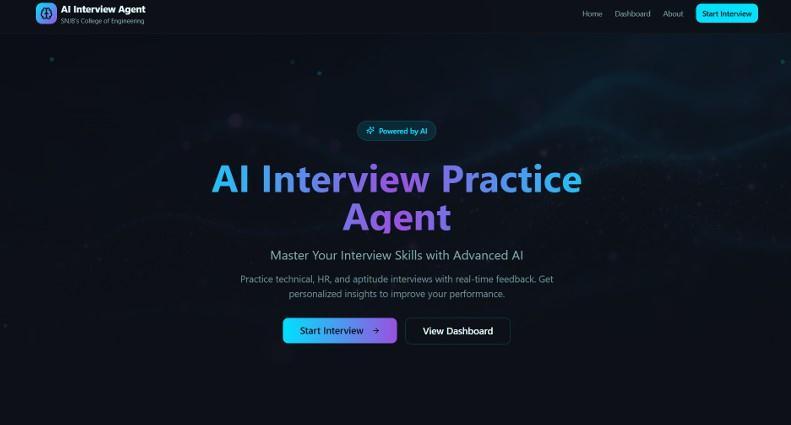
Figure 2 presents the implementation of the dashboard module. The dashboard is responsible for displayinguser statisticsandmonitoringinterviewprogress.
International Research Journal of Engineering and Technology (IRJET) e-ISSN: 2395-0056
Volume: 13 Issue: 06 | Jun 2026 www.irjet.net p-ISSN: 2395-0072
Thedashboardprovidesvariousperformanceindicatorsincluding:
• Totalnumberofinterviewsattended
• Averageperformancescore
• Improvementpercentage
• Totalpracticetime
• Interviewhistory andpreviousreports
Thedashboardactsasapersonalizedanalyticsplatformthatenablesuserstotracktheirprogressovermultipleinterview sessions.Sinceallinterviewrecordsarestoredinthedatabase,userscanaccesstheirpreviousperformancereportsand monitortheirimprovementovertime.
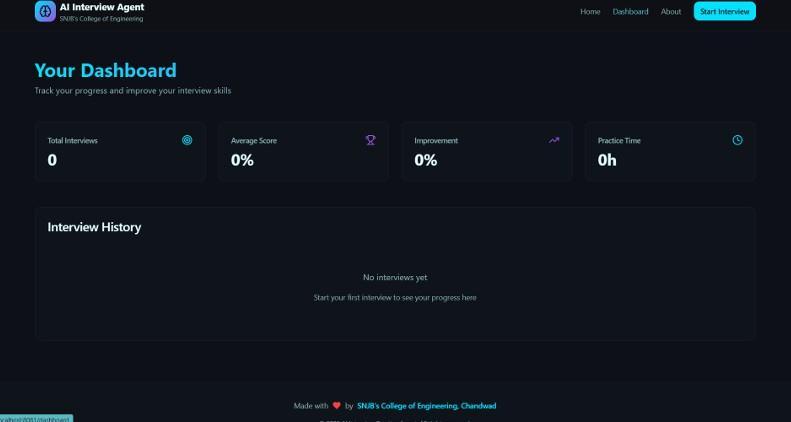
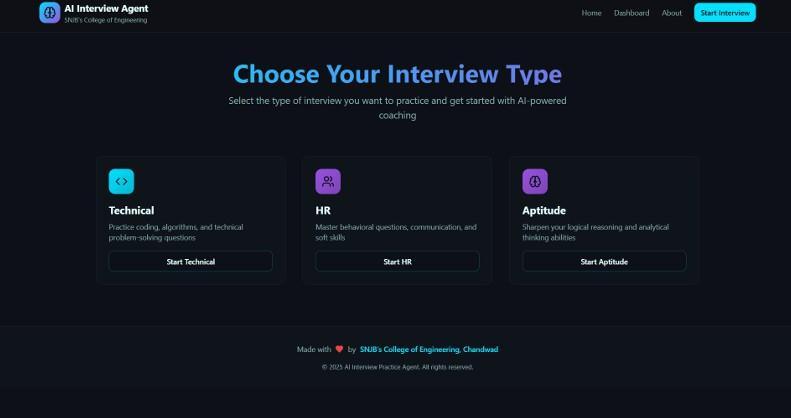
Figure3showstheimplementationoftheinterviewtypeselectionmodule.Thesystemcurrentlysupportsthreeinterview categories:
1) TechnicalInterview
2) Human Resource (HR) Interview
3) AptitudeInterview
TheTechnicalInterviewmodulefocusesonprogrammingconcepts,algorithms,datastructures,anddomain-specific questions.TheHR Interviewmoduleevaluatescommunicationskills,behavioral re-sponses,andpersonalitytraits.The AptitudeInterviewmoduleassesseslogicalreasoning,analyticalthinking,andproblem-solvingabilities.
Themodulardesignallowsadditionalinterviewcategoriestobeintegratedinfutureversionswithoutaffectingtheexisting architecture.
International Research Journal of Engineering and Technology (IRJET) e-ISSN: 2395-0056
Volume: 13 Issue: 06 | Jun 2026 www.irjet.net p-ISSN: 2395-0072
After receiving candidate responses, the AI engine performs multi-dimensional analysis using Natural Language Processingtechniques.Eachresponseisevaluatedonthebasisof:
• Content Relevance
• TechnicalKnowledge
• CommunicationClarity
• ConfidenceLevel
• Problem-SolvingAbility
Theoverall performancescoreis computedusing: where,
• R =RelevanceScore
• T = Technical Knowledge Score
• C =CommunicationScore
• F = Confidence Score
• S=Problem-SolvingScore
Thecalculatedscoresarestoredinthedatabaseandaresubsequentlyutilizedtogeneratepersonalized recommendations andperformancereports.
TheproposedAIInterviewAgentwasexperimentallyevaluatedtoexamineitseffectivenessincon-ductingadaptive interviews,assessingcandidateperformance,andprovidingpersonalizedfeedback.Thesystem wastestedacrossmultiple interview categories, including Technical, Human Resource (HR), and Aptitude interviews. The experiments focused on evaluatingthefunctionality,adaptability,userexperience,andoverallperformanceofthesystem.
Theexperimentalimplementationdemonstratedthattheproposedsystemsuccessfullyconducteddynamicandcontextaware interviews. Unlike traditional interview platforms that use fixed questionnaires, the developed system generated questionsadaptivelybasedoncandidateprofiles,skills,andpreviousresponses.Thisadaptivemechanismenabledthesystem tosimulaterealisticinterviewscenariosandmaintainconversationalcontinuitythroughouttheinterviewsession.
Theimplementationresultsindicatethatallmajormodulesoftheproposedsystemperformedsuccess-fully.Theprofile managementmodule effectivelycollected andstoredcandidateinformation, while theresumeanalysismodule extracted relevantskillsandeducationaldetailsrequiredforinterviewcustomization.
Thequestiongenerationenginesuccessfullygeneratedpersonalizedquestionsaccordingtotheselectedinterviewcategory andcandidateprofile.Furthermore,theconversationalenginemaintainedcontextduringinteractionsandproducedmeaningful follow-upquestions,therebycreatinganunscriptedandengaginginterviewenvironment.
Theresponseevaluationmodulesuccessfullyanalyzedcandidateanswersbasedonmultipleassessmentparametersand generatedperformancescoresautomatically.Finally,thereportgenerationmoduleproduceddetailedperformancereports containingstrengths,weaknesses,recommendations,andoverallassessmentscores.
Thefunctional performance ofdifferent modules is summarized in Table I.
International Research Journal of Engineering and Technology (IRJET) e-ISSN: 2395-0056
Volume: 13 Issue: 06 | Jun 2026 www.irjet.net p-ISSN: 2395-0072
Module
UserAuthenticationAndProfileManagement
Resume Analysis andSkill Extraction
DynamicQuestionGeneration
AdaptiveInterviewManagement
ResponseEvaluationEngine
PerformanceReportGeneration
DashboardandAnalytics
B. Performance Analysis
Performance Status
SuccessfullyImplemented
SuccessfullyImplemented
SuccessfullyImplemented
SuccessfullyImplemented
SuccessfullyImplemented
SuccessfullyImplemented
SuccessfullyImplemented
Theproposedsystemevaluatescandidateperformanceusingmultipleassessment parameters,namely:
• Content Relevance
• TechnicalKnowledge
• CommunicationClarity
• ConfidenceLevel
• Problem-SolvingAbility
Each parametercontributes totheoverall performancescoreaccordingtothefollowing equation:
5 (4) where,
• R=RelevanceScore
• T=TechnicalKnowledgeScore
• C=CommunicationScore
• F=ConfidenceScore
• S=Problem-SolvingScore
Theoverallperformancescorelieswithintherange: 0 ≤P ≤10 (5)
Based on experimental observations, the generated scores provided an objective representation of candidate performance andenabledmeaningfulfeedbackgeneration.
C. Interview Analytics
Thedashboardmodulecontinuouslyrecordedinterviewsessionsanddisplayedperformancestatistics,enablingusersto monitortheirprogressovertime.
Theanalytics dashboardprovidedthefollowinginformation:
• Totalnumberofinterviewscompleted
• Averageperformancescore
• Improvementpercentage
• Totalpracticetime
• Interviewhistory and reports
International Research Journal of Engineering and Technology (IRJET) e-ISSN: 2395-0056
Volume: 13 Issue: 06 | Jun 2026 www.irjet.net p-ISSN: 2395-0072
The availability of historical interview data significantly improved self-assessment capabilities and encouraged continuouslearningandimprovement.
The proposed AI Interview Agent was compared with traditional interview preparation systems and manual recruitmentprocesses.ThecomparativeanalysisispresentedinTableII
Feature Traditional Systems Proposed System
QuestionGeneration FixedQuestions Dynamic and AdaptiveQuestions
FeedbackGeneration Limited Feedback Personalized andDetailed Feedback
EvaluationMethod SubjectiveAssessment ObjectiveAI-BasedAssessment
Scalability Limited High Scalability
PerformanceTracking GenerallyUnavailable Dashboard-BasedAnalytics
CandidateEngagement Moderate High
Report Generation Manual AutomatedReports
Multi-InterviewSupport Limited
Technical,HRandAptitude Interviews
The experimental results indicate that the proposed system offers significant improvements over conventional interviewsystems.Theadaptivequestiongenerationmechanismprovedparticularlyeffectiveinmaintaininginterviewrealism andpreventingrepetitiveinteractions.Bygeneratingcontext-awarefollow-upquestions,thesystemsuccessfullysimulatedthe behaviorofhumaninterviewers.
Theautomatedevaluationmechanismalsodemonstratedconsiderableadvantages.Traditionalinterviewsoftendepend heavily on interviewer experience and subjective judgment, leading to inconsistencies inassessment.Incontrast, the proposed system employed predefined evaluation metrics and NLP-based analysis techniques to ensure consistent and objectivecandidateassessment.
The personalized feedback mechanism emerged as one of the most beneficial features of the system. Students participating in mock interviews received detailed insights into their performance, including technical strengths, communicationdeficiencies,andareasrequiringimprovement.Thisfeedback-drivenapproachencouragedcontinuouspractice andimprovedinterviewpreparedness.
Fromanorganizationalperspective,theproposedsystemsubstantiallyreducedtheeffortassociated withinitial candidatescreening.Recruiterscouldutilizegeneratedreportsandperformanceanalyticstoidentifypromisingcandidates quickly and make data-driven recruitment decisions. The ability to conduct multiple interviews simultaneously further improvedscalabilityandoperationalefficiency.
The dashboard implementation also contributed positively to the overall effectiveness of the system. Visual representationof performance metricsandinterview history enabled usersto track progressover multiple sessionsand identifyimprovementtrends.Theanalyticscomponenttransformedinterviewpreparationfromaone-timeactivityintoa continuouslearningprocess.
Despite achieving satisfactory results, certain limitations were observed during experimentation. The current implementationprimarilyanalyzestextualresponsesanddoesnotevaluatenon-verbalcommunicationaspectssuchasfacial expressions,voicemodulation,andbodylanguage.Furthermore,evaluationaccuracycanbeimprovedbyincorporatinglarger datasetsandadvancedtransformer-basedlanguagemodels.
Overall,theexperimentalresultsvalidatethefeasibilityandeffectivenessoftheproposedAIInterviewAgent.The system successfully integrates Artificial Intelligence, Natural Language Processing, adaptive questioning strategies, and automated assessment mechanisms to provide a realistic, scalable, and personalized interview platform. The results
International Research Journal of Engineering and Technology (IRJET) e-ISSN: 2395-0056
Volume: 13 Issue: 06 | Jun 2026 www.irjet.net p-ISSN: 2395-0072
demonstrate that the proposed approach has significant potentialfordeploymentineducationalinstitutions,professional trainingprograms,andorganizationalrecruitmentenvironments.
Interviewsplayavitalroleinevaluatingacandidate’stechnicalknowledge,communicationskills,problem-solving abilities,and overall suitabilityforacademicandprofessional opportunities.However,traditional interview preparation methods and recruitment processes often suffer from limitations suchasdependenceonhumaninterviewers,subjective evaluations,fixedquestionnaires,limitedscalability, andinadequatefeedbackmechanisms.Thesechallengescreatetheneed foranintelligentandautomatedinterviewsystemthatcanproviderealisticinterviewexperiencesandobjectivecandidate assessment.
This research presented the AI Interview Agent, an intelligent and adaptive interview platform that integrates Artificial Intelligence(AI),NaturalLanguageProcessing(NLP),anddynamicquestiongenerationtechniquestoautomateinterview preparationandcandidatescreeningprocesses.Theproposedsystemoperatesintwodistinctmodes,namelyStudentMode andBusinessMode,therebyaddressingtherequirementsofbotheducationalinstitutionsandorganizations.
The implemented system successfully conducts dynamic andunscripted interviews bygenerating context-aware questionsbasedoncandidateprofiles,resumes,skills,jobdescriptions,andpreviousresponses.Unliketraditionalinterview systems that rely on predefined question sets, the proposed approach adapts the interview flow according to candidate performanceandmaintainsconversationalcontinuitythroughouttheinterviewsession.
The response evaluation mechanism analyzes candidate answers using multiple performance metrics, including contentrelevance,technicalknowledge,communicationclarity,confidencelevel,andproblem-solving ability. The generated performance scores and detailed reports provide objectiveassessmentsandactionablerecommendationsforimprovement. Furthermore,thedashboardmoduleenablesuserstomonitortheirprogressthroughinterviewhistory,performanceanalytics, andimprovementtrends.
Experimentalimplementationandevaluationdemonstratedthattheproposedsystemprovidesseveraladvantages overconventionalinterviewsystems,includingadaptivequestioning,automatedevaluation,personalizedfeedbackgeneration, performancetracking,andhighscalability.Thesystemeffectivelyreducesmanualeffort,improvesinterviewpreparedness amongstudents,andassistsorganizationsinmakingdata-drivenrecruitmentdecisions.
Therefore,itcanbeconcludedthattheproposedAIInterviewAgentsuccessfullybridgesthegapbetweeninterviewpreparation and recruitment automation by providing an intelligent, scalable, and personalized interview platform. The system demonstratesthepracticalapplicabilityofAIandNLPtechnologiesincreatingrealisticinterviewenvironmentsandenhancing botheducationalandprofessionalassessmentprocesses.
Although the proposed system achieved satisfactory performance and demonstrated promising results, several enhancementscanbeincorporatedinfutureversionstofurtherimproveitscapabilitiesandpracticalapplicability.
One of the major future extensions involves the integration of voice-based interview functionality. Incorporating speech recognitionandspeechprocessingtechnologieswouldallowcandidatestointeractwiththesystemusingspokenresponses insteadoftextualinputs,therebycreatingamorerealisticinterviewenvironment.
Anothersignificantenhancementistheimplementationofvideo-basedanalysistechniques.Byutilizingcomputer visionandfacialexpressionrecognitionalgorithms,thesystemcananalyzenon-verbalcommunicationaspectssuchaseye contact,facialexpressions,posture,andbodylanguage.Thesefactorsplayanessentialroleinreal-worldinterviewsandcan improve the comprehensiveness of candidate assessment. Emotion recognition and sentiment analysis can also be integrated to evaluate candidate confidence, stress levels, enthusiasm, and emotional states during interviews. Such capabilities wouldprovidedeeperinsights intocandidate behavior andimprove the quality of performance evaluations.
International Research Journal of Engineering and Technology (IRJET) e-ISSN: 2395-0056
Volume: 13 Issue: 06 | Jun 2026 www.irjet.net p-ISSN: 2395-0072
The proposed system can further be extended to support multilingual interviews. By incorporating multilingual NaturalLanguageProcessingmodelsandtranslationmechanisms,theplatformcanconductinterviews inmultiplelanguages and become accessible to users from diverse linguistic backgrounds.
Futureversionsmayalsoincorporateadvancedtransformer-basedLargeLanguageModels(LLMs)forgenerating more sophisticated and context-aware interview questions. The use of state-of-the-art language modelscansignificantly improveconversationalquality,domainunderstanding,andpersonalizedfeedbackgeneration. Anotherpromisingdirectioninvolvesthedevelopmentofpredictiveanalyticsandhiringrecommendationsystems.Byanalyzing historicalinterviewdataandcandidateperformancepatterns,machinelearningalgorithmscanpredictcandidatesuitability andassistorganizationsinmakingmoreinformedrecruitmentdecisions.
ThesystemcanalsobeintegratedwithApplicantTrackingSystems(ATS),LearningManagementSystems(LMS),and institutionalplacementportals.Suchintegrationswouldfacilitateseamlessdataexchangeandenableend-to-endautomationof interviewpreparationandrecruitmentprocesses.
Furthermore, future research can explore adaptive learning mechanisms that continuously refine inter-view strategiesandevaluationcriteriabasedoncandidateinteractionsandfeedback.Theincorporationofreinforcementlearning andself-improvingAImodelscanmakethesystemincreasinglyintelligentandeffectiveovertime.
Insummary,theproposedAIInterviewAgentprovidesastrongfoundationfordevelopingnext-generationintelligent interview systems. Future advancements in Artificial Intelligence, Natural Language Processing, Speech Analytics, and ComputerVisiontechnologieshavethepotentialtotransformtheplatformintoacomprehensive,multimodal,andhighly personalizedinterviewecosystemcapableofrevolutionizingbothinterviewpreparationandrecruitmentautomation.
[1] S.RussellandP.Norvig,ArtificialIntelligence:AModernApproach,4thed.,PearsonEducation,2021.
[2] D. Jurafsky and J. H. Martin, Speech and Language Processing: An Introduction to Natural Language Processing, ComputationalLinguistics,andSpeechRecognition,3rded.,Pearson,2023.
[3] T.B.Brownetal.,“LanguageModelsareFew-ShotLearners,”inAdvancesinNeuralInformationProcessingSystems (NeurIPS),vol.33,pp.1877–1901,2020.
[4] J. Devlin, M. W. Chang, K. Lee, and K. Toutanova, “BERT: Pre-training of Deep Bidirectional Transformers for Language Understanding,”inProceedingsofNAACL-HLT,pp.4171–4186,2019.
[5] A.Vaswanietal.,“AttentionIsAllYouNeed,”inAdvancesinNeuralInformationProcessingSystems(NeurIPS),pp. 5998–6008,2017.
[6] T.Davenport,A.Guha,D.Grewal,andT.Bressgott,“HowArtificialIntelligenceWillChangetheFutureofMarketing,” Journal oftheAcademyofMarketingScience,vol.48,no.1,pp.24–42,2020.
[7] M.Mohri,A.Rostamizadeh,andA.Talwalkar,FoundationsofMachineLearning,2nded.,MITPress,2018.
[8] I.Goodfellow,Y.Bengio,andA.Courville,DeepLearning,MITPress,2016.
[9] C.D.Manning,P.Raghavan,andH.Schutze,IntroductiontoInformationRetrieval,CambridgeUniversityPress,2008.
[10] A. Ram, R. Prasad, C. Khatri, A. Venkatesh, R. Gabriel, Q. Liu, J. Nunn, B. Hedayatnia, M. Cheng, A. Nagar, and E. Yang,“ConversationalAI:TheScienceBehindtheAlexaPrize,”arXivpreprintarXiv:1801.03604,2018.
[11] P.J.Guo,“OnlineLearningand IntelligentTutoringSystems:AReviewofRecentDevelopments,”ACMComputing Surveys,vol.54,no.5,pp.1–35,2021.
[12] M.Allal-Che´rifandO.Makhlouf,“UsingArtificialIntelligenceinRecruitment:SystematicLiteratureReview,”Strategic HRReview,vol.20,no.6,pp.293–299,2021.
[13] S.K.SahuandA.K.Singh,“ArtificialIntelligenceinRecruitmentandSelectionProcess:AReview,”InternationalJournal ofAdvancedResearchinComputerScience,vol.11,no.4,pp.15–20,2020.
[14] R.Collobertetal.,“NaturalLanguageProcessing(Almost)fromScratch,”JournalofMachineLearningResearch,vol. 12,pp.2493–2537,2011.
[15] Y.LeCun,Y.Bengio,andG.Hinton,“DeepLearning,”Nature,vol.521,no.7553,pp.436–444,2015.