
International Research Journal of Engineering and Technology (IRJET) e-ISSN: 2395-0056
Volume: 12 Issue: 02 | Feb 2025 www.irjet.net p-ISSN: 2395-0072
International Research Journal of Engineering and Technology (IRJET) e-ISSN: 2395-0056
Volume: 12 Issue: 02 | Feb 2025 www.irjet.net p-ISSN: 2395-0072
Vaibhav Gawas, Omkar Gore, Kaustubh Indulkar, Siddhesh Jagtap, Prof. Yogita Fatangare
Department of IT Engineering, P.E.S. Modern College of Engineering, Maharashtra, Pune
Abstract - Thissurveyexplorestheevolvingroleofgenerative artificial intelligence (GenAI) in content creation, software development, and educational applications, synthesizing insights from current research and real-world implementations. The review emphasizes advancements in program code generation through GenAI, evaluating aspects such as accuracy, efficiency, and maintainability in comparison to human-generated code. Additionally, frameworks like GAIDE demonstrate GenAI’s transformative potentialineducation,whereitsignificantlyreducesworkload and enhances content quality for instructional design. The implications of GenAI extend across various fields including academiccontentdevelopment,professionalwriting,andSEO highlighting its dual impact as a productivity catalyst and a source of challenges related to academic integrity, ethical considerations,andqualityassurance.Thispaperunderscores the importance of strategic GenAI integration to maximize benefits while addressing potential limitations..
Keywords: Generative AI, Content Generation, Program Code Evaluation, GAIDE, GPT models, SEO.
1.INTRODUCTION
Therapidadvancementofgenerativeartificialintelligence (GenAI) has transformed various domains, including software development and content generation. Emerging tools based on large language models (LLMs), such as OpenAI's GPT series, Codex, and specialized educational frameworks,haveshowcasedthepotentialofAItoautomate andenhancetaskstraditionallyrequiringhumanexpertise. Thishasledtoahugeshiftinhowcontentisproduced,from academic materials and instructional design to program codegeneration.
TheimpactofGenAIextendsbeyondsimpleautomation;it redefines the efficiency, accessibility, and adaptability of creatingcomplex results.Researchhasdemonstrated that whileGenAImodelscanproducehigh-quality,human-like content, their outputs vary in terms of correctness, maintainability,andcomputationalefficiency.Forexample, studiescomparingAI-generatedcodefromdifferentmodels reveal notable performance disparities based on the complexity of problems and the programming languages used.
In the educational sector, the demand for innovative teachingmethodsandtoolshasencouragedtheintegration ofGenAIintocoursecontentdevelopment.Frameworkssuch asGAIDE(GenerativeAIforInstructionalDevelopmentand
Education) emphasize structured methodologies that leverageGenAI’scapabilitiesforeducators,addressingthe needforscalableandengagingcontent.However,thesetools come with challenges related to academic integrity and relianceonAI-generatedmaterials.
This survey paper studies current research and findings relatedtoGenAIapplicationsincontentandcodegeneration. It reviews evaluations of generative models, discusses practical frameworks, and highlights the dual impact of GenAI acting as both an enabler of innovation and a potentialdisruptorofestablishednorms.Thepaperaimsto provide a comprehensive overview of how GenAI can be effectivelyintegratedintovariousfieldswhileemphasizing strategiestomitigateassociatedlimitations.
In the end, this AI-powered content generator aims to democratize content creation by providing users with a powerful,flexibletoolthatautomatesmuchoftheprocess. Whetherusersarelookingtogeneratesocialmediaposts, blog articles, or even code snippets, this application will streamlinetheworkflowandenableuserstoproducehighqualitycontentatscale.Theprojectbridgesthegapbetween AI capabilities and everyday content creation, offering a versatile solution for a wide range of industries and individuals.
1. The study by Sangita Pokhrel, Shiv Raj Banjade [1] explores a content generation tool leveraging GPT-3 for producinghigh-qualityoutputsforblogs,socialmediaposts, andothertextcontent.Thetool'suseofanRNNarchitecture enhancespredictiveaccuracycomparedtotraditionalrulebased systems. While the tool improves content creation efficiency,challengesremainregardingethicalimplications andmaintainingaudiencerelevance.
2.EthanDickey,AndresBejarano[2]explainhowGAIDE frameworkintroducesastructuredmethodforeducatorsto integrateGenAI,suchasChatGPT3.5and4.0,intocurriculum design. It helps streamline content development, reducing workloadandimprovingmaterialquality.Whileearlyresults showpromiseintermsofefficiencyandstudentengagement, thestudyacknowledgespotentialissues,suchasdependency onAIandoccasionalinaccuracies.
3.ThissurveyYIHANCAO,SIYULI,YIXINLIU,ZHILING YAN,YUTONGDAI,PHILIPS.YU,LICHAOSUN[3]tracesthe evolution of AI-generated content, from early GANs to
International Research Journal of Engineering and Technology (IRJET) e-ISSN: 2395-0056
Volume: 12 Issue: 02 | Feb 2025 www.irjet.net p-ISSN: 2395-0072
advanced multimodal models like ChatGPT and DALL-E. It covers foundational generative techniques across text and image modalities, along with challenges such as content authenticityand ethical concerns. The survey underscores thesignificantimpactoftransformer-basedmodelsandRLHF inadvancingmultimodalcontentgeneration.
4.ThispaperBaskhadIdrisov,TimSchlippe[4]compares AI-generated code with human-produced code, evaluating their correctness, efficiency, and maintainability. Using modelslikeGPT-basedCodex,ChatGPT,andCodeWhisperer, the study reveals that while GitHub Copilot achieved the highest problem-solving rate, performance varied significantlyamongmodels.Ithighlightsthatevenpartially correct AI outputs often require minimal adjustments for correctness, showcasing both the potential and current limitationsofGenAIincoding(ResearchPaper4).
5.ThisstudyGUELAILIARedouane,BOUZIANEMohamed [5] examines AI's impact on Search Engine Optimization (SEO), using machine learning (ML) and natural language processing (NLP) to improve ranking factors like content qualityanduserexperience.TheauthorsaddressAI'srolein refiningSEOstrategieswhilealsoconsideringchallengeslike data privacy. AI-enhanced SEO is shown to boost search visibility and user engagement, thus supporting brand development.
6.ThispaperDaeseungPark,Gi-taekAn,ChayapolKamyod, Cheong Ghil Kim [6] investigates prompt engineering to enhancecontentgenerationinKoreanLLMs.Byintroducinga QueryTransformationModule(QTM)thatrephrasesinput prompts,theauthorsachievedan11.46%improvementin the naturalness and specificity of responses. Their results highlightpromptengineering’spotentialforimprovingLLM performance in conversational AI without extensive finetuning.
3.1.
ThissurveyexaminesgenerativeAImodelsacrosstext, image,audio,andcodedomains,focusingonstate-of-the-art architectures like Transformer-based models (e.g., GPT-3, GPT-4)fortext,GANsforimagegeneration,andmultimodal models such as CLIP and DALL-E. These models were selectedbasedontheirrelevanceandprovencapabilitiesin generatingdiversetypesofAI-drivencontent[1],[3].
Dataformodeltrainingandevaluationwassourcedfrom publicly available datasets widely used in AI content generation. For text generation, datasets such as CommonCrawl,Books,andgeneralwebdatasetswereused. Image generation models were trained on datasets like ImageNetandCOCO,whicharestandardincomputervision
research. Code generation relied on open-source GitHub repositories and competitive coding datasets, such as HumanEval,toprovidediversecodingexamples.Toimprove modelperformanceandoutputquality,datapreprocessing included filtering out noise, normalizing image data, and ensuringcodedatametsyntaxandlogicstandards[4],[3].
The selected models were initially trained on large, generalized datasets to build foundational knowledge, followed by task-specific fine-tuning to adapt to nuanced content generation needs. Fine-tuning included Reinforcement Learning from Human Feedback (RLHF) to improve coherence and relevance in text models, making adjustments based on user feedback. Additionally, reward models and task-specific adjustments were employed, especially for instructional content models, to refine responses based on desired outcomes. These fine-tuning methodshelpedtailormodelsforspecific tasks,enhancing accuracyandreliabilityincontentgeneration[1],[3].
To assess model performance across various types of generated content, we applied distinct, domain-specific metrics. Text generation was evaluated based on fluency, coherence,andrelevanceusingmetricslikeBLEU,ROUGE, andhumanpreferenceratings.Imagegenerationqualitywas assessedusingFréchetInceptionDistance(FID)forrealism anddiversity,aswellaspromptalignment.Audiogeneration qualitywasevaluatedthroughspectralanalysisandhuman assessmentsfocusedonclarity,naturalness,andsimilarityto human-produced audio. For code generation, metrics included correctness, maintainability (measured by cyclomaticcomplexity),andefficiency.Thesemetricsallowed for a thorough evaluation of each model’s quality and applicabilityinreal-worldscenarios[4],[3].
Models were compared across both unimodal and multimodaltaskstoevaluatetheireffectiveness,adaptability, and scalability in different content generation contexts. Consistent benchmark datasets were used to ensure fair comparisons,enablinginsightsintoeachmodel'sstrengths andlimitationsacrossvariouscontenttypes[3].
3.6.
This survey acknowledges inherent biases in training datasets and human evaluations, which can impact model output quality. Mitigation efforts included diverse dataset selection and preprocessing, although computational constraintslimitedtestingonnewerdatasets.Despitethese precautions, subjective biases in qualitative evaluations remainaconsideration[1],[4].
International Research Journal of Engineering and Technology (IRJET) e-ISSN: 2395-0056
Volume: 12 Issue: 02 | Feb 2025 www.irjet.net p-ISSN: 2395-0072
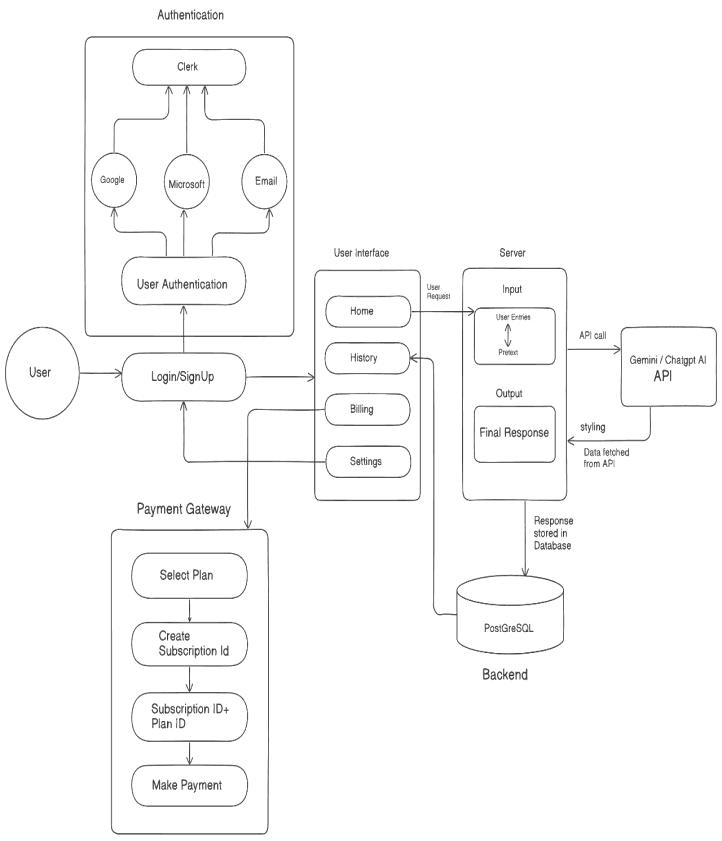
Proposed system is built on a microservice-based architecture,whichintegratesseveralkeycomponents..The systemconsistsofthefollowingprimarymodules:
1.UserAuthentication:
We implement authentication using Clerk, a serverless authentication service that provides OAuth login options, includingGoogle,Microsoft,andemail.Thisensuressecure andscalableaccesscontrolforusers.
Upon login/signup, users are authenticated and allowed access to the core functionality of the content generation platform.
2.UserInterface(UI):
Thefrontendisstructuredwithclearsectionsfornavigation, including:
Home: The starting page where users can initiate content requests.
History: A log of previous user interactions, showing the contentgenerated.
Billing:Foruserstomanagetheirpaymentplans.
Settings:Customizablepreferencesforeachuser.
TheUIsendsrequeststotheserver,whereusersinputthe contenttheywanttogenerate(viauserentriesorpretext)
3.Server-SideProcessing:
The core of our AI content generation lies in the server, whereuserinputispreprocessedandsenttoAImodelsvia anAPI.WeuseAPIssuchasGeminiorChatGPTAItogenerate contentbasedonuserinputs.TheresponsefromtheseAPIs isthenformattedandstyledaccordingtopredefinedrules.
PostgreSQL is used to store user interaction history and responsesforeasyretrievalontheUI.
4.PaymentGateway:
Tomonetizetheservice,wehaveintegratedasubscriptionbasedpaymentsystem.Theworkflowisasfollows:
Usersselectaplan.
ASubscriptionIDandPlanIDarecreated.
Theuserisdirectedtothepaymentgatewaytocompletethe transaction.
Upon successful payment, the user is granted access to premiumfeatures.
5.DataCollectionandPreprocessing
ThecontentgeneratedbytheAImodelsisbasedondynamic userinputs.WeutilizevariousAPIslikeChatGPTorGemini
International Research Journal of Engineering and Technology (IRJET) e-ISSN: 2395-0056
Volume: 12 Issue: 02 | Feb 2025 www.irjet.net p-ISSN: 2395-0072
AItoprocessandgeneratehuman-likecontent.Thedataflow involves:
UserInputs:Theuserprovidespretextorspecifickeywords, whicharesentviaanAPIcalltotheselectedAImodel.
Preprocessing: User inputs are sanitized to remove any unwanted characters or injections. This preprocessing ensurescleanandaccurateinputsaresenttotheAImodels.
APIResponses:TheAPIreturnsastructuredresponsewhich is then styled and formatted as per the application's requirements.
6. AlgorithmsImplemented
TheAImodelusedbehindthescenesisbasedonstate-of-theart NLP models like GPT (Generative Pre-trained Transformer) from OpenAI or other equivalent large languagemodels(LLMs).Thesemodelsarepre-trainedon massivecorporaoftext,enablingthemtogeneratecoherent andcontextuallyrelevantcontent.
Thealgorithmshandletextgenerationtasksby:
Parsinguserinput.
Utilizingtransformerarchitecturestopredictthenextword sequencebasedoncontext.
Generatingcontentwithfluencyandrelevancetotheuser’s request.
4. CONCLUSIONS
This survey underscores the transformative potential of generative AI (GenAI) in fields like content creation, software development, and education. By automating complextasks,GenAIenhancesefficiencyandaccessibility, as seen in tools for code generation and frameworks like GAIDEforacademiccontentdevelopment.However,GenAI's widespreadusealsopresentschallenges,includingquality assuranceandethicalconsiderations.AsGenAItechnologies advance, addressing these limitations through strategic safeguards will be essential for responsible application, allowing GenAI to maximize its impact as a valuable, trustworthytoolacrossdiversedomains.
[1] Pokhrel, Sangita & Banjade, Shiv. (2023). AI Content GenerationTechnologybasedonOpenAILanguageModel. Journal of Artificial Intelligence and Capsule Networks. 5. 10.36548/jaicn.2023.4.006..
[2]Dickey,E.,&Bejarano,A.(2023).GAIDE:AFramework for Using Generative AI to Assist in Course Content Development.ArXiv.https://arxiv.org/abs/2308.12276Lee, Mina,MeghaSrivastava,AmeliaHardy,JohnThickstun,Esin
Durmus, Ashwin Paranjape, Ines Gerard-Ursin et al. "Evaluating human-language model interaction." arXiv preprintarXiv:2212.09746(2022).
[3] Cao, Y., Li, S., Liu, Y., Yan, Z., Dai, Y., Yu, P. S., & Sun, L. (2023).AComprehensiveSurveyofAI-GeneratedContent (AIGC): A History of Generative AI from GAN to ChatGPT. ArXiv.https://arxiv.org/abs/2303.04226
[4] Idrisov, B.; Schlippe, T.Program Code Generation with Generative AIs. Algorithms 2024, 17,62. https://doi.org/10.3390/a17020062.
[5]Redouane,G.U.E.L.A.I.L.I.A.,&Mohamed,B.O.U.Z.I. A. N. E. Enhancing Search Engine Optimization through ArtificialIntelligence.
[6]D.Park,G.-t.An,C.KamyodandC.G.Kim,"AStudyon Performance Improvement of Prompt Engineering for GenerativeAIwithaLargeLanguageModel,"inJournalof WebEngineering,vol.22,no.8,pp.1187-1206,November 2023,doi:10.13052/jwe1540-9589.2285.