
International Research Journal of Engineering and Technology (IRJET) e-ISSN: 2395-0056
Volume: 13 Issue: 02 | Feb 2026 www.irjet.net p-ISSN: 2395-0072
International Research Journal of Engineering and Technology (IRJET) e-ISSN: 2395-0056
Volume: 13 Issue: 02 | Feb 2026 www.irjet.net p-ISSN: 2395-0072
Shreya Sakpal1 , Nidhi Shinde2 , Unnati Shinde3 , Samruddhi Jadhav4
1Shreya Sakpal Co, Viva Institute of Technology, Shirgaon, India
2Nidhi Shinde Co, Viva Institute of Technology, Shirgaon , India
3Unnati Shinde Co, Viva Institute of Technology, Shirgaon, India
4Samruddhi Jadhav Co, Viva Institute of Technology, Shirgaon, India
Abstract - Legal documents often use complex language, include long clauses, and contain important obligations that need careful interpretation. This makes manual analysis challengingandtime-consuming, especiallyforthose without legal training. Understanding these documents promptly is crucial to reduce legal risks and support better decisionmaking. Traditionaldocumentreviewmethodsusuallydepend on manual reading or simple keyword tools. These methods can be inefficient, prone to mistakes, and limited in context.
This paper discusses the design and development of an AIbasedLegalDocumentAnalyzerthatautomatestheanalysisof legaldocuments usingNaturalLanguageProcessingandlarge language modeltechniques. Thesystemaccepts documents in PDF and Word formats, as well as direct text input, allowing for flexible and uniform processing. It applies text preprocessing and semantic analysis to create concise summaries, extract key elements like involved parties and important dates, identify significant clauses, and spot potential legal risks.
Additionally, thesystemincludes a LawExplorermodulethat identifies relevantlegalprovisionsmentionedinthedocument and offers simple, context-aware explanations of applicable laws. This feature helps users gain a deeper understanding of legal concepts. By combining automated analysis with interactive exploration of legal knowledge, the proposed system increases efficiency, reduces manual work, and makes legal information more accessible. This solution is especially valuable for students, startups, and those without a legal background, providing useful insights and improving understanding of legal documents in real-world situations.
Key Words: Legal Document Analysis, Natural Language Processing, Artificial Intelligence, Large Language Models, Law Explorer, Clause Extraction, Risk Detection
Legal documents are important in areas like courts, companies, educational institutions, and government organizations. Documents such as contracts, service agreements, terms and conditions, and legal policies are oftendetailedandhardtounderstand.
Readingandanalyzingthesedocumentstakesalotoftime andlegalknowledge
With improvements in AI and NLP, computers can now understand and process human language to some degree. Thesetechnologiesallowfortheautomaticanalysisoflarge amountsoftextdata.UsingAIandNLPinthelegalfieldcan helpsimplifytheanalysisoflegaldocumentsandreducethe needformanualwork.
The AI Legal Document Analyzer proposed in this paper aimstoautomatetheprocessoflegaldocumentanalysis.The system assists users by extracting key information, summarizingcontent,andpresentingtheresultsclearly.This projectseekstomakelegaldocumentseasiertounderstand and more accessible to both legal professionals and the generalpublic.
The proposed system is an AI-based Legal Document Analyzerdesignedtohelpusersinterpretlegal documents efficiently.Legaltextscanbelongandcomplex,whichmakes reviewingthemmanuallychallengingandslow.Thesystem tacklesthisproblembyprovidinganautomatedframework thatanalyzeslegalcontentandextractsusefulinformationin a structured way. Its purpose is to support users in understanding legal documents better, without taking the placeofprofessionallegaljudgment.
Users can input legal content by uploading documents or enteringtextdirectly,providingflexibility.Afterreceivingthe input,thesystemchangesthedocumentintoastandardized text format suitable for analysis. A preprocessing pipeline organizes the content by separating sections, identifying sentenceboundaries,andgettingthetextreadyforfurther interpretation.Thisstructuredpreparationensuresthatthe legalinformationisprocessedaccuratelyandconsistently.
Once preprocessing is complete, the system uses Natural LanguageProcessingtechniquestoanalyzethelegaltext.It identifieskeyclauses,contractconditions,responsibilities,
andreferencesthatareimportanttothedocument’spurpose. Ratherthanjustperformingsurface-levelanalysis,thesystem aims to understand the contextual meaning of legal statements,whichhelpsinclearlyidentifyingsignificantlegal
International Research Journal of Engineering and Technology (IRJET) e-ISSN: 2395-0056
Volume: 13 Issue: 02 | Feb 2026 www.irjet.net p-ISSN: 2395-0072
components.Theanalyzedinformationisthenorganizedinto areadableoutputfortheuser.
TheproposedsystemalsofeaturesanoptionalLawExplorer tool that improves legal understanding. This tool provides simplifiedexplanationsoflegalterms,acts,orsectionsfound in the document. By offering contextual legal information within the system, the Law Explorer helps users clear up doubtsandgainbetterinsightsintolegalreferences.Overall, theproposedsystemreducesanalysistime,improvesclarity, and makes legal documents more accessible to students, professionals,andgeneralusers.
TheAILegalDocumentAnalyzerisaweb-basedsystem thatcombinesdocumenthandling,languageprocessing,and analysisintooneworkflow.Itusesamodulardesign,where eachparthasaspecificroleandcontributestotheoverall analysisofdocuments.Thisdesignmakesitclearer,easierto maintain,andbetterperforming.
The Document Input Module lets users upload legal documentsorentertextmanually.Itsupportscommonfile formatsandchecksthatuploadeddocumentsarevalidand readable.Afterverification,themoduleextractstherawtext fromthedocumentandsendsittothenextprocessingstage.
This module processes the extracted text. It removes unnecessarysymbols,breaksthetextintotokens,andgets the text ready for analysis. NLP models then analyze the content and identify key clauses, important terms, and meaningful patterns. This module is essential for understandingthelegalcontentofthedocument.
TheOutputandVisualizationModuleshowstheanalyzed results to the user. It presents summaries, highlighted clauses, and organized legal information in a clear and simpleformat.Thishelpsusersquicklygraspthekeypoints ofthedocumentwithoutreadingtheentiretext.
TheAILegalDocumentAnalyzerhasalayereddesignthat promotesmodularity,scalability,andefficientprocessingof legal documents. It has four layers: User Interface, Processing,Analysis,andPresentation.Eachlayerservesa specificpurpose.
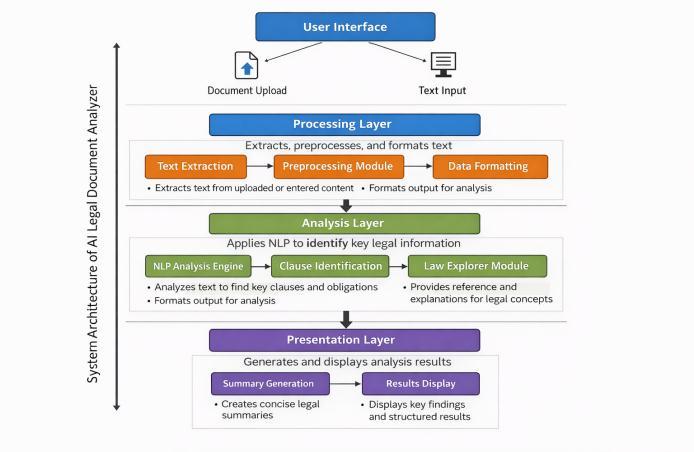
The User Interface allowsuserstouploadlegaldocuments (PDF, Word, or text) or enter text manually. It checks the entries and sends them to the processing module. The Processing Layer extracts, cleans, and organizes the text, fixingformattingissuestoensureaccurateanalysis.
The Analysis Layer isthemainpartofthesystem.Itusesan NLP engine to find key clauses and obligations. It has a Clause Identification module to categorize important sections and a Law Explorer module for contextual explanationsandlegalreferences.
The Presentation Layer organizesandshowstheanalyzed results.Itcreatesclearsummariesandstructuredinsights, helpingusersquicklyunderstandthedocumentandmake informeddecisionswithoutneedingdeeplegalknowledge. Thisdesigncombinesautomation,smartanalysis,andclear presentation to improve accessibility and efficiency in reviewinglegaldocuments.
and
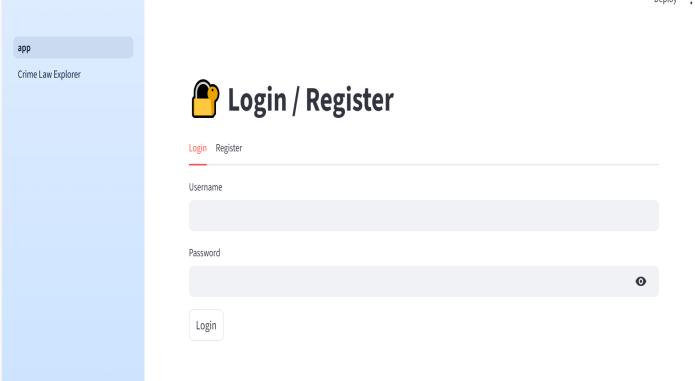
Thisimageshowstheuserauthenticationpagewhereusers can log in or register by entering their username and passwordtoaccessthesystem.
International Research Journal of Engineering and Technology (IRJET) e-ISSN: 2395-0056
Volume: 13 Issue: 02 | Feb 2026 www.irjet.net p-ISSN: 2395-0072
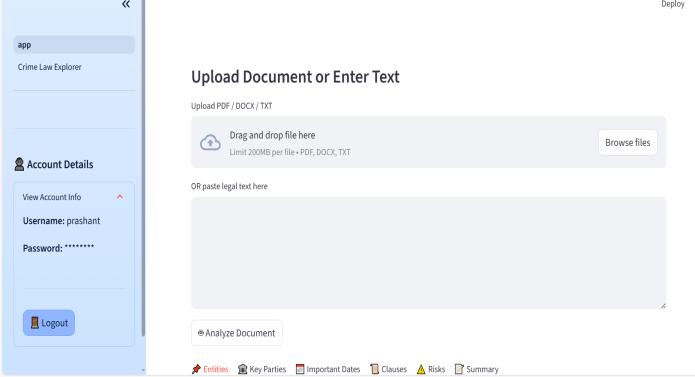
Fig. 5.2 Document Upload Interface
This screen allows users to upload a legal document (PDF/DOC/TXT) or paste legal text manually for analysis afterloggingintothesystem.
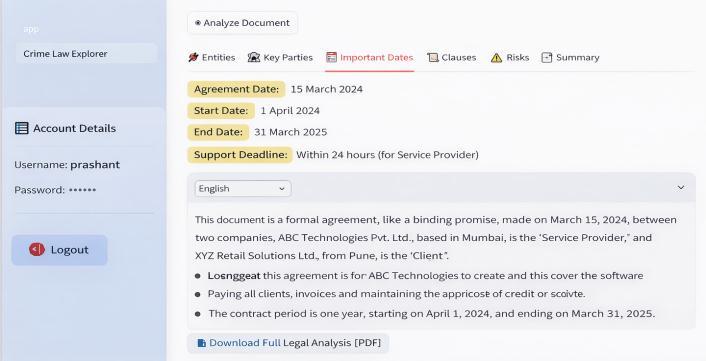
Fig. 5.3 Analysis, Summary &Detailed Output
This screen displays extracted important dates, an autogeneratedsummary,andaPDFdownloadoptionforthefull legalanalysis.
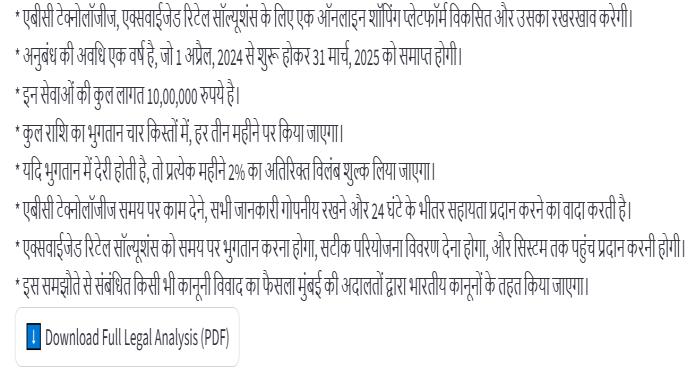
Fig. 5. Document Translation Interface
Thisscreenshowsthetranslatedordetailedlegalanalysis andprovidesanoptiontodownloadthefullanalysisreport inPDFformat.
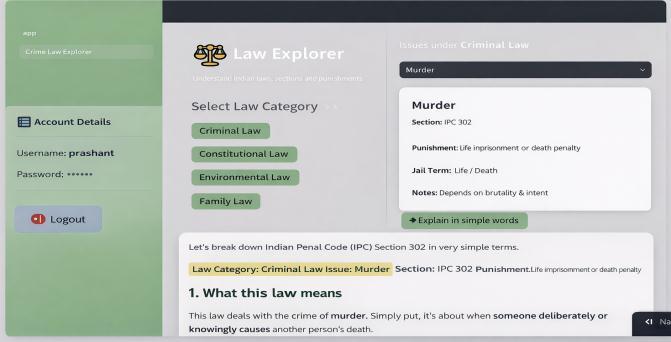
Fig. 5.5 Law Explorer
ThisscreendisplaystheLawExplorerinterfaceshowingIPC Section 302 (Murder) details along with punishment informationandasimplifiedexplanationfeatureforbetter understanding.
The AI Legal Document Analyzer offers a smart way to automate the analysis of legal documents. It uses natural language processing, clause identification, and contextual legalinsights.Byusingalayeredarchitecture,thesystemis modular, efficient, and easy to interact with. This makes complex legal information accessible to users who do not havelegalexpertise.
Thisapproachreducesmanualworkandanalysistimewhile alsoimprovingaccuracyinidentifyingimportantclausesand legal obligations. The proposed system shows how AI can changelegaldocumentreview.Itopensthedoorformore scalablesolutionsinthelegalfield.
1] Integration of multilingual NLP models to support legal documents from different languages and jurisdictions.
2]ImplementationofanAI-basedquestion-and-answer systemforcontext-awarelegalqueries.
3] Addition of voice-assisted features using speech-totextandtext-to-speechtechnology.
4] Support for image uploads and real-time document scanningforautomatictextextractionandanalysis.
5]Enhancements to improve overall efficiency, accessibility,andreal-worldusability.
International Research Journal of Engineering and Technology (IRJET) e-ISSN: 2395-0056
Volume: 13 Issue: 02 | Feb 2026 www.irjet.net p-ISSN: 2395-0072
[1]“SemanticAnalysisofLegalDocuments,”ResearchGate, 2024:https://www.researchgate.net/publication/3794528 66_Semantic_Analysis_of_Legal_DocumentsPresents semantictechniquesforunderstandingcontextualmeaning inlegaltext
[2] “Natural Language Processing for Automated Legal DocumentAnalysisandContractReview,”ThrewsJournalof Information:https://journals.threws.com/index.php/IT/articl e/view/315Uses transformer-based NLP models for automatedcontractandclauseanalysis.
[3]“AutomatedLegalDocumentAnalysisUsingNatural LanguageProcessing,”InternationalJournalofScientific ResearchinEngineeringand Management(IJSREM).:https://ijsrem.com/download/auto mated-legal-document-analysis-using-natural-languageprocessing/AppliesNLPmethodsforlegaltextextraction, entityrecognition,andsummarization.