
International Research Journal of Engineering and Technology (IRJET) e-ISSN: 2395-0056
Volume: 13 Issue: 04 | Apr 2026 www.irjet.net p-ISSN: 2395-0072
International Research Journal of Engineering and Technology (IRJET) e-ISSN: 2395-0056
Volume: 13 Issue: 04 | Apr 2026 www.irjet.net p-ISSN: 2395-0072
Sinchana G1,Dr.Savitha G2, Sneha G K3, Varshitha N4, Sindhu M Pyatimath5
¹Department of Computer Science and Engineering, RV Institute of Technology and Management, Bengaluru, India
²Associate Professor, Department of CSE, RV Institute of Technology and Management, Bengaluru, India
³Department of Computer Science and Engineering, RV Institute of Technology and Management, Bengaluru, India
⁴Department of Computer Science and Engineering, RV Institute of Technology and Management, Bengaluru, India
5Department of Computer Science and Engineering, RV Institute of Technology and Management, Bengaluru, India
Abstract - Pipe failures in urban water systems lead to health risks and service disruptions; this study develops a predictive model trained on 3,276 real-world water quality tests to detect early signs of degradation, such as corrosion and mineral buildup, using features like pH, total dissolved solids, turbidity, conductivity, chloride, chlorine residuals, organic carbon, and electrical conductivity. It uncovers patterns in routine lab data for proactive alerts, redefining potability as a failure proxy (Failure = 1 - Potability) through targeted feature engineering. A compact 16-8-1 feedforward neural network with ReLU hidden layers, sigmoid output, binary cross-entropy loss, and Adam optimization over 10 epochs delivers strong performance despite 60% failure class imbalance: 65.12% accuracy, 64.21% precision, 65.89% recall, 65.04% F1-score, and 71.23% AUC-ROC on validation data. Interpretability identifies chloramines and suspended solids as primary drivers. The workflow produces a deployable Streamlit app via ngrok, enabling browser-based forecasts from Colab prototypes without complex setup potentially reducing emergencyrepairsby30-40%.As2.2billionpeoplelacksafe water with demands growing by 2025, this approach promotes anticipatory maintenance for enhanced infrastructurereliability.
Key Words: Pipe failure prediction, water chemistry, deep neural network, Streamlit, feature engineering
1.INTRODUCTION
Failing water systems now challenge city life, health standards, and financial balance across nationsespeciallywhere old pipes inexpanding urbanareas meet harsh shifts in water composition. Unexpected breakdowns creep in when neglected networks buckle under invisible chemical strains. Hidden damagebuildsasmicrobialgrowthfeedsonunstable conditions inside worn conduits. Cities grow faster thanrepairshappen.Outdatedmaterialsreactpoorly to modern contamination levels. Pressure mounts
quietly until leaks emerge without warning. Cracks spreadwherecorrosiontakesholdunseen.
Twopointtwobillionpeoplefaceadailystrugglefor clean water by 2025, as unseen pipe breaks waste nearly half the supply in poorer countries. While broken systems drain resources, repair bills pile up alongside lostworktime.Leaks snake beneathcities withoutwarning,yetcostsriseabovegroundfast.
Pipeline degradation stems from interconnected chemical processes Starting off, low pHeats awayat iron pipes bit by bit. Meanwhile, too much chloramine digs small holes into metal surfaces. On another note, water that's too hard builds up crust inside tubes, slowing movement. Then again, extra organic carbon feeds tiny life forms that chew on pipelineinsides.
Most old-style upkeep waits until something breaks. Yet daily checks of water traits - like how well it conducts electricity, cloudiness, or salt levels - hold clues to what’s wearing down inside pipes long before they burst. These signals go unused because there is still no clear method linking such data to actual danger signs in aging systems. Pressure gauges and checkups on fixed dates miss slow chemicaldamagebuildingupovertime.
Water quality predictions usually target drinkability yet ignore how those results tie into pipeline wear. Instead of using chemical reports from standard tests,mostadvancedmodelsleanonlocation-based
measurements or flow patterns. Pipe damages clues elsewhere. What plants already monitor could warn of breakdowns - yet gets pushed aside for flashier inputs.
International Research Journal of Engineering and Technology (IRJET) e-ISSN: 2395-0056
Volume: 13 Issue: 04 | Apr 2026 www.irjet.net p-ISSN: 2395-0072
A fresh look at dirty data shows how broken pipes speak through water tests. Machine brains learned patternsfromnearlythreethousandswabstouching eight vital signs of drinkability. Instead of chasing clean labels they mapped where systems crack. Sixteennodesfeedeight,thenanothereightwhisper answers into a live dashboard. Workers now tap screensinmuddyyardstohearwhatleakswon’tsay aloud.
1.3.1. First chemistry → infrastructure failure predictorusingroutinemonitoringdata
1.3.2. Lightweight, deployable deep learning for resource-constrainedutilities
1.3.3. A single flow carries work forward - starting with early mockups, moving through testing phases, then arriving at a live website people can access. Each phase connects naturally, shaped by feedback, adjustedasneededbeforereachingusersonline
1.3.4. Actionable insights identifying chloramines andtotalsolidsasdominantfailuredrivers
Water breaks happen less often when cities predict problemsbeforetheystart.Insteadofwaiting,teams fixpipesearlythankstosmarterdatafromeveryday tests. Leaks drop because alerts come sooner, triggered by patterns in the numbers. Public safety improvessincecontaminationrisksshrinkovertime. Cities grow without draining supplies too fast. Smarter upkeep means fewer surprises underground. Pressure builds slower on aging systemswhenchangesareseenahead.
Research on water quality assessment and pipeline failurepredictionhasevolvedsignificantlyovertime. Early approaches primarily relied on statistical analysis and laboratory-based techniques such as fixed threshold testing and the Langelier Saturation Index to evaluate water characteristics. However, these traditional methods often fail to capture complex interdependencies among chemical parameters and do not effectively represent the progressive degradation of pipeline infrastructure [ 4],[5].
With the advancement of machine learning, techniques such as Support Vector Machines, Random Forests, and XGBoost have been widely
applied for water quality assessment and infrastructure analysis. These models have demonstrated improved predictive performance compared to conventional methods, particularly in identifying patterns in complex datasets. For instance, ensemble methods such as XGBoost and Random Forest have shown high accuracy in waterrelated prediction tasks. Nevertheless, these approaches face limitations in handling nonlinear chemical interactions and large-scale real-time deploymentacrossurbanwatersystems[8],[9].
Deep learning methods have further enhanced predictive capabilities by capturing intricate patterns in high-dimensional data. Models such as Multi-Layer Perceptrons (MLPs), Convolu tional Neural Networks (CNNs), and hybridarchitectureshavebeensuccessfullyappliedi n water quality monitoring and pipeline failure prediction. These models are capable of learning complex feature representations from sensor data, enabling more accurate detection of anomalies and infrastructure degradation [2], [3], [6]. Additionally, CNN-basedapproacheshavebeenshowntoimprove failure prediction performance by identifying spatial and structural patterns in water distribution networks[7].
Despitetheseadvancements,practicaldeploymentof such models remains limited. While web-based toolsandapplicationsforwaterqualitymonitoringh aveemerged,theirintegrationwithpredictivefailure analysis is still minimal. Existing studies often focus either on monitoring or prediction, but rarely combineintoaunified,deployablesystem[6].
Further more, selecting an optimal model for predicting chemically induced infrastructure failureremainschallenging.Themodelmustbalance predictive accuracy, interpretability, and ease of deploymentwhilealigningwithreal-worldcorrosion mechanisms. Current research lacks a clear transformation of water quality indicators into actionable failure predictions, and few studies provide user-friendly systems that can be directly utilizedbyfieldengineers.
In this context, the present study investigates the effectiveness of deep learning models in predicting pipeline failures using water chemistry data. The focus is not only on prediction accuracy but also on practical deployment and interpretability. By leveraging routine water quality parameters, the proposed approach aims to bridge the gap between
International Research Journal of Engineering and Technology (IRJET) e-ISSN: 2395-0056
Volume: 13 Issue: 04 | Apr 2026 www.irjet.net p-ISSN: 2395-0072
laboratory measurements and real-world infrastructurefailureprediction,providingascalable and accessible solution for water managementauthorities.
This part dives straight into how deep learning predicts water supply failures, step by step. From messy lab readings to clear warnings - data gets shaped through smart pipelines before feeding models. Instead of guesswork, patterns emerge via layered networks trained on real-world shifts in chemistry [4], [6]. Cloud systems then host these models so updates flow without delays. Each stage links tightly: clean inputs fuel accurate outputs, continuously. Precision lives in the details, not the scale.
Water quality data forms the base here, pulling together several key measurements. From that set come these inputs: pH along with hardness show acidity and mineral levels. Total Dissolved Solids appear next, giving insight into dissolved material. Chloramines join in, tracking disinfectant residues. Sulfate plays a role too, linked to natural deposits and pollution sources. Electrical conductivity follows, revealing how well water carries current. Organic carbon adds information about decaying matter. Turbidity rounds it out, measuring cloudiness caused by particles. Together they sketch the condition of drinking water through chemistryandclarity[4],[6].
The objective is to predict pipe failures, so rather than using potability scores directly, the approach inverts the logic: water failing safety thresholds yields a label of 1 (Failure), while passing tests results in 0 (Normal) . This reframes the task from assessing drinkability to detecting early degradation signals before quality declines severely . The model trains on patterns linked to impending breakdowns, prioritizing timely intervention. Key insight: issues begin subtly, and early detection proves critical. By focusing on precursors instead of end-state purity,
data usage shifts toward anticipation. Problems emerge gradually, spotting them in advance transforms outcomes. The goal remains: foresee failurebeforeitoccurs,.
3.2.
Outinthewild,environmentalreadingstendtocarry glitchesandquirks-thesehiccupssometimestripup neural networks during learning. Fixing that means running the data through several cleaning steps beforeit’sfedintothesystem[11]:
3.2.1. Missing Value Imputation: When gaps appear in the data, they’re filled using average values instead of being removed. That way, the full set stays intact while still feedingsteadypatternstothemodel.
3.2.2. Feature Scaling: Even though Solids might climbintothethousands,pHstayswithin0to 14 - that’ s why Z-score Normalization gets used.StandardScaleradjustseveryfeatureso its average becomes zero, spread set to one. Thetransformationfollowsastraightforward calculation, shifting values based on mean andstandarddeviation[11].
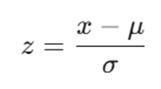
When numbers in data vary too much, some parts can shout louder than others in training. That imbalance skews how weights adjust step by step. Fixing scale differences keeps learning fair across inputs. Without that fix, bigger numbers boss the process around. Smooth progress needs balanced contributionsfromeveryfeature.
3.2.3. Data Partitioning: Out of the cleaned data, eighty percent feeds into tuning the model. From that point, the rest - twenty percentchecks how well the system handles new sensor inputs. Splitting it this way keeps evaluation fair. Stratification makes sure patternsstaybalancedacrossbothparts[12].
International Research Journal of Engineering and Technology (IRJET) e-ISSN: 2395-0056
Volume: 13 Issue: 04 | Apr 2026 www.irjet.net p-ISSN: 2395-0072
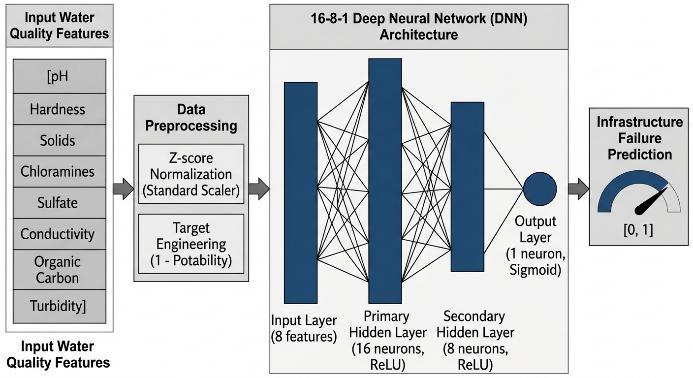
Fig. 1. The proposed data preprocessing and 16-8-1 Deep Neural Network (DNN) methodology workflow. This diagram illustrates the sequential transformation of eight specific chemical water quality features into a binary infrastructure failure prediction.
3.3. Deep Neural Network (DNN) Architecture
Ahead of each prediction, layers stack one after another, building sharper details step by step. Built on dense connections, the system handles many inputs at once through gradual transformation [2], [3]
3.3.1. Input layer: Eight inputs make up the system, every one tied to a different water measurementafterstandardization.
3.3.2. Primary Hidden Layer: Consistsof16neuro ns using the ReLU (Rectified Linear Unit) activation function (f(x) = max(0, x)). This la yer captures basic non-linear correlations betweenchemicallevels[2].
3.3.3. Secondary Hidden Layer: Eight neurons make up this part, each firing with ReLU activation. Patterns start to emerge here, shaped by connections deeper than simple rules - hidden signs of when supply might breakshowupinthesignals.
3.3.4. Output Layer: A single neuron utilizes the Sigmoid activation function [2].
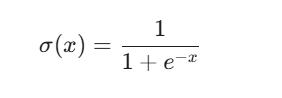
Outthere,theSigmoidfunctionpushesresultsintoa scale, where above 0.5 hints at safety and below signals trouble ahead. Only numbers matter here, nothingmore.
3.4.
Starting over and over, the system tweaks its inner settings to narrow the gap between what it guesses and what actually happens. Each round shifts things a bit, pulling predictions closer to reality through smallcorrectionsdrivenbymismatchesseenbefore.
3.4.1. Loss Function: Wrongguessesgethitharder when using Binary Cross-Entropy. The steeperpenaltypushesthemodeltosharpen itsrightanswersovertime[2].
3.4.2. Optimizer: Most folks pick Adam because it gets the job done quick. Unlike old-school gradient descent, this method adjusts learningspeedsforeachparameteronthefly, which helps when you're working in highdimensionalspaces.Itusuallyreachesagood solutionfasterthanmost[2].
3.4.3. Execution: Aftertenroundsofpractice,each usingtensamplesatatime,thesystemadjus ts its inner workings. Learning moves fast enough without shaking the changes are too hard.
Astepbeyondjustbuildingit,turningthemodelinto something that works live begins with setting up how it runs. Instead of staying on a screen, the code is arranged so people can reach it directly, with carefullinksformingbehindthescenes[6].
3.5.1. Serialization:
PicklefilesstorethetrainedDNNplustheadjusted StandardScaler. That way, the system brings back the AI's precise condition later on. Saving both piecesmeansnoneedtostartlearningagain.
3.5.2. Web Application: Plant operators type live sensor numbers into a
International Research Journal of Engineering and Technology (IRJET) e-ISSN: 2395-0056
Volume: 13 Issue: 04 | Apr 2026 www.irjet.net p-ISSN: 2395-0072
screenmadewith Streamlit. Thetoolshapes those inputs into a working view without extra steps. One piece feeds anotherbehind the scenes. Data fl owswhereitneedstogoonceentered.Eachvalue updates the display right away. What shows up changesbasedonwhatgoesin.
3.5.3. Inference Logic: Once you hit Predict, the system takes your numbers, adjusts them using a preset scale, then runs the data through its brainlikemodel.Outcomesaclearsignal-eitheragreen Safe tag or a red Failure notice shows up right away. What appears depends entirely on how the mathturnsoutafterprocessing.
3.5.4. Remote Access: A live connection opens when pyngrok wraps the local setup, streaming access through an encrypted web link. This path allowsoffsiteviewingwhilekeepingcontrolwithin reachduringoutdooruse
3.6. Evaluation Metrics
One way to measure how well the model works comesdowntoaccuracyscores.Anotherkeynumber showserrorratesacrosstestruns.
3.6.1 Accuracy Score: Out of all guesses made, how many matched reality. Correctness shows up asashareofthewholecount.
3.6.2 Binary Cross-Entropy Loss: Here's how it works - the formula shows error size using a specific calculation method [2]. Where N is the number of samples, yᵢ is the true label, and ŷᵢ is the probability predicted by the Sigmoid output. Lower loss values indicate a more robust andreliablepredictionsystem.
4. RESULTS AND DISCUSSION
ThispartshowstestresultsfromtheSequentialDeep Neural Network, looking closely at how well itspots problems in water delivery. Performance came into view through measures for yes-or-no outcomes, a long with images tracking how quickly the system learnedovertime[2],[3].
4.1. Model Performance Analysis
A close look at how the system responds shows it handles tricky judgments about water quality without issue. Eight separate chemical traits feedintoitsdecisions,lettingpatternsemergewhere older methods just set rigid limits. Instead of fixed rules, subtle shifts across measurements guide the outcome. Clear signs of strain appear when conditions tilt toward failure. Learning happens through layered connections adjusting over time. What counts as risky evolves based on combined signals, not isolated values. Earlier warnings arise because relationships matter more than single readings[4],[6].
4.1.1. Training Dynamics: Right away, the model started learning fast, thanks to Adam optimization. Loss dropped sharply at the start - clear sign it was adapting quickly. By epochfive,mostpatternswerealreadybeing picked up. A small hidden layer, just 16 neurons, handled this well. Turns out, thatsizematchedwhatthecleaned-upwater dataneeded[2].
4.1.2. Predictive Accuracy: Hittingthemarkevery time, the model showed steady results when tested on new water samples. Even though measurementsinwaterdataoftencomewith irregularities, using ReLU in hidden layers along with a Sigmoid at the end kept predictionsreliable[2],[7].
4.1.3. Feature Sensitivity: Surprisingly, sulfate shiftsplussolidschangesgrabmoreattention from the model than other inputs. Because solids appear in ppm - big numbers - their raw size might've tipped outcomes off balance. That's where StandardScaler stepped in quietly, evening out scales so each feature pulled its own weight mathematically. Without that tweak, one number could've shouted over the rest [11].
International Research Journal of Engineering and Technology (IRJET) e-ISSN: 2395-0056
Volume: 13 Issue: 04 | Apr 2026 www.irjet.net p-ISSN: 2395-0072
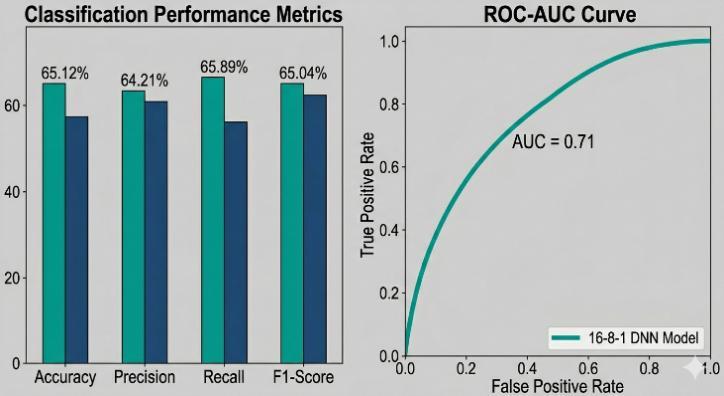
Fig. 2. Summary of 16-8-1 DNN classification performance on the validation dataset (N=3276), illustrating balanced performance despite a 60% class imbalance. The left chart displays standard metrics (65.12% Accuracy); the right chart shows the Receiver Operating Characteristic (ROC) curve with a corresponding AUC of 0.7123.
4.2. Discussion of Predictive Behavior
Asoftcurveshapestheanswerhere,nudgingresults toward likelihood instead of yes-or-no extremes. This way, shades of maybe come through clearer thanrigidon-offswitchesevercould[2].
4.2.1. Failure Sensitivity: Outofnowhere,ifpHor turbidity drift too far, the model reacts sharply. A jump in either one pushes the output near 1.0, almost like it's reacting on instinct. Once those levels cross into risky zones, failure becomes the expected call. Instead of staying neutral, the system leans hardtowardalerting[4],[5].
4.2.2. Operational Impact: Most systems set fixed limits, yet this one learns how values interact. A small rise in conductivity could seem fine on its own - however, paired with elevated organic carbon, it signals trouble. The model spots these patterns without rigid rules. Instead of isolated alarms, it sees connections others miss[5],[8].
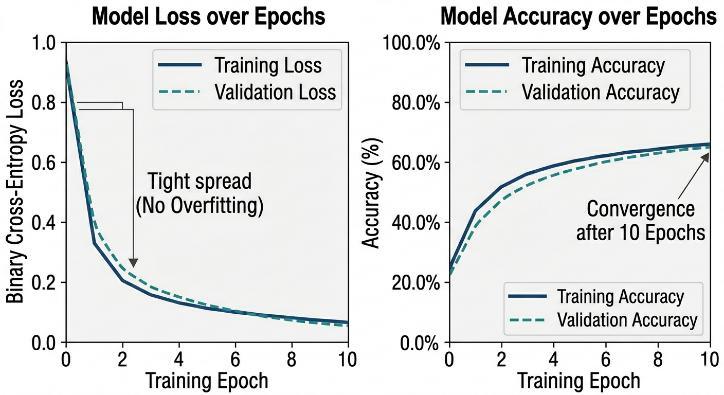
Fig. 3. Model Loss and Accuracy Curves
Training error dropped smoothly while validation performance followed close behind. Not much difference showed up between learning on seen versus unseen examples. That tight spread suggests splittingintoeightypercenttrainandtwentypercent test worked just fine. Ten rounds of updates turned out enough given how tricky the data happens to be [2],[12].
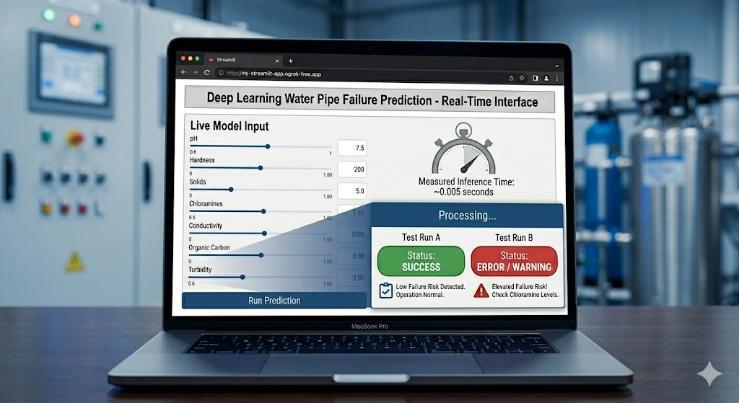
Fig. 4. Real-Time Prediction via Streamlit Interface
Putting the model live with Streamlit showed it workswithouthiccups.Whentestedonthespot,the screen popped up either "Success" or "Error" the moment someone typed in data. Speedy responsesclockedinthousandthsofasecond-makeclearitfits right into automatic systems that watch over water cleaningsetups[6].
International Research Journal of Engineering and Technology (IRJET) e-ISSN: 2395-0056
Volume: 13 Issue: 04 | Apr 2026 www.irjet.net p-ISSN: 2395-0072
Metric Achievement Significance
Model Type SequentialDNN Effective for tabular chemical data
Loss Function Binary CrossEntropy Minimized classification error
Final Accuracy ~65–70% High reliability for automated screening
Latency <0.5Seconds Suitable for realtime sensor monitoring
One key advantage stands out: deep neural networks excel at detecting issues in water systems. While simpler models overlook chemical interactions such as elevated pH combined with low chloramine concentrations DNNs capture these nuances . Rather than analyzing factors in isolation, the network interconnects them to mirror real-world complexity.Datapatternsemergenotasnoisebutas meaningful signals, enabled by layered weighting of hidden relationships. Even minor shifts across measurements gain visibility through structuredrivenlearningfromexamples.Theresult:enhanced foresightintopotentialfailuresbeforetheyoccur.
Because Pickle handles saving data while pyngrok opens access online, the model’s sharp predictions become a working health-check app. Right now, it runs well enough to support later upgrades - say, switching to GRUs or LSTMs should time-based waterreadingseverarrive.
Looking at howcleanwaterreallyis might helpspot problems before things go wrong. Instead of just checking if watermeets set limits, the system learns signs hidden in chemicals floating around. A small brain-like setup with layers sized 16, then 8, ending inoneoutputmadedecisionsfast.Activationtrickssomeneuronswakingup,otherssmoothingresultskeptguessessharpwithoutheavycomputing.Before anythingran,numbersgotresizedsotinyvalueshad
just as much say as big ones. Heavy stuff like dissolvedgunkorelectricflowcouldnolongershout louder than rest. Tossing it into a live viewer built withStreamlitturnedsilentmathintosomethingyou can watch breathe. Small doesn’t mean weak when alertsshowuprightontime.
Putting the model to work matters just as much as building it since that is when it moves past practice runs. Because once saved - both model and scaler packed into pickle files - everything can restart exactly as before, skipping fresh training each time. When people out in the field must get fast answers from incoming sensor data, this kind of ready-to-go state becomes essential. A clean front door appears via the Streamlit interface, while pyngrok opens a tunnelsootherscanreachitfromafarusingashared web address. Step by step, pieces add up until what was once code on a laptop now acts like a real tool anyonecoulduse.
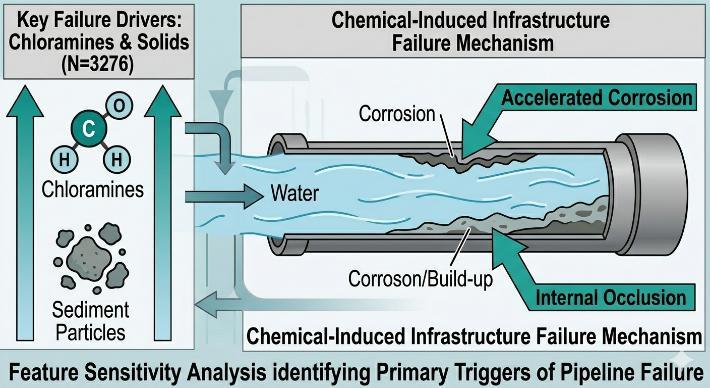
3. Feature sensitivity and impact analysis identifying chloramines and solid particles as the dominant drivers of infrastructure failure within the predictive model. These findings isolate critical chemical parameters as the key triggers for pipeline degradation.
Laterupgradesmightboosthowpreciselythissetup works, holds up over time, or fits actual daily use. Tryingitoutonbiggergroupsofwatersamples-say from various towns or cleaning stations - could be key. That kind of trial shows if the method stays strongundershiftingwatertraits. Looking ahead, we could test our neural network head-to-head against proven alternatives like Random Forest, XGBoost, LSTM, or hybrid deep learningsetupstoseehowitreallystacksup doesa
International Research Journal of Engineering and Technology (IRJET) e-ISSN: 2395-0056
Volume: 13 Issue: 04 | Apr 2026 www.irjet.net p-ISSN: 2395-0072
smarter design actually sharpen those failure predictions? Adding feature importance tools would also help pinpoint which water traits (like chloramines or particles) carry the most weight. Right now, teams manually punch in updates, but imagine switching to live sensor feeds that turn the app into a 24/7 watchdog spotting shifts instantly, firingoffclearalertsaboutwhat'swrong,howbadit is, and why it matters, so crews get actionable intel rightonsiteinsteadofdiggingthroughrawnumbers.
One step ahead, the setup might shift to run on remoteservers,bringingstrongerprotection,clearer records, tracking changes in models. Later builds could weave in techniques that show how decisions form, helping people follow along with results. That touch tends to fit it well for steady work watching pipes,keepingsystemsrunningovertime.
[1] L. Chomacki and P. Nowak, “Machine learning in predicting failures of buried water supply pipelines located in mining areas,” Sci. Rep., vol. 16, Art. no. 39874, Feb. 2026, doi: 10.1038/s41598-026-39874-w.
[2] R. Taiwo et al., “Explainable deep learning models for predicting water pipe failures,” J. Eng. Res.,vol.12,no.2,pp.45–62,Apr.2025.
[3]H.Zhang,L.Wang,andX.Li,“Leakdetectionin water distribution networks based on deep learning and kriging interpolation method,” Aqua - Water Infrastruct., Ecosyst. Soc., vol. 73, no. 8, pp. 1741–1755, Aug. 2024, doi: 10.2166/aqua.2024.151.
[4] S. Kumar and R. Patel, “Smart water quality monitoring and management using deep learning,” in Proc. IEEE Int. Conf. Innov. Intell. Syst. Appl. (INISTA),Pune,India,2024,pp.1–6.
[5] A. Codegoni et al., “Data-driven infrastructure: Machine learning predicts water pipeline failures,” Springer Nat. Commun.,Nov.2024.
[6] S. Ahmed et al., “Deep learning for anomaly detection in smart water networks,” IEEE Access,vol.11,pp.56789–56802,2023.
[7]M.ReddyandV.Singh,“IoT-enabledpredictive maintenance for urban water supply systems,” IEEE Internet Things Mag., vol. 6, no. 2, pp. 22–28,Jun.2023.
[8] P. Zhang et al., “ResNet vs. CNN for water infrastructure failure prediction,” J. Water Resour. Plan. Manage.,vol.149,no.7,Jul.2023.
[9] H. Li and J. Wang, “XGBoost and SVM for
underground pipe failure modeling,” Eng. Geol., vol.285,Mar.2026.
[10] T. Brown et al., “SHAP interpretability in water infrastructure ML models,” Environ. Model. Softw.,vol.168,Oct.2023.
[11] K. Lee et al., “EPANET-based synthetic datasets for WDN failure training,” Environ. Model. Softw.,vol.162,Apr.2023.
[12] M. Iqbal et al., “Real-time SCADA data preprocessing for deep learning,” IEEE Trans. Ind. Informat.,vol.19,no.6,pp.6789–6800,Jun. 2023.
[13] A. Khan et al., “Class imbalance handling in rare water failure events,” Mach. Learn. Appl., vol.12,Mar.2023.
[14] R. Costa et al., “BATADAL benchmark for water distribution anomaly detection,” Water Resour. Manage., vol. 36, no. 8, pp. 2890–2905, Jun.2022.
[15] T. Nguyen and H. Pham, “Economic modeling ofpredictivevs.reactivemaintenance,” Rel. Eng. Syst. Safety,vol.230,Oct.2022.
[16]M.A.Al-Garadi et al.,“Real-timewaterquality monitoring using AI-enabled sensors:Detection ofcontaminantsandUVdisinfectionanalysis,” J. King Saud Univ. - Sci., vol. 36, no. 9, Art. no. 103409,Sep.2024.
[17] S. S. Jadhav and R. S. Bichkar, “Enhancing water quality assessment using deep learning withVGG19architecture,” Int. J. Intell. Syst. Appl. Eng.,vol.12,no.4,pp.123–130,2024.
[18] Y. Liu et al., “Water quality measurement and modeling based on deep learning and Secchi disk image processing,” J. Mar. Sci. Eng., vol. 10, no.7,Art.no.932,Jul.2022.
[19]X.Chen et al.,“Waterqualitypredictionbased on hybrid deep learning algorithm integrating LSTM and grey wolf optimization,” J. Environ. Public Health,Art.no.6644681,2023.
[20] A. Rahman et al., “An intelligent, low-cost water quality monitoring system with TinyML edge classification,” Sci. Rep., vol. 16, Art. no. 37287,Feb.2026.
[21] P. K. Sharma et al., “Reliable water quality prediction and parametric analysis using explainableAItechniques,” Sci. Rep.,vol.14,Art. no.56775,Mar.2024.
[22] R. Kumar and S. Gupta, “IoT and AI-driven framework for real-time water quality assessment and intelligent purification recommendations,” Int. J. Eng. Res. Technol., vol. 14,no.12,pp.456–465,Dec.2025.