
International Research Journal of Engineering and Technology (IRJET) e-ISSN: 2395-0056
Volume: 13 Issue: 06 | Jun 2026 www.irjet.net p-ISSN: 2395-0072
International Research Journal of Engineering and Technology (IRJET) e-ISSN: 2395-0056
Volume: 13 Issue: 06 | Jun 2026 www.irjet.net p-ISSN: 2395-0072
Prathamesh P. Amle1, Tanuja S. Teknar2, Saniya A. Dhanure3 and Shreya K. Khairnar4 , Prof. Sandhya E. Aghav5
Department of Artificial Intelligence & Data Science Engineering, SNJB’s Late Sau Kanta Bai Bhavar Lalji Jain College of Engineering, Chandwad, Nashik – 423101, Maharashtra, India
Abstract - The rapid growth of online learning and digital examination platforms has created a strong need for secure and reliable remote examination systems. Traditional online exams often face issues such as cheating, identity fraud, unauthorizedcommunication,andinadequatemonitoring.To address these problems, the Smart AI Proctoring System uses ArtificialIntelligence(AI),MachineLearning(ML),Computer Vision, and Deep Learning to monitor students automatically during online examinations. The system uses webcam and microphone access to track student activities in real time. Facial recognition is used to authenticate students before the examstarts.Duringtheexamination,thesystemmonitorseye movement, head position, background noise, screen activity, and multiple face detection to identify suspicious behavior. If anyunusualactivityisdetected,alertsaregeneratedinstantly, and the event is recorded for further review. TheSmartAIProctoringSystemhelpseducationalinstitutions conduct secure online examinations with less human intervention and greater efficiency. It also generates automated reports with timestamps, captured images, and detectedviolations,improvingtransparencyandreliabilityin the examination process. This research paper discusses the system architecture, methodology, technologies used, advantages, limitations, and future scope of the proposed solution for enhancing fairness and security in online assessments.
Index Terms: Artificial Intelligence (AI), Smart Proctoring System, Face Recognition, Eye Tracking, Computer Vision, Audio Monitoring, Suspicious Activity Detection, Online Examination Security, Automated Invigilation, Machine Learning, Real-Time Monitoring, Examination Surveillance.
Therapidgrowthofdigitaltechnologyandinternetservices has brought maFTP1306F0611jor changes in the field of education. Today, online learning platforms, virtual classrooms, and remote examinations have become an important part of schools, colleges, universities, and professional institutions. After the rapid rise of remote learningacrosstheworld,manyeducationalorganisations startedconductingexaminationsthroughonlineplatformsto ensurecontinuityineducation.Onlineexaminationsprovide
flexibility, convenience, and easy access for students from different locations. However, maintaining fairness, transparency, and examination integrity in an online environment remains a significant challenge. Traditionalexaminationsystemsaremonitoreddirectlyby human invigilators inside examination halls. Invigilators supervisestudentactivities,preventmalpractice,andensure that examination rules are properly followed. In contrast, online examinations do not provide physical supervision, which creates opportunities for unfair practices such as cheating,impersonation,unauthorisedcommunication,use ofelectronicdevices,andaccessingstudymaterialsduring exams.Conductingmanualonlinemonitoringisalsodifficult becauseitrequiresalargenumberofinvigilators,increases operational costs, and may fail to provide accurate, continuous observation of every student. Toaddresstheseissues,SmartAIProctoringSystemshave been developed using advanced technologies such as ArtificialIntelligence(AI),MachineLearning(ML),Computer Vision, Facial Recognition, Deep Learning, and Audio Analysis.Thesetechnologieshelpautomatetheexamination monitoring process and reduce human dependency. The systemuseswebcams,microphones,andscreenmonitoring toolstoobservestudentsthroughouttheexaminationinreal time.Beforetheexaminationbegins,theSmartAIProctoring System verifies the identity of students through facial recognition and authentication methods. The system comparesthestudent’slivewebcamimagewiththestored databaseimagetoconfirmauthenticity.Onceverificationis completed, the examination sessionstartsunderAI-based monitoring. During the examination, the system continuously tracks various student activities and behaviours.Itmonitorseyemovements,headposition,facial expressions, voice or background noise, multiple-person detection, and screen activities to identify suspicious behaviourorpossiblemalpractice.Ifanyunusualactivityis detected, the system immediately generates alerts or warningnotificationsfortheexamineroradministrator.In addition, the system stores evidence such as screenshots, timestamps, audio-video recordings, and activity logs for futurereviewandanalysis.TheSmartAIProctoringSystem helps educational institutions conduct secure, fair, and efficient online examinations. It reduces the burden on human invigilators, improves monitoring accuracy, minimisescheatingpossibilities,andensurestransparency in the online examination process. As online education continues to grow, AI-based proctoring systems are
International Research Journal of Engineering and Technology (IRJET) e-ISSN: 2395-0056
Volume: 13 Issue: 06 | Jun 2026 www.irjet.net p-ISSN: 2395-0072
becoming an essential solution for maintaining trust and credibilityindigitalexaminations.
To improve monitoring in offline examination halls, researchersdevelopedanAI-basedproctoringsystemusing CCTVcamerasandConvolutionalNeuralNetworks(CNNs). The system automatically detects suspicious student activities such as abnormal head movement and cheating behaviour,reducingdependencyonmanualinvigilation [1]. With the help of deep learningand behaviouranalysis, an intelligent framework was introduced for detecting suspicious examinationactivities.Eyegazetracking, facial behaviouranalysis,andreal-timealertgenerationwereused toimprovemonitoringaccuracyduringexaminations[2]. An AI-drivenproctoringframeworkwasdesignedusingfacial recognition,objectdetection,andeyetrackingtechnologies. ByintegratingOpenCVandmachinelearningalgorithms,the system continuously monitored students and identified possible cheating activities effectively [3]. To strengthen offlineexaminationsecurity,YOLOv8objectdetectionand VGG-16 deep learning models were implemented for monitoring student behaviour. The system successfully detected unauthorised objects and suspicious movements inside examination halls [4]. Advanced face detection and recognition techniques were utilised to develop an intelligent examination monitoring system. The proposed model identified abnormal activities such as face disappearance, identity replacement, and unusual face rotationwithhighaccuracy [5]. AmultimodalAIframework combining facial recognition, gaze tracking, head pose estimation,andobjectdetectionwasintroducedtoenhance examination monitoring. Real-time cheating probability analysishelpedreducehumaninterventionwhileimproving monitoring efficiency [6]. Along with technological advancements, ethical concerns regarding AI-based proctoring systems were also discussed. Privacy issues, biometric data collection, transparency, and fairness in automated monitoring were highlighted as important challenges in AI-driven examination systems[7]. Different facial expression recognition methods using RGB images, thermal imaging, and 3D facial analysis were reviewed to improve behaviourmonitoringsystems.Thesetechniques contributedtomoreaccuratesuspiciousactivitydetectionin AI-basedproctoringenvironments [8].
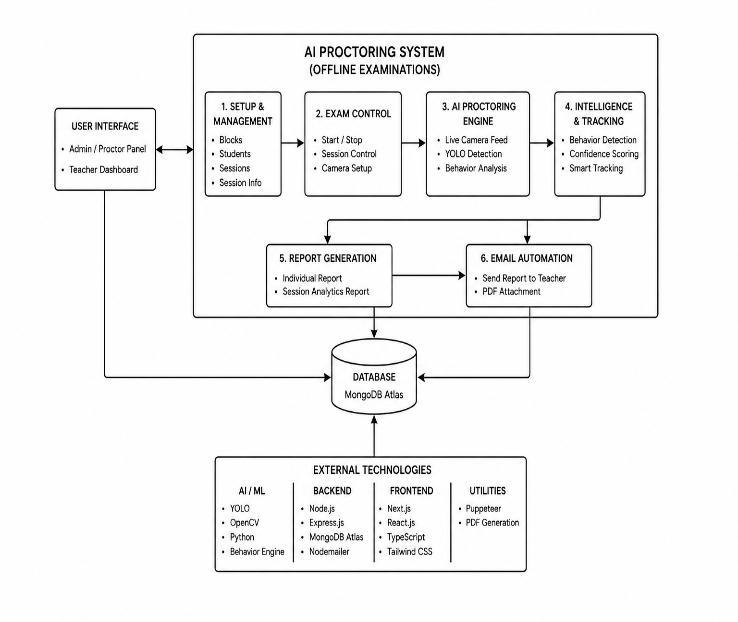
Thesystemstartsbycapturingliveclassroomvideothrough connectedcamerasduringtheexamination.TheAIengine processes the video feed for real-time student detection, behavior analysis, suspicious activity tracking, phone detection,andabsentdetection.Theprocesseddataissent tothebackendserverandsecurelystoredinMongoDBAtlas. Aftertheexaminationsessionends,thesystemautomatically generatesindividualstudentreportsandsessionanalytics
reports, which can also be shared with faculty members throughautomatedemailservices.
The Frontend Layer is developed using Next.js, React.js, TypeScript,andTailwindCSS.Itprovidesinterfacesforblock management, session handling, student registration, live monitoring,analyticsdashboards,reportviewing,andemail automation.Thefrontendcommunicateswiththebackend usingRESTAPIsandsocket-basedreal-time communication forcontinuousmonitoringupdates.
The Backend Layer is implemented using Node.js and Express.js,whiletheAIprocessingengineisdevelopedusing Python, FastAPI, YOLO, and OpenCV. This layer manages session control, camera connectivity, student tracking, report generation, and email services. The AI engine processes live camera feeds to perform real-time student detection, behavior analysis, phone detection, absent detection, and suspicious activity tracking. Confidence scoringandmajorityvotesmoothingtechniquesareusedto improvedetectionaccuracyandreducefalsepredictions.
TheDatabaseLayerusesMongoDBAtlasforsecurecloudbaseddatastorage.Itstoresstudentrecords,sessiondetails, attendancelogs,AIdetectionresults,analyticsreports,and faculty information. This layer ensures reliable data management, fast retrieval, and persistent storage of examination records. The hybrid architecture improves scalability, modularity, real-time performance, and intelligentmonitoringefficiency,makingthesystemsuitable forsecureandautomatedofflineexaminationmanagement.
International Research Journal of Engineering and Technology (IRJET) e-ISSN: 2395-0056
Volume: 13 Issue: 06 | Jun 2026 www.irjet.net p-ISSN: 2395-0072
A. USER INTERFACE & DASHBOARD MANAGEMENT
Next.js, React.js, TypeScript, and Tailwind CSS are used to develop the responsive dashboard, session management panels,livemonitoringinterface,analyticsvisualization,and overalluserinteractionsystem.
B. SERVER MANAGEMENT & REPORT AUTOMATION
Node.js and Express.js are used for API handling, session control,backendcommunication,andreportmanagement. Nodemailer is used for automated faculty email services, whilePuppeteerisusedforgeneratingdownloadablePDF reports.
C. AI-BASED STUDENT MONTORING AND DETECTION
Python,FastAPI,YOLO,andOpenCVareusedforreal-time student detection, behavior analysis, suspicious activity tracking, phone detection, absent detection, and multistudentmonitoringthroughlivecamerafeeds.
D. CLOUD STORAGE & DATABASE MANAGEMENT
MongoDB Atlas and Mongoose are used for secure cloudbasedstorageandefficientdatabasemanagementofstudent records,sessiondetails,monitoringlogs,attendancedata,AI analytics,andgeneratedreports.
3.4 ALGORITHMS
1) YOLO algorithm is used for real-time student and objectdetectionfromlivecamerafeeds.
2) OpenCV-based tracking is used for continuous multi-studentmonitoringandframeprocessing.
3) Majority Vote Smoothing algorithm is used to reducefalsebehaviourpredictions.
4) Confidence Scoring algorithm is used to improve detectionaccuracyandreliability.
IV.
5) Head Movement Detection algorithm is used to identifysuspiciousleftandrightmovements.
6) PhoneDetectionalgorithmisusedtodetectmobile phoneusageduringexaminations.
7) Human Presence Detection algorithm is used to identifyabsentstudentsduringmonitoring.
8) RiskAnalysisalgorithmisusedtocalculatecheating probabilityandstudentrisklevels.
Traditionalofflineexaminationsystemsmainlydependon manualinvigilationformonitoringstudentsandmaintaining examinationdiscipline.Althoughwidelyused,thesesystems faceseverallimitationsrelatedtoaccuracy,scalability,realtime monitoring, and automated analysis. Human invigilators may fail to identify subtle cheating activities, especially in large examination halls, which affects the overallsecurityandfairnessoftheexaminationprocess.
1. LIMITED MONITORING EFFICIENCY
Limited Monitoring Efficiency- Human invigilators cannot continuously monitor every student effectively during examinations.
2. DIFFICULTY IN DETECTING MALPRACTICE
Subtle cheating activities such as eye movement signals, whispering,orsuspiciousbehaviourmaygounnoticed.
3. LACK OF REAL-TIME ALERT
Traditional systems do not provide automatic alerts for suspiciousactivitiesduringexaminations.
4. SCALABILITY ISSUES
Managing large examination halls requires multiple invigilators, increasing complexity and manpower requirements.
5. ABSENCE OF AUTOMATED ANALYSIS
Existing systems lack AI-based analysis for behaviour trackingandviolationdetection.
6. MANUAL REPORT GENERATION
Examination reports and violation records are prepared manually, making the process time-consuming and less efficient.
7. INCONSISTENT MONITORING
Monitoringqualitymayvarydependingontheinvigilators' attentivenessandexperience.
International Research Journal of Engineering and Technology (IRJET) e-ISSN: 2395-0056
Volume: 13 Issue: 06 | Jun 2026 www.irjet.net p-ISSN: 2395-0072
Traditionalsystemsusuallydonotmaintainproperrecorded evidenceofexaminationactivitiesandviolations.
The Smart AI Proctoring System is an advanced offline examinationmonitoringsolutiondevelopedtoimprovethe security, fairness, and efficiency of the examination process.Thesystemautomaticallyverifiesstudentidentity, monitorsstudentactivities,trackseyemovements,detects suspiciousbehaviour,andgeneratesreal-timealertsduring examinations. It also maintains detailed records and generates reports of detected violations for further analysis. By reducing dependency on manual invigilation andenablingautomatedmonitoring,thesystemprovidesa morereliable,accurate,andefficientapproachforsecure offlineexaminationmanagement.
Thissectionprovidesadditionaltechnicalandfunctional informationrelatedtotheSmartAIProctoringSystem.It includes details about system requirements, modules, features, applications, and future enhancements of the proposedsystem.
TheSmartAIProctoringSystemisdevelopedusingPython and operates on platforms such as Windows or Linux. MongoDBisusedforstoringstudentrecords,examination logs, violations, and generated reports. The system requireshardwarecomponentssuchasanHDwebcam,a microphone, and a laptop or desktop with sufficient processing capability for smooth monitoring during examinations.
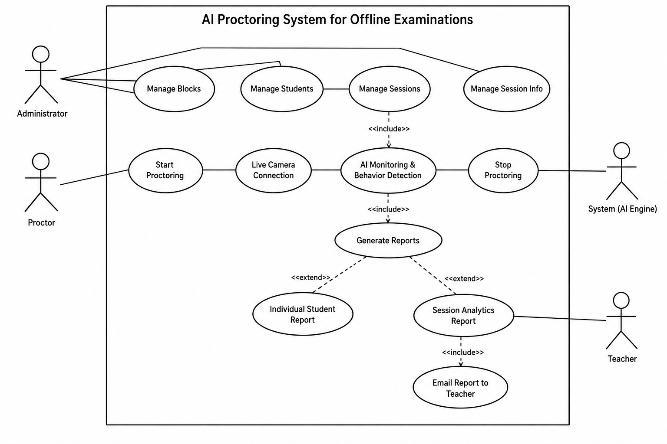
ThesystemconsistsofanAuthenticationModule,aVideo Monitoring Module, an Audio Detection Module, an Eye Tracking Module, an Alert Generation Module, and a ReportGenerationModule.Thesemodulesworktogether toverifystudentidentity,monitorexaminationactivities, detectsuspiciousbehaviour,generatealerts,andmaintain detailedexaminationreports.
Thesystemprovidesfeaturessuchasautomatedstudent verification, real-time monitoring, suspicious activity detection, eye movement tracking, alert generation, and automated report creation. It can be used in schools, colleges,competitiveexaminations,certificationtests,and training centres to improve examination security and reduce dependency on manual invigilation. Future enhancements may include cloud-based monitoring, mobile application integration, and advanced AI-based behaviouranalysis.
The authors express their sincere gratitude to the Department faculty and project guide of SNJB's Late Sau. Kanta Bai Bhavar Lalji Jain College of Engineering, Chandwad,Nashik,fortheirvaluableguidance,continuous support, motivation, and encouragement throughout the developmentoftheSmartAIProctoringSystem.Theauthors arethankfultotheHeadofDepartmentandallteachingstaff members for providing the necessary resources, technical knowledge, and academic support required for the successful completion of this project. The authors also extend their appreciation to all contributors, friends, and teammemberswhosesuggestions,cooperation,andefforts playedanimportantroleincompletingthisresearchwork successfully.
[1]Hema,K.,etal.,AIProctoringforOfflineExaminationswith 2-Longitudinal-Stream Convolutional Neural Networks, ScienceDirect,2022.
[2] Proctor Net: An AI Framework for Suspicious Activity Detection in Online Proctored Examinations, ScienceDirect, 2022.
[3]Singh,A.,etal.,OnlineExamProctoringSystemBasedon ArtificialIntelligence,ResearchGate,2023.
[4]Magesh,P.,etal.,OfflineProctoringUsingYOLOv8andVGG16,ResearchGate,2024.
[5]Hu,M.,etal.,iExam:ANovelOnlineExamMonitoringand Analysis System Based on Face Detection and Recognition, arXiv,2022.
[6]Rahman,M.,etal.,AutoOEP:AMulti-modalFrameworkfor OnlineExamProctoring,arXiv,2025.
[7]Caines,A.,etal.,GoodProctororBigBrother?AIEthicsand OnlineExamSupervisionTechnologies,arXiv,2020.
[8] Corneanu, C. A., et al., Survey on RGB, 3D, Thermal,and Multimodal Approaches for Facial Expression Recognition, arXiv,2016.