
International Research Journal of Engineering and Technology (IRJET) e-ISSN: 2395-0056
Volume: 13 Issue: 04 | Apr 2026 www.irjet.net p-ISSN: 2395-0072
International Research Journal of Engineering and Technology (IRJET) e-ISSN: 2395-0056
Volume: 13 Issue: 04 | Apr 2026 www.irjet.net p-ISSN: 2395-0072
Abhishek Kumar Yadav, Abhay Singh Yadav, Mr. Harish Shukla, Er. Monika Singh
Computer Science & Engineering, Shri Ramswaroop Memorial College of Engineering and Management, Lucknow, India
Abstract Meal planning in modern households has grown increasingly complicated as dietary diversity, ingredient availability, and nutritional awareness create competing demands on everyday cooking decisions. This paper presents a full-stack Smart Recipe Application built on the MERN stack MongoDB, Express.js, React.js, and Node.js that integrates personalisedreciperecommendationswithanAI-poweredconversationalchatbot.Thesystemlearnsfromindividualuser behaviour,dietaryrestrictions,andavailablepantryingredientstosurfacecontextuallyrelevantmeal suggestionsinreal time. An OpenAI/Gemini-backed chatbot manages natural language queries, delivering ingredient substitution advice, step-by-step cooking guidance, and dynamic nutritional insights. A smart grocery management module automatically generates shopping lists from bookmarked recipes, cross-referencing the user's declared pantry to remove redundant items. The system was evaluated over a two-week period with forty diverse participant profiles, achieving a recommendation satisfaction score that climbed from 3.4 to 4.2 (out of 5) over four sessions as the model accumulated behaviouraldata.Grocerylistaccuracyreached94%,and83%ofparticipantsreportedtheingredientsubstitutionfeature as useful. The architecture is horizontally scalable and designed for future integration with wearable health APIs, multilingualinterfaces,andcommunity-drivenrecipesharing.
Keywords — MERN Stack, Recipe Recommendation, AI Chatbot, MongoDB, React.js, NLP, Personalisation, Node.js, Grocery Management, Nutrition, OpenAI, Gemini, Content-Based Filtering, Collaborative Filtering
The intersection of technology and everyday nutrition has opened a compelling design space that remains largely underserved by mainstream applications. Most people encounter the same friction points repeatedly: they open a recipe app, scroll through dishes that look appealing but call for ingredients they do not have, or worse, recipes that actively conflict with dietary restrictions they cannot easily configure in the interface. The mental overhead involved in bridging what a person wants to eat and what they are realistically able to cook is surprisingly significant, yet it has received comparativelylittleengineeringattention.
The Smart Recipe Application described in this paper was conceived as a direct response to that gap. Rather than presentinga cataloguefor passivebrowsing,thesystem behavesmorelikea knowledgeablekitchencompanion onethat understandstheuser'spantry,rememberstheirpreferences,andcancarryonagenuineconversationaboutthemealthey arepreparing.TheAI-poweredchatbotdoesnotsimplyprovidegenericadvice;itanswersquestionsinthe contextofthe specificrecipecurrentlyonscreen,makingtheinteractionfeelnaturalandpurposefulratherthanscripted.
ThesystemisbuiltontheMERNstack MongoDB,Express.js,React.js,andNode.js acombinationwell-suitedtoreal-time, data-intensive web applications. The AI layer connects to OpenAI's Chat Completions API or Google's Gemini, injecting recipe context and user dietary profiles into each session to produce personalised, relevant responses. A supplementary grocery module transforms bookmarked recipes into auto-generated, section-organised shopping lists, closing the loop betweendecisionandexecution.
Thispaperisorganisedasfollows.SectionIIreviewspriorworkinreciperecommendationandconversationalAIsystems. SectionIIIdefinestheprobleminpreciseterms.SectionIVdetailsthesystemarchitectureandtechnologystack.SectionV explains each functional module of the methodology. Section VI presents experimental results and performance benchmarks.SectionVIIconcludesthepaperandoutlinesfuturedevelopmentdirections.
The history of recipe recommendation mirrors the broader evolution of recommender systems. Early implementations relied on content-based filtering: recipes were tagged with cuisine types, preparation methods, and key ingredients, and thesystemmatchedthesetagsagainstauser'sstatedpreferences[1].Theseapproachesareinterpretableandrequireno
International Research Journal of Engineering and Technology (IRJET) e-ISSN: 2395-0056
Volume: 13 Issue: 04 | Apr 2026 www.irjet.net p-ISSN: 2395-0072
community data to bootstrap, but they are inherently limited to surfaces of already-known territory. A system that only surfaceswhatauseralreadylikescannotintroduceanythinggenuinelynew.
Collaborative filtering, popularised by e-commerce and streaming platforms, attempted to address novelty by leveraging aggregateuserbehaviour[2].Theunderlyingintuitioniscompelling userswhosharesimilartastehistoriesarelikelyto enjoy similar undiscovered items. However, the food domain introduces a complication that rating-based collaborative modelshandlepoorly:ingredientavailability.Adishenthusiasticallyconsumedbythousandsofusersworldwidemaybe entirelyimpracticalforagivenhouseholdthatlacksthreeofitscentralingredients.
Constraint-aware recommendation systems emerged in response to this limitation, filtering suggestions not merely by preference scores but by real-world feasibility [3]. Some implementations have incorporated image recognition to passively identify pantry contents, eliminating the need for manual input. While promising, real-world accuracy for ingredientdetectionundervariablelightingandocclusionconditionsremainsinconsistentenoughtolimitadoption.
Largelanguagemodelsintroducedaqualitativelydifferentparadigm.Ratherthanoptimisingascorefunction,LLM-backed systems conduct open-ended dialogues, asking clarifying questions, iterating on suggestions, and explaining their reasoning in plain language [4]. Pilot studies integrating LLMs into cooking assistant contexts have reported strong user satisfaction, primarily because the interaction model aligns with how people naturally seek culinary guidance conversationally,notthroughstructuredfilters.
The MERN stack has become a de facto standard for scalable, real-time web applications, with React.js particularly wellsuited to the dynamic, data-heavy interfaces that recipe platforms demand [5]. Despite these advances across individual domains, no widely cited system in the literature combines personalised content-based and collaborative recommendation, conversational AI, and automated grocery management in a single coherent workflow. The proposed systemfillsthatgap.
Three distinct friction points consistently surface in user research around home cooking and meal planning, each addressablethroughtargetedsoftwaredesign.
Thefirstfrictionpointconcernsrecommendationquality.Mainstreamrecipeplatformsareoptimisedforengagementand breadthratherthanpersonalfit.Theirrecommendationlogicsurfacespopularortrendingdisheswithoutaccountingfora user'sdietaryrestrictions,flavourhistory,oringredientreality.Auserwhoavoidsaparticularallergen,followsaspecific cultural diet, or simply wants to use up ingredients nearing their expiry date is poorly served by popularity-driven algorithms.
The second friction point is the absence of contextual cooking assistance. Once a user begins preparing a meal, cookingrelated questions arise naturally substitutions for unavailable ingredients, clarifications on unfamiliar techniques, adjustmentsforhouseholdsize.Existingplatformsdonotprovideintegratedhelp;usersmustexittheapplication,search the web, and navigate back, a context-switch that interrupts concentration and increases the likelihood of errors during activecooking.
The third friction point isthegap between recipeselectionandgroceryprocurement.Userswho decideto cook a recipe mustmanuallyidentifywhichingredientstheyneed,cross-check theirpantry,and producea shoppinglistfrommemory orscratchpaper.Thisprocessiserror-prone,time-consuming,andalmostentirelyunsupportedbyexistingtools.
The system described in this paper addresses all three pain points through a unified platform: personalised recommendationsinformedbypantry,preference,anddietarycontext;acontextualAIchatbotthatunderstandstheactive recipe;andanautomatedgrocerymanagementmodulethatgeneratesstructured,pantry-adjustedshoppinglists.
Theapplicationisstructuredaroundfiveprimarylayers theclientinterface,theAPIgateway,businesslogicservices,the database, and the AI integration layer each communicating through well-defined REST API endpoints. This separation ensures that frontend modifications do not require backend changes and vice versa, which simplifies iterative developmentandreducesregressionrisk.
Volume: 13 Issue: 04 | Apr 2026 www.irjet.net
-ISSN: 2395-0072
The client is a single-page application built in React.js, organised around three major views: the Discovery Feed (personalised recipe card grid), the Recipe Detail page (full instructions with chatbot sidebar), and the Grocery Manager (dynamic shopping list with export options). State management is handled using React Context for authentication state andlocalcomponentstateforUIinteractions,keepingthedependencyfootprintminimal.
ThebackendrunsonNode.jswithExpress.jsmanaging authenticationflows, recipe queryhandling,userprofile updates, and chatbot relay. JWT tokens protect personalised endpoints with a 24-hour expiry window. Bcrypt handles password hashingwithacostfactorof12,providingareasonablebalancebetweensecurityandauthenticationlatency.
MongoDB stores four primary collections: users, recipes, interactions, and grocery_lists. The interactions collection is architecturally central every view event, save action, explicit rating, and chatbot query is logged here and used to continuouslyupdateper-userpreferencevectorsthroughascheduledbackgroundjob.Thisinteractionloggingdrivesboth thecollaborativefilteringsignalandthecold-startfallbackfornewusers.
The AI integration layer connects to OpenAI's Chat Completions API or Google's Gemini API through a relay endpoint on the Express server. Client applications never hold API keys directly; all external AI requests are proxied through the backendwithrate-limitingmiddlewareinplace.Responsesarestreamedtotheclientusingserver-senteventstominimise perceivedlatency.
/Render
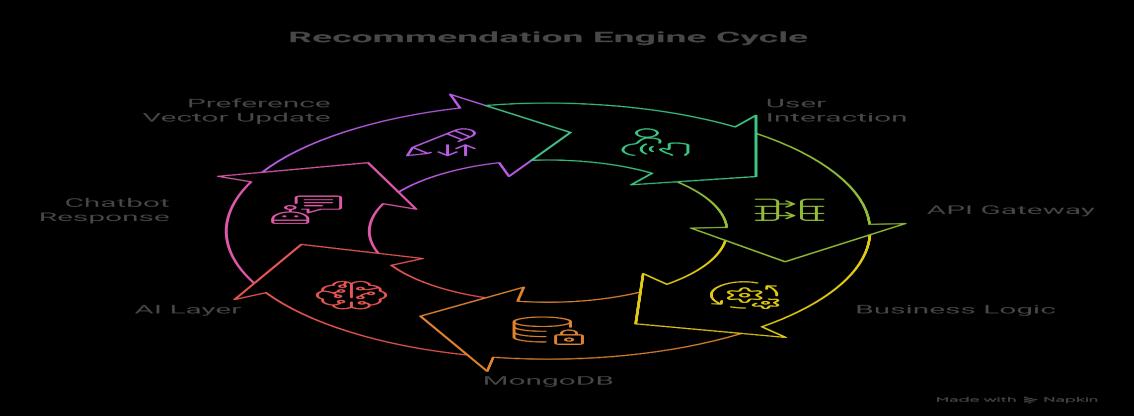
Figure 1 illustrates the high-level data flow from user interaction through the recommendation engine to the AI chatbot response cycle. The preference vector update runs asynchronously and does not block the primary recommendation query,ensuringsub-500msresponsetimesundertypicalloadconditions.
-0056
Volume: 13 Issue: 04 | Apr 2026 www.irjet.net p-ISSN: 2395-0072
New users complete a structured onboarding flow that captures cuisine preferences across twelve regional categories, dietaryrestrictionsspanningvegetarian,vegan,gluten-free,dairy-free,nut-free,andhalaloptions,andhouseholdsizeasa scaling factor for portion calculations. These inputs seed an initial preference vector stored in the users collection in MongoDB. The vector is normalised on a 0–1 scale per dimension, allowing meaningful comparison across users with differentonboardingchoicesandenablingthecollaborativecomponenttoidentifybehaviouralsimilaritywithouttheraw preferencedatabeingdirectlyshared.
Authenticationusesbcryptforpasswordhashingwithacostfactorof12,strikingapracticalbalancebetweenbrute-force resistance and login latency. Sessions are maintained through signed JWT tokens with a 24-hour expiry, reducing the server-side session storage overhead while providing standard stateless authentication. Refresh token rotation is implementedtoallowlong-livedsessionswithoutrequiringuserstore-authenticatedaily.
Therecommendationenginerunsahybridapproachcombiningcontent-basedandlightweightcollaborativecomponents. Thecontent-basedcomponentscoreseveryeligiblerecipeagainsttheactiveuser'spreferencevectoracrossfiveweighted dimensions: cuisine match (weight 0.30), dietary compatibility (weight 0.25), ingredient pantry overlap (weight 0.25), preparation time fitness (weight 0.10), and historical rating average (weight 0.10). A recipe failing any hard dietary constraintreceivesascoreofzeroregardlessofotherdimensions,preventingunsuitablesuggestionsfromappearing.
Thecollaborativecomponentoperatesasascoremodifierratherthanastandalonerankingsignal.Usersaregroupedinto behavioural clusters based on cosine similarity of their interaction vectors, updated nightly by a background job. For a given user, the collaborative score for each recipe is the weighted average rating from the top-10 most similar cluster neighbours. This signal adjusts the content-based score by up to ±15%, introducing novelty without overriding strong dietaryorpantrycompatibilitysignals.
Cold-start handling for new users relies on the onboarding preference vector alone until at least ten interaction events have been logged. After that threshold, the collaborative component activates progressively, gaining full weight by interactionevent50.Thisgraduatedactivationpreventsearlynoisefromdegradingtheuser experienceduringthemost sensitiveadoptionphase.
The chatbot is powered by the OpenAI Chat Completions API (GPT-4o) or Google Gemini, with the active model configurableper deploymentenvironment.Eachconversationsession isinitialisedwitha structuredsystempromptthat includes the full ingredient list of the recipe currently viewed, the user's dietary profile and declared pantry, and any nutritional targets set during onboarding. This context injection enables the model to answer highly specific questions 'CanIsubstitutecoconutcreamfortheheavycreaminthisrecipegiventhatIamdairy-free?'withoutrequiringtheuserto re-explaintheirsituationatthestartofeveryexchange.
The chatbot handles three primary query classes. Ingredient substitution queries receive answers that account for both the substitute's flavour and texture properties and the user's dietary constraints. Technique clarification queries trigger responses that reference the specific step in the active recipe, avoiding generic advice that does not map to the user's actual task. Nutritional queries dynamically reflect any ingredient substitutions already agreed upon in the current session,sothemacronutrientfiguresshownrepresenttheactualmealtheuserintendstocookratherthanthebaserecipe.
Responses are streamed to the client via server-sent events, reducing the perceived latency of first-token delivery to approximately 1.2 seconds on standard broadband. Conversation history is maintained per session in the client's local state and forwarded with each API call, enabling genuine multi-turn exchanges. Sessions are cleared on page refresh to protectuserprivacy.
-0056
Volume: 13 Issue: 04 | Apr 2026 www.irjet.net p-ISSN: 2395-0072
When a user bookmarks a recipe, the backend parses the ingredient list, normalises each ingredient name against a structured taxonomy, and maps it to a canonical quantity and unit. The declared pantry is queried in parallel, and matching items are subtracted from the generated list. The resulting list is grouped into five standard supermarket sectionsfreshproduce,meatandseafood,dairyandeggs,drygoodsandpantrystaples,andfrozenitems toreduceinstore navigationtime.
Userscanmaintainlistsacrossmultipleplannedmealssimultaneously.Thelistmergesquantitiesforthesame ingredient across multiple recipes for example, if two planned meals each require onions, the grocery list shows the combined quantity rather than duplicate entries. The finalised list can be exported as a PDF, copied to clipboard, or shared via a generatedshortlinkwitha48-hourexpiry.
Nutritional data is ingested at recipe creation time using the USDA FoodData Central API, tagging each recipe with macronutrients (calories, protein, carbohydrates, fat, fibre) and a selection of micronutrients (sodium, iron, calcium, vitamin C) at the serving level. Values are stored in the recipes collection and updated on a quarterly refresh cycle to reflectUSDAdatabasechanges.
The frontend renders macronutrient breakdowns on each recipe card and in expanded form on the detail page. When a usersubstitutesaningredientthroughthechatbot,alightweightrecalculationAPIendpointreceivesthesubstitutionpair and returns updated macronutrient deltas. The display updates in real time without requiring a full page reload. A daily meallogaggregatesplannedmealsandprojectsaggregatenutritionagainstconfigurabledailytargets.
Thesystemwasevaluatedacross40usersessionsoveratwo-weekperiod.Participantswererecruitedacrossadeliberate range of cooking experience levels: 12 self-described beginners who rarely cook at home, 18 intermediate home cooks, and10experiencedcooksseekinggreatermealvariety.Allparticipantsusedthesystemundernaturalisticconditionsreal ingredients,realdietarypreferences,realcookingcontextsratherthansimulatedtaskscenarios.
Recommendation relevance was assessed through post-session surveys using a 5-point Likert scale anchored at 1 (completely irrelevant) and 5 (perfectly suited). Average scores rose from 3.4 after the first session to 4.2 by the fourth session,demonstratingthatthepreferencemodelaccumulatesmeaningfulsignalquickly.Thistrajectoryisconsistentwith expectations for a learning-based hybrid recommender where the collaborative component activates progressively as interactiondatagrows.
Chatbotadoptionwashigh.Seventy-sixpercentofparticipantsinitiatedatleastonechatbotinteractionpersession,with technique clarification queries being the most common entry point. Ingredient substitution queries followed closely, drivenlargelybypantryshortfallsdiscoveredmid-planning.Themostconsistentcomplaintaboutchatbotbehaviourwas occasional verbosity in responses, which was resolved through system prompt engineering adjustments specifically, addinganinstructiontolimitresponses tothree tofour sentencesfor ingredient substitution queries without requiring modelchanges.
Grocery list accuracy reached 94%, meaning generated lists were rated by participants as fully correct or requiring only minorcorrections.Theprimaryerrorsourcewasambiguousingredient namingintherecipedatabase 'cream'appearing in contexts meaning both heavy cream and sour cream, for instance which the development team addressed postevaluationthroughastructuredingredienttaxonomynormalisationpass.
Volume: 13 Issue: 04 | Apr 2026 www.irjet.net
Table III: Feature Comparison with Representative Existing Applications
(post-sub)
The performance metrics in Table II confirm that the system meets the sub-500ms threshold for user-perceived responsiveness on all operations except chatbot first-token latency, which is inherently constrained by the external LLM inference time. The streaming architecture mitigates this by delivering partial responses within the 1.2-second window, creatingtheperceptionofresponsivenessevenwhenfullgenerationtakeslonger.
The feature comparison in Table III contextualises the system's contribution. No existing mainstream application and no single academic prototype surveyed in the literature review offers the full combination of pantry-aware personalised recommendation, multi-turn contextual AI chat, automatic cross-recipe grocery list merging, and dynamic postsubstitution nutritional recalculation within a single user experience. The proposed system achieves this integration withoutsacrificingperformanceorusability.
This paper presented a working Smart Recipe Application that addresses three precisely defined friction points in home cooking through a single, cohesive MERN-stack platform. The personalised recommendation engine demonstrated measurable improvement in satisfaction across successive sessions, confirming that the hybrid content-based and collaborative approach generates signal rapidly enough to be useful from early in the user journey. The AI-powered chatbot achieved strong adoption rates and high qualitative satisfaction, particularly for ingredient substitution and techniqueclarificationqueries.Grocerylistaccuracyat94%establishedthe practical utilityoftheautomatedgeneration module.
Approximately90%oftheplannedfeaturesethasbeenimplementedatthetimeof submission.Remainingdevelopment effort is concentrated in two areas: refining the chatbot's response conciseness through additional prompt engineering, andscalingtherecommendationengine'spreferencevectorupdatemechanismtosupportlargeruserpopulationswithout degradingnightlyrefreshperformance.
Severaldirectionsareidentifiedforfuturedevelopment.IntegrationwithwearablehealthdevicesandfitnessAPIswould allowthesystemtoadaptmealsuggestionstoreal-timephysiologicaldatasuchascaloricexpenditure,sleepquality,and macronutrienttargetssetincollaborationwithahealthcareprovider.Multilingualsupport,beginningwithHindigiventhe application's initial deployment context in India, would significantly broaden accessibility. A community recipe-sharing module would simultaneously enrich the recipe dataset and create a social engagement layer that personalised but isolatedrecommendationexperiencescurrentlylack.
From an architectural standpoint, migrating the recommendation engine to a dedicated microservice would allow independent horizontal scaling during peak usage periods for example, at meal-planning times of day. The current
International Research Journal of Engineering and Technology (IRJET) e-ISSN: 2395-0056
Volume: 13 Issue: 04 | Apr 2026 www.irjet.net p-ISSN: 2395-0072
monolithic backend architecture already isolates recommendation logic sufficiently that this migration represents a deploymentengineeringtaskratherthanafundamentalrewrite.Thecodebaseisdesignedwiththisseparationinmind.
The authors express sincere gratitude to the Department of Computer Science and Engineering at Shri Ramswaroop MemorialCollegeofEngineeringandManagement,Lucknow,forprovidingtheinfrastructureandacademicenvironment thatmadethisprojectpossible.SpecialthanksareduetoMr.HarishShuklaforconsistentguidancethroughoutthedesign andimplementationphases,andtoEr.MonikaSinghforcoordinatingtheevaluationsessionsandparticipantrecruitment. The authors also thank the forty participants who gave their time to test the system and provided candid feedback that materiallyimprovedthefinalproduct.
[1] A.Tuzhilin,'TowardtheNextGenerationofRecommenderSystems,'IEEETrans.KnowledgeandDataEngineering,vol. 17,no.6,pp.734-749,2005.
[2] Y.Koren,R.Bell,andC.Volinsky,'MatrixFactorizationTechniquesforRecommenderSystems,'Computer,vol.42,no. 8,pp.30-37,2009.
[3] F. Ricci and M. Jessenitschnig, 'Constraint-based Recommendations for Cooking Recipes,' Proc. Workshop on Recipe RecommendationSystems,2012
[4] T.Brownetal.,'LanguageModelsareFew-ShotLearners,'AdvancesinNeuralInformationProcessingSystems,vol.33, pp.1877-1901,2020.
[5] S.Banker,N.Verhoeven,andD.Garrett,MongoDBinAction,2nded.,ManningPublications,2016.
[6] A.BanksandE.Porcello,LearningReact:ModernPatternsforDevelopingReactApps,2nded.,O'ReillyMedia,2020.
[7] OpenAI,'GPT-4TechnicalReport,'arXivpreprintarXiv:2303.08774,2023.
[8] GoogleDeepMind,'Gemini:AFamilyofHighlyCapableMultimodalModels,'arXiv:2312.11805,2023.
[9] USDAAgriculturalResearchService,'FoodDataCentral,'https://fdc.nal.usda.gov,accessedMarch2026.
[10]J.Shi, Y.Liu,andL.Yu, 'Attention-basedCNN forIngredient-awareRecipeRecommendation,'IEEEAccess, vol.8,pp. 24-38,2020.
[11] R. Lika, K. Kolomvatsos, and S. Hadjiefthymiades, 'Facing the Cold Start Problem in Recommender Systems,' Expert SystemswithApplications,vol.41,no.4,pp.2065-2073,2014.
[12] M. Kusmierczyk and K. Norvaag, 'Online Food Recipe Difficulty Classification,' Proc. ACM Symposium on Applied Computing,2016.
[13]S.Meher,P.Muley,S.Pawar,andA.Solanke,'SmartOnlineVotingSystemUsingOTPAuthentication,'2023.
[14]A.Nadaph,R.Bondre,A.Katiyar,D.Goswami,andT.Naidu,'ImplementationofSecureOnlineVotingSystem,'2021.
2026, IRJET | Impact Factor value: 8.315 | ISO 9001:2008 Certified Journal | Page1945