
International Research Journal of Engineering and Technology (IRJET) e-ISSN: 2395-0056
Volume: 13 Issue: 03 | Mar 2026 www.irjet.net p-ISSN: 2395-0072

International Research Journal of Engineering and Technology (IRJET) e-ISSN: 2395-0056
Volume: 13 Issue: 03 | Mar 2026 www.irjet.net p-ISSN: 2395-0072
Harshitha Meesa1 , Vijaya Kiran Kummari2 , Jaya Surya Kummari3 , P. Naveen Kumar 4
1Dept. of Computer Science and Engineering, Joginpally BR Engineering College, Ranga Reddy, Telangana, India.
2Dept. of Computer Science and Engineering, Joginpally BR Engineering College, Ranga Reddy, Telangana, India
3Dept. of Computer Science and Engineering, Joginpally BR Engineering College, Ranga Reddy, Telangana, India.
4Assistant Professor, Dept. of Computer Science and Engineering, Joginpally BR Engineering College, Ranga Reddy, Telangana, India
Abstract - The rapid increase in competition for campus placements has created a strong demand for effective interview preparation tools that go beyond traditional learning methods. This paper introduces Smart Mock, an AIdriven mock interview and assessment platform designed to support comprehensive student preparation. The system integrates resume-based question generation, self-practice interviews, faculty-led interview sessions, behavioral monitoring, and performance evaluation within a unified framework.Byanalyzinguserresumes,theplatformgenerates role-specific questions, enabling personalized interview experiences. It further evaluates responses based on multiple parameters and provides structured feedback to help users identify strengths and improvement areas. The proposed solution aims to bridge the gap between academic learning andreal-worldinterviewexpectationsbyofferingcontinuous practice and intelligent assessment.
Key Words: Artificial Intelligence, Mock Interview System, Resume-Based Question Generation, Interview Assessment, Behavioural Monitoring, Lecturer-Led Interview, WebRTC, Placement Preparation etc.
Intoday’scompetitivejobmarket,securingemployment requiresmorethanjustacademicknowledge.Organizations expect candidates to demonstrate confidence, communicationskills,clarityofthought,andtheability to solve problems effectively during interviews. While many students possess strong technical knowledge, they often struggle to express their ideas clearly under interview conditions.
Oneofthemajorchallengesfacedbystudentsisthelackof structured interview preparation. Traditional learning methodsfocusmainlyontheoreticalunderstandinganddo not provide sufficient exposure to real interview environments. As a result, students may experience nervousness, hesitation, and difficulty in presenting their knowledgeeffectively.
To overcome these challenges, there is a need for an intelligentsystemthatcansimulateinterviewscenariosand
provide continuous feedback. The proposed Smart Mock platform is designed to address this need by combining automatedinterviewgeneration,real-timeinteraction,and performanceevaluationintoasinglesystem.Thisapproach enables students to practice regularly and improve their overallreadinessforjobinterviews.
Studentstypicallyprepareforjobopportunitiesbyfocusing on technical subjects, solving aptitude problems, and improving communication skills. While these efforts are essential, they often lack practical application in real interview scenarios. Many students are unable to connect theirknowledgewithjob-specificquestionsorfailtopresent theiranswersconfidently.
Thisgaphighlightstheimportanceofstructuredinterview practice,wherestudentscanexperiencerealisticinterview situationsandreceiveconstructivefeedback.
Traditional mock interviews conducted in colleges are useful butlimitedinavailabilityand scalability.Not every studentgetsequalopportunitiestoparticipate,andfeedback isoftensubjectiveorinsufficient.
An AI-based interview system can overcome these limitationsbyoffering:
Continuousaccesstopracticesessions
Personalizedquestiongeneration
Objectiveevaluationofresponses
Instantfeedbackandperformanceanalysis Such systems can significantly improve student preparednessandconfidence.
Despiteexistingpreparationmethods,manystudentslack sufficientexposuretostructuredinterviewpractice.Current approaches are often generic, do not adapt to individual profiles,andfailtoprovidedetailedperformanceanalysis. There is a clear need for a system that supports both independentpracticeandguidedinterviewswhiledelivering meaningfulevaluationandfeedback.
International Research Journal of Engineering and Technology (IRJET) e-ISSN: 2395-0056
Volume: 13 Issue: 03 | Mar 2026 www.irjet.net p-ISSN: 2395-0072
The primary objective of this work is to develop an AIdriven mock interview platform that enhances student preparation. The system aims to Generate personalized interviewquestionsbasedonresumes,Provideself-practice interview sessions, Enable faculty-led mock interviews, Evaluate responses using defined criteria and Generate detailedperformancereports
Thesystemisdesignedmainlyforstudents,lecturers,and placementpreparationactivities.Itcoversresumeupload, question generation, self-practice interviews, lecturer-led interviews,andreportgeneration.Thecurrentworkfocuses on improving interview readiness in a simple, structured, andpracticalway
Recent advancements in artificial intelligence have significantly influenced the development of interview preparation systems. Researchers have explored various approaches to improve candidate readiness through automation,personalization,andfeedbackmechanisms.
Several studies have focused on automated interview evaluationsystemsthatsimulaterealinterviewscenariosand assess candidate responses. These systems aim to provide users with repeated practice opportunities while helping themunderstandtheirperformanceovertime.
OtherresearchhasexploredtheuseofNaturalLanguage Processingtechniquesforresumeanalysis.Byextractingkey skills and matching them with job requirements, these approaches improve the efficiency of candidate evaluation andreducemanualeffort.
In addition, behavioural analysis has gained attention in recent years. Systems incorporating facial expression recognition, speech analysis, and response timing provide deeperinsightsintocandidateperformancebeyondtextual answers. These features help in assessing confidence, attentiveness,andcommunicationeffectiveness.
Some advanced systems integrate multiple components such as resume analysis, technical questioning, and performance evaluation into a single framework. These integratedapproacheshaveshownbetterresultscompared tostandalonesystems.
However, despite these advancements, most existing solutionsfocusonspecificaspectsofinterviewpreparation ratherthanprovidingacomplete,unifiedplatform.Thereis still a need for systems that combine self-practice, faculty interaction, behavioural monitoring, and performance
reportinginaseamlessmanner.TheproposedSmartMock systemaddressesthisgapbyintegratingallthesefeatures intoasingleplatform.
Theproposedsystem, SmartMock,isdevelopedtoprovide a structured and intelligent environment for interview preparation. It integrates multiple functionalities such as resume-based question generation, interview simulation, performanceevaluation,andreportgenerationintoasingle platform. The main objective of this system is to help studentsimprovetheirinterviewskillsthroughcontinuous practiceandguidedassessment.
Unliketraditionalmethodsthatfocusonlyontheoretical preparation,thissystememphasizespracticalexposureby simulating real interview conditions. It supports both independent practice and faculty-assisted interview sessions, making it suitable for a wide range of users includingstudents,lecturers,andplacementcoordinators.
Smart Mock is an AI-powered mock interview platform designed to enhance student readiness for job interviews. The system works by analyzing user-provided data, particularly resumes, and generating interview questions tailoredtotheindividual’sprofile.
Theplatformofferstwoprimarymodesofoperation:
Self-practiceinterviewmode Lecturer-ledinterviewmode
Bycombiningthesetwoapproaches,thesystemensures that users can practice independently while also experiencing real-time interaction when required. In addition,theplatformprovidesperformanceevaluationand feedback mechanismsthathelpuserstrack theirprogress overtime.
In the self-practicemode, thesystemallowsstudents to attend mock interviews without the need for external supervision.Theprocessbeginswhenthestudentuploads theirresumetotheplatform.Thesystemthenprocessesthe resume and extracts relevant information such as skills, projects,andareasofexpertise.
Based on the extracted data, the platform generates interview questions that are aligned with the student’s profileandselectedjobrole.Thesequestionsarepresented oneatatime,simulatingarealinterviewsequence.
The student responds to each question, and the system capturestheresponseineithertextorspeechformat.After completing the session, the responses are analyzed, and a
International Research Journal of Engineering and Technology (IRJET) e-ISSN: 2395-0056
Volume: 13 Issue: 03 | Mar 2026 www.irjet.net p-ISSN: 2395-0072
performance report is generated. This report includes scores, strengths, weaknesses, and suggestions for improvement.
This mode enables students to practice multiple times, helping them gradually improve their confidence and communicationskills.
Thelecturer-ledmodeintroducesamoreinteractiveand realistic interview experience. In this mode, a faculty memberinitiatesaninterviewsessionandsharesasession linkwiththestudent.
Thestudentjoinsthesessionthroughtheprovidedlink, and a live interview is conducted. During this session, the lecturerinteractsdirectlywiththestudent,asksquestions, andevaluatesresponsesinrealtime.
Thisapproachprovidesahumanelementtotheinterview process, allowing students to experience actual interview conditions.Italsoenableslecturerstoprovidepersonalized feedbackbasedonthestudent’sperformance.
Thecombinationofsystemsupportandhumaninteraction makes this mode particularly effective for advanced preparation.
The AI-based assessment component is responsible for evaluatingthestudent’sperformanceduringtheinterview process.Intheself-practicemode,thesystemautomatically analysesthestudent’sresponsesandassignsscoresbased onpredefinedevaluationcriteria. Thesecriteriainclude: Relevance of the answer to the question, Clarity of explanation,Confidencelevel,Overallqualityofresponse
In the lecturer-led mode, the system can support evaluation by recording responses and assisting in structuredanalysis.Althoughthelecturerplaystheprimary roleinassessment,thesystemhelpsorganizeandpresent evaluationdatainaconsistentformat.
Thisdual approachensuresbothautomatedandguided evaluation, improving the reliability of the assessment process.
Afterthecompletionofaninterviewsession,thesystem generates a detailed performance report. This report is designedtoprovideaclearunderstandingofthestudent’s strengthsandareasthatrequireimprovement. Thereporttypicallyincludes:
Overallperformancescore
Question-wiseevaluation
Strengthsidentifiedduringtheinterview
Weaknessesandimprovementsuggestions
Inself-practicemode,thereportisdirectlyaccessibleto the student, allowing them to review their performance immediately. In lecturer-led mode, the report can also be usedbyfacultymemberstoprovidefurtherguidance.
Thereportingfeatureplaysacrucialroleinthelearning process, as it transforms raw performance data into actionable insights. By reviewing these reports regularly, students can track their progress and focus on improving specificskills.
ThearchitectureoftheSmartMockplatformisdesignedto ensure smooth interaction between different components while supporting both self-practice and lecturer-led interviewworkflows.Thesystemfollowsamodularclientserver structure, allowing each component to handle a specific responsibility while maintaining overall coordination.
Thearchitectureintegratesmultiplelayers,includingthe frontend interface, backend processing system, database management, real-time communication support, and AIbasedevaluationmodules.Thislayeredapproachimproves scalability,maintainability,andperformanceoftheplatform.
The overall system is based on a client-server model, whereusersinteractwiththeplatformthroughthefrontend, andallprocessingishandledbythebackendservices.
The client side (frontend) isresponsibleforuser interaction, including login, resume upload, interviewparticipation,andreportviewing.
The server side (backend) manages core functionalitiessuchasresumeprocessing,question generation, response evaluation, and report creation.
The database stores all relevant data, including user details, resumes, interview sessions, and performancerecords.
Forlecturer-ledinterviews,thesystemincorporatesrealtime communication features, enabling live interaction betweenstudentsandlecturers.Allthesecomponentswork together to deliver a seamless interview preparation experience.
International Research Journal of Engineering and Technology (IRJET) e-ISSN: 2395-0056
Volume: 13 Issue: 03 | Mar 2026 www.irjet.net p-ISSN: 2395-0072
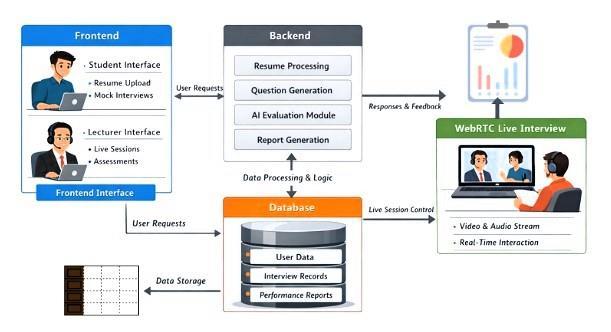
The frontend layer is designed to provide a simple and user-friendlyinterfaceforbothstudentsandlecturers.Itacts as the access point to the system and ensures smooth navigationacrossdifferentfeatures.
Theinterfaceincludesmultiplefunctionalpagessuchas: Userauthentication(loginandsignup),Resumeuploadand profile management, Selection of interview mode (selfpractice or lecturer-led), Interview session interface, Performancereportdisplay
The frontend also handles user actions such as starting interview sessions, submitting responses, joining live interviews,andviewingfeedback.Itcommunicateswiththe backend through API requests to send and receive data efficiently.
The backend serves as the core processing unit of the platform.Itisresponsibleforhandlingalllogicaloperations andensuringthatthesystemfunctionscorrectly. Keyresponsibilitiesofthebackendinclude:
Processing uploaded resumes and extracting relevant information and Generating interview questionsbasedonuserdata
Managinginterviewsessionsandworkflows
Evaluatinguserresponsesusingpredefinedcriteria andGeneratingstructuredperformancereports
The backendalsoactsasa bridgebetweenthefrontend andothersystemcomponents,ensuringsecuredatatransfer andproperexecutionoftasks.
The database is used to store user details, resume information,generatedinterviewsessions,evaluationdata, and report records. It helps in maintaining structured informationsothattheplatformcanretrievestudentdata, sessiondetails,andpastperformancewheneverneeded.The database design supports organized storage for both selfpracticeandlecturer-ledinterviewactivities.
To support lecturer-led interview sessions, the system integrates real-time communication using WebRTC technology. This enables live interaction between the studentandthelecturerduringinterviewsessions.
Throughthisintegration,theplatformallows:
Real-timeaudioandvideocommunication
Livequestioningandanswering
Interactiveinterviewexperience
This feature enhances realism by simulating actual interview conditions, helping students become more comfortablewithreal-timeinteractions.
TheAIevaluationcomponentisresponsibleforanalysing interviewresponsesandgeneratingperformanceinsights.It processes user answers and evaluates them based on multiplefactorssuchasrelevance,clarity,andconfidence.
In self-practice mode, the evaluation is performed automatically,providingimmediatefeedbacktotheuser.In lecturer-led mode, the system supports structured evaluation by assisting in organizing and analysing responses.
TheAIevaluationmoduletransformsrawresponsesinto meaningful insights, enabling users to understand their performanceandidentifyareasforimprovement.
The SmartMock platform isorganizedasa collection of interconnected modules, where each module performs a specific function within the overall interview preparation process. Instead of treating interview practice as a simple question-and-answer activity, the system is structured to handlethecompleteworkflow,startingfromuseraccessand resumeprocessingtointerviewexecution,evaluation,and reporting.
This modular design improves system organization, scalability, and maintainability. It also allows different featurestooperateindependentlywhilestillcontributingto a unified platform. As a result, both self-practice and lecturer-led interview modes can be supported efficiently withoutoverlappingfunctionalities.
Eachmoduleplaysadistinctrole,andtogethertheycreate a comprehensive environment for structured interview preparation.
2395-0056
Volume: 13 Issue: 03 | Mar 2026 www.irjet.net p-ISSN: 2395-0072
TheUserAuthenticationModuleservesastheentrypoint totheplatform.Itmanagesuseridentityandensuresthat onlyauthorizeduserscanaccessthesystem. Thismodulehandles:
Userregistration(signup)
Loginverification
Sessionmanagement
By validating user credentials and maintaining session continuity,themoduleensuressecureandorganizedaccess totheplatform.Italsohelpsindifferentiatingbetweenuser rolessuchasstudentsandlecturers,enablingappropriate accesstosystemfeatures.
The Resume Upload and Parsing Module is a core componentresponsibleforenablingpersonalizedinterview preparation. Instead of relying on generic questions, the systemusestheuploadedresumetounderstandtheuser’s background.
Oncearesumeisuploaded:
The system extracts textual content Identifies relevant sections such as education, skills, and projects Converts unstructureddataintoastructuredformat
Thisstructureddatabecomesthefoundationforfurther processing,allowingthesystemtotailorinterviewquestions accordingtotheuser’sprofile.
TheSkillExtractionModuleprocessestheparsedresume datatoidentifykeytechnicalandprofessionalskills.Itscans the content to detect important keywords such as programming languages, tools, frameworks, and domainspecificknowledge.
Theextractedskillsarethenorganizedintoastructured format, which is used for generating relevant interview questions.Thisensuresthattheinterviewprocessisaligned withtheuser’scapabilitiesandareasofexpertise.
TheInterviewQuestionGenerationModuleisresponsible forcreatingdynamicandpersonalizedinterviewquestions. Itusestheextractedskillsandselectedjobroletogenerate differenttypesofquestions,including:
Generalquestions
Technicalquestions
Project-relatedquestions
Thismoduleensuresthateachinterviewsessionisunique andrelevanttotheuser.Byavoidingfixedquestionsets,it
supports repeated practice and improves the overall effectivenessofthepreparationprocess.
TheStudentPracticeInterviewModuleenablesusersto participateinmockinterviewsindependently.Itsimulatesa real interview environment by presenting questions sequentiallyandcapturinguserresponses.
Keyfeaturesinclude:
Displayingquestionsoneatatime
Capturingresponsesthroughspeech
Allowingmultiplepracticeattempts
This module provides flexibility and encourages continuous practice, helping users build confidence and improvecommunicationskillsovertime.
The Lecturer-Led Interview Module facilitates real-time interactionbetweenstudentsandfacultymembers.Itallows lecturerstocreateinterviewsessionsandshareaccesslinks withstudents.
Duringthesession: Studentsjointhroughtheprovidedlink,Lecturersconduct theinterviewinrealtimeandResponsesareobservedand evaluated
Thismoduleaddsahumanelementtothesystem,making the interview experience more realistic and interactive. It also allows for personalized feedback and guided assessment.
TheBehaviouralMonitoringModulefocusesonanalysing non-verbalaspectsoftheuserduringinterviewsessions.It usescamera-basedinputtoobservefactorssuchas:
Facevisibility
Attentionlevel
Basicpostureorpresence
This module helps users understand the importance of bodylanguageandpresentationskillsduringinterviews.It encourages better awareness and contributes to overall performanceimprovement.
TheAIEvaluationModuleisresponsibleforanalysinguser responsesandgeneratingperformanceinsights.Itevaluates answersbasedonmultipleparameterssuchas: Relevancetothequestion,Clarityofexplanation,Confidence level,Overallquality
International Research Journal of Engineering and Technology (IRJET) e-ISSN: 2395-0056
Volume: 13 Issue: 03 | Mar 2026 www.irjet.net p-ISSN: 2395-0072
Based on this analysis, the system assigns scores and preparesfeedback.Thismoduleconvertsrawresponsesinto structuredevaluationdata,helpingusersidentifystrengths andareasthatrequireimprovement.
The Report and Analytics Module generates detailed performance reports after each interview session. These reports are designed to present results in a clear and structuredformat. Thereportincludes:
Overallperformancescore
Question-wiseanalysis
Strengthsandweaknesses
Suggestionsforimprovement
This module also supports progress tracking, allowing userstocompareperformanceacrossmultiplesessions.It providesvaluableinsightsforbothstudentsandlecturers, making interview preparation more effective and datadriven.
The methodologyofthe SmartMock platform describes thecompleteworkflowfollowedbythesystem,startingfrom user input and ending with performance evaluation and report generation. The process is designed to make interview preparation more structured, personalized, and easytoanalyse.
The system follows a sequence of interconnected steps where each stage contributes to the overall interview experience. This approach ensures that both self-practice andlecturer-ledinterviewmodesoperatesmoothlywithina unifiedframework.
Thefirststageinvolvescollectinginputdatafromtheuser. Thisincludes:
Usercredentialsduringlogin,Resumefilesuploadedbythe studentandResponsesprovidedduringinterviewsessions,
Oncethedataiscollected,preprocessingisperformedto prepareitforfurtheranalysis.
Forresumes:Textisextractedfromtheuploadedfile and Unnecessary formatting and noise are removed and Importantsectionsareidentifiedforprocessing
Forinterviewresponses:Capturedanswersareprepared for evaluation and Speech inputs are converted into analysableform
This preprocessing step ensures that the data is clean, structured, and suitable for accurate processing in later stages.
After preprocessing, the system analyzes the resume to identifykeyinformationsuchasskills,projects,andareasof expertise. These extracted details are used to create a personalizedquestionset.
Insteadofpresentingthesamequestionstoeveryuser,the system adapts the interview content based on individual profiles. This makes the interview more relevant and meaningful.
By aligning questions with the user’s background and selected role, the platform improves the effectiveness of practice sessions and better prepares students for realworldinterviews.
During the interview session, the system captures user responsestothegeneratedquestions.Theplatformsupports response collection through speech input, making the experienceclosertoanactualinterview.
Inself-practicemode:Thesystempresentsaquestionand theuserrespondsverballyandtheresponseisrecordedfor evaluation
Inlecturer-ledmode:Responsesarecapturedaspartofthe live interaction and the system may store recordings for lateranalysis
Thisstepisessentialforsimulatingrealinterviewconditions andimprovingverbalcommunicationskills.
Once the responses are captured, the system evaluates them based on a set of predefined criteria. These criteria ensurethattheassessmentisconsistentandmeaningful. Keyevaluationparametersinclude:
Relevanceoftheanswertothequestion
Clarityandstructureoftheresponse
Confidenceanddelivery
Overallqualityandcompleteness
Basedonthesefactors,thesystemassignsascoretoeach response. The scoring logic helps convert qualitative performance into measurable results, making it easier for userstounderstandtheirprogress.
After evaluation, the system generates feedback that highlightstheuser’sperformance.Insteadofprovidingonly numericalscores,theplatformoffersdescriptiveinsights.
International Research Journal of Engineering and Technology (IRJET) e-ISSN: 2395-0056
Volume: 13 Issue: 03 | Mar 2026 www.irjet.net p-ISSN: 2395-0072
Thefeedbackincludes:
Strengthsdemonstratedduringtheinterview
Weakareasthatneedimprovement
Suggestionsforbetterperformanceinfutureattempts
This approach ensures that users receive actionable guidance rather than just evaluation results. It supports continuouslearningandhelpsusersimproveovertime.
Thefinalstageofthemethodologyinvolvespresentingthe evaluationresultsinaclearandunderstandableformat.The system uses structured reports and visual elements to displayperformancedata. Thesemayinclude:
Scoresummaries
Highlightedstrengthsandweaknesses
Progressindicators
Bypresentingresultsvisually,theplatformmakesiteasier for users and lecturers to interpret the data and take appropriateactionsforimprovement.
The Smart Mock platform is developed using a combinationofmodernwebtechnologies,databasesystems, artificialintelligencelibraries,andreal-timecommunication tools. Each technology is selected based on its ability to efficiently handle specific functionalities such as user interaction, data processing, interview management, and performanceevaluation.
Theintegrationofthesetechnologiesenablestheplatform tosupportbothself-practiceinterviewsandlecturer-ledlive sessionsinaseamlessandscalablemanner.
Thefrontendofthesystemisbuiltusing React.js,awidely used JavaScript library for developing dynamic and responsiveuserinterfaces. React.jsisusedtodesignandimplementvarioususer-facing components,including:Loginandsignuppages
Resumeuploadinterface,Interviewmodeselection AI-ledinterviewscreens,Lecturer-ledsessioninterface
Performancereportdisplay
The use of React.js allows for efficient rendering, smooth navigation, and improved user experience. It alsosupportscomponent-baseddevelopment,making theinterfaceeasiertomanageandextend.
The backend of the platform is developed using Python along with the FastAPI framework. This combination
provides a robust and efficient environment for handling server-sideoperations.
FastAPIisusedtocreateRESTfulAPIsthatmanage: Resume upload and processing, Interview question generation, Response evaluation, Session management, Reportgeneration
Pythonischosenduetoitssimplicityandstrongsupport for data processing and artificial intelligence libraries. It enablesquickdevelopmentandeasyintegrationofmachine learningcomponents.
TheplatformusesMySQLfordatabasesupport.Itisused tostoreuserdata,resume-relateddetails,interviewsession information,andreport-relatedrecords.
The platform uses scikit-learn and spaCy for AI-related processingtasks.Theselibrariessupportfunctionssuchas textanalysis,resumeskillextraction,andanswerevaluation. In addition, MediaPipe is used for basic behavioral monitoringthroughcamera-basedfacedetection.
For supporting live interview sessions, the platform integrates real-time communication using WebRTC (Web Real-TimeCommunication).
WebRTCenables:
Real-timeaudioandvideointeraction
Directcommunicationbetweenstudentandlecturer Low-latencyliveinterviewexperience
This technology plays a critical role in simulating real interviewenvironments,especiallyinlecturer-ledsessions wheredirectinteractionisrequired.
The implementation of Smart Mock was carried out by combining frontend development, backend processing, resume analysis, interview session handling, evaluation logic,andreportgeneration.Thesystemwasdevelopedina step-by-stepmannersothateachfunctioncouldbetested separatelyandlaterintegratedintothecompleteplatform.
Thedevelopedwasperformedusingaweb-basedsoftware development environment with support for frontend and backendintegration.Thefrontendwasimplementedusing React.js,whilethebackendwasdevelopedusingPythonand FastAPI. Supporting libraries for text processing, resume
International Research Journal of Engineering and Technology (IRJET) e-ISSN: 2395-0056
Volume: 13 Issue: 03 | Mar 2026 www.irjet.net p-ISSN: 2395-0072
analysis,andbehaviormonitoringwerealsoincludedduring development.
Thesystemwastestedinabrowserenvironmenttoverify user interaction, page flow, interview handling, and evaluationoutput.Thisenvironmenthelpedincheckingboth self-practice mode and lecturer-led interview mode in a practicalway
The user interface was designed with simplicity and usabilityaskeypriorities.Separatepageswerecreatedfor different functionalities to ensure a clear and structured workflow.
Theinterfaceincludes: Login and signup pages, User dashboard, Resume upload section, Interview selection interface, AI-led interview screen,Lecturer-ledinterviewinterface,Performancereport display
Thedesignensuresthatuserscaneasilynavigatebetween featuresandperformactionswithoutconfusion.
Theresumeprocessingpartwasimplementedbyallowing userstouploadresumefilesintothesystem.Onceuploaded, thebackendreadstheresumecontentandextractsuseful textforfurtherprocessing.Thistextisthenusedtoidentify thestudent’simportantskillsandprofiledetails.
Theinterviewsessionimplementationsupportstheselfpractice workflow of the system. In this mode, generated questions are presented to the user, and the student responds through voice input. The system captures the answer,processesit,andsendsittotheevaluationmodule.
Thelecturer-ledinterviewfeatureisimplementedusing session-based interaction. Lecturers can create interview sessionsandgenerateuniquelinksforstudentstojoin. Oncethesessionbegins:
Studentsconnectusingtheprovidedlink
Real-timeinteractionisestablished
Questionsareaskedandresponsesaregivenlive Thisfeatureenhancesthesystembyincorporatinghuman interaction,makingtheexperienceclosertoactualinterview scenarios.
TheAI-basedassessmentsystemevaluatesresponsesby analysingtheircontentandstructure.Theevaluationlogic
assignsscoresbasedondefinedparameterssuchasclarity, relevance,andconfidence.
Thesystemprocessesresponsesandgeneratesfeedback automaticallyinself-practicemode, whilealsosupporting structuredevaluationinlecturer-ledsessions.
Aftertheevaluationprocess,thesystemgeneratesdetailed performance reports. These reports present results in a structuredandeasy-to-understandformat.
Thereportincludes:
Overall score, Question-wise evaluation, Strengths and weaknesses,Suggestionsforimprovement
The Smart Mock platform was tested to evaluate its functionality and effectiveness in supporting interview preparation. The system successfully performed all major operations, including resume processing, question generation, interview simulation, and performance evaluation.
The platform demonstrated successful integration of all coremodules.Userswereableto:
Access the system through login and dashboard Upload resumesandextractrelevantinformation Participateinselfpractice interviews Join lecturer-led sessions Receive detailedperformancereports
These results confirm that the system operates as a completeinterviewpreparationsolution.
In self-practice mode, the system effectively generated personalizedquestionsbasedontheuploadedresume.Users were able to complete interview sessions and receive feedbackimmediately.
Theevaluationreportsprovidedclearinsightsinto:
Answerquality
Communicationeffectiveness
Areasrequiringimprovement
This mode supports repeated practice and gradual improvement.
The lecturer-led interview feature enabled real-time interaction between students and faculty members. The system successfully supported live communication and structuredevaluation.
International Research Journal of Engineering and Technology (IRJET) e-ISSN: 2395-0056
Volume: 13 Issue: 03 | Mar 2026 www.irjet.net p-ISSN: 2395-0072
Afterthesession,reportsincludedperformanceindicators suchas:
Communicationskills,Technicalunderstanding,Confidence level
Thismodeprovidedamorerealisticinterviewexperience.
The system included basic behavioural monitoring featuresthatobserveduserpresenceduringinterviews.This added an additional layer of evaluation beyond textual responses.
Althoughbasic,thisfeaturecontributedtoimprovinguser awarenessregardingpresentationandattentiveness.
9.5 Performance Analysis
Thegeneratedreportsprovidedstructuredinsightsinto user performance. The use of score summaries, feedback sections, and performance breakdowns made the results easytounderstand.
This analysis helps users identify strengths and focus on improvingweakerareas.
9.6 Advantages of the Proposed System
Personalizedinterviewpreparation
Integrationofmultiplefeaturesinoneplatform
Supportforbothindependentandguidedpractice
Continuousperformancetracking
Structuredfeedbackandreporting
9.7 Limitations of the System
Behaviouralanalysisisbasicandcanbeenhanced
Limitedsimulationofcomplexreal-worldinterview scenarios
AI evaluation can be further improved for deeper analysis
TheSmartMockplatformpresentsaneffectivesolutionfor improving interview preparation among students. By integrating resume analysis, personalized question generation,interviewsimulation,andAI-basedevaluation, the system provides a structured and practical learning environment.
The platform supports both independent practice and faculty-led sessions, making it versatile and suitable for academic use. The inclusion of performance reports and feedback mechanisms allows users to understand their strengthsandareasforimprovement. Overall, the system bridges the gap between academic preparation and industry expectations by offering a comprehensiveanduser-friendlyinterviewpreparationtool.
Although the current system successfully achieves its objectives, there are several opportunities for further enhancement.
Futureimprovementsmayinclude:
Advanced AI models for deeper answer evaluation. Improved speech analysis for better communication assessment. Enhanced behavioural monitoring with facial expression and eye tracking. Automated analysis of live interview sessions. Integration of company-specific interviewpreparationmodules
The platform can also be expanded to support institutional-levelanalytics,enablingcollegestotrackoverall studentreadinessandperformancetrends.
Withcontinuousdevelopment,thesystemhasthepotential to evolve into a scalable solution for interview training acrosseducationalinstitutionsandtrainingcenters.
[1] Ch.SriLatha,N.KrishnaKalyan,J.Abhilash,O.V.S.N. Kaushik, V. Balmiki, and S. Venukumar, “Automated InterviewEvaluation,”E3SWebofConferences,vol.430, Art.no.01026,2023.
[2] M.Saatçı,R.Kaya,andR.Ünlü,“ResumeScreeningwith Natural Language Processing (NLP),” Alphanumeric Journal,vol.12,no.2,pp.121–140,2024.
[3] S. Dhavale, D. Anwat, P. Derle, P. Nagare, and H. R. Agashe, “Facial Expression and Sound Analysis for Interview Assessment: An AI-Based Application,” International Journal of Emerging Technologies and Innovative Research (JETIR), vol. 11, no. 4, pp. c269–c278,Apr.2024.
[4] H.Koshti,P.Gosavi,R.Pagar,P.Khairnar,andS.Talekar, “AI-PoweredInterviewPreparationSystem:Integrating Resume Analysis, HR Simulation, and Technical Skill Assessment,” Journal of Engineering Research and Reports, vol. 27, no. 5, pp. 21–33, 2025, doi: 10.9734/jerr/2025/v27i51489.
[5] V.Kabade,G.Patil,S.Godse,A.Jain,andM.Kumbharde, “AI-EnabledAutomatedInterviewEvaluationSystem,” IJIRMPS,vol.13,no.3,2025.
[6] P.ChavanandS.Jadhav,“AReviewPaperOnAI-based MockInterviewSystem,”IJIRMPS,vol.13,no.6,Nov.–Dec.2025.