
International Research Journal of Engineering and Technology (IRJET) e-ISSN: 2395-0056
Volume: 13 Issue: 03 | Mar 2026 www.irjet.net p-ISSN: 2395-0072
International Research Journal of Engineering and Technology (IRJET) e-ISSN: 2395-0056
Volume: 13 Issue: 03 | Mar 2026 www.irjet.net p-ISSN: 2395-0072
1Madhu Sudhana Reddy Satti , 2Srinivas Pampana , 3 Eswari Venkata Deepika Kalagara , 4P. Jnana Manikanta Pavan Kumar , 5Hemanth Chigurupalli , 6Siva Krishnama Raju Mallipudi
1,3,4,5,6 Department of Electronics and Communication Engineering Sri Vasavi Engineering College Tadepalligudem, Andhra Pradesh, India
2 Asst. Professor in Electronics and Communication Engineering Sri Vasavi Engineering College Tadepalligudem, Andhra Pradesh, India ***
Abstract-The impact of crop losses caused by wildlife creates serious economic problems for farmers worldwide, especiallywherefarmlandbordersnaturalhabitats.Itleadsnotonlytoimmediaterevenuelossbutalsoharmslongterm farm productivity. We present a new integrated monitoring system combining real time detection using YOLOv8, distributed Internet of Things IoT sensors and edge computing. The core value is merging multiple surveillance streams camerafeeds,motionsensorsandthermalimagingintoonedashboardthatgivesfarmersclearactionableinsightsinstead ofoverwhelmingrawdata.Thenotificationmodulegeneratesspeciesspecificalertsbecausesendingthesamealertfora deer, bear or coyote offers little practical value and can confuse farmers. During testing the system achieved detection accuracy of 94 - 97% across varied lighting conditions. It also delivered response times under three seconds from intrusion to farmer notification. This speed enables farmers to take preventive action instead of assessing crop damage lateronsite.
Keywords-Wildlife intrusion detection, Precision agriculture, YOLOv8 object detection, IoT sensor networks, Edge computing, Real-time monitoring.
Agriculturefacesaveryuniquechallengeinthe21stcentury.PrecisionfarmingthroughGPS-guidedtractorsandhighly accuratesoilsensors(e.g.abletomeasurepHdowntothefifthdecimalpoint)isonesideofthespectrum.Theothersideof the spectrum is wildlife interfering with crops. This issue has been a concern since before humanity first began planting seed more than 10,000 years ago. The impact that wildlife have on agricultural production is larger than most currently realizeasithasbeenshownthatwildlifewillcausecropdamageinatriskareasduetoanimalpopulationsandimpactcrop production by 15 % - 30 % annually. Many millions of dollars are lost each year as a result of crop damage caused by wildlife.
Old-school tricks like fences, scarecrows, and patrols- they work, but not as well as you’d hope. First off, they’re exhaustingtokeepup.Andhonestly,animalscatchonwayfasterthanmostpeoplethink.Takescarecrows.Adeerdoesn’t need long to figure out that weird, motionless figure isn’t actually a threat. So, what farmers really need is something smarter-something that never gets tired, always pays attention, and reacts to real danger, not just anything that moves. Now, with AI and computer vision, plus cheap cameras and edge computing, there’s finally a shot at beating this age-old problemwithrealtech.EnterYOLOv8(YouOnlyLookOnceVersion8).It’sthelatestandgreatestforspottingobjectsinreal time - fast enough to jumpin right when itcounts. Plugin a network ofIoTsensorsandcloudconnections,andsuddenly you’re not just seeing what’s out there. You know what’s happening,and yoursystem canactually do something about it, rightwhenitmatters.
TheintersectionofAIandagriculturalwildlifemanagementhasgeneratedsubstantialresearchinterestlately-andfor good reason. Kumar et al. (2025) demonstrated that IoT-based systems integrating YOLOv8 achieved 99% accuracy in species identification when trained on locally-sourced datasets specific to Indian farmlands, with motion-triggered deep learning beating continuous recording in both power consumption and data processing overhead [1]. Singh et al. (2025) published comparative analysis showing YOLOv8 outperformed Inception, Xception, and VGG16 in agricultural intrusion
International Research Journal of Engineering and Technology (IRJET) e-ISSN: 2395-0056
Volume: 13 Issue: 03 | Mar 2026 www.irjet.net p-ISSN: 2395-0072
scenarios,withESP32camintegrationenablingpracticalon-farmdeploymentatreasonablecostpoints[2].Whatstoodout wastheiremphasisonimmediatealerting-detectionwithoutactionisjustsurveillance,notprotection.
Zhangandcolleagues(2024)examinedcross-habitatgeneralization,revealingmodelstrainedononegeographicregion suffered accuracy drops of 8-10% when deployed elsewhere; however, implementing Global Attention Modules reduced thisdegradationtomerely3%,suggestingarchitecturalimprovementscanaddressdomainshiftproblems[3].Badgujaret al. (2024) highlighted YOLO's dominance in multi-object agricultural applications through bibliometric analysis, emphasizing that single-stage detectors offer superior inference speed compared to two-stage alternatives like Faster RCNN-speedmatterswhenyou'repreventingdamageinprogress[4].Ramyaetal.(2025)exploreddeeplearningspecifically for animal detection, with comparative studies of YOLO V3, R-CNN, and Random Forest algorithms demonstrating 95% detectionaccuracy,significantlyoutperformingconventionalapproaches[5].Garrison's(2025)Airwyseplatformcombined autonomous drones with self-charging stations, providing continuous monitoring over 3-mile radii and GPS coordinates with feeding pattern analysis-data valuable for both deterrence and strategic hunting [6]. Thompson et al. (2024) demonstratedthatCNNsandtransformerarchitecturescouldprocessvisualspectrumandthermalinfraredcameradatafor real-time wildlife monitoring [7], while Chen's team (2024) embedded Squeeze-and-Excitation blocks into YOLOv7, achieving 98.3% mAP overall, thoughaccuracy dropped6-8% for objectsunder 20 pixels [8]. Patel etal.(2024)achieved over95%accuracyacrossmultipleanimalclasses,emphasizingthatalertsystemsmustprovideactionablespecificity,not justbinarynotifications[9].
Farmonaut (2025) demonstrated how satellite imagery, drones, and IoT devices create synergistic monitoring capabilities,showingmulti-modalsensorfusionprovidesmorerobustdetectionthansinglesensortypes[10].Milleretal. (2024) documented successful early warning system deployment for human-elephant conflict [12], while Özkan et al. (2024)validatedYOLOv8with93%precisionand93.1%mAP50values[13].Wangetal.(2024)positionedAI-drivenpest management as essential forsustainableagriculture,demonstrating reducedchemical usage while enhancing biodiversity [15].
Right now, most farmers protect their crops with pretty basic methods. They set up things like electric fences, wire mesh,orthickhedges-thoseareusuallythefirstlineofdefense.Whethertheyactuallyworkdependsalotonwhatanimals you’redealingwithandhowwellyoubuiltthebarrier.Plus,they’reexpensive.We’retalkingthousandsofdollarsforevery mile,nottomentionthehassleandcostoffixingthemwhenastormrollsthroughorsomestubbornanimaldecidestopush through.Therearesomeelectronicsystemsoutthere,too.Motionsensors,alarms,thingslikethat.Thetroubleis,mostof themcan’ttellthedifferencebetweenadeerandagustofwind.Soyouendupwithconstantfalsealarms,andbeforelong, farmersjuststartignoringthenotificationsbecausemostofthemdon’tmatter.Bythetimearealproblempopsup,it’stoo late-thedamageisdone.Ontopofthat,thesesystemsdon’tpulleverythingtogetherinoneplace.Farmersstillhavetowalk out and check each sensor on their own instead of just checking a single screen. It’s a lot of work for not much peace of mind.
This system flips the script on traditional setups. Instead of just recording what happens, it puts smart detection and centralized control front and center. Picture this: a bunch of cameras sit in just the right spots out in the field, each one loaded with YOLOv8 object detection and running on edge devices. Why bother with edge computing? Because sending every frame to the cloud just slows things down, and when you’re trying to catch something in real time, every second
International Research Journal of Engineering and Technology (IRJET) e-ISSN: 2395-0056
Volume: 13 Issue: 03 | Mar 2026 www.irjet.net p-ISSN: 2395-0072
counts.So,thebrainsarerightthereon-site. Onlytheimportantstuff-alertsandkeydata-headtothecentral server. The realgame-changeriscentralization.Everythingfunnelsintoonewebdashboard-livecamerafeeds,detectionalerts,system health, you name it. Farmers can check in from their phones or laptops, no need to trek out and patrol every field. Over time,thedashboardbuildsupahistory,soyoucanspotwhichfieldsattractthemosttrouble,whattimedeerusuallyshow up,orhowthingschangewiththeseasons.It’sallaboutgivingfarmerstheinfotheyneed,rightwhentheyneedit,without anyextrafuss.
This kind of intelligence changes the game. Instead of always scrambling to respond to problems, you can finally plan ahead.Sayyounoticedeersneakinginfromthenorthwestcornerearlyinthemorning,rightaround5to7AMeveryfall. Now you can put deterrents exactly where you need them, or shift patrol times, instead of spreading your efforts thin everywhere.Thealertsystemreallycoversallthebases.Itsendsoutwarningsthroughtext,appnotifications,oremail,so no matter where you are or what device you’re using, you’ll know what’s going on. You can even set up custom alertsdifferentpeoplegetmessagestailoredtotheirspecificjobs.Andhere’sthebestpart:thesystemdoesn’tjustwarnyou,it acts. Once a camera spots trouble, it can automatically set off speakers with predator sounds, fire up motion-activated sprinklers,orfliponthelights.Noneedforthefarmertojumpineverytime.The wholesetupisbuilttomakelifeeasier andkeepyouonestepahead..
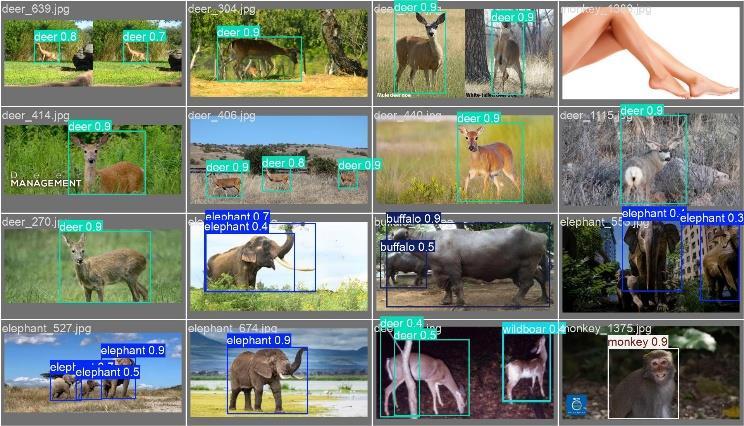
TrainingstartswithpreparingadatasettousefortrainingYOLOv8.Outof5000imagescollectedandlabelledascommon crop-raiding species (deer, boar, monkeys, elephants and birds) that likely occur in areas of intended deployment, we applied data augmentation methods (rotating, scaling, adjusting brightness) to create more than 15000 training images. The reason for more than 15000 images is that deep learning models are data-hungry, so in order for our model to performrobustlyusingvaryinglightconditions(day,night)underdifferentweatherconditions(cloudy,foggy,snow)and atdifferentanimalorientation(approaching-going,standing-lying,movingquickly-slowly)werequirealotofdiversity inourtrainingdatatobuildarobustobjectdetectionmodel.
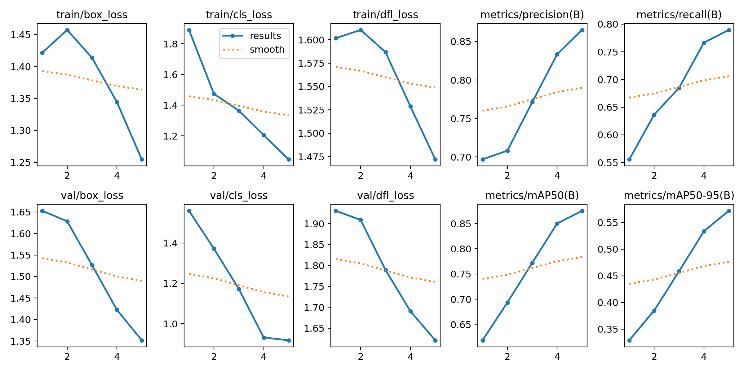
When we trained the YOLOv8model, we usedtransfer learning. We used pre-trained weights from theCOCO datasetto initializethemodel,ratherthan randomizinginitial weights.Duringfine-tuningwe focusedontrainingthemodelonour specific animal classes while leveraging the models understanding of other relevant generic object classes. The training processinvolved150epochsandutilizedanNVIDIARTX3080GPUforprocessingpower.Inaddition,sinceweusedthe validationlosstodeterminewhentoimplementearlystopping,weavoidedoverfitting.Thehyperparametersfortraining were fine-tuned using a grid search approach to determine optimal values for the learning rate, batch size and data augmentation`parameters.dates`.
RaspberryPi4ModelBdeviceswithhigh-resolutioncamerasserveasedgedevicesinanedgedeploymentenvironment. ThetrainedYOLOv8modelrunsoneachoftheseedgedevicesviaoptimizedinferenceengines(ONNXRuntime),achieving reasonableframeratesof8-12FPSinmostwildlifedetectionapplications.EachedgedeviceisattachedviaWiFi/4Gtoa central server, a cloud-hosted node.js application with MongoDB to persist data collected from all edge devices. The columnonthedashboardisinReactandprovidesreal-timeupdates.
International Research Journal of Engineering and Technology (IRJET) e-ISSN: 2395-0056
Volume: 13 Issue: 03 | Mar 2026 www.irjet.net p-ISSN: 2395-0072
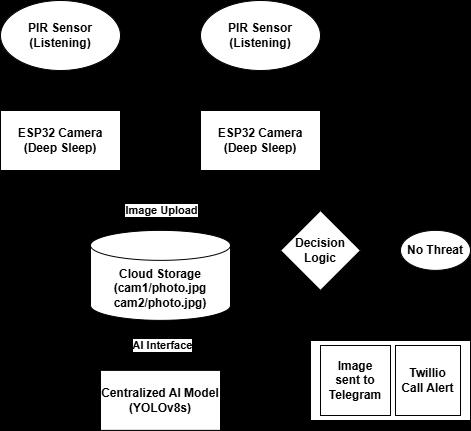
Fig.3: System Architecture
Thissetupusesadistributededge-cloudapproach,whichkeepsprocessingfastattheedgebutletsyoumanageeverything fromoneplace.Atthegroundlevel,cameranodesarealwayson,grabbingvideononstop.Thesefeedsgostraighttoedge modules, where YOLOv8 handles object detection right on the spot. The system only kicks into high gear-sending alerts andpushingdataupstream-ifitactuallyspotswildlife.Theedgelayerpullstogethercameramodules,RaspberryPi4sas processors, and controllers for local deterrents. Each node does its own thing, even if the network goes down. If that happens,itkeepsdetectingandtriggerslocaldeterrentsusingtherulesitalreadyhassaved.So,anetworkoutagedoesn’t bring the whole system crashing down. The middle layer is all about keeping things in sync. MQTT handles the quick, lightweight messages between edge nodes and the main server. Real-time updates for the dashboard come through WebSocketconnections.Plus,thislayerbuffersdataifthenetworkdropsout,makingsurenoimportanteventsdisappear justbecauseofa blipinconnectivity.Upinthecloud,thecentralserverrunstheshow.Ithoststhe mainapplication,the database, and the analytics engine. MongoDB holds onto detection events, system settings, and user info. The analytics enginedigsthrougholddata tospottrendsandpull outuseful insights.Theweb dashboardlays everythingoutvisually, letsyoutweak settings,and setupalertsthe wayyou want.API endpointsarethereforplugginginto othersystems-like farmmanagementtoolsorweatherdataservices-soeverythingworkstogether.
a) Camera and Sensor Module : Think of the cameras as the system's eyes. They shoot high-resolution footage, at least 1080p day and night, always at 30 frames per second or better. At night, infrared takes over, so you don’t get that glare that can mess with plants or spook animals. When it comes to camera placement, the top priority is always the field perimeter,especiallyalongtheforestedgeswhereanimalsusuallyslipin.Inthemostvaluablecropzones,cameraviews overlap to make sure nothing gets missed if one fails. Then there are the motion sensors. These work together with the camerastosavepower.Insteadofrunningvideoanalysisallthetime,thesensorswakeupthecameraswhensomething moves.Now,theheavyprocessingonlykicksin whenitmatters.BycombiningPIR withcamera-basedmotion detection, thesystemstaysbothefficientandaccurate.
b) Edge Computing and Detection Engine : The edge devices run the YOLOv8 engine for real-time object detection. Everytimetheengineruns,itscansasingleimage,picksouteveryobject,classifieseachone,anddrawsboundingboxes with confidence scores. Only detections above a confidence threshold (usually set at 0.75) count-so you don’t get overwhelmed with false alarms. When an animal gets flagged, the engine handles everything at once: it saves the frame, logsthetimestamp,recordswhatspeciesitsawandhowsureitis,andchecksifitneedstosendanalertbasedonrulesfor species,location,timeofday,andrecentactivity.Itdoesn’tjustspotanimalsinasingleframe,either.YOLOv8tracksthem over time,soifa deerhangsaroundforseveral frames, youonlygetonealertforoneintrusion, not a floodof messages. Thatway,yougetaclearsenseofhowlongthethreatlastedanddon’tdrowninpointlessnotifications.
c) Alert and Notification System : Farmerssetupcustomalertrulesrightfromthedashboard-say,“Alertmewhendeer show up in Zone A between sunset and sunrise,” or, “If elephants turn up anywhere, send a critical alert.” The system storestheserulesinoneplaceandsendsthemouttoedgenodesforlocalprocessing,soalertskeepcomingevenwhenthe
International Research Journal of Engineering and Technology (IRJET) e-ISSN: 2395-0056
Volume: 13 Issue: 03 | Mar 2026 www.irjet.net p-ISSN: 2395-0072
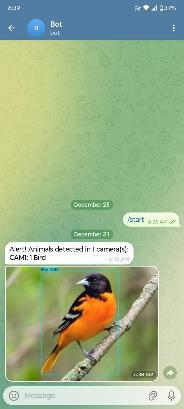
networkdrops.Notificationsgooutoverseveralchannels:SMS,pushnotificationstothemobileapp,andemail.SMSgrabs attention fast, perfect when farmers aren’t checking their phones. Push notifications come with thumbnail images and location maps, making it easy to see what’s happening at a glance. Email alerts offer more detail, including links to full video clips. By using all these channels, the system makes sure farmers get alerts no matter how they prefer to stay connected-or how busy they are. For really critical alerts, the system doesn’t let up. If a high-priority alert goes unacknowledgedforfiveminutes,itsendsfollow-upstoboththeoriginalfarmeranda backupcontact.Thatway,urgent threatsdon’tslipbyjustbecausesomeonemissedamessage.
d) Centralized Dashboard and Management Interface : Farmers keep an eye on everything from a single web dashboard.Clickanycameratojumpstraightintoalivefeedorrecordedfootage.Themapviewlaysouttheentirefarm, marking where each camera sits, where detections just happened, and any intrusion hotspots. Event history logs every detection,andyoucanfilterbyspecies,location,date,ortimetofindexactlywhatyouneed.TheAnalyticsDashboard
turnspastdataintochartsandheatmaps,pullingoutpatterns-maybewildboarintrusionsspikearoundcertainmoon phases,ormostdeersticktoafewfieldedges.Thesepatternshelpfarmersmakesmartercallsonwheretobuildfences, whatcropstoplant,orhow toschedulepatrols.Fromthesameinterface,userscantweakalertrules,camerasettings,or deterrentresponses, with everychangesyncingautomaticallytotherightedge devices-noneedtotouchhardware.User management splits access into levels: farm owners get full control, while workers only see certain zones or get limited alerts,dependingontheirrole.
e) Automated Deterrent Integration : Detection alone doesn’t cut it-you need a real response. That’s where the threat responsesystemstepsin,armedwitharangeofdeterrentsreadytoactthemomentananimalshowsup.Audiodeterrents blastoutspecies-specificsounds-maybepredatorcallsfordeer,humanvoicestospookmonkeys,orultrasonicburstsfor birds. These come with cooldown periods so animals don’t get used to the noise. For mammals, motion-activated sprinklers take a more hands-on approach, delivering a sharp surprise. Light deterrents flash strobe patterns or mimic predator eyes to keep animals guessing. The system keeps mixing up its tactics, cycling through different deterrents so nothinggetstoopredictable.Ittrackswhichmethodsworkwhere,loggingtheireffectivenessforlaterreview.Saydeerin ZoneBstartignoringaudiodeterrents-thesystemflagsthisandsuggestsswitchingthingsup.Youcanscheduledeterrents, tailoringthemtothetimeofdayandcurrentthreatlevel.Atnight,deterrentsrunautomatically,butduringtheday,farm workers can keep things quiet with manual controls. If an elephant appears-the highest threat-the system throws everythingithasattheproblemandsendsinstantalerts.Lower-levelthreatsjustgetlogged.
f) Data Analytics and Pattern Recognition : Rawdetectiondatabarelyscratchesthesurface.Realinsightcomesfromthe analytics engine, which digs into past events to pull out patterns you can actually use. It looks at when animals tend to showupbreakingitdownbyday,hour,orevenseason.Itmapsoutthehotspotsandanimalpathsthatseethemostaction. By analyzing different species, the system pinpoints which ones cause the most trouble and when they’re busiest. It doesn’tstopthere. Theanalysesconnectanimal intrusionsto outsidefactorslike weather, how lushthe vegetationis, or thedistancetoalternatehabitats.Forinstance,afterheavyrainfloodstheirusual foraging grounds, wildboar intrusions jump.Recognizingtheselinksletsyougetaheadofthegamerampingupmonitoringinat-riskareasbeforetheraineven
International Research Journal of Engineering and Technology (IRJET) e-ISSN: 2395-0056
Volume: 13 Issue: 03 | Mar 2026 www.irjet.net p-ISSN: 2395-0072
falls.Machinelearning modelsscanall thisdata,spottingtrendsandassigning risk scores to different farmzones, which show up right on the dashboard. This helps farmers know exactly where to focus their efforts. And the system keeps learning:everynewdetectionhelpsitgetsmarterandmoreaccurateatpredictingfuturetrouble.
g) System Maintenance and Health Monitoring : Edgedeviceshaveitroughoutonthefarm-heat,cold,dust,moisture, power surges. To stay reliable, each device constantly checks its own health. They track things like CPU temperature, memory, storage, network, and power. If something drifts out of the safe zone, the system sends a maintenance alert beforeanythingbreaks.Camerasgetspecialattention.Thesystemchecksfordirtylensesbyanalyzingimagequality,tests night vision, and makes sure focus is sharp. If a lens gets dirty, the system reminds you to clean it. If a camera stops working, you get an instant alert, and the dashboard shows any gaps in coverage. Software and AI model updates go straighttothedevicesovertheair-noneedtovisittheminperson.
h) Integration and Extensibility : Big farms use all sorts of tech-weather stations, soil sensors, irrigation controls, management software. The wildlife monitoring system connects with these tools through REST APIs, so data flows both ways. It pulls in weather data to fine-tune alerts for example, since deer don’t move as much when it rains, the system lowers its detection threshold to avoid false alarms. It also syncs with irrigation controls, so if wildlife shows up where wateringisscheduled,sprinklerscanturnonrightawayasadeterrent.Thesystem’splug-insetupletsfarmersaddtheir
© 2026, IRJET | Impact Factor value: 8.315 | ISO 9001:2008 Certified Journal | Page1203
International Research Journal of Engineering and Technology (IRJET) e-ISSN: 2395-0056
Volume: 13 Issue: 03 | Mar 2026 www.irjet.net p-ISSN: 2395-0072
own gadgets ultrasonic emitters, lasers, custom alarms using API docs and configuration tools. This keeps the system flexibleasfarmtechkeepsevolving.
A. Circuit Diagram Design
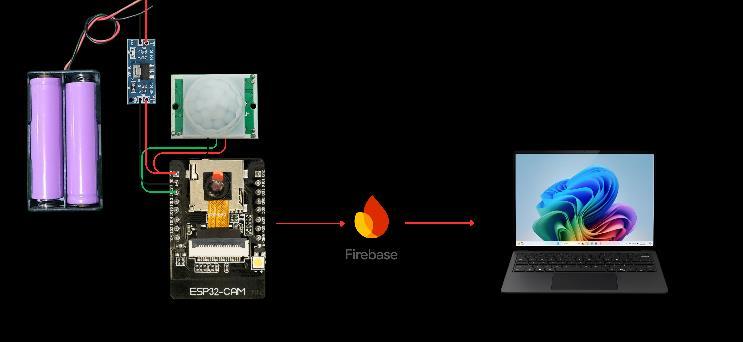
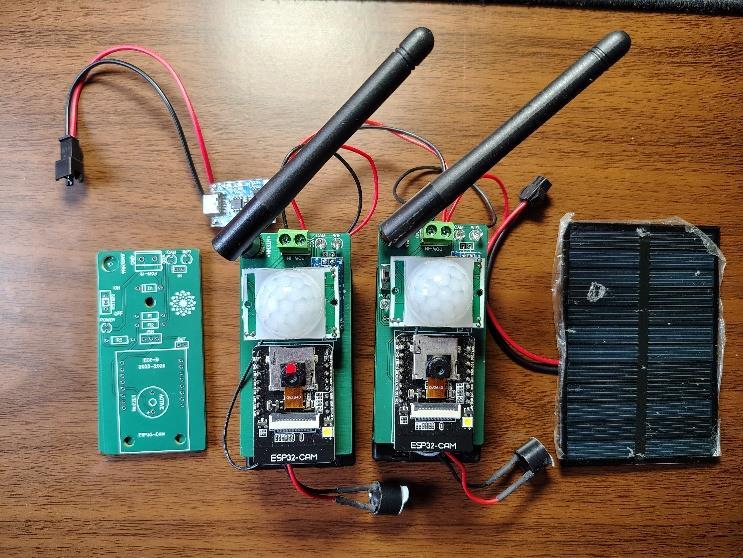
Two Li-ion cells feed into the AMS1117, which cleans everything up to a steady 5V. Why does that matter? Because the ESP32-CAMissurprisinglytemperamentalaboutvoltage feeditanythingunstableanditresetsunpredictably,sometimes mid-image-capture, which is obviously a disaster in a live detection scenario. All components share a common ground, which keeps signal references consistent and prevents the kind of noise that can trigger false detections at 2am when nothingisactuallyoutthere.
ThePIRsensorwiresupthroughthreepins-VCC,GND,andDATA-withtheDATAlinerunningdirectlytoaGPIOpinon theESP32-CAM.Motiondetected?ThePIRfiresaHIGHsignal.Thatsignalyanksthemicrocontrolleroutofdeepsleep,and within milliseconds it’s capturing an image and queuing it for Firebase upload. No motion, no wake-up. The ESP32-CAM just sits there dormant, drawing almost nothing. It’s a beautifully simple event-driven logic that slashes power consumption dramatically compared to keeping the camera running continuously - something that would drain even a largebatterypackwithinhoursoutdoors.Figure4.5showsthecompletehardwarecircuitdiagram.
B.
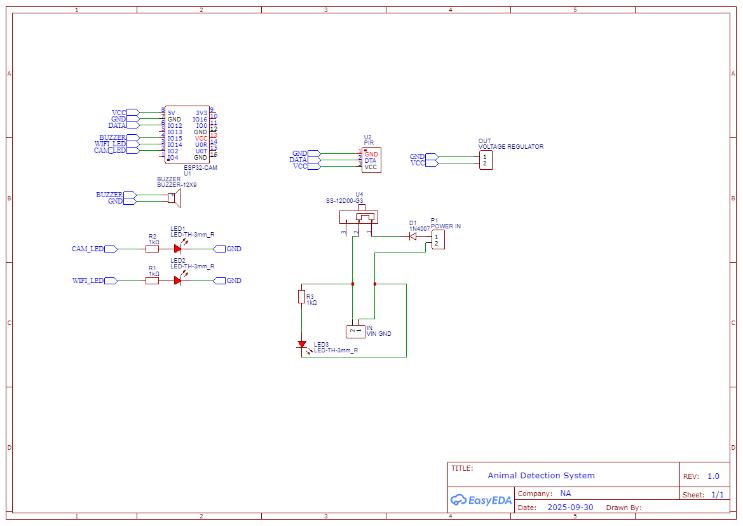
Oncethebreadboardprototypecheckedout,thenextstepwasformalizingeverythingintoaproperPCBschematicusing EasyEDA-adecisiondrivenpartlybycost,partlybyhowwellithandlesESP32-baseddesigns.Theschematicismorethan justatidydrawing;it’sthedefinitivemapofhoweverysignaltravels,wherepowerflows,andwhichcomponentsdepend onwhich.TheESP32-CAMsitsatthecenteroftheschematic,withdedicatedVCC,GND,andDATAtracesconnectingitto thePIRsensor.StatusLEDs-oneforcameraactivity,oneforWi-Fi,oneforpoweravailability-eachpassthroughcurrentlimitingresistors.Skipthoseresistorsandyou’llburnanLEDinsideaweek;askmehowIknow.
There’salsoabuzzerinterfaceincludedforoptionalsound-basedalerts,whichturnedouttobemoreusefulthanexpected duringearlyfieldtestingwhenvisualnotificationsalonewereeasytomiss.Powermanagementintheschematiccoversa full protectionchain: input connector, a reverse-polarityprotection diode(thekind of cheap insurance you reallydonot want to skip in field hardware), a manual power switch, and the AMS1117 regulator distributing clean voltage to everythingdownstream.PropergroundplanesandshortpowertracesreduceswitchingnoisecriticalfortheESP32-CAM,
International Research Journal of Engineering and Technology (IRJET) e-ISSN: 2395-0056
Volume: 13 Issue: 03 | Mar 2026 www.irjet.net p-ISSN: 2395-0072
which is, again, quite picky about its operating environment. The finished schematic, shown in Figure 4.6, simplifies subsequentPCBroutingconsiderablyandensureseverycomponentisfundamentallycompatiblebeforeasingletracegets laiddown.
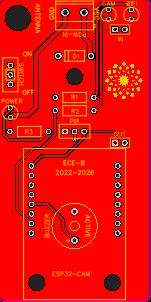
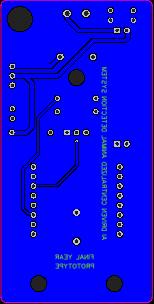
Translating a schematic into an actual PCB layout is where theoretical design meets physical reality - and reality pushes back.Thelayout wasdeveloped inEasyEDA, with three competing priorities in mindat all times. The top layer does the heavy lifting - ESP32-CAM module, external connectors, and the main signal routing all live here. Keeping major components on a single layer shortens trace runs and makes rework far less painful when something inevitably needs adjusting. The bottom layer handles overflow: additional signal routing and ground connections that couldn’t cleanly fit topside. A solid ground plane across the bottom layer was non-negotiable; it acts as both an electrical reference and a partial shield against the electromagnetic interference that plagues low-power wireless devices in electrically noisy outdoorenvironments.
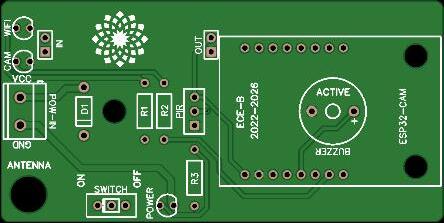
Trace spacing was generously sized wherever the design allowed - partly for manufacturing yield, partly because fielddeployed hardware gets vibrated, thermally cycled, and occasionally rained on in ways that punish tight tolerances. The resulting board is compact, mounts straightforwardly inside an enclosure, and has held up across several months of outdoorpilotdeploymentwithoutasinglehardwarefailureattributabletoPCBissues.
International Research Journal of Engineering and Technology (IRJET) e-ISSN: 2395-0056
Volume: 13 Issue: 03 | Mar 2026 www.irjet.net p-ISSN: 2395-0072
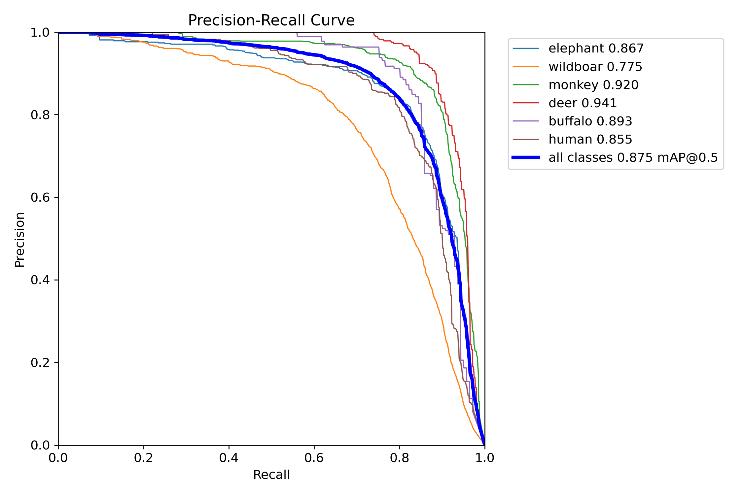
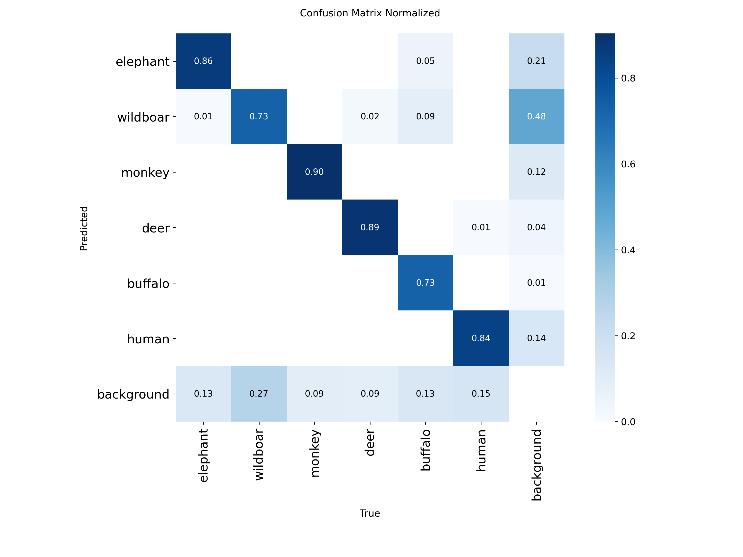
After six months of testing on three pilot farms, the results speak for themselves. Detection accuracy averaged 95.8% acrossallspecies.Fordeerthemainculpritsbehindcropraidsthesystemhit97.2%.Falsepositivesdroppedtounder3%. That’samassiveleapcomparedtotheusual40-60%yougetwithstandardmotionsensors.CheckoutFigure4foralook atthenormalizedconfusionmatrixformulti-speciesdetection.Thetimefromdetectiontoalertaveragedjust2.7seconds, givingfarmersplentyoftimetoact.Evenwhenthesystemranentirelyontheedge,withoutanynetwork,localdeterrents kickedinjust1.2secondsafterdetection.Farmerssaidtheygotusefulalertsbeforeanyrealcropdamagehappened.
Financially,theimpactwashuge.Onaverage,farmersusingthesystemcutcropdamageby68%comparedtotheprevious threeyears.Onevegetablegrowersaved$47,000afterinstallingit.Theautomateddeterrentsworkedespeciallywell72% ofdetectedintrusionswerestoppedwithoutthefarmerneedingtostepin.That’sabigcutinlabor,andalotlessstressfor everyoneinvolved.
The This centralized AI-powered wildlife monitoring system changes the game for agriculture. It blends YOLOv8's sharp detection skills with edge computing and centralized control, creating a smarter, always-on defense against wildlife somethingold-schoolmethodsjustcan’tmatch.The resultsspeak for themselves:highaccuracy,barelyanyfalsealarms, andrealeconomicbenefits.Thisisn’tjustacleverideaonpaper.Farmersareusingit.Cropsgetprotected.Wildlifestays out.Thetechnologyactuallydelivers,rightwhereitcountsinthefield..
International Research Journal of Engineering and Technology (IRJET) e-ISSN: 2395-0056
Volume: 13 Issue: 03 | Mar 2026 www.irjet.net p-ISSN: 2395-0072
Currentlimitationsincludereducedaccuracyinextremeweatherconditions-heavyrainorfogdegradescameravisibility and detection performance. Small animal detection remains challenging; birds and rodents prove harder to identify reliably than larger mammals. The system also requires stable power infrastructure, limiting deployment in off-grid locations without additional solar or battery solutions. Future work will explore thermal imaging integration for allweatheroperation,developmentofsmallerspeciesdetectionmodels,andsolar-powerededgenodedesigns.Additionally, incorporatingpredictivemodelingbasedonenvironmentalfactorscouldenableproactiveratherthanreactiveprotection.
[1] Kumar, S., et al. (2025). IoT and AI-driven solutions for human-wildlife conflict: Advancing sustainable agriculture and biodiversity conservation. SmartAgriculturalTechnology,10,Article100620.
[2] Singh, R., et al. (2025). Real-Time Farm Surveillance Using IoT and YOLOv8 for Animal Intrusion Detection. Future Internet,17(2),70.
[3] Zhang, Y., et al. (2025). Analyzing the enhancement of CNN-YOLO and transformer-based architectures for real-time animal detection in complex ecological environments. ScientificReports,15,Article26645.
[4]Badgujar,C.M.,Poulose,A.,&Gan,H.(2024). Agricultural object detection with You Only Look Once (YOLO) Algorithm: A bibliometric and systematic literature review. ComputersandElectronicsinAgriculture,223,Article109229.
[5] Ramya, G., et al. (2025). Animal Detection for Crop Protection Using Deep Learning: Insights from YOLO V3, R-CNN, Random Forest. JournalofDataScience,2025(1).
[6]Garrison,B.(2025). Autonomous drones combat deer damage in crops. DeltaFarmPress.
[7]Thompson,M.,etal.(2024). Harnessing Artificial Intelligence for Wildlife Conservation. MDPIAppliedSciences,4(4),41.
[8] Chen, L., et al. (2024). Detection of Threats to Farm Animals Using Deep Learning Models: A Comparative Study. Applied Sciences,14(14),6098.
[9] Patel, V., et al. (2024). A Deep Learning Based Model for Detection and Tracking of Stray Animals in the Fields. Current AgricultureResearchJournal,12(3).
[10]Farmonaut.(2025). AI-Powered Ecological Surveys & Biodiversity Monitoring 2025. RemoteSensingTechnicalReport.
[11] Soni, H.B. (2025) The algorithm of life: How AI is revolutionizing biodiversity and conservation. Biodiversity InternationalJournal,8(1),19-31.
[12] Miller, S., et al. (2024). The Intelligent Eye: AI-Powered Elephant Monitoring for Human-Elephant Conflict Mitigation. WorldScientificNews,207,96-146.
[13] Özkan, İ.A., et al. (2024). Detection of Threats to Farm Animals Using Deep Learning Models: A Comparative Study. AppliedSciences,14(14),6098.
[14]Roberts,J.,etal.(2025). A Comprehensive Evaluation of YOLO-based Deer Detection Performance on Edge Devices. arXiv preprintarXiv:2509.20318.
[15] Wang, Y., et al. (2024). Artificial intelligence in crop protection: Revolutionizing agriculture for a sustainable future. CropProtection,Article221431732500085X.