
International Research Journal of Engineering and Technology (IRJET) e-ISSN: 2395-0056
Volume: 13 Issue: 03 | Mar 2026 www.irjet.net p-ISSN: 2395-0072
International Research Journal of Engineering and Technology (IRJET) e-ISSN: 2395-0056
Volume: 13 Issue: 03 | Mar 2026 www.irjet.net p-ISSN: 2395-0072
Iqra Kadri1 , Manaal Shaikh2 , NoorJahan Samani3 , AlfiyaBi Shaikh4 , Amina Qureshi5 , Neha Salunkhe6
1 , Frontend Developer(Team Leader)
2 , Frontend Developer
3 , Frontend Developer
4 , Backend Developer
5 , Backend Developer
6, Dept. of Computer Engineering, Anjuman Islam’s Abdul Razzaq Kalsekar Polytechnic, Maharashtra, India (Team Mentor) ***
Abstract - Natural disasters such as earthquakes, floods, landslides, and building collapses often leave many people trapped under debris or stranded in dangerous environments. One of the major challenges faced by rescueteamsduringsuch situations is identifying survivors quickly and accurately. Traditional search methods rely heavily on manualinspection and rescue dogs, which may require significant time and resources. Delays in locatingsurvivorsmayreducethechances of saving lives. This research proposes an AI-based real-time survivor detection with rescue alert system that helps detect human survivors using a smartphone camera. The system consists of an Android mobile application integrated with an artificial intelligence detection model. The application captures live camera frames and analyzes them using computer vision techniques to detecthumanpresence.Whena human is detected, the system automatically captures the device’s GPS location and generates an alert. The alert information is stored in a cloud databaseandnotificationsare sent to rescue teams through push notifications. The system supports two types of users: normal users and rescuers. Normal users initiate thedetectionprocessthroughthemobile application, while rescuers receive alerts and view survivor locations through a dedicated dashboard. The proposed system aims to improve disaster response efficiency by enabling faster survivor detection and assisting rescue teams in locating them quickly. By combining artificial intelligence, mobile technology,andreal-timealertmechanisms,thesystem provides a cost-effective and scalable solution for emergency rescue operations. In addition, the system can support largescale disaster management by allowing multiple users to participate in the detection process. This collaborative approach increases the chances of locating survivors quickly, especially in large disaster areas where rescue teams may have limited manpower.
Key Words: Artificial Intelligence, Survivor Detection, Disaster Management, Computer Vision, Mobile Application, Real-Time Alert System, Human Detection, GPS Location Tracking, Image Processing, Cloud Database, PushNotifications,EmergencyRescueSystem.
Naturaldisasterssuchasearthquakes,floods,landslides,and buildingcollapsescauseseveredamagetobothhumanlife and infrastructure. During such events, many people may becometrappedunderdebrisorremainstrandedinunsafe locations. Locating survivors quickly becomes one of the mostimportanttasksforrescueteams.Traditionalrescue operations rely on manual searching, rescue dogs, and specialized equipment. Although these techniques are effectiveinmanycases,theyoftenrequiresignificanttime andmanpower.Searchinglargedisasterareasmanuallycan be slow and difficult, especially when visibility is poor or when debris blocks access to certain locations. Advancementsinartificialintelligenceandcomputervision technologieshavecreatednewopportunitiesforimproving disaster management systems. AI-based detection models are capable of analyzing images and identifying human presence with high accuracy. By integrating such technologies into mobile applications, it is possible to develop systems that assist rescue teams in locating survivors more efficiently. This research proposes an AIBased Real-Time Survivor Detection with Rescue Alert System that uses a smartphone camera and AI detection technologytoidentifypossiblesurvivorsandautomatically notifyrescueteamswithlocationdetails.Theimportanceof suchsystemshasincreasedsignificantlyinrecentyearsas disastershavebecomemorefrequentduetoclimatechange andurbandevelopment.Inmanycases,thefirstfewhours after a disaster are critical for saving lives. Therefore, technologies that can assist in faster detection and communicationplayanessential roleinimproving rescue outcomes.
Artificialintelligencehasbecomeanimportanttechnology inmanymodernapplications.Itiswidelyusedinfieldssuch ashealthcare,securitysurveillance,transportationsystems, smart homes, and disaster management. AI systems help computers perform tasks that normally require human
International Research Journal of Engineering and Technology (IRJET) e-ISSN: 2395-0056
Volume: 13 Issue: 03 | Mar 2026 www.irjet.net p-ISSN: 2395-0072
intelligence,suchasrecognizingobjects,analyzingimages, andmakingdecisionsbasedondata.
Oneimportantareaofartificialintelligenceiscomputer vision.Computervisionallowsmachinestounderstandand interpretvisualinformationfromimagesandvideos.Using computer vision techniques, systems can automatically identifyobjects,recognizepatterns,andanalyzevisualdata. These capabilities make computer vision useful for many real-worldapplicationswhereimageanalysisisrequired.
Deep learning models used in object detection have become very powerful in recent years. These models are trained using large datasets so that they can recognize differenttypesofobjectswithhighaccuracy.Theyarewidely used in applications such as security monitoring systems, autonomous vehicles, smart surveillance platforms, and industrial inspection systems. These models can detect human figures, vehicles, and other objects in images and processtheinformationinrealtime.
Indisastersituations,AI-baseddetectionsystemscanplay animportantroleinhelpingrescueteamslocatesurvivors morequickly.Insteadofrelyingonlyonmanualsearching,AI modelscananalyzecameraimagesandautomaticallyidentify humanpresence.Thiscanhelprescueteamssavetimeand focustheireffortsonareaswheresurvivorsarelikelytobe present.
WhenAIdetectiontechnologyisintegratedwithmobile devices,thesystembecomesmoreportableandaccessible. Smartphonesarewidelyusedandalreadyincludefeatures suchascameras,internetconnectivity,andlocationservices. Because of this, mobile-based AI systems can be easily deployed in emergency situations without requiring specializedequipment.
Anotheradvantageofusingmobile-basedAIsystemsis theirflexibility.Sincesmartphonesarecommonlyavailable, many people can use the application during disaster situationstoassistinthedetectionprocess.Thismakesthe proposed solution practical for both developed and developing regions where advanced rescue infrastructure may not always be available. By combining artificial intelligencewithmobiletechnology,itbecomespossibleto create efficient and affordable solutions for disaster managementandrescueoperations.
Themainobjectiveofthisresearchistodevelopamobilebased system that can detect human survivors using artificialintelligenceandautomaticallynotifyrescueteams during disaster situation. The system uses a smartphone camera to capture images and analyze them with an AIbasedhumandetectionmodeltoidentifypossiblesurvivors. When a person is detected, the application automatically collectsthedevice’sGPSlocationandgeneratesanalert.This
alertisthenstoredinaclouddatabasesothatrescueteams can access the information easily. The system also sends real-time notifications to rescuers, helping them respond quicklyandreachthesurvivor’slocationfaster.Inaddition, the application provides a dashboard where rescue team memberscanviewsurvivoralertsalongwiththeirlocation details.Thesystemisalsodesignedtobesimpleandeasyto use,sothatpeoplecanoperatetheapplicationquicklyeven during stressful disaster situations without needing any technicalknowledge.
During disaster situations, rescue teams face many difficulties while searching for survivors. In many cases, victimsmaybetrappedunderdebrisorlocatedinareasthat aredifficulttoreach.
Traditional rescue operations depend heavily on manual searchingandspecializedequipment.Whilethesemethods canbeeffective,theyoftenrequirealargeamountoftime and effort. In large disaster zones, searching every area manuallymaydelayrescueoperations.
Anotherproblemisthelackofreal-timeinformationabout survivor locations. Rescue teams may not always know where survivors are located, which makes the search processevenmorechallenging.
Thereisa needfora system thatcanautomaticallydetect human presence and immediately inform rescue teams aboutpossiblesurvivorlocations.
The proposed AI-based detection system addresses this issue by using a smartphone camera and computer vision technologytoidentifyhumanpresenceandgeneratealerts withGPSlocationinformation.
Varioustechnologieshavebeenstudiedanddevelopedto improve disaster rescue operations. Researchers and engineers have proposed different systems to help rescue teamslocatesurvivorsmorequicklyandefficientlyduring emergencysituations.Thesetechnologiesaimtoreducethe timerequiredforsearchinglargedisasterareasandincrease thechancesofsavinglives.
One common approach that has been explored in many researchstudiesistheuseofdronesequippedwithcameras. Drones can fly over disaster-affected areas and capture imagesorvideos fromabove.Thisallowsrescue teams to scan large areas in a short amount of time and identify possiblesurvivors.Dronesareespeciallyusefulinlocations that are difficult or dangerous for humans to reach. However, drone-based systems require specialized equipment, trained operators, and proper maintenance.
International Research Journal of Engineering and Technology (IRJET) e-ISSN: 2395-0056
Volume: 13 Issue: 03 | Mar 2026 www.irjet.net p-ISSN: 2395-0072
Because of these requirements, they may not always be practicaloraffordableforeveryrescueteam.
Another technology that has been used in disaster rescue operationsisthermalimaging.Thermalcamerasdetectthe heatemittedbythehumanbodyanddisplayitasathermal image.Thismakesiteasiertoidentifysurvivorseveninlowvisibility environments such as darkness, smoke, or areas coveredwithdebris.Althoughthermalimagingcanbevery effective, thermal cameras are usually expensive and may not be easily available in many regions or rescue organizations.
With the advancement of artificial intelligence and deep learningtechnologies,computervisionsystemshavebecome more powerful and accurate. AI-based object detection modelsarecapableofanalyzingimagesandautomatically identifying objects such as humans, vehicles, and other importantelements.Thesemodelscanprocessvisualdata quicklyandprovidedetectionresultsinrealtime.Becauseof thiscapability,AI-basedsystemscanassistrescueteamsby automaticallydetectinghumanfiguresincameraimages. TheproposedsysteminthisresearchfocusesonusingAIbased human detection integrated with a smartphone application.Thisapproachreducestheneedforexpensive hardware while still providing an effective way to detect survivors.Sincesmartphonesarewidelyavailableandeasy touse,thismethodmakesthesystemmoreaccessibleand practicalfordifferentenvironments.
In addition to detection technology, many recent studies have also highlighted the importance of real-time communicationduringdisasterrescueoperations.Systems thatcombinedetectionmethodswithinstantnotificationor alertmechanismscangreatlyimprovecoordinationbetween rescue teams and emergency responders. Quick communicationensuresthatrescueteamsreceiveimportant information immediately and can respond faster to save survivors
The proposed system is a mobile-based application designedtohelpdetecthumansurvivorsandinformrescue teams during disaster situations. The application uses the smartphonecameratocapturereal-timeimages,whichare thenanalyzedusinganartificialintelligencedetectionmodel toidentifywhetherahumanispresent.Ifthesystemdetects apersoninthecapturedimage,itautomaticallycollectsthe GPS location of the device and creates an alert. This alert informationisstoredinaclouddatabase,andanotification isimmediatelysenttorescueteams. Thesystemsupports twotypesofusers:normalusersandrescueteammembers. Normalusersstartthedetectionprocessusingthemobile application,whilerescueteammembersreceivealertsand view survivor locations through a dashboard. The system
worksinrealtimesothatalertscanbegeneratedinstantly afterasurvivorisdetected.Thishelpsrescueteamsrespond fasterandreducesthedelaysthatusuallyoccurintraditional searchandrescueoperations.
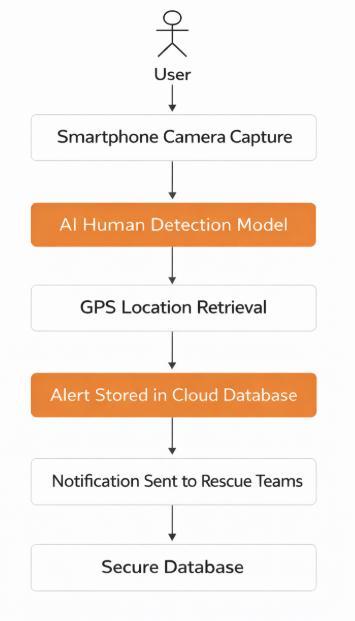
Theproposedsystemisdividedintoseveralcoremodules that work together to detect survivors and send alerts to rescueteams.Eachmoduleperformsaspecificfunctionto ensure that the system operates smoothly and efficiently duringdisastersituations.
TheUserAuthenticationModuleisresponsibleformanaging the login and registration process of users. The system allows users to create an account using their email and password.FirebaseAuthenticationisusedtosecurelyverify usercredentialsandcontrolaccesstotheapplication. During registration, users select their role in the system. Therearetwotypesofusers:normalusersandrescueteam members.Afterloggingin,thesystemcheckstheuserrole and redirects them to the appropriate dashboard. This module ensures that only authorized users can access the system.
TheCameraDetectionModuleisresponsibleforcapturing imagesfromthesmartphonecamera.Whentheuserstarts the detection process, the camera is activated and begins capturing frames continuously from the surrounding environment.
Volume: 13 Issue: 03 | Mar 2026 www.irjet.net p-ISSN: 2395-0072
ThecapturedframesarethensenttotheAIdetectionmodel for analysis. This module plays an important role in collecting visual data that is used for identifying human presenceduringdisastersituations.
[3] 3.3 AI Detection Module
The AI Detection Module is responsible for analyzing the capturedimagesanddetectinghumanfigures.Thismodule usesanartificialintelligencemodelbasedondeeplearning andcomputervisiontechniques.
TheAImodelprocessestheframesreceivedfromthemobile applicationandcheckswhethera human ispresentinthe image. If a human figure is detected with sufficient confidence, the system considers it as a possible survivor detection.Thismodulehelpsautomatethedetectionprocess andreducestheneedformanualsearching.
[4] Location Tracking Module
TheLocationTrackingModuleretrievestheGPSlocationof the device when a survivor is detected. The system automatically captures the current latitude and longitude coordinatesusingthesmartphone’slocationservices. Thislocationinformationhelpsidentifythe exactposition wherethedetectionoccurred.Thecapturedlocationdatais included in the alert message so that rescue teams can quicklyreachthedetectedlocation.
[5] Alert Generation Module
The Alert Generation Module is responsible for creating alertswhenthesystemdetectsapossiblesurvivor.Thealert includesimportantinformationsuchasthecapturedimage, locationcoordinates,timeofdetection,anduserdetails. Thisinformationisstoredintheclouddatabasesothatitcan beaccessedbyrescueteams.Thealertsystemensuresthat detection results are properly recorded and shared with authorizedusers.
[6] Notification and Rescuer Dashboard Module
This module sends push notifications to rescue team memberswhenanewsurvivordetectionalertisgenerated. FirebaseCloudMessagingisusedtodelivernotificationsin realtime.
Rescueteammemberscanopentheapplicationdashboard to view the alert details, including the survivor image, location,andtimeofdetection.Thedashboardalsoallows rescuers to navigate to the detected location using map services.
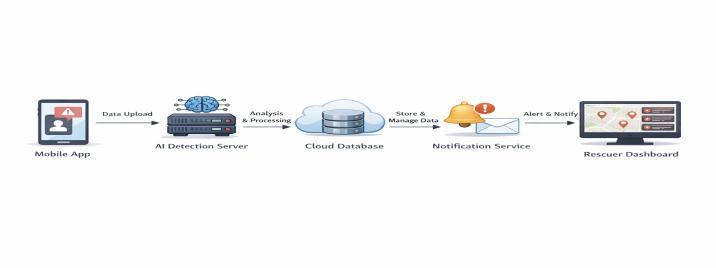
Thesystemarchitectureoftheproposedsolutionismadeup of several important components that work together to detect survivors and send alerts to rescue teams. These componentsincludethemobileapplication,theAIdetection module, the backend server, andtheclouddatabase.Each part of the system has a specific role in ensuring that the detectionandalertprocessworkssmoothly.
The mobile application is the main interface used by the user.Itrunsonasmartphoneandusesthedevice’scamera tocaptureimagesorframesfromthesurroundings.These capturedimagesarethensenttotheAIdetectionmodulefor analysis.Theapplicationalsomanagesuserinteraction,such as starting the detection process and displaying detection results.
The AI detection module is responsible for analyzing the captured images using computer vision and artificial intelligencetechniques.Thedetectionmodelprocessesthe imagesandcheckswhetherahumanfigureispresent.Ifa humanisdetectedintheimage,thesystemconsidersitasa possiblesurvivorandpreparestogenerateanalert.
Once a survivor is detected, the system automatically retrievesthecurrentGPSlocationofthedevice.Thislocation information helps identify the exact place where the detectionoccurred.Thealertdetails,includingthecaptured image,locationcoordinates,andtimeofdetection,arethen storedinaclouddatabaseforfurtheraccessandmonitoring.
Afterstoringthealertinformation,thesystemsendspush notifications to rescue team members through the application. Thesenotificationsinformthe rescuersthata possible survivor has been detected. The rescue team can opentheapplicationdashboardtoviewthealertdetailsand examinethelocationinformation.
Rescuers can access the alert data through the dashboard interface, where they can see the survivor image, time of detection,andGPSlocation.Usingmapservicesintegrated intotheapplication,theycaneasilynavigatetothelocation andstarttherescueoperation.
The backend server acts as the central component of the entire system. It connects the mobile application, AI detectionsystem,andclouddatabase.Theserverreceives requests from the mobile application, processes the data, and manages communication between different system components.Italsoensuresthatalertinformationisstored correctlyandthatnotificationsaredeliveredtorescueteams withoutdelay.
Overall, the system architecture is designed to ensure smooth communication between all components so that survivordetectionandrescuealertscanhappenquicklyand efficientlyduringdisastersituations.
International Research Journal of Engineering and Technology (IRJET) e-ISSN: 2395-0056
Volume: 13 Issue: 03 | Mar 2026 www.irjet.net p-ISSN: 2395-0072
The development of the AI-Based Real-Time Survivor DetectionandRescueAlertSystemrequiresseveralsoftware tools and technologies. These tools are used to build the mobile application, implement the artificial intelligence detection model, manage cloud storage, and enable communicationbetweenthesystemcomponents. Themainsoftwarerequirements fortheproposedsystem aredescribedbelow.
[7] Android Studio
Android Studio is used as the primary development environmentforbuildingthemobileapplication.Itprovides tools for designing the user interface, writing application logic, testing the application, and debugging errors. The mobileapplicationdevelopedinAndroidStudioallowsusers tocaptureimagesusingthephonecameraandinteractwith thedetectionsystem.
[8] Java Programming Language
The mobile application is developed using Java or Kotlin programminglanguages.Theselanguagesarewidelyused forAndroidapplicationdevelopment.Theyhandlethecore functionalityoftheappsuchasuserauthentication,camera operations, communication with the backend server, and interactionwithFirebaseservices.
[9] XML Layouts
XMLisusedtodesignthegraphicaluserinterface(GUI)of the Android application. It helps create different screens such as the login page, registration page, user dashboard, camerascreen,andrescuer dashboard.XMLlayouts make theapplicationinterfacestructuredandeasytomanage.
[10] CameraX API
CameraXisusedtoaccessthesmartphonecamerawithinthe Android application. It enables real-time camera preview andallowstheapplicationtocaptureframescontinuously. ThesecapturedframesaresenttotheAIdetectionsystem foranalysis.
[11] Python
Python is used for developing the backend system that performs human detection using artificial intelligence. Python is widely used in machine learning and computer vision applications because it supports many powerful librariesforimageprocessinganddeeplearning.
[12] Flask / FastAPI Framework
Flask orFastAPIisusedtocreatethebackendserverthat communicates with the mobile application. The server receivesimagesfromthemobileapp,processesthemusing theAIdetectionmodel,andsendsthedetectionresultsback totheapplication.
[13] YOLO (You Only Look Once)
YOLOisusedastheobjectdetectionmodelforidentifying human presence in images. It is a deep learning model capableofperformingreal-timeobjectdetectionwithhigh accuracy.Inthisproject,YOLOv5orYOLOv8isusedtodetect humansurvivorsfromcameraframes.
[14] OpenCV
OpenCVisanopen-sourcecomputervisionlibraryusedfor image processing. It helps in reading images, converting image formats, and preparing images before they are processedbytheYOLOdetectionmodel.
[15] Firebase Authentication
Firebase Authentication is used to manage user login and registrationinthesystem.Itallowsuserstosecurelysignin usingtheiremailandpassword.Theauthenticationsystem alsohelpsmanagedifferentuserrolessuchasnormalusers andrescueteammembers.
[16] Firebase Firestore Database
FirebaseFirestoreisusedastheclouddatabaseforstoring systemdata.Itstoresuserinformation,survivordetection alerts, location details, timestamps, and other important recordsgeneratedbythesystem.
[17] Firebase Cloud Messaging (FCM)
FirebaseCloudMessagingisusedtosendpushnotifications to rescue team members. When the system detects a survivor, an alert notification is automatically sent to all rescuerssothattheycanquicklyrespondtothesituation.
[18] REST API Communication
RESTAPIsareusedtoenablecommunicationbetweenthe mobile application and the backend server. The mobile applicationsendscapturedimagestothebackendAPI,and theserverreturnsthedetectionresultsinJSONformat.
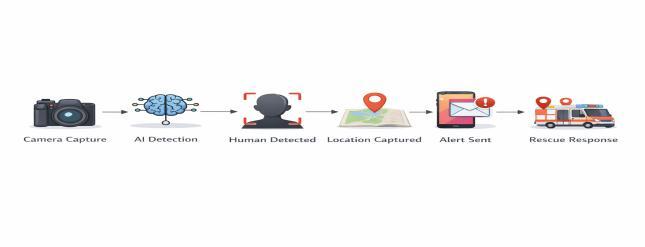
The proposed system follows a step-by-step process to detectsurvivorsandgeneratealertsforrescueteams.The methodology focuses on using artificial intelligence and mobile technology to automate the detection process and reducethetimerequiredtolocatesurvivorsduringdisaster situations.
First,theuseropensthemobileapplicationandlogsintothe system using their registered credentials. After successful login, the user is directed to the application dashboard wheretheycanaccessdifferentfeaturesofthesystem.From thedashboard,theusercanstartthedetectionprocessby activatingthedetectionoption.
Oncethedetectionprocessstarts,thesmartphonecamerais activated.Thecamerabeginscapturingframescontinuously fromthesurroundingenvironment.Theseframesarethen
International Research Journal of Engineering and Technology (IRJET) e-ISSN: 2395-0056
Volume: 13 Issue: 03 | Mar 2026 www.irjet.net p-ISSN: 2395-0072
processedbytheAIdetectionmodelthatisintegratedwith thesystem.Thedetectionmodelanalyzeseachframeusing computer vision techniques to identify whether a human figureispresentintheimage.
The AI model compares the captured frames with trained patterns to recognize human shapes and features. If the modelidentifiesahumanfigurewithsufficientconfidence, thesystemtreatsitasapossiblesurvivordetection.
Afterahumanisdetected,thesystemautomaticallyretrieves the current GPS location of the device. This location informationhelpsdeterminethe exactposition wherethe detection occurred. The system then creates an alert that includesthecapturedimage,GPScoordinates,andthetime ofdetection.
This alert information is stored securely in the cloud database so that it can be accessed by authorized rescue teammembers.Atthesametime,pushnotificationsaresent to the rescue teams through the application. These notifications inform rescuers that a possible survivor has been detected and provide them with the necessary informationtorespond.
Rescueteammemberscanopentheapplicationandviewthe alert details on their dashboard. The dashboard displays importantinformationsuchasthedetectedimage,location coordinates,andthetimeofdetection.Usingtheintegrated mapservice,rescuerscannavigatedirectlytothelocation andbeginrescueoperations.
Themethodologyisdesignedtofocusonautomation,speed, and ease of use. The system minimizes manual effort by automatically detecting survivors and sending alerts. This ensuresthatthesystemcanoperateefficientlyevenduring emergency situations where quick response is extremely important
6. Results and Discussion
The proposed system demonstrates how artificial intelligenceandmobiletechnologycanbeusedtogetherto supportdisasterrescueoperations.Byusingasmartphone cameraalongwithanAI-baseddetectionmodel,thesystem isabletoidentifythepresenceofhumansinrealtime.Once a human figure is detected, the system automatically generates an alert and sends the information to rescue
teams. This helps in reducing the time required to locate survivorsduringemergencysituations.
Anotheradvantageofthissystemisthatitiscost-effective. Thesystemdoesnotdependonexpensiveequipmentsuch asdronesorthermalimagingcameras,whichareoftenused inadvancedrescueoperations.Instead,itusessmartphones, whicharealreadywidelyavailableandeasytouse.Because of this, the system can be deployed quickly in different environments without requiring special hardware or complexsetup.
The integration of GPS location tracking and push notification technology plays an important role in the system. When a survivor is detected, the system automaticallycapturesthecurrentlocationofthedeviceand sends this information along with the alert. Rescue teams receivethenotificationimmediatelyandcanviewtheexact locationofthepossiblesurvivor.
This quick communication can significantly improve responsetimeduringemergencysituationsandincreasethe chancesofsavinglives.
In addition, the system promotes collaboration between normalusersandrescueteams.Peoplepresentinadisasteraffectedareacanusethemobileapplicationtohelpdetect survivors by simply scanning the surroundings with their phone camera. When multiple users participate in this process, the overall coverage area becomes larger. This collaborativeapproachincreasesthepossibilityoflocating survivors more quickly, especially in large disaster zones where rescue teams may not be able to search every area immediately.
Overall, the proposed system shows how modern technologies such as artificial intelligence, mobile applications, and real-time communication can work together to support disaster management and improve rescueoperations.
This research presented an AI-Based Real-Time Survivor DetectionandRescueAlertSystemthatisdesignedtoassist rescueteamsduringdisastersituations.Themainpurposeof the system is to help detect human survivors quickly and sendalertstorescuerssothattheycanreachthelocationas soon as possible. The system uses a smartphone camera alongwithartificial intelligencetechnologytoidentifythe presenceofhumansinthesurroundingenvironment.
Inthissystem,themobileapplicationcapturesimagesusing thedevicecameraandsendsthemtotheAIdetectionmodel for analysis. When the system detects a human figure, it automatically retrieves the current GPS location of the deviceandgeneratesanalert.Thisalertinformationisthen
International Research Journal of Engineering and Technology (IRJET) e-ISSN: 2395-0056
Volume: 13 Issue: 03 | Mar 2026 www.irjet.net p-ISSN: 2395-0072
stored in a cloud database and shared with rescue teams through notifications. By providing both detection results and location details, the system helps rescuers quickly identifywhereapossiblesurvivorislocated.
Oneofthemainadvantagesoftheproposedsystemisthatit is simple and cost-effective. It does not require expensive equipmentsuchasdrones,thermalcameras,orspecialized rescue devices. Instead, it uses smartphones, which are alreadywidelyavailableandeasytooperate.Becauseofthis, thesystemcanbeimplementedindifferentregionswithout requiringcomplexinfrastructureorhighcosts.
The integration of artificial intelligence with mobile technology allows the system to perform detection and communicationinrealtime.Rescueteamscanreceivealerts quickly and view the location of the detected survivor through the application dashboard. This faster communication can help improve response time during emergency situations and increase the chances of saving lives.
Theproposedsystemprovidesabasicplatformfordetecting survivorsandsendingalertstorescueteams.However,the system can be further improved by integrating additional technologiesthatcanincreasedetectionaccuracyandmake rescueoperationsmoreeffective.Futuredevelopmentscan helpmakethesystemmorereliableandcapableofworking incomplexdisasterenvironments.
Onepossibleimprovementistheintegrationofdronesfor aerialsearchoperations.Dronesequippedwithcamerascan scanlargedisasterareasquicklyandcaptureimagesfrom locations that may be difficult for humans to reach. By connectingdronecameraswiththeAIdetectionsystem,it wouldbepossibletodetectsurvivorsfromtheairandsend alertstorescueteamsmoreefficiently.
Anotherimprovementcouldbetheuseofthermalimaging sensors.Thermalcamerasdetectheatemittedbythehuman body and can help identify survivors even in dark environments or areas with poor visibility. Combining thermalimagingwiththeexistingAIdetectionsystemcould improve the accuracy of survivor detection, especially in situationswherenormalcamerasmaynotperformwell.
The system can also be enhanced by implementing more advanced deep learning models. Improved AI models can increasetheaccuracyofhumandetectionandreducefalse detections.Asartificialintelligencetechnologycontinuesto evolve,newermodelscanbeintegratedintothesystemto achievebetterperformanceandfasterprocessing.
Inaddition,thedevelopmentofmultilingualinterfacescan maketheapplicationmoreaccessibletousersfromdifferent
regions.Providingsupportformultiplelanguageswillallow more people to use the system easily during emergency situations,especiallyinareaswithdiversepopulations.
Anotherusefulimprovementwouldbetheadditionofoffline detectioncapabilities.Inmanydisastersituations,internet connectivitymaybeweakorcompletelyunavailabledueto damagedcommunicationnetworks.Ifthesystemisableto perform detection locally on the device and store alerts temporarily,theinformationcanbesentautomaticallyonce the network connection is restored. This would make the systemmorereliableinremoteordisaster-affectedareas.
Overall,thesefutureenhancementscanmaketheproposed systemmorepowerful,reliable,andsuitableforlarge-scale disastermanagementapplications.
[1]S.RussellandP.Norvig,ArtificialIntelligence:AModern Approach,Pearson,2020.
[2]I.Goodfellow,Y.Bengio,andA.Courville,DeepLearning, MITPress,2016.
[3]J.Redmonetal.,“YouOnlyLookOnce:UnifiedReal-Time ObjectDetection,”IEEEConferenceonComputerVisionand PatternRecognition,2016.
[4]A.Krizhevskyetal.,“ImageNetClassificationwithDeep Convolutional Neural Networks,” Advances in Neural InformationProcessingSystems,2012.
[5] D. Lowe, “Distinctive Image Features from ScaleInvariant Keypoints,” International Journal of Computer Vision,2004.
[6]M.Everinghametal.,“ThePascalVisualObjectClasses Challenge,”InternationalJournalofComputerVision,2010