
Volume: 13 Issue: 01 | Jan 2026 www.irjet.net
International Research Journal of Engineering and Technology (IRJET) e-ISSN:2395-0056 p-ISSN:2395-0072

Volume: 13 Issue: 01 | Jan 2026 www.irjet.net
International Research Journal of Engineering and Technology (IRJET) e-ISSN:2395-0056 p-ISSN:2395-0072
Rohit Rahul Dhanedhar1, Jagdish Sanjay Gaikwad2, Anil Naik3

¹Students, Department of Computer Engineering, S.Y.P Shreeyash College of Engineering and Technology (Polytechnic), Chh. Sambhajinagar, India.
²Students, Department of Computer Engineering, S.Y.P Shreeyash College of Engineering and Technology (Polytechnic), Chh. Sambhajinagar, India.
³Head of Department, Computer Engineering, S.Y.P Shreeyash College of Engineering and Technology (Polytechnic), Chh. Sambhajinagar, India.
Abstract - Online examination systems have become an essential component of modern education and recruitment processes. However, traditional systems fail to evaluate the mental state, confidence level, and behavioral integrity of candidates during examinations. This paper presents an AIbased smart online examination system that integrates realtime emotion detection, stress analysis, confidence scoring, andcheatingdetectiontoenhanceassessmentreliability.
The proposed system uses computer vision and speech processing techniques to monitor candidates throughout the examination. Facial emotion recognition is performed using live webcam input to identify emotions such as happiness, fear, anger, and neutrality. These emotions are further mapped to calculate stress levels dynamically. Simultaneously, speech-to-text and text-based answers are analyzed to determine answer correctness and confidence levels usingartificialintelligencemodels.
Toensure examinationintegrity,thesystem detectscheating behavior by identifying face absence or multiple faces during the exam session. All examination results, including correctness score, stress percentage, confidence score, and behavioral analysis, are securely stored in a CSV-based database and visualized through an admin dashboard with chartsandtables.
The proposed system improves candidate evaluation by combining technical knowledge assessment with psychological and behavioral analysis. This approach can be effectively applied in online recruitment, academic assessments, and remote interviews. Experimental results demonstratethatthesystemprovidesa more comprehensive and reliable evaluation compared to conventional online examinationplatforms.
Key Words: Online Examination, Emotion Detection, Stress Analysis, Confidence Scoring, Cheating Detection, Artificial Intelligence, Computer Vision
1.
The exponential growth of web technologies, artificial intelligence, and machine learning has led to a paradigm shift in the way educational institutions and corporate
organizations conduct examinations and recruitment assessments. Traditional online examination systems primarily evaluate candidates based on the correctness of submitted answers, while largely ignoring crucial behavioral and psychological parameters such as emotional stability, stress handling capacity, confidence level, and examination integrity. As a result, such systems oftenfailtoprovidea holisticandreliableassessmentofa candidate’s true performance and mental state under examinationconditions.
In recent years, the increasing demand for remote examinations and online interviews has further amplified concerns related to impersonation, cheating, lack of supervision, and limited behavioral analysis. These challenges highlight the need for an intelligent examination framework capable of continuously monitoring the candidate’s actions, facial expressions, and emotional responsesinreal time.Byintegratingcomputer vision techniques with artificial intelligence models, it is possible to extract meaningful insights related to a candidate’s emotional state and behavioral patterns throughouttheexaminationprocess.
This paper presents the design and implementation of an AI-drivenintelligentexaminationsystemthatincorporates facial emotion recognition, stress level estimation, confidence score computation, and cheating detection mechanisms within a unified web-based platform. The proposed system utilizes real-time webcam input to capturefacialimagesofthecandidate,whichareprocessed using emotion detection algorithms to classify emotional states such as happiness, neutrality, fear, sadness, and anger. Thesedetected emotionsarethenmappedtostress scores, allowing the system to evaluate the candidate’s psychological condition dynamically during the examination.
In addition to emotion-based analysis, the system also evaluates the candidate’s confidence level by combining answer quality, emotional stability, and stress trends observed throughout the examination session. Cheating detection is implemented through continuous face monitoring techniques that identify suspicious activities such as the absence of a face or the presence of multiple
International Research
(IRJET) e-ISSN:2395-0056 p-ISSN:2395-0072 Volume: 13 Issue: 01 | Jan 2026 www.irjet.net
faces within the camera frame, thereby enhancing examinationauthenticityandfairness.Uponcompletionof the examination, the system generates a comprehensive performance report that includes answer accuracy, stress level,confidencescore,andbehavioralinsights.
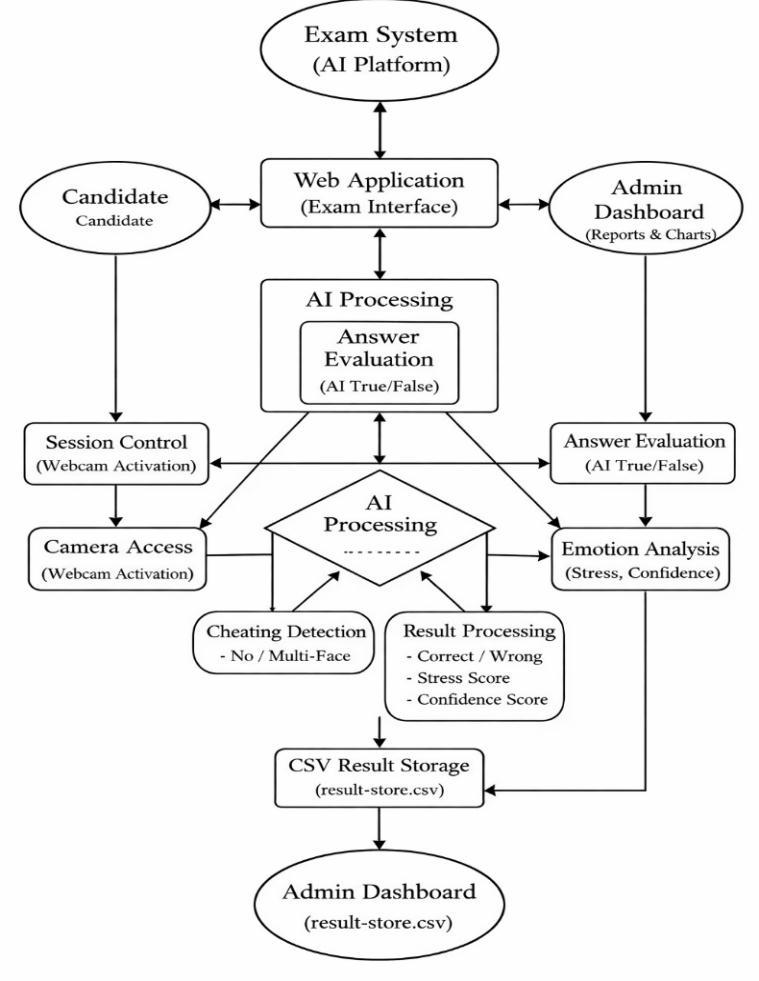
Before initiating the implementation of the intelligent examination system, it is essential to establish a welldefined system architecture that clearly outlines the interaction between the frontend, backend, and artificial intelligence modules. The proposed architecture follows a modular design approach, where each functional component operates independently while maintaining seamless communication with other modules. This modularity improves system scalability, maintainability, andperformance.
Thefrontendmoduleprovidesaninteractivewebinterface that allows candidates to register, select examination topics, view dynamically generated questions, and submit answers using either text or voice input. Simultaneously, thesystemactivatesthewebcamtocapturereal-timefacial images of the candidate at fixed intervals. These images areforwardedtothebackendserverforfurtherprocessing andanalysis
The backend module plays a critical role in managing session data, generating questions using artificial intelligence models, evaluating answers, and performing emotion-based analysis. The facial images captured from the webcam are processed by the emotion recognition module to determine the candidate’s emotional state, which is subsequently used to calculate stress and confidence scores. Additionally, cheating detection logic continuously verifies the presence of a single face throughout the examination to ensure compliance with examinationrules.
All examination results, including candidate details, performance metrics, stress levels, and confidence scores, are securely stored in a structured CSV-based database. These records are later visualized through an admin dashboard using statistical charts and tables, enabling evaluators to gain deeper insights into candidate performance. The integration of behavioral analytics with conventional evaluation methods significantly enhances the reliability and effectiveness of online examination systems.
In this section, the overall system design and implementation methodology of the proposed AI-based intelligent examination platform is presented. The system is designed to integrate real-time question generation, candidate monitoring, automated answer evaluation, emotiondetection,stressanalysis,confidencescoring,and result visualization into a unified web-based interface Each module interacts seamlessly with the backend AI enginetoensureaccurateperformancemetricsandsecure datahandling.
All abbreviations and acronyms used in this section are definedattheirfirstoccurrenceinthetext.Forinstance, AI (Artificial Intelligence), CSV (Comma-Separated Values), and NLP (Natural Language Processing) are introduced properly, and abbreviations such as IEEE, SI, MKS,CGS,sc, dc,rms are used without further definition whenstandard.
Table1System Specifications and Development Parameters
SoftwareStack Python3.11,Flask,OpenAI API,HTML5,CSS3,JS,Chart.js
AIModels
GPT-4o-miniforQuestion GenerationandAnswer Evaluation
EmotionRecognition CustomCNN/Face ExpressionRecognition Models
StressAnalysis
DerivedfromEmotionTrends (Score:0–100%)
ConfidenceScoring ComputedfromAnswer Accuracy,Stress,andEmotion Stability
ResultStorage
CSV-basedDatabase(resultstore.csv)
Fig
Execution Stages:
The examination process begins with candidate registration, where basic details such as name, position, and selected examination topic are collected. Once authenticated,auniqueexaminationsessioniscreatedand stored securely in the backend to track all user activities throughoutthetest.
After successful login, the system initializes the examination environment. The webcam and microphone are activated with user consent to enable real-time facial expression analysis, voice input processing, and cheating detection. The first question is dynamically generated using the AI question generation module based on the selectedtopic.
The system generates interview-style questions using a Natural Language Processing (NLP) model. Each question is displayed on the examination interface and
(IRJET) e-ISSN:2395-0056 p-ISSN:2395-0072
simultaneouslyconvertedintospeechusingtext-to-speech technologytoassistcandidates.
Candidates may submit answers either through text input or speech recognition. The submitted answer is evaluated using an AI-based answer validation model that determines correctness. A maximum of four attempts is allowed per question. If the answer is correct, the system proceeds to the next question; otherwise, it tracks attempts and moves forward when the attempt limit is exceeded.
During the examination, the system periodically captures facial images from the webcam. These images are processed using a facial emotion recognition model to identify emotions such as happiness, stress, fear, or neutrality. Based on detected emotions over time, a stress score is computed to assess the candidate’s psychological state.
The confidence score is calculated by combining multiple factors, including answer accuracy, detected facial emotions, response behavior, and stress levels. This score reflects the candidate’s overall confidence during the examination and is updated dynamically after each response.
Thesystemcontinuouslymonitorsthevideofeedtodetect cheatingactivities.Ifnofaceormultiplefacesaredetected, the system flags suspicious behavior and logs the event. This enhances examination integrity and prevents unfair practices.
Each question’s outcome is visually represented using progress indicators. Correct answers are marked in green, while incorrect or skipped attempts are marked in red. This provides real-time feedback to the candidate without revealingevaluationdetails.
After completing all questions, the system computes final results,includingtotalcorrectanswers,incorrectanswers, average stress level, and overall confidence score. These results are securely stored in a CSV database for record maintenanceandadministrativereview.
Volume: 13 Issue: 01 | Jan 2026 www.irjet.net
International Research Journal of Engineering and Technology (IRJET) e-ISSN:2395-0056 p-ISSN:2395-0072
The candidate is redirected to the result page, where performancestatisticsaredisplayedusinggraphicalcharts. Simultaneously, the administrator can access a dashboard that presents aggregated results, stress analysis, confidence trends, and performance metrics for all candidates.
1. Frontend Web Interface: Developed using HTML5, CSS3, and JavaScript, providing responsive layouts for candidate registration, question answering, and result display.
2. Backend Server: Python Flask framework manages API requests, session handling, and real-time AI computations.
3. AI Modules: GPT-4o-mini is used for dynamic questiongenerationandautomaticanswerevaluation. Emotiondetectionisperformedusingpre-trainedCNN models. Stress and confidence scores are computed basedonbehavioralanalysis.
4. Data Storage: Candidate performance metrics, emotiontrends,andresultsarestoredinasecureCSV file (result-store.csv) to maintain consistency and facilitateadministrativereview.
5. Admin Dashboard: Displays aggregated metrics, charts, and historical data, enabling administrators to evaluatecandidateperformanceeffectively
Thispaperpresentedthedesignandimplementationofan AI-driven intelligent online examination system that integrates automated question evaluation, real-time emotion analysis, stress assessment, confidence scoring, andcheatingdetectionmechanisms.Theproposedsystem effectivelyaddresseskeychallengesinconventionalonline examinations, such as lack of transparency, limited candidatemonitoring,andsubjectiveevaluation.
By combining natural language processing, computer vision, and machine learning techniques, the system ensures accurate answer validation while continuously monitoring the candidate’s facial expressions and behavioral patterns. The incorporation of emotion-based stress and confidence analysis provides deeper insights into the candidate’s psychological state during the examination, enabling a more comprehensive evaluation beyond mere correctness of answers. Additionally, the implementation of face-based cheating detection
significantly enhances the integrity and reliability of the examinationprocess.
The experimental results demonstrate that the system operates efficiently in real time and successfully records all examination metrics in a structured format for further analysis through the administrative dashboard. Overall, the proposed solution offers a scalable, secure, and intelligent framework for modern online assessments, making it suitable for academic institutions, recruitment platforms,andprofessionalcertificationsystems.
Although the proposed system demonstrates high accuracy, performance may vary under low lighting conditions and limited webcam quality, which can be improvedinfutureimplementations.
In the future, the proposed system can be enhanced by integrating advanced deep learning models for more accurate emotion recognition and stress estimation. Biometric authentication techniques such as iris or fingerprintrecognitioncanfurtherstrengthenexamination security. Additionally, cloud-based deployment and blockchain-enabled result storage can improve scalability, transparency, and data integrity. The system can also be extended to support multilingual examinations and adaptivedifficultylevelsbasedoncandidateperformance.
The authors would like to express their sincere gratitude to the project mentors, faculty members, and institutional support staff for their continuous guidance and encouragement throughout the development of this work. Special thanks are extended to the open-source community for providing valuable tools and libraries that facilitated the implementation of the AI models and web technologiesusedinthisproject.
[1] [1] D. Kornack and P. Rakic, “Cell Proliferation without Neurogenesis in Adult Primate Neocortex,”Science,vol.294,Dec.2001,pp.2127–2130,doi:10.1126/science.1065467.
[2] [2] M. Young, The Technical Writer’s Handbook. MillValley,CA:UniversityScience,1989.
[3] [3] R. Nicole, “Title of paper with only first word capitalized,”J.NameStand.Abbrev.,inpress.
[4] [4] K. Elissa, “Title of paper if known,” unpublished.
International Research Journal of Engineering and Technology (IRJET) e-ISSN:2395-0056 p-ISSN:2395-0072
Volume: 13 Issue: 01 | Jan 2026 www.irjet.net
Mr. Rohit Rahul Dhanedhar¹ ¹Student,DepartmentofComputerEngineering, S.Y.P Shreeyash College of Engineering and Technology (Polytechnic), Chh.Sambhajinagar,India
Mr. Jagdish Sanjay Gaikwad ² ²Student,DepartmentofComputerEngineering, S.Y.P Shreeyash College of Engineering and Technology (Polytechnic), Chh.Sambhajinagar,India
Prof. Anil Naik³
³HeadofDepartment,ComputerEngineering, S.Y.P Shreeyash College of Engineering and Technology (Polytechnic), Chh.Sambhajinagar,India