
International Research Journal of Engineering and Technology (IRJET) e-ISSN: 2395-0056
Volume: 13 Issue: 04 | Apr 2026 www.irjet.net p-ISSN: 2395-0072
International Research Journal of Engineering and Technology (IRJET) e-ISSN: 2395-0056
Volume: 13 Issue: 04 | Apr 2026 www.irjet.net p-ISSN: 2395-0072
Dr. Mercy S¹, Saurav Suman², Om Tayal², Shivanjay Tripathi², Syed Sabeel²
¹ Associate Professor, Department of Information Science and Engineering, Bangalore Institute of Technology, Bengaluru, Karnataka, India
² Final Year Student, Department of Information Science and Engineering, Bangalore Institute of Technology, Bengaluru, Karnataka, India
Abstract - Traditional quiz and assessment systems are largelystatic, offeringlimitedpersonalization, adaptability, andlearnerengagement.Thesesystemsoftenfailtoaddress individual learning needs, resulting in reduced motivation and ineffective knowledge assessment. To overcome these limitations, this paper presents QUIZ-AI, an Artificial Intelligence–based adaptive quiz generation and personalized learning platform. The proposed system integrates Natural Language Processing (NLP), Machine Learning (ML),and Optical Character Recognition (OCR) to automatically generate quizzes from textual documents andPDFs.QUIZ-AIdynamicallyadjustsquizdifficultybased on learner performance and provides real-time feedback, analytics, and progress tracking. The system supports multiple user roles, including students and educators, enabling automated quiz creation, intelligent evaluation, and data-driven insights. Experimental evaluation demonstrates improved learner engagement, enhanced assessment accuracy, and efficient content generation compared to traditional quiz systems. The proposed approach highlights the potential of AI-driven educational platforms to transform assessment into a personalized, scalable,andadaptivelearningexperience.
Key Words: Artificial Intelligence, Quiz Generation, Personalized Learning, Adaptive Assessment, Natural Language Processing, Machine Learning, Educational Technology.
The rapid evolution of digital educationhasincreased the demandforintelligentandadaptivelearningsystemsthat can cater to diverse learner needs. Traditional quiz platformsrelyonfixedquestionbanksandmanualcontent creation, which limits personalization and adaptability. Such systems often present the same difficulty level to all learners, regardless of their knowledge state, resulting in disengagementandpoorlearningoutcomes.
Recent advancements in Artificial Intelligence (AI) and Natural Language Processing (NLP) have enabled automated contentgeneration,learner profiling,and realtimeanalytics.Thesetechnologiesprovideanopportunity to design quiz systems that adapt dynamically to learner performance.
QUIZ-AIisproposedasanintelligentassessmentplatform that generates quizzes automatically from uploaded documents, personalizes question difficulty, and offers meaningful feedback to both students and educators. The system aims to transform traditional assessments into an engaging,data-driven,andlearner-centricprocess.
ThispaperexplorestheintegrationofArtificialIntelligence (AI) techniques, particularly Natural Language Processing (NLP) and Machine Learning (ML) models, into an intelligent framework for automated quiz generation and personalized learning. By learning meaningful representations from unstructured educational content such as text documents and PDFs, the proposed system reduces dependence on manual question creation, enhances adaptability to diverse learning levels, and improvesrobustnessacrossmultiplesubjectsanddomains. The AI-driven approach enables dynamic quiz generation, difficulty adjustment based on learner performance, and real-timefeedback,therebytransformingtraditionalstatic assessmentmethodsintoadaptivelearningexperiences.
Inthispaper,weaddressthelimitationsoftraditionalquiz and assessment systems used in educational and training environments. These systems are largely static, rely on manually created question banks, and fail to adapt to individual learner abilities, often resulting in reduced engagement and ineffective evaluation of knowledge. Manual quiz creation and grading also increase the workload for educators and limit scalability in large or diverselearningsettings.
AlthoughArtificialIntelligence(AI)techniqueshaveshown potential for automating question generation and personalizinglearningexperiences,theirpracticaladoption is hindered by challenges such as inconsistent question quality, limited contextual understanding, data sparsity across subjects, and difficulty in accurately modeling learner performance. Additionally, concerns related to interpretability of AI decisions and adaptability across different educational domains remain unresolved in realworld academic and large-scale educational deployment environments.
International Research Journal of Engineering and Technology (IRJET) e-ISSN: 2395-0056
Volume: 13 Issue: 04 | Apr 2026 www.irjet.net p-ISSN: 2395-0072
In this paper, the goals are to examine the limitations of traditional quiz and assessment systems and identify shortcomings in existing evaluation methods. We aim to design and implement a practical content acquisition strategy that captures educational data from text documents and PDF files in real-world learning environments. We will develop and compare AI-based models for automated question generation, difficulty classification,andpersonalizedquizdelivery.Additionally, we will create data preprocessing and optimization strategies to address content imbalance and enhance the system’s ability to handle diverse subjects and learner profiles. We will also integrate AI-based assessment with real-time performance analytics for accurate learner evaluation and targeted feedback. We plan to evaluate system performance using standard learning and assessment metrics and test how well it works across differenteducationaldomainsandusergroups.
In this paper, the methodology starts with gathering data from educational resources such as text documents and PDF files using Natural Language Processing (NLP) techniques and Optical Character Recognition (OCR) to extract relevant content. The collected textual data goes throughpreprocessingsteps,includingtokenization,stopwordremoval,normalization,sentencesegmentation,and semantic filtering to prepare it for question generation. Data augmentation techniques are also applied to enrich content diversity and balance subject coverage.For questiongenerationandassessment,ArtificialIntelligence models are employed. NLP-based models generate multiple-choice and short-answer questions from processed text. Machine Learning algorithms analyze learner responsestoclassifyquestion difficultyandadapt quizcontentdynamically.Hybridmodelscombinecontent understanding and learner performance analysis to support personalized quiz delivery. Training and optimization utilize techniques such as adaptive learning rates, regularization, and early stopping to ensure robustnessandpreventoverfitting.
Automated quiz and question classification is vital for identifying the difficulty level, relevance, and learning intent of assessment content in intelligent educational systems. Traditional quiz platforms rely on manually tagged question banks or basic rule-based logic for classification. These approaches typically use simple statistical methods or conventional machine learning classifierssuchasSupportVectorMachines(SVMs)orbasic ArtificialNeuralNetworks(ANNs).
NaturalLanguageProcessing(NLP)modelsbasedonDeep Learning are commonly used to classify questions generated from textual content and documents. Models such as transformer-based architectures and neural embeddings automatically capture semantic patterns, contextual relationships, and linguistic structures, which relate to question types such as factual, conceptual, or analytical questions. Recurrent Neural Networks (RNNs), particularlyLongShort-TermMemory(LSTM)models,are effective when processing sequential text data, as they capture contextual dependencies across sentences and phrases. Hybrid models that combine contextual text understanding with learner performance analysis further enhance classification accuracy under diverse educational conditions. Autoencoders (AEs) are also employed for unsupervised feature learning, where they compress textual representations into low-dimensional embeddings beforeclassification.
Comparativestudiesindicatethatdeeplearning–basedNLP models outperform traditional methods in question classification and difficulty estimation, while sequencebased models excel in handling varied and noisy textual inputs. Hybrid approaches consistently achieve higher accuracyacrossmultipleeducationaldomains.
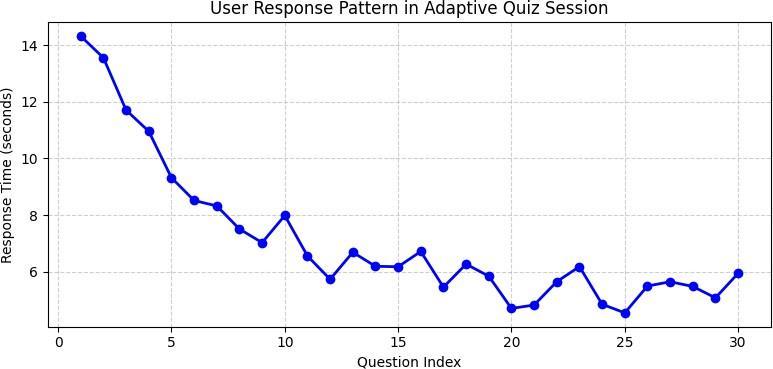
Thefigurerepresentsatypicalinteractionpatternbetween alearnerandtheQuiz-AIsystemduringaquizsession.The initial response peak indicates the user’s first interaction with a generated question, reflecting the cognitive effort required to understand and answer the question. This is followed by variations in response time and accuracy, which stabilize as the quiz progresses and the system adapts the difficulty level based on learner performance. Suchresponsepatternshighlightthedynamicandadaptive nature of the Quiz-AI framework. Key indicators such as response time, correctness, and progression trend are important for identifying learner proficiency, knowledge gaps,andengagementlevels.
International Research Journal of Engineering and Technology (IRJET) e-ISSN: 2395-0056
Volume: 13 Issue: 04 | Apr 2026 www.irjet.net p-ISSN: 2395-0072
Thefigureillustratesatypicaluserresponsepatternduring an adaptive quiz session in the Quiz-AI system. Key characteristics such as initial response time, rate of improvement,fluctuationrange,andstabilizationtrendare derivedfromthisgraphtoevaluatelearnerunderstanding, cognitive load, and engagement level. The high response timeobservedatthebeginningreflectsthelearner’sinitial effort to comprehend newly generated questions, while subsequentvariationsindicatetheadjustmentphaseasthe system adapts question difficulty based on user performance.
3.2 FeatureExtraction andDifficultyAnalysisinQuizAI
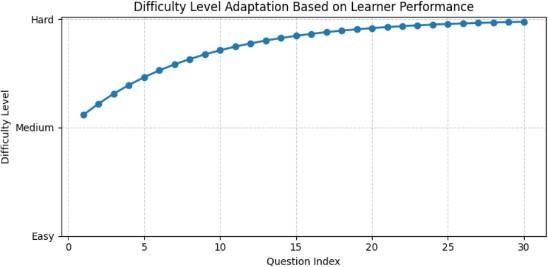
Fig -2:Difficultylevelvariationbasedonextractedlearner interactionfeatures.[2]
Fig. 3.2 shows the variation of question difficulty level acrossaquizsessionderivedfromlearnerinteractiondata. Key features such as response time, answer accuracy, progression rate, and consistency are taken from these interactions to evaluate learner proficiency and question difficulty. The gradual increase in difficulty reflects improved learner performance, while stabilization indicates that the system has identified an appropriate challenge level. These characteristics provide valuable insightintolearnerunderstandingandengagementduring thequiz.
However, differences in learner background knowledge, subjectfamiliarity,attentionspan,andexternaldistractions often make manual difficulty assessment difficult in traditionalquizsystems.InAI-basedlearningframeworks, raw user interaction data is fed directly into adaptive modelsthatautomaticallylearnperformancepatternsand temporal dependencies. This reduces the need for extensivemanualfeatureengineeringandallowsformore accurate difficulty classification and personalized quiz adaptationinreal-worldeducationalenvironments.
3.3 Comparison of Quiz Classification Methods
The table compares the performance of different quiz question classification methods based on three main
parameters: classification accuracy, adaptability, and response time cost. The Convolutional Neural Network (CNN) method shows the best performance, with a classification accuracy of 91.30%, adaptability of 88.90%, and a reduced response time of about 2 seconds. This makes it a strong choice for real-time assessment applications.TheArtificial NeuralNetwork(ANN)method has a similar classification accuracy of 84.50% but lower adaptability at 79.20%, and it takes around 3 seconds, which makes it less practical for highly adaptive quiz systems. The traditional rule-based method has moderate adaptability at 68.40% but the lowest classification accuracyat72.80%.Thisshowsitslimitedeffectivenessfor quiz question classification, even though it has a faster responsetimeoflessthan1second.ThehybridCNN–LSTM method achieves a classification accuracy of 95.40% and adaptability of 93.80%, with a response time of around 3 seconds, but it still outperforms the other methods. In summary, this comparison shows that CNN-based and hybrid models provide higher accuracy and more reliable classification.
Table-1: Resultscomparingquizclassification methods.[2]

AutomatedFeatureExtraction:Deeplearningremoves the need for manual question tagging and rule-based difficultyassignment,whichreduceshumaneffortand improvessystemefficiency.
High Accuracy: Models like CNN, LSTM, and hybrid architectures achieve high classification accuracy in quizdifficultyandlearnerperformanceanalysis.
Scalability:Thesemodelscanhandlelargenumbersof learners and diverse question datasets, making them suitableforonlinelearningplatforms.
Personalized Learning: They enable adaptive quiz delivery by analyzing learner behavior in real time, whichimprovesengagement.
International Research Journal of Engineering and Technology (IRJET) e-ISSN: 2395-0056
Volume: 13 Issue: 04 | Apr 2026 www.irjet.net p-ISSN: 2395-0072
High Data Requirement: Effective training requires largevolumesoflabelededucationaldata,whichcanbe time-consuming.
Computational Cost: Training deep learning models requires powerful hardware such as GPUs and significant memory resources, increasing deployment cost.
Black Box Nature: Limited interpretability makes it difficult for educators to understand model decisions andexplainassessmentoutcomes.
Generalization Limits: Models may not perform well acrossdifferentsubjectsorlearnergroupsunlessthey areretrainedwithrepresentativedata.
ModelBias:Learningmodelsmayreflectbiasespresent in training data, which can affect fairness in question difficultyandlearnerevaluation.
Maintenance Overhead: Regular model updates and performance monitoring are required to maintain accuracy.
ThestudydemonstratesthatapplyingArtificialIntelligence (AI)andDeepLearning(DL)techniquestoquizgeneration and assessment provides an effective solution for personalized and adaptive learning. Traditional quiz systemsrelyheavilyonmanualquestiondesignandstatic evaluation, which limits scalability and learner engagement. In contrast, AI-based models such as Convolutional Neural Networks (CNNs), Recurrent Neural Networks (RNNs), and Long Short-Term Memory (LSTM) networks significantly enhance automated feature extraction, question classification accuracy, and learner performanceanalysis.
Experimental results show that deep learning-based approaches achieve higher classification accuracy and improvedadaptabilitycomparedtoconventionalmethods, making them suitable for real-time educational applications. Despite challenges related to data requirements, computational complexity, and interpretability,theselimitationscanbeaddressedthrough optimized training strategies and explainable AI techniques. Overall, the integration of AI-driven quiz systemsrepresentsashifttowardintelligent,scalable,and learner-centric assessment, offering significant potential for modern digital education platforms. Furthermore, the proposedQuiz-AIframeworkdemonstratesthepotentialof intelligent assessment systems to support continuous learning improvement through data-driven decisionmaking.Byadaptingquestiondifficultyandfeedbackbased onlearnerperformance,thesystemenhancesengagement and knowledge retention. These capabilities highlight the
role of AI in transforming traditional evaluation methods into efficient, adaptive, and learner-focused assessment solutions.
[1] V. Rus and A. C. Graesser, “Automated Question GenerationforEducationalApplications,”AIMagazine, vol.30,no.1,pp.30–42,2009.
[2] P.Laban,T.C.Miller,andJ.Hearst,“QuizDesignTask: Helping Teachers Create Quizzes with Automated Question Generation,” Proceedings of the NAACL, pp. 354–368,2022.
[3] A. K. Bhowmick, S. Das, and P. Mitra, “Automatic Question Generation from Educational Text Using NaturalLanguageProcessing,”SpringerLectureNotes inComputerScience,vol.13738,pp.210–221,2023.
[4] Y.Wang,Z.Chen,andJ.Zhang,“AI-BasedAdaptiveQuiz SystemforPersonalizedLearning,”Proceedingsofthe Educational Data Mining Conference, pp. 145–152, 2023.
[5] M.Delianidi,S.Papadopoulos,andI.Kompatsiaris,“DKPRACTICE: A Personalized Learning Platform Using Artificial Intelligence,” arXiv preprint arXiv:2402.01845,2024.
[6] K.Kurdi,J.Leo,andA.Parsia,“ASystematicReviewof Automatic Question Generation for Educational Purposes,” International Journal of Artificial Intelligence in Education, vol. 30, no. 1, pp. 121–204,2020.
[7] E.Kurdi,H.Leo,J.Parsia,M.Sattler,andA.Al-Emari,“A Systematic Review of Automatic Question Generation for Educational Purposes,” International Journal of Artificial Intelligence in Education, vol. 30, no. 1, pp. 121–204,2020.
[8] S. Afzal and R. Mitkov, “Automatic Generation of Multiple Choice Questions from Text,” Proceedings of the Workshop on Natural Language Processing for Education,pp.12–19,2014.
[9] Z. Liu, X. Wang, and Y. Liu, “Automatic Question Generation for Reading Comprehension Using Transformer-Based Models,” IEEE Access, vol. 9, pp. 112345–112356,2021.
[10]T. Yang, K. Xiong, and J. Zhao, “An Intelligent Online Quiz System Based on Machine Learning and Student Behavior Analysis,” International Journal of Emerging Technologies in Learning, vol. 16, no. 8, pp. 45–58, 2021.
International Research Journal of Engineering and Technology (IRJET) e-ISSN: 2395-0056
[11]A.HeilmanandN.A.Smith,“GoodQuestion!Statistical Ranking for Question Generation,” Proceedings of the North American Chapter of the Association for Computational Linguistics (NAACL), pp. 609–617, 2010.
Volume: 13 Issue: 04 | Apr 2026 www.irjet.net p-ISSN: 2395-0072 © 2026, IRJET | Impact Factor value: 8.315 | ISO 9001:2008