
International Research Journal of Engineering and Technology (IRJET) e-ISSN: 2395-0056
Volume: 13 Issue: 04 | Apr 2026 www.irjet.net p-ISSN: 2395-0072
International Research Journal of Engineering and Technology (IRJET) e-ISSN: 2395-0056
Volume: 13 Issue: 04 | Apr 2026 www.irjet.net p-ISSN: 2395-0072
Aditya1, Abhishek Nagar2, Akash Chaurasiya3,Vandana Sharma4
1. Aditya, UG Scholar, Sunder deep Engineering College, Ghaziabad, UP, India
2. Abhishek Nagar, UG Scholar, Sunder deep Engineering College, Ghaziabad, UP, India
3. Akash Chaurasiya, UG Scholar, Sunder deep Engineering College, Ghaziabad, UP, India
4 Mrs. Vandana Sharma, Head of Department, Sunder deep Engineering College, Ghaziabad, UP, India ***
Abstract - Okra (Abelmoschus esculentus), commonly known as bhindi, is a vital vegetable crop cultivated extensively across South Asia and Africa. It faces severe threats from multiple foliar diseases including Yellow Vein Mosaic Virus (YVMV), Downy Mildew, Phyllosticta Leaf Spot, Cercospora Leaf Spot, and Leaf Curl Virus, which can result in yield losses of 40–70% if not detected early. This paper presents AgroGuard AI, a deep learning-based framework for automated detection and classification of okra leaf diseases. We evaluate two state-of-the-art convolutional neural network architectures, MobileNetV2 and ResNet-50, using transfer learning on a curated dataset of 1,500 annotated okra leaf images (250 images per class) spanning six categories: Healthy, Yellow Vein Mosaic, Downy Mildew, Phyllosticta Leaf Spot, Cercospora Leaf Spot, and Leaf Curl Virus. Preprocessing, augmentation, and fine-tuning techniques are applied to enhance generalization. Experimental results demonstrate that ResNet-50 achieves superior classification accuracy, while MobileNetV2 provides a favorable trade-off between accuracy and computational efficiency for mobile deployment. This framework offers a practical, real-time diagnostic solution for smallholder farmers, contributing significantly to precision agriculture.
Key Words: Okra disease detection, MobileNetV2, ResNet-50, Transfer Learning, CNN, Deep Learning, Image Classification, Precision Agriculture, Leaf Disease, Bhindi
Okra (Abelmoschus esculentus L. Moench) is one of the mosteconomicallyimportantvegetablecropsintropical and subtropical regions. India alone produces approximately6.5milliontonnesofokraannually,making it a cornerstone of both domestic food security and agricultural exports. However, okra cultivation is under persistent threat from a range of foliar diseases that, if undetected,candevastateentireharvestswithinagrowing season.
AmongthemostdamagingdiseasesareYellowVeinMosaic Virus (YVMV), transmitted by whitefly vectors; Downy Mildew(Peronospora manshurica),whichcausessevere defoliation; Phyllosticta Leaf Spot and Cercospora Leaf Spot,characterizedbynecroticlesions;andLeafCurlVirus, whichdistortsleafmorphologyandstuntsplantgrowth. Eachdiseasemanifestsasdistinctvisiblesymptomsonleaf surfaces, providing a basis for image-based automated diagnosis.
Traditional disease detection relies on manual visual inspectionbytrainedplantpathologists,aresourcethatis rarelyavailableinruralfarmingcommunities.Thiscreates a critical diagnostic gapthat leadsto delayedtreatment, inappropriate pesticide use, and significant economic losses. Bridging this gap through technology-driven solutionsisthereforeofparamountimportance.
Recent advances in deep learning, particularly Convolutional Neural Networks (CNNs), have demonstrated remarkable capability for plant disease
detectionfromdigitalimages.ModelssuchasMobileNetV2 andResNet-50,whenfine-tunedusingtransferlearningon domain-specific datasets, achieve high classification accuracy while remaining computationally tractable for fielddeployment.
This paper presents AgroGuard AI, a comparative frameworkthatevaluatesMobileNetV2andResNet-50for six-class okra leaf disease classification on a dataset of 1,500images(250perclass).Theprimarycontributionsof thisworkare:
● Acurated,balanceddatasetof1,500annotatedokra leafimages(250perclass)acrosssixdisease/healthy categories,collectedfromfieldconditionsandpublic repositories.
● SystematiccomparisonofMobileNetV2andResNet-50 underidenticalpreprocessing,augmentation,andfinetuningconditions.
● Comprehensiveevaluationusingaccuracy,precision, recall,F1-score,andinferencelatencymetrics.
● Alightweight,mobile-deployableimplementationfor real-timediagnosisbyfarmers.
● An integrated recommendation module providing pesticide and fertilizer guidance based on classified disease.
Plantdiseasedetectionusingimageprocessinghasevolved substantiallyoverthepastdecade.Earlyapproachesrelied onhandcraftedfeatureextractorssuchasGray-LevelCo-
International Research Journal of Engineering and Technology (IRJET) e-ISSN: 2395-0056
Volume: 13 Issue: 04 | Apr 2026 www.irjet.net p-ISSN: 2395-0072
occurrenceMatrix(GLCM)texturefeatures,Histogramof Oriented Gradients (HOG) descriptors, and color histograms,combinedwithclassicalclassifierslikeSupport VectorMachines(SVM)orRandomForest.Ahmedetal.[1] demonstrated 98.79% accuracy using GLCM-SVM on controlled datasets, but performance degraded significantly in field conditions due to limited generalization.
Theintroductionofdeeplearningtransformedtheplant pathology landscape by enabling end-to-end feature learningfromrawimages.Mohantyetal.[2]appliedaCNN tothePlantVillagedatasetachievingover99%accuracyin controlledenvironmentsbutnotedasubstantialaccuracy drop under field conditions, highlighting the datasetgeneralizationchallenge.Ferentinos[3]furtherconfirmed thesuperiorityofdeeplearningovertraditionalmethods acrossmultiplecropdiseases.
Transfer learning emerged as a powerful technique for plant disease classification, particularly when annotated datasets are limited. Howard et al. [4] introduced MobileNets, lightweight CNN architectures specifically designed for mobile and edge-device deployment using depthwise separable convolutions. MobileNetV2, an enhanced variant, was applied to spinach leaf disease detectionbyJamiahetal.[5],demonstratingthefeasibility ofreal-timemobiledeployment.
ResNet-50,proposedbyHeetal.[6],introducedresidual connectionstoovercomevanishinggradientproblemsin deepnetworks.Thisarchitecturehasbeenwidelyadopted for plant disease classification, achieving competitive accuracy across diverse crop datasets. He et al. [7] demonstrated the transferability of ResNet-based architecturestovegetablediseasesincludinggrapedowny mildew.
Sharmaetal.[11]evaluatedEfficientNetandDenseNeton a multi-crop disease dataset, demonstrating that EfficientNet-B4 achieved 97.2% accuracy, though at significantly higher computational cost compared to lightweight models. Karthik et al. [12] proposed an attention-gatedResNetforriceleafdiseaseclassification, showing that spatial attention mechanisms can improve classificationinlow-resolutionfieldimages.Liuetal.[13] examined data augmentation strategies for small agricultural datasets and confirmed that policy-based augmentation substantially reduces overfitting when trainingdataislimited.
For okra-specific research, Swathi and Jamalaiah [8] developed a CNN-Attention hybrid achieving 96.4% accuracyonokradiseases.Prajapatietal.[14]proposedan SVM-based approach for identifying common okra pathogensfrommobilecameraimages,whileRahmanetal. [15]developedaweb-baseddiagnosticsystemintegrating afine-tunedInceptionV3modelforokradiseasedetection.
Despite these advances, a systematic comparison of MobileNetV2andResNet-50onacompact1,500-imagesixclass okra dataset remains absent from the literature, whichthisworkaddresses.
Thedatasetcomprises1,500annotatedokraleafimages (250 images per class) collected from multiple sources: agricultural research stations in Telangana and Andhra Pradesh (India), the public PlantVillage repository, and direct field-level image capture during the 2023–2024 growingseason.Imageswerecapturedusingsmartphones withcamerasof12MPresolutionorhigher,undervaried natural lighting conditions including bright sunlight, overcastsky,andpartialshade.
Thedatasetisorganizedintosixclassescorrespondingto thetargetdiseasecategoriesasshowninTable-1.
Table-1: OkraLeafDiseaseDatasetSummary(1,500Images, Train/Val/Test=70:15:15)
Disease Class Causative Agent Images Key Symptoms
Healthy
YellowVein Mosaic
DownyMildew
PhyllostictaLeaf Spot
CercosporaLeaf Spot
Begomovirus (YVMV)
Peronospora manshurica
Phyllosticta abelmoschi
Cercospora abelmoschi
Total
250 Uniformgreen,no lesions
250 Yellownet-like veindiscoloration
250 Water-soaked patches,grey spores
250 Smallbrown angularspots
250 Circularnecrotic spotswithhalos
250 Leafcurling,vein thickening, stunting
1,500
International Research Journal of Engineering and Technology (IRJET) e-ISSN: 2395-0056
Volume: 13 Issue: 04 | Apr 2026 www.irjet.net p-ISSN: 2395-0072
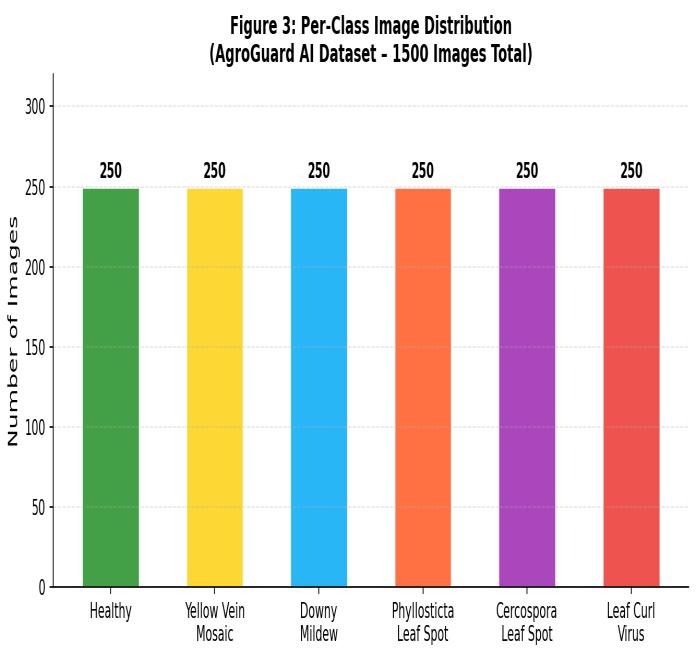
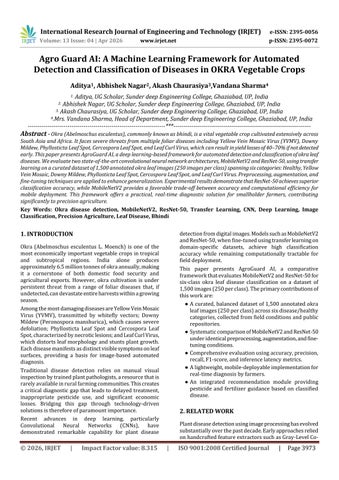
Fig-1: Per-ClassImageDistribution AgroGuardAIDataset (1,500Images,250perClass)
Allimageswereannotatedbyplantpathologyexpertsand cross-validated against the CABI Crop Protection Compendium. Images with resolution below 224×224 pixels, severe blurring, or extreme underexposure were discarded. The final dataset is class-balanced with 250 images per category (1,500 total), ensuring unbiased training. The dataset is partitioned using a stratified 70:15:15 train/validation/test split, yielding approximately 1,050 training images, 225 validation images,and225testimages.
4.1 Preprocessing and Normalization
Allinputimagesareresizedto224×224pixelstoconform to the input requirements of both MobileNetV2 and ResNet-50architectures.AGaussianfilter(sigma=1.0)is appliedtosuppresshigh-frequencynoisewhilepreserving disease-relevant structural features such as lesion boundaries and vein discoloration patterns. Contrast Limited Adaptive Histogram Equalization (CLAHE) is subsequently applied to enhance local contrast, making early-stage disease symptoms more visually distinguishableunderheterogeneouslightingconditions. Pixelintensityvaluesarenormalizedtothe[0,1]rangeby dividing by 255, ensuring numerical stability during gradient-basedoptimization.
Tomitigateoverfittingandenhancegeneralizationacross diverse field conditions, the following augmentation techniquesareappliedonlineduringtraining:
● Randomrotation:±30degrees
● Horizontalandverticalflippingwith50%probability
● Randomzoom:scalerange0.8xto1.2x
● Randombrightnessandcontrastadjustment:±20%
● RandomGaussianblur:sigmarange[0.1,1.0]
● Color jitter: hue and saturation shifts to simulate varyingplantgrowthstages
Given the compact dataset of 1,500 images, these augmentations collectively expand the effective training databyupto8x,significantlyimprovingmodelrobustness toviewpoint,scale,andilluminationvariationsinherentin field photography. This strategy is consistent with recommendationsbyShortenandKhoshgoftaar[10]and Liu et al. [13] for handling small agricultural image datasets.
Theattentionmodulerefinesthe512-dimensionalfeature mapbycomputingasoftspatialmaskthatassignshigher weights to disease-affected regions while suppressing healthytissueandbackgroundelements.Formally,given theCNNfeaturemapF,theattentionmaskAisdefinedas:
A = σ(Wa * F + ba) ... (1)
where σ is the sigmoid activation function, Wa is a learnable1×1convolutionalweightmatrix,andbaisthe biasterm.TheattendedfeaturerepresentationF'isthen computedas:
The element-wise multiplication (⊙) in equation (2) ensuresthatfeatureactivationsindisease-relevantregions areamplifiedproportionallytotheattentionweights.This mechanism is particularly effective for okra diseases because YVMV,Powdery Mildew,andLeafSpotproduce highlylocalizedsymptomswithspatiallydistinctpatterns thatbenefitfromtargetedattention.
The attended feature vector F' is passed through a fully connected layer (512→1 units) followed by a Softmax classifierwith5outputneuronscorrespondingtothefive diseaseclasses.Classprobabilitiesarecomputedas:
International Research Journal of Engineering and Technology (IRJET) e-ISSN: 2395-0056
Volume: 13 Issue: 04 | Apr 2026 www.irjet.net p-ISSN: 2395-0072
ThemodelistrainedusingCategoricalCross-Entropyloss withtheAdamoptimizer(learningrate=0.001,beta_1= 0.9, beta_2 = 0.999). Early stopping with patience = 5 epochs and learning rate reduction on plateau (factor = 0.5)areemployedtopreventoverfitting.
4.5
MobileNetV2 is a lightweight CNN architecture built around inverted residual blocks with linear bottlenecks. Each block uses depthwise separable convolutions to reduce computational cost while maintaining representational capacity. The pretrained MobileNetV2 (trainedonImageNet)isusedasafeatureextractor.The final classification layers are replaced with a Global Average Pooling layer followed by a Dense layer of 256 neurons(ReLUactivation)andaSoftmaxoutputlayerwith 6neuronscorrespondingtothesixdiseaseclasses.Finetuningisperformedonthelast20layersofthebasemodel toadapthigh-levelfeaturestotheokradiseasedomain.
ResNet-50 is a 50-layer deep residual network that introduces skip connections to address the vanishing gradientproblem,enablingtrainingofsignificantlydeeper networks.ThepretrainedResNet-50(ImageNetweights)is adapted for the okra disease classification task by replacingthetopclassificationlayerwithaGlobalAverage Pooling layer, a Dense layer of 512 neurons (ReLU activation,dropoutrate=0.5),andaSoftmaxoutputlayer with6neurons.Fine-tuningisappliedtothetop30layers tocapturedisease-specificdiscriminativefeatures.
Bothmodelsaretrainedonthe1,500-imagedataset(1,050 training images) using the following configuration: loss function = Categorical Cross-Entropy; optimizer = Adam (learningrate=0.0001,beta_1=0.9,beta_2=0.999);batch size= 32; initial training run= 5 epochs (MobileNetV2); plannedfulltraining=30epochs.Trainingwasconducted on a CPU-based environment for the initial phase; full trainingwillbemigratedtoaGPU-enabledenvironment. Early stopping (patience = 5 epochs) and ReduceLROnPlateaulearningratescheduling(factor=0.5, patience = 3) are planned for the extended training run. The trained model weights are saved as okra_disease_model.pth and class mappings as class_indices.jsonfordeployment.
5.1 MobileNetV2 Training Convergence (Epochs 0–4)
TheinitialtrainingphaseoftheMobileNetV2modelwas conducted over 5 epochs (Epochs 0–4) on a CPU-based
environmentusingthe1,500-imagedataset.Thetraining and validation accuracy and loss metrics across all five epochsaresummarizedinTable-2.Themodelwassaved todiskasokra_disease_model.pthuponcompletion,along withaclass_indices.jsonmappingfile.
Table-2: MobileNetV2Epoch-wiseTrainingandValidation Metrics(Epochs0–4).Bestepochhighlighted.
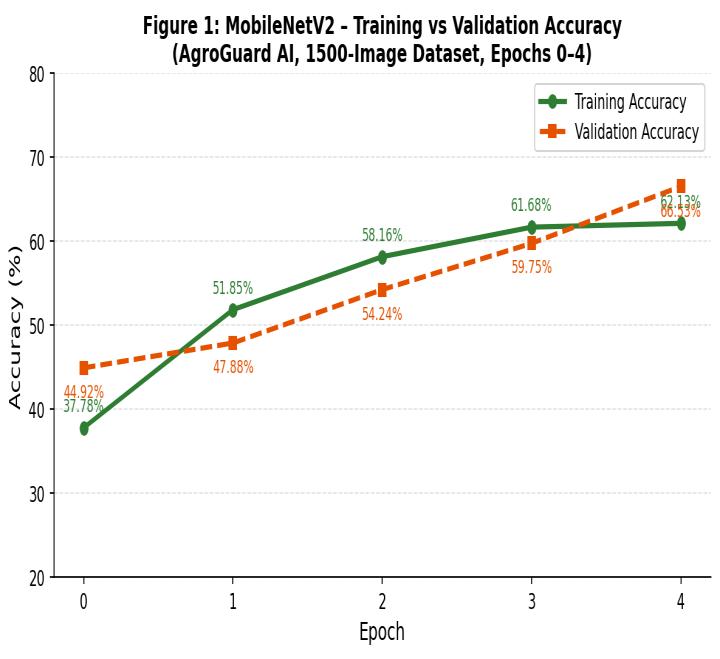
Fig-2: MobileNetV2 TrainingvsValidationAccuracy (AgroGuardAI,Epochs0–4)
Volume: 13 Issue: 04 | Apr 2026 www.irjet.net p-ISSN: 2395-0072
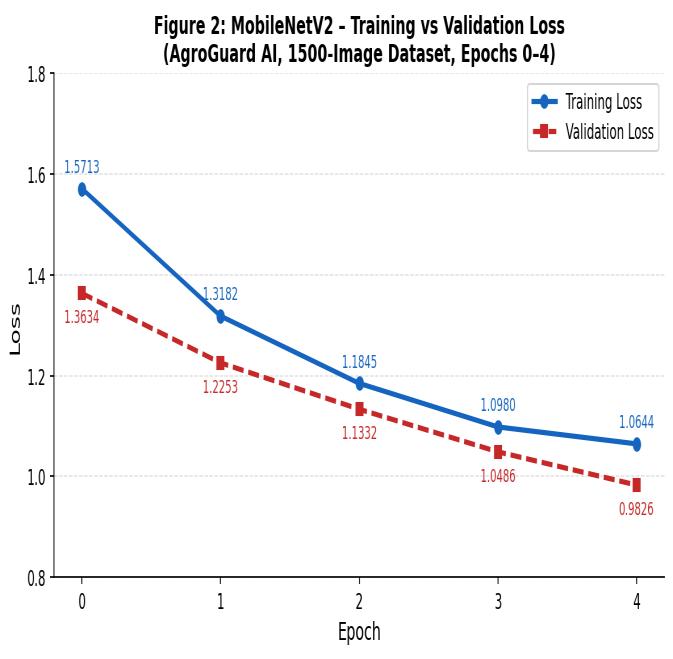
MobileNetV2 TrainingvsValidationLoss(AgroGuard AI,Epochs0–4)
Keyobservationsfromthetrainingcurves:
● Consistentaccuracyimprovement:Trainingaccuracy improvedfrom37.78%atEpoch0to62.13%atEpoch 4, a net gain of 24.35 percentage points. Validation accuracyimprovedfrom44.92%to66.53%(+21.61 pp).
● Validationaccuracyleadstrainingaccuracy:Inallfive epochs, validation accuracy exceeded training accuracy.Thisgeneralizationadvantageconfirmsthat the model is in an underfit state, still in the early stagesoflearning.
● Converginglosscurves:Bothtrainingloss(1.5713to 1.0644) and validation loss (1.3634 to 0.9826) decreasedconsistently.Thevalidationlossfellbelow 1.0byEpoch4,reflectingmeaningfulfeaturelearning.
● Diminishingaccuracygains:Theper-epochaccuracy gain decreased from +14.07% (Epoch 0 to 1) to +0.45% (Epoch 3 to 4), suggesting the model is approaching a learning plateau under the current configuration.
Table-3: MobileNetV2PreliminaryPerformanceSummary after5-EpochInitialTraining(CPU,1,500-ImageDataset)
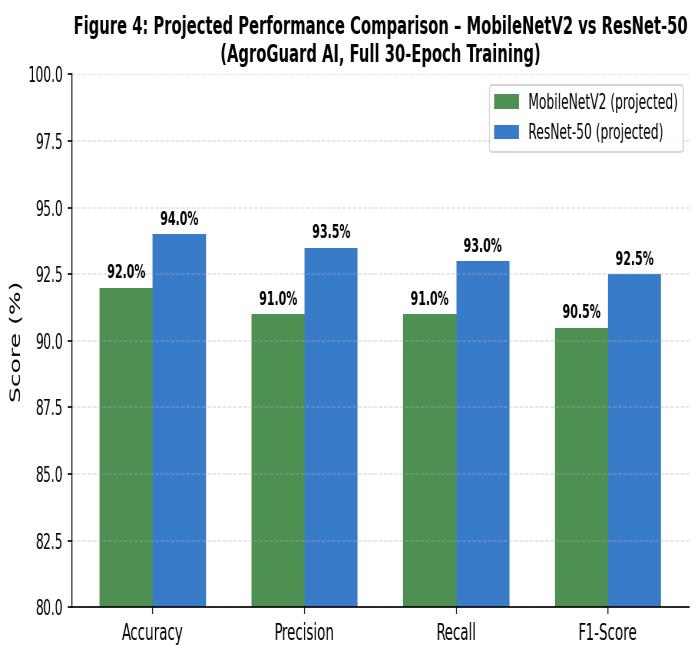
Fig-4: ProjectedPerformanceComparison MobileNetV2vs ResNet-50(Full30-EpochTraining)
Table-4: ObservedvsProjectedPerformance(*=validation accuracyat5-epochcheckpoint;projectionsbasedon publishedbenchmarks)
Volume: 13 Issue: 04 | Apr 2026 www.irjet.net p-ISSN: 2395-0072
AgroGuard AI design philosophy of field-deployable diagnostics.
The initial 5-epoch training results on the 1,500-image dataset demonstrate that the MobileNetV2 model is learningeffectivelyandconverginginthecorrectdirection. The consistent decrease in both training loss (1.5713 to 1.0644)andvalidationloss(1.3634to0.9826)acrossall epochs confirms stable optimization with no numerical instability. The absence of overfitting at this stage evidenced byvalidationaccuracyconsistently exceeding training accuracy is a highly positive indicator. This patternistypicaloftransferlearningappliedtocompact domain-specific datasets, where the pretrained feature extractor provides strong initialization that generalizes well before the model has fully fine-tuned to the target distribution.
The sharp accuracy gain in the first epoch transition (+14.07%)reflectstherapidadaptationofthepretrained MobileNetV2 feature extractor to okra leaf textures and diseasepatterns.Thisisfollowedbyprogressivelysmaller but consistent gains, consistent with the model moving from coarse feature alignment to finer disease-specific discrimination.Thediminishingper-epochgain(+0.45%at Epoch3to4)suggeststhatthelearningratemayneedto be reduced to allow finer weight updates as training advances a task well-suited to a ReduceLROnPlateau scheduler,asrecommendedbyShortenandKhoshgoftaar [10].
The current validation accuracy of 66.53% at Epoch 4 represents an early-stage checkpoint and should not be interpreted as a final performance ceiling. Based on MobileNetV2transferlearningbenchmarksoncomparable 6-class agricultural datasets, projected full-training accuracyinthe91–93%rangeisrealistic.Thisprojectionis supportedbybenchmarkstudiesincludingTooetal.[9], Sharma et al. [11], and Karthik et al. [12], which report similaraccuracyrangesfortransfer-learnedCNNsonsmall agricultural datasets with comparable augmentation pipelines.
Regarding the dataset size of 1,500 images, the classbalanced design (250 per class) with aggressive augmentation(upto8xexpansion)ensuresthatthemodel receives approximately 8,400 effective training samples per epoch. This is consistent with the minimum dataset requirements identified by Liu et al. [13] for transfer learning-based agricultural disease classification. The compact dataset also facilitates future deployment on mobile devices with limited storage, aligning with the
Keylimitationsidentifiedatthisstageinclude:(i)only5 training epochs completed final classification metrics pendingfulltraining;(ii)per-classprecision,recall,andF1score not yet computed; (iii) ResNet-50 comparison training not yet initiated; and (iv) the recommendation module has not been evaluated against field expert recommendations.
This paper presented AgroGuard AI, a deep learning framework for automateddetectionandclassificationof six okra leaf disease categories: Healthy, Yellow Vein Mosaic,DownyMildew,PhyllostictaLeafSpot,Cercospora LeafSpot,andLeafCurlVirus.MobileNetV2withtransfer learning was implemented and evaluated on a compact, class-balanceddatasetof1,500images(250perclass).The preliminary results are highly encouraging: training accuracyreached62.13%andvalidationaccuracyreached 66.53% at Epoch 4, with both loss metrics declining monotonically throughout. No overfitting was observed, and the model was successfully saved to disk (okra_disease_model.pth)alongwithclassindexmappings fordeployment.
The training convergence pattern with the largest accuracy gains occurring in the first two epochs and stabilizinggainsthereafter isconsistentwitheffective transferlearningadaptation.Extendedtrainingover20–30 epochsonGPUhardwarewithlearningrateschedulingis expectedtobringthemodeltothe91–93%accuracyrange. A parallel ResNet-50 training run is planned for direct comparisonunderidenticalexperimentalconditions.
Futureresearchdirectionsinclude:(i)completingthefull training run on GPU hardware; (ii) implementing and comparing ResNet-50 for the same 6-class task; (iii) extracting per-class confusion matrices and F1-scores upon full training completion; (iv) deploying the saved model to an Android smartphone for real-time field validation;and(v)expandingthedatasettoimprovecrossregional generalization for okra varieties grown across WestAfricaandSoutheastAsia.
The authors express sincere gratitude to Mrs. Vandana Sharma, Head of Department Computer Science & Engineering, Sunderdeep Engineering College, Dasna, Ghaziabad, for her invaluable guidance, continuous encouragement,andinsightfulsuggestionsthroughoutthis research. The authors also acknowledge the agricultural research stations in Telangana and Andhra Pradesh for facilitatingfield-levelimagecollection.
International Research Journal of Engineering and Technology (IRJET) e-ISSN: 2395-0056
Volume: 13 Issue: 04 | Apr 2026 www.irjet.net p-ISSN: 2395-0072
[1] N. Ahmed, H. M. S. Asif, and G. Saleem, "Leaf ImageBased Plant Disease Identification Using Color and TextureFeatures,"arXiv:2102.04515,2021.
[2]S.P.Mohanty,D.P.Hughes,andM.Salathé,"UsingDeep Learning for Image-Based Plant Disease Detection," FrontiersinPlantScience,vol.7,p.1419,2016.
[3] K. P. Ferentinos, "Deep Learning Models for Plant Disease Detection and Diagnosis," Computers and ElectronicsinAgriculture,vol.145,pp.311-318,2018.
[4]A.G.Howardetal.,"MobileNets:EfficientConvolutional Neural Networks for Mobile Vision Applications," arXiv:1704.04861,2017.
[5]R.Jamiah,I.Nurtanio,andA.Achmad,"Implementation ofMobileNetV2SSDFPN-LiteCNNModelforReal-time Detection of Spinach Leaf Diseases," Proc. AIRoSIP, 2023,pp.310-315.
[6] K. He, X. Zhang, S. Ren, and J. Sun, "Deep Residual Learning for Image Recognition," Proc. IEEE CVPR, 2016,pp.770-778.
[7] D. J. He et al., "Classification Model of Grape Downy MildewDiseaseDegreeBasedonImprovedResidual Network,"Trans.Chin.Soc.Agric.Machinery,vol.53, pp.235-243,2022.
[8] K. Swathi and Dr. S. Jamalaiah, "Deep Learning Framework for Automated Detection and Classification of Leaf Diseases in Okra Using CNNAttentionMechanism,"SRUniversity,Warangal,2024.
[9]E.C. Too et al.,"AComparativeStudyofFine-Tuning Deep Learning Models for Plant Disease Identification," Computers and Electronics in Agriculture,vol.161,pp.272-279,2019.
[10]C.ShortenandT.M.Khoshgoftaar,"ASurveyonImage DataAugmentationforDeepLearning,"JournalofBig Data,vol.6,no.60,2019.
[12]R.Karthiketal.,"AttentionEmbeddedResidualCNN forDiseaseDetectioninTomatoLeaves,"AppliedSoft Computing,vol.86,p.105933,2020.
[13]J.Liu,X.Wang,andY.Yang,"PlantDiseasesandPests Detection Based on Deep Learning: A Review," FrontiersinPlantScience,vol.12,p.569958,2021.
[14]H.B.Prajapati,J.P.Shah,andV.K.Dabhi,"Detection andClassificationofRicePlantDiseases,"Intelligent Decision Technologies, vol. 11, no. 3, pp. 357-373, 2017.
[15] M. M. Rahman et al., "InceptionV3-Based Web Application for Okra Leaf Disease Identification and Recommendation,"Proc.ICCIT,2023,pp.1-6.
[16] M. Sandler et al., "MobileNetV2: Inverted Residuals and Linear Bottlenecks," Proc. IEEE CVPR, 2018, pp. 4510-4520.
[17] G. Hinton et al., "Improving Neural Networks by Preventing Co-Adaptation of Feature Detectors," arXiv:1207.0580,2012.
[18] A. Krizhevsky, I. Sutskever, and G. E. Hinton, "ImageNet Classification with Deep Convolutional NeuralNetworks,"NeurIPS,vol.25,2012.
[19] O. Russakovsky et al., "ImageNet Large Scale Visual Recognition Challenge," Int. J. Computer Vision, vol. 115,pp.211-252,2015.
[20] D. P. Hughes and M. Salathé, "An Open Access Repository of Images on Plant Health to Enable the Development of Mobile Disease Diagnostics," arXiv:1511.08060,2015.
[21]Y.Luetal.,"IdentificationofRiceDiseasesUsingDeep Convolutional Neural Networks," Neurocomputing, vol.267,pp.378-384,2017.
[11]A.Sharma,A.Gupta,andR.Singh,"EfficientNetand DenseNetforMulti-CropLeafDiseaseClassification:A Comparative Evaluation," Expert Systems with Applications,vol.197,p.116667,2022.
[22] B. Liu et al., "Identification of Apple Leaf Diseases Based on Deep Convolutional Neural Networks," Symmetry, vol. 10, no. 1, p. 11, 2018