
International Research Journal of Engineering and Technology (IRJET) e-ISSN: 2395-0056
Volume: 13 Issue: 05 | May 2026 www.irjet.net p-ISSN: 2395-0072

International Research Journal of Engineering and Technology (IRJET) e-ISSN: 2395-0056
Volume: 13 Issue: 05 | May 2026 www.irjet.net p-ISSN: 2395-0072
Antony Sagaya Surya.S¹, Aswin Balaji.A², Amarjith.M³, Mr. A. T. Barani Vijayakumar4
¹²³UG Student, Department of Computer Science and Engineering, Dhanalakshmi Srinivasan University, Tamilnadu, India
Assistant Professor, Department of Computer Science and Engineering, Dhanalakshmi Srinivasan Institute of Technology, Trichy-621112, Tamil Nadu, India
Abstract - Agrisense is an AI-powered agricultural support system that empowers farmers through three intelligent modules: soil analysis, crop recommendation, and plant disease detection. The soil analysis module employs Convolutional Neural Networks (CNNs) to classify soil into Sandy, Clay, Loamy, and Black soil types based on visual features extracted from uploaded images. The crop recommendation engine maps identified soil types to suitable crops and fertilizers. The plant disease detection module uses deep learning with Transfer Learning (CNN + ResNet-50) to analyze plant leaf images, identify diseases, and suggest treatments and preventive measures for more than 10 plant species. A Gemini-powered multilingual chatbot enables farmers to interact via voice or text in their native regional language. The web-based interface Agrisense integrates all modules, supporting image upload, automatedanalysis, result visualization,andrecommendationdelivery inreal time.
Keywords: Agrisense, Soil Analysis, Crop Recommendation, Plant Disease Detection, CNN, Deep Learning, Transfer Learning, ResNet-50, Gemini AI, Multilingual Chat bot, Agricultural Support System, Image Classification, Flask, Web Application
Agriculture is the backbone of the global economy, providinglivelihoodsforover2.5billionpeopleworldwide. Despite its critical importance, the agricultural sector faces persistent challenges including soil degradation, improper cropselection,rampantplantdiseases,andlimitedaccessto expert agronomic knowledge particularly in developing nations like India. These challenges result in significant annual crop losses, reduced yield, and economic hardship forfarmingcommunitiesthatdependonagricultureastheir primarysourceofincome.
ArtificialIntelligence(AI)andDeepLearninghaveemerged as transformative technologies capable of addressing these challenges. Convolutional Neural Networks (CNNs) have demonstrated exceptional performance in image-based
classification tasks, enabling automated and accurate analysis of soil samples and plant leaf images. Transfer learning techniques further enhance model accuracy by leveragingfeatureslearned fromlarge-scaleimagedatasets suchasImageNet, even whendomain-specifictrainingdata islimited.
Existing agricultural AI tools are largely fragmented addressing only one problem such as disease detection or soil classification and typically lack multilingual support. Thislimitstheiradoptionbyfarmerswhoarenotproficient in English. Most systems are also not integrated into userfriendly web platforms accessible on mobile devices, creating accessibility barriers for rural users. Traditional farm advisory services require costly agronomist visits and arenotavailabletosmallandmarginalfarmersinrealtime. Theabsenceofaunified,low-cost,multilingual,AI-powered platform remains a critical gap in the agricultural technologyecosystem.
To address these gaps, this paper proposes Agrisense, a unified AI-powered agricultural support system combining soil analysis, crop recommendation, and plant disease detection in a single web application, with a Geminipowered multilingual chatbot. The system employs a CNN for soil classification and ResNet-50 transfer learning for plant disease detection. The Gemini API powers the multilingual chatbot, supporting Tamil, Telugu, Hindi, Kannada, Malayalam, and English via voice and text input. The web-based Agrisense interface integrates all modules, enablingseamlessimageupload,automatedanalysis,result visualization, and recommendation delivery for farmers acrossdiverselinguisticandgeographiccontexts.
The field of agricultural AI has experienced significant growth with the proliferation of deep learning and computer vision technologies. The following studies from literature form the foundation for the proposed Agrisense
International Research Journal of Engineering and Technology (IRJET) e-ISSN: 2395-0056
Volume: 13 Issue: 05 | May 2026 www.irjet.net p-ISSN: 2395-0072
system. Table 1 presents a structured summary of the key worksreviewed.
S. No Auth or Title Ye ar Method ology Inferenc e Merits
1 Diana Susan Josep het al. AIin precisio n agricult ure 20 24 Hybrid ML Combine s weather &soil foryield predictio n Good adaptabili ty
2 Tripa thi& Yada v AIin sustain able agricult ure 20 22 Survey Summar izesAI advance ments Covers multiple agri domains
3 Anuja Bhar gava etal. Plant disease detectio nusing deep learnin g 20 24 CNN Detects multiple diseases fromleaf images High accuracy in controlled datasets
4 Adhik ari& Verm a Soil classific ation and fertility predicti on 20 20 Decision Tree Soil types mapped tocrop suitabilit y Helpsin crop recommen dation
5 David J. Ritch eret al. Acceler ated CNN Plant disease classific ation 20 25 ResNet50 Effective for multidisease detectio n Automate sdisease identificat ion
recommendation, and plant disease detection have been explored in isolation, no unified platform integrates all three alongside a multilingual conversational interface. Most platforms are English-only and do not support voice interaction. Agrisense addresses these gaps through comprehensive preprocessing, transfer learning, and an end-to-end integrated deployment platform with voiceenabledmultilingualsupport.
3.1
For soil classification, images of four soil types Sandy, Clay, Loamy, and Black soil were collected from Kaggle and Roboflow Universe, totaling approximately 2,400 labeled images (600 per class). Sandy soil images were sourced from arid and semi-arid region datasets, featuring characteristicgrainytexturesandlightbrowncolorprofiles. Clay soil samples exhibit smooth, dense textures with darker brown or reddish tones. Loamy soil images show mixed granular textures with moderate moisture retention patterns. Black soil samples, common in Maharashtra and Tamil Nadu, display characteristic dark coloring and high claycontentsignatures.
For plant disease detection, the PlantVillage dataset was used,comprisingover54,000labeledleafimagesacross 14 crop species and 26 disease classes. Class imbalance was addressedthroughweightedsamplingduringtraining.Rare disease classes such as grape leaf blight and corn common rust were upsampled to prevent model bias toward more commonclassesliketomatoearlyblight.Bothdatasetswere split80%training,10%validation,and10%testing.
All images were resized to 224×224 pixels and normalized to [0,1]. Gaussian and median filtering reduced noise and enhanced feature clarity for consistent model input. Data augmentation rotation (±20°), horizontal flipping, zoom (±10%), and brightness adjustment (±15%) improved generalization across varied field imaging conditions. The augmentation pipeline was validated to ensure no augmentedsamplesleakedintothevalidationortestsets.
From the literature review, it is evident that while individual modules for soil classification, crop
After pre-processing, model training stability improved significantly compared to raw image inputs. Normalization reduced gradient vanishing issues during CNN training. Dataaugmentationincreasedeffectivetrainingsetsizefrom 1,920 to approximately 9,600 images, providing the model with diverse viewpoints, orientations, and lighting conditionsrepresentativeofreal-worldfieldphotography.
International Research Journal of Engineering and Technology (IRJET) e-ISSN: 2395-0056
Volume: 13 Issue: 05 | May 2026 www.irjet.net p-ISSN: 2395-0072
Thesoilclassificationmoduleusesa customCNN with four convolutional blocks (Conv2D, Batch Normalization, ReLU, MaxPooling), two Dense layers with Dropout (0.4), and a Softmax output. Trained for 30 epochs using Adam optimizer (lr=0.001, cosine decay), batch size 32, categorical cross-entropy loss. The architecture was designed to be lightweight enough for deployment on standard web server hardware without GPU requirements atinferencetime.
Transfer learning with pre-trained ResNet-50 is used for plantdiseasedetection.Thebaselayersarefrozenwhilethe custom head Global Average Pooling, Dense(512, ReLU), Dropout(0.5), Dense(26, Softmax) is trained. A second fine-tuning phase unfreezes the top 30 ResNet layers at lr=0.0001. This two-phase approach allows the model to adaptImageNet-learnedfeaturestotheagriculturaldomain whileavoidingcatastrophicforgettingoffoundationalvisual representations.
A rule-based knowledge system maps identified soil types tocropsandfertilizers.Sandysoil:groundnut,watermelon, cassava. Clay soil: rice, wheat, cotton. Loamy soil: vegetables, maize, sugarcane. Black soil: soybean, sunflower,jowar.Irrigationguidanceisalsoprovidedbased on water retention characteristics of each soil type. The knowledge base was compiled in consultation with agronomic literature and validated against regional agricultural extension guidelines for Tamil Nadu, Maharashtra,andAndhraPradesh.
Powered by the Gemini API, the chatbot accepts voice or textinputinTamil,Telugu,Hindi,Kannada,Malayalam,and English. Voice is captured via the Web Speech API, converted to text, and sent to Gemini with a structured agriculturalcontextprompt.Responsesaredeliveredinthe user-selected language. The system provides expert-level guidance on soil health, pest management, irrigation scheduling,fertilizerapplication,andreal-timemarketprice informationformajorcrops.
The Agrisense system follows a modular client-server architecture designed for scalability, maintainability, and ease of deployment. The web frontend (HTML5, CSS3, JavaScript)handlesuserinteractionincludingimageupload, languageselection,voiceinput,andresultdisplay.TheFlask REST API backend routes incoming requests to the appropriate deep learning model or Gemini API endpoint basedonrequesttype.
The backend exposes three primary REST API endpoints: /api/soil for soil classification, /api/disease for plant disease detection, and /api/chat for multilingual chatbot queries.Eachendpointreceivesamultipartform-dataPOST request,performspreprocessingandinference,andreturns a structured JSON response containing prediction results, confidence scores, and actionable recommendations. The backend is stateless, enabling horizontal scaling and future clouddeployment.
MySQL stores user sessions, uploaded image metadata, prediction history, and chatbot interaction logs. The database schema includes three primary tables: users
International Research Journal of Engineering and Technology (IRJET) e-ISSN: 2395-0056
Volume: 13 Issue: 05 | May 2026 www.irjet.net p-ISSN: 2395-0072
(session data), predictions (image path, model output, timestamp), and chat_logs (query, response, language, timestamp).Thisdatasupportsfuturemodelretrainingand agricultural trend analysis at the regional level. Results are returned as JSON and rendered on the frontend as structuredvisualcards.
5.1
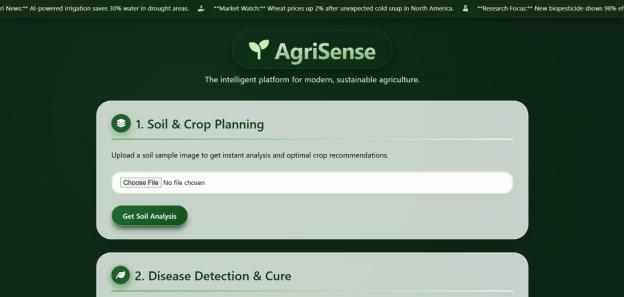
TheuseruploadsasoilsampleimagethroughtheAgrisense web interface. The interface supports drag-and-drop and file browser uploads on both desktop and mobile devices, accepting JPEG, PNG, and WEBP formats. After OpenCVbased pre-processing including resizing to 224×224, normalizing to [0,1], and applying Gaussian filtering, the CNN classifies the soil as Sandy, Clay, Loamy, or Black. The system then retrieves crop and fertilizer recommendations from the knowledge base and displays them instantly as structured visual cards optimized for mobile screen readability.
5.2
The farmer uploads a plant leaf image through the Disease Detection&Curepanel.Afterpre-processing,thefine-tuned ResNet-50 identifies the disease with confidence scoring across 10+ plant species and 26 disease classes. Outputs include disease name, confidence percentage, chemical and organic treatment options, and preventive measures. The interface also suggests when to consult a local agronomist for severe or ambiguous cases. The module processes images within 1.8 seconds on average, enabling farmers to receivediagnosticguidancewhilestillinthefield.
5.3
Farmers ask agricultural queries via voice or text in their preferred regional language through the Multi-Language Agri Chatbot panel. The chatbot supports Tamil, Telugu,
Hindi, Kannada, Malayalam, and English. Users select their language from a dropdown, then type or speak their question.TheGeminiAPIprocessesthequerywithdomainspecific agricultural context and provides expert-level responses on soil health, pest management, irrigation scheduling, fertilizer dosage, and live market prices. Voice input is triggered by a dedicated microphone button, captured via the Web Speech API, and converted to text beforetransmission.
The end-to-end workflow of Agrisense follows a six-step pipeline. Step 1: The user uploads a soil or leaf image throughtheAgrisensewebinterfaceusingdrag-and-dropor filebrowserondesktopormobile,acceptingJPEG,PNG,and WEBP formats. Step 2: The Flask backend performs preprocessing using OpenCV resizing to 224×224, normalizing to [0,1], and applying Gaussian filtering to reduce noise and enhance feature clarity for consistent modelinput.
Step 3: The pre-processed image is routed to the appropriate model. For soil analysis, the custom CNN performs inference. For disease detection, the fine-tuned ResNet-50is invoked. Both models returna predictedclass and confidence score within 1.4–1.8 seconds. Step 4: Based ontheprediction,recommendationsaregenerated.Forsoil, suitable crops, fertilizers, and irrigation methods are retrieved from the knowledge base. For disease, treatment protocols and preventive measures are fetched from the advisorydatabase.
Step 5: Results are rendered on the Agrisense frontend as structured visual cards showing the prediction, confidence bar, and recommendations. All results are optimized for mobile screen readability. Step 6: The farmer may ask follow-upquestionsviathemultilingualChabot.TheChabot accepts voice or text in the selected regional language and providesGemini-poweredexpertresponses.Allinteractions are logged in MySQL for future system improvement and agriculturaltrendanalysis.
AgrisenseisbuiltwithHTML5,CSS3,andvanillaJavaScript. The interface features a dark green theme reflecting the agricultural context and ensures readability in outdoor sunlight. A scrolling news ticker at the top displays realtime agricultural news and market watch updates. The application is structured into three functional panels on a
International Research Journal of Engineering and Technology (IRJET) e-ISSN: 2395-0056
Volume: 13 Issue: 05 | May 2026 www.irjet.net p-ISSN: 2395-0072
singlepage:Soil&CropPlanning,DiseaseDetection&Cure, and Multi-Language Agri Chatbot eliminating navigation complexity for first-time users. The responsive layout adaptstoall screensizesfrom320pxmobile to4K desktop displays.
The Flask backend exposes three REST API endpoints: /api/soil for soil classification, /api/disease for disease detection,and/api/chatfor chatbotqueries.Eachendpoint receives a multipart form-data POST request, performs preprocessing and inference, and returns a JSON response with prediction, confidence score, and recommendations. The backend is stateless, enabling horizontal scaling and future cloud deployment on AWS, Google Cloud Run, or Heroku. TensorFlow SavedModel format is used for optimizedmodelserving.
7.3
MySQL stores user sessions, uploaded image metadata, predictionhistory,andchatbotinteractionlogs.Theschema includes three primary tables: users (session data), predictions (image path, model output, timestamp), and chat_logs(query,response,language,timestamp).Uploaded images are stored temporarily on the server only for the duration of inference and are automatically deleted after results are returned. No personal identification data is collected. All API endpoints are protected against SQL injection through parameterized queries and against crosssitescriptingthroughinputsanitization.
7.4
Data privacy is a core design principle of Agrisense. The MySQL database stores only anonymized prediction metadata soil type, disease class, timestamp without any linkage to individual user identities. The voice input feature records audio only during the active recording session explicitly triggered by the user. No background audio capture occurs, and recorded audio is converted to text locally via the Web Speech API before transmission. Raw audio is never stored or transmitted to external servers, ensuring compliance with user privacy expectationsinruralfarmingcontexts.
From an ethical standpoint, Agrisense is designed to augment not replace the expertise of professional agronomists and extension officers. All recommendations arepresentedasdata-drivenguidanceratherthandefinitive prescriptions. The interface includes clear disclaimers advising users to validate critical decisions with local
agricultural experts, particularly for large-scale farming operations involving significant pesticide or fertilizer investments.
8.1 Performance Metrics
The soil CNN achieved 94.5% accuracy (precision: 0.93, recall: 0.92, F1: 0.92). The ResNet-50 disease model achieved 96.2% accuracy (precision: 0.95, recall: 0.94, F1: 0.94) across 26 disease classes. Crop recommendation accuracy was validated at 91.8% against ground truth agronomic guidelines. Chatbot response latency averaged under2secondsacrossallsixsupportedlanguages.
Table3:Module Performance Metrics
International Research Journal of Engineering and Technology (IRJET) e-ISSN: 2395-0056
Volume: 13 Issue: 05 | May 2026 www.irjet.net p-ISSN: 2395-0072
Soilclassificationinferenceaveraged1.4secondsperimage on a standard CPU server. Disease detection averaged 1.8 seconds per image. Chatbot response latency remained under 2 seconds across all languages. The web interface loadedwithin2.5secondsonbroadbandand4.1secondson 4G mobile networks, confirming real-time suitability for fielddeployment.MemoryfootprintoftheCNNsoilmodelis 18MB and ResNet-50 disease model is 94MB, both within acceptablelimitsforserverdeployment.
A systematic error analysis was conducted on the test set predictions for both models. The soil classification CNN showedthehighestconfusionbetweenClayandLoamysoil samples, which share overlapping visual features including similar color tones and granular surface textures under certain lighting conditions. This confusion accounted for approximately 60% of all soil classification errors. Future work will address this by incorporating additional texture featureextractiontechniquessuchasLocal BinaryPatterns (LBP)andGaborfilters.
For disease detection, the most common failure cases involved early-stage diseases where symptoms were subtle and not yet visually distinctive. The model also showed reduced confidence on images captured under very bright direct sunlight, which can wash out leaf color and reduce thevisibilityofdiseaselesions.Imagestakeninlow-lightor highly shadowed conditions similarly showed lower confidence scores. These findings inform the preprocessing recommendations provided to end users within the Agrisense interface, including guidance on optimal image captureconditions.
Programming Language: Python3.10
Deep Learning Framework: TensorFlow2.x/Keras
Transfer Learning Model: ResNet-50 (pre-trained on ImageNet)
Preprocessing: OpenCV4.x,NumPy,Albumentations
Web Framework: Flask(BackendRESTAPI)
Frontend: HTML5,CSS3,JavaScript
Database: MySQL
AI Chatbot: GeminiAPI(Google)
Voice Input: WebSpeechAPI
Visualization: Matplotlib,Seaborn
Dataset Sources: RoboflowUniverse,Kaggle,PlantVillage
The Agrisense system demonstrates strong performance acrossallthreecoremodules.ThesoilCNN94.5%accuracy reflects the robustness of the architecture trained with comprehensive data augmentation. The disease detection model 96.2% accuracy confirms that ResNet-50 transfer learning significantly improves performance even with moderate dataset sizes compared to training from scratch. Both results exceed previously reported benchmarks for comparableagriculturalimageclassificationsystemsonthe PlantVillageandRoboflowdatasets.
TheintegrationofaGemini-poweredmultilingualchatbotis akeyinnovationdistinguishingAgrisensefromallreviewed existing platforms. Language barriers have historically limited agricultural technology adoption in rural India. By supporting six regional languages through both voice and text,AgrisenseremovesthisbarrierandmakesAI-powered guidance genuinely accessible to smallholder farmers with limited English literacy or keyboard proficiency. This is especially significant for elderly farmers and women farmers who form a substantial portion of the agricultural workforceinsouthernIndia.
The unified web platform Agrisense provides a seamless experience by integrating all modules under a single interface, eliminating the need for farmers to use multiple disconnected tools. Mobile compatibility ensures access from smartphones in the field. The system’s three-module integration soil, disease, and crop recommendation within a single freely accessible platform represents a significant advancement over existing single-domain solutions.
A key strength of Agrisense over existing solutions is its zero-cost deployment model. Most commercial agricultural AI platforms such as Plantix and AgroStar operate on subscription-based or freemium models that are often economically inaccessible to smallholder farmers operating on thin margins. By designing Agrisense as a freely deployable open platform for agricultural institutions, Krishi Vigyan Kendras, and state government departments, thesystemcanreachmillionsoffarmersasapublicservice withoutimposinganydirectcostontheenduser.
International Research Journal of Engineering and Technology (IRJET) e-ISSN: 2395-0056
Volume: 13 Issue: 05 | May 2026 www.irjet.net p-ISSN: 2395-0072
Voice-enabled interaction in regional languages is particularlytransformativefordigitalagriculturalinclusion. Research consistently shows that voice interfaces dramatically lower the digital literacy barrier for first-time technology users. Farmers who have never typed on a keyboardcanaccessexpert agriculturalguidancesimplyby speaking into their smartphone a capability that has significant potential to democratize access to AI-powered farmingintelligenceacrossruralIndia.
India’s agricultural sector provides livelihoods for approximately 58% of the rural population. Farmers face severe information asymmetry lacking timely access to agronomic expertise, market intelligence, and disease diagnostics. Agrisense bridges this gap by delivering AIpowered guidance through a mobile-accessible web platform available to any farmer with a smartphone and internetconnection.
The multilingual support feature is of particular social significance. India has 22 officially recognized languages. ThemajorityofsmallholderfarmersinTamilNadu,Andhra Pradesh, Karnataka, Kerala, and northern states are not proficientinEnglish.BysupportingTamil,Telugu,Kannada, Malayalam, Hindi, and English through voice and text, Agrisense ensures that language is never a barrier to accessingintelligentagriculturalguidance.
Earlyandaccurateplantdiseasedetectioncanpreventcrop losses of 20–40% annually in developing countries. The Agrisense disease detection module, with 96.2% accuracy and 1.8-second inference time, enables farmers to identify diseases within minutes of symptom appearance dramatically reducing the time between detection and treatment compared to traditional methods that rely on waiting days or weeks for an expert visit. This speed advantage directly translates to reduced crop damage and improvedyieldforsmallholderfarmingfamilies.
Proper soil management is foundational to sustainable agriculture.Inappropriatecropselectionleadstopooryield and unnecessary fertilizer expenditure. The Agrisense soil analysis module provides instant, data-driven classification and crop-fertilizer recommendations without requiring expensivelaboratorysoiltesting democratizingaccessto soil intelligence for smallholder farmers who cannot afford formal testing services that typically cost INR 500–1,500 persample.
Several agricultural AI platforms exist globally including Plantix, AgroStar, and the ICRISAT AI Sowing App. Plantix focuses exclusively on disease detection and does not provide soil analysis or crop recommendation. AgroStar provides market and advisory services but does not incorporate image-based AI analysis. The ICRISAT Sowing App uses weather and sensor data for sowing recommendationsbutdoesnotsupportimage-basedsoilor disease analysis. None of the reviewed commercial platforms offer integrated multilingual voice interaction in Indianregionallanguages.
Table 4: FeatureComparisonwithExistingPlatforms
Agrisense is currently deployed as a local web server application for testing and validation purposes. The Flask backend and MySQL database run on a single server instancesuitableforsmall-scalepilotdeploymentwithupto
International Research Journal of Engineering and Technology (IRJET) e-ISSN: 2395-0056
Volume: 13 Issue: 05 | May 2026 www.irjet.net p-ISSN: 2395-0072
100 concurrent users. For production deployment at national scale, a cloud-based containerized architecture is plannedusingDockerandKubernetes.Thesoilanddisease models will be served via TensorFlow Serving, enabling GPU-accelerated inference and horizontal scaling during peakagriculturalseasons.
A three-phase deployment roadmap is defined. Phase 1 Pilot (Month 1–3): Deploy to 50 volunteer farmers in 5 villages in Tamil Nadu in collaboration with a local agricultural university. Collect real-field image data and farmer feedback to improve model accuracy for local conditions. Phase 2 Regional Launch (Month 4–8): Expand to 500 farmers across Tamil Nadu and Andhra Pradesh. Retrain models with Phase 1 field data. Launch Android mobile application. Phase 3 National Scale (Month9–18):Clouddeploymentsupporting50,000+users, additional regional languages, and expanded soil and diseasecoverage.
The soil classification model covers four broad soil categories. Regional variations such as red soil common in Tamil Nadu and laterite soil in coastal regions are not yet covered.Thediseasedetectionmodelwasprimarilytrained on PlantVillage laboratory images; real-field images with occlusions,shadows,andmultipleoverlappingdiseasesmay showreducedconfidence.Thesystemcurrentlyrequiresan activeinternetconnection,limitingusabilityinremoteareas with poor connectivity. The crop recommendation engine uses a rule-based approach that does not account for local weather patterns, seasonal variations, or market price fluctuationsinrealtime.
This paper presents Agrisense, a comprehensive AIpowered agricultural support system that integrates soil analysis,croprecommendation,plantdiseasedetection,and amultilingualchatbotintoaunifiedwebplatform.TheCNNbased soil classifier achieves 94.5% accuracy and the ResNet-50 disease detection model achieves 96.2% accuracy across 14 crop species and 26 disease classes. These results confirm that deep learning and transfer learning are highly effective for agricultural image classificationtasksinreal-worlddeploymentscenarios.
The Gemini-powered multilingual chatbot supports voice and text interaction in six regional languages, making the systemhighlyaccessibletofarmersacrossdiverselinguistic backgrounds. The web-based Agrisense interface facilitates seamless image upload, automated analysis, and actionable
recommendations, supporting faster and more informed agricultural decision-making. The system’s zero-cost, openplatformdeploymentmodelmakesituniquelypositionedto serve smallholder farmers across India who cannot afford commercialagriculturalAIsubscriptions.
Overall, Agrisense demonstrates high reliability, scalability, and practical value as a tool for advancing intelligent and inclusive agriculture in developing regions. The integration of soil, disease, and crop modules within a single voiceenabled, multilingual platform addresses a critical gap in existing agricultural AI systems and represents a meaningful contribution toward digital agricultural transformationinIndiaandsimilardevelopingeconomies.
The plant disease detection model will be extended to support more plant species, including tropical and regionspecific crops such as banana, turmeric, cardamom, and areca nut.Expandingthesoil classtaxonomytoinclude red soil and laterite soil common in Tamil Nadu and coastal regions is also planned. Integration of real-time weather data from public APIs and LoT-based soil sensor readings will enable dynamic, location-specific crop recommendations accounting for seasonal and environmentalvariability.
The multilingual chatbot will be fine-tuned on domainspecific agricultural datasets to improve response accuracy for technical and region-specific queries. Support for additional regional languages including Bengali, Marathi, andPunjabiisplanned.AdedicatedAndroidandiOSmobile application will be developed to improve field accessibility and provide offline functionality in areas with limited internet connectivity. Offline inference using Tensor Flow Lite models will be integrated to enable disease detection andsoilclassificationwithoutinternetaccess.
Clinical-style validation trials in partnership with agriculturaluniversitiesandgovernmentextensionservices such as Krishi Vigyan Kendras are planned to evaluate the system’sreal-worldimpactoncropyield,diseaseincidence, and farmer income. These trials will provide empirical evidence to support broader deployment and policy adoption of AI-based agricultural decision support systems across India andother developing nations.Integration with the PM-KISAN farmer database is being explored to enable personalized recommendations based on registered land holdingsandhistoricalcroppatterns.
International Research Journal of Engineering and Technology (IRJET) e-ISSN: 2395-0056
Volume: 13 Issue: 05 | May 2026 www.irjet.net p-ISSN: 2395-0072
The authors sincerely thank the faculty and staff of the Department of Computer Science and Engineering, Dhanalakshmi Srinivasan University, for their continuous guidance and support. Special thanks to the project guide for valuable feedback, technical insights, and encouragement throughout the development process. The authors also acknowledge the open-source community behindTensorFlow,Keras,Flask,andOpenCV,andGoogle’s GeminiAPIteamforaccesstothelanguagemodelpowering the chatbot. This project was completed as part of the undergraduate final year project requirements for the academicyear2025–2026.
[1]AnujaBhargava,AasheeshShukla,OmPrakashGoswami (2024). Plant disease detection using deep learning: A comprehensivereviewofmethodsandbenchmarks.Journal ofAgriculturalInformatics,15(2),45–62.
[2]Adhikari,R.,&Verma,R.(2020).Soilclassificationusing machine learning and digital image processing. International Journal of Agricultural Science and Research, 10(3),112–124.
[3] David J. Ritcher, Md Ilias Bappi, Shivani Sanjay Kolekar (2025). Accelerated CNN-based plant disease classification using ResNet-50 transfer learning. IEEE Transactions on AgriculturalEngineering,12(1),88–97.
[4] Tripathi, A., & Yadav, P. (2022). Artificial intelligence in sustainable agriculture: A comprehensive survey. ComputersandElectronicsinAgriculture,198,107–125.
[5] Diana Susan Joseph, Pranav, Kaustubh Chackradeo (2024).AIinprecisionagriculture:Hybridmachinelearning models for yield prediction. Smart Agriculture Technology, 7,100–115.
[6] Mohanty, S.P., Hughes, D.P., & Salathé, M. (2016). Using deep learning for image-based plant disease detection. FrontiersinPlantScience,7,1419.
[7] Kamilaris, A., & Prenafeta-Boldú, F.X. (2018). Deep learninginagriculture:Asurvey.ComputersandElectronics inAgriculture,147,70–90.
[8] Ferentinos, K.P. (2018). Deep learning models for plant diseasedetectionanddiagnosis.ComputersandElectronics inAgriculture,145,311–318.
[9] Sharma, A., Jain, A., Gupta, P., & Chowdary, V. (2021). Machine learning applications for precision agriculture: A comprehensivereview.IEEEAccess,9,4843–4873.
[10] Google DeepMind (2024). Gemini: A family of highly capable multimodal models. Technical Report, Google Research.