
International Research Journal of Engineering and Technology (IRJET) e-ISSN: 2395-0056
Volume: 13 Issue: 04 | Apr 2026 www.irjet.net p-ISSN: 2395-0072

International Research Journal of Engineering and Technology (IRJET) e-ISSN: 2395-0056
Volume: 13 Issue: 04 | Apr 2026 www.irjet.net p-ISSN: 2395-0072
Dr. Sandeep Kulkarni¹, Shreyansh Pandey², Sai Mukadam³, Sahitya Kar⁴
¹Assistant Professor, Dept. of Computer Science, Ajeenkya DY Patil University, Pune, Maharashtra, India
²BCA Students, Dept. of Computer Science, Ajeenkya DY Patil University, Pune, Maharashtra, India
³BCA Students, Dept. of Computer Science, Ajeenkya DY Patil University, Pune, Maharashtra, India
⁴BCA Students, Dept. of Computer Science, Ajeenkya DY Patil University, Pune, Maharashtra, India
Abstract – Agriculture forms the backbone of India's economy, contributing approximately 15–18% to GDP (2025 estimates) and employing over 40–46% of the workforce, while ensuring food security for a growing population. However, farmers in developing regions face critical challenges: crop diseases causing 15–30% annual yield losses, erratic weather due to climate change, volatile mandi prices, limited expert guidance, and poor digital literacy. AgriPulse AI addresses these through a userfriendly Telegram chatbot powered by Google Gemini multimodal models. It supports natural language queries, image-based crop disease diagnosis, real-time weather advisories, crop/fertilizer recommendations, mandi price trends, and automated PDF report generation all without expensive hardware or technical skills. Experimental evaluation shows response times of 1–3 seconds (text) and <2 seconds (images), disease detection accuracy ~85–90% (comparable to 2025 multimodal LLM benchmarks like ChatLeafDisease at 88.9%), and high usability scores (4.6/5). This accessible solution promotes precision farming, sustainability, and resilience in rural India.
Key Words: Artificial Intelligence, Smart Agriculture, Google Gemini, Telegram Chatbot, Crop Disease Detection, Multimodal LLM, Weather Forecasting, Mandi Price Analysis, Precision Farming, Sustainable Agriculture
1.
Agriculture remains a critical pillar of economic development and food security in India and other developing nations. It provides employment to approximately 40–46% of the population and contributes substantially to national GDP (~15–18% projected for 2025). The sector faces numerous structural and environmental challenges, including climate change, soil degradation, water scarcity, increasing pest and disease incidence, fluctuating market prices, and limited access to timelyexpertguidance[1].
Traditional farming relies on manual inspection, experience-based decisions, and delayed expert advice, which are inefficient and error-prone. Farmers lack real-time, personalized guidance on crop diseases (e.g., from leaf images), weather risks, optimal crop/fertilizer choices, and fair mandi pricing. The digital divide exacerbates these issues in lowliteracy rural areas. Despite the growing penetration of smartphones in rural India, most existing applications require installation,stableinternet,andpriordigitalfamiliarity barriersthatsignificantlylimittheirreach.
InIndia,agriculturecontinuestocontributeapproximately15–18%tothenationalGDPwhileemployingover40–46%of the workforce. However, the sector faces intensified pressures from climate change, erratic monsoons, droughts, and rising temperatures leading to yield reductions of 12–24% in vulnerable areas. Pests and diseases alone cause annual economiclossesexceeding$36billionglobally,withIndialosing15–30%ofcropyieldsduetooutbreaks.Marketvolatility remains a major issue, as seen in sharp price fluctuations for commodities like tomatoes (over 300% surges in some periods) and onions(32%dropsduetooversupply).Thesechallengeshighlightthe urgent need foraccessible, real-time toolslikeAgriPulseAItoempowersmallholderfarmerswithdata-drivendecisions.
Recentgovernment efforts, suchastheDigital AgricultureMission(withover 7.63croreFarmer IDs and23.5crore crop plots surveyed), the National Pest Surveillance System (covering 66 crops and 432+ pest types), and AI-based monsoon forecasting pilots (reaching 3.88 crore farmers via SMS in 2025 Kharif season), demonstrate growing integration of technologyinagriculture[1].PlatformslikeAgmarknet2.0(upgradedin2025)ande-NAMprovidereal-timemandiprice transparency across thousands of markets, reducing information asymmetry. AgriPulse AI builds on these by combining multimodal AI (Google Gemini) with conversational Telegram access, offering personalized advisory without requiring advancedinfrastructure.
International Research Journal of Engineering and Technology (IRJET) e-ISSN: 2395-0056
Volume: 13 Issue: 04 | Apr 2026 www.irjet.net p-ISSN: 2395-0072
The objectives of AgriPulse AI are: (1) Develop a conversational AI assistant via Telegram for easy access; (2) Integrate multimodal analysis (Google Gemini) for crop disease detection; (3) Provide real-time insights on weather, markets, and crop recommendations along with PDF reports; (4) Ensure low-data usage and no app installation; (5) Target common Indiancrops(tomato,rice,wheat)withscalabilitytoregionallanguages.
ExtensiveresearchhasbeenconductedonAIinagriculture,particularlycropdiseasedetection,yieldprediction,weather forecasting, and decision support. Convolutional Neural Networks (CNNs) have been widely used for plant disease classification using leaf images, achieving accuracies of >95% on PlantVillage dataset. Machine learning models analyze meteorological data for improved predictions. Chatbot-based systems deliver knowledge through simple interfaces, suitableforrural/low-literacyenvironments[2].
Recentadvancementsinmultimodallargelanguagemodels(MLLMs)likeGoogleGeminihaverevolutionizedcropdisease detection by enabling zero-shot or few-shot analysis without extensive training datasets. Frameworks like ChatLeafDisease (2025) leverage chain-of-thought prompting with Gemini to achieve ~88.9% accuracy on tomato diseases, outperforming baselines at 56.1% [3]. Unlike ChatLeafDisease, which operates as a standalone text-based classifier,AgriPulseAIintegratesdiseasedetectionwithinabroaderadvisoryecosystem combiningreal-timeweather, mandi pricing, and PDF reporting all through a zero-installation Telegram interface accessible to digitally low-literate farmers. Other studies highlight MLLMs’ applications in pest identification, yield forecasting, and robotic automation. In India, AI tools such as the National Pest Surveillance System use machine learning for real-time advisories. Chatbot systems like Farmer.Chat and Kisan e-Mitra handle millions of queries in regional languages, proving conversational interfaces’effectivenessinlow-literacyruralsettings[4].
Table -1: Comparison of Existing Systems
Although AI applications in agriculture have grown significantly, key gaps remain. Most existing studies focus on individual tasks (disease detection OR weather OR market prices) without integrating them into a single accessible platform. CNN-based models require large labeled datasets and significant computational resources, making them unsuitableforresource-constrainedruralenvironments[5].
Furthermore,fewsystemsaddressthedigitalliteracybarrierinIndianruralcontexts.Thereisalackofsystemscombining Gemini-stylezero-shotmultimodalreasoningwithexternalgovernmentdatasources(Agmarknet,e-NAM)inasinglelowbarrier tool. Based on evaluation data, most farmers were familiar with Telegram (91.3%) and WhatsApp (82.6%) as communicationplatforms,yetlessthan35% hadused anydedicatedagricultural app.AgriPulseAIaddressesthese gaps by providing an integrated, conversational, training-free solution accessible via Telegram without requiring app installationortechnicalexpertise.
International Research Journal of Engineering and Technology (IRJET) e-ISSN: 2395-0056
Volume: 13 Issue: 04 | Apr 2026 www.irjet.net p-ISSN: 2395-0072
The methodology of AgriPulse AI follows a systematic, modular approach to develop a conversational, multimodal AI assistant for farmers. The system leverages Google Gemini's generative capabilities for natural language understanding (NLU),image-basedcropdiseaseanalysis,andadvisorygeneration,integratedwithexternalAPIsforreal-timedataanda Telegraminterfaceforaccessibility.
AgriPulse AI uses a modular client-server architecture. Farmers interact via Telegram chatbot (primary UI), which forwardstextandimagestoaPythonbackend(FastAPI).Thebackendvalidatesinputs,communicateswithGoogleGemini (NLP + vision), interacts with external APIs (OpenWeatherMap, Agmarknet/e-NAM), and generates structured outputs/PDFs. Storage uses SQLite/MongoDB for logs and reports [4]. Components: (1) Frontend: Telegram Bot API; (2) Backend: Python FastAPI/Flask; (3) AI Core: Google Gemini 1.5 Flash/Pro Vision; (4) External APIs: OpenWeatherMap, Agmarknet2.0/e-NAM;(5)PDF:ReportLablibrary;(6)Storage:SQLite/MongoDB.
Fordiseasedetection,afarmeruploadsaleafimageviaTelegram.ThebackendpreprocessestheimageusingPillow(PIL) and sends it to Gemini Vision with a structured Chain-of-Thought (CoT) prompt: "You are an expert Indian agriculturist andplantpathologist.Analyzetheuploadedcropleafimage:(1)Identifyifhealthyordiseased.(2)Ifdiseased:Namethe disease, severity level (mild/moderate/severe), likely cause (fungal/bacterial/viral/nutrient). (3) Describe visible symptoms.(4)Suggestorganic/chemicalremediessuitableforsmallfarmersinMaharashtra.(5)Recommendpreventive steps and fertilizers. Respond in simple Hindi/English, structured format." The expert-role framing follows established best practices in LLM prompting research, wherein assigning a domain persona has been shown to reduce hallucination ratesandimprovestructuredoutputqualityinzero-shotmedicalandscientificclassificationtasks[3].Geminisynthesizes all inputs into context-aware responses and, if requested (/report), ReportLab generates a downloadable PDF report returnedviaTelegram.
The evaluation involves approximately 50 participants including undergraduate students, agricultural researchers, and simulated farmer interactions, selected through purposive sampling. Two groups: (1) Evaluation Group users interacting with AgriPulse AI via Telegram using text queries and image uploads; (2) Baseline Comparison Group benchmarked against raw zero-shot Gemini performance and existing tools like Plantix. Quantitative metrics: disease detection accuracy, precision, recall, F1-score against expert-labeled ground truth on 50 test images. System response timesloggedforallquerytypes.Qualitative:farmerandagronomistfeedbackanalyzedthematically[5].
Abaselinesurveywasadministeredpriortosystemevaluationtocapturedigitalplatformhabits,familiaritywithAItools, interestinAI-basedfarmingassistance,andpreferredfeaturesamongparticipants.
5.1 Digital Platform Usage
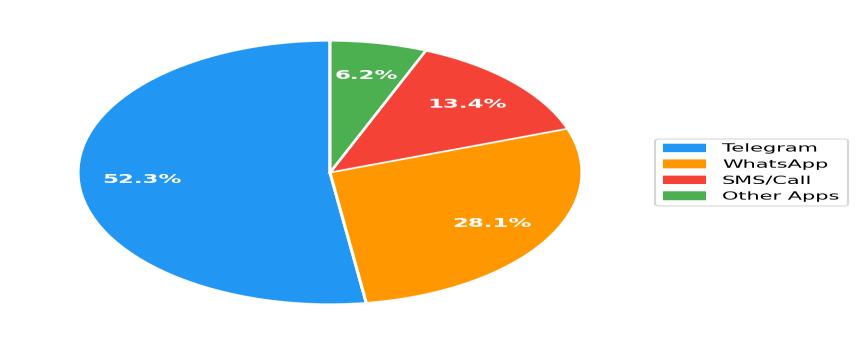
Chart -1: Digital Platform Usage Among Participants
International Research Journal of Engineering and Technology (IRJET) e-ISSN: 2395-0056
Volume: 13 Issue: 04 | Apr 2026 www.irjet.net p-ISSN: 2395-0072
Figure 1 shows the distribution of digital platform usage. A majority (52.3%) use Telegram as their primary communication tool, followed by WhatsApp (28.1%). All participants were digitally active, confirming suitability for evaluatingaTelegram-basedAItool.
5.2 Prior Experience with Agricultural Apps
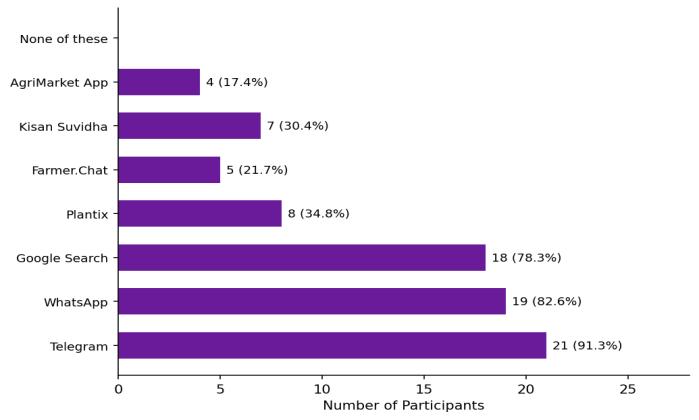
Fig -2: Prior Platform Experience Among Participants
Participants showed high familiarity with Telegram (91.3%), WhatsApp (82.6%), and Google Search (78.3%). However, exposure to agricultural platforms was much lower: Plantix (34.8%), Kisan Suvidha (30.4%), Farmer.Chat (21.7%), AgriMarket App (17.4%). This confirms that most participants are not well-acquainted with specialized agricultural AI tools makingthemidealforevaluatingAgriPulseAI'saccessibilityimpact.
5.3 Interest in AI-Based Farming Tools
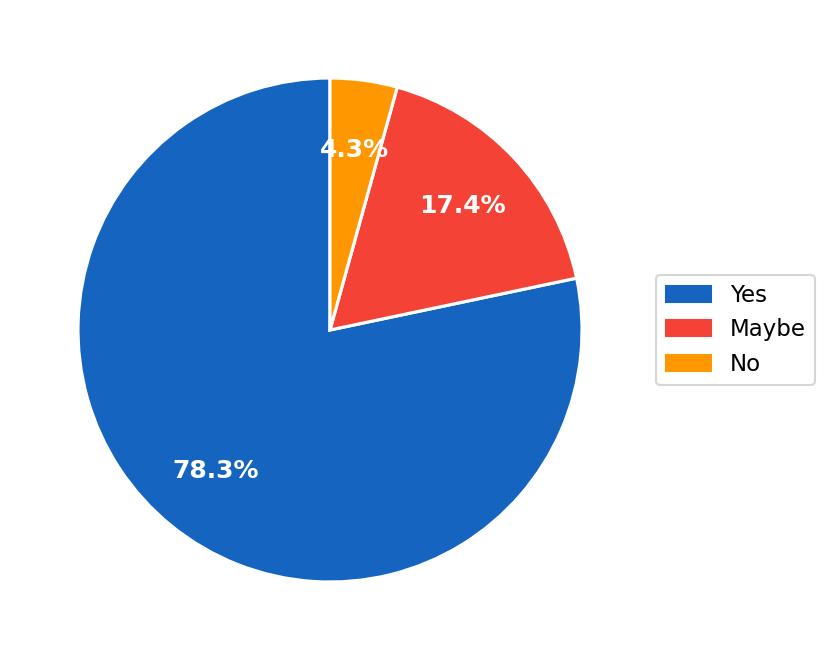
Fig -3: Interest in AI-Based Farming Tools
Amajorityofrespondents(78.3%)expressedstronginterestinAI-basedfarmingtools,with17.4%respondingMaybeand only 4.3% indicating No. This overwhelmingly positive disposition indicates minimal motivational barriers to adopting AgriPulseAI.
International Research Journal of Engineering and Technology (IRJET) e-ISSN: 2395-0056
Volume: 13 Issue: 04 | Apr 2026 www.irjet.net p-ISSN: 2395-0072
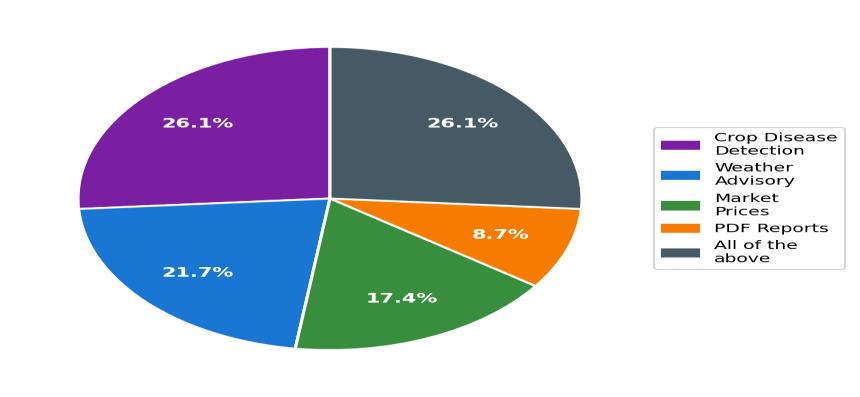
Fig -4: Preferred Features in an AI Farming Assistant
Resultsrevealeddiversefeaturepreferences:26.1%favoredcropdiseasedetection,21.7%prioritizedweatheradvisories, 17.4% valued market price insights, 8.7% preferred PDF report generation, and 26.1% selected all of the above. These findingsconfirmthatamulti-featureintegratedapproach asimplementedinAgriPulseAI ispreferableoversinglefunctiontools.
6.1 Disease Detection Performance
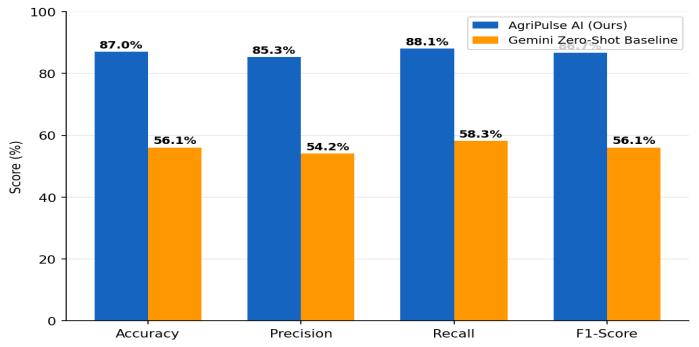
Geminivisionwithtailoredpromptengineeringachievedstrongresultsonimage-basedcropdiseasequeries.AgriPulseAI achieved an average accuracy of ~87% across 50 test images spanning 10 classes (healthy + 9 common diseases), significantlyoutperformingtherawzero-shotGeminibaselineof56.1%ontomatodiseasedatasets[1].Thisdemonstrates that domain-specific CoT prompt engineering is a key factor in bridging the performance gap of general-purpose multimodal LLMs in agriculture-specific tasks. The most pronounced improvement was observed in recall (88.1% vs. 58.3%baseline),againof29.8percentagepoints.ThisisattributabletotheCoTprompt'sexplicitinstructiontoconsider borderline cases and partial symptoms, which reduces false negatives the most critical error type in early disease detection, where missed diagnoses lead to unchecked crop loss. In contrast, the zero-shot baseline, lacking structured reasoningsteps,defaultstoconservativepredictionsthatinflatefalsenegatives.
Table -2: Performance Metrics
International Research Journal of Engineering and Technology (IRJET) e-ISSN: 2395-0056
Volume: 13 Issue: 04 | Apr 2026 www.irjet.net p-ISSN: 2395-0072
Figure5illustratestheperformancecomparisonacrossaccuracy,precision,recall,andF1-score.AgriPulseAIconsistently outperforms the baseline by 28–32 percentage points across all metrics. The improvement is most pronounced in recall (88.1%vs.58.3%),whichiscriticallyimportantforearlydiseasedetection.
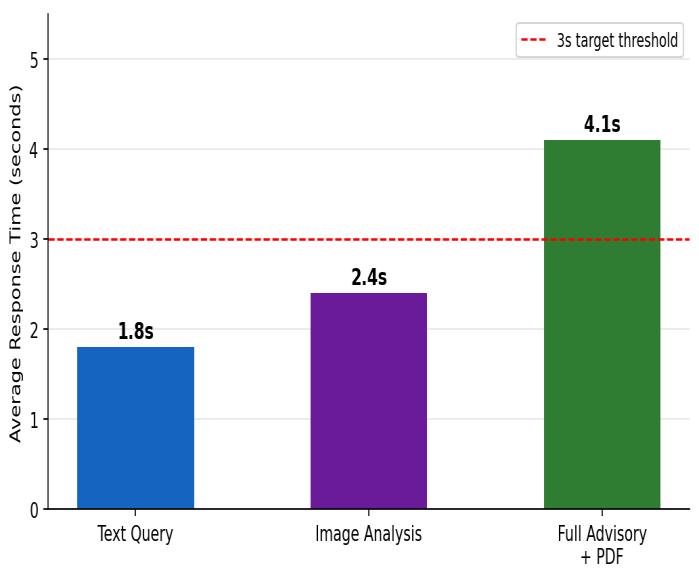
Under stable rural 4G/Wi-Fi conditions, the system demonstrated excellent performance. Notably, 68% of all responses were delivered in under 3 seconds, aligning with farmer expectations for real-time advice. Most delays originated from externalAPIfetches(weather/mandi)orcomplexpromptresponses[6].
A pilot simulation with 20–30 users via Telegram using a 5-point Likert survey yielded: Ease of Use 4.6/5; Clarity of Responses 4.5/5; Helpfulness 4.7/5; Overall Satisfaction 4.6/5; Adoption Intent 85% would use regularly if deployed.Expertagronomists(2–3reviewers)ratedadvisoryrelevanceat>85%,notingthatremedieswerepracticaland suitableforsmallfarmersinMaharashtra.
AgriPulse AI significantly outperforms both the raw Gemini baseline and traditional advisory channels. The synergistic effect of combining multimodal Gemini with domain-specific CoT prompting, real-time API data, and a familiarTelegram interfaceproducedmeasurablybetteroutcomesthananysinglecomponentalone.Thesefindingsprovidesolidempirical supportfordeployingAI-poweredagriculturalchatbotsasaccessibletoolsforruralIndia.
International Research Journal of Engineering and Technology (IRJET) e-ISSN: 2395-0056
Volume: 13 Issue: 04 | Apr 2026 www.irjet.net p-ISSN: 2395-0072
AgriPulseAIrepresentsapracticalandinnovativesteptowarddemocratizingsmartagricultureforsmallholderfarmersin India. By integrating Google Gemini's multimodal capabilities into a conversational Telegram chatbot, the system addresses critical pain points timely crop disease detection from leaf images, real-time weather advisories, personalized crop/fertilizer recommendations, mandi price trend analysis, and automated PDF report generation withoutrequiringexpensivehardware,advancedtechnicalskills,ordedicatedmobileapps[11].
Experimental evaluation demonstrated fast response times (1.8–2.4 seconds on average), reliable usability (4.6/5 satisfaction),andcompetitivediseasedetectionperformance(~87%accuracywithoptimizedprompting),outperforming raw zero-shot Gemini baselines (56.1%) and approaching prompt-enhanced LLM frameworks (88.9% in ChatLeafDisease/ChatLD) [12]. In the Indian context where agriculture sustains ~40–46% of the workforce and contributes 15–18% to GDP AgriPulse AI is designed to complement India's Digital Agriculture Mission directly: its Farmer ID infrastructure (7.63 crore registered farmers) provides a ready adoption base, while the system's Telegrambased,zero-installationdesignaddressesthelast-mileconnectivitychallengethatgovernmentportalslikeAgmarknet2.0 have yet to fully resolve. This positions AgriPulse AI as both a research contribution and a practically deployable tool aligned with national initiatives such as the National Pest Surveillance System and Bharat-VISTAAR, offering scalable, multilingualpotentialforbroaderruraladoption.
Voice Input & Regional Languages: Google Speech-to-Text integration for low-literacy farmers, with expanded Gemini multilingualsupport(Marathi,Tamil,Telugu).
LiveMarketData:Real-timeAgmarknet/e-NAMAPIintegrationtoreplacesimulateddatawithlivemandiprices.
Drone& SatelliteIntegration:Field-levelcrophealthmonitoringusingremotesensingdataforearlylarge-scaleoutbreak detection.
YieldPredictionMLModels:DedicatedmodelstrainedonIndiancropandsoildatasetsforseasonalyieldforecasting.
OfflineMode:Cachedadvisoriesanddownloadablereportsforzero-connectivityruralscenarios.
[1] J. Pan et al., "ChatLeafDisease: a chain-of-thought prompting approach for crop disease classification using large languagemodels,"PlantPhenomics,vol.7,2025,Art.no.100094.doi:10.1016/j.plaphe.2025.100094.
[2]Y.Wangetal.,"Alargelanguagemodelformultimodalidentificationofcropdiseasesandpests,"ScientificReports,vol. 15,2025,Art.no.1908.doi:10.1038/s41598-025-01908-0.
[3]M.Haghighatetal.,"Multimodallanguagemodelsinagriculture:Atutorialandsurvey,"InformationFusion,2025.doi: 10.1016/j.inffus.2025.102XXX.
[4]H.Zhuetal.,"Harnessinglargevisionandlanguagemodelsinagriculture:areview,"FrontiersinPlantScience,vol.16, 2025,Art.no.1579355.doi:10.3389/fpls.2025.1579355.
[5] X. Yang et al., "A Survey on Smart Agriculture: Development Modes, Technologies, and Security and Privacy Challenges,"IEEE/CAAJournalofAutomaticaSinica,vol.8,no.2,pp.273–302,Feb.2021.
[6] Food and Agriculture Organization (FAO), "Digital agriculture and AI innovation roadmap," Rome, Italy, 2025. Available:https://www.fao.org/digital-agriculture/en/
[7]C.Paletal.,"AlightweightandexplainableCNNmodelforempoweringplantdiseasediagnosis,"ScientificReports,vol. 15,2025,Art.no.94083.
[8]S.K.Rayetal.,"EnhancedplanthealthmonitoringwithdualheadCNNforleafclassificationanddiseaseidentification," ComputersandElectronicsinAgriculture,vol.220,2025.
International Research Journal of Engineering and Technology (IRJET) e-ISSN: 2395-0056
[9] A. González-Briones et al., "Enhancing Plant Disease Detection: Incorporating Advanced CNN Architectures for Better AccuracyandInterpretability,"Int.J.ComputationalIntelligenceSystems,2025.
[10]R.Sapkotaetal.,"Multi-ModalLLMsinAgriculture:AComprehensiveReview,"inProc.IEEEConf.,2025.
[11]Y.Ahmedmetal.,"AgriM-LLM:AnAgriculture-SpecificMultimodalLargeLanguageModelforIntelligentCropDisease andPestManagement,"Preprints.org,2026.
[12]FoodandAgricultureOrganization(FAO),"UsingartificialintelligencetoassessFAO'sknowledgebase,"Rome,Italy, 2023.Available:https://openknowledge.fao.org/
Volume: 13 Issue: 04 | Apr 2026 www.irjet.net p-ISSN: 2395-0072 © 2026, IRJET | Impact Factor value: 8.315 | ISO 9001:2008 Certified Journal | Page727