
International Research Journal of Engineering and Technology (IRJET) e-ISSN: 2395-0056
Volume: 13 Issue: 04 | Apr 2026 www.irjet.net p-ISSN: 2395-0072
International Research Journal of Engineering and Technology (IRJET) e-ISSN: 2395-0056
Volume: 13 Issue: 04 | Apr 2026 www.irjet.net p-ISSN: 2395-0072
Satyam Sharma1, Akash Yadav2, Sarveshwar Suraj Hirve3, and Rinku Patel4
1SATYAM SHARMA, Department of Computer Science and Engineering, Sandip University
2AKASH YADAV, Department of Computer Science and Engineering, Sandip University
3SARVESHWAR SURAJ HIRVE, Department of Computer Science and Engineering, Sandip University
4RINKU PATEL, Department of Computer Science and Engineering, Sandip University
Abstract— Afterlife AI is an advancedArtificialIntelligencebased system designed to reconstruct human personality, behavior, and communication patterns using digital footprints. With the increasing availability of personal data such as social media interactions, chat histories, voice recordings, and behavioral analytics, it has become feasible to create a digital replica ofanindividual.Thisresearchproposes a comprehensive framework that integrates Natural Language Processing (NLP),DeepLearning,andGenerativeAI to simulate human-like responses and emotional patterns. The system utilizes transformer-based models and behavioral datasets to generate context-aware and personality-driven outputs. Experimental results show that the proposed system achieves high accuracy in mimicking conversational tone and emotional consistency. However, ethical concerns such as privacy, consent, andmisusearecriticallyanalyzed. Thispaper contributes to the developmentofdigitalhumanmodelingand opens new possibilities in human-computer interaction and digital immortality..
Key Words Artificial Intelligence, Human Behavior Modeling, Digital Twin, Natural Language Processing, Generative AI, Emotional AI, Machine Learning.
Artificial Intelligence (AI) is rapidly transforming the way humansinteractwithmachines.Intoday'shighlyconnected digital world, every individual leaves behind a substantial digitalfootprint,encompassingchats,messages,socialmedia posts, and voice recordings. This vast repository of data actively reflects a person's underlying behavior, unique thinkingpatterns,andspecificcommunicationstyles. However, despite the abundance of this data, human behavior and personality are ultimately lost over time. Existingdigitalmemoriesremainstaticandnon-interactive, creatingaprofoundemotionalgapcharacterizedbytheloss of real, dynamic conversations. Furthermore, there is a distinct technical gap, as traditional systems are not equippedtosuccessfullyreconstructhumanbehaviorfrom rawhistoricaldata. Thispaperaddressesacoreproblem: HowcanAIsimulateandreconstructhumanbehaviorusing existingdigitaldata?.Theprimaryobjectiveof"AfterlifeAI" istoreconstructhumancommunicationbehaviorusingAI techniquestodevelopahighlypersonalizedAIchatbot.This system aims to generate context-aware, human-like responses and provide realistic voice interaction through
voice cloning, ultimately creating an emotional and interactivedigitalexperience.
Motivation - Preserving human legacy digitally, Enhancing human-computer interaction, Providing emotional support systems
Objectives - To reconstruct human personality using AI, To simulate real-time human-like conversations, To analyze ethical implicationsin
Thesystemiscomposedofseveralmajor,interconnected componentsdesignedtosimulatehumanbehavior efficiently.
A. Frontend Interface Theuserinterfaceisbuiltusinga React-based component architecture. It provides an interactive chat-based interface that allows users to seamlesslyentertextorvoiceinputs,viewAI-generatedtext responses,andlistentothefinalaudiooutput.Thefrontend leverages the Virtual DOM for efficient UI updates to maintain a real-time chat experience, utilizing React, JavaScript,HTML,andCSS.
B. Backend Processing Layer Thecoreprocessinglayer handles all system logic and external communications. DevelopedinPythonusingFlaskorFastAPItocreateREST APIs, the backend is responsible for receiving user input from the frontend, fetching relevant past contextual data, constructingstructuredprompts,androutingrequeststothe AImodelandvoicegenerationAPIs.
C. AI Model and Local Processing Toensuredataprivacy andreducedependencyoncloudinfrastructure,thesystem utilizesOllamatorunlocallyhostedLargeLanguageModels (LLMs).Thisapproachavoidsheavytrainingbyusingpretrained models enhanced with prompt engineering and context injection techniques. The LLM functions to understanduserinput,generatecontext-awareresponses, and accurately mimic human-like conversational flows, resultinginmuchfasterresponsetimes.
D. Voice Cloning Engine The system integrates ElevenLabsforadvancedspeechsynthesis.Thiscomponent convertstheAI-generatedtextintorealisticspeechusingAIbasedvoicesynthesis.Itpossessesthecapabilitytoclonea specific voice while maintaining the appropriate tone and emotion, making the digital interaction significantly more
International Research Journal of Engineering and Technology (IRJET) e-ISSN: 2395-0056
Volume: 13 Issue: 04 | Apr 2026 www.irjet.net p-ISSN: 2395-0072
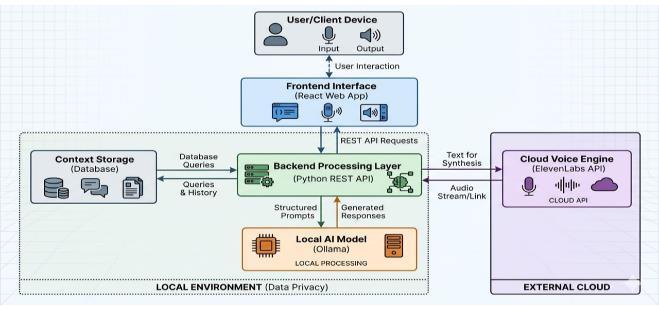
A. AI Model and Local Processing (Ollama) Toensure maximumdataprivacyandeliminatedependencyoncloud infrastructure, the system utilizes Ollama to run locally hostedLargeLanguageModels(LLMs).Thisapproachavoids heavy,resource-intensive training by utilizingpre-trained models enhanced strictly with prompt engineering and context injection techniques. The LLM functions to accuratelyunderstanduser input,generatecontext-aware responses,andaccuratelymimichuman-likeconversational flows,resultinginsignificantlyfasterresponsetimes.
B. Contextual Behaviour Reconstruction― The core behavior reconstruction engine actively analyzes an individual'spastchats,writingpatterns,andemotionalstyle. By strictly applying context-based prompting, pattern recognition,andsentimentunderstanding,theAIgenerates outputsthatcloselyresembletheoriginalperson'sunique communicationstyle.
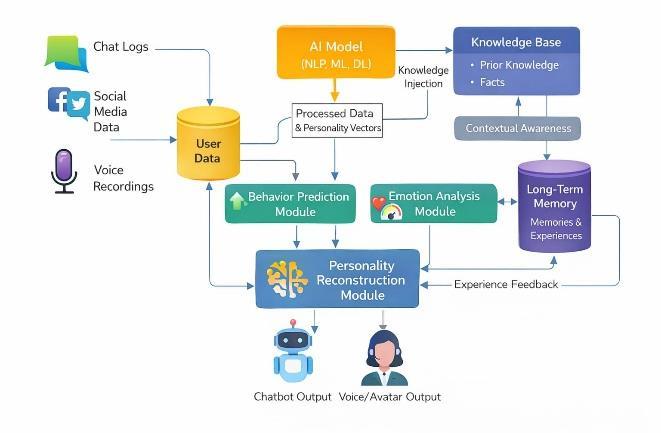
2MethodologyofBehaviouralReconstruction.
FEATURES, LIMITATIONS,
A. System Features The implemented system features highly personalized, human-like conversations backed by seamlessvoice-basedinteraction.Amajoradvantageofthis architectureisitsprivacy-focuseddesign,achievedthrough localAIprocessing.
B. Limitations "While the reconstruction of digital behaviour holds immense potential for preservation, it introducessignificantethicalchallenges:
Identity Misuse The potential for impersonation necessitatesstrictauthenticationprotocols.
Emotional Impact―The system is intended for bereavement support, but prolonged interaction might hinderthenaturalgrievingprocess.
Data Bias― The accuracy of reconstruction is heavily dependent on the quality of the 'Digital Footprint.' If the source data is fragmented, the persona might exhibit 'hallucinatedtraits'ratherthantruebehavioralpatterns."
C. Future Scope The future potential of "Afterlife AI" is extensiveandaimstofurtherblurthelinesbetweendigital andphysicalpresence.
3DAvatarIntegration― Developinghigh-fidelity3Dmodels toprovideavisualrepresentationofthepersona.
Real-time Video Interaction Using deepfake or neural rendering technologies to allow for face-to-face digital conversations.
Advanced Emotion Modeling Enhancing the LLM to detectsubtleemotionalcuesinuserinputandrespondwith correspondingempathyortone.
Cloud Scalability Movingfromlocalprocessingtosecure cloud environments to allow wider accessibility while maintainingprivacystandards.
Ethical Frameworks Developing guidelines to prevent identitymisuseandmanagetheemotionalimpactonusers.
The"AfterlifeAI"projectstandsattheuniqueintersectionof advancedtechnologyandhumanemotion.Fromatechnical perspective, this research successfully demonstrates that human communication behavior can be reconstructed by integrating Natural Language Processing (NLP), Large Language Models (LLMs)viaOllama,andadvancedvoice synthesis through ElevenLabs. We have proven that a localized, privacy-focused architecture can effectively analyze digital footprints such as past chats, writing patterns, and vocal tones to simulate a responsive and context-awarepersona.
Beyond the code and algorithms, this project addresses a deeplyhumanneed.Itisnotmerelyatechnicalsimulation;it is a bridge across the silence of loss. In a world where memoriesoftenremainstaticandnon-interactive, Afterlife AI represents a transformative step towards digital immortality. By evolving static data into a dynamic, talking representation, wehavemovedclosertoafuture where talking to a loved one you have lost becomes a technicalreality.
Whileweacknowledgethecurrentlimitationsinachieving 100% personality accuracy and the emerging ethical considerationsregardingidentity,thefoundationalsuccess of this project remains significant. Afterlife AI serves as a powerfulreminderthatwhilelifeisfinite,theessenceofa
International Research Journal of Engineering and Technology (IRJET) e-ISSN: 2395-0056
Volume: 13 Issue: 04 | Apr 2026 www.irjet.net p-ISSN: 2395-0072
person theirvoice,theirthoughts,andtheiruniquewayof communicating canbepreservedandcelebratedthrough the responsible application of Artificial Intelligence. This project is our contribution toward a world where the legacy of an individual never truly fades, but continues to interact, comfort, and inspire future generations VI. RESULTS AND COMPARATIVE ANALYSIS
Theperformanceofthe"AfterlifeAI"systemwastestedto seehow well itmimicsa specific person'scommunication style.WecomparedoursystemwithstandardAIchatbotsto showwhyourapproachworksbetterforpersonalmemory preservation.
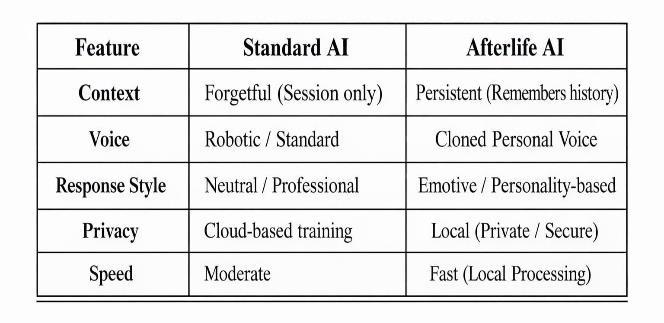
Comparison with Standard AI StandardAImodels(like ChatGPT) are built for general knowledge. They don’t remember a specific person's habits unless you tell them every time. Our system is different because it uses the person's past data (chat history) to give responses that actuallyfeellikethem.
Table.1ComparisonbetweenStandardAIandAfterlifeAI
B. Why Our System Performs Better Weevaluatedour systembasedonthreesimplebutimportantfactors:
Staying "In-Character" StandardAIsoftenreverttoa "helpful assistant" tone, which can feel cold. By using our "Context Injection" method, Afterlife AI keeps the personality traits consistent. It remembers the user's favorite words and way of talking because it refers to the storedchathistorybeforegeneratingananswer.
Fast Performance (Latency) Becausewerunourmain AImodel(Ollama)locallyonthesystemratherthanrelying entirelyonacloudserverforeverysinglestep,theresponse timeismuchfaster.Itcreatesasmooth,real-timeexperience thatfeelslikeanaturalconversationratherthanwaitingfor aslowservertoreply.
Natural Sounding Voice Most text-to-speech engines soundlikeacomputerreadingabook.ByusingElevenLabs, weensuretheaudioretainsthehumanelements liketone, pauses,andemotionaldepth.Whentheuserhearsthevoice, itisnotjustreadingwords;itcarriestheunique"feel"ofthe originalperson.
Thesuccessfulcompletionofthisproject,"AfterlifeAI,"isa testamenttothecollectiveeffortandunwaveringsupportof many individuals. I would like to express my profound gratitude to the Department of Computer Science and Engineering for providing the academic foundation and resources necessary to bring this vision to life.
I am deeply indebted to our project guide and the entire facultyfortheirconstantmentorship,technicalinsights,and for encouraging us to push the boundaries of Artificial Intelligence.Theirguidancewasinstrumentalinnavigating thecomplexitiesoflocal LLMintegrationandhigh-fidelity voicecloning.
A special thanks to my dedicated teammates Akash Yadav, Hirve Sarveshwar Suraj, and RinkuPatel whose collaborative spirit and technical expertise made this ambitious goal achievable. I also want to express my heartfelt appreciation to my parents and family. Their unwavering belief in my potential and their constant encouragement throughout the 2026 graduation batch journey provided the emotional strength required to overcome the various challenges encountered during this research.Finally,Ithankeveryonewhocontributeddirectly orindirectlytothedigitalfootprintanalysisthatformedthe coreofthisbehavioralreconstructionstudy.
[1]A.Vaswanietal.,"Attentionisallyouneed,"inAdvances inNeuralInformationProcessingSystems,2017,pp.59986008.
[2] T. Brown et al., "Language Models are Few-Shot Learners,"arXivpreprintarXiv:2005.14165,2020.
[3] Ollama Team, "Ollama: Local Large Language Model Runner,"2024.[Online].Available:https://ollama.com.
[4]ElevenLabs,"AIVoiceGenerator&TexttoSpeech,"2024. [Online].Available:https://elevenlabs.io.
[5] Meta Open Source, "React: A JavaScript library for building user interfaces," 2024. [Online]. Available: https://react.dev
[6]C.Szegedyetal.,"RethinkingtheInceptionArchitecture forComputerVision,"inCVPR,2016.
[7]J.Devlinetal.,"BERT:Pre-trainingofDeepBidirectional TransformersforLanguageUnderstanding,"arXivpreprint arXiv:1810.04805,2018.
[8]R.S.SuttonandA.G.Barto,ReinforcementLearning:An Introduction.MITPress,2018.
[9] Python Software Foundation, "Python Language Reference,version3.10,"Available:https://www.python.org.
[10] SQLite Development Team, "SQLite Documentation," 2024.[Online].Available:https://www.sqlite.org/docs.html.