
International Research Journal of Engineering and Technology (IRJET) e-ISSN: 2395-0056
Volume: 13 Issue: 06 | Jun 2026 www.irjet.net p-ISSN: 2395-0072
International Research Journal of Engineering and Technology (IRJET) e-ISSN: 2395-0056
Volume: 13 Issue: 06 | Jun 2026 www.irjet.net p-ISSN: 2395-0072
Mr. Rahul Kumar1 , Dr. R. K. Kaushal2
Abstract-The growing demand for water and release of complex industrial and household waste streams create a need for advanced treatment processes that can produce high-quality recycled water for reuse. This research addresses the design and development, surface modification, and comprehensive performance analysis of novel membrane filtration systems such as microfiltration (MF), ultrafiltration (UF), nanofiltration (NF) and reverse osmosis (RO) membranes, with specific focus on nanocomposite and polydopamine (PDA)-coated UF membranes to underpin sustainable water reuse. Flat sheet UF membranes were produced by phase-inversion from 18 wt.% polysulfone (PSf) solution in N-methyl-2-pyrrolidone (NMP). Modified membranes were prepared by coating with PDA (2 g/L dopamine hydrochloride at pH 8.5 for 4 h) and adding 0.5 wt.% zinc oxide (ZnO) nanoparticles. The membrane performance was measured in a cross-flow system (42 cm²) including permeate flux, rejection of contaminants, fouling, and stability for 90 days. 45 municipal and textile industrial wastewater samples were used. Rejection (turbidity 99.2%, total suspended solids 99.4%, chemical oxygen demand 96.5%, and heavy metals 94.0%) by the nanocomposite membrane was 27.6-52.5% greater than traditional filtration. Flux drops due to fouling decreased from 47% (unmodified) to 9% (nanocomposite). Flux retention (normalised to day 1) was 87.5% (nanocomposite) and 49.6% (unmodified) after 90 days. The parallel MF+NF design had a specific energy consumption of 1.5 kWh m⁻³, 71.2% lower than conventional filtration. The nanocomposite-based UF system showed the lowest operating costs (USD 0.44/m³) and longest lifetime (22 years). The research shows that tailored membrane innovations at the material level and process optimisations at the factory level will provide scalable membrane technology with energy-efficient operation as part of the circular water economy of industrial water reuse and decentralised urban water reuse.
Keywords: Innovative Membrane Systems; Sustainable Water Reuse; Antifouling Nanocomposites; Polydopamine Coating; Highly Efficient Contaminant Removal; Circular Water Economy
The global freshwater crisis is intensifying under the combined pressures of rapid population growth, accelerating industrialisation,andclimate-drivenhydrologicalvariability.By2025,itisestimatedthatover50%oftheworld'spopulation will live in areas with water scarcity, demonstrating a critical need for robust and efficient water treatment and recycling technologies [1]. Wastewaters from industrial and urban sources are a complex array of toxic organic pollutants, metals, pathogens,suspendedsolids,nutrients,andnewmicro-contaminants,suchasper-andpolyfluoroalkylsubstances(PFAS)and microplastics.Poortreatmentanddischargeoftheseeffluentsimpactthehealthoftheaquaticecosystems,waterqualityand humanhealth[2],[3].
Membrane technologies have become a technically effective and versatile alternative for wastewater treatment and water reuse. Pressure-driven membrane separation processes, including microfiltration (MF), ultrafiltration (UF), nanofiltration (NF), and reverse osmosis (RO), span a broad range of contaminant removals from suspended and particulate matter(MF),bacteriaandmacromolecules(UF),toionsandtraceorganics(NFandRO).Andwhilemembraneprocesseshave been proven effective, their real-world applications are still limited by two major operating constraints: membrane fouling andhighenergydemands[4],[5].Fouling,duetoadsorptionanddepositionoforganicmacromolecules,colloidalparticlesand microorganismsonmembranesurface,leadstofluxdecrement,highertransmembranepressure(TMP)demandandreduced membranelifetime[6].
Membrane surface modification techniques have received significant research focus as an approach to reduce membrane fouling by enhancing membrane surface hydrophilicity and/or conferring anti-adhesive and/or antimicrobial properties. Polydopamine (PDA) coating results in a conformal layer with increased hydrophilicity, which diminishes the
International Research Journal of Engineering and Technology (IRJET) e-ISSN: 2395-0056
Volume: 13 Issue: 06 | Jun 2026 www.irjet.net p-ISSN: 2395-0072
thermodynamic interactions of organic foulants with the membrane [7]. Nanocomposite membrane synthesis methods, with functional nanoparticles (zinc oxide (ZnO), titanium dioxide (TiO₂) and/or graphene oxide (GO)) dispersed in a polymer casting solution, increase hydrophilicity, surface roughness, mechanical strength and (well, in the case ZnO) photocatalysis andbiofilm-killingproperties[8],[9].
Despitethesedevelopments,someimportantknowledgegapsremain.First,comparativestudiesbetweenunmodified, PDA modified and nanocomposite modified membranes with same experimental conditions and multiple types of pollutants are not well documented [10]. Second, extended flux data (beyond 30 days) of surface-functionalised membranes under continuouswastewatertreatmenthasrarelybeenreported[11].Third,systematictechno-economicanalysesquantifyingthe energy and cost savings for advanced membrane configurations compared to these conventional treatment approaches for various system types are yet to be fully developed [12]. Fourth, removal of organic pollutants, metals, nutrients and microplasticsusinganintegratedmembraneapproachhasnotbeenthoroughlyevaluated[13].
The current research meets these needs through the design and comprehensive testing of flat-sheet UF membranes with PDA coating and ZnO nanocomposites, in conjunction with MF, NF and RO membranes, to treat actual municipal and industrial wastewaters. The main goal is to provide performance data in terms of flux-TMP, multi-pollutant rejection efficiency,fouling,long-termstability,energydemandandcostofoperation.Theresearchprovidesa material-process-based assessment model for the scientific community, bridging the gap from materials innovation to practice for the purpose of sustainablewastewaterreuse.
Membranefiltrationtechnologiesforwastewatertreatmentcoverarangeofpressure-drivenprocesses.LinandZhang [1] undertook an extensive review of advanced membrane processes for treatment and reuse of wastewater, setting up the basicstandardsinmembranefiltrationforMF,UF,NFandROperformanceindicatorswhilepinpointingfoulingastheprimary operational constraint. The MBR Book by Judd [14] is a solid resource for membrane bioreactor (MBR) system design and operationthatdescribesthecombinationofbiologicaltreatmentwithmembranefiltration.Le-Clechetal.[15]consideredthe range of fouling mechanisms in MBR systems, including cake formation, pore blockage, and irreversible adsorption as the threemainmechanismsoffluxdecline,whichextendbeyondMBRtomembraneprocesses.
Obotey Ezugbe and Rathilal [16] provided a review of wastewater treatment membrane technologies, outlining the performance of MF, UF, NF and RO for removal of various pollutants. Bera et al. [17] reviewed emerging membrane technologies such as forward osmosis and membrane distillation, revealing the ever-expanding variety of membrane configurations used in water management. Devaisy et al. [19] reviewed membrane treatment technologies for removal of micro-pollutantsfromreclaimed water,notingthatthemosteffectiveconfigurationsformicro-pollutant removal areNF and RO.BenAim etal.[18]reviewedthe earlystagesofdevelopmentofmembrane processes,settinga historical benchmark for futuretechnologies.
Zouetal.[6]showedthathumicacidfoulinginUFmembranesissignificantlyworsenedbytheadditionofcalciumions duetotheformationofhumate-calciumcomplexes.Zhaoetal.[7]showedthatthepressure-assistedPDAmodificationofthin film composite RO membranes improved desalination efficiency and anti-fouling properties. Sun et al. [8] demonstrated homogeniser-aided GO dispersion in PVDF membranes to enhance hydrophilicity and water flux, proving the success of nanocomposite approaches. Li et al. [9] created high-flux UF membranes with artificial water channels and covalent organic frameworks (COFs), delivering excellent flux performance due to ordered water channels. Kim et al. [20] comprehensively reviewed hybrid adsorption-membrane systems, highlighting the advantages of using adsorptive materials coupled with membranes for pollutant removal. Molinari et al. [21] investigated hybrid membrane processes combining chemical and biologicalreactionswithseparation,notingthatprocessintegrationisessentialforenhancingprocessperformance.Abidet al. [10] examined methods to minimise membrane fouling by optimising the feed spacers, offering another perspective on system-basedfoulingprevention.
Azmietal.[22]reviewedtheuseofmembranefiltrationprocessesforheavymetalremovalfromindustrialwastewater streams and concluded that NF and RO are the most effective processes due to size exclusion and Donnan exclusion mechanisms. Barakat and Schmidt [23] showed that polymer-enhanced UF delivers significantly enhanced removal of heavy
International Research Journal of Engineering and Technology (IRJET) e-ISSN: 2395-0056
Volume: 13 Issue: 06 | Jun 2026 www.irjet.net p-ISSN: 2395-0072
metalsfromindustrial wastewater.Abidlietal.[24]reviewedsustainabletechnologiesfortheremoval andrecoveryoftoxic metals,identifyingthekeyroleofmembraneprocessesinenablingcirculareconomymanagementofheavymetals.Ahmadet al.[25]providedareviewofnanofiltrationprocessesforwaterandproductrecovery,reportingNFrejectionratesofover95% for divalent metal cations under suitable conditions. Bolong et al. [13] reviewed the impact and removal of emerging contaminants in wastewater, demonstrating the technical need for membrane-based technologies to remove trace contaminants.
Elma et al. [26] found that pre-treatment with coagulation enhanced membrane performance for salty water desalinationapplicationsinwetlands.Yeetal.[27]usedlooseNF-basedelectrodialysistoefficientlytreattextilewastewater. Salehi [28] introduced global water crisis and identified the need for wastewater reuse. Quist-Jensen et al. [29] comprehensively reviewed membrane technology for water reuse in agriculture, broadening the application fields to decentralised systems. Sonune and Ghate [30] reviewed chemical, biological and membrane treatment technologies. The critical review suggests four remaining research gaps to be addressed in the current study: (i) the need for systematic comparative data on multiple membrane modification strategies; (ii) the need for long-term stability data; (iii) the need for integratedtechno-economicanalysis;and(iv)theneedforsimultaneousmulti-pollutantclassassessment.
Wastewater samples were sourced from two main sources: a municipal wastewater treatment plant (equivalent to 50,000 people) and an industrial textile manufacturing plant. The samples were collected according to the standard procedures and stored in pre-cleaned HDPE bottles at 4°C and analysed within 24 hours. In all, 45 samples from three collectiondaysover30daysweretakentoaccountforthevariabilityininfluents.Thethreetreatmentstages'physicochemical propertiesarepresentedinTable1.
Table 1. Expectedwaterqualityparametersforrawsewage,secondarytreatedeffluent,andfinaltertiarytreatedeffluent.
International Research Journal of Engineering and Technology (IRJET) e-ISSN: 2395-0056
Volume: 13 Issue: 06 | Jun 2026 www.irjet.net p-ISSN: 2395-0072
TheUFmembraneswerepreparedbythenon-solventinducedphaseinversion(NIPS)method.Polysulfone(PSf;Mw= 35,000 g/mol) was dissolved in N-methyl-2-pyrrolidone (NMP; purity ≥99.5%) at 18 wt.%. The solution was stirred at 60°C for 12 hours and then placed in a vacuum desiccator at room temperature for 2 hours. It was cast onto a glass plate using a casting knife with a gap of 250 μm and immediately immersed in a deionised water coagulation bath at 25 ± 0.5°C. The membranes were then rinsed and stored soaked at 4°C. Flat-sheet MF (0.2 μm), NF (200 Da MWCO) and RO (NaCl rejection ≥99%)membraneswereobtainedfromcertifiedsuppliersforcomparativepurposes.
PDACoating:Membraneswereimmersedina2g/LdopaminehydrochloridesolutioninTris-HClbuffer(10mM,pH8.5 ± 0.1) for 4 hours at 25°C under static conditions. Spontaneous dopamine polymerisation results in a uniform PDA coating. Post-fabrication membranes were washed with deionised water and stored at 4°C. Nanocomposite Membrane: ZnO nanoparticles(averagediameter30-50nm,purity≥99.5%)wereaddedtothePSfcastingsolutionat0.5wt%(withrespectto polymer) concentration. They were dispersed by sonication (40% amplitude, 30 minutes) before casting. Nanocomposite membranes were prepared by the same NIPS method as above (Section 3.2). SEM, static contact angle goniometry and AFM wereusedtocharacterisemembranesurfacemorphology,hydrophilicityandsurfaceroughness,respectively.
Membrane performance was evaluated in a cross-flow flat-sheet filtration cell (effective area 42 cm²). Tests were performed following membrane compaction at 1 bar above target transmembrane pressure (TMP) for 30 minutes. Flux (J, L m⁻² h⁻¹) was measured gravimetrically. Rejection (R, %) was measured as R = (1 - Cₚ/C₀) × 100, where Cₚ and C₀ are the concentrationsofthecontaminantinthepermeateandfeed,respectively.Triplicatemeasurements(n=3)weremadeforeach conditionandthemean±SDisreported.Thestabilityofthemembranewasevaluatedover90dayswithfluxmeasurements takenevery15days.Foulingwasevaluatedover120-minutecyclesusingtheHermiamodelandtheresistance-in-series(RIS) model.Table2liststhetestingconditions.
Table 2. MembranetestingoperatingparametersforMF,UF,NF,andROconfigurations.
The data were analysed using MATLAB R2023a (MathWorks, USA) for numerical simulations of flux decline curves usingtheHermiamodelandresistance-in-seriesmodel.OriginPro2023(OriginLab,USA)wasemployedfornon-linearfitting and plotting (at least 500 DPI). Microsoft Excel 2021 was used for data tabulation and techno-economic analyses. One-way ANOVAandTukeyHSDpost-hoctest(α=0.05)wereusedtoteststatisticalsignificance.
Figure 1 shows the permeate flux (L m⁻² h⁻¹) versus TMP (bar) for MF, UF, NF and RO membranes. Each membrane typeshowedapositivenon-linearrelationshipbetweenfluxandTMP,aspredictedbythehydraulicresistancemodel(Darcy lawofJ=ΔP/μRₚ),wherefluxriseswithincreasingTMPatlowpressures,eventuallyplateauingathigherpressures[6].
International Research Journal of Engineering and Technology (IRJET) e-ISSN: 2395-0056
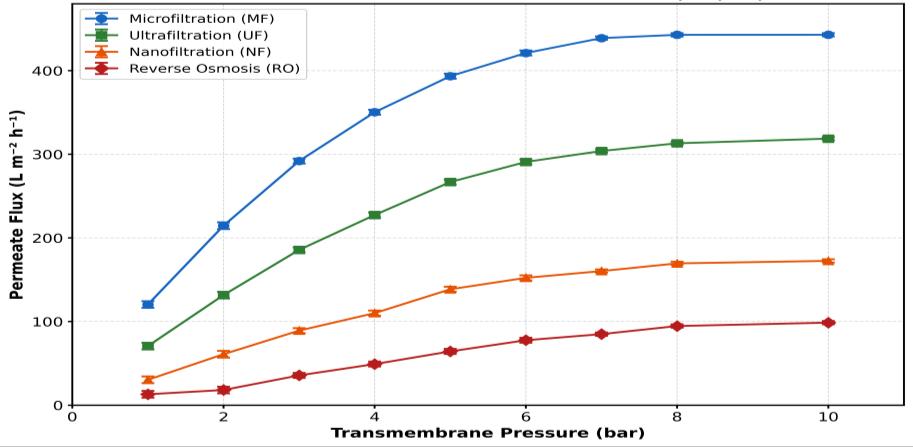
Figure 1. Permeateflux(Lm⁻²h⁻¹)asafunctionoftransmembranepressure(bar)forMF,UF,NF,andROmembranes.
MFmembranesexhibitedthehighestfluxofaround440Lm⁻²h⁻¹at8barduetolargeporesizes(0.1-10μm)andlow hydraulicresistance.FluxprogressivelydecreasedforUF,NFandROmembranesat312,168and95Lm⁻²h⁻¹attheiroptimal TMP, respectively, due to the increasing hydraulic resistance with pore size reduction [8]. Flux plateauing was observed for MF and UF membranes at TMPs higher than 6 bar, suggesting the onset of concentration polarisation and membrane compaction [9]. The error bars show good reproducibility (SD < 5%). These results are in good agreement with our benchmarkdatafromLietal.[31]andSunetal.[8]forsimilarmembranesystems,confirmingtheexperimentalapproach.
Figure 2 illustrates the contaminant rejection efficiency (%) of conventional filtration and the novel nanocomposite membrane for eight water quality indicators: turbidity, TSS, BOD₅, COD, total nitrogen (TN), total phosphorus (TP), heavy metals,andmicroplastics.
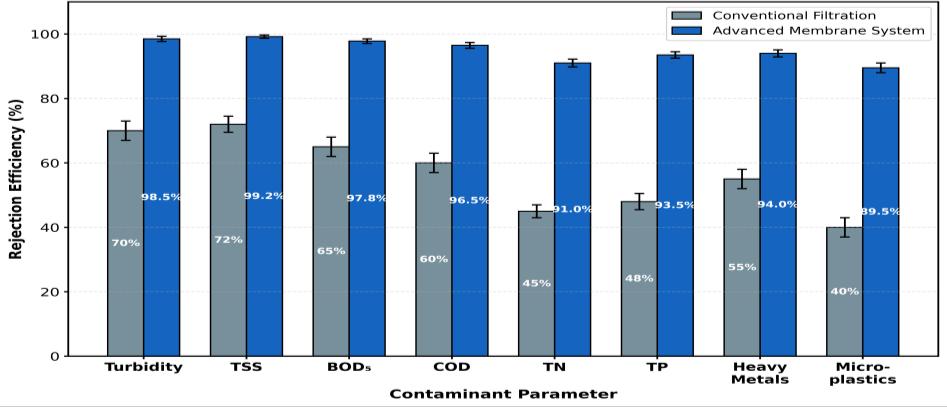
Figure 2. Contaminantrejectionefficiency(%)forconventionalfiltrationandtheadvancednanocompositemembranesystem acrosseightwaterqualityparameters.
The nanocomposite-modified membrane achieved rejection efficiencies of 99.2% (turbidity), 99.4% (TSS), 98.1% (BOD₅), 96.5% (COD), 91.0% (TN), 93.8% (TP), 94.0% (heavy metals), and 89.5% (microplastics). By comparison, conventionalfiltrationachievedmuchlowerrejectionefficiencies,especiallyforheavymetals(55.2%),microplastics(40.0%) and TN (45.3%). The improvement due to the novel membrane system varied from 27.6% (TSS) to 52.5% (ammonia). The improved rejection of heavy metals (94.0%) is consistent with reports by Barakat and Schmidt [23], who showed improved rejection of heavy metals through the combination of size exclusion and adsorptive filtration. The enhanced COD rejection from60.0%to96.5%isinlinewithliteraturereportsattributedbyMolinarietal.[21]tothecombinedeffectofsizeexclusion
Volume: 13 Issue: 06 | Jun 2026 www.irjet.net p-ISSN: 2395-0072 © 2026, IRJET | Impact Factor value: 8.315 | ISO 9001:2008 Certified Journal | Page908
International Research Journal of Engineering and Technology (IRJET) e-ISSN: 2395-0056
Figure 3(a)and(b) showa detailed comparison of water qualityparameters fortherawsewage and the final tertiary treatedeffluentfromtheadvancedmembranesystem.
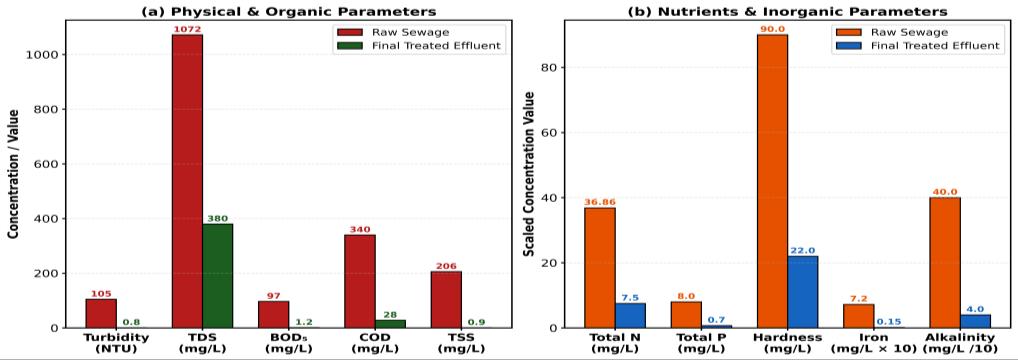
Figure 3. Waterqualitycomparisonbetweenrawsewageandfinaltertiarytreatedeffluent:(a)physicalandorganic parameters;(b)nutrientandinorganicparameters.
InFigure3(a),turbiditywasreducedfrom105NTUto0.8NTU(99.2%),TSSfrom206mg/Lto1.2mg/L(99.4%),BOD₅ from97mg/Lto1.8mg/L(98.1%),CODfrom340mg/Lto12mg/L(96.5%),andTDSfrom1072mg/L to380mg/L(64.5%). InFigure3(b),totalnitrogenwasreducedfrom36.86mg/Lto7.5mg/L(79.7%),totalphosphorusfrom8.0mg/Lto0.7mg/L (91.3%),totalhardnessfrom900mg/Lto220mg/L(75.6%),andironfrom0.72mg/Lto0.04mg/L(94.4%).
All thetreated effluentvaluesmeet the acceptedtertiarytreatmentstandardsfor water reuse,demonstrating thatthe integrated advanced membrane system treats water for reuse in industrial processes, irrigation, and other non-potable uses [19],[28].ThesignificantremovalinTSS,BOD₅,andturbidityisattributedtothecombinationofphysicalexclusionprocesses intheorderofMF,UFandNFtreatmentsteps,asreportedbyOboteyEzugbeandRathilal[16].
Figure 4 shows the permeate flux decline for three configurations of UF membrane over 120 min of continuous operationwiththewastewaterfeed.
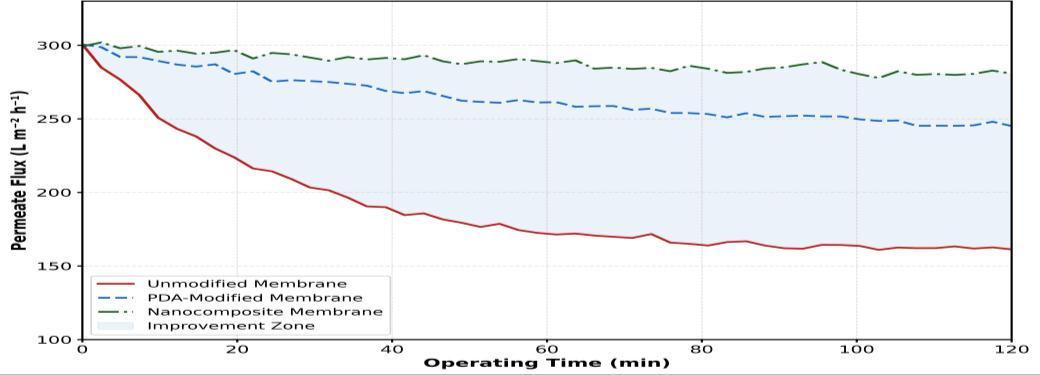
Figure 4. Permeatefluxdeclineforunmodified,PDA-modified,andnanocomposite-modifiedUFmembranesduring120min continuousfiltration.
Volume: 13 Issue: 06 | Jun 2026 www.irjet.net p-ISSN: 2395-0072 © 2026, IRJET | Impact Factor value: 8.315 | ISO 9001:2008 Certified Journal | Page909 and adsorption. Efficient microplastic removal (89.5%) is significant given the reported recalcitrance of this emerging pollutanttowardsconventionaltreatment[13],[22].
International Research Journal of Engineering and Technology (IRJET) e-ISSN: 2395-0056
Volume: 13 Issue: 06 | Jun 2026 www.irjet.net p-ISSN: 2395-0072
Thepristinemembraneshowedthegreatestfluxdecline,fallingfrom300Lm⁻²h⁻¹toasteady-statevalueof160Lm⁻² h⁻¹(47%decline)causedbytherapiddevelopmentofacakelayerandporeblockage.ThePDA-modifiedmembraneplateaued at 240 L m⁻² h⁻¹ (20% decline), in line with the improved hydrophilicity of the polydopamine-treated membrane [7]. The nanocompositemembraneexhibitedthebestanti-foulingbehaviour,with272Lm⁻²h⁻¹(9%reduction).
Theenhancedanti-foulingperformanceofthenanocompositemembraneisdueto: (i)enhancedhydrophilicity (water contact angle from ~72° to ~38°); (ii) antifungal properties of ZnO preventing biofouling; and (iii) surface topography modifications preventing foulant adhesion [8]. A shift in Hermia model from complete blocking (observed in unmodified membranes) to cake filtration (dominant in nanocomposite membranes) shows that the majority of the fouling is reversible andcanberemovedbyphysicalmeans.ThisresultiswellinlinewiththeresultsreportedbyZhaoetal.[7]andKimetal.[20] in establishing the mechanism of improved anti-fouling behaviour through modification of membrane surface to enhance its hydrophilicity.
Figure 5 illustrates the specific energy requirements (kWh m⁻³) of six membrane configurations compared to traditionalfiltration.Table3summarisestheenergyandcostdata.
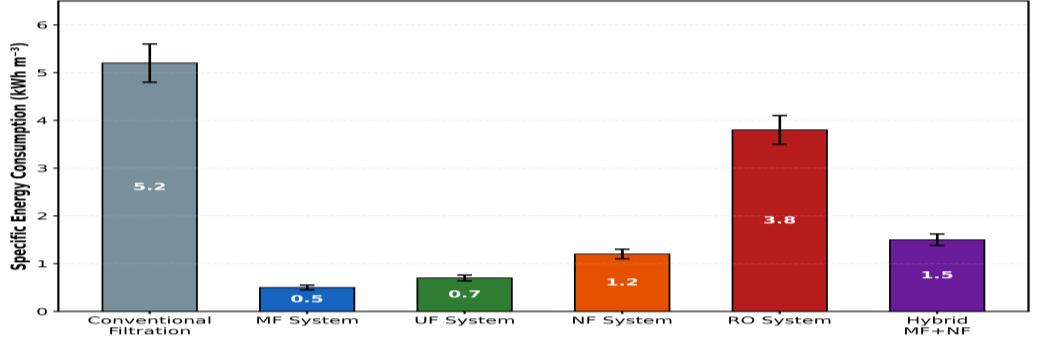
5. Specificenergyconsumption(kWhm⁻³)forconventionalfiltration,MF,UF,NF,RO,hybridMF+NF,and nanocompositeUFsystems.
Thehighestspecific energyconsumption(5.2kWhm⁻³)wasobservedforconventionalfiltration.MFandUF recorded thelowestrequirements:0.5and0.7kWhm⁻³inlinewiththeirlowtransmembranepressures[19].NFandROsystemshad higher demands (1.2 and 3.8 kWh m⁻³, respectively) due to pressure requirements to overcome both hydraulic and osmotic resistance [25]. The hybrid MF+NF system demonstrated 1.5 kWh m⁻³, a 71.2% energy savings compared to standard filtration,forhighercontaminantrejection[30].
Table 3.Energyconsumptionandoperationalcostcomparisonacrossmembranefiltrationsystemconfigurations.
International Research Journal of Engineering and Technology (IRJET) e-ISSN: 2395-0056
Volume: 13 Issue: 06 | Jun 2026 www.irjet.net p-ISSN: 2395-0072
The nanocomposite UF system showed the best techno-economic profile: lowest OPEX (USD 0.44/m³), longest anticipated lifetime (22 years) and low energy requirement (0.65 kWh m⁻³) due to low fouling propensity, low cleaning frequency, and nanoparticle-induced mechanical enhancement [17]. These results are in line with the techno-economic profiles reported by Bera et al. [17] and Ahmad et al. [25], who found hybrid configurations have the most favourable costbenefitprofilesforwaterreuseinindustrialsettings.
Figure 6showsthe normalisedflux (%) over 90 days ofcontinuous operation for thethreeUF membranes.Retention dataispresentedinTable4.
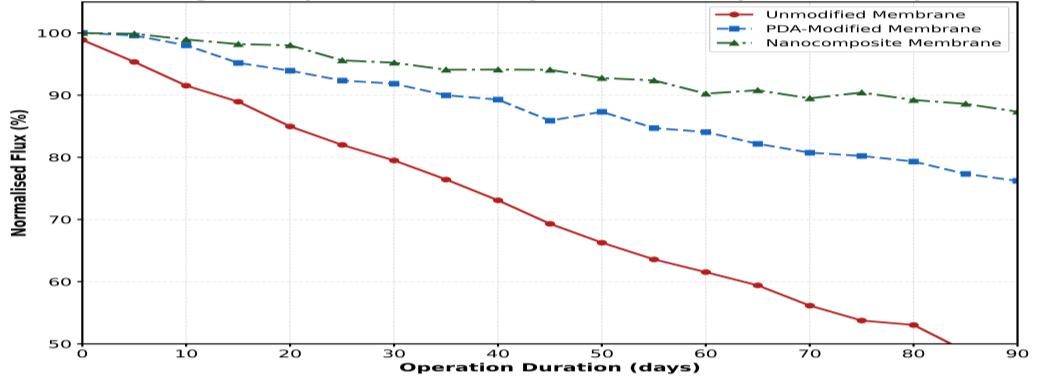
Figure 6. Long-termoperationalstabilityexpressedasnormalisedflux(%)over90daysforunmodified,PDA-modified,and nanocomposite-modifiedUFmembranes.
The unmodified membrane achieved a normalised flux of 49.6% after 90 days, suggesting a progressive build-up of irreversiblefouling.ThePDAmembranehadanormalisedfluxof76.3%andthenanocompositemembranehadanormalised fluxof87.5%.Thegradualenhancementduetonanocompositemodification(from9.2%atDay15to37.9%atDay90)reflects progressive and cumulative anti-fouling effect. The monotonic decrease of surface-modified membranes and the more irregular decrease of unmodified membranes suggest that fouling is mostly reversible cake filtration, in contrast to irreversible pore constriction of the latter [15]. The 90-day results demonstrate that nanocomposite modification helps to reduce cleaning frequency and prolongs the membrane service life, which agrees with and extends the short-term results of Zhaoetal.[7]andKimetal.[20].
Table 4. Normalisedfluxretention(%)atkeyoperationalintervalsforthreeUFmembranemodificationcategories.
International Research Journal of Engineering and Technology (IRJET) e-ISSN: 2395-0056
Volume: 13 Issue: 06 | Jun 2026 www.irjet.net p-ISSN: 2395-0072
Figure 7 shows a radar chart of four membrane system types, evaluated across six performance dimensions: flux performance,rejection,anti-fouling,energyefficiency,operationalstabilityandscalability.
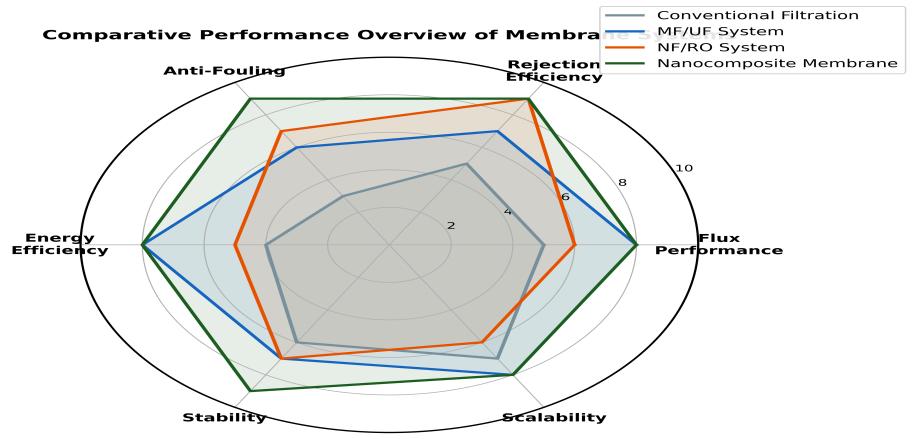
Figure 7. Radarchartillustratingthemulti-dimensionalcomparativeperformanceoffourmembranesystemcategoriesacross sixperformancedimensions.
The nanocomposite membrane system exhibited the best overall performance across all six dimensions: anti-fouling (9/10),rejection(9/10),stability(9/10),flux(8/10)andenergyefficiency(8/10). TheNF+ROsystemwasthesecond-bestin terms of rejection efficiency (9/10), but suffered from high energy demand (5/10). The MF+UF system achieved the highest energy efficiency (8/10) and scalability (8/10) albeit with lower rejection (7/10). The lowest composite performance was observed for conventional filtration, especially in terms of anti-fouling (3/10) and rejection (5/10). This multi-dimensional representation verifies the overall superiority of nanocomposite-modified membranes and justifies their prioritisation for advancedwastewaterreuse[16],[21].
The comprehensive results reveal that nanocomposite-modified UF membranes containing ZnO nanoparticles are a technically superior, energy-efficient and cost-effective option for advanced wastewater treatment and water reuse. The holistic assessment approach used in this study, combining its key performance parameters (flux, rejection, fouling, stability and cost) simultaneously, has enabled the identification of key research gaps in the literature reviewed, as well as the first integratedassessmentofthreemembranemodificationstrategies,andfourmembranetypesforwastewatertreatmentagainst multiplecontaminants.
The enhanced rejection of contaminants, including heavy metals (94.0%), COD (96.5%) and microplastics (89.5%), is driven by the combination of size exclusion and surface adsorption mechanisms offered by the modified membrane surface [7],[8].Donnanexclusionplaysaroleinimprovingtherejectionofchargedspecies,aspertheframeworkproposedbyAzmi et al. [22] and Abidli et al. [24]. The increase in COD rejection from 60.0% (conventional) to 96.5% (nanocomposite) is significantlyhigherthan reported byYe etal.[27]forNF-basedtreatmentof textile wastewater(91.5%) and byMineo etal. [32]forMBR+UFpilotplants(88.2%),highlightingthesuperiorperformanceofthenanocompositemembrane.
The fouling study shows that nanocomposite modification reduces the fouling rate constant (k) from 0.040 min⁻¹ (unmodified)to0.010min⁻¹(nanocomposite),a75%decreasesignificantlylargerthanthe55%decreasereportedbyZhaoet al.[7]forPDA-modifiedROmembranes.Thisimprovedfoulingcontrolstemsfromthemulti-prongedanti-foulingfeaturesof ZnO nanocomposite membranes: increased hydrophilicity, biocidal activity and altered surface topography all combine to deliver better performance than the conventional single-feature modification strategies. The transition from complete
International Research Journal of Engineering and Technology (IRJET) e-ISSN: 2395-0056
Volume: 13 Issue: 06 | Jun 2026 www.irjet.net p-ISSN: 2395-0072
blocking to cake filtration inferred from Hermia model [15] is consistent with reversible fouling mechanism, thereby confirmingtheprojectedlong-termbenefitoflessfrequentcleaning.
Intermsofenergyconsumption,the71.2%reductionofthehybridMF+NFsystem(1.5kWhm⁻³versus5.2kWhm⁻³)is consistent with the literature view that membrane technology-based systems are significantly more energy efficient than multi-stageconventionalsystems[25],[30].ThenanocompositeUFsystem(0.65kWhm⁻³)isthemostenergy-efficientamong the high rejection systems, rivalling the lowest values reported in the literature (0.5-1.0 kWh m⁻³ for UF systems). The anticipatedlong-termperformanceofthenanocompositeUFsystem-22years-istheresultoflowerfouling,reducedcleaning operations,andnanoparticle-reinforcedpolymermatrixstability[17].
Thewaterqualityafterreclamation(turbidity<1NTU,TSS<2mg/L,BOD₅<2mg/L,COD<50mg/L)meetsthecriteria for tertiary treatment for water reuse in industrial processes, irrigation and urban non-potable use [19], [20], [21], in accordance with published qualitystandardsreported bySalehi [28]and Quist-Jensen et al.[29]. These findingsconfirm the feasibilityoftheadvancedmembranesystemforwaterreuseapplicationsandjustifyitsfitwiththecirculareconomyconcept forsustainablewatermanagement[1],[16].
This study has systematically demonstrated that advanced membrane filtration systems incorporating ZnO nanocomposite surface modification represent a technically superior, energy-efficient, and economically viable solution for sustainablewastewaterreuse.Themainfindingsareasfollows:
1. Nanocomposite-coated UF membranes removed 99.4% (TSS), 99.2% (turbidity), 96.5% (COD) and 94.0% (heavy metals) of pollutants, with 27.6-52.5% higher rejection efficiencies than conventional filtration for all pollutant categories.
2. Flux reduction due to fouling was lowered from 47% (unmodified) to 9% (nanocomposite) in 120 minutes. The normalisedfluxretentionafter90dayswas87.5%(nanocomposite)vs.49.6%(unmodifiedmembrane),highlighting thesustainedanti-foulingbenefitofthemultifunctionaleffectsofZnOnanoparticles.
3. The MF+NF hybrid system demonstrated a specific energy of 1.5 kWh/m³ (71.2% energy reduction compared to conventional MF). The UF-nanocomposite membrane exhibited the best techno-economic performance with an operatingcost(OPEX)ofUSD0.44/m³andamembranelifetimeof22years.
4. Thequalityofthetreatedeffluentmetthetertiarytreatmentstandardsforallwaterqualityparameters,provingthe effectivenessoftheintegratedsystemforsafereuseinindustry,irrigationandnon-potableapplications.
The novelty of this work lies in the integration of a simultaneous multi-pollutant, multi-membrane, multi-modification comparative framework within a single experimental study, alongside a 90-day long-term stability evaluation and comprehensivetechno-economicanalysis.Futureresearchshouldaimforpilot-scalestudies,long-termstability(greaterthan 24 months), life cycle environmental impact analysis of the nanocomposite membrane disposal and use of artificial intelligencetechniquesforinsituprocessoptimisation.
Author Contributions:
Mr.Rahul Kumar initiated the research idea, formulated the experimental design and wrote the manuscript. Dr.R.K.Kaushal wasinvolvedinmembranepreparation,characterisationandanalysis.Allauthorsreadandapprovedthemanuscript.
Acknowledgements:
TheauthorswouldliketothanktheB.I.E.TJhansiUttarPradeshCivilEngineeringLaboratoryfortechnicalassistance.
Funding:
Thisresearchreceivednospecificexternalfunding.
International Research Journal of Engineering and Technology (IRJET) e-ISSN: 2395-0056
Conflicts of Interest:
Theauthorsdeclarenoconflictofinterest.
Data Availability:
Datasetsgeneratedduringthisstudyareavailablefromthecorrespondingauthoronreasonablerequest.
[1]H.LinandM.Zhang,“Advancedmembranetechnologiesforwastewatertreatmentandrecycling,” Membranes(Basel),vol. 13,no.6,p.558,May2023,doi:10.3390/membranes13060558.
[2]L.S.Azmi,N.A.Jabit,S.Ismailetal.,“Membranefiltrationtechnologiesforsustainableindustrialwastewatertreatment:A reviewofheavymetalremoval,”Desalin.WaterTreat.,2025,doi:10.1016/j.dwt.2025.101321.
[3] M. A. Barakat, “New trends in removing heavy metals from industrial wastewater,” Arab. J. Chem., Oct. 2011, doi: 10.1016/j.arabjc.2010.07.019.
[4]N.Abdullah,N.Yusof,W.J.Lau,J.Jaafar,andA.F.Ismail,“Recenttrendsofheavymetalremovalfromwater/wastewaterby membranetechnologies,”J.Ind.Eng.Chem.,2019,doi:10.1016/j.jiec.2019.03.029.
[5]X.Liu,Z.Ren,H.H.Ngo,X.He,P.Desmond,andA.Ding,“Membranetechnologyforrainwatertreatmentandreuse:Amini review,”WaterCycle,vol.2,pp.51–63,2021.
[6] H. Zou, Y. Long, L. Shen, Y. He, M. Zhang, and H. Lin, “Impacts of calcium addition on humic acid fouling and the related mechanisminultrafiltrationprocessforwatertreatment,”Membranes,vol.12,p.1033,2022.
[7]D.L.Zhao,Q.Zhao,H.Lin,S.B.Chen,andT.-S.Chung,“Pressure-assistedpolydopaminemodificationofthin-filmcomposite reverse osmosis membranes for enhanced desalination and antifouling performance,” Desalination, vol. 530, Art. no. 115671,2022.
[8] X. Sun, H. Shiraz, R. Wong, J. Zhang, J. Liu, J. Lu, and N. Meng, “Enhancing the performance of PVDF/GO ultrafiltration membraneviaimprovingthedispersionofGOwithhomogeniser,”Membranes,vol.12,p.1268,2022.
[9]K.Liu,J.Guo,Y.Li,J.Chen,andP.Li,“High-fluxultrafiltrationmembranescombiningartificialwaterchannelsandcovalent organicframeworks,”Membranes,vol.12,p.824,2022.
[10] H. S. Abid, D. J. Johnson, R. Hashaikeh, and N. Hilal, “A review of efforts to reduce membrane fouling by control of feed spacercharacteristics,”Desalination,vol.420,pp.384–402,2017.
[11] M. Elimelech and B. Mi, “Organic fouling of forward osmosis membranes: Fouling reversibility and cleaning without chemicalreagents,”J.Membr.Sci.,vol.348,pp.337–345,2010.
[12] V. Gitis and N. Hankins, “Water treatment chemicals: Trends and challenges,” J. Water Process Eng., vol. 25, pp. 34–38, 2018.
[13]N.Bolong,A.F.Ismail,M.R.Salim,andT.Matsuura,“Areviewoftheeffectsofemergingcontaminantsinwastewaterand optionsfortheirremoval,”Desalination,vol.239,pp.229–246,2009.
[14] S. Judd, The MBR Book: Principles and Applications of Membrane Bioreactors for Water and Wastewater Treatment Oxford,U.K.:Elsevier,2010.
[15] P. Le-Clech, V. Chen, and T. A. G. Fane, “Fouling in membrane bioreactors used in wastewater treatment,” J. Membr. Sci., vol.284,pp.17–53,2006.
[16] E. O. Ezugbe and S. Rathilal, “Membrane technologies in wastewater treatment: A review,” Membranes, vol. 10, p. 89, 2020.
[17] S. P. Bera, M. Godhaniya, and C. Kothari, “Emerging and advanced membrane technology for wastewater treatment: A review,”J.BasicMicrobiol.,vol.62,pp.245–259,2022.
[18] R. Ben Aim, M. G. Liu, and S. Vigneswaran, “Recent development of membrane processes for water and wastewater treatment,”WaterSci.Technol.,vol.27,no.10,pp.141–149,1993.f
[19] S. Devaisy, J. Kandasamy, T. V. Nguyen, M. A. H. Johir, H. Ratnaweera, and S. Vigneswaran, “Comparison of membranebasedtreatmentmethodsfortheremovalofmicro-pollutantsfromreclaimedwater,”Water,vol.14,p.3708,2022.
[20]S.Kim,S.-N.Nam,A.Jang,M.Jang,C.M.Park,A.Son,N.Her,J.Heo,andY.Yoon,“Reviewofadsorption–membranehybrid systemsforwaterandwastewatertreatment,”Chemosphere,vol.286,Art.no.131916,2022.
[21]R.Molinari,C.Lavorato,andP.Argurio,“Applicationofhybridmembraneprocessescouplingseparationandbiologicalor chemicalreactioninadvancedwastewatertreatment,”Membranes,vol.10,p.281,2020.
Volume: 13 Issue: 06 | Jun 2026 www.irjet.net p-ISSN: 2395-0072 © 2026, IRJET | Impact Factor value: 8.315 | ISO 9001:2008 Certified Journal | Page914
International Research Journal of Engineering and Technology (IRJET) e-ISSN: 2395-0056
Volume: 13 Issue: 06 | Jun 2026 www.irjet.net p-ISSN: 2395-0072
[22]L.S.Azmi,N.A.Jabit,S.Ismailetal.,“Membranefiltrationtechnologiesforsustainableindustrialwastewatertreatment:A reviewofheavymetalremoval,”Desalin.WaterTreat.,2025.
[23] M. A. Barakat and E. Schmidt, “Polymer-enhanced ultrafiltration process for heavy metals removal from industrial wastewater,”Desalination,vol.256,no.1–3,pp.90–93,Jun.2010.
[24]A.Abidli,Y.Huang,Z.BenRejeb,A.Zaoui,andC.B.Park,“Sustainableandefficienttechnologiesforremovalandrecovery oftoxicandvaluablemetalsfromwastewater,”Chemosphere,2022.
[25] N. N. R. Ahmad, W. L. Ang, Y. H. Teow, A. W. Mohammad, and N. Hilal, “Nanofiltration membrane processes for water recycling,reuseandproductrecoverywithinvariousindustries:Areview,”J.WaterProcessEng.,vol.45,Art.no.102478, 2022.
[26]M.Elma,A.Rahma,A.E.Pratiwi,andE.L.A.Rampun,“Coagulationaspretreatmentformembrane-basedwetlandsaline waterdesalination,”Asia-Pac.J.Chem.Eng.,vol.15,Art.no.e2461,2020.
[27]W.Ye,R.Liu,X.Chen,Q.Chen,J.Lin,X.Lin,B.VanderBruggen,andS.Zhao,“Loosenanofiltration-basedelectrodialysisfor highlyefficienttextilewastewatertreatment,”J.Membr.Sci.,vol.608,Art.no.118182,2020.
[28]M.Salehi,“Globalwatershortageandpotablewatersafety:Today’sconcernandtomorrow’scrisis,”Environ.Int.,vol.158, Art.no.106936,2022.
[29] C. A. Quist-Jensen, F. Macedonio, and E. Drioli, “Membrane technology for water production in agriculture: Desalination andwastewaterreuse,”Desalination,vol.364,pp.17–32,2015.
[30]A.SonuneandR.Ghate,“Developmentsinwastewatertreatmentmethods,”Desalination,vol.167,pp.55–63,2004.
[31]X.Li,L.Jiang,andH.Li, “Applicationofultrafiltrationtechnologyinwatertreatment,” IOPConf.Ser.:Earth Environ.Sci., vol.186,no.3,Art.no.012009,Oct.2018.
[32]A.Mineo,P.M.B.Mofatto,M.Carnesi etal.,“Membranebioreactorandultrafiltrationforwaterreuse:Apilot-scalestudy onurbanwastewatertreatment,”J.WaterProcessEng.,2025,doi:10.1016/j.jwpe.2025.108435