
International Research Journal of Engineering and Technology (IRJET) e-ISSN: 2395-0056
Volume: 13 Issue: 04 | Apr 2026 www.irjet.net p-ISSN: 2395-0072
International Research Journal of Engineering and Technology (IRJET) e-ISSN: 2395-0056
Volume: 13 Issue: 04 | Apr 2026 www.irjet.net p-ISSN: 2395-0072
Dr. G. M. Asutkar1 , Mr. Sanket Shakya2, Ms. Samruddhi Khulsange3, Mr. Aryan Nawargaonkar4 , Mr. Atanu Mojumdar5
1Professor, AI & DS, Priyadarshini College of Engineering Nagpur, Maharashtra, India 2345 UG Student, Priyadarshini College of Engineering Nagpur, Maharashtra, India*** - -
ABSTRACT
Agriculturecontinuestoplay avital role inIndia’seconomy, yet crop diseases remain one of the primary causes of reduced agricultural productivity. During our academic project work, we observed that timely identification of crop diseases is often delayed due to dependency on manual inspection and limited access to agricultural experts, particularly in rural regions. This project presents an AIPowered Crop Doctor (PCE Crop Care), developed as part of the undergraduate curriculum, which aims to provide an automated, accessible, and intelligent solution for crop diseasedetectionandadvisorysupport.Theproposedsystem utilizes deep learning–based Computer Vision techniques to analyse crop leaf images captured using mobile devices. Convolutional Neural Networks (CNNs) are employed for disease classification, while Generative Adversarial Networks (GANs) are used to generate synthetic disease images to improve dataset diversity and model generalization. Experimental results obtained during implementation show classification accuracy exceeding 95%. In addition, a Large Language Model (LLM) module is integrated to generate personalized, context-aware, and multilingual treatment recommendations. The complete system is deployed as a web-based and mobile-friendly application, ensuring ease of use for farmers. This work demonstrates how AI-driven solutions can assist farmers in reducing crop losses, improving decision making, and promotingsustainableagriculturalpractices.
Keywords: Crop Disease Detection, Artificial Intelligence, Computer Vision, GAN, Large Language Models, Smart Agriculture.
1. INTRODUCTION
Agriculture is a cornerstone of the Indian economy and supports the livelihood of a large segment of the population. Despite its importance, agricultural productivity is consistently affected by plant diseases that often go undetected until visible damage becomes severe. Based on observations made during field studies and literature analysis conducted as part of this project, traditional disease diagnosis methods rely heavily on visual inspection by experts, which is time-consuming, costly, and not always accessible to small-scale farmers.
These limitations frequently result in delayed treatment, excessiveuseofpesticides,andirreversiblecropdamage.
With recent advancements in Artificial Intelligence, particularly in the areas of deep learning and image analysis, automated disease detection systems have become a feasible alternative. Computer Vision models such as Convolutional Neural Networks (CNNs) have demonstrated strong performance in identifying plant diseasesfromimages.However,duringexperimentation,it was observed that the effectiveness of these models is often constrained by limited and imbalanced datasets. To address this issue, this project incorporates Generative Adversarial Networks (GANs) to synthetically generate realistic crop disease images, thereby improving model robustnessundervaryingreal-fieldconditions.
Furthermore, accurate diagnosis alone is insufficient without clear guidance on remedial actions. Farmers require simple, understandable, and localized recommendations. To bridge this gap, a Large Language Model (LLM) is integrated into the system to provide intelligent advisory responses in multiple languages. The proposed AI-Powered Crop Doctor thus combines visual diagnosis with conversational intelligence, making expert agricultural support digitally accessible and practical for everydayuse.
The application of Artificial Intelligence in agriculture has gained significant momentum in recent years, particularly in the domain of crop disease detection and decisionsupport systems. Researchers have explored various machine learning, deep learning, and generative approaches to improve accuracy, robustness, and accessibilityofagriculturaldiagnostics.
Deep learning techniques have significantly improved the performance of crop disease detection systems through automated image analysis. Mohanty et al. demonstrated theeffectivenessofConvolutionalNeuralNetworks(CNNs)
International Research Journal of Engineering and Technology (IRJET) e-ISSN: 2395-0056
Volume: 13 Issue: 04 | Apr 2026 www.irjet.net p-ISSN: 2395-0072
usingthePlantVillagedataset,achievinghighclassification accuracy across multiple crop species and disease classes [2]. This work established CNNs as a reliable baseline for plantdiseaserecognition.
Subsequently, Ferentinos evaluated various deep learning architectures,includingAlexNet,VGGNet,andGoogLeNet, for plant disease classification and reported high performance under controlled conditions [3]. However, these models exhibited limitations when applied to realworld environments due to variations in illumination, backgroundcomplexity,andimagequality.
In addition, the success of large-scale image classification models such as Alex Net has played a crucial role in advancing deep learning-based agricultural applications [7]. These studies collectively highlight both the effectiveness and limitations of CNN-based approaches in practicalscenarios.
2.2
A major challenge in crop disease detection is the limited availability of diverse and well-balanced datasets. Traditional augmentation techniques such as rotation and flipping help to some extent but often fail to capture realworld variability. To overcome this limitation, researchers have increasingly turned to Generative Adversarial Networks (GANs), introduced by Goodfellow et al., which cangeneraterealisticsyntheticimages[6].
Recent studies show that GAN-based augmentation significantlyimprovesmodelgeneralizationbyintroducing variations that mimic real-field conditions [1]. These syntheticdatasetshelpreduceoverfittingandenhancethe robustness of CNN models when exposed to unseen environments.
Furthermore, modern research integrating generative AI with vision models has demonstrated improved performance in both classification accuracy and adaptability [10]. This makes GANs an essential component in addressing dataset-related challenges in agriculturalAIsystems.
Although high accuracy has been achieved in controlled environments, real-world deployment remains a significantchallenge.Ramcharan etal. developedamobilebased deep learning system for cassava disease detection, demonstratingthefeasibilityofreal-timediseasediagnosis infieldconditions[4].
Earlier approaches based on traditional image processing techniques also contributed to the development of plant disease detection systems but lacked scalability and robustness[5].
More recent studies emphasize the need for lightweight and adaptive models capable of operating under diverse environmental conditions and resource constraints [11]. These developments highlight the importance of bridging the gap between laboratory performance and real-world usability.
Beyond disease detection, providing actionable recommendations is essential for effective agricultural decision-making. Traditional rule-based systems lack flexibility and adaptability. With the advancement of Natural Language Processing (NLP), Large Language Models (LLMs) have emerged as powerful tools for generatingcontext-awareadvisoryresponses[8].
Recent research integrates deep learning models with LLMstoprovidepersonalizedtreatmentrecommendations based on crop type, disease severity, and environmental conditions[14].
Furthermore, hybrid systems combining computer vision and language models have demonstrated improved performance in delivering both diagnosis and advisory services within a unified framework [13]. Such systems enhance usability and accessibility, particularly in multilingualagriculturalenvironments.
Existing literature indicates significant advancements in CNN-based disease detection [2], [3], GAN-based data augmentation [1], [6], and LLM-based advisory systems [8], [14]. However, most existing solutions focus on individualcomponentsratherthananintegratedsystem.
Recent studies suggest that combining vision models, generative techniques, and language-based advisory systems can enhance system performance and usability [10]–[12]. Despite these advancements, there remains a lack of comprehensive frameworks that integrate disease detectionandintelligentadvisoryintoasingleplatform.
Therefore, the proposed system aims to address this gap by developing a unified AI-powered framework that combines CNN-based classification, GAN-based data augmentation, and LLM-driven advisory support for practicalagriculturalapplications.
International Research Journal of Engineering and Technology (IRJET) e-ISSN: 2395-0056
Volume: 13 Issue: 04 | Apr 2026 www.irjet.net p-ISSN: 2395-0072
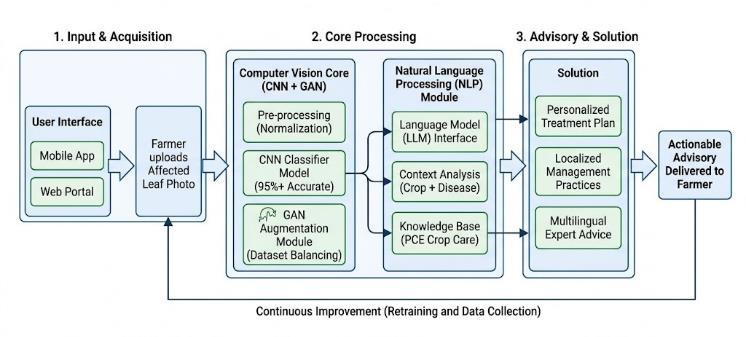
The system architecture follows a modular and scalable design. Farmers capture images of affected crop leaves using a smartphone and upload them through the application interface. The images undergo preprocessing steps suchasresizing, normalization,and noise reduction. A CNN-based classification model then analyses the processed image to identify the disease category. GANgenerated images are used during training to strengthen themodel’sabilitytohandlerealworldvariations.
Once a disease is detected, the output is passed to the advisory module powered by a Large Language Model. Basedontheidentifieddiseaseandcroptype,thesystem
generates treatment recommendations, including preventive measures and management practices. The final results are displayed through a multilingual, user-friendly interface. Cloud-based deployment enables real-time inference, scalability, and periodic model updates using feedbackcollectedfromusers.
Despite the promising performance of the AI-Powered Crop Doctor system, several challenges and limitations were identified during the design, development, and evaluation phases of this project. These limitations arise from data availability, model constraints, real-world deploymentconditions,anduser-relatedfactors.
4.1
One of the primary challenges is the limited availability of high-quality and diverse crop disease datasets. Many publicly available datasets consist of images captured under controlled conditions, which do not accurately represent real-field environments [2], [3]. Variations in lighting, background clutter, and leaf orientation can significantly affect model performance.Although GANbased data augmentation improves dataset diversity, syntheticimagesmaynotfullycapturecomplexreal-world
variations [6], [1]. This can limit the model’s ability to generalize effectively across different agricultural conditions.
While the CNN model achieved high accuracy during trainingandvalidation,itsperformancemaydegradewhen applied to real-world scenarios. Environmental factors such as shadows, dust, overlapping leaves, and mixed disease symptoms introduce noise and ambiguity in classification [4], [11].This limitation highlights the need for continuous model retraining using real-world, usergenerateddatatoimproverobustnessandadaptability.
Deep learning models, particularly GANs, require substantial computational resources and training time. Thiscreateschallenges in deploying such systems on lowcost devices commonly used in rural areas [6].Although cloud-based solutions can mitigate computational limitations, they introduce dependency on stable internet connectivity, which may not always be available in remote agricultural regions [9]. Edge deployment remains a challengeduetohardwareconstraints.
The advisory module relies on Large Language Models (LLMs) to generate treatment recommendations. While LLMs provide context-aware responses, they may not always account for region-specific agricultural conditions such as soil type, climate, or local farming practices [8], [14].Therefore,thegeneratedrecommendationsshould be considered as supportive guidance rather than a replacementforexpertconsultation.
Although multilingual support improves accessibility, accurately translating agricultural terminology into regional languages remains challenging. Certain scientific terms may lack direct equivalents, leading to potential misinterpretation [8].Ensuring linguistic accuracy and contextual relevance is essential for effective communicationwithfarmers.
The effectiveness of the system depends on proper user interaction, including accurate image capture and input. Farmerswithlimiteddigitalliteracymayfacedifficultiesin usingmobile-basedapplications[4].Issuessuchasblurred images, improper angles, or incomplete data input can negativelyimpacttheaccuracyofdiseasedetection.
International Research Journal of Engineering and Technology (IRJET) e-ISSN: 2395-0056
Volume: 13 Issue: 04 | Apr 2026 www.irjet.net p-ISSN: 2395-0072
The system is designed as a decision-support tool rather than a definitive diagnostic solution. Over-reliance on automated recommendations without expert validation may lead to inappropriate treatment decisions [9].Hence, thesystemshouldbeusedinconjunctionwithprofessional agricultural advice to ensure safe and effective crop management.
While the technical implementation of the AI-Powered Crop Doctor achieved a classification accuracy exceeding 95%, the true result isthe bridging of the "expert gap" in rural India.By using GANs to create synthetic leaf images, we successfully trained the model to recognize diseases even when the available real-world data was limited or imbalanced. The integration of the LLM module transformed the system from a simple scanner into a digital consultant,capableofdeliveringremedial advice in regional languages that farmers can actually understand andactupon.
ThedevelopmentofPCECropCaredemonstratesthat AI is no longer just a laboratory concept but a practical tool for sustainable agriculture. By unifying Computer Vision for diagnosis and Large Language Models for advisory support, we have created a framework that addresses the full lifecycle of a crop disease from the first spot on a leaf to the final treatment plan. While challenges like digital literacy andinternetconnectivityinremoteareasremain,this project provides a scalable blueprint. Future iterations focusing on Edge-AI (offline processing) and IoT integration will further empower farmers to makedata-drivendecisions,ultimatelyreducingcrop lossesandsecuringlivelihoods.
[1]Sunil,C.K.,Jaidhar,C.D.,Patil,N.,2023.Systematicstudy on deep learning-based plant disease detection or classification.Artif.Intell.Rev.56(12),14955–15052.
[2]S.P.Mohanty,D.P.Hughes,andM.Salathe,“Usingdeep learning for image-based plant disease detection,” FrontiersinPlantScience,vol.7,pp.1–10,2016.
[3] K. P. Ferentinos, “Deep learning models for plant disease detection and diagnosis,” Computers and ElectronicsinAgriculture,vol.145,pp.311–318,2018.
[4]A.Ramcharan,K.Baranowski,P.McCloskey,B.Ahmed,J. Legg, and D. P. Hughes, “Deep learning for image-based cassava disease detection,” Frontiers in Plant Science, vol. 8,pp.1–8,2017.
[5]H.Al-Hiary,S.Bani-Ahmad,M.Reyalat,M.Braik,andZ. Al-Rahamneh, “Fast and accurate detection and classification of plant diseases,” International Journal of ComputerApplications,vol.17,no.1,pp.31–38,2011.
[6] I. Goodfellow et al., “Generative adversarial networks,” Communications of the ACM, vol. 63, no. 11, pp. 139–144, 2020.
[7]A.Krizhevsky,I.Sutskever,andG.E.Hinton, “ImageNet classification with deep convolutional neural networks,” Advances in Neural Information Processing Systems, pp. 1097–1105,2012.
[8] T. Brown et al., “Language models are few-shot learners,” Advances in Neural Information Processing Systems,vol.33,pp.1877–1901,2020.
[9] FAO, “Crop losses and food security,” Food and Agriculture Organizationof theUnitedNations, Tech.Rep., 2021.
[10]Yang,S.,Guo,J.,&Yu,J.(2026).AgenerativeAI-Driven framework integrating CNN-VLM-LLM for intelligent crop disease diagnosis and control strategy generation. Computers and Electronics in Agriculture, 244, 111475. https://doi.org/10.1016/j.compag.2026.111475
[11] X. Gao, Q. Feng, J. Zhang, S. Yang, J. Zhao, and H. Gao, "Incremental learning with dynamic memory replay for crop-disease classification across diverse environments," Knowledge-BasedSystems, vol.340,p.115703,May2026, doi:https://doi.org/10.1016/j.knosys.2026.115703.
[12] Yuanyuan Yang, Liping Chen, Zhihua Diao, Pan Gao, Baohua Zhang, Chunjiang Zhao,Recent advances in crop pest detection, forecasting and early warning: A review,Artificial Intelligence in Agriculture,2026,,ISSN 2589-7217,https://doi.org/10.1016/j.aiia.2026.03.009.
[13] Changqing Yan, Zeyun Liang, Han Cheng, Shuyang Li, Guangpeng Yang, Zhiwei Li, Ling Yin, Junjie Qu, Jing Wang, Genghong Wu, Qi Tian, Qiang Yu, Gang Zhao, CDIPChatGLM3: A dual-model approach integrating computer vision and language modeling for crop disease identification and prescription,Computers and Electronics in Agriculture,Volume,236,2025,110442,ISSN,01681699,https://doi.org/10.1016/j.compag.2025.110442.
[14] Dip Kumar Saha, Mohammad Rasel Ahmed, Tushar Deb Nath, Rounakul Islam Boby, Md. Jakir Hossen, M.F. Mridha,Fusing explainable deep learning ensembles and LLM recommendations for real-time plant leaf disease
International Research Journal of Engineering and Technology (IRJET) e-ISSN: 2395-0056
Volume: 13 Issue: 04 | Apr 2026 www.irjet.net p-ISSN: 2395-0072
diagnosis,Intelligent Systems with Applications,Volume 28,2025,200596,ISSN26673053, https://doi.org/10.1016/j.iswa.2025.200596.
[15] G. Ma et al., "A tomato leaf fungal disease image dataset and a metaheuristic-based framework for optimizing machine learning classification," Smart AgriculturalTechnology,vol.12,p.101568,Dec.2025,doi: 10.1016/j.atech.2025.101568
[16] Y. Xie et al., "Plant disease phenotype captioning via zero-shot learning with semantic correction based on LLM," Journal of Integrative Agriculture, Mar. 2026, doi: 10.1016/j.jia.2026.03.014.
[17] M. Shafay et al., "An end-to-end vision–language framework with LLM-based reasoning for decisionoriented tomato leaf disease management in greenhouse environments," Computers and Electronics in Agriculture, vol. 247, p. 111692, June 2026, doi: 10.1016/j.compag.2026.111692
[18] C. Xu et al., "Intelligent management of crop diseases andpestsinmultiscaleandmultimodalcomplexscenarios: Technologies,applications,andprospects," Computersand Electronics in Agriculture, vol. 244, p. 111443, Mar. 2026, doi:10.1016/j.compag.2026.111443
[19] R.R.Patiletal.,"Towardraspberrycropmonitoring:A review of AI-driven solutions for sustainable agriculture," Ecological Informatics, vol. 95, p. 103717, May 2026, doi: 10.1016/j.ecoinf.2026.103717
[20] P. Rewthamrongsris et al., "Image-based diagnostic performance of LLMs vs CNNs for oral lichen planus: Example-guided and differential diagnosis," International Dental Journal, vol. 75, no. 4, p. 100848, Aug. 2025, doi: 10.1016/j.identj.2025.100848.
© 2026, IRJET | Impact Factor value: 8.315 | ISO
|